She Carried in Peace with the Food Tray

colossians 3

Last week, I wove through hospital hallways to visit with a dear family friend who was dying.

She allowed me to sit with her, to pray with her, and I was the blessed one to enjoy some time by her side.

While I visited, a steady stream of people filed in for treatments and check-ins, visits and more.

But there was this young girl.

She carried in a tray of food that I knew right away would be left uneaten on the table by the bed.  My friend didn’t want any of it, didn’t have any appetite, and didn’t want to be forced to eat.

I thought that was the end of it.

Then this young lady returned.  She sat gently by the side of the hospital bed.

She said, “Let’s find something light that you might like to eat.  Is there anything on your mind that sounds good?”

They hunted together through the menu on the iPad, finding choices that just might be okay and even picking out ice cream for my friend’s husband.  And that was that, dinner would be served.

Later, as I said my goodbyes and tried to find my way through the hospital corridors back to the elevator (I always get so hopelessly lost!), I saw the young girl with her trays and her menu lingering outside another room a few doors down.

And I thanked her.  Oh, I truly thanked her. I looked her right in the eyes and said how much I appreciated her bringing such cheer and gentleness to those who needed it.

Maybe she thought I made a whole big deal out of a whole lot of nothing that day.

She works in food services.  She delivers trays of food and takes dinner orders from hospital patients day after day.

What, she might have wondered, was so special about that?

But to me, it was the most beautiful ministry.  She took all that time, listening patiently to patients who are in pain, who are frustrated by limitations and people pushing at them all the time to do things they don’t want to do.  They don’t want to be here and they don’t want to eat this.  They don’t want people filing in and out of the room All.  The.  Time.  They probably just want to be left in peace, to put the whole ordeal behind them and just wake up one day and be healthy again.

Instead of going through the motions of service without treating any of the patients like real people…and instead of getting snippy about uneaten trays of food…this young lady  accommodated.  She smiled.  She waited without pressuring.  She spoke quietly and nodded with understanding .

She brought peace right into that room with her.

I learned from her once again the ministry of the small.

In the book of 1 Chronicles, tucked into a listing of the Very Important People in David’s reign is one name that stands out to me:

Jonathan, David’s uncle, was a counselor, being a man of understanding and a scribe. He and Jehiel the son of Hachmoni attended the king’s sons. Ahithophel was the king’s counselor, and Hushai the Archite was the king’s friend.  Ahithophel was succeeded by Jehoiada the son of Benaiah, and Abiathar. Joab was commander of the king’s army. (1 Chronicles 27:32-33 ESV).

The king had counselors and scribes, attendants for his kids, and army commanders.

But Hushai was the king’s friend.

And the ministry of friendship, though it may seem so small, has great value to the king.

We can long to do big things and make big impact, but perhaps God is calling us to be a friend or mom or wife.

Or to pour ourselves into a job that brings us low in order to serve others and carry Christ’s peace to them.

Twice in the same chapter of Colossians, Paul echoes this thought:

And whatever you do, in word or deed, do everything in the name of the Lord Jesus, giving thanks to God the Father through him. Colossians 3:17 ESV

 Whatever you do, work heartily, as for the Lord and not for men,  knowing that from the Lord you will receive the inheritance as your reward. You are serving the Lord Christ. Colossians 3:23-24 ESV

Whatever we do, big or small, may it be in His name today.  May we give thanks for the opportunity.  May we work heartily for Him, knowing we serve Jesus Himself.
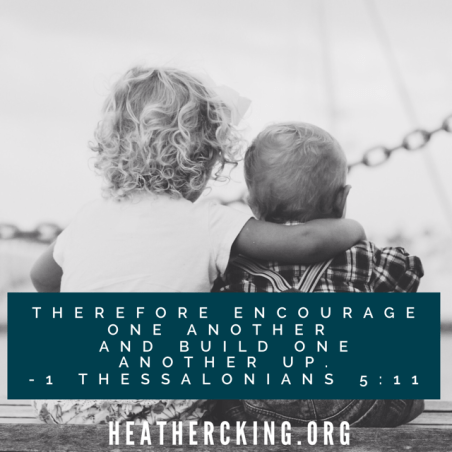
His presence in us makes a difference for those around us.

Be a Jonathan Today

1 thessalonians 5

There’s a couple in our church who’ve been married over 60 years.

They’re in a season of jet-setting, of cruises and spontaneous trips up to New England to see the fall leaves.  They drive all over to visit family and seem busier now than I am with my four kids.

They’ve known sadness too.  They’ve had cancer, lost family members to cancer, even lost a child to cancer.

About a year ago, I passed by my husband as he was chatting with the husband-half of this dynamic duo and I heard these words of wisdom:

These are the best days, when your kids are young.  I remember when all our kids were little and at home and it was crazy, but those were the best days. 

I didn’t catch any other part of that conversation, but oh how those words dug down deep within me.

The other day, I said to my husband as we drove home from church, “We’re super close to the time when we have a built-in babysitter in our home.  Aren’t you excited?  I’m excited!”

It’s so true.  Our kids are getting older, getting ready to stay home alone and even babysit younger siblings.  It won’t be long (dare I say it?) before my oldest daughter can drive herself to activities.  What a day that will be!

Last week, I took four of my kids into a museum and we did not bring the stroller.  Each child carried her own backpack of stuff and I just toted a bag of my own.  Whoa!

This is a new era for me.  And it’s just the beginning.  I’ll be living a life without diapers, wipes, and juice boxes before long.

I should be excited.  This is a new season, and it’s a beautiful season.

But I truly treasure the wisdom from this church-friend of ours because even on days when I’m rushing from activity to activity, breaking up sibling spats, or navigating a grocery store with the ‘help’ of a two-year-old who doesn’t want to ride in the cart, even on the days when I’m most exhausted or most overwhelmed, I hold onto his truth.

These are the best days.  I will never have them again. 

I may get to go on weekend getaways with my husband. I may be less of a taxi driver and more of a world traveler.

But oh the beauty of the now.

Oh the beauty of making this family and loving this family through its most significant character-forming, faith-building, family-identity-forming era.

This gentleman isn’t the only one who has given such a gift of wisdom and perspective.

Last Easter, a dear friend in my church, a joy-bringer and encourager, gave me a little gift with a hummingbird on it.

She said the hummingbird made her think of me, flitting about, always moving, so beautiful.

This was another treasured gift.

I wage this constant battle for balance.  I’m a doer who is happy doing, and that’s something God created in me and what God creates is good.

But I have to choose and discipline myself for rest, for beauty breaks and for finding room to breathe.

I know this about myself.  I know my weakest weakness and how easy it is to call me out for doing too much.

But she chose to see the beauty.

And the funny thing is I’d never seen a hummingbird, not in my whole entire life, until about two years ago when we planted butterfly-attracting plants in our back garden.

Turns out hummingbirds like these flowers too, and they hover all summer long right next to the window where I write every day.

They have become God-gifts to me, sightings and reminders that God sees me and knows me, He made me and He loves me.  He helps me know when to do and when not to do.  He guides me ever so gently and cherishes me the way He made me.

These are the treasures I receive from God’s family, just two of many gifts I’ve been given, words of hope or encouragement, wisdom and perspective.

I’ve been reading 1 Samuel with my kids recently and we discovered this verse:

Then Saul’s son Jonathan came to David in Horesh and encouraged him in his faith in God (1 Samuel 23:16 HCSB).

David was on the run once again from Saul’s envious wrath, and he discovered that the city he was hiding in planned to betray him and him over to Saul. So David escaped with his men into the wilderness.

If ever he needed a treasured friend, it was in his wilderness season.

And Jonathan was that friend.

Can we be a Jonathan for another today?

Can we give a treasure away, encouraging someone in her faith in God, share wisdom, see beauty, give hope?


An epidemic of growing up

Isaiah 40

We have an epidemic of growing up going on over here.

Some of that is reason to rejoice, like the end of another school year ushering in summer break.

But some of it I feel the need to grieve over a bit, like how two of my daughters have long since passed the age of 9 and 9 is a big deal to me.  Bigger than 10. Bigger than 11.

Nine is the halfway point to their 18th birthday and halfway through the time I’ll have with them at home.

When my girls turned 9, I found myself clinging even more to family time so I could treasure it and enjoy it while it’s here.  Of course, they wanted more friend time because they’re growing up.

Then there’s my two-year-old son, who has always called his big sister, “Tat Tat” instead of Catherine.  It’s just the cutest thing.

“Tat Tat go to dance?  Tat Tat go to school?  I want Tat Tat home.”

Seriously.  Adorable.

But lately he transitioned to calling her “Caperine,” which is still kind of sweet but loses some of the tenderness of a nickname.

I’m sad.  I really loved hearing “Tat Tat,” and it’s just one more reminder that he’s not a baby anymore.  It’s a little letting go of something we’ll never get back again.

And then there’s my oldest girl making tough decisions.   I’ve told her she’s old enough now to be personally praying over her choices and looking to God for guidance.

So, I’ve watched as she’s sent in form after form with middle school decisions.

Plus we’ve talked round and round and we’ve prayed and prayed over her choices about her activities.  If she does this, then she can’t do this and this.  So, is it worth it?  Or should she do something else instead?

I want the decision to be hers. I want her to own it, including all of the consequences involved.

But this is a tough one.

She asks me what I think and the truth is I don’t even really know. I acknowledge the difficulties because there’ll be a bit of sadness and loss either way.  You can’t do everything and these are all good things.

Many years ago, when I had just two kids who were both under two years old, a lovely older woman told me, “It’s harder to be a parent of adult children than it is to be a mom with young kids.”

I think I blinked two tired eyes at her in disbelief.

Now I understand a tiny bit.  This is what she was talking about, how it stretches us as moms and weighs heavy on our faith to let our kids make their own decisions and then handle the consequences of those decisions.

That’s starting to make a bit more sense now.

This week, I read in Psalm 127:

Behold, children are a heritage from the LORD,
the fruit of the womb a reward.
Like arrows in the hand of a warrior
are the children of one’s youth.
Blessed is the man
who fills his quiver with them!
He shall not be put to shame
when he speaks with his enemies in the gate (verses 3-5 ESV).

Mostly I hear these verses quoted when people talk about the blessings of having a large family with lots of arrows in the quiver.

David Jeremiah, though, said:

The psalmist says our children are like arrows. And what does an arrow do? It goes to a place we can’t go, to accomplish a purpose we can’t accomplish (Hopeful Parenting).

He also quotes Stu Weber:

“…our children are the only messages we’ll send to a world we’ll never see. They are the only provision we have for impacting a world as a distance.”

I need the reminder just now that I’m not losing these “arrows” of mine as they grow up and they grow into independence.

No, I’m sending them out.

They go where I can’t go.  They accomplish what I can’t accomplish.

They head into a future I can’t fully inhabit and have impact beyond my abilities to impact.

So I value this brief time with my children all the more because as I pour into them and teach them and pray over them, I prepare and equip them to hit the targets of God’s good and perfect will and plan for their lives.

But it also helps me let go a little.

I still mourn some. I mourn not getting to make decisions FOR them or even WITH them, but instead allowing them to decide.

I mourn the loss of “Tat Tat” and other marks of babyhood.

But I find myself letting go and trusting God.

He is with them.

He can teach them and carry out His will.

Their faith becomes personal and that brings me joy.


A Little Library Misunderstanding

proverbs 19-11

It was a tiny bit of a library misunderstanding.

My son played quietly with the toy trains and the dinosaurs (who knew dinosaurs and toy trains went so well together?) so I sat quietly and read.

That’s when I heard two little girls nearby trip along into a conversation pit without realizing it.

They were only about three or four years old, sweet as can be, with ponytails and pink shoes.

Here’s the transcript of what they actually said:

Girl 1:  Can I play with you?

Girl 2:  (As she searches the Lego bin for the right block):  No, I’m playing Legos right now.  We can play later.

Girl 1 then pauses just as she was about to pull a chair up to the Lego table.  Her face reads surprise, then sadness and a little hurt.  She turns away and plays with the farm animals instead.

There were no tears and there was no conflict.  No one tattled or fought.  Each just went about doing her own little thing,  unaware of what the other little girl was truly thinking or feeling.

And, that’s the thing that gives me pause.  Neither of these girls really understood what the other one meant to say.  What each of them truly meant was:

Girl 1:  May I play Legos with you?

Girl 2:  Oh, sure!  I’m playing Legos right now and I’d love for you to join me.

But that’s not what happened.  Girl 1 was asking to join in the building fun.

Girl 2 thought she was being asked to stop her Lego building and go do something else with her little friend and by golly she was having a good old time making Lego animals right now.

Their conversation just missed a little.  It’s like they shot two arrows.  One went under the target and one went over the target, but no one hit the mark.

What resonates a bit with my heart today is when I’m offended or hurt and I let critical words sink deep into my soul,  what if I’m actually misunderstanding?

Sometimes people say hurtful things and they mean them.

Sometimes people say hurtful things without meaning it, but the pain is there just the same.

But sometimes people say things and we just miss.  We thought they meant one thing; they actually meant something else.

And we tote around that offense as a heavy burden, putting up walls of defensiveness in our relationships to protect us from future hurts.

Yes, they should be more careful.  What you say and how you say it matters.  Controlling our tongue and watching our words is a must.

What if we were slow to take offense, though?

I love the Amplified version of James 1:19:

Understand this, my beloved brothers and sisters. Let everyone be quick to hear [be a careful, thoughtful listener], slow to speak [a speaker of carefully chosen words and], slow to anger [patient, reflective, forgiving]

At times the best thing we can do in a conversation is pause.

Taking time to respond rather than react can keep us from misunderstanding, from holding onto hurt, and from escalating conflict.

I have an email sitting in my inbox right now and I’ll be honest, I’m offended.  It is critical of me in ways I feel are unfair.  My defenses are up.

But I’m choosing to pause.

I’ve taken some time to ask, “God, is this true about me?” and I’ve waited and listened for the Holy Spirit’s truth.

I’ve considered whether I truly know this person’s intentions.  Probably they didn’t mean it this way.  It’s most likely, since I don’t know them very well, that I just don’t understand their humor or perspective.

I read over Proverbs 19:11:

Good sense makes one slow to anger, and it is his glory to overlook an offense (ESV).

and even Ecclesiastes 7:21-22:

Do not take to heart all the things that people say, lest you hear your servant cursing you. Your heart knows that many times you yourself have cursed others (ESV).

We live in an easily offended world.  People curse you for simple mistakes and seek vengeance for misunderstandings and accidents.

We are so often quick to anger and quick to speak, leaving behind the wreckage of broken relationships and the ache of loneliness.

I want instead to say little and to listen much.

Sometimes I fail.  I am easily bruised by the criticism of others.

And yet, when I filter the comments of others through the gauze of grace, I can grab hold of truth and let the rest go.  I can respond with more love than I was shown.

Pausing gives us time to choose humility and wisdom, grace and gentleness, and it helps us hit the mark instead of missing and messing up.

Why Can’t I Go to the Carnival Now?

psalm 62-1 MSG

There were tears.

Lots of them.

We’re fully immersed in end-of-the-year testing for my school-age kids, which in Virginia means taking the SOL’s (Standards of Learning).

Maybe you think that means we’re stressed or anxious.

Actually, we’re doing a lot of celebrating.

The girls get more than cereal or toast for breakfast on SOL days, and it’s not often they wake up to a hot breakfast on a Monday morning.

I leave them extra notes of love and encouragement in their lunch bags and slip in treats as well.

They don’t have their regular homework load (hurray!) and we can spend the afternoons playing, relaxing and occasionally running out for ice cream to reward them for their labors.

We celebrate every day they finish a test because we’re one step closer to summer.

So for my first grader—who is too young to take the SOLs (they start in third grade)—all this celebrating seems suspiciously unfair.

Even if she also gets hot breakfasts, ice cream treats, and fun nights just like her older sisters, she’s pretty sure she’s missing out.

That’s why she was bawling at bedtime last week, because her older sisters get to go to the SOL carnival and she can’t.

This carnival is for all the kids at school who take the SOL’s, which means third graders and up.

My first grader has a problem with that.

No water slide?  No games with prizes?  No cotton candy?  No face painting?  No popcorn?

She’s pretty sure she can’t wait until she’s in third grade to experience the joys of the SOL carnival.  Why should she wait, after all, when the older girls are having all the fun now?

We try to reason with her.

How the SOLs are hard work and this is their reward.  Would she want to take those tests now when she hasn’t learned what she needs to know?

We explain how her sisters didn’t get to go to the carnival in first grade either.  They also were first graders who didn’t get to go once upon a time.

Why rush these things?  Sure, there are incentives to growing up.  But there are responsibilities, too.  There are drawbacks and hard jobs and lots of work.

We want her to enjoy now.

She wants to rush on to what she imagines is the glorious future.  She overlooks the hard and longs for the ultimate reward.

We’re asking her to wait.

And waiting is tough.  Waiting requires trusting God’s timing.  Waiting demands patience.  Waiting wearies us because even though we’re moving forward on this journey, sometimes we just feel stuck.

Waiting means lingering with God in the here and now instead of wanting the end already, can we just skip to the end?!

Waiting tugs at our faith and nudges us with doubts because we wonder if God has abandoned us and forgotten us along the way.

I wonder how much I’m like my little girl, so obsessed with future blessing that I want to skip to the end?

And what would that truly mean?  It would mean missing the journey.  It would mean receiving blessings I’m unprepared for and responsibilities I can’t carry.

In 1 Samuel 16, Samuel the prophet anointed the teenage shepherd boy, David, to be king of Israel after Saul.

But that doesn’t mean they held a coronation ceremony right away.

No, Saul was still the king at  the time, so David just went right back to the fields to tend sheep.

Then he defeated Goliath and went to live in Saul’s palace a while.

Then Saul’s jealousy became rage and David spent 13 years running for his life.

Then Saul died.

Even then, David didn’t rush to take the throne. Instead, he spent another 7-1/2 years reigning over Judah alone from a city called Hebron.

Sheila Walsh writes:

“David was content to stay where God told him to stay for as long as it took” (The Longing in Me, p. 93).

All those years of waiting (more than 20 !) between the moment that oil poured down on his head to anoint him as king and the moment when he settled into the Jerusalem palace, David didn’t seem to push ahead.

He didn’t kill Saul.  He didn’t start public opinion campaigns to sway the populace to his side.  He didn’t connive or contrive, plot or plan a way to skip to the end.

He trusted God “for as long as it took.”

Can we trust God like that?

What a day it must have been when David finally sat on that throne in Jerusalem.  King.  After all those years.

God had done the work.  David hadn’t pushed it along or made it happen.  God had done it.  All God and only God.

May that be our testimony too when God completes the work He’s doing in us.


Be Gentle. People Break Easily.

proverbs 15

“Be gentle,” I told her.

My baby girl was four years old and on her way to show-and-tell day at preschool.

There she sat in the minivan, cradling this tiny wind-up caterpillar toy, purple with polka-dots, in her four-year-old hands.   She’d rediscovered it in the toy bin the week before and declared it worthy of a trip to the school to show her classmates.

I had slipped that tiny $1 caterpillar into her stocking two Christamases ago and he was a survivor, more or less intact after all this time with only one missing antenna.

But was he up for the trip to the school?  Was he hardy enough to face one four-year-old and her 19 classmates?

I tested him out on our coffee table.  Wind, wind, wind and then I let him go.  He inched across the wood quickly and my daughter giggled at the sight.

That morning, we had scrambled out to the minivan, and I said it to her because I’m a mom and I have to say certain things, “Be gentle.   He will break easily.”

She nodded like I’m such a worrier.  Silly mom.  As if I didn’t already know that. 

I heard that toy buzz, buzz, buzzing during the drive.  I heard her tossing that cheap plastic around in her hands.

And then I heard those words:  “Oh mom, he broke!”

Sigh.

I refrained from “I told you so” and mom speeches.  I chose grace.

We arrived at the school where we gathered up the pieces of her toy and I hoped my English-major brain could figure out the engineering difficulties of a wind-up toy.

Somehow I managed to snap those pieces together. Success!  And then I carried him into her classroom and set him on the show-and-tell table.

She flashed me a smile and I knew I’d earned my Super-Mom cape for the day.

Later, she told the whole story to her big sisters: How mom saved the day by fixing him just in time.  She paused for dramatic effect and then said, “Really, Mom did that.”

But she left out one little part of the story….how he broke in the first place.  How she hadn’t been gentle enough.

This gentleness with others, isn’t it what we leave out so often?

Paul writes:

Let your gentleness be evident to all. The Lord is near (Philippians 4:5 NIV).

We can make excuses about how we’re just “honest” or we “just tell it like it is.”  That’s just who we are.

We can assume the worst, lose patience, rage, condescend and degrade into sarcastic mocking when others disagree with us.

Or sometimes we have this way of being gentle to strangers, but that harshness, that short temper, that criticism oozes out to the loved ones sitting at our own dinner table.

Our husbands.  Our children.  We are their protectors.  We should be the healing salve to the hurts, treating wounds with tenderness and grace, overlooking failures, encouraging strengths, applauding efforts.

When we’re hurt, angry, frustrated, impatient, though, we tend to stab where it hurts most, highlighting faults and bruising the same feelings again and again.  It’s our self-defense; we wound others when we’re wounded.

Yet, gentleness isn’t a God-request.

It’s not a Holy Spirit suggestion or an option for good days, but something we can ignore on bad days when we’re stressed, tired, overwhelmed, or haven’t slept all night because we are, in fact, moms.

Paul tells us in Colossians that gentleness is the garb of Christ:

Therefore, as God’s chosen people, holy and dearly loved, clothe yourselves with compassion, kindness, humility, gentleness and patience (Colossians 3:12 NIV).

Gentleness is part of living Christ to the those around us, in our home and out of it.  We are to wrap ourselves in gentleness so others see Jesus in us.

“Be gentle.  People break easily.”

That’s the message I remind myself as I put that wind-up caterpillar back in the toy bin after his show-and-tell adventure.

A gentle tongue is a tree of life,
but perverseness in it breaks the spirit (Proverbs 15:4 ESV).

The tongue has the power of life and death,
and those who love it will eat its fruit (Proverbs 18:21 NIV).

The words of the reckless pierce like swords,
but the tongue of the wise brings healing (Proverbs 12:18 NIV).

Gracious words are a honeycomb,
sweet to the soul and healing to the bones (Proverbs 16:24 NIV).

My Son, The Noise Police

mark 4

The noise police.

That’s my two-year-old’s job.

His oldest sister hops in the minivan at the end of the school day and pulls out her recorder for some practice time.

He hears one note, just one note, and he slips his finger up to his lips and says, “Shhhh.  Pease stop it.”  Then he tosses a look her way that commands attention even if he is 8 years younger than she is.

Someone dares to sing along with the radio in the car?

Oh no!  Noise violation. Cited by the noise police.

This toddler will immediately tell you to “Pease stop it.  PEASE stop it.”  And he’ll repeat that message louder and louder until all such violators refrain from singing.

It doesn’t matter if you’re off-key or if you’re a Broadway superstar, if you’re singing, he’s going to ask you to stop.

He shouts for car alarms to “Pease stop it” in the Wal-Mart parking lot and he commands that construction sounds cease when he hears saws and hammers.

This tiny powerhouse assumes that all noise is within his power to control.  He expects instant silence when he says the magic phrase.

At the sound of “Pease stop it” all noise must end.

Of course, it very rarely works that way, which my son doesn’t appreciate.

His sisters insist on singing or talking or playing.

Car alarms keep alarming.  Construction workers keep constructing.

He can say “Pease stop it” all he wants; it doesn’t mean anything truly stops at all.

But I appreciate his effort.  I understand the desire.

Haven’t I shouted “Please stop it” myself  more than a few times when I wanted that conflict with someone else to end….or that situation to finally be resolved?

When I felt tossed around by circumstances out of my control and I just wanted quiet and calm already, no more noisy turmoil and roar of turbulence and strife, I wanted to yell, “Please stop!  Stop the relentless confusion or hurt or tension or stress or uncertainty!”

Yet, even when my greatest efforts at control fail, Jesus can speak the Word.  He can demand that the storm “be still” and it must obey.

He speaks and that is enough.

In Luke 8, I read how he calmed that stormy sea and how the winds and the waves obeyed his command.

But in that same chapter, I read how he calmed a different kind of storm, not just the physical tempest, not actual winds and actual waves, not circumstances that threaten to drown us.

He calmed the storm within.

With the sea now peaceful, the disciples crossed to the other side, where Jesus found a man possessed by demons who ran naked among the tombs and could not be contained by human chains.

Jesus “commanded the unclean spirit to come out of the man” and at that Word, the man was redeemed and restored (Luke 8:29 ESV).

Sheila Walsh writes in Five Minutes with Jesus:

“I love that the stories of Jesus calming the storm and Jesus freeing the demoniac are back-to-back.  Whether a storm is raging in outside circumstances or inside your heart, when Jesus speaks to it, that storm has to obey.”

Two storms.  One without.  One within.

Jesus calmed them both, back-to-back, by the power of His Word.

I am surely weary of wrestling with the ropes on a storm-tossed ship.  I’ve tried everything to calm the wind and waves on my own, every tool, every trick, every skill within my expertise.

I’ve shouted, “Pease stop it!”  but the storm still storms.

Yet, this is what I know.

At any moment, Jesus could rise up and command, “Peace!” and there would be calm and there would be deliverance.

It’s true about the stress and uncertainty, the doubt, the depression, the anxiety and worry, the fear and the desperate need to control what we face within.

It’s true in the relational conflicts and interpersonal fights, the financial shortfalls, the job stresses, and the health scares that we face without.

Whether we face storms internally or externally, when Jesus declares, “Peace” the noise will end.

But in the meantime, I choose faith because I am never too far for Him to rescue me.  No circumstances are beyond His ability to control.

Somehow just the reminder that He is the Word and that His Word is all that is needed to rescue me gives me rest even before the storm ceases and even before the noise ends.


Teach Us What We Are to Do

psalm 25

Years ago, a mom-friend of mine flopped onto the big blue couch in my living room and confessed, “I feel like all I do all day is tell my kids what to do and how to do it.”

I nodded my head knowingly and sympathetically and absolutely had no idea what she was talking about.

At the time, I had one baby less than a year old.  Our conversations usually went like this, “Momma loves you.  You’re so sweet.  Where’s your nose?  Oh, you’re so smart.”

And then she’d respond with, “Mama” or something else equally superior and I’d just know we had connected and that she was a genius bound for great things.

But now I’m older and my kids are older.  One day at dinner I remembered what my friend said and realized she could be describing my life.

Wash your hands before you eat.  Use soap!  Sit like a lady.  Talk like a lady.  Eat like a lady.  Chew with your mouth closed.  Use a napkin.  Don’t spill your milk.  Clean up the milk you spilled.  Clear your place when you’re done eating.

Brush your teeth.  Up and down.  Front to back.  Don’t forget your tongue.  Brush every single tooth.  Don’t leave globs of toothpaste in the sink, on the wall, or on the floor.  Hang up wet towels.

Don’t hit your sister, yell at your sister, push your sister, boss around your sister, roll your eyes at your sister, ignore your sister, say mean things to your sister or tattle on your sister.

Do your homework . . . neatly.  Take pride in your work.  Practice the piano.  Study your memory verses.  Put your shoes away—shoes and socks do not live in the middle of the kitchen floor.

At times it feels like we’re prepping kids for the standardized tests of life and that means covering table manners, relationship skills, character issues, faith lessons, and more.

But what if we miss something?

What if there’s a question we don’t know how to answer?

What if we get it wrong and miss out on cultivating one of their gifts or fail to correct a character weakness?

Oh, how I have collapsed to my knees under the weight of this responsibility for each of my children.

Because I just don’t know.

I don’t know what to say and when to say it and when to hold my tongue.

When do I punish… let it go… reward?

Samson’s parents prayed the same prayers I’ve been groaning out in confused desperation.

In Judges 13, an angel of the Lord appeared to the wife of a man named Manoah to announce she’d have a son and he would be set apart for God from the very beginning.

God already had a plan for her son, Samson: “He shall begin to save Israel from the hand of the Philistines” (Judges 13:5).

What a promise!  And yet how overwhelming for two first-time parents to wonder: “What if I mess this up?”

So, Manoah “prayed to the Lord and said, ‘O Lord, please let the man of God whom you sent come again to us and teach us what we are to do with the child who will be born’” (Judges 13:8 ESV).

Yes, this is how my prayer crams into words:  “Teach me what to do because You know and I just do not.  I could read every parenting book and follow every tip and strategy in every parenting magazine and every idea on every awesome mom-blog and still get this so terribly wrong.”

God answered Manoah’s prayer, returning to visit with this young mom and dad and instruct them on the Care and Keeping of Samson.

So, I also pray with the deepest confession of weakness and need, asking for His help, His strength, His guidance.

And when we come to Him, all overwhelmed and fully aware of our own insufficiency and weakness, He answers.

He sees that purity of our heart’s request: Our deep desire to steward these gifts He’s placed in our hands, and He answers.

Our God:

leads the humble in what is right and teaches them His way (Psalm 25:9 HCSB). 

Yes, He has:

heard the desire of the humble; You will strengthen their hearts. You will listen carefully (Psalm 10:17, HCSB).

On days when we’re clueless, moments when we just don’t know, this is the promise we need:

God brings us the wisdom and strength we need as parents when we humbly seek His help in our home.

Finding the courage for change

joshua 1-9

My daughter wove through the line of families walking into the middle school building.  She left me behind so she could hurry ahead to join her friends.

By the time I made it through the front doors, she’d already flitted along into the auditorium and found a seat way in the front for the Middle School Orientation.

I sat in the back.

Several people asked me that night whether I was okay.  I think everyone is waiting for me to have an emotional breakdown about my oldest daughter leaving the elementary years behind.

I just try not to think about it, that’s all.

Yup, I’m totally fine!

But of course, when you’re sitting in the middle school auditorium, listening to the middle school principal and teachers, and looking at slides about the middle school schedule, curriculum and after school activities, you do actually have to face facts.

Middle school is coming my way.

Obviously, my child isn’t too concerned.  She wasn’t frightened or lost, nervous, insecure, out of place or afraid.

And I was all of those things in middle school.  Those were nightmare years for me of insecurity and feeling lost.

I’ve taught middle schoolers before and they seemed like a whole lot of drama tossed in with a little bit of narcissism and a heaping dose of silly (topped off with lots of smelliness).

But here we are at middle school and my daughter seems excited, happy to be with her friends, and ready for the new.

So, maybe it’s my daughter that’s different…or maybe middle school has grown a lot friendlier and gentler over the years….either way, as I watch her that night, I feel reassured about her.

I’m still a bit worried about me, though.

The truth is this whole middle school thing reeks of change, and I’m tempted to grab the nearest clothespin and run for the door.

My kids have been at a school we love and had teachers we know and adore for five years.

When I walk into the office, I  know them and they know me.

I know the behavior systems and the reading logs.  I know the homework procedures and the cafeteria lines.

I know the books in the library and the special programs and the general schedule for the school year.

I know the bus route and the bell schedule.

And, I’m comfortable here and quite happy in that comfort.

Who wants a new office with new people, new teachers, new kids, new after school programs, a new schedule (that is WAY too early in the morning)?

She has to have gym clothes and lockers.  She has to take electives.  She has to function on an entirely different schedule in an entirely different place than her sisters who are still at the old school doing the old things.

I feel the change pulling at my muscles, stretching them.  They are taut, tight, stiff and reluctant.

I am afraid.

I am resistant.

I don’t want to change.

In Girl Meets Change, Kristen Strong writes:

We all have the opportunity to turn our tight places into prayer spaces. When change shoves us to our knees in dark places, we are in the perfect posture for lifting up our souls to heaven.

Instead of shutting my eyes tight and hoping change just leaves me alone, I’m invited to transform this into a prayer space.

I’m invited to bring the unknown to Jesus, all that uncertainty, all that fear.  I’m invited to trust that He already knows, He’s already there, and He’s with us all the way.

That’s what He promised Joshua, Moses’ protege, who spent years tagging along after Moses and now stepped into those massive shoes of leadership.

Moses was the only leader the people had ever known.

Now Joshua was in charge.

And Joshua wasn’t going to continue in the same tried-and-true way.  He stood on the threshold of the Promised Land, where he’d teach a wandering people how to establish a nation.

God told Joshua

“Have I not commanded you? Be strong and courageous. Do not be frightened, and do not be dismayed, for the Lord your God is with you wherever you go” (Joshua 1:9).

So, I begin here with this prayer space.  I print out the middle school teacher roster and pray through the names.

I pray for my daughter.

I pray for the change.

I pray for the change in me, for the courage and strength I need.

Because even though I’ve never been there and don’t know what it’ll be like, God has and God does, and He will help us with what’s ahead.

prayerchange


Me and My Little Back-Seat Driver

deuteronomy 31-8

I drive around town with a highly vocal, super-opinionated back seat driver.

He is two.

From his car seat, he tries to dictate our destination.  He points his finger and says, “This way!!!” when he doesn’t want to go home and would rather head back into town.

He shouts, “Turn!  Go library!” and then yells “Go back!!!” when we drive right past it instead.

He screams, “Play on the slide!” when we pass the church’s playground.

He wants, “Chicken nuggets” instead of a shopping trip to the grocery store.

More than anything else, he doesn’t want me to pull into the ballet studio parking lot and drop one of his sisters off for dance class.  That just ruins his day.

He is a vocal little commandant, asserting his will in matters of our schedule and destination.

He is determined, loud, relentless, and emotional.


He is also not in control.

Maybe that’s the lesson for this little two-year-old power house.  After all, he can’t spend his whole life hopping from chicken nuggets to the playground to the library and back again.

Sometimes he’ll need to go grocery shopping or visit the bank or post office and then drive on home for naptime.

Sometimes he’ll have to go where he doesn’t want to go.  Sometimes he won’t get to go where he wants to go.

Because I’m the one in control.

And that’s what hits me as I ignored the protests of my toddler and completed my errands this morning; no one likes to lose control.

His tantrum isn’t his alone.  Sometimes I want to scream and point and ask God to “go back” or “turn.”

I want the map and the itinerary.

I want the ‘begin construction’ date, the full route of the detour, and the precise moment when construction will end so I can be on my way.

I can be determined, loud, relentless and emotional.

And I’m also not in control.

Sure, I’d love it if life was all about chicken nuggets, trips to the library and play time on the playground of life, but God directs my path to what is necessary and good and true and ultimately for my good and His glory.

This is the hard trust, not just trusting God to give me what I want or what I think I need, but trusting Him in the invisible, trusting Him when He turns me the other way, trusting Him when I don’t know where we’re going and I don’t know when we’re going to get there.

Yet, here’s what’s true about me as I drive my son around town.

Since he’s only two years old, he’s forced to be buckled into the car seat and dragged along for the ride.  It’s not fun or exciting to be held captive and endure long grocery shopping trips or endless carpools back and forth to ballet.

I understand that.  I have compassion for him.  I mind his tantrums, but I don’t mind his input.

I love him and I do care about journeys that weary him and how hard it is to be a tagalong to your mom’s agenda for your day.

So, I think of my own back seat driver ways.

How maybe I’m always asking God, “Are we there yet?”

How I really want to hold the map and tell him where I’d like to go.

Yet, despite all of that, he doesn’t kick me out of the minivan.

He might mind my tantrums, but I don’t think He minds my honest input.  He has compassion for all my fears and how small I feel when I don’t know where we’re going.

Where God leads me, He goes with me.  Where He leads me, He leads me as gently as I will allow Him.

Where He leads me, He leads me with compassion and sweet affection and deep, enduring, unfailing love.

Deut. 31:8 says:

It is the LORD who goes before you. He will be with you; he will not leave you or forsake you. Do not fear or be dismayed (ESV).

I am reminded that our omnipresent God can be both ahead of me and right beside me.

And suddenly this journey feels less like captivity and more like relationship.

Yes, God has been before me.  He knows the precise path that I take. He knows the number of my days and the u-turns, detours, and obstacles I’ll face along the way.

I can trust Him to lead.

He doesn’t just know the path, though, He also knows me.

And while He’s ahead of me, He’s also with me, never leaving or abandoning me (even if He has to tell this back-seat driver I can’t hold the map every once in a while).