Been There, Done That, Wearing the T-Shirt

Now this I know: The LORD gives victory to his anointed. He answers him from his heavenly sanctuary with the victorious power of his right hand.
Psalm 20:6

One of my indoor cats decided this week to go for an extended stay outside.  He forgot to let me know where he was going and when he would be home.

So inconsiderate of him.

We didn’t see him slip out the back door as we took out the recycling and watered our vegetable garden.  It wasn’t until I returned home from running errands all morning that I realized something was wrong.  Only one cat (my massive black behemoth of a feline) greeted me at the door to see if I had brought home cat food.

After searching the house in all of his favorite hiding spots, I realized the truth—he wasn’t inside, so he must be out.  That’s when I began calling his name and searching along the trees and brush on the edges of our yard.  I peered underneath our deck and rattled some cat food in a dish to get his attention.

My kids and I prayed for him to come home.  Well, most of my kids prayed.  My youngest daughter had been worried about him all day and kept peeking under the beds or tables asking, “Oliver?”  My middle girl declared, “He’s my buddy and I’d be sad if he didn’t come home.”  They prayed.

My older daughter, however, said she thought we should get rid of his cat dish if he was lost forever and, by the way, if we just got rid of our other cat, perhaps we could get a puppy instead.

She’s not a cat person.

At church, I asked my Bible study girls to pray and then my daughters and I prayed again as we drove home.  Once we pulled into my driveway, I drove extra slowly and asked the girls to keep a lookout for him.

That’s when my two-year-old screamed, “There he is.  I find him!!”

I didn’t believe her at first.  She’s the tiniest one of the bunch.  How could she spot him so quickly?  Still, I asked, “Where do you see him?”

“At the house.  There!”

Sure enough, my striking orange cat was sitting up tall on the deck of our house just waiting for us to come home and let him inside.  He was nonchalant about the whole thing, as if his return was never in question.

During our persistent prayers that evening, we didn’t know that God had already delivered the answer we had been seeking.  We were praying for my cat’s return.  He was already hanging out on the deck by our back door.

It was the same for the Israelites, poised on the outskirts of the Promised Land.  Their first major obstacle to possessing the territory they had pursued for 40 years now loomed large in front of them, daunting, impenetrable, impossible.  A walled city.  Jericho.

We’re told, “now the gates of Jericho were securely barred because of the Israelites.  No one went out and no one came in” (Joshua 6:1).

Yet, it was just at this moment, in the shadow of those thick walls with closed gates, that the “Lord said to Joshua, ‘See, I have delivered Jericho into your hands'” (Joshua 6:2, NIV).

The Message says it this way: “Look sharp now. I’ve already given Jericho to you.” (Joshua 6:2 MSG).

It’s the tiniest matter of grammar, the simple fact of the past tense here that draws my attention.  God didn’t say, “I’m going to give Jericho to you” or “In about a week, the walls will fall down and you’ll win the day.”

No, God already declared the victory.  “I have delivered Jericho.”  “I’ve already given Jericho to you.”

It’s a done deal, a finished conquest, a promise, an assertion of fact that the Israelites couldn’t yet see.

They saw the towering walls still standing and blocking their entrance into the Promised Land.
God saw the walls crumbled into pieces and scattered on the ground at the feet of His people.

Then, after declaring that the victory was already theirs, God gave them instructions on how to achieve it.  He described the crazy march, the circumventing of the city for seven days.  He instructed them to shout after that final foolish-looking journey around Jericho.  He declared that the walls would collapse and the Hebrew army would march into the city.

There are some promises we’re waiting to see fulfilled, some prayer requests we’ve brought to God’s feet year after year, and it’s hard to maintain what seems like impossible hope in the light of circumstantial evidence and walls that never seem to fall.

Yet, perhaps God has already declared your victory.  He sees what you do not: The battle finished and the walls toppled over like a block tower sabotaged by a toddler.

This is why we do not lose hope, because God will be faithful to deliver the victories He has promised us.  He has declared it.  The battle is already won.

So we obey the instructions He gives, no matter how foolish-looking, crazy-sounding or wildly imaginative they may seem.  March and shout as He instructs and watch the tiniest gravel start the avalanche that brings down the impenetrable fortress of your circumstances.

If you’re just standing at the walls looking up, don’t lose hope in God’s ability to grant you victory.  Leave the battle in His hands and wait for the rocks to come tumbling down.

Heather King is a wife, mom, Bible Study teacher, writer for www.myfrienddebbie.com and worship leader.  Most importantly, she is a Christ follower with a desire to help others apply the Bible to everyday life with all its mess, noise, and busyness.  To read more devotionals by Heather King, click here.
Altars of Uncut Stones or the Beauty of Simple Obedience

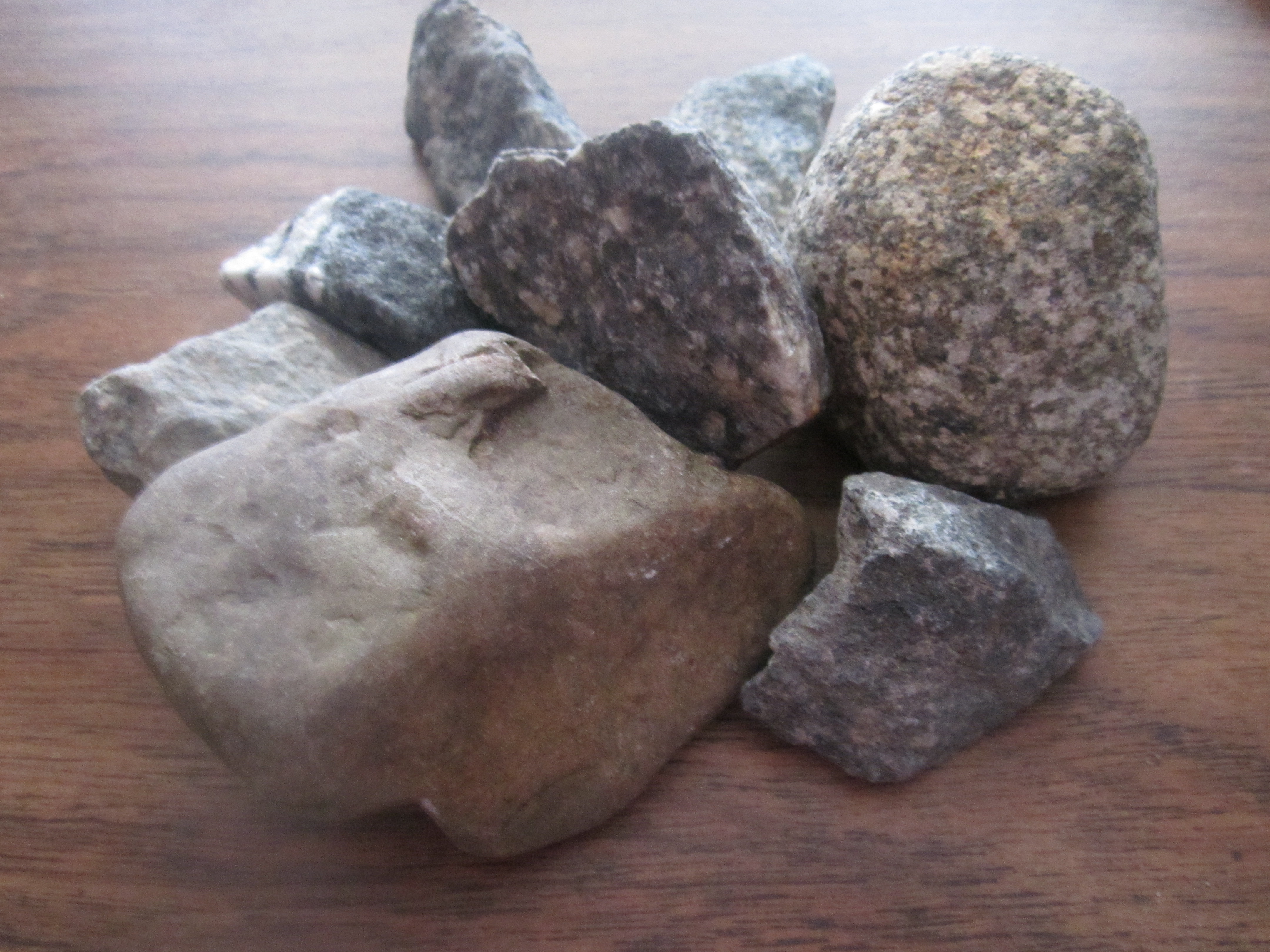
I picked up my daughter’s yellow spring jacket and felt weight, heaviness where it shouldn’t be.  Clearly she had stuffed her pocket at the park with her latest treasure.

Curious about her new discovery, I slipped my hand into her pocket and pulled out . . . a rock.  Two rocks actually, one for each pocket.

They weren’t gems, either.  No sparkles or beauty.  No monetary value.

They were plain ordinary gravel, no different than the layer of rock on my driveway.  In fact, the one crumbled into my fingers with the slightest pressure.

I sighed.  She had been toting home rocks for about two years now.  Everywhere we went, some pebbles, gravel, or smooth stones caught her attention and ended up in her pockets.

She has even tried to remove stones from the paths at Colonial Williamsburg and the zoo and once tried to carry a cement block away from the local museum where its grand function was to hold open the door.

I put my foot down about those.

But if it fits neatly into the pocket of her jacket, she’s likely to tuck it away where I can’t see and add it to her “rock collection.”  Perhaps she’ll even give it a name, which usually ends up being something like “Rocky” or another equally creative moniker.

I made the mistake of tossing “Rocky the First” back into our garden when I discovered it on her dresser.  She cried.  She searched the back garden for a glimpse of him and, finding him, carried Rocky right back inside.

To me, it was an ugly rock.  To her it was a treasured part of her collection, more like a pet than a simple object.

She’s not the only one who finds beauty in simple stones.  God loves them, too.

As they crossed over the Jordan River, the Israelites obeyed God’s instruction, picking up 12 stones from the river bed and lugging them up the embankment onto dry land.  God told them to use those stones to build an altar.

More specifically,

“an altar of stones.  You shall wield no iron tool on them; you shall build an altar to the Lord your God of uncut stones. And you shall offer burnt offerings on it to the Lord your God, and you shall sacrifice peace offerings and shall eat there, and you shall rejoice before the Lord your God” (Deut. 27:5-7 ESV)

Their peace offerings and sacrifices, their worship and rejoicing before the God who had carried them into the Promised Land, may have seemed more fit for an altar of finest gems.

Perhaps their greatest artisans could have finely cut diamonds, emeralds and rubies into an altar fit for worship of the Most High God.

Or, if God insisted on them using river rocks, at the very least they could have chiseled and carved until the altar looked like a marble statue, perhaps of angels or a depiction of the priests carrying the Ark of the Covenant, or of Joshua leading the people.

Yet, God was clear.  Stones, simple stones, uncut by any human tool, formed the altar fit for the offerings of His people.

Why did God even care about a detail so small?  According to Him, “If you make an altar of stone, you shall not build it of hewn stones, for if you wield your tool on it you profane it” (Exodus 20:25).

To God, human construction on the altar stones made them unholy and profane.

That’s because God knew the danger implicit in cut stones and man-made bricks.  The moment we begin to adorn altars with human effort is the moment we shift the focus off of the God we praise.  Instead, we admire the human talent that made the vessel or the human ability that cut the stone.

We become idolaters.  Our worship becomes profane.

This is what God accused the people of doing in Isaiah:

I spread out my hands all the day to a rebellious people, who walk in a way that is not good, following their own devices;a people who provoke me to my face continually, sacrificing in gardens and making offerings on bricks” (Isaiah 65:2-3 ESV).

Israel ignored God’s mandate and chose instead to offer their sacrifice among garden flowers.  They had rejected simple stones in favor of brick altars.

Israel wanted to worship God their own way and on their own terms.  His instructions seemed superfluous and unnecessary.  Their ideas seemed so much nicer, so much better, so superior, so much more religious than God’s request for pure and uncut praise.

In the same way, God sometimes overturns our expectations of adequate offerings and suitable worship.

He desires the simplicity of an obedient heart.

We think He needs more.  

So, we hold back our offerings until they are “fit” for Him.  We hide in the sanctuary pews until we have more to give.  We think other worshipers, who are more talented and more rehearsed, give gifts more worthy.

It isn’t, however, about being the best, most talented, or most qualified; it’s about being called.  Yours is the offering He desires.  It is because of your heart of obedience that He can be glorified in the sacrifices you bring.

There is beauty in the uncut stones of our worship.  It’s never about the show, never about our own talent or training; it’s not about looking good or fitting in, or processing our worship into acceptable forms—all human additions that shift focus off God and onto human ability.

Instead, it’s about responding to God in pure uncut adoration.

Heather King is a wife, mom, Bible Study teacher, writer for www.myfrienddebbie.com and worship leader.  Most importantly, she is a Christ follower with a desire to help others apply the Bible to everyday life with all its mess, noise, and busyness.  To read more devotionals by Heather King, click here.

Copyright © 2012 Heather King

One Minute Devotional – Devotions From My Garden: Underneath the Dirt

I cleaned out my garden last week, clawing at the dirt to extricate the weeds, moving plants around, and spreading mulch.

It turns out that the miniature roses that I thought would stay, well, miniature, grew far larger than I ever expected.  They are dwarfing all of the plants behind them.  After years of watching these rose bushes grow exponentially each season, I’ve finally realized that “miniature” just means the size of the bud—not the size of the bush.

So, I finally broke down and moved one of the rose bushes to the back of the garden where it didn’t look like anything was growing.  But it’s March and many of my perennials and summer bulbs haven’t poked their heads above ground yet.

Sure enough, I pushed my trowel into the dirt only to overturn a bulb.

I guess something was growing there after all.

In the garden and in life, it’s so often the hidden things we can’t see that produce the life we do see.

In his devotional book A Year With Jesus, Eugene Peterson wrote: “Jesus’ work was not always public, out where people could see it.  There were also quiet interludes of retirement and rest.  The quiet asides are as characteristic of his ministry as the glorious signs.”

Jesus not only valued the moments of solitude and quiet, but He also called His disciples away when they were weary from service:

Then, because so many people were coming and going that they did not even have a chance to eat, he said to them, “Come with me by yourselves to a quiet place and get some rest
(Mark 6:31 NIV).

What is “characteristic” of God’s work in you?  Is it just the visible that matters?  Is it the Sunday masquerade or the busyness of church life?  Is it committee meetings, ministry sign-ups, the quantifiable and the identifiable?

Don’t mistake this.  We are to serve God where He has called us to serve.  We shouldn’t linger on the pew when He’s asked us to step out and get busy.  Be assured that He will equip you and strengthen you when you act in obedience.

But don’t scorn the quiet, hidden work of God, either.  Don’t get so wrapped up in doing that you fail at being at the feet of God.  The Master Gardener may be growing something great in you just beneath the soil, something beautiful that you haven’t yet seen.  And it begins with you sitting before an open Bible, with your prayers laid down at His feet, with your songs of praise during the morning commute.  It begins in the hidden places alone with Him.

More Devotions From My Garden:

Heather King is a wife, mom, Bible Study teacher, writer for www.myfrienddebbie.com and worship leader.  Most importantly, she is a Christ follower with a desire to help others apply the Bible to everyday life with all its mess, noise, and busyness.  To read more devotionals by Heather King, click here.

Copyright © 2012 Heather King

Weekend Walk, 02/25/2012

Hiding the Word:

My small group is reading through the Bible this year and we’ve made it to Leviticus.

(Insert audible groaning here.)

Most of the time, people complain about Leviticus being boring.  Or maybe they rejoice in its soporific side effects.  It has, after all, been the solution of many a person’s insomnia.

Whenever I read this book of the priestly laws God gave to Moses, however, I’m not as likely to say, “how boring,” as I am to say, “Ewwww . . . . gross!”

Leviticus with its gory splattering and smearing of blood from sacrifices and its detailed discussion of fungi, bodily discharges, and skin rashes is hardly comfortable reading.

But it’s really not meant to make me comfortable.  Leviticus, if anything, is designed to make me uncomfortable with the law and the sacrificial system.  It’s to remind us that we just can’t ever be pure enough to meet God’s holy standard.

We’d need constant sacrifices, ritual cleanings, and a priest all up in our personal business just to keep us from dropping dead in the outer ring of the tabernacle courtyard.

That’s why as I read Leviticus I am giving thanks and praise for our Savior, Jesus Christ, who became our once-for-all sacrifice.

Not only that, I’m flipping my Bible over to the New Testament book of Hebrews chapter 10, which tells us:

And by that will we have been sanctified through the offering of the body of Jesus Christ once for all.

 And every priest stands daily at his service, offering repeatedly the same sacrifices, which can never take away sins. But when Christ had offered for all time a single sacrifice for sins, he sat down at the right hand of God, waiting from that time until his enemies should be made a footstool for his feet. For by a single offering he has perfected for all time those who are being sanctified.  (Hebrews 10:10, 14).

This week, I’ll be meditating on verse 14 and giving thanks to Jesus for sacrificing so that I can be sanctified.

Weekend Rerun:

I Choose to Obey
Originally published 03/14/2011

“Therefore, my brothers, stand firm. Let nothing move you.  Always give yourselves fully to the work of the Lord, because you know that your labor in the Lord is not in vain”
(1 Corinthians 15:58).

Today is piano lesson day in my house.  I stopped giving lessons to other students when my youngest daughter was born, but I still teach my older girls once a week.  At times, this may seem like a raw deal to my daughters, having a teacher there not just for lessons, but for practice time, as well.  They might not fully appreciate me hovering over their shoulders and correcting their mistakes all week.  I change their hand positions when they shift their fingers too far.  I show them the right notes when they stray to a wrong key.  I remind them of the OTHER song they were supposed to practice this week, not just the song they really like.

In many ways, me being their mom and their teacher has been helpful, not just because I make sure they practice the songs the right way all week long, but also because I’m there to encourage them each day to keep going and not give up.

In the beginning, my oldest daughter asked me to quit about once a week.  Any time she got a new song that was just a little bit harder than the last one, she thought it was a good time to give up.  One minute, she would be super excited about mastering her old lesson, playing it 20 times so I can hear how great she is, and then I’d turn the page to a new song.  Some new notes.  A new hand position.  A new skill.  And she’d be discouraged and a little afraid.  She’d tell me that what she had learned was enough , that she was a great piano player because of how well she could play “Old MacDonald,” so there was clearly no need to play “Aura Lee.”

But, I’m her teacher and mom and I know better.  I know the new song isn’t too hard and that if she just gave it one good practice session, she’d regain confidence. Within a week she’d have mastered it and be ready for something new.  So, I tell her, “Don’t give up.  Keep trying.  You can do it.  The best things in life take hard work and the effort is worth it.”

Today, I feel like giving up.  I’ve looked around at where I’m at and how hard it is, and I’ve thought, “I’ve gone far enough.  I’ve exerted enough effort.  It’s just too costly and time-consuming and emotionally draining and I think I need to stop.  Take a vacation.  Escape.  Quit and do something easier.  Settle for something less.  Did you really call me to this?  Did I hear correctly or am I just off doing my own thing?  I just can’t do this anymore, God.  I’m not seeing any results, blessing or reward, so this just doesn’t seem worth it.”

Have you been there?

Have you changed your 13th diaper for a morning and thought, “I’m over this.  I’m done.   Nine months old sounds like a perfectly reasonable time to potty train.”

Have you listened to yet another fight between your kids and wanted to scream and just shut the door and hide until your husband comes home?

Have you washed every dish and bit of clothing in your house only to find the sink and hampers filled by the evening and just been totally overwhelmed by the endlessness of it all?

Have you given everything you had in ministry only to see little tangible result and watched as someone else seemed to reap success with little effort, so you just want to pack it in?

Have you worked hard to get out of debt or saved to put money aside, only to face a totally unexpected bill or rising gas prices that cut into your budget, and find that you’re never any closer to your goals no matter how hard you work or cut expenses?  And you think, “What’s the point.  Why am I trying so hard?”

But, God’s our Teacher and our Father and He knows better.

He knows that sometimes we grow tired and weary and that in those moments, it’s hard to remember the vision He gave us or the call He placed on our hearts.  He knows we just want to escape sometimes and curl up in His lap for comfort and rest, but He encourages our hearts by telling us, “Don’t give up.  Don’t run away now, not when you’re so close to the reward.  It is worth it; it is all worth it.  Just take another step, go a little further.”

Today, I’ve felt a little like John the Baptist just before the end of his life.  This man had boldly proclaimed the coming Messiah, publicly baptized Jesus and personally witnessed the Holy Spirit descending like a dove with God’s voice from heaven proclaiming, “This is My Son, in whom I am well pleased.   It may seem like if anyone in Scripture had the assurance of his calling and confidence in his ministry, it was John.

Yet, when John was in prison, he sent some of his followers to Jesus to ask, “‘Are you the one who is to come, or should we expect someone else?” (Matthew 11:2, NIV).

As he sat in that prison, preparing for death, John must have begun to wonder, “Was it worth it?  Did I put everything on the line for the truth or for a lie?  Should I just give up?  Did I hear wrong from God?  Should I have stayed in the desert and never stood before a crowd to preach at all?  Was this guy even the Messiah or has this all been for nothing?”

So, Jesus replied, “Go back and report to John what you hear and see:  The blind receive sight, the lame walk, those who have leprosy are cleansed, the deaf hear, the dead are raised, and the good news is proclaimed to the poor” (Matthew 11:4-5, NIV).   Jesus didn’t just send back a message of platitudes and inspirational quotes.  He gave John concrete evidence and specific reminders that God was at work and that it was all true and worth it.  Just like I tell my daughter at the piano, “Remember when you couldn’t play this song?  Now you can.  Remember when playing with hands together was hard?  Now it’s easy.”  I give her tangible signs of progress and success.

God gives us encouragement for those days when we question our call and think giving up sounds a whole lot better than persevering.

  • “Therefore, my dear brothers and sisters, stand firm. Let nothing move you. Always give yourselves fully to the work of the Lord, because you know that your labor in the Lord is not in vain” (1 Corinthians 15:58, NIV).
  • “But as for you, be strong and do not give up, for your work will be rewarded” (2 Chronicles 15:7, NIV).
  • “Let us not become weary in doing good, for at the proper time we will reap a harvest if we do not give up” (Galatians 6:9, NIV).

These Scriptures remind me that it’s worth it, all the effort and sacrifice and heartache and time.  There’s a reward and blessing at the end of this as long as I don’t give up.  But, I can’t stop here.  I have to keep going, step after step after step. Even though I can’t see the end result, I can trust that to God.  All I can see is now and in this moment, I choose to obey.

*********************************************************************************************************

Heather King is a wife, mom, Bible Study teacher, writer for www.myfrienddebbie.com and worship leader.  Most importantly, she is a Christ follower with a desire to help others apply the Bible to everyday life with all its mess, noise, and busyness.  To read more devotionals by Heather King, click here.

Copyright © 2012 Heather King

Whatever You Do, Part II

Don’t forget the giveaway going on to celebrate the one-year anniversary of this blog!  You can read all about it here and posting a comment anywhere on the blog this week will enter you to win!!

************************************************************************************************

Just over a year ago, I sat at the kitchen table with my husband.  I told him that I had this insane, totally crazy idea that I couldn’t shake.

And I was trying to shake it.

“I don’t want to blog,” I said.  “I’m not a blogger.  I don’t have time to blog.  I don’t want to talk about me.  What in the world could I say day after day?  I’d probably write for a month and then have to stop.”

I tried to convince him that it was a stupid idea.

He looked at me and said, “If God wants you to do this, you need to do it.  None of that really matters.”

I don’t know what’s next, how long it’ll take, what it will look like.  All I can do is obey here and now, writing these devotionals as God directs.

In Whatever You Do, Part I, I wrote that we need to be faithful in the everyday tasks God has given us, giving Him glory in the smallest, most basic areas of our lives.

Life rolls along in its repetitious way—commuting to work, picking up kids, going to church, supervising the brushing of hair and teeth, making lunches and cooking dinners.

Then one day God asks us to do something crazy—like write a blog that you don’t want to write when you don’t have time to write it.

Or:

Start a new ministry.  Visit the nursing home regularly.  Take a missions trip across the globe.  Feed the hungry.  Foster or adopt children in need.  Make blankets for children in the hospital.  Volunteer at the local school.  Send shoes overseas.

This is the way ordinary people like you and me can have impact in this massive world.  We move when and where God tells us to move and we serve faithfully where He has placed us to serve.

Paul lived this kind of radically obedient life.  He was a tentmaker by trade and he had no qualms about setting up shop in a city and sewing tents during the moments he wasn’t teaching in the synagogue, writing the bulk of the New Testament, or preaching Christ to the Gentiles.

This is what he did in Corinth when he stayed and worked with Aquila and Priscilla—tentmakers and teachers in their own New Testament house church (Acts 18:1-3).

Paul easily could have lived out a tentmaking life with a small-town ministry to the local synagogue.  He could have made himself comfortable, happy and content there.

God, however, told him to pack his bags and get going.  So he did.  In all things, he submitted to God’s direction and timing.

During his second missionary journey, Paul wanted to travel to the Asian church of Ephesus, but “they were forbidden by the Holy Spirit to preach the word in Asia” (Acts 16:6). Then, they “tried to go into Bithynia, but the Spirit did not permit them” (Acts 16:7).

After all those “no’s”, you’d think Paul would be discouraged.

Instead, God sent him to Macedonia, where Paul became the first Christian missionary in Europe.  He baptized Lydia there and she started the first European church in her home.

God reached a continent because Paul was willing to do the crazy and unexpected in obedience to God’s call.

Even then, Paul could have settled into life as a missionary to Europe.  But now that the time was right, God released him to preach in Asia and off Paul went to Ephesus (Acts 18).

This world needs us to live obedient lives, just as Paul did, yielding to God and going where and when He tells us to go.

The people in our homes, our neighborhoods, our churches, our jobs need us to engage fully in the ministry God has given us in those places.  When God tells us to settle in and care for our families, we do.  When he tells us to minister in our community, we roll up our sleeves and serve.

But we refuse to slip into complacency, snuggling down into our comfortable nests and spending all our time tending our own chicks and redecorating our own spaces with sticks and straw.

So, if he tells us to pack our bags for a journey in radical obedience, we yank out the suitcase.

How do we discern this?  How do we know what to do when there is so much need in the homes in our neighborhood and in the countries we can’t even locate on the globe?

How can a small-town mom minister to the poorest of the poor?  How can a working woman in a local school save orphans?  How can an average girl serve widows?

How can any of us reach the world with Christ?

Elisabeth Elliott’s advice is just to “do the next thing.”

We don’t need to have a map for our entire mission on this earth.  Paul didn’t even know from one moment to the next whether he was headed to Asia or Europe or just setting up a tent business in town for a while.

But he did the next thing.  And then God gave him the next thing.  Then there was the thing after that.

In every instance, he obeyed, whether it was simple or difficult, logical or totally insane.

Has God given you a next thing?  Have you sat at the kitchen table telling someone how insane it is and how you don’t want to do it?  Has God asked you to do something that sounds impossible?  Has He opened your eyes and heart to need that you never noticed before?

Do the next thing.  Don’t worry about meeting every need or making the project a success.  Just take this step of obedience.  That’s how we change the world, one submissive bowing of the head and bending of the knee at a time.

You can read more devotionals on this topic here:

Heather King is a wife, mom, Bible Study teacher, writer for www.myfrienddebbie.com and worship leader.  Most importantly, she is a Christ follower with a desire to help others apply the Bible to everyday life with all its mess, noise, and busyness.  To read more devotionals by Heather King, click here.

Copyright © 2012 Heather King

Weekend Walk: 12/03/2011

Hiding the Word

My second Christmas memory verse for the season is one of my favorites.  When she talks with her cousin, Mary, for the first time about their pregnancies and the babies that they carry, Elizabeth exclaims:

  Blessed is she who has believed that the Lord would fulfill his promises to her!”
Luke 1:45

Scripture tells us in Luke 1:41 that the moment Elizabeth heard Mary’s greeting, the baby she was carrying jumped in her womb and she “was filled with the Holy Spirit.”

That’s a powerful moment.  I think we overlook too often the fact that we Christians have the Spirit within us all the time, everywhere we go.  But, people before Christ’s resurrection and ascension did not.  Until that point, the Spirit fell upon particular people at certain times only for specific purposes.

So, imagine Elizabeth going about her daily business and then BAM, the rush of the Holy Spirit coursed through her being.  She can’t help but give God praise.  It just pours out of her in an instant.

Part of what she exclaims in this spontaneous worship and prophetic recognition that Mary was carrying the Messiah is the declaration that Mary was blessed because she believed the promises of God.

And so are we.  How blessed we are when we believe that God will fulfill His promises to us.

This is my verse for meditation and memorization this week.  I hope you’ll join me or choose one of your own!

Weekend Rerun

For Your Name’s Sake
Originally Published 03/04/2011

This morning, I filled my minivan up with gas and about choked on my bottled water when I saw the little rolling numbers climbing higher and higher.  I started imagining the what-if’s of our future like not being able to afford food for my children and my husband having to sleep at his office because we couldn’t afford the gas for him to commute.  Within a few seconds, I had my family out on the street with one pair of clothes each and no food.

So, I took one look at my total gas bill and marched inside the store and bought myself a caramel cream doughnut with chocolate frosting and a double chocolate milk.   I almost bought two doughnuts, but a little Holy Spirit self-control kicked in—thank goodness.

Many of the storms in our lives are simply the result of living in this sinful, messed up, broken world.  We can’t blame God for the crises we face.  It’s not God’s fault my gas bill each month is about half my mortgage.  Sometimes the storms we face are because we’ve sinned or have chosen to disobey God and now we’re facing the consequences.  Other times, Satan is at work, trying to discourage and defeat us with trial after trial.

Regardless of whether our difficulties are God-caused or God-allowed, we can trust that He’s always at work for our benefit and for His glory.

In the case of the disciples in Mark 6:45-52, just because they were in a storm, didn’t mean they were out of God’s will or that they had sinned.   It says, “Jesus made his disciples get into the boat and go on ahead of him to Bethsaida” (verse 45, NIV).  He intended for them to be out on that sea, facing the wind and waves.  Clearly, this particular storm served a purpose in their lives–two of the same purposes that God often has for our life storms.   He uses them to prepare us for our future and to show His glory.

Lessons for the Future

When the disciples faced their first storm on the sea in Mark 4:35-41, Jesus was in the boat with them the whole time, sleeping on a cushion in the stern.  At any time during the storm, they could reach over and wake Him up and that’s what they finally did.  The disciples exhausted their own resources and acknowledged that the storm was too much for them, so they “woke him and said to him, ‘Teacher, don’t you care if we drown?'” (Mark 4:35-41).

But, this second storm in Mark 6:45-52 was different.  Jesus wasn’t physically in the boat with them.  He had stayed on the other shore and went off by Himself to pray.  So, when the storm got too much for the disciples this time, they couldn’t just do what they did before.   In this storm, they were physically alone.

Jesus uses this second storm to teach them that just because He wasn’t physically in the boat, doesn’t mean He was unaware of what they were facing or unable to save them.  This was a vital lesson for their future!  Every day brought them one step closer to the cross, to His resurrection and His ascension—to a time when they would have to live out everyday life without Jesus talking, walking and eating with them.  Without this lesson in this boat in the storm on the sea, the disciples wouldn’t have survived a single trial after Jesus left them.  They wouldn’t know how to withstand a storm without Jesus physically in their boat.

God doesn’t waste the experiences in our lives–the storms, the trials, the bad days, the annoyances, the interruptions.  All of it.  He can be at work in our lives, teaching us and growing our faith, transforming us to be more like Christ, comforting us so we can later comfort others, as long as we yield those moments to Him and willingly receive the lessons.

For His Glory

Not only can God use our every experience to teach and prepare us for the future, but He is also intentional about being glorified in our every circumstance.

In the case of the disciples, when Jesus walked across the water in the middle of the night and climbed into the boat with them, the storm ceased.  As you can imagine, the disciples “were completely amazed.”  I’d be amazed, too!  In the companion passage in Matthew 14:33, it says, “Then those who were in the boat came and worshiped Him saying, ‘Truly you are the Son of God.'”

When God gives us too much to handle, it’s not so we feel defeated or broken or ashamed.  It’s not to humble us or make us fall.  God gives us too much so that we give everything to Him. Then, when He carries the burdens that force us to the ground, He is glorified.  People stand in amazement and see God in us and at work in our lives.  There is no question of whether “Heather did this amazing thing”—No, it can only be God.

That means that instead of praying for the miracles I think I need, I can tell God my problems and simply pray for Him to be glorified in every situation.  That’s not natural for an in-control, planning person like myself.  I am so tempted to pray for specific miracles when I go through tough times and tell the God of the Universe exactly how He can provide for my need.

Praise God that He shows me enough grace not to give me what I ask for!

I’ve slowly learned not to pray for the miracle I think I need, but to pray for God’s glory instead.  When David was surrounded by enemies and running for his life, he so often prayed for God to rescue him or save him for God’s glory and for the honor of God’s name.  In Psalm 31:3, he prayed, “For You are my rock and my fortress; Therefore, for Your name’s sake, Lead me and guide me.”

Whatever you are facing, you can trust God to know the perfect way to provide for you and to rescue you.  Give your problems to Him and ask Him, “Lord, be glorified in this situation.  Be amazing.  Be awesome.  For Your name’s sake, take me through this storm.  For the glory of Your name, rescue me.  Whatever brings You glory, Lord, that’s what I ask for.”

Today, I saw this kind of faith in a prayer from another family.  I don’t personally know the little girl, Kate McCrae, who is fighting metastatic brain cancer for the second time in her young life.  But, her story has touched my heart.  I pray for her all the time and I follow her family’s updates and prayer requests.  At the end of her post today, Kate’s mom wrote, “We continue to pray that Kate would be healed of this disease, and that Jesus would be glorified through our heartbreak.

What an example of faith for us.  Not many of us will face a crisis in this life as big as this family is facing and yet this hurting mom is willing to place everything in God’s hands and just ask that He be glorified.

Is my daily life too much for me to handle?  All the time.  Is Kate’s cancer too much for her family to handle?  It’s too much for any of us on this earth.  But absolutely nothing is too much for God, and so we hoist the burdens that are too heavy for our shoulders onto His back and let Him carry them and us as well—and then we give Him all the glory.

Please join me in praying for Kate McCrae as she begins radiation treatments for her cancer.  You can follow this link to learn more about her story.

********************************************************************************************************

Heather King is a wife, mom, Bible Study teacher, writer for www.myfrienddebbie.com and worship leader.  Most importantly, she is a Christ follower with a desire to help others apply the Bible to everyday life with all its mess, noise, and busyness.  To read more devotionals by Heather King, click here.

Copyright © 2011 Heather King

Online Bible Study: Week Eight (Chapter 15)

Ladies, we have made it to the end of our study of Priscilla Shirer’s Discerning the Voice of God and I’m so thankful for the chance to walk with you for this summer.  I urge you to take the time to comment to this post some time this week and talk about your overarching thoughts of this book or study and what God has been doing in your heart and mind these last few weeks.

For those of you catching up, these pages will remain open and available for you to go back and comment as you read each section.  We don’t want to miss what you have to say.

My small group will be starting a new book in September called Stumbling Into Grace: Confessions of a Spiritually Clumsy Woman by Lisa Harper.  In it, she discusses topics like fear, forgiveness, the importance of community, resting, being less critical and yet more honest, contentment and dependence on God.

I won’t be formalizing that into an official Online Bible Study format, but I will be following along the topics of the book with posts of my own here in this space.  So, I hope if you can’t join in my small group, you can grab a copy of the book wherever you are and read along with us.  I think you’ll enjoy it!

And, for those of you going to Women of Faith this coming weekend, you’ll get to see Lisa Harper on stage at the Verizon Center in Washington, DC!  I can’t wait!

My Thoughts

We have a well problem at my house.

Also a but problem.  And yes, I spelled that right.

I say, “Girls, it’s time to clean up.  Victoria, you put away the dolls.  Lauren, you put away the books.”

And I hear:

Well . . . she was the last one playing with them so she has to clean it up.

But playing with that wasn’t my idea; it was hers.”
Well . . . this is too much for me to clean up all by myself!”

But I’m not ready to stop playing.  I want to play some more later.”

It’s a well and but problem if ever I’ve heard one.

I’ll admit it.  God could likely say the same about me.  Maybe about you also?  God speaks to my heart through His Word, through others, through the heavy urging and impression of the Holy Spirit and I say:

But, I don’t want to stop doing this.  I’ve been doing it for years.  I enjoy it.  I’m good at it.  I’m used to it.  I’m comfortable and (this is the ringer), who else is going to do it if I stop?”

or

Well . . . you may want me to do that, but I’m scared and I don’t know how it’s all going to work out.  I’m not experienced enough.  I don’t see how doing this is going to matter in the long run.  What if I fail and mess it up?  What if I heard You wrong and I wasn’t supposed to do it after all?”

We say we want to hear the voice of God.  We long to know what He sounds like and desire spiritual discernment.

That’s what we say.  Yet sometimes we’re desperately pleading from God to hear His voice and then when He speaks, we argue with Him.  So, perhaps this waiting time, this sitting silent before a currently silent God, is more about our willingness to obey than our ability to hear.

Maybe He’s not speaking because He knows we’re not ready to obeyMaybe He’s waiting for our hearts to stop “well-ing” and “but-ing” and instead say to Him, “I will hasten and not delay to obey your commands” (Psalm 119:60).

Like Abraham, we should obey “immediately,” “the very same day,” and “early the next morning”  (Genesis 15:10, 17:23, 22:3).

Are you an early riser when it comes to obeying God’s voice?  Or are you more of a lingerer, a wait until it’s comfortable and makes sense, wait until the provision comes, wait until You can’t bear the heaviness of the Spirit any longer kind of child?

Choose to obey in advance of the command.  Set your heart on obedience.  It is the most precious worship to our God, more precious than any sacrifice you could lay at His feet.  “Does the Lord delight in burnt offerings and sacrifices as much as in obeying the Lord? To obey is better than sacrifice, and to heed is better than the fat of rams” (1 Samuel 15:22).

Chapter Outline:

Chapter Fifteen: The Obedient Response

  • On p. 174, she notes that “God does not speak simply to be heard.  He speaks to be obeyed.”  She goes on to say that if we’re not willing to commit to obedience, He may very well choose not to speak to us.
  • She notes that people who always have an “escape plan” are called “double-minded” in James 4:8.  On p. 177, she encourages you to check your heart for double-mindedness if you aren’t hearing from God.

Your Thoughts:

  • Do you have an example of a time you obeyed God even when it didn’t make sense or seemed silly or confusing, and He rewarded your obedience?
  • How quickly do you tend to obey God’s voice?  Has a delay in obedience ever been costly for you?
  • Do you have any quotes, verses or passages that were your favorite in the conclusion of the book?
  • Have you changed anything in your spiritual walk as a result of this study?
  • What’s the most important concept or thought that you’ll take away from this book?

Heather King is a wife, mom, Bible Study teacher, writer for www.myfrienddebbie.com and worship leader.  Most importantly, she is a Christ follower with a desire to help others apply the Bible to everyday life with all its mess, noise, and busyness.  To read more devotionals by Heather King, click here.

Copyright © 2011 Heather King

VBS Lessons, Day Three: God watches over you

This week I’m going through the lessons of Group’s PandaMania VBS and considering how they apply to more than just kids!

God Watches Over You
“Even in darkness I cannot hide from You”
Psalm 139:12

“God is watching, watching over you.  Twenty-four-seven, watching over you.  My life is in your hands, whoa!  He’s got great big plans ’cause He’s watching over you.”

We’ll be singing that tonight at Vacation Bible School and I know it’ll be a favorite of the kids.  Not my favorite perhaps, but theirs, so we’ll likely sing it often during these last few days of VBS.

They may like the song because it’s catchy or the video that goes with it is in a roller skating rink (flashback to the 80’s).  Some of them like the motions that accompany the words.

But there’s something here that I do love—“My life is in your hands . . He’s got great big plans.”

God has a plan for you and He desires that you respond in obedience to His call.  We can even prepare our hearts in advance for His directives.  Oswald Chambers wrote that we should “make the determination to abide in Jesus wherever you are now or wherever you may be placed in the future.”

Before we even know what He will ask of us, we say in radical faith, “No matter what, God, I want to obey you.  I’m willing to follow where you lead.  I want the plans that You have prepared for me.”

Then, when God directs our steps and asks us to follow Him, we should leap up like Matthew the tax-collecting disciple, who abandoned his paper and pen to follow after Jesus in instantaneous obedience.  There’s power when we abandon our plans and instead follow after God.  Oswald Chambers also wrote: “I must realize that my obedience even in the smallest detail of life has all the omnipotent power of the grace of God behind it.”

That’s the amazing thing about obedience.  It’s all God requires of us.  He doesn’t expect that we come up with the results.  His “great big plans” don’t depend on our ability or know-how.  The success of God’s plans rely solely on our submission and His omnipotent power.

Have you obeyed God?  Don’t worry if you are in darkness right now or if the results haven’t been the glorious success you envisioned.  Your responsibility is to obey.  God can handle everything else.

But how do we obey?  Sometimes we envision God’s will for our lives as a hit or miss discovery.  We occasionally stumble into God’s will and then other times trip right out of it.

When we worry and fret over God’s will in that way, we are saying that God is fickle and demanding, that He removes His love and favor at whim if we fail to choose the right answer in the multiple choice test of life.

As long as our hearts are set on obedience and the desire of our heart is to be in God’s will, we can trust the God who created communication to communicate His desires to us. It is then our choice whether to obey or disobey those “great big plans” that the VBS song talks about.

Even if we choose disobedience, though, and go our own way, God doesn’t turn His back and shut His eyes to what we endure. Jonah knowingly boarded a boat headed in the opposite direction of God’s command.  It may not have looked like it at the time, but even then God was with him.

It was God that shook the ship Jonah was on with a storm that made even experienced sailors panic and look for a supernatural cause for the tempest.

It was God that set him on a ship of pagan sailors whose hearts were prepared to respond in faith to God.  God even used Jonah, the runaway, disobedient prophet to evangelize them: “At this the men greatly feared the LORD, and they offered a sacrifice to the LORD and made vows to him” Jonah 1:16.

It was God that sent a giant fish up from the depths of the ocean to swallow Jonah whole and carry him safely to land.

Jonah could indeed echo the words of Psalm 139:7-12″

Where can I go from your Spirit?
Where can I flee from your presence?
If I go up to the heavens, you are there;
if I make my bed in the depths, you are there.
If I rise on the wings of the dawn,
if I settle on the far side of the sea,
Even there your hand will guide me,
your right hand will hold me fast.
If I say, “Surely the darkness will hide me
and the light become night around me,”
even the darkness will not be dark to you;
the night will shine like the day,
for darkness is as light to you.

Sometimes the darkness and the storm and the big fish are grace in disguise.  They are God’s way of guiding us and holding us fast when we have traveled away from His side.

Even when we’ve remained in His will, though, and responded in obedience at every call, even then we sometimes face darkness.

But, God is watching over you, every moment of every day.  His back was not turned when you faced tragedy.  His eyes were not shut tight when you were hurt.  Sometimes in this evil world full of sin we face the ugliest circumstances possible, but “even the darkness will not be dark to (God); the night will shine like the day, for darkness is as light to (Him)” (Psalm 139:12).

Heather King is a wife, mom, Bible Study teacher, writer for www.myfrienddebbie.com and worship leader.  Most importantly, she is a Christ follower with a desire to help others apply the Bible to everyday life with all its mess, noise, and busyness.  To read more devotionals by Heather King, click here.