Complicating Grace

We had given them instructions.

While I was away all day at a conference in Richmond, Dad was on duty for swim lessons and a friend’s birthday party and everything in between.

So, I prepped my daughters in advance with specific instructions because you have to go through the bathrooms at the gym in order to reach the pool.  One dad…three daughters….suddenly this whole 003job becomes more complicated.

“Now, you can’t change at the pool after swim lessons,” I told them.  “You just need to slip your cover-up on over your swimsuits and quickly move through the bathroom to the other side where Dad will be waiting for you. He’ll take you home where you can change.”

He told them the same thing.

So, 20 minutes after he sent them through the bathroom after swim lessons, they finally emerged.

Fully dressed.

Mostly.

Because we had planned this all out, I hadn’t packed them underwear to change into after swim class.  They were, after all, supposed to wear their swim suits home.

I can only imagine what every other woman in the gym bathroom witnessed as these three girls tried to change into clothes and discovered a lack of undergarments.

Oh my.

Fortunately, a mom we know had pity on my youngest and at least gave her a plastic bag for her wet swimsuit.  This is what my daughter told me as soon as I arrived home that night.

“How were swim lessons?” I asked.

“Good.  Natalie’s mom gave me a plastic bag.”

Okay….

They must have struggled through wet clothes and changing in a public bathroom and searching frantically through the clothes for the things they needed and then had to makeshift a solution when they found their resources were lacking.

But if they had listened to us, yes, if they had just listened and obeyed the simple instructions we’d given, they would have had everything they needed.  It would have been so simple.

And I take this to heart.

Yes, if I just listen to my God—all-knowing, all-powerful, so gracious and loving—then perhaps I wouldn’t struggle with so much insufficiency and lack, perhaps the situations that threaten to drown me in frantic worry and desperate searching would be simplified and peace-filled.

Yet, sometimes I’m just not listening.

And sometimes I’m listening; I’m just not obeying.

Either way, I create havoc.

I’m not alone in this, I know.  God granted Solomon supernatural wisdom, and yet the vast kingdom he inherited from his father, King David, disintegrated when Solomon died.

All because he didn’t listen.

God gave such clear instructions for the kings of Israel:

However, he (the king) must not acquire many horses for himself or send the people back to Egypt to acquire many horses, for the Lord has told you, ‘You are never to go back that way again.’ He must not acquire many wives for himself so that his heart won’t go astray. He must not acquire very large amounts of silver and gold for himself (Deuteronomy 17:16-17).

Three simple commands:

1. Don’t have too many horses (especially ones you get from Egypt, where you were once enslaved).

2. Don’t have many wives (especially those who will lead your heart astray).

3. Don’t build up extreme personal wealth.

Perhaps the rules seemed so arbitrary, even unfair, and certainly not fun.  All the other kings, I’m sure, married for political alliances, acquired wealth and then showed it off, and maintained stables with pride.

Why not Solomon and the kings of Israel?

The Bible Knowledge Commentary notes that “All three prohibitions, then, were designed to reduce the king to the status of a servant totally dependent on His Master, the Lord.”

God planned for his king’s heart to be humbled, for him to remember Who would deliver him in battle and Who would provide for his needs.

Sadly, Solomon doesn’t have a reputation for wisdom alone.  No, he’s known for opulence, and his 700 wives (plus 300 concubines), who led him to worship foreign gods and stone idols.

And his horses.

We’re told: “Solomon had 4,000 stalls for his chariot horses, and he had 12,000 horses” (1 Kings 4:26).  Not only that, but Solomon’s horses came from Egypt (2 Chronicles 1:16).

Lisa Harper writes:

grace can masquerade as difficulty and discipline”(Malachi).

So it was for malachiSolomon.  This was grace in disguise and he missed it, missed seeing through the mask of rules and restrictions to know that God was at work here.

And me, when I’m rushing and not listening, or listening and not heeding, how can I see grace for the grace it is?

Instead, I’m begging, “Mercy,” and this mercy He’s already given.

I still my heart to listen.

I steel my heart to obey.

And grace is what I see.

Heather King is a wife, mom, Bible Study teacher, writer and worship leader.  Most importantly, she is a Christ follower with a desire to help others apply the Bible to everyday life with all its mess, noise, and busyness.  Her upcoming book, Ask Me Anything, Lord: Opening Our Hearts to God’s Questions, will be released in the Fall of 2013!  To read more devotionals by Heather King, click here.

Copyright © 2013 Heather King

Dealing With Gnats and Other Problems

She stood at the top of the slide pointing them out to me and I stood at the bottom of the slide smashing the gnats.010

When it’s over 70 degrees outside in the middle of winter, you play hookie from chores and pop your preschooler into the minivan for an afternoon at the park.  We had rushed up the hill to the playground and she tried the swings and the sandbox and the seesaw (which exhausts this mommy who has to do all the see-sawing with my own muscles).

When she climbed to the top of the slide, though, she complained about all the bees…or were they ants?

“Gnats,” I tell her.  Fifty of them at least dotted all along the yellow slide.  The closer you looked, the more you saw.

“They’ll bite me,” she whined.

I reassured her.  Gnats are a pesky, annoying nuisance, but hardly a health hazard or a reason to fear the slide.  But she stood there paralyzed, so I wiped them away.

When she climbed up again for another slide down, though, they were back.  Or, to be more accurate, fifty other gnats had landed.

We repeated it relentlessly.  I smooshed bugs.  She slid down.  She climbed back up.  I smooshed more bugs.

In between, I swatted the pests away from my face.

Like most kids, I spent a week during several summers away at camp and the line for the dining hall there at this camp along the Potomac River stretched outside.  We lined up morning, noon and night for our meals, knowing one thing for sure:

The gnats would drive us crazy.

They swarmed in tiny black clouds around us.  Some of the other girls started walking around with one hand raised up on top of their heads, looking like a rooster with feathers all fanned out.

“Gnats always go to the highest part of your body,” they explained, all-knowing as sixth grade girls always are.

I never was sure if walking around with a hand on top of my head really kept the gnats from swarming around my face.

Perhaps it really was as ineffective as squashing the gnats on the playground slide over and over again only to watch more land within seconds.

But when you’re bothered or stressed, anxious, annoyed, pestered, worried and troubled, solutions are what you seek–no matter how ridiculous or sane.

Unfortunately, sometimes God is the last solution we seek to the messes we find ourselves in.

Certainly for Pharaoh, the pattern of the plagues was clear (at least to us) and yet he was desperate to find a solution outside of God.

Over and over, Moses asked for the deliverance of God’s people.
Pharaoh refused.
A plague of boils, blood, frogs, gnats or worse descended on the Egyptians.
Pharaoh asked Moses to pray.
The plague ceased.

So, when “gnats infested the entire land, covering the Egyptians and their animals.  All the dust in the land of Egypt turned into gnats,” the solution to us seems obvious (Exodus 8:17).

Pray Pharaoh.  Pray hard.  Step down off that mighty Egyptian throne, throw yourself on God’s mercy, so abundant, so longsuffering.  Bow that head and bend that knee in humility to God and God alone and obey His Word.

But that turning aside from self, that relinquishing of personal programs and plans and the solutions you’ve charted out so carefully takes humility.  It means confessing the hard-to-swallow truth.

I can’t do this on my own.

God, please help me.

Even Pharaoh’s magicians exclaimed, “This is the finger of God!”  But he resisted.  That proud earthly king would rather breathe in gnats and swallow gnats and swat gnats away from his face and sleep with gnats rather than rely on the mercy of a Merciful but Mighty God.

Oh, the humbling.  For Egyptians who prided themselves on hygiene and personal cleanliness, the perpetual buzz of pests must have been the ultimate pride destruction.

Still Pharaoh resisted.

Still we resist at times, too. We’re puzzling out our problem and feeling the shame of broken relationships, broken marriages, broken finances, broken lives, broken ministries, broken hearts, brokenness.

And what God wants is for us to just ask Him, to turn to Him first, to confess that we’ve messed up and to do things His way this time.

To pray and pray hard.  To bow that head and bend that knee.  To lay it all out at His nail-scarred feet and say what’s true:

I can’t do this on my own.

God, please help me.

Oh yes, we pray: “Let Your mercy, O Lord, be upon us, just as we hope in You” (Psalm 33:22 NKJV).

Kyrie eleison.  “Lord, have mercy.”

Amen and amen.

Heather King is a wife, mom, Bible Study teacher, writer and worship leader.  Most importantly, she is a Christ follower with a desire to help others apply the Bible to everyday life with all its mess, noise, and busyness.  Her upcoming book, Ask Me Anything, Lord: Opening Our Hearts to God’s Questions, will be released in the Fall of 2013!  To read more devotionals by Heather King, click here.

Copyright © 2013 Heather King

And In the End

Long ago and far away in my teen years, before the advent of all this newfangled technology, I spent the week or so before family road trips performing one of our favorite traditions: recording our own travel tapes.

Those were the days (am I so old already?) before MP3 players, iPods and all digital music.  We listened to music together in the car during the drives to my grandmother’s house in South Carolina: five kids and two parents all cramming our musical tastes onto a few homespun cassettes.

Every family member submitted song requests and then I sat on the living floor buried under towers of CDs and a handful of blank tapes to create the “mix.”

We reveled in the diversity of the playlist, placing songs from popular artists immediately after a selection from one of Wagner’s operas, which came after the Beatles, which followed Andrew Lloyd Weber, which followed Patsy Cline.  It was a curious weave of musical styles and statements and we loved it.

The ritual was never complete, though, without squeezing our traditional “Travel Tape Closing Song” onto the last 23 seconds of every single cassette.  Twenty-three seconds exactly.  That’s just enough time to fit in The Beatles’ song, “Her Majesty.”  No travel tape was complete without it.

It’s a quirky little tune thrown in as the final song on The Beatles’ final album, so it seemed a fitting end to our own musical creations.

Somehow the other day, in the same mysterious way that these things always happen, I thought of the song “Her Majesty” and sang it quietly to myself as I peeled potatoes in my kitchen.

Her Majesty’s a pretty nice girl, but she doesn’t have a lot to say.  Her Majesty’s a pretty nice girl, but she changes from day to day….

Then I thought of endings and the endings of travel tapes and childhood and the closing of a year before the beginning of something new.  Another Beatles’ song came to mind from the same album as I made the leap from one curious thought to another.

In that song, Paul McCartney sings, “And in the end, the love you take is equal to the love you make.”

And I thought, “That’s just not true.  Is it?”

All this life we live, all these daily graces, all this lavish mercy from God in ways we see and ways we don’t….well, there’s no way we could ever repay that. We’re perpetual debtors and yet God erases the account books and sets us free, saying we’re redeemed, paid for, no longer owing or lacking.

I’m no math whiz, but even I can tell you there’s nothing “equal” about it.

That’s the beauty of this story, that God’s always pouring out undeserved mercy, always faithfully giving even when we stubbornly refuse to trust, or obey, or drop to those knees and lift those hands in praise.

It’s the beauty of Elizabeth’s story in Luke 1.  All those married years of longing for a baby and remaining childless, month after month of hope unfulfilled.  Then God came in His extravagant glory and gave the barren woman a son. Not just any baby boy.  The forerunner of the Messiah, cousin to the Savior of mankind.

So much blessing must have knocked her to the floor in tear-filled worship.

After nine months, she cradled that newborn “and when her neighbors and relatives heard that the Lord had been very merciful to her, everyone rejoiced with her” (Luke 1:58, NLT).

The Message reads:  “Her neighbors and relatives, seeing that God had overwhelmed her with mercy, celebrated with her.”

Yes, “the Lord had been very merciful to her.”  He had “overwhelmed her with mercy,” making her life whole, healing brokenness, fulfilling promises, giving far more than she had ever asked or imagined.

It’s overwhelming mercy that people can’t miss.  Everyone saw.  Everyone rejoiced with her.  No one could mistake God’s mercy for coincidence or fluke or fate.  They couldn’t even imagine someone righteous and faithful like Elizabeth and her husband deserving such a miraculous gift.  It was all God’s mercy and nothing of their merit.

The people say it themselves in Luke 1:66: “Clearly, God has his hands in this.”

And in the end of an old year and the beginning of something new, that’s what I hope for, a story so amazing I can’t steal any glory away from God.  It has to be Him.  It’s so clearly His hand, so overwhelmingly full of mercy that there’s no mistaking the imprint of His hand.

It’s not about maintaining some cosmic balance, giving and receiving love in an equilibrium.

It’s about humbly confessing that as much as we pour out in responsive praise, God out-gives us.  By that, we are amazed. For that, we are grateful.  Because of that, we are saved.

Heather King is a wife, mom, Bible Study teacher, writer and worship leader.  Most importantly, she is a Christ follower with a desire to help others apply the Bible to everyday life with all its mess, noise, and busyness.  Her upcoming book, Ask Me Anything, Lord: Opening Our Hearts to God’s Questions, will be released in the Fall of 2013!  To read more devotionals by Heather King, click here.

Copyright © 2012 Heather King

Is this what Mercy looks like?

She screamed almost the entire way home from church.

It was a shock to me.  After church ended, my preschooler bounced out of the nursery cheerful and excited.  We had just marched in the town Christmas parade the day before, so she practiced her “parade wave” all the way down the halls of the church, greeting every single person that passed us by.

But when my daughters climbed all over each other to claim seats in the mini-van for the 12-minute ride home from church—as if they were choosing their positions for a round-the-world tour—my three-year-old hopped in the back seat.

She knows better.  No booster seat until her fourth birthday.  For now, she’s restricted to the five-point harness-equipped seats in the middle of the van.  Normally, she’s just joking, hopping into the back and giggling hysterically until I motion her to her normal place.

Not yesterday.  Apparently she decided that enough was enough.  This waiting until her fourth birthday thing was totally overrated.  No ballet classes until she’s four.  No back seat until she’s four.  No three-day-a-week preschool until four.  No Children’s Church until she’s four.

Sheesh.  It’s a hard life being just three years old.047

The thing is, I love her and it’s my job not just to give her what she wants, but to give her what she needs.  Protection, limits, boundaries, rules, bedtimes, baths, healthy meals, love and affection.  That’s my job.  Making sure she’s in the car seat is part of the parental package.

So I made her move seats.  And she screamed herself to sleep on the drive home from church.

Perhaps to her my restrictions were unreasonable, even mean,

Really, though, it was love and it was grace.  It was looking out for her best no matter what.

We don’t always know what grace and mercy really look like either, do we?

We think that promotion, that dream-guy, that check in the mail, that recovery, that hugely successful ministry event, that healthy child—yes, that’s picture perfect grace.  Those actions that don’t fit our Grace Template are the mysteries of God, the painfully chafing rub of disappointed religious expectations.

In The Book of Common Prayer these last two mornings, I prayed:

“Show us your mercy, O Lord”

“And, we pray, give us such an awareness of your mercies,
That with truly thankful hearts we may show forth your praise,
not only with our lips, but in our lives”

“Have mercy on us, Lord, have mercy.
Lord, show us your love and mercy;
For we put our trust in you.”

Not only have I prayed for mercy, but I’ve prayed for the awareness of it, the ability to see with a truly thankful heart how God is graciously caring for me.

Even when it doesn’t look much like grace at the time.

Even when I’d rather have the easy and obvious mercy, the kind you pop up out of your pew on testimony Sunday to share, the kind that others applaud and rejoice with you about.

I’ve prayed to see with new eyes, looking through a filter of trust in God.  That means trusting in His character, trusting in His love, trusting in His timing, trusting Him no matter what.

The apostle Peter encountered people just like me, those who thought if God wasn’t quick to fulfill His promises, if they had to wait too long or endure too much pain along the way, then God wasn’t fulfilling His end of the “bargain.”

God didn’t move when I thought He would move.  God didn’t provide the way I thought He’d provide.  God didn’t come through for me the way I wanted.

Sometimes we immediately assume the problem is with God.  Maybe He isn’t really good!  Maybe He isn’t really gracious.

That’s what the people in 2 Peter were questioning.  Christ hadn’t returned right away as they expected and life was hard for the persecuted church and waiting was difficult.

Really, though, the problem isn’t with God.  The problem is with our expectations.  The problem is we’ve stopped looking at Him with eyes of trust.

Peter wrote to these struggling believers:

 The Lord isn’t really being slow about his promise, as some people think. No, he is being patient for your sake. He does not want anyone to be destroyed, but wants everyone to repent (2 Peter 3:9 NLT).

God wasn’t being delinquent; He was being patient for their own sake.  It wasn’t deficiency, apathy, or cruelty that caused His delay.

It was mercy, to give people time to accept Jesus Christ as Savior.

Sometimes mercy is “yes” and sometimes mercy is “no.”  Sometimes grace is instant and sometimes it’s waiting and waiting and waiting.

But it is always for our sake.  It is because He loves us that God cares for us the way He does.

Heather King is a wife, mom, Bible Study teacher, writer and worship leader.  Most importantly, she is a Christ follower with a desire to help others apply the Bible to everyday life with all its mess, noise, and busyness.  Her upcoming book, Ask Me Anything, Lord: Opening Our Hearts to God’s Questions, will be released in the Fall of 2013!  To read more devotionals by Heather King, click here.

Copyright © 2012 Heather King

Weekend Walk: A Messy Unraveling and a Thanksgiving Verse

We had made a mess.

So far, my daughter’s work at sewing class had impressed me.  She was getting into the groove of things: set the needle, angle the cloth, put down the foot, press the pedal, sew forward, backward and forward again, always guiding the material with her hands without getting her fingers sewn.

That’s a lot for me to remember, much less my six-year-old!

She was proud of her work and I was proud of her concentration and focus.  We’re learning, though, mostly together.  I’m probably not much more expert than she is.  So mistakes are inevitable.

During one of our rows of stitching, she slammed her foot down on the pedal like she was racing in Nascar without setting the needle and without clamping down the material.

We didn’t realize the extent of the disaster at first.  I just stopped her and we started the row over, correctly this time.  But when we lifted the finished row of material off the machine and flipped it over we saw a tangled, unraveling mess of string and knots where a row of straight and even stitches could be.

Sometimes mistakes and mess are like that, hidden underneath the surface.  We look like we have it all together and are happy and whole.

But we’re really unraveling.

And we can only hold it together so long before it all comes apart.

This Thanksgiving week, I’m thankful for mentors and teachers who can teach you how to get it right and what to do when you get it wrong.

But I’m also thankful for grace and fresh starts, for the fact that sometimes God lets us rip out the stitches, reset the material and start again.

I’m thankful that He never leaves us in an unraveling mess.  He’s always stitching us back together, with care and attention.

Our God is full of faithfulness, abundant in mercy and worthy of our praise, and our verse to meditate on all this Thanksgiving week is a reminder of that.

Psalm 100: A Psalm of Thanksgiving

 Shout with joy to the Lord, all the earth!
Worship the Lord with gladness.
Come before him, singing with joy.
Acknowledge that the Lord is God!
He made us, and we are his.
We are his people, the sheep of his pasture.
 Enter his gates with thanksgiving;
go into his courts with praise.
Give thanks to him and praise his name.
 For the Lord is good.
His unfailing love continues forever,
and his faithfulness continues to each generation.

Heather King is a wife, mom, Bible Study teacher, writer for www.myfrienddebbie.com and worship leader.  Most importantly, she is a Christ follower with a desire to help others apply the Bible to everyday life with all its mess, noise, and busyness.  To read more devotionals by Heather King, click here.

Copyright © 2012 Heather King

Veggie Tales, a Rubber Duck, and a lesson on Grace

We have a Veggie Tales system at our house.

My girls tumble all over themselves, hooting with laughter and interrupting one another, to explain to me the very funniest parts of a Veggie Tales video.

And then I tell them how very funny that really is and then how it’s kind of like the Bible account, but here’s “the rest of the story.” This, of course, isn’t nearly as funny as the way singing vegetables without hands have told it, but I give it my best shot.

So, when my daughters finished telling me yesterday how King George, the cucumber who collects rubber duckies, had stolen the only rubber ducky owned by his neighbor, a tiny asparagus…I told them (a slightly modified) Biblical version of King David and Bathsheba.

Skipping the more explicit issues of adultery, I emphasized that King David (err…George) didn’t have Uriah smacked in the face with cream pies. David essentially murdered him.

Why?

Because David wanted Uriah’s wife for himself.

My oldest, my everything-is-black-and-white-without-any-gray kind of girl, wrinkled up her nose in confusion.  “But mom, I thought David was a good guy!  I thought he loved God.”

Oh, and there is the heart of the matter.  That, my sweet girl, is the whole point.

How desperately we try to categorize and define people, sorting them perpetually into good and bad, and ultimately we’re trying to decide who is the hero and who is the villain…who is worthy and who isn’t.

But grace demolishes all these overly simplified judgments, these definitions and categories we shove people into.

That we cram ourselves into.

After all, don’t we even do this for ourselves?  We—I— begin to feel worthy of God’s affection and deserving of His pardon and His sacrifice.  Like I’m one of the “good guys” in this epic story of salvation.

I’m a church girl, not a murderer, after all.

Nothing like David, lusting after a beautiful woman and killing her husband.  Even his failure to take control of his sons and defend the rape of his daughter raises my eyebrows.

Oh yes, there’s ugly sin there, and if we just focused on those portions of his story, we’d easily define him as one of those ungodly kings, too self-focused and pleasure-motivated to be of any use to God.

And yet, he’s the hero of the Sunday School lessons week after week.  The brave lad who conquered Goliath.  The true and loyal friend of Jonathan.  The God-anointed king of Israel.  The poet and musician who penned the words we still sing in worship on Sunday mornings.

He’s a bad guy?  He’s a good guy?

He’s a crazy messed up human, who chose right and chose wrong, but who repented before God.  His testimony can’t be anything other than grace, grace, marvelous grace of a God who always calls the unworthy.

It is because of that realization that David wrote the song of repentance:

Have mercy on me, O God,
according to your unfailing love;
according to your great compassion
blot out my transgressions.
  Wash away all my iniquity
and cleanse me from my sin.

 For I know my transgressions,
and my sin is always before me.
(Psalm 51:1-3)

It’s the sobbing out of a man who remembered, oh yes, I am unworthy.

In Luke 14, Jesus tells of a master hosting a banquet.  Those wealthy and important enough to receive an invitation declined to come, too busy making excuses to consider the loss.

So the master invited “the poor, the crippled, the blind and the lame.”

‘Sir,’ the servant said, ‘what you ordered has been done, but there is still room.’

“Then the master told his servant, ‘Go out to the roads and country lanes and compel them to come in, so that my house will be full.” (Luke 14:21-23).

Joni Eareckson Tada writes, “in this parable, the master’s grace is not lavished on the deserving but on the undeserving.  The unacceptable.  Those who shouldn’t be invited…God’s grace is not a response to what men do.  God’s grace is a divine initiative which is totally unconnected to a person’s merit.  And not only is the grace of God an initiative but a radical one that most would consider outlandish if not mad” (Diamonds in the Dust, p. 355)

This is why Paul reminds us:

For it is by grace you have been saved, through faith—and this is not from yourselves, it is the gift of God (Ephesians 2:8)

and

He saved us, not because of righteous things we had done, but because of his mercy (Titus 3:5).

We too easily slip into complacency, overlooking the glory of the gift He’s given, assuming that we deserve it or somehow our “goodness” merits the affection He bestows.

But we’re the unworthy ones feasting at the banquet table.

And it’s all because of His mercy.  It’s all a matter of grace.  I’m determined to remember that today and to give thanks.

Heather King is a wife, mom, Bible Study teacher, writer for www.myfrienddebbie.com and worship leader.  Most importantly, she is a Christ follower with a desire to help others apply the Bible to everyday life with all its mess, noise, and busyness.  To read more devotionals by Heather King, click here.

Copyright © 2012 Heather King

Have Mess, Need Mercy

“But this I call to mind, and therefore I have hope:
The steadfast love of the Lord never ceases; his mercies never come to an end;

they are new every morning; great is your faithfulness”
Lamentations 3:21, 22

We all have mess.  I surely do.

When I was a young girl, my mom handed me the book, Old Yeller, and told me, “you’re going to cry when you read this.”

I didn’t.  It was a spiteful hardness, the determination that no matter how intensely sad the story became, I wouldn’t cry simply because she said I would.

This hasn’t changed much over time.  I can generally keep an open mind until someone tells me, “You WILL, you WON’T you CAN’T, you MUST, you HAVE to . . . ”  Anything that pushes me into a corner receives a (sometimes unwarranted) push back.

I have other stuff, too.  Like the fact that I ALWAYS get lost and the directions that make so much sense to everyone else on the planet become a jumbled mass of confusion to me.

I have an organized mind that sees the world in a perpetual outline with points I, II and II and subpoints A, B, and C, but I desperately need a personal secretary to keep me from losing papers and to clean through my desk and help me remember where I put my keys, the library book, the document, the super important thing that I absolutely cannot lose but have managed to misplace.

It doesn’t end there.  I’m a people-pleaser in daily need of encouragement and too easily crushed by constructive criticism.  I’m not always patient with failure, especially in myself, and even sometimes with my kids.  I have a problem with jealousy, not so much for “stuff,” but maybe for success or impact.

There’s more.  The longer I sit here typing away, the more mess I’ll probably discover.

And while in any and all of these areas God has been at work, digging out junk, sometimes with a gentle gloved hand and sometimes with a pick-axe, still there is mess.  There are days where it’s a little overwhelming. Or maybe a lot.

When my house is too disorderly, I can’t think, I can’t concentrate, my stress level rises.  It’s the same with my heart when I see the junk drawers overflowing or discover trash hiding in corners that I hadn’t noticed before.

How is there any room left for what is good and pure and lovely? 
How is there any possibility of inviting God in amongst junk? 
How can anyone feel welcomed and loved into this place of distracting trash?

Once when she was out driving, Ruth Graham noticed that a stretch of highway that had undergone road work for far too long was finally finished and reopened.  They had even posted a sign: “End of Construction.  Thanks for Your Patience.”
She wanted that message to be on her tombstone, a reminder that it’s only in heaven, at the feet of God and clothed in the forgiveness of Christ, that construction on our hearts and minds will be complete.

Until then, we need people–and God–to be patient with us.  Yes, we even need to be a little patient with ourselves.

God is able to transform us and make us new as long as we give over sin, faults, idols, foibles, weakness and failures to Him.  This is part of our salvation story, not a one-time dip in the cleansing blood of Christ’s sacrifice.  It’s the journey of our faith, the sanctification or making holy over time.

And it does take time.

This is what Paul promises, “And I am sure of this, that he who began a good work in you will bring it to completion at the day of Jesus Christ” (Philippians 1:6 ESV).

In the meantime, we have grace, precious grace, and the reminder that our mess is never too heavy to bring to God.

My own efforts are little more than attempts at self-control, self-direction, self-justification, self-perfection, self-reliance and self-confidence.

Then, SELF just becomes part of the mess that we lug to the feet of Jesus.

Ultimately, our own efforts fail.  Giving up completely hinders our relationship with God.  Wallowing in self-loathing means we reject His grace as insufficient to cover our sin.

All that’s left is to bring our mess to God and rejoice in His mercy.  Like the woman who poured out her tears and expensive perfume on Jesus’ feet, we find ourselves moved to passionate worship of and service for a God who has forgiven our many sins (Luke 7:47).

Paul wrote, “I urge you, brothers, in view of God’s mercy, to offer your bodies as living sacrifices, holy and pleasing to God” ( Romans 12:1).

We aren’t holy and pleasing sacrifices to God because we’re finished, perfected, construction complete.

Instead, we offer ourselves up, mess and all,  “in view of God’s mercy.”

His grace covers us, cleanses us and, in His compassion, He transforms us.  He’s big enough and gracious enough to tackle our mess until the day He decides that construction is complete and He takes us home.

Heather King is a wife, mom, Bible Study teacher, writer for www.myfrienddebbie.com and worship leader.  Most importantly, she is a Christ follower with a desire to help others apply the Bible to everyday life with all its mess, noise, and busyness.  To read more devotionals by Heather King, click here.

And Then There’s Cancer

“God must have a better plan.”
“God always works things out for the best.”
“You can’t out-give God.”
“God always provides.  Look at the birds and the flowers.  He’ll take care of your needs, too.”
“God always comes through.”
“God’s timing is perfect.”
“God never gives you more than you can handle.”

They’re the fairy tale endings of the Christian faith, the trite promises and pat religious phrases we find ourselves spewing out simply when we don’t know how else to explain it when life is hard and overwhelming and scary.

Like when there’s cancer.

Like when there’s starvation and bloating hunger in villages where there simply is no food—not in anyone’s home, not in a local church running a food pantry, not at a grocery store where you can beg for a loaf of bread from other shoppers.

How do we dare make life sound simple, flowery, and easy when it’s not?  This is the conversation I had with a friend this week.

A few days later, in a sanctuary filled with mourners, corporately grieving the loss of a beautiful Christian woman to breast cancer, a few stood up to share their memories and thoughts about her life.  The rest of us passed tissues down the rows and echoed sniffles.

One woman stood and said something I don’t think I’ll ever forget.  In one of their last conversations together, sitting across from a woman so ill from the cancer recurrence filling her lungs with fluid and sapping strength from her limbs, they agreed that they felt beaten down by the promises in Scripture.

They knew death was near and they did not think they’d see the healing, deliverance, restoration, and happy ending they had so longed for, they had prayed for, and that the “happy filter” of God’s promises would make you expect.

So now what?

I remember the moment also when I sat by my dad’s death bed.  He was decrepit, a large man shrunken down to frail bones.  He was living in a sick shell of a body.  Once so witty and smart, boisterous and just plain big in his personality and manner, now he was a trapped soul, mostly in a coma, no longer in control of his body or mind—totally dependent on others, mostly unaware, mostly unresponsive.

I believed and I still believe that the God who could call Lazarus to step out of a tomb, throw off grave clothes and come to life again could have healed my dad at any time, even when death seemed imminent, as in any second near.

But He didn’t.  God chose not to heal that time.  He chose not to heal the woman we remembered at her memorial service this weekend.

What then?

In tears, the woman sharing at the memorial service said that when they felt totally beaten down, like their faith had just been battered and bashed, her friend facing death said, “Then we must pray and ask God to make us more tender.”

Please make me tender, Lord.  Use these times of sadness and the seasons we don’t understand, the moments when faith is so hard to stand on and the promises of Scripture seem too simple to hold true, please then make my heart tender again. 

What other response can there be at times but bitterness?

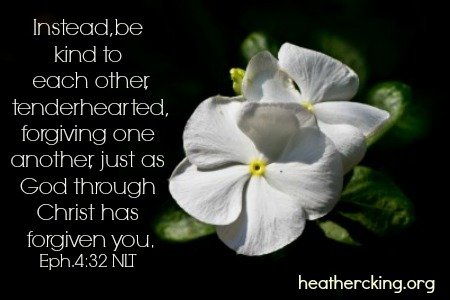
It’s something I’d never considered before, but both Paul and Peter urged believers to be tenderhearted:

“Be kind to one another, tenderhearted, forgiving one another, as God in Christ forgave you” (Ephesians 4:32).

and

Finally, all of you, have unity of mind, sympathy, brotherly love, a tender heart, and a humble mind” (1 Peter 3:8).

This tender heart so often develops when we ourselves feel broken and beaten down and we are made soft and receptive in the process.ephesians4

If our faith depends on quick answers to prayer and fairy tale lives with superficially happy endings, we’ll be hardened to the needs of others, uncomprehending when they share out of their pain and unmoved by compassion when we see their brokenness.

Not only that, but if our faith doesn’t depend on the Rock of God and His character, but instead stands only on happy (and often misquoted and taken out of context) Christian catch-phrases, we’ll watch the wind and waves of the storm demolish and destroy our houses on the sand (Matthew 7).

We don’t necessarily need enough faith to calm any storm, to walk on the water in the midst of a tempest or sit unmoved and unafraid when our boat seems ready to sink. We just need enough faith to stretch out our hand to Jesus as we sink and cry out, “Lord save me” (Matthew 14:30).

Even that is enough for Jesus to hold us up out of the waves.

Let’s be honest today.  It’s not always easy to sing, “‘Tis so sweet to trust in Jesus.”  Sometimes it’s downright difficult.  It’s murky and hazed over and difficult to see.  Sometimes it’s desperately painful.

But we don’t have to have all the answers.  In fact, we don’t really need to say much of anything at all.  Certainly, we don’t have to pretend that it’s easy or shrug mourning off our shoulders with little more than, “it’s all for the best.”

Instead, we can ask for God to make our hearts tender, soft and pliable in His hands because of the pain we’ve endured.  And we can reach out one desperate hand and cry out, “Lord, save me.” Sometimes, that’s all we can honestly say and that’s enough.

Heather King is a wife, mom, Bible Study teacher, writer for www.myfrienddebbie.com and worship leader.  Most importantly, she is a Christ follower with a desire to help others apply the Bible to everyday life with all its mess, noise, and busyness.  To read more devotionals by Heather King, click here.

It’s A Miracle!

The LORD is good to those whose hope is in him,
to the one who seeks him (Lamentations 3:25)

Years ago, the sweet man who led our choir then leaned back in his stool at the front of the choir room.  He told us in a slow southern drawl what he remembered about his mother. I think about his story often.

On the dark and stormy nights of his childhood, when the thunder raged and lightning struck close enough to illuminate his room, he would awaken to find his mom sitting in a chair at the foot of his bed.  She sat with him through the storms, praying over him, even while he continued to sleep.

That’s what he remembered about her: her presence in the stormy nights.

Last night, I supervised the brushing of teeth and the donning of pajamas, packing lunches and backpacks, and laying out clothes for the new day.  We read bedtime stories.  We prayed as a family.

This morning, I poured cereal and buttered toast.  I placed ice packs in the lunches and zipped up the backpacks, all full for the day.

I helped with shoes and socks, combed hair, and reminded my daughters (too many times) to brush their teeth and to do it well because they don’t want cavities or bad breath and, by the way, we’re going to the dentist next week.

Sticking my head out the door for a moment, I checked the weather.  Then I held jackets open for each girl to slip in her arms.  I broke up a fight and gave a crying daughter a hug, calmed her down, and then placed the two sisters on a school bus.

And the day went on with more little tasks and routine activities.

I don’t remember these moments from my childhood.  Do you?  I don’t remember my mom tying my shoes or helping me put on my jacket.  I don’t remember her supervising bath time or pulling my hair into pigtails.

Even though I don’t remember those things, she did them.  I was clean, fed, dressed, and groomed.  My life must have been filled with years and years of everyday love that I don’t remember.

Usually these acts of love remain unnoticed and undervalued . . . unless they’re missing.  Those children who aren’t fed well, bathed, read to, hugged, kept safe, and tucked into their own cozy beds at night feel the lack.  Only they perhaps really know how important the small things are.

What will my kids remember about this time with me? It’s not likely they’ll remember the moments of jackets and breakfasts and backpacks.  They don’t lack for these things.  They likely take them for granted, just as I did.

But they might remember something unique or big, just like the man who recalls his mom sitting with him through stormy nights.

I wonder, then, what do I remember about God, my Father?  When I tell about His presence in my life, what has become part of my story? Usually, it’s the stormy times when I awaken in fear only to find His presence by my side.  It’s the times He’s kept me safe and delivered me from danger.

Yet, we so often overlook the miracles of everyday grace, the simplest signs of His affection and the fact that He cares for our needs and yes, sometimes even our desires.

When we always look for the glorious miracle, the immediate and the extraordinary, we miss thanking God for the gradual, the expected, and the small.

C.S. Lewis wrote, “A slow miracle is no easier to perform than an instant one.”

Yet, we revel in the answers to prayer that come fast. The ones that don’t require interminable waiting and inconvenient patience.

We pray, “Give us this day our daily bread” and then miss the miracle of everyday provision—until it seems in jeopardy.

In the book of Nehemiah, the exiles who returned to Jerusalem skipped sleep, fended off enemies, prayed, and labored with a sword in one hand and a trowel in the other.  They hefted bricks until the walls of Jerusalem were complete, all in just 52 days.  It was a miracle.  Even their enemies knew that:

When all our enemies heard about this, all the surrounding nations were afraid and lost their self-confidence, because they realized that this work had been done with the help of our God (Nehemiah 6:16).

How easy it would be to forget that, though, because God chose not to build the walls with a word from His lips or destroy their enemies with an earthquake or flood.

As Kelly Minter writes in Nehemiah: A Heart That Can Break:

“It’s worth noting that so far we’ve read nothing of angels, burning bushes, or talking donkeys.  Instead, we’ve seen God use what we might consider ordinary to bring about extraordinary transformation: prayer, repentance, willingness, hard work, sacrifice, humility, faith.  Though miraculous displays of God’s power are to be desired and cherished, I’m equally impressed with God speaking silently to Nehemiah’s heart in the most ‘normal’ of circumstances.  Be encouraged that the common, everyday realities are ideal environments for God to put something in our hearts to do” (Minter 116).

Take time to thank God today for the daily bread, for forgiving our trespasses, for His mercies made new every morning, for His great faithfulness, and because He is good to you (Lamentations 3:23-26).  Thank Him for answered prayers and ministry opportunities.  Thank Him for the quiet ways He speaks to your heart and for the encouragement He brings you day after day.

It may not be spectacular, like fireworks in the night sky.  Still, it’s love.  That’s worth remembering.

Heather King is a wife, mom, Bible Study teacher, writer for www.myfrienddebbie.com and worship leader.  Most importantly, she is a Christ follower with a desire to help others apply the Bible to everyday life with all its mess, noise, and busyness.  To read more devotionals by Heather King, click here.

Copyright © 2012 Heather King

There’ll Be A Scar

The doctor said there will be a scar.

I stood over my two-year-old as she laid on the hospital bed in the emergency room, cradling her hand in mine and gently stroking her blood-soaked hair.

More than two hours before, she had been tucked in her bed when she felt inspired to climb into the crib on her own.  We heard the thud and then her cry.  Then we heard the cries of the older girls who were certain they “saw her brains coming out” and were afraid “she was going to die.”

My husband and I scooped up my baby girl, threw on her jacket and snatched up her shoes.  Pressing a rag to her head to cover the gash and to stop the bleeding, my husband snuggled her close as he carried her to the van for our ride to the emergency room.

And I prayed.

Sometimes when you’re in that place of adrenaline and potential bad news, fear, and love for your child, you can’t pray much more than the name of Jesus.  I’m thankful that’s enough.

In the emergency room we waited . . . and waited . . . and waited some more.  By a true miracle, my two-year-old played happily for two-and-a-half hours without one single tear, entertained only by the items I happened to have in my purse.  Two crayons.  Three miniature My Little Ponies.  Two children’s books.  A sheet of stickers.

When we saw the doctor, I confessed that I’d never had a child receive stitches for anything.  So, he cleaned out the gash in her forehead, probed it and kind of hmmmed and sighed for a few minutes.  Then he announced, “There’ll be a scar no matter what.  But in order to avoid a needle and anesthetic for her and to keep you from passing out, let’s try glue instead of stitches.”

That sounded good to me.

When I told her the story, my friend said, “Who doesn’t have a scar with a story from their childhood??”

I’ve been thinking about this all week, every time I peek under the Band-Aid and examine the line of dark red across my baby’s face.  Don’t we all have scars?  Not just from childhood, but we bear the wounds of hurtful words from a supposed friend, the betrayal of someone who said they loved you, the embarrassments from long ago, and the pain over last week’s mistake.

Jesus chose, following His resurrection, to keep His scars.  He was healed and restored to life, but when He extended His hands, the palms still bore the signs of what He did for us.  This didn’t just give a basis for the disciples’ faith, but “Jesus came and stood among them and said to them, ‘Peace be with you.’ When he had said this, he showed them his hands and his side” (John 20:19-20). 

His scars are our source of peace.  His hands upturned remind us that our healing, our forgiveness, our deliverance, our freedom, our redemption, our eternity are all part of the peace He gave us through His sacrifice.

Isaiah tells us:

“But he was pierced for our transgressions,
   he was crushed for our iniquities;
the punishment that brought us peace was on him,
   and by his wounds we are healed” (Isaiah 53:5).

Jesus’ scars are a reminder of what He has done and that gives us peace.

Our scars can do the same.  Oh, I don’t mean we cling to burdens, shame, guilt, hurts, and fears, refusing to lay them down at the cross and remaining forever imprisoned by the stories of our past.

Scripture is clear.

God forgives us.
“As far as the east is from the west, so far has he removed our transgressions from us” (Psalm 103:12).

God heals our broken hearts.
“The Spirit of the Sovereign LORD is on me, because the LORD has anointed me to proclaim good news to the poor. He has sent me to bind up the brokenhearted, to proclaim freedom for the captives and release from darkness for the prisoners” (Isaiah 61:1)

God sets us free.
“It is for freedom that Christ has set us free. Stand firm, then, and do not let yourselves be burdened again by a yoke of slavery” (Galatians 5:1)

God doesn’t hold our past against us.
“Therefore, there is now no condemnation for those who are in Christ Jesus” (Romans 8:1)

We are washed clean, made new, redeemed and set free because of the scars Christ bore on our behalf.

Yet, the experiences that He brought us through, all of the times He carried us, and the moments when we stumbled, aren’t times we completely forget.  They are, instead, seasons of transformation in our lives.  He uses each trial and mistake to change our hearts and draw us closer to Him.

The scars we bear from those times of difficulty and growth are our testimony to others.  We can point to our own scabs and gashes and say, “Look what God has done in me.  He brought me through this.”  We are walking reminders of His mercy, standing testaments to His grace, and an ever-present sign of His peace among the hurting, the broken, and the oppressed.

And it’s not despite our scars; it’s because of them.  That’s why Peter, after experiencing the pain of rejecting Christ, became the apostle who argued so passionately for humility.

That’s why Paul, knowing that he had been a murderer and a persecutor of Christians in the past, became the apostle best known for defending grace.

Their scars became part of their testimony and pointed to Christ.

Years ago, I stumbled upon what became one of my favorite songs, Point of Grace’s Heal the Wound.  I hope it blesses you as it did me!

You can click on the video from the blog in order to listen or follow the link here: http://youtu.be/KjnCxvH4Q3w

You can read more devotionals on this topic here:

Heather King is a wife, mom, Bible Study teacher, writer for www.myfrienddebbie.com and worship leader.  Most importantly, she is a Christ follower with a desire to help others apply the Bible to everyday life with all its mess, noise, and busyness.  To read more devotionals by Heather King, click here.