All the things you can’t do until you’re four years old….and why that’s mercy

She screamed almost the entire way home from church.

It was a shock to me.  After church ended, my preschooler bounced out of the nursery cheerful and excited, waving to everyone we greeted in the hallway.

But when my daughters climbed all over each other to claim seats in the mini-van for the 12-minute ride home from church—as if they were choosing their positions for a round-the-world tour—my three-year-old hopped in the back seat.

She knew better.  No booster seat until her fourth birthday.  In the meantime, she was restricted to the five-point harness-equipped seats in the middle of the van.  Normally, she just joked, hopping into the back and giggling hysterically until I motioned her to her normal place.

Not that day.  Apparently she decided that enough was enough.  This waiting until her fourth birthday thing was totally overrated.  No ballet classes until she’s four.  No back seat until she’s four.  No three-day-a-week preschool until four.  No Children’s Church until she’s four.

Sheesh.  It’s a hard life being just three years old.047

The thing is, I love her and it’s my job not just to give her what she wants, but to give her what she needs.  Protection, limits, boundaries, rules, bedtimes, baths, healthy meals, love and affection.  That’s my job.  Making sure she’s in the car seat is part of the parental package.

So I made her move seats.  And she screamed herself to sleep on the drive home from church.

Perhaps to her my restrictions were unreasonable, even mean,

Really, though, it was love and it was grace.  It was looking out for her best no matter what.

We don’t always know what grace and mercy really look like either, do we?

We think that promotion, that dream-guy, that check in the mail, that recovery, that hugely successful ministry event, that healthy child—yes, that’s picture perfect grace.  Those actions that don’t fit our Grace Template are the mysteries of God, the painfully chafing rub of disappointed religious expectations.

In The Book of Common Prayer these last two mornings, I prayed:

“Show us your mercy, O Lord”

“And, we pray, give us such an awareness of your mercies,
That with truly thankful hearts we may show forth your praise,
not only with our lips, but in our lives”

“Have mercy on us, Lord, have mercy.
Lord, show us your love and mercy;
For we put our trust in you.”

Not only have I prayed for mercy, but I’ve prayed for the awareness of it, the ability to see with a truly thankful heart how God is graciously caring for me.

Even when it doesn’t look much like grace at the time.

Even when I’d rather have the easy and obvious mercy, the kind you pop up out of your pew on testimony Sunday to share, the kind that others applaud and rejoice with you about.

I’ve prayed to see with new eyes, looking through a filter of trust in God.  That means trusting in His character, trusting in His love, trusting in His timing, trusting Him no matter what.titus3-5

The apostle Peter encountered people just like me, those who thought if God wasn’t quick to fulfill His promises, if they had to wait too long or endure too much pain along the way, then God wasn’t fulfilling His end of the “bargain.”

God didn’t move when I thought He would move.  God didn’t provide the way I thought He’d provide.  God didn’t come through for me the way I wanted.

Sometimes we immediately assume the problem is with God.  Maybe He isn’t really good!  Maybe He isn’t really gracious.

That’s what the people in 2 Peter were questioning.  Christ hadn’t returned right away as they expected and life was hard for the persecuted church and waiting was difficult.

Really, though, the problem isn’t with God.  The problem is with our expectations.  The problem is we’ve stopped looking at Him with eyes of trust.

Peter wrote to these struggling believers:

 The Lord isn’t really being slow about his promise, as some people think. No, he is being patient for your sake. He does not want anyone to be destroyed, but wants everyone to repent (2 Peter 3:9 NLT).

God wasn’t being delinquent; He was being patient for their own sake.  It wasn’t deficiency, apathy, or cruelty that caused His delay.

It was mercy, to give people time to accept Jesus Christ as Savior.

Sometimes mercy is “yes” and sometimes mercy is “no.”  Sometimes grace is instant and sometimes it’s waiting and waiting and waiting.

But it is always for our sake.  It is because He loves us that God cares for us the way He does.

Originally published 12/3/2012

Heather King is a wife, mom, Bible Study teacher, writer and worship leader.  Most importantly, she is a Christ follower with a desire to help others apply the Bible to everyday life with all its mess, noise, and busyness.  Her book, Ask Me Anything, Lord: Opening Our Hearts to God’s Questions, is available now!  To read more devotionals by Heather King, click here.

Copyright © 2014 Heather King
Pursuing His Presence: Because Being Still Is Not Enough

I found her with untied tap shoes on her feet and eyes red from crying.

We zipped into the ballet studio, one mom and three girls (plus one baby boy) on a mission.exodus33

Three daughters in four back-to-back and sometimes overlapping dance classes during observation week.  This means instead of huddling in my minivan or zooming around town doing errands in between classes, I sat in the corner of class taking pictures.

We all piled into my youngest daughter’s class except for my tap-dancing girl who left to change into her tap-tap-tappy shoes.  I watched the clock carefully and slipped out just in time to check on her before her tap class began.

She wiped her eyes and explained, “I couldn’t get the ribbons on my shoes tied and I didn’t have anyone to help me….”

I tie the ribbons swiftly and then smooth down her hair with my hand.  Then I say it so she knows it’s not just about shoes anymore:

You didn’t trust me to come help you.  I knew you’d need help and I came just in time.

She’d been frantic and upset and all along I had a plan for her rescue and I was right on time, not a second too late.

So, all her fretting had been unnecessary drama.

And when is fretting not?

I started this year with intentionality: 12 months of pursuing the presence of Christ in the middle of the noise, mess, and busyness of life.  Today, I finish January’s journey, learning to be still and know that He is God.

For months, I dreaded this start to the year, knowing it would be the busiest and craziest of our busy and crazy schedule.  I feared the stress—-as in, tearful eyes, breathless suffocation just thinking about it.

But here we are.  We made it.  God is gracious.  When I felt that familiar strangulation of fear, I heard that still and small reminder: Don’t worry about that.  Just think about today.

So I did.

And, as much as I whine perhaps about winter, the overload of snow days has given me unexpected rest when we needed it most.psalm46-10

God planned the perfect rescue at the perfect moment for me all along, but I had been fretting and worrying.

Why?

Because I didn’t trust Him.

So often, we read that familiar Psalm—-BE STILL and know—and we focus on the stillness (Psalm 46:10).

Yes, stop with the flustered activity, the desperate attempts to fix things on our own, the frantic search for help from everyone except the only One who can truly save….

“Cease striving” it says in the NASB.

So, for a moment we pause.

Here’s what I’ve learned this month, though—“Being still” is not enough. It simply tells me what not to do.

I can’t forget that after I’ve ceased that striving and calmed my heart, God tells me what I should be doing in the stillness:

Know Him, Know He is God, Know that He’s got this under control and I can rest in the knowing that He cares for me.

Ann Voskamp reminds me of this….to remember He is I AM.  His very name is the reminder of His Presence here in this present moment.

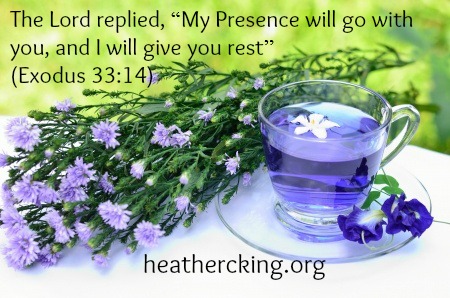
Like Moses, I’ve asked in the boldest of ways that God will show me His Glory this year.  And, like Moses, I’ve told God that I don’t want to move from this place until His presence will go with me.

So, like Moses standing there on a holy mountain before a Holy God, I pray this also:

If you are pleased with me, teach me your ways so I may know you and continue to find favor with you (Exodus 33:13).

Because, God, in order to dwell in Your presence day after hectic day, I must be still and know You more, know You as I AM, know You as God present with me.

To read more about this 12-month journey of pursuing the presence of Christ, you can follow the links below!  Won’t you join me next month as I focus on Praying Simply?

Heather King is a wife, mom, Bible Study teacher, writer and worship leader.  Most importantly, she is a Christ follower with a desire to help others apply the Bible to everyday life with all its mess, noise, and busyness.  Her book, Ask Me Anything, Lord: Opening Our Hearts to God’s Questions, is available now!  To read more devotionals by Heather King, click here.

Copyright © 2014 Heather King

It’s When They’re Quiet That You Need to Be Worried…

It’s when they’re quiet that you need to be worried.

That’s parental advice passed down through generations, usually learned from personal experience.

I learned my lesson, too.

My oldest girl did this thing when she was three years old called a “tantrum.”  Maybe you’ve heard of them?  Maybe you’ve seen one . . . or thrown one.

After a particularly rowdy tantrum on the car ride home one day, she stomped into the house still screaming, ran into my bathroom and slammed the door.

Unfazed, I took my time setting her baby sister down for a nap and tossing my keys and arm-full of papers and baby paraphernalia onto the kitchen counter.  I breathed in deep breaths of Mom sanity.

Then I realized that the banshee wail had subsided into silence, frighteningly loud silence.

Throwing open my bathroom door, I saw my red-faced preschooler crouched on the carpet, her hands covering her head as she sobbed.

On the floor next to her was her hair.

Her hair!

Her long, totally beautiful, golden curly hair.  In her rage, she had climbed onto my bathroom counter and dug through to the bottom of my makeup case where I hid the hair scissors.  Then she had systematically snipped off the two pig-tails on the tip-top of her head.

She was bawling.  I was bawling.  We raced to the local hair salon and plopped her up in the chair for a rescue mission.  Our superhero that day sported a comb and some clippers.

Sometimes we think silence means inactivity and stagnation, abandonment and loneliness, but instead it’s often a sign of focused activity.

With kids, that might mean trouble.

With God, though, as heart-wrenching and full of despair as His silence is, we needn’t fear the quiet.  It’s often a promise that He’s at work right there in the middle of your circumstances, deeply involved in your life.

This was me not long ago.  I thought I had it figured out, what God was doing and how He was at work and how He planned to bless and care for us, but I was wrong.psalm55

The thing about cramming God into boxes is that He shatters the confines of the cardboard.

So, when life didn’t go as I had planned, I cried out to Him: What are you doing?  What does this mean?

Why can’t I hear You?

The silence is so oppressive and filled with overwhelming sadness.  We just want to hear His voice, His quiet voice or His booming command, His encouraging cheer, or His tender whisper.  Whatever He wants to say, we’re desperate to hear it.

Because we feel afraid.

I drove off that night on an arbitrary errand, alone in my car, praying away in the quiet.  Then I hit the play button on the CD for our church Christmas cantata:

“Peace, oh my soul, weary from the struggle
Don’t be afraid, Love knows your deepest need.
There is a light shining in the darkness.
There is no shadow where it cannot reach.
Peace, peace, Jesus has come
O soul, be still, receive your King”

The song faded and one lone voice cut through the silence:

“The Lord is with you . . . Fear not, Mary ….For nothing is impossible with God….Joseph, fear not.  Fear not!  For unto us a child is born, to us a Son is given…Fear not; for, behold, I bring you good tidings of great joy…Fear not!  They will call Him Immanuel–which means, ‘God with us.’  Fear not, for I am with you”

My husband asked me when I flopped on the couch later, “Were you crying?”

How could I do anything but cry?

I had been desperate for the slightest trickle of His voice and He had drenched me in His Word.

But even when I didn’t hear Him, God was still there, still active, still with me. That hadn’t changed.

In his book, Greater, Steven Furtick writes:

God is often working behind the scenes of your life, orchestrating His destiny for you.  Even though you don’t have a clue what He’s up to.  Just because you haven’t heard God call your name or tell you specifically what to do with your life doesn’t mean He’s not conspiring great things for you.

Sometimes we feel like Job: “I cry out to you, God, but you do not answer; I stand up, but you merely look at me” (Job 30:20).

But even in the silence we can hold to the promise:

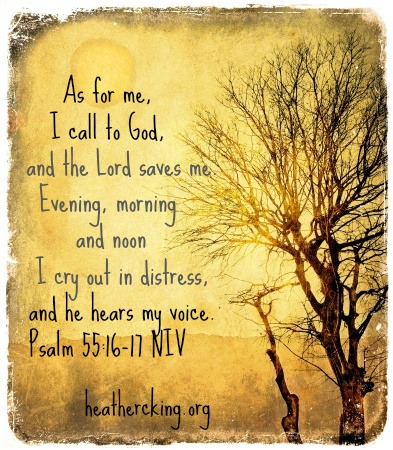
As for me, I call to God, and the Lord saves me.
Evening, morning and noon I cry out in distress,
and he hears my voice
(Psalm 55:16-17).

He hears you.  And when He chooses to speak, the wave of His voice might wash over you and knock you off your feet and carry you to safety.  For now, just keep listening, keep waiting, and don’t be afraid of the silence.

Originally published October 5, 2012

Heather King is a wife, mom, Bible Study teacher, writer and worship leader.  Most importantly, she is a Christ follower with a desire to help others apply the Bible to everyday life with all its mess, noise, and busyness.  Her book, Ask Me Anything, Lord: Opening Our Hearts to God’s Questions, is available now!
To read more devotionals by Heather King, click here.

Copyright © 2014 Heather King

Ask Me More…Where were you?

She said her dad didn’t love anybody.

Not her mom.  Not the kids.  Nobody.

That’s what the girl told my daughter.  And that’s what my daughter told me.

My daughter struggles to understand this invasion of innocence.

We adults slowly learn to cope with the ugly truth about how sin distorts, taints, and breaks.  How this world is hard sometimes, hurtful and messy.

But she’s not accustomed to the pain yet or desensitized to the sadness, so her heart aches for her friend and she struggles with questions and brings them to me:

What does that mean? How come her family isn’t together any more?  Why does that happen to families?  Where will she stay?  Will she still see her dad?

Pain often provokes our questions, too.

There’s something about tragedy that stirs up doubt and wondering.  We want to wrestle with the beasts of injustice and sorrow, trying to make sense of it all with logic and defeat them with some philosophical musings.

But we just don’t know.

We can’t always see why this happened or how it will all work out or what good could come of any of it or what God is doing in the midst of the rubble.

In Scripture, it’s Job that engages in this fight.

We gloss over his pain so quickly as Christians:  Job was a good guy who had bad things happen to him.  Lots of bad things.  Blah blah blah, yeah yeah yeah.

“Bad things” hardly.

His property destroyed, his servants killed, his own body festering with sores, his wife grown bitter, his friends on platforms of self-righteousness……maybe those are “bad things.”

Yet, every single one of his children was killed at once in a freak accident.

If you’ve cradled your own baby in your arms, stroking his cheek with your finger, cooing baby talk, tickling her baby belly, rocking and swaying and humming sweetly, then consider Job’s loss.

Seven sons, three daughters—-dead like a snapping of the fingers.job19

How could he ever breathe again?  No wonder he just wanted to die himself.

So, he ponders and postulates and asks God to explain Himself.  He longs to put God on trial and pose the questions with God on the witness stand.

“Where were you?” Maybe that’s what Job longed to ask God and have answered.

Yet, God never answers all of Job’s questions, not in this life anyway.

Instead, God lets Job pour out all of that bitterness and hurt, knowing perhaps that what we need most in sorrow is the opportunity to be sorrowful.

Then, God responds, not with answers, but with questions.

Lots of lots of questions.  Chapters and chapters of questions.  Pages and pages of questions.  Just about 60 in all.

But here’s the bottom line:

Where were you when I laid the foundation of the earth?
Tell Me, if you have understanding… (Job 38:4 NASB)

Was Job there when God parted the seas from the land or set the birds in the sky or there as He makes the sun to rise and set every single day as faithfully as our faithful God?

Does Job even know how God makes it rain, or feeds the lions, or transforms water into ice?

The questions bring Job to this place where he looks in a mirror and sees his own limitations.

I don’t know. 

What else could he say?

What else to answer but this:

“Behold, I am insignificant; what can I reply to You?
I lay my hand on my mouth.
“Once I have spoken, and I will not answer;
Even twice, and I will add nothing more”  (Job 40:3-5 NASB)

So, I confess this to my daughter, “I don’t know, baby girl.”

Sometimes there’s not much else to say.

Yet, there were two things that Job did know:

“As for me, I know that my Redeemer lives,
And at the last He will take His stand on the earth.  Job 19:25 NASB

and this:

“I know that You can do all things,
And that no purpose of Yours can be thwarted.
Job 42:2 NASB

Maybe we don’t always know the answer to “why” or “what now” or “how could this be…”

Still we know this:

Our God lives and will return one day in victory to redeem us and to redeem this broken world.

and

God can do anything  There’s nothing too insignificant to escape His notice and nothing too difficult for Him to handle.

When God asks us questions, we might not always know the answers, but we know He does.  That’s the simplicity and the challenge of faith.

Heather King is a wife, mom, Bible Study teacher, writer and worship leader.  Most importantly, she is a Christ follower with a desire to help others apply the Bible to everyday life with all its mess, noise, and busyness.  Her book, Ask Me Anything, Lord: Opening Our Hearts to God’s Questions, is available now!  To read more devotionals by Heather King, click here.

Copyright © 2013 Heather King

Devotions for Thanksgiving: Bitter Ingredients and Pumpkin Pie

Almost all of my favorite Thanksgiving memories aren’t really of the feast itself, even though I still say it’s my favorite holiday.  Mostly I grow nostalgic for Thanksgiving Eve and the Wednesday night family baking sessions we had as a kid.

There’s something deeply relational about baking, whether it’s for someone or with someone.  I find myself even now telling stories as my daughters stir and imparting generational wisdom like: why the butter and sugar get creamed together first and how you have to pack down brown sugar when you measure it out.

Hugely important life lessons like that.

And maybe I learn something, too.

The last time we crowded around the table to make pumpkin pie, my oldest asked, “Mom, what does pumpkin taste like by itself?”

She thought it would be sweet heavenly golden goodness.  After all, this daughter and I share a passion for all things pumpkin—pies, breads, cookies and cupcakes.

But I knew the dark secret about pumpkin and I tried to warn her, “You can try it if you like, but just a small taste.  It’s bitter.”

She licked a tiny bit off her finger and made the appropriate “nasty” face.

How can something so incredibly delicious in everything we bake be so horrible on its own?

I pulled out the vanilla and she bravely tasted the tiniest droplet of that also, despite the grimace over the pumpkin.thanks3

Yup, vanilla doesn’t fair any better on its own.

She even smelled each of the spices before we measured them into the bowl.  It turns out that cloves, nutmeg and ginger are more potent than sweet and more pungent than enticing.

The eggs were runny, sticky and gross.

The salt was…well, salty.

All in all, it was utterly mystifying when we finished stirring and I handed her the spoon to lick, which she popped into her mouth with a muffled, “Yummmmm.”

The truth about baking is the truth about life.  We have a reason to be thankful for every ingredient, even the ones that seem too bitter or salty or potent to turn into anything mouth-watering and delicious.

As Christians, most of us have not only heard Romans 8:28 a million times, we’ve probably quoted it a few thousand times ourselves:

And we know that all things work together for good to those who love God, to those who are the called according to His purpose (Rom. 8:28 NKJV).

You may have even just skimmed through that verse just now because you’ve heard it so often and know it so well.

And yet, we tend to emphasize the “for good” part of this verse, which means we could be expecting instant pumpkin pie when life hands us a can of Libby’s pumpkin.

That job you lost, how can that be for good?

That time of sadness, that mourning, that separation and grief, the broken relationship and the conflict…..tastes so bitter.  It doesn’t seem possible for any of it to be “for good.”

Philosophically, we know the deal.  We’ve heard the sermons.  Maybe one day we’ll see how God turned these times of sadness and stress into blessing.  Maybe it won’t be until heaven, but at least then we’ll be able to see the good that came from the ugly.

It’s a long, hard lesson, realizing that “for good” doesn’t necessarily mean “right now” or “without pain.”

But it’s true, of course.  There are eternal perspectives and long-term visions that we just can’t see from our limited, finite looking glass on circumstances so up-close and personal.

There’s something about this verse that we often overlook, though.  God isn’t just working “for good,” He’s doing it so that “all things work together.” The good comes from the mixing of ingredients, the pooling together of the circumstances into one beautiful wholeness—His plan and will for Your life.

Rick Warren says it this way:

“The events in your life work together in God’s plan.  They are not isolated acts, but interdependent parts of the process to make you like Christ….If you will give God all your distasteful, unpleasant experiences, he will blend them together for good” (The Purpose Driven Life, p. 195).

I’ve had Thanksgivings where gratitude came easy, practically gushing out of me in response to blessing.

And there were years where thankfulness was a discipline of the soul, a determined trusting in God, a sacrifice of praise.

Regardless of whether this year is easy or harder for you, remember that the pumpkin, the eggs, the salt, the vanilla, the spices aren’t delicious on their own.

But trust–and give thanks–that God will bring everything together and it will be sweet and for your blessing and beyond what you could imagine.

Originally published November 21, 2012

Heather King is a wife, mom, Bible Study teacher, writer and worship leader.  Most importantly, she is a Christ follower with a desire to help others apply the Bible to everyday life with all its mess, noise, and busyness.  Her book, Ask Me Anything, Lord: Opening Our Hearts to God’s Questions, is available now!  To read more devotionals by Heather King, click here.

Copyright © 2013 Heather King

Ask Me More: When Anger is Justified But Not ‘Right’

One of the hardest parts of writing a book isn’t always choosing what to put in; it’s choosing what to leave out.

So, when I wrote Ask Me Anything, Lord, I had to choose which questions God asked in Scripture that I would include in the book and which ones I couldn’t.

That was tough.  In the end, I trusted God to lead me and even had to cut out some of my very favorite questions in favor of others I felt He wanted me to cover.

But now, I’d like to share some of the other questions with you in a series on the blog: Ask Me More.

And, if these questions intrigue you, please check out my book, Ask Me Anything, Lord: Opening Our Lives to God’s Questions for a deeper study on how we can let God search our hearts with the very questions He asked others in the Bible.

****************************************************************************************************************************

She’s angry, that’s obvious.

Anger transforms my blond beauty into a furious mess.  Her face burns red hot and tears sting her eyes and cheeks.  Her long hair escapes hair clips and ponytail holders and frizzes out all wild and untamed.  She stomps around as if her feet alone weigh 50 pounds each and her whole body closes in—her fists clenched, her arms crossed, her chin buried into her chest.

It’s her sense of justice that typically sends her into a fit.

This is right.

That’s wrong.

And I’m going to fight to prove it.

She gets that from her dad.  It’s one of the reasons I fell in love with him.

And, normally it’s the beauty in her, too: this absolute willingness to defend justice and truth no matter what it takes or costs.  One day maybe she’ll advocate for orphans and for the oppressed and she’ll be a mighty force on their behalf.

But sometimes, she doesn’t see the whole picture.  She is, after all, only eight years old, and when you’re eight, you don’t know as much as you think you know.

That’s why she assumes a fighting stance when her four-year-old sister munches on an ice cream sandwich.  How come she gets a treat?  That’s not fair!  I talk my crusader down off the ledge and remind her that she hadn’t even asked.  Why get angry when my answer would be yes?

And why rage over whether or not I punish her younger sister often enough?  It must be that she doesn’t trust me as a mom to discipline well, to show grace when needed, and to teach my children what is right.

I understand.  Don’t I sometimes rage myself over my own causes?

Don’t you?

Lord, why are you blessing them and I’m struggling?  I’m the one trying to be obedient and live the righteous life and they aren’t following you at all.  That’s just not fair!

Lord, did you see what they did to me?  Did you see how cruel and unfair, how they slandered and lied and spread the muck to others? Can’t you strike them with lightning or something?

Anger isn’t wrong in itself. We can fight with that same righteous indignation of Jesus cleansing the temple grounds of con men and scam artists.

But sometimes what we claim is righteous indignation really is not trusting God to see truth, to defend us, to care for us, to show mercy when mercy is needed and justice in its time.

That was the prophet Jonah, sitting on the outskirts of Nineveh in a foul mood all because God showed mercy to an entire nation when they repented following Jonah’s hellfire and brimstone proclamation.

This change of plans greatly upset Jonah, and he became very angry. So he complained to the Lord about it: “Didn’t I say before I left home that you would do this, Lord? That is why I ran away to Tarshish! I knew that you are a merciful and compassionate God, slow to get angry and filled with unfailing love. You are eager to turn back from destroying people. Just kill me now, Lord! I’d rather be dead than alive if what I predicted will not happen’ (Jonah 4:1-3).

He raged about God’s character, spitting out the words that should be worship as angry accusations instead:  I knew it.  You’re merciful, compassionate, slowly angered, abounding in love.

God could have defended Himself.  He could have given Jonah his wish and killed the frustrated prophet on the spot.jonah4

Instead, he used a question to dig out the mess of unforgiveness in Jonah’s heart and reveal God’s own character of compassion for the lost.

God asked:

 “Is it right for you to be angry about this?”  Jonah 4:4

It did seem right and just.  Nineveh was the enemy of God’s people!  They had destroyed Jonah’s friends and family! Surely they deserved revenge, not grace!

But God didn’t let the prophet linger there in hatred.  He caused a plant to grow overnight to shade Jonah’s hot head (in more ways than one!).  Then, when Jonah rejoiced over that plant, feeling somehow that he deserved God’s favor and blessing, God sent a worm to chomp that plant right down to nothing.

Jonah raged again.

And again God asked the question:

“Is it right for you to be angry because the plant died?”
“Yes,” Jonah retorted, “even angry enough to die!”  (Jonah 4:9)

God pressed in, challenging how Jonah cared more for a plant than for a nation of 120,000 lost people.  He shifted Jonah’s perspective and He urged Jonah to trust Him.

That’s what’s at stake for us, as well.

When we’re angry, can we still trust?

When anger seems justified, can we still lay our right to rage down at God’s feet and leave it all in His hands?

And as we do, we worship: You are merciful, compassionate, slow-to-anger, full of unfailing love.

Yes, Amen, Lord.  Your will be done even in this.

Heather King is a wife, mom, Bible Study teacher, writer and worship leader.  Most importantly, she is a Christ follower with a desire to help others apply the Bible to everyday life with all its mess, noise, and busyness.  Her book, Ask Me Anything, Lord: Opening Our Hearts to God’s Questions, is now available!  To read more devotionals by Heather King, click here.

Copyright © 2013 Heather King

A Reflection of Faith

He wasn’t but a few hours old when the questions began.

“Who does he look like?”

I wonder.  These eyes, this nose, his little round face and fuzz of light brown hair…do I see a reflection of me or are these my husband’s features in our newborn son?069

The debate is familiar.  I’ve swaddled three daughters and one son in hospital blankets and visitors have glanced into their faces and declared each time:

Just like dad.

Just like mom.

The opinions differ, this person…that person….there’s no consensus here.

So they ask me and what to say?  I fail at this every time, not seeing all him, all me.  Seeing only “our baby.”

That’s what we decide, not so much that my son looks like dad or mom.  Instead, he looks like a “King baby” and the comparisons are less with his parents and more with his sisters—these sibling counterparts with shared DNA.

I think of my own reflection and how people have told me my whole life that I look exactly like my mom.

But this light brown hair, my blue eyes, my fair skin, my (unfortunate) chin….those aren’t my mom’s features.  Those belong to my father.

What they see in me isn’t a physical copy of my mom, but a personality, a laugh, a voice and a spirit that make me her “spitting image.”

So maybe the essence of who we are truly overcomes the external and influences—maybe even determines—the way others see us.

People can look right at me and yet see past all that is physical to the spirit within.

And so the apostle Paul could see past body frailty to find faith in a man.

In Lystra there sat a man who was lame. He had been that way from birth and had never walked. He listened to Paul as he was speaking. Paul looked directly at him, saw that he had faith to be healed and called out, “Stand up on your feet!” At that, the man jumped up and began to walk (Acts 14:8-10). 

How many people had looked directly at that man and seen only external limitation?  From his birth, he’d been crippled and all through childhood he’d been defined by disability.

Yet, his faith was so great, so overpowering, as to be his greatest noticeable characteristic when Paul looked his way.  How could it be so clear, so definitive in one lame man among a mob of many?2corinthians

What does such faith look like?  What are its features?

If someone looked at me in a crowd, would they see this faith above all else in me?

It must have been mountain-moving faith the man had.  The kind that makes room for miracles and doesn’t crowd them out with doubt rooted in practicalities and self-reliance.

Me?

Could I have faith so bold?

And daily faith, what about that?  Would Paul have seen faith in me amidst the most minor of daily annoyances, the stresses of the schedule, the disappointments of the moment and the way I have to face up to my very own mistakes and failings?

Doesn’t that take faith also?

To choose not to make a forgotten phone call a crisis or a lost library book or the 5 minutes on the clock screaming at me that we’re late or my mistake from rushing too much (yet again).  How we react in the most mundane of stressors reflects our faith or lack of it.

Do we trust that God has everything under control?

Everything?

Yes, the overwhelming issues we can’t possibly handle, but can we trust Him even with our calendar and our kids’ homework and our grocery bill?

And, if He is so trustworthy, why then fret and fear instead of relax easy into the trust that is faith in a God so mighty and so merciful?

The Proverbs 31 woman “can laugh at the days to come” (Proverbs 31:25).

She has no fear of tomorrow or any days after that and no worries over what-if’s and hypotheticals.

She has faith.  And it shows up in her demeanor, in her belly of laughter instead of a wrinkled face of worry.

Proverbs also tells me this:

As a face is reflected in water, so the heart reflects the real person (Proverbs 27:19 NLT).

This reflection of mine should radiate faith, confident assurance that God is who says He is and He will do what He says He will do.  It’s the firm, unshakeable belief that whatever I face any day in this world is in His hands and never beyond His control or His caring.

Who do I look like, then?

Oh, I hope it’s a woman of deep, unshakeable faith and that it’s written all over my features and in every part of my being so you could pick me out in a crowd and know I belong to my God.

Heather King is a wife, mom, Bible Study teacher, writer and worship leader.  Most importantly, she is a Christ follower with a desire to help others apply the Bible to everyday life with all its mess, noise, and busyness.  Her book, Ask Me Anything, Lord: Opening Our Hearts to God’s Questions, is now available!  To read more devotionals by Heather King, click here.

Copyright © 2013 Heather King

How a Smelly Fish Can Rescue Us

What wisdom is this?

My children hopped into the minivan and answered the weekly question.

“What’d you learn in church today?”  They know I’ll ask; talking about church lessons is what we do every Sunday afternoon.

So my daughter tells me the basics: Jonah and the big fish.

Her sister fills in the peripherals about eating crackers shaped like fish and other sea creatures for snack and we praise their teachers’ creativity.  Then she holds up storyboard cutouts she made with construction paper and markers.

Here’s Jonah (he looks remarkably like a Veggie Tales character).  Here’s the fish.  Here’s the ship.  Here’s the island. 

She holds them up for display and, in my mom-way, I praise her work and notice the details.

They finish off the story together about hearing God, about disobedience, about forgiveness, about God’s grace.

Mostly, it’s normal Sunday fare, the retelling of a story they’ve heard, read and seen a hundred times at least.

Yet, my eight-year-old stops me there breathless as we sit in the idling minivan while Dad drives us home from the church building.jonah2

“Mom,” she says, “what if the whale was God’s way of rescuing Jonah?”

What if it was part of God’s plan, a salvation mission, a blessing, a large, smelly, hulking mass of grace out there in the middle of the sea on a stormy night?

I’ve heard grown men and women finally come to that conclusion about Jonah, but this child of mine thinks it through slowly.

Because he was out in the middle of nowhere.  And sure the fish was smelly and he could have been digested, but he’d never be able to swim on his own to land.  He would have drowned.

God sent a fish to save Jonah’s life.

That’s what she concludes.

Not just his physical heart-beating, breath-filled, flesh and blood life either.

That fish gave Jonah the time, the opportunity, and the reason to repent and declare:  “Salvation comes from the Lord” (Jonah 2:9 NIV).

Yes, it says it right there in the Bible that I open later as I sit at my kitchen table and ponder this child’s wisdom:

Now the Lord provided a huge fish to swallow Jonah, and Jonah was in the belly of the fish three days and three nights (Jonah 1:17 NIV).

The Lord provided that fish, just as much as manna in the wilderness for a wayward nation, and a ram in the brush for Abraham to sacrifice, and loaves and fish to feed a hungry crowd of more than 5,000.

Miraculous provision and mysterious grace–that’s what that fish was.

Sometimes the grace we encounter is just such a mystery, salvation disguised as circumstances that reek with stench and leave us sitting in the darkness day after solitary day, maybe even as circumstances that seem to vomit us out onto the shore.

Jonah saw the provision of the whale as the unmistakable evidence of God at work.

We don’t always see.  We might not know the end result, the reason, the whys and wherefores of this and that.

Perhaps, like Jonah, God disciplines and redirects us.  Perhaps, He simply redeems the evil and downright difficult circumstances of a fallen world, protecting us and delivering us in the end.

Perhaps we won’t know all the ways He’s at work in our lives.

Why didn’t we get that job or promotion? 

Why not this relationship?

Why this illness?

Why was I stuck in this traffic jam and late for the appointment?

Why this brokenness?

Can we always see the reason for the big fish?  No, not always.  Yet, we trust that it’s there, a purpose or plan, and we’re just too finite-minded and near-sighted to see it.

We can stop beating the sides of the beast in hopes we’ll be released right out into the middle of the sea….and instead start praising God from the belly of that whale, thanking Him that even when we don’t see the reason or the destination, He’s in control and He’ll take us safely to the shore.

That’s what an eight-year-old teaches me on a Sunday afternoon drive home from church.

What wisdom is this?

Heather King is a wife, mom, Bible Study teacher, writer and worship leader.  Most importantly, she is a Christ follower with a desire to help others apply the Bible to everyday life with all its mess, noise, and busyness.  Her upcoming book, Ask Me Anything, Lord: Opening Our Hearts to God’s Questions, is available now!  To read more devotionals by Heather King, click here.

Copyright © 2013 Heather King

What are you waiting for?

I am having the best time reading your comments and hearing how you would title a book about your life or what God has been teaching you over on the Giveaway Post!
Please continue sharing your comments and posting to social media like Facebook and Twitter.  I’ll be announcing the giveaway winners of two signed copies of Ask Me Anything, Lord this Friday!  You can enter the Giveaway by clicking here and following the instructions.
****************************************************************************************************************
Originally published July 2, 2012 as Devotions from My Garden: What Are You Waiting for?

So let’s not allow ourselves to get fatigued doing good. At the right time we will harvest a good crop if we don’t give up, or quit (Galatians 6:9 MSG).

We planted in pots and crates on our deck, tiny seedlings of cucumbers, tomatoes in three varieties and jalapeno peppers.

Then we waited.

And waited.

And waited.013

We watered.  We tended.

But mostly we waited.

From one day to the next, the leaves didn’t appear to expand and the stems didn’t seem to reach any higher than the day before or the day before that.

It took standing back and surveying growth over time for us to notice we had plants and not seedlings any longer.  Then there were the first tiny yellow flowers on the cucumber plant.

The day we spotted the tiniest baby tomato, I called all three of my daughters over to see.  There we stood, a mom and three girls gently pushing aside green leaves to marvel at the promise of growth.

And then we waited some more.

And waited.

And waited.

For signs of ripeness and readiness for harvest.

Gardening, like life, is so often about waiting.  The difference, though, is that we waited for our first vegetables with anticipation and excitement.  We tracked the progress and closely watched the physical signs of a promising future because we knew the day would come when we sat down to salad and salsa from our garden.

But in life we often wait with a hopeless aggravation and a frustrating impatience.

We wait on God, tapping our foot and glancing often at our wrists with urgency.

Perhaps, though, we should wait for God, watching the signs of growth, rejoicing over every bud and clapping our hands with joy every time we see a reminder that the harvest is coming.

This is how the crowds prepared for Jesus’ arrival:

“Now when Jesus returned, the crowds welcomed him, for they were all waiting for him” (Luke 8:40). 

Can you imagine the crowd watching the road for the first glimpse of Jesus’ sandal?  Perhaps kids ran back and forth bringing news of Jesus’ journey.  “He’s coming.  He’s near.  He’s closer.  He’s just around the corner.”

He’s here!

Imagine the hush of the people.  They weren’t whining about the wait or postulating that perhaps Jesus wasn’t coming after all.

No, they were likely listening intently for the first sound of His voice chatting with His followers as He traveled on the road.

This is how we wait for God–we look forward with excited anticipation and uncontainable joy for the moment we see God at work.

And while we wait, we prepare to receive all that He’s bringing our way.

Like the kings who faced the overwhelming enemy might of Moab, we wait for God’s promise.  He said He would:

“fill the ditches in the dry streambed with water” overnight and without wind or rain.  Yes, He would bring the refreshment and victory they needed (2 Kings 3:16-18).

In the very next chapter, Elisha tells the destitute widow to gather “empty vessels and not too few” and then the Lord filled as many as she gathered with rich oil, saving her from starvation and poverty (2 Kings 4:3).

In two back-to-back passages, God miraculously fills His people up to the brim, giving them all they had prepared to receive.

So we grab as many jugs and cups and bowls and pots and buckets as we can hoping not to miss out on one drop of God’s provision.

We stand at the foot of the dry streambed and rather than complaining about our parched throat, we should dress in a swimsuit, ready to dive into the pools overflowing with His miraculous water-without-rain.

It’s waiting still, surely, as we watch for the signs, the growth, the buds, the tiniest hint of what is to come.  We look for God-movement here and there, projecting change and something new.

It can be scary.  Sometimes waiting is what we know.  Change, even good change, can worry us.

So what are we to do?

See the signs of God on the move, the promises of harvest, and yet refuse to budge?  “No thanks, God, I’ll stick with what I have and what I know because at least I’ve dug into a trench of trusty comfort and reliability.”

Or do we hang my shoulders in defeat and stomp away, not seeing the harvest quickly enough?  Tired of waiting, we dump over the vessels waiting for oil or walk away from the streambed thirsty for water . . . turning away from those waiting for the first sight of Jesus and choosing instead to complain at home that He didn’t come.

Or we could wait, joyfully and with excitement, nervous perhaps but ready nonetheless.  Jumping up and down trying to see Jesus over the heads of the crowd, we could wait for God, not wait on Him.

This is how we reap the harvest, when “we don’t give up, or quit” (Galatians 6:9).  This is how we don’t miss out on one drop of what God has planned.

Heather King is a wife, mom, Bible Study teacher, writer and worship leader.  Most importantly, she is a Christ follower with a desire to help others apply the Bible to everyday life with all its mess, noise, and busyness.  Her upcoming book, Ask Me Anything, Lord: Opening Our Hearts to God’s Questions, will be released in the Fall of 2013!  To read more devotionals by Heather King, click here.

Copyright © 2013 Heather King

Ask Me Anything: Seeing The Impossible

“I pray that the eyes of your heart may be enlightened in order that you may know the hope to which he has called you, the riches of his glorious inheritance in his holy people”
Ephesians 1:18, NIV

When Hagar ran off into the wilderness with her son for the second time in Genesis 21, she ended up wandering in the Desert of Beersheba. She was a homeless single mother, without friends, caring for her boy in unfamiliar desert territory and running out of supplies.

Her circumstances were desperate.askmeanything8

Placing Ishmael under a bush, she walked away so she wouldn’t have to watch him die. “And as she sat there, she began to sob” (Genesis 21:16 NIV).

It’s in the impossible situations where God is often most visible.

So it was with Hagar. God visited with her once again and asked:

“What is the matter, Hagar? Do not be afraid; God has heard the boy crying as he lies there. Lift the boy up and take him by the hand, for I will make him into a great nation.”

Then God opened her eyes and she saw a well of water. So she went and filled the skin with water and gave the boy a drink” (Genesis 21:17-19 NIV).

Just like His question, “Where have you come from and where are you going,” this new question, “What’s the matter, Hagar?” shows that He was concerned about her. He knew where she was and what her circumstances were. Not only that, but He opened her eyes to see the deliverance He had prepared for her.

Nothing about Hagar’s circumstances changed. She was still a homeless single mother, short on provisions and without friends or direction.

It’s possible that God miraculously placed a new well nearby where she sat. Scripture simply says “God opened her eyes and she saw a well of water.”

It could also be, though, that the only thing that changed was Hagar’s vision. Blinded by impossibilities and overwhelmed with despair, Hagar had given up when a well was so close. God revealed to her grace and provision that she simply hadn’t seen before.ask-me-anything-lord_kd

In the same way, God miraculously gave supernatural sight to Elisha’s servant in 2 Kings 6:15-17.  Surrounded by an impossibly large enemy army with horses and chariots, the servant cried out in despair, “Oh no, my lord!  What shall we do?” Clearly, they were doomed to defeat. Yet, Elisha assured his anxious friend:

“‘Don’t be afraid . . . those who are with us are more than those who are with them.’  And Elisha prayed, “Open his eyes, Lord, so that he may see.’ Then the Lord opened the servant’s eyes, and he looked and saw the hills full of horses and chariots of fire all around Elisha” (2 Kings 6:15-17 NIV).

Suddenly their odds of winning didn’t seem so impossible anymore, yet their reality was unchanged. Those heavenly defenders had been there all along; the servant simply hadn’t seen them.

Pray that God will open your eyes to His provision and plan for you.

Sometimes we feel that our circumstances are too impossible even for God.  We forget that He is the God of creation, who spoke the sun and moon and all of the earth’s creatures into existence out of nothing.

God hasn’t stopped being a creator God. He can create something out of nothing.  He can place wells where there has been no water.  He can create a heavenly army to deliver you when you are defenseless.

Remember that, “With man this is impossible, but not with God. All things are possible with God” (Mark 10:27 NIV). You can trust that the God Who Sees you will know what you need exactly when you need it.

Taken from Ask Me Anything, Lord,© 2013 by Heather King. Used by permission of Discovery House Publishers, Grand Rapids, Michigan. 49501. All rights reserved. www.dhp.org.

To pre-order a copy of this book, click here.

For more information about the book release, you can click here.

Heather King is a wife, mom, Bible Study teacher, writer and worship leader.  Most importantly, she is a Christ follower with a desire to help others apply the Bible to everyday life with all its mess, noise, and busyness.  Her upcoming book, Ask Me Anything, Lord: Opening Our Hearts to God’s Questions, will be released in the Fall of 2013!  To read more devotionals by Heather King, click here.

Copyright © 2012 Heather King