Finding God While Folding Clothes

I was crying and laughing at the same time.

All these years, I’ve heard about that, how you’re spilling over with overwhelming emotions and your body just doesn’t know what to do.  Cry out the tears?  Burst out in laughter?

There’s Sarah in the Bible, who waited month after month, year after year, decade after decade for a baby…and then when God said she’d have a son, she laughed.  She just couldn’t hold that in, that joy….that disbelief…that incredulity….that moment of shock when your whole life changes in one second and you’re thrown off balance and grabbing onto a furniture or to an outstretched hand to  steady yourself.

Me?  A son?

Sarah had her moment; I had mine.  Lying there on an exam table while an ultrasound tech rolled a wand expertly over my pregnant self.  She tells me these are kidneys, this is the stomach, there are the chambers of the heart….My baby looks so beautiful and healthy, and I’m already exhaling that big held in breath and each of my muscles slowly relaxes just hearing the good news.

Then she says the words, “It’s a boy.”

This momma to three daughters laughed through tears.  I can’t even remember what I said, but it was something like:  No way!  I can’t even believe it.  Are you sure?  Are you sure your sure?

My husband asks me later if I’m disappointed, but it’s not that.  I’m excited, yes, just still in a bit of shock.

All these years, I’ve become a girl’s mom.  I’ve learned all things girl and prayed over all things girl, read the books and considered the truths about being a mom to girls.

Truth be told, I’m feeling pretty confident most days, not always but often, thinking maybe I’ve gotten the hang of this. Maybe I know what to do.

Bringing up girls is what I do and being a mom to daughters is who I am.

Now I’m reading blog posts and books and listening to podcasts about raising boys.  I’ve watched sons with their moms in the store, in the park, at the school.  I’ve leaned in close and listened to friends and made mental notes about being a mom to boys. 

And I’ve prayed.

Maybe that’s the point.

Nine years ago, pregnant with my very first baby, I thought I’d have all boys and thought I’d be a great boys’ mom.  That was when the news of a daughter first shook apart any foolish confidence I had.

How I had prayed then when God gave me this unexpected gift of three daughters, and my Mom-life still holds together simply because of my worn-out knees from constant prayer.

So here I am now, stumbling down onto my knees again and I’m reminded: I am insufficient.  I don’t know.  I don’t have it all together and I’m not sure how to do this right.

I start by dragging out bag after bag of girls’ clothes from the Rubbermaid containers in the garage and sorting them into piles to give away to friends.004
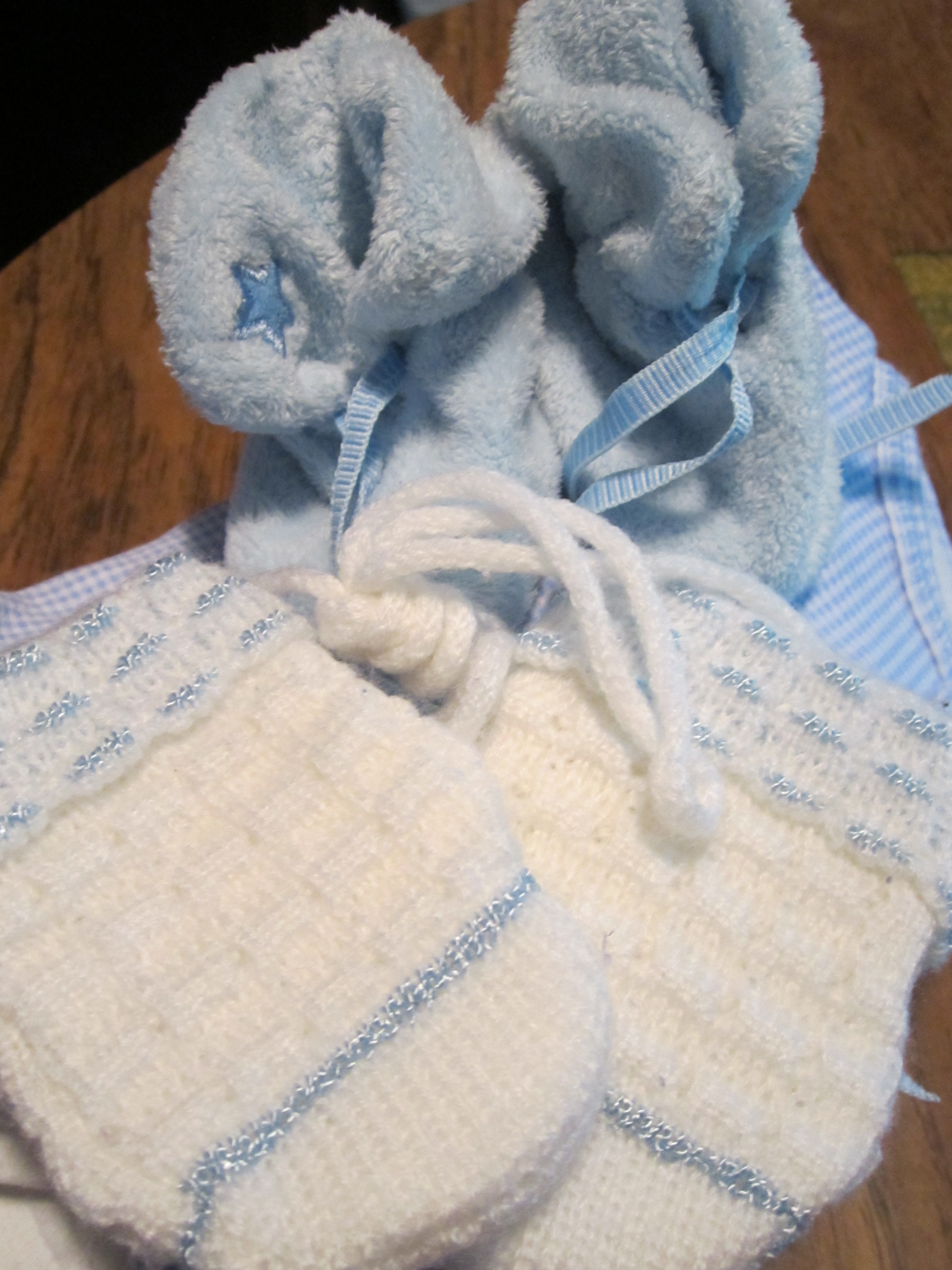
Then I remember how over the years some people mis-heard the news and thought we were having a son when we were having another girl, so they gave me gifts for boys.  Then there were those who worried that ultrasound techs got things wrong, so they gave me gifts of yellow, green and white just in case.

I pull out the collection I’ve amassed over 9 years of having babies.

And right there God meets me.  Right there as I’m folding these tiny boy’s clothes and watching the pile grow.

I had no idea how long He’d been at work preparing me for a son.  I didn’t realize how much abundance He’d provided unexpectedly and beyond all reason.  Blue outfits, blue t-shirts, little boy washcloths and towels, hats, blankets, mittens, sleepers, and socks: it all piled up on the back of my sofa as I folded the clothes until the piles were about falling over.

God had been at work all along, making room for grace.

I still feel insufficient.  I still feel overwhelmed with all that I don’t know and amazed that He would trust this gift to me when I feel so incapable.

Paul said it, though:

He said to me, “My grace is sufficient for you, for power is perfected in weakness.” Therefore, I will most gladly boast all the more about my weaknesses, so that Christ’s power may reside in me. (2 Corinthians 12:9)

This grace of God’s is sufficient.

But we don’t realize it, don’t rely on that, don’t allow Him to be fully sufficient until we realize just how insufficient we are.   The more we are driven to our knees by our unworthiness, the more we declare Him worthy of all praise.

Heather King is a wife, mom, Bible Study teacher, writer and worship leader.  Most importantly, she is a Christ follower with a desire to help others apply the Bible to everyday life with all its mess, noise, and busyness.  Her upcoming book, Ask Me Anything, Lord: Opening Our Hearts to God’s Questions, will be released in November 2013!  To read more devotionals by Heather King, click here.

Copyright © 2013 Heather King

I Failed Napping

Part guilt, part pride.  That’s the odd tangled mess of emotions I feel about rest.

Yes, guilt.  Napping is difficult for me; sometimes impossible.  All those years of new motherhood when the wise older women are telling you, “Rest when the baby is resting….” and you understand their gray hairs mean wisdom, but your body just doesn’t DO that, doesn’t nap and feel better for it.

Mostly I toss and turn.  I count to 100 and then back from 100 and then up to 100 again, fighting hard for sleep because I’m fatigued and maybe even tired, but I’m failing so often.

And even if I can kind of sleep, it’s not deep and restful.  It’s semi-conscious and mostly I just lie there thinking of how I’m wasting that time in that bed.  When I finally give up all frustrated and still tired, I’m a groggy mess.

Napping frustrates me rather than refreshes.

My husband teases me about never watching TV or movies.  “You don’t watch; you just listen,” he says.

It’s true.  I like to listen to the dialogue while cleaning up the kitchen, packing the lunches, folding the laundry, sweeping the kitchen floor, dusting the furniture, signing homework slips and agenda books.  Or maybe I am done with my chores, so I busy my hands with knitting or sewing projects or the crossword puzzle.

But sitting totally still, just watching the television…that’s not rest; that stirs up restlessness in me.

I read the verses, how Scripture tells me to rest, and all this time I thought I just failed at this.

Could this be sin?  Could I struggle with this so much that I’m a hopeless case of incessant busyness?  A certifiable Martha who can’t possibly be Mary at the feet of Jesus?

Oh, the guilt.

But there’s the pride, too.  This secret truth:  how it feels good to confess to a “weakness” that’s really all about my strength.

I’m a doer.  I like to be busy.  I get things done. I don’t need rest like others do because I have this superhuman ability, this super-mom power to do and do and do.  I have a strong work ethic and I’m not lazy or unproductive.

That’s never what I say; it’s never that blatantly boastful.  But I know they pride is there.  I live with that arrogant inner dialogue every day.

Oh, but this week there is freedom and I keep coming back to this again and again.  Daily I return because I don’t want to wrestle this Guilt/Pride monster any longer.

In her book Wonderstruck: Awaken to the Nearness of God, Margaret Feinberg writes:

“But rest isn’t a purely passive activity.  Rest invites us to participate in restorative activities….Sometimes what’s most restful and restorative to you might involve activity…Sometimes what feels like rest to you may feel like work to someone else (and vice versa)…

Some people experience rest and rejuvenation through physical exercise,  others prefer a creative outlet like painting, sculpting or finding a project on Pinterest.  Still others experience rest through spending time at the rifle range, reading an entertaining book, working on a car, enjoying a comedy, or cooking a new recipe”  (p. 72).

Rest doesn’t have to mean napping.  It doesn’t have to mean Hallmark movie watching, a day on the sofa or a morning spent late in the bed.

It can.  If that’s how God hand-crafted your heart and mind, then that’s how He asks you to rest.

But finally I see how all these years of feeling like I never rest just meant I rested through creating or growing.

….Baking the bread and the cookies and huddling around the kitchen table with three daughters and a new recipe.

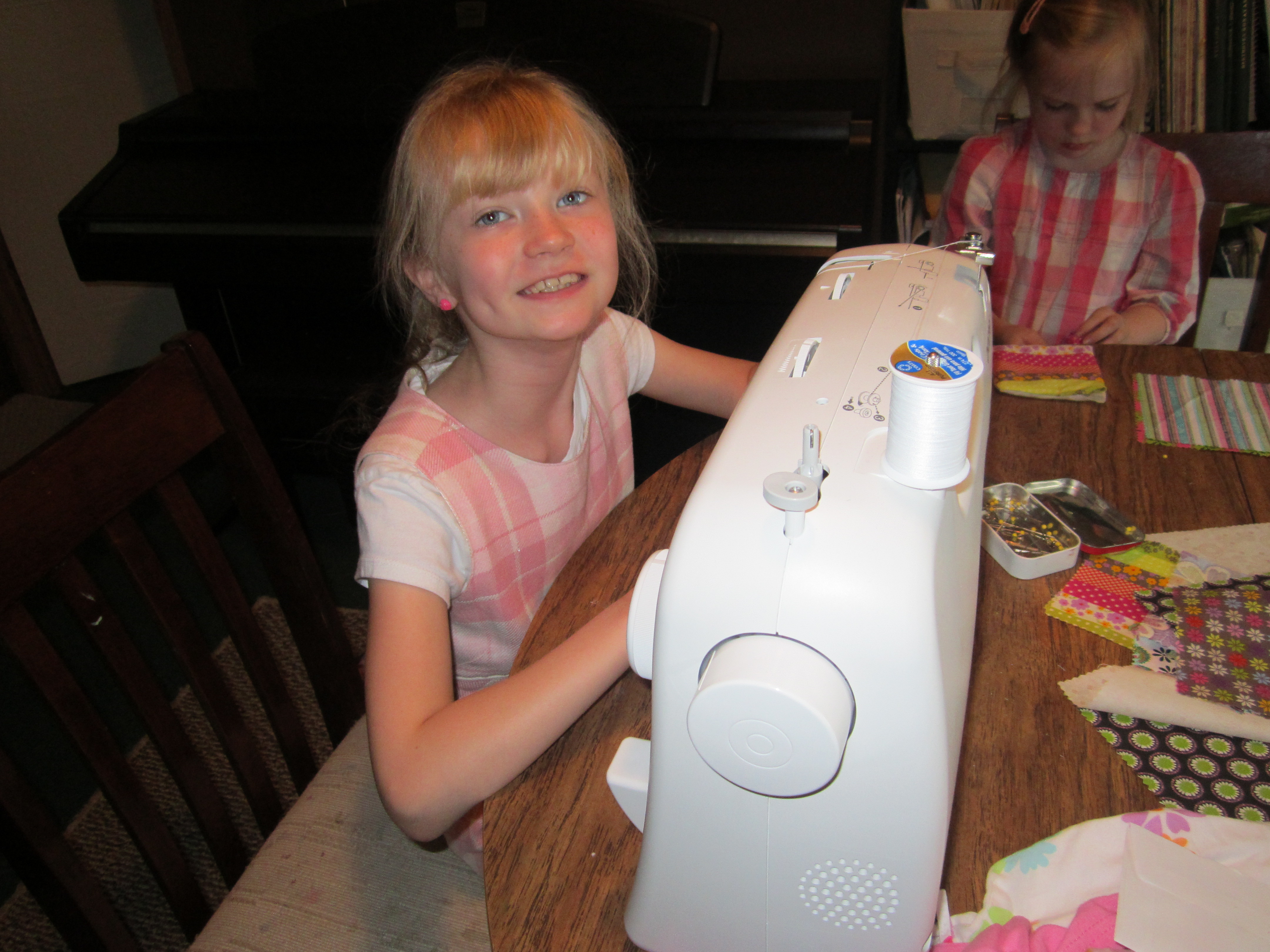
….Pulling out the sewing machine on Mother’s Day and spending hours pinning and running the fabric through the machine and then hand-stitching the corners.020

….Pressing the trowel down deep in the dirt, pushing away the soil with fingers and sinking the herbs deep down, and then fingering the buds on the miniature roses, on the echinacea, counting the un-ripe strawberries and giving up because of the abundance.

….Walking a mile and breathing in the air, hearing for the first time that day the sound of the birds and smelling the mown grass and the roses in bloom.

….Finishing that book, filling in the crossword puzzle, reading the Bible un-rushed without a to-do list to beckon.

This is how my Shepherd leads me, knowing and loving this non-napping sheep as He does: “He makes me lie down in green pastures, he leads me beside quiet waters, he refreshes my soul.” (Psalm 23:2-3 NIV).

And yes, that’s doing, but it’s resting.  It’s deep soul rest for me, the kind where I see beauty, and I create and know God as Creator, and I take time long enough to catch the slightest hint of His glory as He passes by.

Heather King is a wife, mom, Bible Study teacher, writer and worship leader.  Most importantly, she is a Christ follower with a desire to help others apply the Bible to everyday life with all its mess, noise, and busyness.  Her upcoming book, Ask Me Anything, Lord: Opening Our Hearts to God’s Questions, will be released in the Fall of 2013!  To read more devotionals by Heather King, click here.

Copyright © 2013 Heather King

“Facts” About Mom and “Facts” About God:

It seems to be a Mother’s Day staple for elementary school children.  Both of my older daughters made these projects and, according to my Facebook feed, so did the kids of most of my mom friends.002

On Mother’s Day, my daughters presented their handmade creations:  An ice cream cone picture with six adjectives to describe their sweet momma and a worksheet with “Facts About My Mom.”

Mostly as various moms posted their own kids’ responses to similar projects on Facebook, we laughed over the outrageous things kids say about us.

Like when they get our names wrong (!!!) or guess that we’re either 15 years old or 100.

But I opened the handmade gifts on Mother’s Day and didn’t read silly, mistaken or perhaps outrageously funny comments from my kids.

Somehow my daughters got it right.

Sweetly right, but maybe painfully right, too.

(Well, other than the “fact” that I’m probably 20 feet tall and probably weigh 45 pounds.  That’s a little off.)

Yet there were other “facts,” too.

There was the objective data, of course.  Adjectives to describe her mom?  “Married” and “pregnant” made it on the list.  Undeniable truth.

My other girl included “musical, gardener…..and competitive.”

What second grader diagnoses her mom as “competitive?”  My girl.  The one who has heard me apologize for my struggle to her face, and the one I held close while confessing how wrong I was to fret and worry over foolish competitions and how sorry I was that I ever put even one ounce of pressure on her shoulders when I’m so proud of her just as she is.

What does your mom like to wear?  Pants and a sweater.

Simple and sweet truth-telling right there.  Those are my happy clothes.

What is something your mom always says?  Do your homework.  Play piano.  Hurry up.  Go to bed.

Oh, here I pause.  Because last year on this same little assignment, she wrote that her mom always says, “I love you.”  And now here it is in pencil on paper, how I’m always giving instructions, always directing, always focused on getting those daily tasks done.  Why is it so hard to make the words, “I love you” ring truer and louder than the drill sergeant commands of everyday necessity?

What makes your mom mad?  When everything is out of control and no one listens.

When everything is out of control…..

Yes.  Isn’t that what smashes down all of my hold-it-together personal strength? Isn’t it what makes me grumpy, short-tempered and anxious?

When I feel like I’ve lost control so therefore there must be no control, always forgetting that God is in control…. yes, that’s what makes me “mad.”  That’s what God uses to plow right through my heart and break up all of that well-tended ground covering over my insecurities and my deep-down sin attitudes and misplaced trust.

Second graders can be so wise at times.

But I wonder, given a worksheet like this, what would I say about God?

Would I get the “facts” right and answer the questions correctly?  Not giving the dictionary facts or the Bible study answers.  Not the good church girl responses or the pat Christian phrases that tie Mighty God up in neatly packaged paper with a perfect bow on top.

No: Would I know Him?  Would I know His heart?  What makes Him happy?  What makes Him mad?  What do I love about Him the most and why is He the perfect Father for me?

Or would I get it all wrong?

In the book of Job, one man lost family, friends, servants, status in the community, riches, property, and physical health.  And without sinning, he questioned God.  Why this seeming injustice, he wondered, why this tragedy and pain for a righteous man?

Job wants to call God into court and question Him on the witness stand.

Yet, God remains silent.  He waits.  He listens and doesn’t answer. Finally, after almost 40 chapters of Scripture, God speaks.

In her book Wonderstruck, Margaret Feinberg writes,

Instead of focusing on the Why’s of our life circumstances, God calls our attention back to Him and reminds us of the Who that controls everything (p. 37).

That’s God’s answer to the incessant questions.  He never answers “Why,” but He tells who He is in one thundering declaration of sovereignty and power over all creation after another.Wonder Struck

It isn’t until the taking away, the sorrow, the mourning and the grief that Job doesn’t just know about God; He knows Who God is.

And that is enough.

Job says, “I know that you can do anything, and no one can stop you” (Job 42:1).  Yes, now he knew, not about God, but now He had seen God with his own eyes (Job 42:5).

Intimacy in silence.  Intimacy in the listening, the waiting, the mourning.  That’s how we know Him, too.

Heather King is a wife, mom, Bible Study teacher, writer and worship leader.  Most importantly, she is a Christ follower with a desire to help others apply the Bible to everyday life with all its mess, noise, and busyness.  Her upcoming book, Ask Me Anything, Lord: Opening Our Hearts to God’s Questions, will be released in the Fall of 2013!  To read more devotionals by Heather King, click here.

Copyright © 2013 Heather King

A Prayer for When You Just Don’t Know

Years ago, a mom-friend of mine flopped onto the big blue couch in my living room and confessed, “I feel like all I do all day is tell my kids what to do and how to do it.”

I nodded my head knowingly and sympathetically and absolutely had no idea what she was talking about.  At the time, I had a baby less than a year old.  Our conversations usually went like this, “Momma loves you.  You’re so sweet.  Where’s your nose?  Oh, you’re so smart.”

And then she’d respond with, “Mama” or something else equally superior and I’d just know we had connected and that she was a genius bound for great things.

But now I’m older and my kids are older.  One day at dinner I remembered the words of that mom and realized that she could be describing my life.

Wash your hands before you eat.  Use soap!  Sit like a lady.  Talk like a lady.  Eat like a lady.  Chew with your mouth closed.  Use a napkin.  Don’t spill your milk.  Clean up the milk you spilled.  Clear your place when you’re done eating.

Brush your teeth.  Up and down.  Front to back.  Don’t forget your tongue.  Brush every single tooth.  Don’t leave globs of toothpaste in the sink, on the wall, or on the floor.  Hang up wet towels.

Don’t hit your sister.  Don’t yell at your sister.  Don’t manipulate your sister.  Don’t push your sister. Don’t boss your sister.  Don’t roll your eyes at your sister.  Don’t tattle on your sister.

Do your homework . . . neatly.  Take pride in your work.  Practice the piano.  Study your memory verses.  Put your shoes away—shoes and socks do not live in the middle of the kitchen floor.

At times it feels like we’re prepping kids for the standardized tests of life and that means covering table manners, relationship skills, character issues, faith lessons, and more.

This isn’t just about the Mom-life.  Teachers, church leaders, aunts, grandmas, big sisters, small group leaders and more all have speeches we’ve mastered and a curriculum to cover.

But what if we miss something?  What if there’s a question we don’t know how to answer?  What if we get it wrong and miss out on cultivating one of their gifts or fail to correct a character weakness?

Oh, how I have collapsed onto my knees under this responsibility in the past and now again for one of my daughters.

Because I just don’t know.

I don’t know what to say and when to say it and when to hold my tongue.  When do I punish, let it go, reward?

Samson’s parents prayed the same prayers I’ve been groaning out in confused desperation.

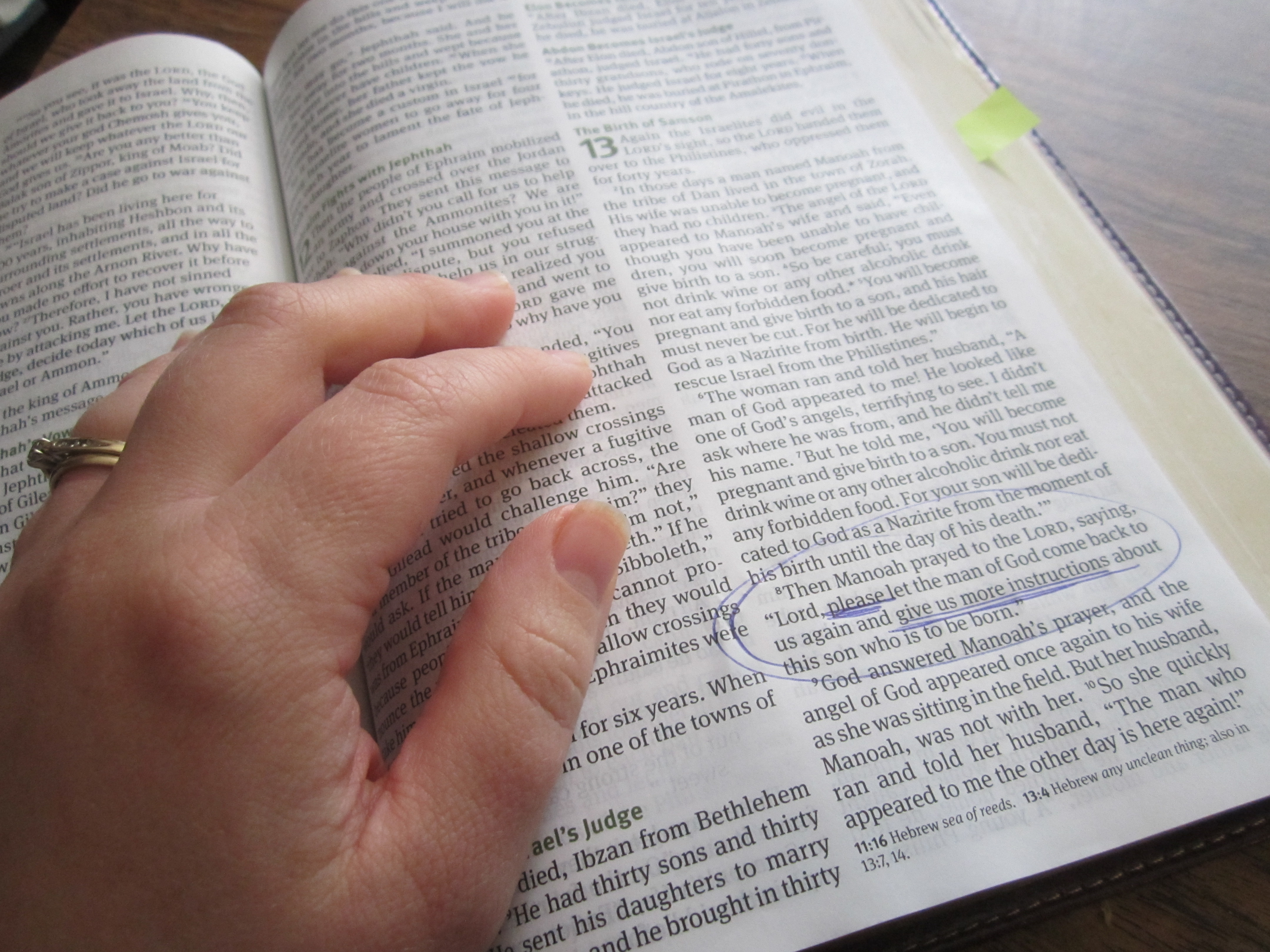
In Judges 13, an angel of the Lord appeared to the wife of a man named Manoah to announce that she’d no longer be childless.  She would have a son and he would be set apart for God from the very beginning as a Nazirite—no alcohol, no cutting his hair, nothing unclean.

God had a plan for Samson: “He shall begin to save Israel from the hand of the Philistines” (Judges 13:5).

What a promise, and yet how overwhelming for two first-time parents to wonder: “What if I mess this up?”prayer Bible

So, Manoah “prayed to the Lord and said, ‘O Lord, please let the man of God whom you sent come again to us and teach us what we are to do with the child who will be born’” (Judges 13:8 ESV).

Yes, this is how my prayer crams into words:  “Teach me what to do because You know and I just do not.  I could read every parenting book and follow every tip and strategy in every parenting magazine and every idea on every awesome mom-blog and still get this so terribly wrong.”

God answered Manoah’s prayer, returning to visit with this young mom and dad and instruct them on the Care and Keeping of Samson.

So, I pray with the deepest confession of weakness and need, “God, I’m clueless.  I don’t know where to begin.  I don’t know how to get it all done.  I don’t know where to go or how to make this happen.  Please teach me.”

And when we come to Him, all overwhelmed and fully aware of our own insufficiency and weakness, He answers. He sees that purity of our heart’s request: Our deep desire to steward these gifts He’s placed in our hands, the way we’re not flippantly shuffling through every day with inattention and unconcern.

Our God:

leads the humble in what is right and teaches them His way (Psalm 25:9 HCSB). 

Yes, He has:

heard the desire of the humble; You will strengthen their hearts. You will listen carefully (Psalm 10:17, HCSB).

On days when we’re clueless, moments when we just don’t know, this is the promise we need.

Heather King is a wife, mom, Bible Study teacher, writer and worship leader.  Most importantly, she is a Christ follower with a desire to help others apply the Bible to everyday life with all its mess, noise, and busyness.  Her upcoming book, Ask Me Anything, Lord: Opening Our Hearts to God’s Questions, will be released in the Fall of 2013!  To read more devotionals by Heather King, click here.

Copyright © 2013 Heather King

Garden Devotions–It’s Crowded In Here

Originally published April 27, 2012

My daughters and I reached a compromise.

I announced that I didn’t want to grow a vegetable garden this year.  It was too much work for too little result.  It didn’t save money.  It started out fun in April and ended up a horrible, rotten, ugly chore by the middle of July.  Various ravenous insects destroyed and devoured my plants.

Their response was unanimous.  “But Ma—awm.  We like to grow our own food.”

So we narrowed down the lists of vegetables we would grow and planted a container garden on our deck.

We filled large wooden crates with garden soil, vegetable food and the tiny plants of tomatoes, cucumbers and peppers we had chosen.  Then we dropped the carrot seeds into the dirt, following exact directions on how far down to push them and how far apart they needed to be spaced.

After a while my daughters disappeared to work on their own project. They held out the result to me with pride.  It was a small planter with dirt in it.

“We planted radishes,” they announced, “all by ourselves.”

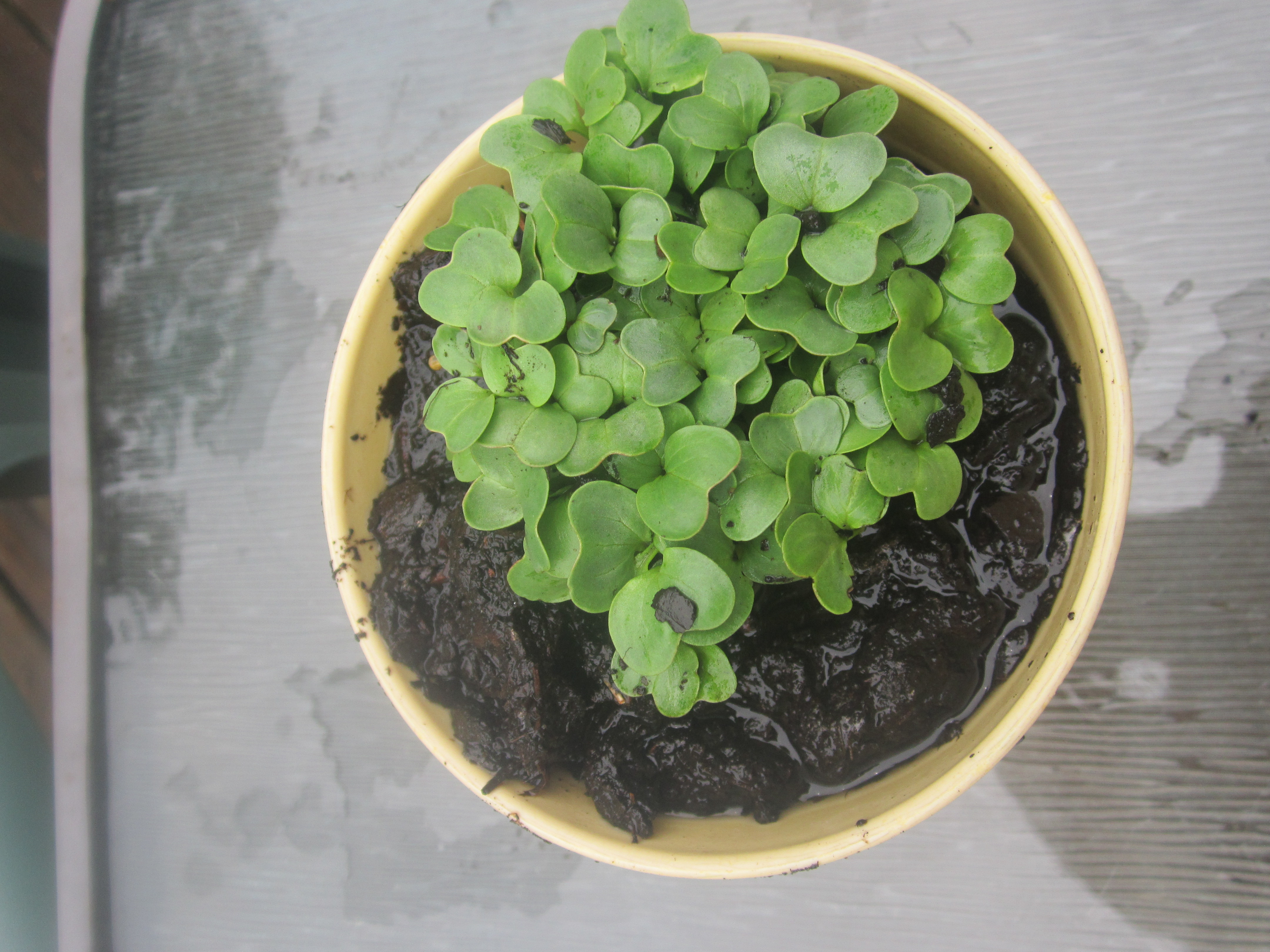
I shrugged.  The radish seeds were leftovers from last year.  It seemed unlikely they’d grow.  Yet, the girls faithfully watered that pot for days and surprisingly they were rewarded by the first hints of green.

A day later, the pot was crowded by infant radishes.  The girls must have dumped 20 seeds all into the same tiny space in the miniature pot.

It was going to be really crowded in there.

Unfortunately, even though it is hard and a little sad, we now have to make some tough choices.  If all the radish plants remain in that pot, none of them will grow correctly.  Some of them have to come on out of there.

Sometimes our lives are just as crowded as that tiny radish pot.  Every single seedling may have potential for beauty, growth, and produce, but nothing can grow when they are all shoved into the small space of one simple life and the restriction of 24-hour days.

Even though it’s hard and a little sad, there are times when some things have got to go so that other areas of your life can grow to their full potential.

It’s not always a mystery when choosing what to toss.

When Jesus walked into the temple and saw the vendors hocking their wares–doves for sacrifices and loans for people needing money for their offering–He responded immediately.  It didn’t take a second’s thought for Jesus to overturn their tables and chase the mercenaries out of the holy space of the temple courtyard.

He threw out sin, contaminated worship, and the profanation of the holy.

As soon as Jesus cleared the place, the blind and the lame came to him at the temple, and he healed them” (Matthew 21:14).

The only reason they could seek healing in the temple, the only reason there was room for the blind and lame to worship, was because Jesus had thrown out the tainted and unholy.

The Message emphasizes this when it says, “Now there was room for the blind and crippled to get in.”

Until Jesus cleaned house, there hadn’t even been room in the temple for those who needed God the most.

Will we allow Jesus to overturn the tables in our heart where sin and the unholy have set up shop?  Will we clear out the trash and the disgusting, so that we have room to come to Jesus—and to bring others along who need Him the most?

Of course, it’s not always so easy to tell what has to go in our lives.  We have a million choices of how to invest our time, energy, talents, and money, and all of them could be good.  We could lead hundreds of crusades against a world of evil.

But if we crowd out our lives with too much that is good, nothing will grow as it should.

Jesus Himself exhibited the kind of focus we need, to hone in on our purpose and refuse to be distracted by every demand and need.

During His ministry, mobs of people sought out Jesus for healing, and He frequently healed those who sought out His help.

But He didn’t heal everyone.

In fact, when the crowds grew too large and people sought Him out for healing alone, He moved onto another town or escaped the masses to pray alone on a mountain or by the sea.

Healing was fine.  Miracles were part of His ministry.  But it was not His main purpose for coming and He never wanted that to be the focus of His presence.  Instead, He had come to “seek and to save the lost” (Luke 19:10) and “to save the world” (John 3:17).

Maybe it’s time for you to pull out some of the extra radishes from your pot.  The first ones to go are easy—yank out the sprouts of sin, the unholy habits and the remnants of the flesh life.

Then prayerfully ask God to help you focus.  What seedlings should you tend and invest in until you harvest their potential?  What seedlings need to be set aside so that other areas of your life can grow?


Heather King is a wife, mom, Bible Study teacher, writer and worship leader.  Most importantly, she is a Christ follower with a desire to help others apply the Bible to everyday life with all its mess, noise, and busyness.  Her upcoming book, Ask Me Anything, Lord: Opening Our Hearts to God’s Questions, will be released in the Fall of 2013!  To read more devotionals by Heather King, click here.

Copyright © 2013 Heather King

What I’m Complaining About…

I’ve been trying to teach her just to say, “No, thank you.”

It’s simple.  It’s polite.

Really, I don’t need an Oscar-worthy performance every time I serve mashed potatoes.

“EEEEEWWWWWW.  I HATE potatoes.  They are GROSS.  This is DISGUSTING.  Don’t put ANY on MYYYY plate!”

I’m beginning to wonder if the child has ever even eaten a single potato.  I have this sneaking suspicion that she just screams about hating potatoes because she’s decided to hate potatoes and because the rest of the family happily eats them.

The complaints are always prolonged, noisy, and accompanied by a pantomime of a wrinkled nose and contorted face.  When she’s really inspired, she might even gag a little.  Just for effect.

I’ve gone the spiritual route with her.  “Do everything without complaining and arguing,” I quote (Phil 2:14 NLT).

Everything?

Yes, everything.

Eat potatoes without the side show?

Yes.  Or at the very least, give a simple “no, thank you,” as you pass the potatoes on to the next person.

So far, that has been unsuccessful.

So, I tried the empathy route.

How would it feel if you shared something you made and people publicly whined and complained for at least 5 minutes about how terrible it was?

The empathy route isn’t working either. Lately, she’s taken to shrugging her shoulders and lying to my face: “I wouldn’t care.  My feelings don’t get hurt like that.”

Right.  Whatever.

But the spiritual route and the empathetic route work for me.  Her mealtime complaint festivals make me realize just how grating and ungrateful whining really is.

And unfortunately, I’ve been thinking about how often I’m the one doing the complaining.

We all have our weaknesses, the things that set us off and the people who get stuck listening to us complain.

You can ask my husband to be sure, but I don’t think I’m a complaining wife, per se.  It’s not really like me to nag or pester or pick him apart and I don’t really complain about him.

But it might be to him.

And it’s usually about truly annoying things:

Like the dentist’s office forgetting to send reminder cards out about our appointments so I completely forgot when I had to drop everything else in my insanely busy schedule to get my teeth picked at by sharp metal objects.

Like our house phone and Internet connection constantly cutting out on me at the most inconvenient times.

Or the store not keeping their shelves stocked so week after week after week I go to buy what I need and it’s not there AGAIN and how hard is it anyway to order more of something when the shelf is empty for goodness sake?!

Things like that.

Too often, though, we’re fooled into thinking that as long as our complaints are justified, then they’re allowed.  Or that “venting” is acceptable, even if it involves calling friend after friend not for wisdom or prayer, but so they can fuel our anger and annoyance.

It’s complaining, but it’s justified complaining.  That’s how we explain it.

Yet, when I’m being honest, I have to confess that if I’m continually complaining …then I’m a complainer.

And when we think about the negative and talk about the negative, pretty soon all we can see is the negative…in people, in life, in situations.

God knows that sometimes life is painful.  We’re not always complaining about grocery store shelf-stocking policies or bad drivers.  Sometimes our hearts are filled with deeply painful disappointment, even betrayal.

And He’s not asking us to fake it or shrug it off our shoulders and paste on happy-faced masks.

But he does ask that we bring it to Him.

Like David, we don’t complain about everything and we don’t complain to everyone around us.  Instead, we drag that cumbersome burden of cares and troubles to the feet of the only One who can carry it for us:

I cry aloud to the Lord;prayer
I plead aloud to the Lord for mercy.
I pour out my complaint before Him;
I reveal my trouble to Him.
Psalm 142:1-2

Maybe we need a trusted friend or counselor (or husband) at times to listen well, but “they should not be where we go first” (Linda Dillow, What’s It Like to Be Married to Me?)

We run to God before any other, and even when we bring these needs to Him, C.H. Spurgeon reminds us:

We do not show our trouble to the Lord that He may see it, but that we may see Him.  It is for our relief and not for His information, that we make plain statements concerning our troubles.

When I’m complaining, is it just to be heard?  Or is it so I can see God more clearly in my circumstances?

I can’t truly say that all my complaining is an invitation for God to show me His glory,

But, oh Lord, may it be so today.

Heather King is a wife, mom, Bible Study teacher, writer and worship leader.  Most importantly, she is a Christ follower with a desire to help others apply the Bible to everyday life with all its mess, noise, and busyness.  Her upcoming book, Ask Me Anything, Lord: Opening Our Hearts to God’s Questions, will be released in November 2013!  To read more devotionals by Heather King, click here.

Copyright © 2013 Heather King

My Addiction

Originally posted April 13, 2012

“So here’s what I want you to do, God helping you: Take your everyday, ordinary life–your sleeping, eating, going-to-work, and walking-around life–and place it before God as an offering” (Romans 12:1, MSG).

I love routine.

I plod around my house each morning with my eyes barely open, doing the same tasks I did the day before. I follow a schedule day by day, week by week.

Each night, I drink a cup of hot tea in one of my favorite mugs before I go to bed.  Every night.  Summer, winter, makes no difference.

So, a few weeks ago when my whole schedule was off and it was far too late for a reasonable cup of tea before bed, I felt a little shaky and definitely “off.”  I couldn’t do it.  I couldn’t settle in under the covers and turn out the light without at least a few sips from my teacup.

It’s not that I’m a tea addict. 

I’m a routine addict.

Given my love for the routine of daily life, I was not at all surprised when my six-year-old brought me a neon orange paper that read (and I quote):

Lauren:003
eat Breckfest
Brush teeth
Go to school
Play Victoria’s games
Play hide and seek
eat lunch
watch TV
take a Nap
eat Dinnr.
Brush teeth
Go to bed

The basic reality of daily life, of routine, and of the mundane is that we all live it in some way or another—me in my adult world, my daughter in her child world.

We commute to work.  We go to school.  We walk the dog.  We make phone calls.  We volunteer.  We give baths and make dinners.  We run errands.  We clock in; we clock out.

There’s beauty in the resurrection appearances of Jesus as He invited himself into the daily and mundane routine of the disciples. 

Sure He appeared to them in the upper room where they were gathered for worship and prayer. That’s to be expected.

But then He did something unexpected.  He showed up on the shore of the Sea of Galilee and watched them wrestle with fishing nets and bring emptiness up from the water.

Yes, Jesus went to their workplace.

Early in the morning, maybe as the first flickers of sunlight skipped over the Galilean waters, Jesus called out to his tired friends.  They didn’t recognize his voice; he was just some curious bystander sticking his nose into their own personal business, giving them instructions as if He knew more about fishing than they did—a bunch of expert fisherman.

He told them to “‘Throw your net on the right side of the boat and you will find some.’ When they did, they were unable to haul the net in because of the large number of fish” (John 21:6).

That’s when they recognized the Lord.

In A Year With Jesus, Eugene Peterson wrote:

“Work that was futile apart from Christ becomes successful in His presence . .. Your resurrection life, Lord Jesus, is like a sunrise in work that has lost meaning and in routines that have become pointless.  Whatever my work today, I will do it in the recognition of Your presence and under Your command” (p. 594).

and

“The resurrection transforms Monday work as much as Sunday worship” (p. 596).

Jesus made it clear in those 40 days following His resurrection that He wasn’t just looking to be part of our sacred lives and in the religious moments we schedule on the calendar.

He wanted us to live with a curious mesh and entwining of sacred and secular, where He’s with us during every part of our day.

He sets our routine.  He is our routine.  He shakes up our routine.  He designs our routine. He redesigns our routine.

You’d think we fairly intelligent people could get by on our own living out our daily lives.  But, I’ve decided that I can’t and I’m okay with that.

That’s why you’ll find me in the Wal-Mart parking lot once a week with my head bent low in the few minutes before I exit my car.  It’s because I’m a mess on my own—making stupid decisions about what to buy and what not to buy, forgetting what I need, falling for advertising gimmicks and sales tricks, traveling back and forth across the whole store because I forgot something on my list, making a list and then leaving it in my car or at home, trying to use outdated coupons and failing to use perfectly good coupons that I spent perfectly good time cutting out.

Why should God care about my budget and my meal plan for the week and for the items on my list and my own personal sanity?  Because He loves me, that’s why.  Because the grocery store is where I lay out my nets and hope for an abundance of fish.

You have your own Galilean place, where Jesus is trying to invite Himself and where He’s waiting to give you input and advice.

Perhaps it’s the routine that makes you feel so comfortable and that you think you can handle all on your own.  Perhaps it’s the place you feel most capable and expert.  Maybe it’s a place where you experience failure and emptiness.

You haven’t seen abundance until you’ve felt the blessing of His presence in the midst of your routine.  It’s time to invite Him into the boat with you.

You can read more devotionals on this topic here:

Heather King is a wife, mom, Bible Study teacher, writer and worship leader.  Most importantly, she is a Christ follower with a desire to help others apply the Bible to everyday life with all its mess, noise, and busyness.  Her upcoming book, Ask Me Anything, Lord: Opening Our Hearts to God’s Questions, will be released in November 2013!  To read more devotionals by Heather King, click here.

Copyright © 2013 Heather King

More Than a Spoonful of Sugar

I keep checking the tickets that I printed off weeks ago.  Do I have the day right?  The time?  Have I forgotten something?

Every time I unfold the creased sheets of paper and read over the details, I’m amazed by God.  Really and truly in awe.

It started with such a simple thing, the Broadway show, Mary Poppins, coming to good old Virginia twice in four months.

The first time I missed it.  Life was too crazy, too expensive, just too much.  But I dared to hope and even just pray a little around Christmas time this tentative request:

Lord, I know this isn’t something I need and I do need other things instead and this is crazy and extravagant.  I’m not even asking that my whole family gets to go.  If you could just maybe provide the money for two tickets for me and my husband, that’d be awesome.  Or even one ticket; that’d be okay.  Maybe I could go with a friend?  And I understand if you say, ‘no,’ because I know it’s a silly thing anyway.

It felt so selfish to even ask.  Normally I stick to the basics: car repairs, bills, car tax payments…that kind of thing.

But then we received unexpected Christmas money, enough to pay for exactly five seats to see the Broadway show for my whole family.marypoppins-1-1024x768

I had sheepishly asked for one ticket.

God gave me five.

And I’m struck by this kind of extravagant grace, the way our God loves to bless His children, enjoys giving them good gifts, promises to give us what we need and then sometimes just indulges us in the whims and desires of our hearts.

Why then, knowing His character, do I treat Him like such a stingy Scrooge of a God so often?  I hesitate to even ask him for another coal for the fire.   I avoid His gaze and stammer out requests as if I’m a burden, a pest, and ashamed to even ask.

Even when it’s a Need and not a Want, I pray and ask, but give Him an out, not truly trusting that He will do this, that He could do this, that He would want to do this for me.

“Well, I guess if you don’t provide it’s just Your will and Thy Will Be Done,” that’s what I pray in a sort of hyper-pious acknowledgment of His sovereignty without any confidence in the might and mercy of His character.

But what would have happened if blind Bartimaeus had been hesitant about his need, reluctant to ask, limiting his request and thereby limiting his Savior?

Jesus asked him, “What do you want me to do for you?”

“Lord, I want to see,” he replied.

Bartimaeus didn’t try to give Jesus an easy out.  “Lord, I’d like to be a little less blind than I am.  Jesus, if you could just correct my vision a little bit I’d at least be able to walk around.  Could I see in just one eye?  Could you maybe provide me with a guide or seeing eye dog to help me out?”

No, Jesus asked what he wanted and Bartimaeus wanted to see—see all the way.

And Jesus didn’t just open his eyes to the minimum amount necessary to just barely survive.  He made the blind man see, truly see, 100%, abundantly, without reservation or drawback…see.

Sometimes our God tells us “no,” out of love and His infinite wisdom. He’s no over-indulgent parent giving into the whims of spoiled children.  And He’s no prayer request vending machine, automatically dispensing answers indiscriminately to whoever puts in the coin.

But there are times it just gives Him so much joy to give us not just the daily bread, but the Krispy Kreme as a special treat.

Paul wrote:

In him we have redemption through his blood, the forgiveness of sins, in accordance with the riches of God’s grace that he lavished on us (Ephesians 1:7-8 NIV)

and

Observe how Christ loved us. His love was not cautious but extravagant. He didn’t love in order to get something from us but to give everything of himself to us. Love like that (Ephesians 5:1-2 MSG).

He’s no miser, this God of ours, rationing His gifts to us and frowning grumpily when we need….or even sometimes when we want.  And while we trust His “no” when He declines a request, one of the reasons we trust His love and best intentions for us is because “no good thing does he withhold from those who walk uprightly” (Psalm 84:11 ESV).

If He knows it’s good, it blesses Him to give it.

And it blesses us to receive it as the lavish, rich, and extravagant grace it is, not what we deserve or have earned, but what He has given anyway simply because He loves.

Heather King is a wife, mom, Bible Study teacher, writer and worship leader.  Most importantly, she is a Christ follower with a desire to help others apply the Bible to everyday life with all its mess, noise, and busyness.  Her upcoming book, Ask Me Anything, Lord: Opening Our Hearts to God’s Questions, will be released in November 2013!  To read more devotionals by Heather King, click here.

Copyright © 2013 Heather King

Sorrow, Disappointment and Leaving the Valley

She had bounced out of bed that morning and sprinted across the house to tell me the news, “It’s morning time!  And I feel all better!”

I scooped her up in a hug and felt her forehead.  The day before, my three-year-old had spent all afternoon on the sofa, mostly asleep, periodically waking to chatter cheerfully and then drifting back into dreams moments later.

Now here she sat on my lap a day later, placing a headband in her hair and showing it off so I could tell her how pretty it looked.

And she said, “This is what I’m going to wear to the birthday party.”

That’s when I had to tell her the news.  Yesterday while she had been sleeping away the sickness, we had slipped out the door quietly for the birthday celebration.

And she had missed it.

I broke it to her as gently as I could, explaining how she had been sick, reminding her of other special days.

Yet, disappointment is full of sorrow, even when it makes sense, even if you understand why it all happened, even if you know there will be other days and other opportunities, even when you’re deep down truly okay.

Still we feel the sadness over loss.

For a three-year-old, it’s missing out on a birthday party because of a fever.  She covers her face with her hands, crying to me as I comb my hand through her hair and gently pat her back because she “really wanted to go.”

For us, it could be that or so much more.  It’s disappointment in ourselves and the mistakes we make, so much foolishness, words that we speak without thinking, sins, habits, failings, misjudgments and mis-steps.

Or it could be disappointment in God for not sticking to THE plan (AKA “our plan”) or for the deliverance that delays or seemingly doesn’t come.

Or maybe it’s disappointment with others and how they’ve let us down or wronged us or hurt us in ways we carry as scars long after the initial injury.

Disappointments can’t be erased completely.  My girl missed that party and there’s no conjuring it up again or transporting through time to relive the moment.

So it is for us.  The past is the past and there it is.

Yet, God is a redeeming God: Redeeming our circumstances even when it’s our own foolish fault for being in this ugly mess….reminding us of His perfect plans far surpassing our imperfect schemes…renewing our hope even when all we see at the moment is hopelessness.

This is what God promised to do for His people in the book of Hosea, as they wallowed in this disappointment—knowing it was their own disobedience that led to captivity, feeling hopelessly lost and uncertain about the future.

God said:

Therefore, I am going to persuade her,
lead her to the wilderness,
and speak tenderly to her.
  There I will give her vineyards back to her
and make the Valley of Achor
into a gateway of hope.
There she will respond as she did
in the days of her youth,
as in the day she came out of the land of Egypt.
(Hosea 2:14-15 HCSB).

valley2

That Valley of Achor is something we know; all of us have walked those paths of shadows.  It means “Valley of Trouble,” the lonely walking beneath the mountains, barely touched by light, unable to see over the peaks, feeling oh so very far from rescue or escape.

Yet our God so gently promises to take that Valley of Trouble and do what our transforming, redeeming God always does—make it “into a gateway of hope.”

After all, He knows the pathway out of disappointment.

He knows what encouragement our hearts need.

He knows sometimes we need to sob for a moment and express the sadness and then move on with our day, looking for new joy rather than dragging along that regret like a chain holding us captive to the past.

He knows we may need to shake that burden of shame, recrimination and regret right down off our back and to just let…it…go already.

Yes, God can transform whatever valley of trouble or disappointment you find yourselves in.  He is indeed always a God of Hope (Romans 15:13).

But we have to look up to see the change. 

If we’re trudging along with our eyes fixed on the ground of the valley, we’ll never see it become a Gateway of Hope, never see that there’s a way out, never notice that suddenly it’s beautiful and freeing and maybe not the end of the world it felt like just a moment ago.

Valleys always look like endless valleys until we look up and notice we’re free.

Heather King is a wife, mom, Bible Study teacher, writer and worship leader.  Most importantly, she is a Christ follower with a desire to help others apply the Bible to everyday life with all its mess, noise, and busyness.  Her upcoming book, Ask Me Anything, Lord: Opening Our Hearts to God’s Questions, will be released in the Fall of 2013!  To read more devotionals by Heather King, click here.

Copyright © 2013 Heather King

Help!

They say knowledge is power, but language has its own particular potency.

After all, when you can finally cram all of your emotion, thoughts, and need into one or two perfect words, it helps relieve the pressure.

It was true for my oldest daughter when she was still wobbling between baby and toddler.  My job as a mom was to help harness some of her passion, help her direct some of that God-given strength—all by showing her how to put into words what she needed and how she was feeling.

But at little more than one years old, what is there to say?

So I taught her one powerful word to capture my attention instead of tantrums, screaming  514885-R1-24-24fits, and bouts with hysteria that turned her face red and plain wore mommy out.

“Help!”

When you can’t figure out the puzzle, when the toy isn’t working, when you can’t reach, when your buttons won’t fasten….. when life is difficult and you just can’t do it on your own and you’re collapsing into rage and tears of frustration and failure….”Help!” is all you need say.

It quickly became the favorite, most oft-used word in her vocabulary.  “Help, Mommy” I’d hear all through the day.

What I failed to teach her, though, was how to gauge the seriousness of the situation and adjust the volume and tone of her “help” accordingly.

Thus, friends on the phone would hear my little one screaming “Help! Help!” at the top of her lungs when all she needed was the top yanked off a marker or a new outfit buttoned on her baby doll.

I can’t say I’ve figured it out any more than she did, when to scream out “help” in desperation and when to quietly lift my hands high for assistance, when to whisper hushed pleas for intervention and when to just sob and let the Holy Spirit intercede for me.

But I know that sometimes, maybe lots of the time, what I need is help.  It’s not any more complicated than that.  I can pray at God (or nag at Him) for hours; I can explain and complain, whine and appeal.

Really, though, “Help” would do just fine.

The Psalmist knew this.  He asked, “I lift up my eyes to the mountains—where does my help come from?” (Psalm 121).

It’s a traveler’s Psalm, a song of ascension sung by the Israelite pilgrims on their journey to Jerusalem to worship.  The Psalmist literally lifts his eyes higher and higher along the skyline, a reminder of just how small he really is—just a regular guy on a valley trail beside the vastness of a mountain’s peak.

So, where to look for help?  To nature, to fellow travelers, to the material goods he’s packed neatly into his bags for the journey?  To false gods who weren’t even mighty enough to create the very mountains in his view?

No, he declares, “my help comes from the Lord, the Maker of heaven and earth” (Psalm 121:2).

God formed these very mountains.  He’s so grand, so magnificent, so creative, so capable. All of these other idols I’ve been looking to are weak, helpless, disappointing, and distracting. 

And if I’m screaming out for “help” or dropping to my knees in a confession of weakness, it’s a God that mighty I need to answer.

And He does answer.  That one word, “help,” always gets His attention.

The pilgrims explain it in metaphors from their journey.  How does God help?

He will not let your foot slip—
he who watches over you will not slumber;
  indeed, he who watches over Israel
will neither slumber nor sleep.

The Lord watches over you—
the Lord is your shade at your right hand;
  the sun will not harm you by day,
nor the moon by night.

Protection from scorching heat and the coolness of night, the rocks along the path and the obstacles in the road; this is what God gives them.  This is what He gives us.

In the original Hebrew, the Psalmist pushes His point in verses 7 and 8, saying essentially: “The Lord is your protector! The Lord will protect you from all harm! The Lord will protect your life! The Lord will protect your coming and going now and always!” (Beth Moore, Stepping Up).

Our translations soften the repetition, saying instead

The Lord will protect you from all evil;
He will keep your soul.
The Lord will guard your going out and your coming in
From this time forth and forever.

But the intent  of the repetition is to say it so clearly and so often, to repeat it so much that even a forgetful, wayward, worrier of a soul like me can’t miss this promise:

The Lord Will Protect You.

We only need lift our eyes to His face and ask for His help.

Heather King is a wife, mom, Bible Study teacher, writer and worship leader.  Most importantly, she is a Christ follower with a desire to help others apply the Bible to everyday life with all its mess, noise, and busyness.  Her upcoming book, Ask Me Anything, Lord: Opening Our Hearts to God’s Questions, will be released in the Fall of 2013!  To read more devotionals by Heather King, click here.

Copyright © 2012 Heather King