Remembering: I’ve Fallen and I Can’t Get Up

Hi all!  I’m still enjoying time away with my family and am just logging on to share an old post with you about prayer initially and fervently about all things—without worrying and fretting first.  Enjoy!

********************************************************************************************

I’ve Fallen and I Can’t Get Up!

Originally posted on August 19, 2011

“Three times a day he got down on his knees and prayed, giving thanks to his God, just as he had done before” (Daniel 6:10)

Bam!
Waaaaaaaaaaaaaaa!
Thump, thump, thump, thump, thump.
Sniffle, sniffle, sniffle.
Mom!  Mom mom!!

With my genes, my girls didn’t have much of a chance at grace and my baby girl is no different. So these are the sounds heard in my home multiple times any given day.

It’s the immediate reaction of any child to trouble, the crying out to mom and the running to her side to tell her all about the tragedy and pain.

There’s little I can do most of the time to fix the problem.  My baby’s fallen and hurt (maybe even angry) and while I can’t change the fact of her fall and no Band-Aid is going to alleviate the temporary soreness, I can kiss her, cuddle her close and tell her I love her. And so I do.

Then I fall down, tripping over my own sin, or another person who invaded my space, or an obstacle I didn’t foresee, or an unexpected pit in my road.

To whom do I run?  What is my immediate response, my instantaneous reaction to pain?  What is yours?

For some, it’s to hold our bruises close for a while and to snap at any bystanders who offer to help us stand back to our feet.  Maybe even hide our heads in embarrassment for the spectacle of the fall in the first place.

For some, it’s to call out for help from those nearby, asking them to both hoist us up and even bear the burden of our weight for a while as we wobble around on a weakened leg.

For some, it’s to haul out our own first aid kit and apply ice and bandages to our own wounds and refuse the expert care so readily available.

For some, it’s to sit without moving, paralyzed by fear.  What if our leg is broken?  What if we never walk again?  What if . . . what if . . . what if . . . ?

In Beth Moore’s study, Daniel, she notes how his immediate response to the king’s edict prohibiting prayer was to go “to his upstairs room where the windows opened toward Jerusalem. Three times a day he got down on his knees and prayed, giving thanks to his God, just as he had done before” (Daniel 6:10).

He didn’t worry first and then pray.  He didn’t try to fix the situation through his political abilities and then pray. He didn’t even concede defeat and stop his public prayer habits, choosing instead to silently petition God at night while others slept.

Daniel prayed.  It was his initial reaction; it was his only solution.

Then there’s the matter of what he prayed.  Sure, some of us have indeed trained ourselves to “take it to the Lord in prayer” without hesitation.  We run to his side and bury our noses in the hem of His robe, sniffling out our requests to Him.  But are we giving thanks amidst those tears?

Daniel was.  Scripture says he “got down on his knees and prayed, giving thanks to God” (Daniel 6:10).  When I’m smarting from an injury, I’m more likely to complain about the pain than sing hymns of thankful praise.

Not Daniel. Political enemies, a manipulated king, a dangerous edict, his faith attacked, his life on the line—still Daniel gave thanks.

Paul made the same connection when he wrote,

Do not be anxious about anything, but in every situation, by prayer and petition, with thanksgiving, present your requests to God. And the peace of God, which transcends all understanding, will guard your hearts and your minds in Christ Jesus (Philippians 4:6-7).

Peace in the midst of pain is there for the taking sometimes, and yet we choose anxiety instead.  We opt for fear by trying to control our own problems rather than running to God’s side and dumping them at His feet.  We allow worry to reign in our hearts and minds by refusing to pray with thanksgiving at all times and in every situation.

I confess I’m a rebel at times.  Even though I know I should shove aside my grumbling and choose to be thankful—even when it takes struggling and squinting to see that sparkle of light in a dark place– still I decline.

I dusted off my thankfulness journal this morning after two weeks of shoving it aside. I didn’t want to be thankful.  I wanted to feel wronged.  I didn’t want some secret formula to maintaining joy in trials; I wanted no more trials!  I wanted God to feel pity for me and feel sorry for letting me be hurt.  Perhaps what I wanted was an apology from Him.

It’s like emotional manipulation of the Almighty God.  “I’m not going to praise You or worship You or give You thanks or hand over my fears to You until You rescue me in the way I desire.”

It’s handing God a sheet and pillow and pointing to the couch.
It’s ignoring His phone calls and giving Him the silent treatment at the dinner table.
It’s holding my breath until he gives me what I want.

And it’s just about as effective as all those tactics.  So when my tantrum is done, I pray and I give thanks.  Reluctantly at first, perhaps, and yet I try.  Maybe the next time I trip and fall, I pray with thanksgiving immediately because I have learned that gratitude shifts my focus off my need and onto the face of my Deliverer.

Heather King is a wife, mom, Bible Study teacher, writer for www.myfrienddebbie.com and worship leader.  Most importantly, she is a Christ follower with a desire to help others apply the Bible to everyday life with all its mess, noise, and busyness.  To read more devotionals by Heather King, click here.

Copyright © 2012 Heather King

Once in a Lifetime

“The soul is nurtured by beauty.  What food is to the body . . . pleasing images are to the soul” (Thomas Moore, Care of the Soul)

I grew up not far outside of Washington, DC.  At the time, a $5 Metro fare and a 20 minute train ride opened up a world of free museums and monuments.

I could easily Metro in just to see one exhibit at the Folger Shakespeare Library or spend a day slowly walking the halls of the National Gallery of Art or meandering through the presidential portraits in the National Portrait Gallery.

We could day-trip in for the Cherry Blossom Festival exactly when the cherry trees around the Jefferson Memorial were in full bloom.

And I did all those things.

Everything was simply so accessible, so convenient, so inexpensive, and perfect for someone like me who finds these experiences to be spiritual and a refreshing deep breath for my soul.

Our Creator God designed beauty and placed in human hearts the longing to create beauty ourselves.  So, I worship God amidst art and architecture.

Yes, I had access to a spiritual retreat with little effort or cost and I didn’t even know it.

Then in middle school, we watched an episode of one of our favorite shows, Saved By the Bell.  The show’s heartthrob, Zack, desperately wanted to win a contest with a fabulous grand prize— a week-long trip to Washington, DC.

This was unimpressive to me.

Who chooses a grand prize that is just 20 minutes away from my house?  Why not Disney World?  Hawaii?  London?

Of course, we don’t often appreciate what we have, not until it’s gone anyway.

Now, I live just far enough away for a trip to DC to be inconvenient and easily deterred by a busy life and tired children.  A week-long trip to the city would be fabulous!

When we live close to something, when it’s easy, when it’s inexpensive and effortless, it’s easy to overlook it’s value, becoming complacent and unappreciative.

That’s true about time in God’s presence, too.

For us, being with God is as simple as a one-sentence prayer while driving or singing praise songs while washing dishes.  When I’m worried, I pray about 100 times a day over one particular problem.

But it used to be far more complicated and rare than that.  In Luke 1, a priest named Zechariah was chosen by lottery to burn incense in the temple.

He won the grand prize.

Priests were the only ones who could perform this job, the only ones allowed beyond the outer area into the holy places before God Most High.

Even Zechariah, who God declares was “righteous in the sight of God, observing all the Lord’s commands and decrees blamelessly” (Luke 1:6) would only burn incense before the Lord once in his entire life.

One chance to be in God’s Holy presence.
One opportunity to stand before Almighty.
One moment of intimate communion with Him.

Beth Moore writes:

“The responsibility of the priest on duty was to offer a corporate prayer.  Furthermore, the priest’s intercession for the nation undoubtedly included a petition for the Messiah, Israel’s promised Deliverer and King” (Jesus, the One and Only, p. 4)

Zechariah prayed for the nation, prayed for a Messiah, and maybe, just maybe took his one and only chance before God and prayed for his own family’s brokenness.

He and his wife Elizabeth were childless and “very old” (Luke 1:7).  Their dreams for a family seemed hopeless now.

But an angel appeared in that private moment between God and this aging priest.  The angel said, “Do not be afraid, Zechariah; your prayer has been heard.” (Luke 7:12).

Which prayer?  The one for the nation?  For the Messiah?  For himself?

Yes to all of them.

He and Elizabeth became parents to John the Baptist, the forerunner of the Messiah, the hope of the nation.

One powerful moment in the Lord’s presence brought Zechariah the answer to all he had sought for so long.

If we only had one brief opportunity to be in God’s presence, how would we act and what would we do?  How would we worship and what would we request?

David knew exactly what he desired:

One thing I ask from the Lord,
this only do I seek:
that I may dwell in the house of the Lord
all the days of my life,
to gaze on the beauty of the Lord
and to seek him in his temple (Psalm 27:4).

God’s presence was his “one thing,” the deep longing in his heart.

Praise God that because of Jesus we aren’t limited to one single moment in God’s presence!

We have access to the throne of grace at all times and anywhere we go.  We have the Holy Spirit dwelling in us, communing, comforting, counseling, teaching, convicting and bringing peace.

But let’s not let easy access breed complacency.  Let’s treat our times with God as precious as they really are, remembering that it is only because of Christ that we can come before God at all.  Let’s thank Him for the that.

Heather King is a wife, mom, Bible Study teacher, writer for www.myfrienddebbie.com and worship leader.  Most importantly, she is a Christ follower with a desire to help others apply the Bible to everyday life with all its mess, noise, and busyness.  To read more devotionals by Heather King, click here.

Copyright © 2012 Heather King

Weekend Walk, 06/30/2012: Life in Slow Motion

Hiding the Word:

Five puzzles, six books (or more), one game of Memory, word searches, and some tricycle training . . .

That’s what happens when we lose power or Internet at our house.  Life slows down.  When a daughter appears with board game in hand and a pleading look on her face, I have no excuse to give, no busyness to distract, nothing to prevent me from sitting  . . . and playing . . . and resting with my kids

I complain and whine with the best of them about the loss of conveniences and comfort and I’d prefer running water with temperature control and the ability to cook meals and refrigerate food any day of the week.

But a day without email and the telephone . . . well, that’s a welcome vacation sometimes.

So, after an unexpected extreme thunderstorm hit our area last night, I’m thinking about rest and all that it means and I’m choosing a verse to meditate on this week that compels me to be refreshed in Christ.

“Then, because so many people were coming and going that they did not even have a chance to eat, he said to them, ‘Come with me by yourselves to a quiet place and get some rest'” (Mark 6:31).

In Jesus: The One and Only, Beth Moore notes that “the original word for rest in this verse is anapauoPauo means “to cease, give rest.”  Guess what ana means?  “Again!”  We don’t need this kind of rest just once.  We need it again and again” (p. 116).

And again  . . . and again . . . and again.

Weekend Rerun:

The Holy Act of Doing Dishes

Originally posted on September 2, 2011

You will seek me and find me when you seek me with all your heart.
Jeremiah 29:13

A week ago to the day, I was escaping the mundane and the daily to retreat to Women of Faith.  Even with the interruption and distraction of a hurricane, I managed to get away for one of the intended two days and it was uplifting, encouraging, and challenging.

I walked away from that trip with some verses and thoughts that I’m deeply weighing, considering and praying through.  It’s trite to say that a conference or speaker or book “changed my life.”  Yet, it happens all the time.  I read a new perspective and alter my behavior.  I listen to a speaker and adjust my thinking.

Life-changing events can happen more often than we realize.  Shouldn’t we be transforming daily into the image of God’s Son? Life changes don’t necessarily require “bigness.”  It’s not just choosing whom to marry or deciding to change careers that qualifies.  Instead, it means trimming this, discarding that, washing away this, and adding that so every day we’re making the changes that bring us one step closer to Jesus.

So, I can truly say that the speakers at Women of Faith this year changed my life.  And so did being without power for 5-1/2 days following Hurricane Irene.  And so has having the power restored last night. I’m different today than I was a week ago.

You see, last Thursday I was longing to escape from the repetitiveness of my everyday—the dishes, the laundry, the sweeping and mopping, the cleaning up and vacuuming and more.

Today, I was thanking God all morning.  For what?

For safety in the storm, surely.  But also that today I can wash my dishes with running water and a dishwasher.  And I scrubbed my counters with a rag dumped in soapy water instead of a Clorox wipe.  I vacuumed instead of picking up large pieces of child-debris by hand.  Praise God for the chance to vacuum!  All morning I have listened to the humming and spinning of the washer and dryer.  I’m thankful that I can use these machines to give my family clean clothes.

If only they had a machine to fold the clothes and put them away.  But, that’s another story . . . and probably heaven.

I truly believe in the value of spiritual retreating.  Christ Himself called His disciples away from the crowds and busyness of their lives to spend time with him alone.  Often, Jesus would send His disciples on ahead of Him while He remained to pray alone long into the night.

Sometimes we need to go away, to escape all that distracts us here so we can fix our attention on Him there.

And then the real work begins. Meeting God when we have set aside time for Him is expected.  We listen to speakers, we pray, we worship, or maybe we even head for a private retreat into the mountains where we pour out our hearts to Him and then sit in silence as He speaks to us.

We anticipate seeing God in the specifically designated portions of our lives we call “Spiritual” and the times we have set aside as “Holy.”

Then we must return to the daily life in all its mundane activity and we must carry into that everyday behavior all that we learned in the holy moments we had set aside.

Can mopping the floor be spiritual?  Can folding clothes be a God-moment? Can doing dishes be part of my quiet time?

If we deny Him a place in the mundane day-to-day life, confining Him instead to a corner of our hearts designated “God stuff,”  then we miss Him and what He’s doing in us and through us.

It’s what the prophet Jeremiah wrote: “You will seek me and find me when you seek me with all your heart.”  Not spiritual heart pieces and holy corners, but all that is in our heart searches after God.

Naaman almost missed finding God.  He was a big-shot, who commanded the army of the king of Aram.  “He was a great man in the sight of his master and highly regarded, because through him the Lord had given victory to Aram. He was a valiant soldier, but he had leprosy” (2 Kings 5:1).

Hearing about Elisha the prophet, Naaman traveled to him to receive healing.  Elisha didn’t even come out of his house to meet with the big, important army commander.  Instead, Elisha sent out a messenger with some simple instructions: “Go, wash yourself seven times in the Jordan, and your flesh will be restored and you will be cleansed.”

This was so . . . .basic.  So unimpressive.  So nonspiritual.  So, “Naaman went away angry and said, ‘I thought that he would surely come out to me and stand and call on the name of Lord his God, wave his hand over the spot and cure me of my leprosy” (2 Kings 5:11).

Naaman wanted a magic show with special effects rather than an order to take seven baths in the Jordan.  But, his servants challenged him: “My father, if the prophet had told you to do some great thing, would you not have done it? How much more, then, when he tells you, ‘Wash and be cleansed!’” (2 Kings 5:13).

A few dips in the Jordan later, Naaman’s leprosy was totally healed.  All because he obeyed God in something simple and unimpressive.

If we have our eyes set only on the spectacular, we will miss God’s healing and cleansing work in our everyday lives.

Will I manage to keep this perspective over time?  Probably not.  I will likely grow weary and burdened with the stresses of daily busyness.  I’ll need to retreat again, stepping away from it all to focus solely on God.

But then I’ll come back home where dishes and laundry and homework is what happens here and that, yes even that dailyness, changes my life bit by little bit.

Heather King is a wife, mom, Bible Study teacher, writer for www.myfrienddebbie.com and worship leader.  Most importantly, she is a Christ follower with a desire to help others apply the Bible to everyday life with all its mess, noise, and busyness.  To read more devotionals by Heather King, click here.

Copyright © 2012 Heather King

Weekend Walk, 06/09/2012: Searching for Water in the Desert

Hiding the Word:

For the last few days, we’ve been waving at each other from the rear view mirror of our cars.

At least that’s how it feels.  My husband is performing in a show for the next two weeks.  The girls and I have been flitting here and there to concerts, day trips, birthday parties, doctor’s appointments and more.  Plus we’ve started rehearsals for a show of our own.

I kiss my husband goodbye in the morning before he grabs his bagged lunch from the counter.  The next thing I know, I’m waking up to the sound of his car pulling into the driveway past my bedtime.

It’s okay.  It’s temporary.  His show will end.  Our summer groove will settle into place.  We’ll have other weeks of craziness, but nights of rest as well.

But just for today, just for this moment, I am thinking how nice it would be to chat with him about his day and talk about how all this whirlwind of life is going.  If we could talk without children interrupting, fighting, or protesting their bedtime routine, even better.

It’s why I would have failed as a Navy wife–my need for the continuance of connection.  One night without the phone call after his work day, one day when he’s up early and home late, and I miss my husband.  I make determined efforts to sit by his side and hear what happened in his life that day.

Because if you don’t make the time, it generally doesn’t just happen on its own.

How long can you go before you miss God?  How many days can slip past before you feel the void of His presence and mourn the loss of connection with Him?

If we’re walking in intimacy with our God, shouldn’t we miss Him the moment we’ve started a day without prayer or the instant we’ve flown past our quiet time?

On the busiest days, when a snack (preferably chocolate) and mindless television seem the answer to my tired body and exhausted mind, that’s exactly when I long for God the most. Because if I don’t make the time, it doesn’t just magically happen.

It’s the day when I missed my afternoon cup of tea over Scripture because I’m out and about with frenetic activity that I flop into my dining room chair in the first moments after my kids’ bedtime.  I take one long indulgent sip sweet hot tea, open up my Bible and pray, “Dear Jesus, how I’m desperate for You today.  Pleas meet me in this place.”

Since life is crazy, I’ve chosen a verse for the week that reminds us all of how desperately we should seek after intimacy with God:

O God, you are my God;
    I earnestly search for you.
My soul thirsts for you;
    my whole body longs for you
in this parched and weary land
    where there is no water
(Psalm 63:1 NLT)

This time with God isn’t a luxury.  It’s not a bonus, an extra, an amenity, or a perk.

It’s life itself.  It’s as simple as desperation for water for a soul in the desert.

Let’s seek Him earnestly this week, making it an active and engaged pursuit of His presence.  Making it a priority, not just nonchalantly hoping a few minutes of unstructured time will show up in our day.  Because if we don’t make it happen, it never will.

Weekend Rerun:

Well-Hunting in the Desert

Originally posted on July 20, 2011


“Water will gush forth in the wilderness and streams in the desert. The burning sand will become a pool, the thirsty ground bubbling springs”
(Isaiah 35:6-7).

When we first moved into this house, we quickly discovered something unnoticed during the walk-through or inspection.  The water smelled like rotten eggs. As a result, I was brushing my teeth with bottled water and holding my breath while taking a shower.

Like any good 21st century homeowners, we Google-searched our way into solutions and scoured the Internet for answers.  Which we found.  Simply open the top of our well and shock the water with a $1 jug of bleach.

Sounded easy.  Until we realized that somewhere on this half acre of land is the top to a well that we could not find.  We knew it had to be there.  We had running water and didn’t pay the city for it.  We consulted drawings of our property and sheepishly hinted to the water specialist (whom we had to call since we couldn’t fix the stinky water ourselves, having not found the well), that we really would like to know where the well was hidden on this land of ours.  He wasn’t helpful.

We have a guess as to where it might be, but we are in some ways still well-hunters, searching for the source of our water, assuming its presence without seeing it ourselves.

I’ve been well-hunting recently in real life, too.  Like Hagar, wandering in the wilderness, running low on provisions, hopelessly lost and not able to go back and yet not certain where to go instead. Out there in her wilderness, “God opened her eyes and she saw a well of water” (Genesis 21:19).

“Open my eyes,” I’ve prayed, “to the well of your provision, to the fountain of Your presence, to the water of sustenance and hope. I want to see the well You have provided in this desert place.”

Because I’m parched and yet I feel like I’m drowning.

It’s so often God’s way to bring water and with it so much more to those in His care.

To Hagar, a well in the desert that she hadn’t seen before.

To Elijah, “bread baked over hot coals, and a jar of water” to sustain him on a 40-day walk to the Mountain of God (1 Kings 19:6).

To the Israelites who complained, “there is no water to drink!,” He brought forth water from rock.

For the redeemed, He promises that “water will gush forth in the wilderness and streams in the desert. The burning sand will become a pool, the thirsty ground bubbling springs” (Isaiah 35:6-7).

To the woman sitting next to a well with a jar on her shoulder, Living Water drawn up even without a bucket (John 4:10).

Out of nothing, amidst wilderness and desert, even burning sand, He brings water that heals, sustains, provides, and gives life eternal.  He brings it in abundance with bubbling springs, streams filled so quickly that they are pooling, water we could drink that would satisfy us forever.  All out of nothing.

We could spend our lives sitting by clear-running streams of water, never risking the travel through the valley.  We could pitch our tents there by the known source of water and never lose sight of the well, never grow uncomfortable, never walk far enough away to be uncertain of provision, never venture one step into the wilderness.

But we’d never make it to the Mountain of God like Elijah and the Israelites.  Never know the God Who Sees like Hagar.  Never know the Giver of Living Water like the woman at the well.

So, as we scan the horizon and see only barren land, rocks of gray and dusty earth cracked from lack of rain, we search for the well.  It’s there.  Maybe hidden now so that we cannot see, but God works in the hidden places to bring us provision at the exact moment of our need.

David searched for the well in the desert.  He wrote:

“You, God, are my God, earnestly I seek you; I thirst for you, my whole being longs for you, in a dry and parched land where there is no water” (Psalm 63:1).

and

“As the deer pants for streams of water, so my soul pants for you, my God.
My soul thirsts for God, for the living God” (Psalm 42:1-2)

David, my fellow well-hunter, knew the best way to find the hidden water, even when his soul was downcast, even when he thirsted for God’s presence like a deer dehydrated after too long a journey away from the stream.

  • Put your hope in God.
  • Praise Him even in sorrow.
  • Remember what God has done.

He says: Why, my soul, are you downcast? Why so disturbed within me? Put your hope in God, for I will yet praise him, my Savior and my God.  My soul is downcast within me; therefore I will remember you (Psalm 42:5-6).

Years ago, Caedmon’s Call sang these words: “Down in the valley, dying of thirst.  Down in the valley, it seems that I’m at my worst.  My consolation is that You baptize this earth when I’m down in the valley.  Valleys fill first.”

Valleys fill first, my friend.  When God brings the water, when He rains down “showers of blessing” in their season (Ezekiel 34:26), the valley is where you will want to be so that you can fully receive all that He pours over your head.

Heather King is a wife, mom, Bible Study teacher, writer for www.myfrienddebbie.com and worship leader.  Most importantly, she is a Christ follower with a desire to help others apply the Bible to everyday life with all its mess, noise, and busyness.  To read more devotionals by Heather King, click here.

And the Answer Is . . .

Fear and trembling come upon me, and horror overwhelms me . . .But I call to God,
    and the Lord will save me.
(Psalm 55:5, 16)

I failed my driver’s test at least twice.  I say “at least” because I might have blanked out and actually failed it three . . . possibly four times.  It’s hard to say.  It’s enough to tell you that I still refuse to parallel park 16 years later.

So, when a friend of mine in college said that sometimes he just needed to drive, I didn’t get it.  Driving was stressful for me, parking even more so.  For him, though, it was like therapy.  Overwhelmed and overcome, he’d just cruise down the highway with an unimportant and undefined destination.

Today, for the first time, I understood.  Kissing my older girls goodbye and waving to them as they left on the school bus, I walked my toddler to the minivan and helped her into her seat. Then we drove.

As a mom, I’ve generally lost all control over the music in the car, so I let my two-year-old sing for a while about numbers, pirates, monkeys and queens.

Then I announced, “Mommy’s turn” and flicked a switch, only to hear:

Send me a sign: a hint, a whisper
Throw me a line ’cause I am listening
Come break the quiet; Breathe your awakening
Bring me to life ’cause I am fading . . .

Shine Your light so I can see You
Pull me up, I need to be near You
Hold me, I need to feel love
Can You overcome this heart that’s overcome?
{David Crowder *Band singing SMS (Shine}

That’s when I knew why I was driving.  Just like my friend, I was overwhelmed and overcome.

It’s been one of those seasons of ministry and of life when you’re surrounded by death, cancer, divorce, adultery, abuse, child custody battles, the loss of babies, alcoholism, financial crisis, and unemployment.  I’ve been praying for many miracles these days.

In her book, Knowing God by Name, Mary Kassian wrote about El Oseh Phela or The God Who Works Wonders, focusing on the fact that “The Lord brought us out of Egypt with a mighty hand and an outstretched arm, with great deeds of terror, with signs and wonders” (Deut. 26:8). 

She notes the phrase “outstretched arm . . . implies a work not yet fully completed–a work in progress.  The image of a mighty hand and an outstretched arm illustrates that God is intentionally involved in history on an ongoing basis” (p. 66 emphasis mine).

It’s part of God’s character, His name, a promise based on who He is that He sometimes chooses to deliver us with all of the glory of signs and wonders.  And it’s now, not just thousands of years ago for Moses or Joshua, for Elijah and Daniel.  It’s for us, too, which gives me hope when I’m praying for “impossible” requests.

Yet, at times we’re looking for the fireworks, lightning bolts, and parting seas of miraculous intervention, only to overlook the answer He’s already given to our prayers of desperation—through the ministry of others.

That’s why God fed Elijah once miraculously with food carried in the claws of ravens and then fed Elijah miraculously through the generosity of the widow of Zarephath (1 Kings 17).  It was God’s way of meeting Elijah’s needs and blessing the widow at the same time by allowing her to be part of God’s activity.

Sometimes we are the miracle God is sending to another.  We are the blessing He has offered; we are the provision; we are His answer to the tearful prayers in the night.

Not that it’s because of our own ability or volition.  It’s God’s generous way of allowing us to be used in service and His gracious method of linking people together, knowing that we need the connection and relationship that it brings.

At the start of this year, I read Billy Graham’s book Nearing Home and I wrote this in a devotional:

We tend to give when it’s convenient.  We often make decisions based on what’s practical.  We give what we can afford.  We get together when we’re “free.”

But Jesus served others when it was inconvenient and impractical.  He skipped meals, changed plans, took the long way around, gave up time away for those who needed Him and died to save them.  He didn’t stay up on the cross for the sake of a theology or a plan.  He did it for love of people.

My husband said, “often what is important isn’t what’s practical” in our relationships with others.

So, this year I want to major on the important, even if it’s impractical, hard, or downright crazy.”

Starting in my own home and moving out from there, I’m challenged again to follow Christ’s example and make people my priority and passion.

The Message says it this way:

Those of us who are strong and able in the faith need to step in and lend a hand to those who falter, and not just do what is most convenient for us. Strength is for service, not status. Each one of us needs to look after the good of the people around us, asking ourselves, “How can I help?” That’s exactly what Jesus did. He didn’t make it easy for himself by avoiding people’s troubles, but waded right in and helped out” (Romans 15:1-4 MSG)

Maybe we’re praying for God’s intervention in situations and it really is going to take His mighty hand and outstretched arm to deliver.  But maybe we’re praying for the miracles and God’s already given the answer . . . and the answer is us.

So, I’m ending today with the words to another of my favorite songs, a prayer of sorts for God’s people to love people.

Where there is pain, let us bring grace
Where there is suffering bring serenity
For those afraid, let us be brave
Where there is misery, let us bring them relief
And surely we can change . . . Something
(David Crowder *Band, Surely We Can Change)

You can watch the video for SMS (Shine) by clicking here or by clicking on the image from the blog.  Please take the time to watch and listen today!!!

And here’s the link to Surely We Can Change.

You can read other devotionals on this topic here:

Heather King is a wife, mom, Bible Study teacher, writer for www.myfrienddebbie.com and worship leader.  Most importantly, she is a Christ follower with a desire to help others apply the Bible to everyday life with all its mess, noise, and busyness.  To read more devotionals by Heather King, click here.

Copyright © 2012 Heather King

Who’s In Charge Here?

I drafted the letter carefully.

Nope, that’s not the word.

I drafted the letter meticulously, cautiously, prayerfully, thoughtfully, and s-l-o-w-l-y. I read it over in my head at least 20 times.  It took me about an hour to type out two paragraphs on my computer and I drank a whole cup of tea in the process.

Then I walked away.  Than I came back and read it again.  I changed some things.  Then I walked away.  Then I impulsively printed it up and signed my name, slipped it into an envelope, and addressed it.

Then I placed it in my dayplanner instead of the mailbox and carried it around for a while.

It was a letter to the principal of my daughter’s new school.  I wrote it last August and finally threw it away last September.

To say that I was stressed and worried over my daughter’s first year in the public school would be an award-winning understatement.  I asked every mom I knew with kids at that school who they thought should be my daughter’s first grade teacher.

Nine out of ten moms agreed that I needed to request one particular teacher to ensure my girl’s success and happiness.

In fact, I wasn’t really just thinking about first grade.  I was thinking about the power of this one teacher to encourage or destroy a love for learning FOR LIFE.  She could ruin my daughter’s entire educational future, career path, and self-esteem or she could positively influence my girl in ways that led to life-time motivation and success.

So, I explained in my letter to the principal how special my daughter was and how smart and how sensitive and how based on this teacher’s reputation in the community, I thought she would be the best fit to guide my daughter in her first grade year.

I kept trying to send the letter, really and truly.  But then I’d get that same nagging feeling—Did I trust God to take care of my girl or not?  Who did I really think was in charge of her development, character and future?  Me?  A principal?

Or God?

It was terrible to feel powerless over a decision of such magnitude.  I hate when the future of me or my family seems to depend on the choices of someone else.

And it so often seems that way, doesn’t it?  How much of your life seems to rest in the hands of others?

The human resources lady who decides whether to offer you the job.
The boss who determines whether you get a raise or promotion.
The lawyer who decides how to argue your case.
The judge who decides how much time you spend with your kids and how much time your ex does.
The church leadership who decide how you minister.
The committee that accepts or rejects your idea.
The loan officer who determines if your credit is good enough.

And so it goes.  Everyone making decisions everyday about our own personal life, and not arbitrary meaningless decisions either.  Big decisions that have real impact.

I finally decided to trust that if God wanted my daughter in a particular classroom, He could make that happen.  He could even direct the decisions of the principal.

So, we arrived at Open House at the end of August, all of us a little jittery and overwhelmed.  Stepping up to the table for people with last names starting with A through K, we waited to hear the big news.  Who was going to be the magical first grade teacher who would hold my daughter’s future in her hands?

The very teacher I wanted.  There was never any need to write that letter.  God had already made the decision for me and directed the path of those in charge.

Now that the school year is ending, I’ve already begun the inevitable fretting over next year’s teacher.  This never gets easy, does it?  The lesson that God is in control is a perpetual one.

David asked a tough question in the Psalms:

  The Lord is on my side; I will not fear.
    What can man do to me? (Psalm 118:6 ESV).

What can man do to me?  I’ll tell you what!  Fire me.  Pick the wrong teacher for my kids.  Pass judgment against me in a courtroom.  Put me on a bad work schedule.  Make my life miserable.  Cut off my funding.  Shut down my ministry.  Slice my paycheck.

It may seem that way at times, but David was right–there’s no need to fear.  Solomon explained why when he wrote that:

The king’s heart is a stream of water in the hand of the Lord;
    he turns it wherever he will (Proverbs 21:1).

God can direct the heart of a king if He chooses and set the course of a principal and open the eyes of a judge.

Because He alone is God.  No one else is or should be lord over our lives or god over our circumstances.  Scripture admonishes us to:

“know therefore today, and lay it to your heart, that the Lord is God in heaven above and on the earth beneath; there is no other” (Psalm 118:6 ESV).

He is God.  There is no other.  Your life isn’t in the hands of anyone but Him and while life isn’t always easy or perfect, we can trust that He’s in control and He’ll care for us and guide us at all times.

Heather King is a wife, mom, Bible Study teacher, writer for www.myfrienddebbie.com and worship leader.  Most importantly, she is a Christ follower with a desire to help others apply the Bible to everyday life with all its mess, noise, and busyness.  To read more devotionals by Heather King, click here.

Copyright © 2012 Heather King

Weekend Walk, 04/28/2012

Hiding the Word:

We had plans. Big plans.

It was pirate weekend in Yorktown Virginia and the annual book sale at our public library.  Add in my niece singing the lead role in an opera, church, and a birthday party and you had a full weekend.

It was inevitable, I suppose, that after two of my daughters spent time on the couch this week with fever and vomiting that the third would get sick, as well.  I sent her to bed Friday night with the beginnings of a fever.

This morning, she emerged looking bedraggled and ill and asking, “Do you think I’m better yet?”

Her skin, fire to the touch, clearly said otherwise, but I humored her with a thermometer test.  103 degrees.  “No, babe,” I said, “you’re pretty sick.”

Then there were the tears of disappointment, trading in a weekend of fun for a weekend of ginger ale and napping.

It’s one of those lessons you just can’t learn often enough in this life–that you can plan and schedule and postulate, but God has the prerogative to interrupt your agenda and alter your plotted course at any time.

Even when you know it’s for the best, that His design for you is better than you can imagine and what ultimately comes to pass is for your good, still it’s nonetheless disappointing in the moment.

For us, these interruptions are sometimes minor losses and daily annoyances; sometimes they’re the source of great sorrow and bitter grieving.

Regardless of their magnitude, we can all learn to pray as Jesus did, kneeling in the garden and submitting His will to the Father’s.

“Nevertheless, not my will, but yours, be done” (Luke 22:42b).

It’s the verse for this week, to contemplate and memorize.  Maybe it seems short, but it’s truth is powerful and perhaps a little painful.

Weekend Rerun:

He Rested

Originally Posted on April 26, 2011

“And God blessed the seventh day and made it holy, because on it he rested from all the work of creating that he had done”
(Genesis 2:3 ,NIV).

For months, one week in April glared off my calendar menacingly.  My husband and I focused all of our attention and energy on getting to that week and getting through that week—appointments, birthday parties, wedding, special church services, meetings, and holiday activities piled on top of our normal schedule.

I had the individual events in my calendar circled in different colors multiple times so that I wouldn’t overlook any one of them.   When people asked us about May, our eyes glazed over uncomprehendingly.  May?  What’s May?  As far as we were concerned, finishing April was the goal.

I’m sure you have weeks on your calendar that look like that, too, an overload of busyness, and you hold your breath in anticipation of it, stress when you think about it, and dream about making it through.

But then our week was done.  The last event finished.  We survived.  We drove home.  We rested.

It sounds so easy, really, to say “rest,” and yet for me rest takes great effort.

I’m physically incapable of napping.  Instead of sleeping, I lie awake thinking about all the things I should be doing instead of sleeping.  By the time I finally give up and throw back the covers in defeat, I’m frantic about the wasted time and move faster through my to-do list to make up for it.

I feel guilty for leisure, embarrassed by free time, and apologetic for fun.

Accepting help or taking a break feels like failure and an admission of weakness.

There’s something else at work here beyond just an addiction to adrenaline.  Oh, how I hate for it to be true, and yet digging down deeply enough reveals its ugly presence—-pride.  Truly, it feels good to be needed.  It feels important to be so busy.

When I run around in a breathless pace, doing, doing, doing all the time, I act as if the world depends on me to function, as if me sitting down for 15 minutes would create cosmic meltdown.

And that’s why God, from the very first week of creation, instituted a Sabbath rest.  It wasn’t for His benefit, as if the Almighty God who created a sun, moon, and planet with the power of His words grew weary and needed to sleep.  No, the Sabbath was not for God.  Instead, Jesus “said to them, ‘The Sabbath was made for man” (Mark 2:27).

He created a day of rest for you and me.  It’s a reminder that the universe can exist without our involvement and labor.  It’s a re-ordering of our perspective, so that we remember it is God who is essential and not us.

So often, we forget that our jobs, our families, our ministries, our relationships, our everything depend not on our ability, but on God’s power.
We stress about meetings because we think everything relies on how well we present ourselves.
We plot out conversations because we think the outcome depends on the words we choose.

We think.  We plan.  We do.  We fix.  We busy ourselves.  We worry.  We analyze.  We lose sleep.

God knows the pride that burrows itself into our hearts; the tentacles it wraps around us as we seek fulfillment in accomplishments, in tasks completed, in people depending on us.  I’ve written it before and yet need the reminder of my own words:

I’ve seen many women engage in Busyness Battles with each other.   We ask each other what seems like such a simple question, such as “What have you been up to lately?” or “Have you been busy?”  Then, like a Wild West shootout, we breathlessly list our every activity in an effort to “out-busy” the other woman.  The prize?  The personal pride that we are more stressed than the woman we are talking to.  Don’t be embarrassed to concede defeat and say, “Well, I’ve been focusing on de-stressing. On Sunday, I watched a movie with my family and then read some of my book.” You may have lost the shoot-out, but who wants the title of “Most Stressed Woman” anyway?

I read this week that Craig Groeschel, in his book Weird, recommends a to-don’t list.  It’s a tool for those like me who find inactivity takes effort, to help me choose sitting on the deck while my daughters color with sidewalk chalk over doing laundry or choose pushing my baby girl in her swing and listening to her giggles turn to belly laughs over planning church programs.

This isn’t about rules, regulations and law.  It isn’t about Pharisaical hypocrisy and legalism.  It’s about rest and rest is about a humble stepping aside and the placing and continual re-placing of God in control of our lives.

********************************************************************************************************

For further thoughts, check out:

Heather King is a wife, mom, Bible Study teacher, writer for www.myfrienddebbie.com and worship leader.  Most importantly, she is a Christ follower with a desire to help others apply the Bible to everyday life with all its mess, noise, and busyness.  To read more devotionals by Heather King, click here.

Copyright © 2012 Heather King

 

Broken Crayons And Other Things That Drive Me Crazy

Restore us, O God; let your face shine, that we may be saved!”
(Psalm 80:3, ESV).

Things that drive me crazy:

Procrastination, disorganization, messing with “the plan” and the schedule, slow pokes, Play Doh colors all mixed together, shoes and jackets dropped in the middle of the kitchen floor, crowds, wet towels left on the sink and toothpaste stuck to the bathroom walls, markers with no tops.

Oh, and something else, too: Broken crayons. Even worse, crayons with the paper torn off. I mean, if you rip the paper off, the crayons are more susceptible to breaking. Plus, it’s difficult to tell whether you are holding blue, purple or black in your hand.

It’s enough to give a mom fits.

When my kindergartener told me that Show & Tell this week needed to be something recycled or reused, we started brainstorming.  There was the orange juice carton we turned into a birdfeeder.  The paper towel roll my oldest daughter made into Snow White.  The Popsicle stick my middle girl turned into a pig.  The Mason jar painted over and made into a candle holder.

Or we could find something to do with those pesky broken and naked crayons that drive me so crazy.

Jackpot!

I spent this morning collecting the remnants of Crayola.  Once beautiful, bright, pointy crayons fresh from the box—now broken, bespeckled, faded, and unwrapped.

We filled a tray of heart-shaped silicone with the jumble of brokenness, melted the wax, cooled it and then popped out beautiful new rainbow heart crayons.

We made something fun, colorful, and unique out of the old, broken, and worn out.

God’s plan for restoring us in life is so often like melting down broken wax and transforming it into a uniquely colorful treasure with a beauty all its own.

We pray for restoration, hope for it, long for it with desperate hearts.  We need the fixing, mending, healing power of God in our relationships, in our worship, in our churches, in our sick and hurting bodies, in our grief, in our finances, and more.

David needed it emotionally and knew that the Lord His Shepherd, “restores my soul” (Psalm 23:3).  Later, He needed spiritual restoration after he committed adultery and murderer, as he prayed, “Restore to me the joy of my salvation” (Psalm 51:12).

What we usually long for in the midst of brokenness is full-circle restoration.  We want what we once had, what Satan took from us, or what we’ve lost along our journey.

That’s what Israel prayed for when they were beseiged, starved, and taken captive:  “Restore us to yourself, O Lord, that we may be restored! Renew our days as of old” (Lamentations 5:21 ESV).

Give us back the good old days!

And it seemed like that’s exactly what God did.  When Nehemiah returned to rebuild the ruins of the Jerusalem walls, he began at the Valley Gate (Nehemiah 2:13).  Then, 52 days later, they finished the job and celebrated with choirs, corporate praise, rededication, and a procession that marched out through the gates they had rebuilt, starting with what scholars believe was the Valley Gate.

In Nehemiah: A Heart That Can Break, Kelly Minter writes: “If God began Nehemiah’s journey at the broken Valley Gate and completed it at a restored one, we have reason to hope He will work with the same restorative power in our lives” (p. 151).

They had, after all, come full circle.  This surely renews our hope.

And yet, this wasn’t exactly the same as what they had lost, and that’s also reason to rejoice!  These were rebuilt walls, walls with a testimony.  They showed God’s faithfulness to His people, bringing them back from captivity and helping them rebuild their land.

The rebuilt walls in our lives are also a testimony of God’s faithful lovingkindness and mercy.  They can’t possibly be misunderstood or misinterpreted as walls pounded into place by our own ability and strength.

They are all about how God brought us back and helped us stand.

The best thing about God’s restoration is that He often does more than we expect.  We want the same as the good old days.  Many times, however, He gives us more than we had before or even something better.

He did this for Job, giving him “twice as much as he had before” (Job 42:10).

He does this for us, as Peter tells us:

“And after you have suffered a little while, the God of all grace, who has called you to his eternal glory in Christ, will himself restore, confirm, strengthen, and establish you” (1 Peter 5:10, ESV).

He doesn’t just give us back the pieced-together remnants of our past; He restores us in a way that makes us stronger, and He does it Himself, stitching us back together with His own patient hand.

God doesn’t give up on the broken crayons in our lives or toss away those of us who’ve come unpeeled.  He may melt us down and it may hurt, but He makes us new, beautiful, different, stronger, unique—restored for His glory and with a story to tell of His goodness.

Want to transform your broken crayons into something fun and new?  There are some great “recipes” online, including this one here.

*******************************************************************************************

I don’t just have things that drive me crazy.  Things can make me happy, too!  Like:

Family time, baking with my girls, heartfelt worship, chocolate, hot tea with sugar, time with God at my kitchen table, words that are fun to say, holding my husband’s hand, triple word tiles in Scrabble, honeysuckle candles, free concerts on the beach in the summer time, my daughters giggling, the smell of fireplaces burning in autumn air, pumpkins, my small group, crossword puzzles, the perfect coupon, Masterpiece Classic and Masterpiece Mystery, brand new pointy crayons, fresh Play Doh, the Beatles, comfy white socks, Dickens and Shakespeare, British comedies, when the lights dim and the play starts, listening to my daughters read, a blank computer screen and the clicking of the keys as I fill it up with words.

Heather King is a wife, mom, Bible Study teacher, writer for www.myfrienddebbie.com and worship leader.  Most importantly, she is a Christ follower with a desire to help others apply the Bible to everyday life with all its mess, noise, and busyness.  To read more devotionals by Heather King, click here.

Copyright © 2012 Heather King

My Addiction

“So here’s what I want you to do, God helping you: Take your everyday, ordinary life–your sleeping, eating, going-to-work, and walking-around life–and place it before God as an offering” (Romans 12:1, MSG).

I love routine.

I plod around my house each morning with my eyes barely open, doing the same tasks I did the day before. I follow a schedule day by day, week by week with shopping days, volunteering days, writing days, cleaning days, and such.

Each night, I drink a cup of hot tea in one of my favorite mugs before I go to bed.  Every night.  Summer, winter, makes no difference.

So, a few weeks ago when my whole schedule was off and it was far too late for a reasonable cup of tea before I climbed into bed, I felt a little shaky and definitely a little off.  I couldn’t do it.  I couldn’t settle in under the covers and turn out the light without at least a few sips from my teacup.

It’s not that I’m a tea addict.  I’m a routine addict.

It was late.  It was silly and ludicrous. I should have just plopped my head on the pillow and been done with it, but instead I stayed up an extra 15 minutes so I could sip at my tea just like I do every night.  It was wonderful, peaceful, calming, just right.

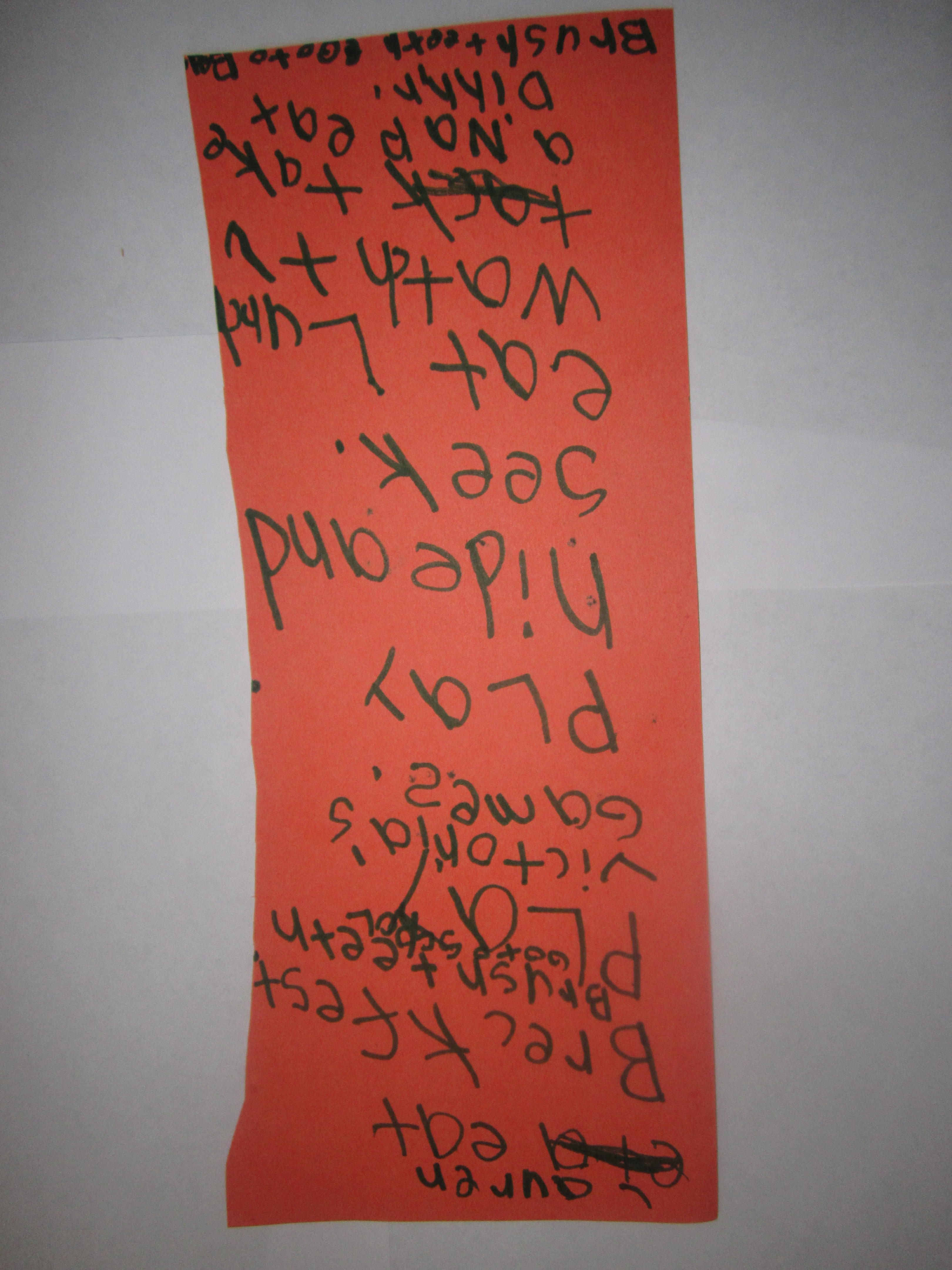
Given my love for the routine of daily life, I was not at all surprised when my six-year-old brought me a neon orange paper that read (and I quote):

Lauren:
eat Breckfest
Brush teeth
Go to school
Play Victoria’s games
Play hide and seek
eat lunch
watch TV
take a Nap
eat Dinnr.
Brush teeth
Go to bed

The basic reality of daily life, of routine, and of the mundane is that we all live it in some way or another—me in my adult world, my daughter in her child world.  We commute to work.  We go to school.  We walk the dog.  We make phone calls.  We volunteer.  We give baths and make dinners.  We run errands.  We clock in; we clock out.

What I love about the resurrection appearances of Jesus is that He surprised the disciples by inviting Himself into their daily routine.  Sure He appeared to them in the upper room, where they were gathered for worship and prayer. That’s to be expected.

But then He did something totally different.  He showed up on the side of the Sea of Galilee and watched them wrestle with fishing nets and bring nothing up from the water.

He went to work with them.

Early in the morning, maybe as the first flickers of sunlight skipped over the Galilean waters, Jesus called out to his tired friends.  They didn’t recognize his voice; he was just some curious bystander sticking his nose into their own personal business, giving them instructions as if He knew more about fishing than they did—a bunch of expert fisherman.

He told them to “‘Throw your net on the right side of the boat and you will find some.’ When they did, they were unable to haul the net in because of the large number of fish” (John 21:6).

That’s when they recognized the Lord.

In A Year With Jesus, Eugene Peterson wrote:

“Work that was futile apart from Christ becomes successful in His presence . .. Your resurrection life, Lord Jesus, is like a sunrise in work that has lost meaning and in routines that have become pointless.  Whatever my work today, I will do it in the recognition of Your presence and under Your command” (p. 594).

and

“The resurrection transforms Monday work as much as Sunday worship” (p. 596).

Jesus made it clear in those 40 days following His resurrection that He wasn’t just looking to be part of our sacred lives and in the religious moments we schedule on the calendar.  He wanted us to live with a curious mesh and entwining of sacred and secular, where He’s with us during every part of our day.

He sets our routine.  He is our routine.  He shakes up our routine.  He designs our routine. He redesigns our routine.

You’d think we fairly intelligent people could get by on our own living out our daily lives.  But, I’ve decided that I can’t and I’m okay with that.

That’s why you’ll find me in the Wal-Mart parking lot once a week with my head bent low in the few minutes before I exit my car.  It’s because I’m a mess on my own—making stupid decisions about what to buy and what not to buy, forgetting what I need, falling for advertising gimmicks and sales tricks, traveling back and forth across the whole store because I forgot something on my list, making a list and then leaving it in my car or at home, trying to use outdated coupons and failing to use perfectly good coupons that I spent perfectly good time cutting out.

Why should God care about my budget and my meal plan for the week and for the items on my list and my own personal sanity?  Because He loves me, that’s why.  Because the grocery store is where I lay out my nets and hope for an abundance of fish.

You have your own Galilean place, where Jesus is trying to invite Himself and where He’s waiting to give you input and advice.   Perhaps it’s the routine that makes you feel so comfortable and that you think you can handle all on your own.  Perhaps it’s the place you feel most capable and expert.  Maybe it’s a place where you experience failure and emptiness.

You haven’t seen abundance until you’ve felt the blessing of His presence in the midst of your routine.  It’s time to invite Him into the boat with you.

You can read more devotionals on this topic here:

Heather King is a wife, mom, Bible Study teacher, writer for www.myfrienddebbie.com and worship leader.  Most importantly, she is a Christ follower with a desire to help others apply the Bible to everyday life with all its mess, noise, and busyness.  To read more devotionals by Heather King, click here.

One Minute Devotional – Devotions from My Garden: Season of Prayer

Therefore, confess your sins to one another and pray for one another, that you may be healed. The prayer of a righteous person has great power as it is working (James 5:16)

We’re captivated by butterflies at my house.  The elegance and beauty of them, the colors and patterns, the transformation they go through—it all enlivens our imaginations.

We’re big fans.

So, last year my daughters begged me, real, true, actual begging, for the five caterpillars you order through the mail and then watch transform into butterflies.  Thank you, TV commercials.

Our cup of painted lady caterpillars arrived and we enjoyed watching them transform and releasing them into our garden in the spring.

This year, the begging commenced again, although my daughters mentioned how nice it would be to grow monarch butterflies because they were, in fact, my oldest daughter’s favorite.

It turns out, however, that they won’t send you monarch butterfly caterpillars unless you have milkweed growing in your garden to feed them.  Seems fair that you feed the butterflies after you grow them.

Here’s the thing, milkweed seeds have to lie dormant in the ground all through the cold of winter before they’ll grow in the spring.  Just like many spring bulbs, they require a season of germination.  So, I can’t –say–magically grow milkweed in two weeks to feed baby monarch butterflies.

Thus, our cup of painted lady caterpillars arrived last week.
And I’ll be planting milkweed seeds in November.

Now, during those winter months, those milkweed seeds will seem utterly useless and far from life.  Yet, water is penetrating the outer shell and ultimately the new life will crack the dead casing and push through into the soil.

When God has given us a season of waiting, perhaps even what looks like death and cold, it doesn’t mean we do nothing.  Instead, we can fill ourselves with God.  We can immerse ourselves in prayer, until life breaks through.

In his book, Nehemiah tells us that when he heard about the ruin of the Jerusalem walls, he “sat down and wept and mourned for days, and I continued fasting and praying before the God of heaven” (Nehemiah 1:4).  Ultimately, he invested three to four months in what Kelly Minter terms the “pre-work of prayer,” before ever acting on his passion.

My husband probably cringes every time he hears me say these few words: “I’ve been thinking . . . ” or “I have an idea.”  For all my ideas, though, I find that God isn’t often in a rush.  He gives me the time I need to pray, sometimes for months, sometimes even longer.  He gives me the assurance that this is right.

It’s not doing nothing; it’s doing the most important thing needed to make any ministry or project successful.  It’s the season of prayer that precedes the season of growth.

More Devotions From My Garden:

Heather King is a wife, mom, Bible Study teacher, writer for www.myfrienddebbie.com and worship leader.  Most importantly, she is a Christ follower with a desire to help others apply the Bible to everyday life with all its mess, noise, and busyness.  To read more devotionals by Heather King, click here.