First Things First

A new year means excitement, fireworks and confetti, predictions and optimistic resolutions.  It’s people declaring, “It’s going to be a great year” and others just hoping that “2012 is better than 2011.”

If there’s anyone out there who is a little like me and perhaps just a little honest, maybe a new year also brings pangs of fear.

Just a bit.

I’m not generally comfortable with the unknown so when you survey a fresh calendar with 12 pages left to go and when you start penciling in dates and activities and you consider how many squares will be filled in later, it can be a little overwhelming.

What if something goes wrong?  What if 2012 isn’t so great?

On New Year’s Day, I picked up my Bible and read these words:

“First this: God created the Heavens and the Earth—all you see, all you don’t see.  Earth was a soup of nothingness, a bottomless emptiness, an inky blackness. God’s Spirit brooded like a bird above the watery abyss” (Genesis 1:1-2 MSG).

“First this.”  For years, I’ve read this verse in other translations and they all begin this way: “In the beginning.”

So, right here at the start of our year, let’s pause and consider what’s first.  What is God doing in our beginning?

Like a blank calendar, the world began “formless and empty” and that’s where fear can reside: in the inky blackness of uncertainty.  It’s not so much in “all you see,” but lurking much more definitely in “all you don’t see.”

But God saw.  He wasn’t surprised by the light, the waters, the land, the creatures or Adam and Eve.  He is the God who designs, plans, forms and creates “all you see, all you don’t see.”  When He said, “Let there be light,” surely He expected light!

Indeed, “the Spirit of God was hovering over the waters” (Genesis 1:1, NIV).  In the past, I considered this mystical perhaps, a hazy and heavy apparition hovering like a fog just above the unformed mass of earth.

But The Message says “God’s Spirit brooded like a bird above the watery abyss” and this is much more the picture here.

John Snyder wrote: “the Hebrew writer portrayed the Spirit of God as ‘hovering over’ the unformed and unruly mass, much like a mother bird fluttering over her brood.  The picture here is the very careful and loving attention God gives to His creation–protecting, shaping, and guiding its development.  In other words, there’s no room for chance or randomness.  Everything is under His control.”

God is in charge.  That’s the reminder here in the very first words of the Bible.  And He’s not an arbitrary ruler or a mysterious mystical force.  He’s loving and attentive.  He brings order out of chaos and light forth from darkness.

That’s what we can look forward to in 2012.  In all of the hectic chaos of our lives, in the disorder of our finances or relationships or jobs, in the shaky ground of ministry or health, in the shadowy uncertainty of all that lies ahead—God is in control, designing a plan for us that isn’t just okay or acceptable.

It’s good.

When God finished off His week of creating, “God saw all that he had made, and it was very good” (Genesis 1:31, NIV).

We should expect nothing less from a Good God who is present and active in our lives, just as He was from the first moments of our world.  Rest in that and dare to enjoy a new year.

Heather King is a wife, mom, Bible Study teacher, writer for www.myfrienddebbie.com and worship leader.  Most importantly, she is a Christ follower with a desire to help others apply the Bible to everyday life with all its mess, noise, and busyness.  To read more devotionals by Heather King, click here.

Copyright © 2011 Heather King
Watcha Reading?

It’s time for all things New Years: resolutions and diet plans and Spiritual re-commitments.  I’m wondering–what are you reading in the new year?  Are you following a Bible reading plan?  A devotional?  Picking up a study or tackling a good book?

Here’s what’s on my kitchen table right now as I plunge into the start of my 2012 reading year.  What’s on your reading list?

The Bible:
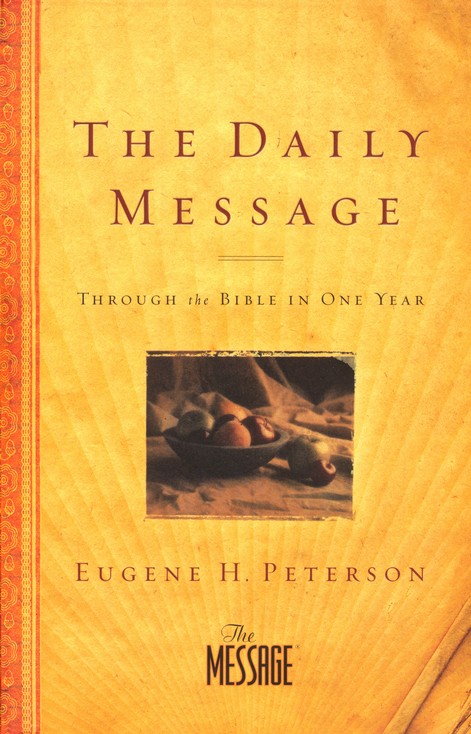
The Daily Message
In his introduction to this one-year Bible reading program, Eugene Peterson writes, “Reading is the first thing, just reading the Bible.”  Few things thrill me more than jumping into another year of reading God’s Word and I’ve already crinkled the first few pages and written my thoughts in the margins for today’s reading.

Scripture Memory:
100 Bible Verses Everyone Should Know By Heart by Robert J. Morgan
I’m excited to read Morgan’s book because it encourages Scripture Memory not just by listing off the verses Christians should know, but explaining a little bit about them and why they matter.  He’s categorized them also, making this Scripture Memory program thematic.

The Study:
James: Mercy Triumphs by Beth Moore
I started this study just a few weeks ago and it’s a dig deep kind of book.  I love it.  James didn’t mince words or pull punches when he wrote his epistle in the Bible, so this is a study that challenges at every turn.  But, James also wrote, that God “gives more grace” (James 4:6) and “draw near to God and He will draw near to you” (James 4:8).  That’s reason enough to step up to the challenge of serious Bible study in 2012.

The Devotionals:
Your 100 Day Prayer by John I. Snyder
I had the chance to review this devotional and prayer guide this past year and decided I’d read through it more carefully and deliberately in 2012.  It’s a commitment to 100 days of focused prayer on a specific prayer need along with a great devotional for each day.  (You can read my full review here.)

A Year with Jesus by Eugene Peterson
This is a daily devotional I started partway through 2011, so I’m still reading through as I begin 2012.  I love it.  Really, really love it.  It’s a handful of verses in either the gospel of Matthew or John, a few sentences with thoughts from Eugene Peterson and then a brief prayer.  I thought it was too short to say anything valuable.  Boy, was I wrong!  Some of the deepest and most Revelation moments I’ve had with God this year have emerged from a page’s worth of reading in this book before I go to sleep each night.

The Book:

The Shelter of God’s Promises by Sheila Walsh

Sheila Walsh writes, “God not only keeps His promises but He longs to keep us in them.”  Studying the promises of God seems like a great way to begin the new year, knowing that He will be true to His Word and faithful to do all that He has said.

It’s a reading list I’m so excited about for the new year!  I hope you’ve found a way to read the Bible, study it and pray through it in 2012 also!

Living In-Between, Part II

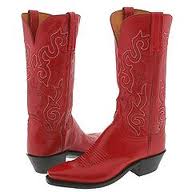
He had these red boots.

A missionary speaker at our church years ago told the story of being a boy growing up in Africa.  In the pile of shoes donated to the kids in his village, there was a pair of fabulous red boots and he loved them. They fit perfectly.  He felt like a super star when he wore them and he wore them everywhere.

Over time, he had to push a little harder to get his heel down in the boots.  His toes began to pinch a little and then curl to squeeze into the shoe.  Instead of choosing to go out and play with his brothers, he’d decline, knowing that walking and running would hurt his feet.  But he didn’t want to admit the boots were too small.  He loved them too much to stop wearing them.

In “Living In-Between, Part I,” I wrote about the first pitfall of our transition times in life.  We tend to run ahead of God.  We want to skip over the waiting time or the training period in order to get right to the good stuff of God fulfilling and completing His work in us.

The second pitfall, though, is no less dangerous.  It’s holding onto the past when God tells us to move on.  It’s squeezing ourselves into too-small red boots, making ourselves uncomfortable and hampering our service to God.

The past holds us hostage to shame.

The apostle Paul wrote:

Brothers and sisters, I do not consider myself yet to have taken hold of it. But one thing I do: Forgetting what is behind and straining toward what is ahead, I press on toward the goal to win the prize for which God has called me heavenward in Christ Jesus (Philippians 3:13-14).

If anyone understood how the shame of the past could imprison you, it was Paul, once a murderer and persecutor of Christians and now a follower of Christ.

He knew you couldn’t just “forget” what happened in the past, but that you had to constantly engage in “forgetting.” This process is ongoing because Satan is forever picking up the clumsy club of shame and beating us over the head with it.

“God can’t use you,” he says.  “You messed up.  Don’t you remember your sin?  Your mistakes?  How you’re impure and worthless?”

Paul also wrote that “there is now no condemnation for those who are in Christ Jesus” (Romans 8:1).  We cling to that daily.  When Satan looms over us with shame, we banish him by purposefully forgetting what is behind and straining ahead to reach all that God’s grace has for us.

The past makes us comfortable with the known.

The missionary knew his red boots were fantastic, albeit ill-fitting. What if some new shoes didn’t measure up?

Some of us settle down so comfortably into the routines of life that we tremble at threats of change.  This is how the Pharisees felt as they were shaken from their roosts of power by an unexpected Savior.

Jesus announced:

“I am the bread of life.  Your ancestors ate the manna in the wilderness, and they died.  This is the bread that comes down from heaven, so that one may eat of it and not die.  I am the living bread that came down from heaven.  Whoever eats of this bread will live forever; and the bread that I will give for the life of the world is my flesh” (John 6:47-51).

He was offering people revolutionary sustenance—the Bread of eternal life.  They preferred to remember the manna in the wilderness. Not that manna was bad.  It was miraculous and sustaining and perfect provision from God at a necessary time.

Yet, manna was no more than a precursor of the ultimate heavenly provision—our Messiah and life-giver.

Are you choosing manna over the Bread of Life?  Have you declined what God is offering because you’re content with what He’s already given?

In A Year With Jesus, Eugene Peterson prayed, “I don’t want to live on the memory of old miracles, but experience fresh ones in faith.  Draw me into the fullness of this day’s grace in which you have new things to do in and through me” (p. 427).

Finally, the past reveals selfishness.

It was hard to do, but at last the little boy admitted the beautiful red boots didn’t fit him anymore.  What good were boots if you couldn’t wear them or walk with them? Reluctantly, he handed the boots down to his younger brother and stepped into some new shoes of his own.

And there’s the key for us.  How long had his brother been without the blessing of perfectly fantastic red boots all because his older brother couldn’t let them go?

Who are we hindering when we refuse to step down from ministries when God has told us to stop?  Who does He want to raise up, to train, to use, to call and to bless?

James wrote: ” But the wisdom that is from above is first pure, then peaceable, gentle, willing to yield, full of mercy and good fruits, without partiality and without hypocrisy” (James 3:17, NKJV).

Heavenly wisdom means we are willing to yield.  Sometimes that means we let others pass or we invite them into the steam of ministry traffic.  Sometimes it means slowing down and giving someone else a chance to jump in.

But, it depends on us to obey God peacefully, gently, with mercy and without hypocrisy when He tells us to stop hoarding the boots all to ourselves and to bless someone else with them instead.

We look forward to a new year full of new encounters with God.  Are you willing to go where He leads even if it means leaving some things behind?

Heather King is a wife, mom, Bible Study teacher, writer for www.myfrienddebbie.com and worship leader.  Most importantly, she is a Christ follower with a desire to help others apply the Bible to everyday life with all its mess, noise, and busyness.  To read more devotionals by Heather King, click here.

Copyright © 2011 Heather King