Praying with a Penny Cup

penny cupThe penny plinked into the cup and I walked away.

It was such a simple thing.  The penny pressed into the palm of my hand and then a quick release, a letting go, and I was done.

Before my penny cup, I thought that I was just persevering in prayer like Jesus told His disciples to do in Luke 18.

There was the widow who came before the unfair judge day after day to demand justice, and finally he gave in because he was annoyed and tired of hearing her complain about it.

There was the neighbor awakened in the middle of the night by obnoxious and persistent knocking at his front door.  He finally opened up the door and stood there in his pajamas listening to his neighbor’s plight—an unexpected guest, no bread in the house, could he share?  Yes!  Take it!  Take anything as long as you stop that knocking, knocking, knocking so I can get some sleep already.

So, Jesus tells us, if an unrighteous judge and a sleep-deprived neighbor gave into requests just because of tenacity, wouldn’t God who loves us respond when we pray and pray and pray and don’t give up praying?

Don’t stop praying.  Even when you’re weary and exhausted and hopeless and think it doesn’t do a bit of good, keep pushing and pushing on in prayer.

But my idea of persevering in prayer wasn’t really prayer any more.  It was more like fretting in front of God’s throne and worrying about a problem before a divine audience.

All night long, I mentally paced in prayer: Lord, here’s my problem and here’s what I need You to do to fix it.  

I plead and argued and orated and then when I’d run out of things to say, I started all over again.

Hour after hour ticked by on my bedside clock and still I continued.

God loves when we pray. We can bring anything and everything to Him in prayer and He never tires of hearing us and never turns us away.

But I never released my need to Him.  I was talking at Him without ever letting go or pausing for even a second to listen or be still.

I was wallowing in anxiety and putting a holy ‘stamp of approval’ on it by calling it prayer.

John wrote:

 Now this is the confidence we have before Him: Whenever we ask anything according to His will, He hears us. 15 And if we know that He hears whatever we ask, we know that we have what we have asked Him for (1 JOhn 5:14-15 HCSB).

I was praying as if He couldn’t hear me.

….as if my will mattered more than His will.

….as if only my solution to the problem was acceptable.

….as if He wasn’t sovereign or compassionate—wasn’t able or didn’t care to rescue me.

… as if He was against me instead of for me.1 john 5

It was a prayer of unbelief.

Then, I read the idea in a discipleship magazine: a penny cup.

It’s not the cup that mattered or even the penny.  Writing a prayer on a slip of paper and slipping it into a prayer box would do just as well.

What matters is a physical reminder to release my white-knuckled grip on my problem and give it over to the God who loves me so.

Every time I  found a wayward penny on a dresser or on the floor, I picked it up and prayed with a quick whisper, “Lord, please take care of this need.  I trust You to deliver me.” Then I released the prayer to Him as I dropped the coin into my penny cup.

I didn’t tell Him how to fix the problem.  I didn’t wrestle with Him for hours every night over the need.

I prayed day in and day out (you’d be surprised how many pennies you find when they become part of your prayer life), but always I gave the problem to Him instead of holding onto it myself.

When the penny cup filled to the brim, I poured out the coins and started again.  For years, I prayed about this one issue, giving it over to God one…..penny….. at….. a….. time.

For the first time, I really prayed.  I didn’t fret and argue and run endless circles of desperate pleading around God.

I persisted in prayer by expressing my need while leaving the solution in His hands.

And God rescued me.  Not in the way I expected.  Not in the timing I expected.  Not without hardship and hurting or obedience or faith in the hard places.  But the deliverance was miraculous and beautiful and perfect in the way only God’s deliverance can be.

Heather King is a wife, mom, Bible Study teacher, writer and worship leader.  Most importantly, she is a Christ follower with a desire to help others apply the Bible to everyday life with all its mess, noise, and busyness.  Her book, Ask Me Anything, Lord: Opening Our Hearts to God’s Questions, is available now!  To read more devotionals by Heather King, click here.

Copyright © 2014 Heather King

12 Bible Verses on God’s Love for Us

  • Psalm 86:15 (NIV)
    But you, Lord, are a compassionate and gracious God,
    slow to anger, abounding in love and faithfulness.
  • Psalm 103:8 NIVversesGodslove
    The Lord is compassionate and gracious,
    slow to anger, abounding in love.
  • Psalm 136:1 NIV
    Give thanks to the Lord, for he is good.
    His love endures forever.
  • Isaiah 30:18
    Yet the LORD longs to be gracious to you; therefore he will rise up to show you compassion.For the LORD is a God of justice. Blessed are all who wait for him!
  • Jeremiah 31:3 NIV
     The Lord appeared to us in the past, saying:
    “I have loved you with an everlasting love;
    I have drawn you with unfailing kindness.”
  • Zephaniah 3:17
    The LORD your God is with you, the Mighty Warrior who saves.
    He will take great delight in you; in his love he will no longer rebuke you,
    but will rejoice over you with singing.
  • John 3:16 NIV
     For God so loved the world that he gave his one and only Son, that whoever believes in him shall not perish but have eternal life.
  • Romans 5:8 NIV
    But God demonstrates his own love for us in this: While we were still sinners, Christ died for us.
  • Romans 8:37-39 NASB
    psalm103

    Photo by just2shutter; 123rf.com


    But in all these things we overwhelmingly conquer through Him who loved us. For I am convinced that neither death, nor life, nor angels, nor principalities, nor things present, nor things to come, nor powers, nor height, nor depth, nor any other created thing, will be able to separate us from the love of God, which is in Christ Jesus our Lord.

  • Ephesians 2:4-5 NIV
    But because of his great love for us, God, who is rich in mercy, made us alive with Christ even when we were dead in transgressions—it is by grace you have been saved.
  • 1 John 4:9-11 NIV
    This is how God showed his love among us: He sent his one and only Son into the world that we might live through him. 10 This is love: not that we loved God, but that he loved us and sent his Son as an atoning sacrifice for our sins. 11 Dear friends, since God so loved us, we also ought to love one another.
  • 1 John 4:16 (NLT)
    We know how much God loves us, and we have put our trust in his love. God is love, and all who live in love live in God, and God lives in them.

What a Letdown

My toddler and I have daily disagreements about what he needs.

I say he needs a nap.   He thinks he needs unlimited playtime.matthew6-33

I say he needs healthy food, like the banana I sliced up on his highchair tray.  He thinks he needs the cookie hidden at the top of the snack cabinet.

I say he needs a diaper change.  He feels the need to scream at the top of his lungs, contort his body, writhe and wriggle to avoid being cleaned up.

After I win that battle and clean his little bottom, I say he needs a new diaper on.  He runs away giggling because he thinks he needs to hang out in the nude.

I say he needs to come out of the bath when the water is cold and his fingers are wrinkling like prunes.  He says he needs to stay in the bath.  Period.  Like, forever.

Momma says he needs to play with his books, his blocks, and his toy trucks.  He thinks he needs to play with my smartphone.

I say he needs to color with the crayons on paper.  He disagrees, believing he needs to color with the crayons on our books and then eat the crayon.

I tell him he needs to pet the cat gently or not at all.  He thinks he needs to jump on the cat, pull the cat’s tail, sit on the cat and then stretch out with his whole body covering the cat and ignore the hissing and growling.

I know what he needs in order for him to be healthy, well-fed, well-rested, clean, and safe.

Yet, if I gave him what he thought that he needed, he’d be naked and starving, covered in his own feces, utterly exhausted and mauled to pieces by an irritated feline.

Perhaps part of growing up is learning what we really need.

Or perhaps we never truly learn.

After all, don’t I sometimes pray for what I need and discover through temporary disappointment and ultimate awe that God knew better? His “no,” though painful in the moment, becomes my salvation.

God loves us enough to give us what we really need rather than what we’ve mistakenly asked for.

Four men carried their paralyzed friend on a cot to see Jesus.  They tried to shove through the mob that was packed into the house, but they failed.

So, they climbed onto the roof, hauled the stretcher up there, broke down the thatch, and lowered their friend into the middle of the room.

They pushed and pushed and pushed through every obstacle so their friend could have what he ‘needed.’

Mark writes:

And when Jesus saw their faith, he said to the paralytic, “Son, your sins are forgiven”  (Mark 2:5 ESV).

Forgiveness?

Is this what they wanted?

In his book, The One-Year Experiencing God’s Presence Devotional, Chris Tiegreen writes:

 Clearly they came for one thing: healing.  They wanted their friend to walk.  He wanted to walk.  A miracle was all they had on their minds.  So a declaration of forgiveness, while a nice spiritual touch, might have been a letdown.

Let down.

Is that how we feel when we come looking for the miracle, and He heals our heart instead?

So often we come to God with the practical need and the specific requests, telling Him our problems and sometimes even telling Him how to fix them.

His desire, though, isn’t just for our best; it’s for our spiritual best.  It’s to break down every obstacle to His presence and cut through every barrier to intimacy with Him.

We ask to walk.

He grants forgiveness first.

That man stood up off that mat and walked out of the house with his friends.  His physical need was met.  But more importantly, Jesus answered his true spiritual need first.

And, what do any of us really need?

A better job?  A healed marriage? An end to conflict?  A bigger house?  A good doctor’s report?

Yes. Maybe.

But more than that…..we need mercy.  We need grace.  We need His Presence.  We need hope.  We need forgiveness.

When we seek Him, truly seek Him, searching for His face, listening for His voice, longing to know Him and to talk with Him, He gives us what we really need.

But seek first the kingdom of God and his righteousness, and all these things will be added to you (Matthew 6:33 ESV).

Lord, what I really need is You.

Heather King is a wife, mom, Bible Study teacher, writer and worship leader.  Most importantly, she is a Christ follower with a desire to help others apply the Bible to everyday life with all its mess, noise, and busyness.  Her upcoming book, Ask Me Anything, Lord: Opening Our Hearts to God’s Questions, is available now!  To read more devotionals by Heather King, click here.

Copyright © 2015 Heather King

Come Messy

My son slipped the yogurt out of the fridge while I was packing school lunches for my daughters.

He carried it delicately over to the living room coffee table.  Then he shoved his hand down through the foil lid and started eating it.

With his fingers.

When I caught him with his snack, he popped his hands up to the top of his head, covering his light fuzz of hair in vanilla yogurt.

Bath time!

He eats with his hands.  He plays with his food.  He dumps out any drinking cups we leave lying around and then splashes in the mess.

He has a magnet for the cat food and would love to lay down in the litter box and act like it’s a day at the beach.

In the morning, he makes a mess of breakfast and makes a mess of playing.

Then he hears that first hint of sound from behind the closed door of our bedroom. It’s his clue—Dad is awake and getting ready for work!

My baby boy runs to the door and stands crying until we open it up so he can throw himself against Daddy’s legs.  For the rest of the morning routine, Daddy has to brush his teeth one-handed and eat his breakfast with a toddler on his lap, and shift the toddler from hip to hip while he puts on his coat.

Daddy is here.  My son will not let him go, not until we pry his hands and body away and Mom holds him tight as he cries and watches Daddy head out the door.

Usually, we’re in a mad scramble to wash my little one’s hands before he snags onto Dad’s pants leg in the morning and refuses to let go.  After all, Dad hardly wants to head to work with vanilla yogurt and banana all over himself.

But I read through this verse again this week:

but Jesus said, “Let the little children come to me and do not hinder them, for to such belongs the kingdom of heaven” (Matthew 19:14 ESV).

We’ve heard it a million times and I’ve heard the sermon illustrations before.

Come to Jesus like a little child:

Come trusting.

Come simple.

Come excited.

Come small and insignificant.

Come unhindered.

And it’s true.  All of it.

Jesus welcomes us just as we are.  He invites us!  He’s pleased to see us and pleased to spend time with us.

matthew11-28

photo courtesy of Viktor Janacek, picjumbo

But there’s something more, I realize, as I wipe my son’s face and hands yet again this morning.

Come messy.

Too often we’re frantically scrubbing ourselves up before we let Jesus see us.

We think our prayers have to be ‘just right.’  We think our Bible time has to be ‘just so.’

We put off spending time with Him because we haven’t gotten it all together.

But the easiest way for Satan to defeat our prayer lives is to tell us prayer has to be hard and that we’re not good enough, so why bother even trying?

Maybe we think that’s in Scripture somewhere: “Come to Me when you have it all together and know how to pray for 30 minutes and haven’t lost your temper in a week and have had a 20-minute quiet time at 5 a.m.”

But that’s not what Jesus says at all.

He says to come as a child.

He also says:

“Come to Me, all who are weary and heavy-laden, and I will give you rest” (Matthew 11:28 NASB).

In A Praying Life, Paul Miller writes:

“The criteria for coming to Jesus is weariness.  Come overwhelmed with Life.  Come with your wandering mind.  Come messy.

We don’t have to pretend in His presence.  We don’t have to be something we aren’t.  We don’t have to be perfect.

When we’re a mess and when we’ve messed up, just come. Come without guile.  Be real and honest. No need to clean up and make ourselves sound “holy.”

Just. Come.


Heather King is a wife, mom, Bible Study teacher, writer and worship leader.  Most importantly, she is a Christ follower with a desire to help others apply the Bible to everyday life with all its mess, noise, and busyness.  Her book, Ask Me Anything, Lord: Opening Our Hearts to God’s Questions, is available now!  To read more devotionals by Heather King, click here.

Copyright © 2015 Heather King

What Can Make You Lose Every Time

I watched as this college friend pulled clothes from her suitcase and packed them into a duffel bag for the Thanksgiving weekend at home.

She still had an empty dresser and a full suitcase 3/4 of the way through the college semester.

I am not like this.  I am an insta-unpacker.  The moment I arrive at a hotel, I nest.  I empty every bag, tuck every item away, fill the mini-kitchen and set up the bathroom sink.

When we return home, I’m going to unpack no matter how late it is.  I’m going to start that load of laundry and pull out the toiletries because it cannot wait until morning, not if I want to get any sleep.

Maybe I looked lost in confusion as I watched my friend move clothes from one bag to another because she stopped to explain it to me.psalm16-11

It wasn’t procrastination or laziness.

It was perfectionism.  It was that ugly enemy that paralyzes us with the lie:  If you can’t do it perfectly, then why do it at all?

“I was so busy,” she said, “I knew I didn’t have time to put my clothes away just right, so I left them in the suitcase.”

Beth Moore wrote:

Perfectionists always lose (Esther).

It’s the same way my son chose to crawl rather than walk for weeks and weeks.  People asked me, “Can he walk yet?”

Yes, he could walk.

Did he always choose to walk?

No.  It amused him to walk a little from room to room or place to place.  But when he wanted to get somewhere with certainty and with speed, he dropped to all fours and crawled like a rocket.

Perfectionism does this; it paralyzes us into this one place of development.  We’re comfortable here.  We move along well enough.  This is what we know.

Why choose stumbling?  Why choose uncertain steps and potential embarrassment?

This is what we lose when we demand perfection from ourselves:  We lose the journey of grace, the way God walks alongside, the way He steadies us with His strong hand and smiles at our progress.  The way He cheers us along and encourages us on the weary days to persevere and not give up, to get up and try once more because He is with us, after all.

Jesus said these words to His disciples and it could have broken over their weary souls like the cracking of a whip, so they felt trampled and beaten and hopeless:

You therefore must be perfect, as your heavenly Father is perfect. (Matthew 5:48 ESV).

Be…..perfect?

It’s tucked in just one tiny verse after the beatitudes and after Jesus tells them not to retaliate against their enemies, not to get divorced, not to lust, not to sin when they’re angry, and to love their enemies.

Yes, do all this.  And be perfect.

That would have caused me some religious whiplash.  If I were taking sermon notes on that hillside, I’d have written it down on my bulletin with exclamation marks and references to look up later in case the preacher was wrong.

Hadn’t the Pharisees preached legalism and works-based faith?  The religious elite told them to be perfect, be perfect, be perfect and if possible, be more perfect, because that’s what it took to please God.

Here I am at the end of my 12-month pursuit of the presence of Christ, and I’m ending the year with this: Abandon Perfection.

But how do you move on past a verse like this?

Be perfect?  That’s impossible.  I’m a mess some days, broken and faulty and prone to sin.

So, Jesus, does that mean we’re hopelessly blocked from Your presence and Your favor because this perfection just trips us all up?

Oh, but here’s the grace we perfectionists need.

Ravi Zacharias writes:

Perfection, then, is not a change in the essential character but the completion of a course...We can never be who God is, but we can complete the task he assigns us to do” (The Grand Weaver).

Jesus didn’t mean we had to attain that holiness on our own or get everything right and never falter or sin.  He knows we can’t.

He asks us, though, to move forward.  Take those steps.  Make progress.  Obey Him.

When He tells us to move, move.  When He plants us, bloom.  When He leads us, follow.  When He prompts us, go.  When He nudges us, yield.

Perfectionists lose because we get so focused on the end that we despair in the middle and simply give up.  Or we never begin in the first place.

But God asks us to just take a walk with Him, rest in His presence, trust His direction, enjoy His company.  Then we’ll be where He wants us to be, with Him….and that’ll be perfect.

To read more about this 12-month journey of pursuing the presence of Christ, you can follow the links below!  Won’t you join me this month as I Abandon Perfection?

Heather King is a wife, mom, Bible Study teacher, writer and worship leader.  Most importantly, she is a Christ follower with a desire to help others apply the Bible to everyday life with all its mess, noise, and busyness.  Her book, Ask Me Anything, Lord: Opening Our Hearts to God’s Questions, is available now!  To read more devotionals by Heather King, click here.

Copyright © 2014 Heather King

Christmas Devotions: When you find something good, don’t keep it to yourself

It’s an annual surprise.

Some afternoon, usually in March, I hang up my gray winter coat for the last time of the season.

There’s no official ceremony or anything and the groundhog’s shadow-predictions never prove perfectly accurate.

It’s just a simple thing.  One day I casually drape my coat across the hook in my closet and there it lingers through spring, summer and fall.

Then, on a morning (usually in November), I stop deceiving myself into thinking that sweaters are enough to keep my teeth from chattering.  I reach past my fall jacket in the closet, pull down that same wool coat from its trusty hook, slip my hands into the sleeves and dip my hand into the pocket.

Whatever I left there eight months before is what I’ll discover on that first pocket search of the winter season.christmas13

I’ve pulled out Mom-things, like pacifiers and baby socks (don’t all moms pop baby socks into pockets)?

Grocery store receipts unfold like magician’s handkerchiefs—always one more emerges from hidden corners.

There are pens and paper clips, ticket stubs, rocks for my daughter’s collection, hair clips and ponytail holders, cough drops, and maybe even tissues (unused, thankfully).

There’s generally little treasure among the trash.  Mostly my life out and about with my kids consists of periodically dumping the overflow of their stuff into my pockets when my hands are full.

Occasionally, though, I reach into that winter coat for the first time in November and pull out coins.  Better yet, a dollar or two or three….or even ten.

That’s enough to make this girl happy dance in the middle of my closet.

Then, pulling myself together, I announce the news to my kids, post a happy-face announcement on Facebook and tell my husband the story later that night.

Discoveries, after all, are meant for sharing.  They’re the kind of spill-all-over joy that we can’t keep quiet about.

Maybe that’s how the Shepherds felt standing on that darkened hillside with snoring sheep.

Perhaps it even explains what the angels were doing, singing their praise songs in the night sky to an audience of somnolent herdsman about a Savior being born.

All of heaven exploded with the “good news that will cause great joy for all the people!” (Luke 2:9), the Messiah, the Lord.  They couldn’t contain the excitement!

One angel made the announcement, but others crowded the sky and joined in the chorus: “Suddenly a great company of the heavenly host appeared with the angel, praising God” (Luke 2:13).

The angel’s joyful news sent the shepherds tumbling all over themselves to see “this thing that has happened, which the Lord had told us about” (Luke 2:15).

When we hear good news, don’t we long to see with our own eyes, to experience this joy ourselves? 

That’s what sharing our testimony does: it ignites passion, it incites curiosity, it encourages a searching and finding of the truth, the Savior, of salvation.

Then, when the shepherds found the manger and peered over the corners at the baby-King, “they spread the word concerning what had been told them about this child and all who heard it were amazed at what the shepherds said to them” (Luke 2:17-18).

They had discovered Jesus and no way could they keep that quiet.

No matter how many times Jesus asked those he healed in his ministry to keep quiet about it, still they rushed home and called up the local newspaper to tell their story.

Jesus himself finally told one man to:

“Go home to your friends and tell them how much the Lord has done for you, and how he has had mercy on you”  Mark 5:19.

Surely his story is our story, too.  We have this testimony, of what He has done and the mercy He has shown.

Our God-stories, the discoveries of how He’s been so good to us, those moments of amazing grace and unexpected mercy in the middle of the daily grind, are all meant to be shared with others.

And the miracle of Christmas is ours to tell and ours to share; it’s the hope that others need and the joy this desperate world is searching for.

So, sing it!  So, tell it!  Don’t let that familiar feel of your salvation, the way apathy closes us in a cozy blanket of complacency, ever let us overlook the awe of this:

God loved us so.

For God so loved the world that he gave his one and only Son, that whoever believes in him shall not perish but have eternal life.  John 3:16

Originally posted October 19, 2012

Christmas devotions: When preschoolers ask ‘why?’

I am cutting out flannel board figures today and pulling out my Jesus Storybook Bible.  I am choosing simple carols that repeat….a lot.  Like Angels We Have Heard on High (Glo-ooooo-ooooo-oooooo-ria) and Go Tell It on a Mountain.titus3

And Jingle Bells.  That’s a carol, right?

Today, I head into a sanctuary of preschoolers to present a Christmas program for them and I want to cut through all that they hear about Christmas—Santa and reindeer and cookies and presents and colorful lights and an elf with a crazy nightlife.

I want to get one message out loud and clear, though, through all that noise:

Jesus.

I know preschoolers.  I’ve had my fair share.  Just last year, my own four-year-old quizzed me all season long:

She asked me:  Why?

Why was the serpent bad in that garden?

Why did Eve give the fruit to Adam, too?

Why did God choose Mary to be Jesus’ mom?

Why did the people shout to kill Jesus when He didn’t do anything wrong?

Why did they slam that crown of thorns down on Jesus’ head and why did they lash His back again and again and again?

Why did He die on that wooden cross?

Why did the women put burial spices on His body and why did they wrap Jesus in those cloths?

Why did Jesus walk on out of that grave?

I tried to break it all down, this Gospel, and explain it in a way she could understand.

I tried to keep it simple.

But I stumbled and tripped, and got tangled up in complicated explanations.

Start, stop, start over.  That’s how it went.

In the minivan, at the dinner table, as we turned the pages of her children’s Bible, as she held my hand and walked out the door, she asked.  “Why.”

Over and over we walk through the Gospel, letting it sink down deep into her heart and mind.

We adults tend to complicate this Good News, fumbling to unwrap the beautiful simplicity with our overgrown paws.

Wasn’t that part of the trouble for the Pharisees, too?  They piled on laws, rules, legalism and judgment, tripping people up with their obstacle-ridden path to redemption.  They took something simple and made it so difficult.In the same way, we can tangle the Christmas story in details and asides, but God unravels the mess and says it clear:

 This is how Jesus the Messiah was born. His mother, Mary, was engaged to be married to Joseph. But before the marriage took place, while she was still a virgin, she became pregnant through the power of the Holy Spirit.  Matthew 1:18

In the Women of Christmas, Liz Curtis Higgs writes, “He summarized the main characters and their plight in a single sentence.”Wreath of Snow_cvr.indd

That’s what we need.  We need our God to free us from complicated explanations and tricky religious routines.

Because when salvation gets complicated, we lose sight of grace.  It becomes about us instead of all about Him.

What a mess we are on our own.  Paul tells us:

Once we, too, were foolish and disobedient.  We were misled and became slaves to many lusts and pleasures.  Our lives were full of evil and envy, and we hated each other.  (Titus 3:3 NLT).

That’s what we are without God.

“But…”

Paul writes that one three-letter word of hope and freedom for all of us chained to sin.

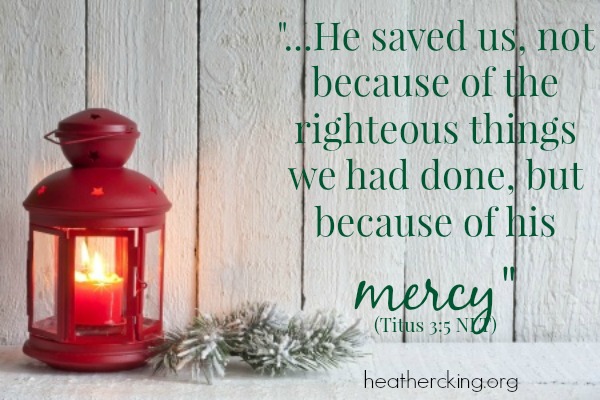
But—“When God our Savior revealed his kindness and love, he saved us, not because of the righteous things we had done, but because of his mercy. He washed away our sins, giving us a new birth and new life through the Holy Spirit.He generously poured out the Spirit upon us through Jesus Christ our Savior. Because of his grace he declared us righteous and gave us confidence that we will inherit eternal life.”  (Titus 3:4-7 NLT)

We bring mess.

He brings mercy.

It’s as simple as that.

All of those “Why’s” preschoolers ask and all of the “why’s” I ask myself when life seems complicated and confusing find their answer here:  “because of his mercy.”

And Christmas, oh how we can tangle it right up with confusion and busyness, but here is the clear and simple truth:

It was at Christmas that God gave us a Savior we didn’t deserve and a sacrifice we didn’t merit.

Why did God send a Savior?

Why did He come as a baby?

Why did He take that crown of thorns, endure that lashing of the whip, die there on that cross?

Why did He walk out of that tomb, alive anew?

Because of His mercy.

Yes, because of His grace.

Heather King is a wife, mom, Bible Study teacher, writer and worship leader.  Most importantly, she is a Christ follower with a desire to help others apply the Bible to everyday life with all its mess, noise, and busyness.  Her book, Ask Me Anything, Lord: Opening Our Hearts to God’s Questions, is available now!  To read more devotionals by Heather King, click here.


Christmas devotions: How Many Days?

“Mom, how many days until Victoria’s birthday?”
Nine.

“How many days until we go see The Nutcracker?”christmas14
Nine.

“Once we see The Nutcracker, how many more days will it be until Victoria’s birthday and then to Christmas?”
Zero and Four.

“How many days until the last day of school before Christmas break?”
Seven.

“How many days until our program?”
Two.

“How many days to Christmas?  Do you know how many hours that might be?”
Thirteen and go ask your dad.

This is my house.

Every day.  All day.  From three of my four children and I’m sure if the 14-month-old could count and talk, I’d be doing this for him, too.

Mom is the walking Advent calendar, the perpetual countdown machine.  Punch in the numbers and out spits the carefully calculated response.

Unless I’ve answered enough times that day, in which case I point mutely to the calendar on the wall and let them do the math.

We are living for the countdowns and loving the promise that on appointed days at specific times, we will celebrate.  The big day will arrive.  The anticipation will give way to fulfillment.

Yet, so much of life seems to hang on uncertain hooks with undefined strength.  The deadlines are hazy.  The promise is there, but not the timing.  We can’ t count down the days and know that on this date, at this time, the one we’ve circled in red on our calendar, God will come through for us.

The waiting will end.

The promise will come.

The deliverance is here.

The prayer will be answered.

The waiting eats away at our hope; it’s the corrosion of impatient despair.

What to do?   What to do when you read the words that God will work this out but each day you wake up thinking “Maybe this is the day” and each night you lie back down, “Maybe it’s tomorrow?”

For 400 years, Israel paused.  For 400 years, they waited for the Messiah and heard only silence between the Old Testament’s end and that first moment that John the Baptist stepped out of the wilderness and yelled out for the people to repent.

In the Gospel of Mark, the very first words we have recorded from Jesus are “The time has come.” (Mark 1:15).  How appropriate.

Maybe some had long since given up hope.  The anticipation perhaps gave way to cynical apathy.  Or frenzy—maybe the desperation spurred them on to follow any false teacher with any false message of hope.

Yet, just when the perfect time had come, Jesus was there.  He wasn’t late, not for a second.  And He wasn’t early.

Paul wrote in Galatians that:

when the set time had fully come, God sent his Son, born of a woman, born under the law, to redeem those under the law, that we might receive adoption to sonship (Galatians 4:4-5, NIV).

And later in Titus:

God, who does not lie, promised before the beginning of time, and which now at his appointed season he has brought to light through the preaching entrusted to me by the command of God our Savior (Titus 1:2-3).

The writer of Hebrews tells us:

But [that appointed time came] when Christ (the Messiah) appeared as a High Priest of the better things that have come and are to come (Hebrews 9:11 AMP).

The appointed time came and God answered.  He is faithful.

Those prophets said it centuries before:

 “For the vision is yet for the appointed time;
It hastens toward the goal and it will not fail.
Though it tarries, wait for it;
For it will certainly come, it will not delay (Habakkuk 2:3, NASB).

God’s promises are for the appointed time.

It feels like so much hesitation and delay, but “It will not fail….wait for it….it will certainly come.”

Christmas does this.  It gives us hope for the waiting room and the silent days because God did not fail His people.  He had not abandoned them.  He never let go of the promised salvation, never wavered or faltered.  Nothing interrupted His plans.  No one stood in His way.  He never for one single second lost sight of the perfect plan for the perfect time.

Christmas is God showing up in glory in the way and on the day they least expected His presence, but in the way and on the day God planned all along.

I don’t want to miss Him showing up in my life.  I don’t want the waiting to rile up doubts.  I don’t want to settle my heart into complacency so I stop even looking for the glory and just shift my eyes to the mundane.

In the waiting, let us keep hope.  In the waiting, let us keep watch.  In the waiting, let us busy ourselves with obedience for today, trusting tomorrow to Him.

Originally posted December 12, 2011

Heather King is a wife, mom, Bible Study teacher, writer and worship leader.  Most importantly, she is a Christ follower with a desire to help others apply the Bible to everyday life with all its mess, noise, and busyness.  Her book, Ask Me Anything, Lord: Opening Our Hearts to God’s Questions, is available now!  To read more devotionals by Heather King, click here.

Christmas Devotions: How many ornaments have we broken so far?

The first crash of that shattering glass hit and it was just the day after Thanksgiving.  We were only one day into the Christmas season and only about 1 hour into Operation Decorate the House.

‘Twas an accident of course.

The penguin soap dispenser hit that floor and ended in a puddle of hand soap and broken glass.

Photo by jeka81, 123rf.com

Photo by jeka81, 123rf.com

That’s decorating with kids.

Accidents happen, you know.

An hour later, another crash.  Our box of special, keepsake, treasured ornaments hit the floor and a daughter cried with remorse.

Still, a little sweeping, a little mopping, a little gluing, a little comforting and we slipped back into the decorating groove, crooning along with Bing Crosby to White Christmas.

Stuff is stuff.  Things break (especially when you’re clumsy like me, especially when you have four kids like us).

Look at our Christmas tree from afar and it still has that glow of perfect.

Look up close and you’ll see the ballerina’s feet are glued on, Noah’s ark is missing a dolphin leaping up out of the ocean waters, and the three kings no longer carry a sign: “Wise Men Still Seek Him.”

Brokenness can still be beautiful when we look with eyes of grace.

But when we squint up close to critique and criticize….when we look right past the glory and seek out the flaws…..suddenly that’s all we see.

Perfectionism is a bully.

It muscles in and takes over our perceptions.

It demands that we see only brokenness and faults.

It insists that we remain chained to the past, obsessing over mistakes, battering us over past sin, beating us up with shame.

Lysa TerKeurst writes:

My imperfections will never override God’s promises (The Best Yes).

The promise of Christmas is “God with us.”  The promise is that when we were farthest from Him, He came to us.

The promise is that we didn’t have to get it right on our own or check the boxes of the law until we’d met some prerequisite to grace.

We didn’t come worthy.

We came needy.

And He came down.

Our imperfections never negated the promise of Emmanuel’s presence.  Not then.  Not now.

He still promises us this, “And surely I will be with you always” (Matthew 28:20 NIV).

He is with us always, but not to leave us there in the brokenness.

Sometimes we stop right there at this thought: “Beauty in the brokenness.  We’re all a mess in need of a Messiah.”

Sometimes we stop right there and, dare I say it, glory in the broken?  We cling to our mess instead of releasing it to Him.

But the glory is in the Healer.  The glory is in the redemption.  The glory is in the One who puts His own pure robe of righteousness over our shaky shoulders.

He doesn’t leave us naked and ashamed.  He “has clothed me with garments of salvation and arrayed me in a robe of his righteousness” (Isaiah 61:10 NIV).

We’ll never be perfect in our own striving and strength.  True.  But we don’t have to remain stuck there in the mud.  He grips us with the hand of grace and pulls us out of that pit so we can move forward with Him.

Those disciples on the road to Emmaus after the resurrection didn’t have it all right.  They didn’t have perfect understanding.  Their belief was delicately trembling and about to topple their whole foundation of faith.

They thought Jesus had been the Messiah, yet He had died.  These rumors from ‘crazy women’ about an empty tomb left them confused and alarmed.

But Jesus walked alongside without them recognizing him, going back to the beginning, telling the story start to finish.

When He was about to leave, “they urged him strongly, ‘Stay with us, for it is nearly evening; the day is almost over.’ So he went in to stay with them.”

There at the dinner table, He broke the bread and their eyes opened wide to the truth: This was Jesus.  This was God in their midst.

I’ve spent a year pursuing the presence of Christ, and as I “Abandon Perfection” this month I’m reminded of this:

God’s presence doesn’t hinge on perfection.

God’s presence doesn’t demand perfect understanding or faith without fail.

But if I want God’s presence, then I have to invite Him in, urge Him strongly, “stay with me…..”

He can only make us whole when we trust Him with the pieces, all of them:

God made my life complete
    when I placed all the pieces before him. Psalm 18:20 MSG

We bring all the pieces.  We don’t hold any back.

We lay them at His feet, not running away or hiding from Him.  We come into His presence, broken as we are, and He makes us whole and holy, and He stays with us.

To read more about this 12-month journey of pursuing the presence of Christ, you can follow the links below!  Won’t you join me this month as I Abandon Perfection?

Heather King is a wife, mom, Bible Study teacher, writer and worship leader.  Most importantly, she is a Christ follower with a desire to help others apply the Bible to everyday life with all its mess, noise, and busyness.  Her book, Ask Me Anything, Lord: Opening Our Hearts to God’s Questions, is available now!  To read more devotionals by Heather King, click here.

Copyright © 2014 Heather King


Christmas Devotions: How to lose at Candy Land

“Congratulations.”

That’s the word we taught our daughters to say when they lost at Candy Land.

Maybe around 2 years old when they could first maneuver those colored gingerbread men around that candy-covered game board, we taught them this massive word.

Mastering the vocabulary came difficult.  They lisped out ‘congratulations’ and we’d smile over the cuteness of a tinchristmas8y person tackling the syllables.

But more difficult than that, harder than the language itself, was the heart uprising at having to spill out “congratulations” to someone else.

Because we all want to win…all the time.  And when someone else’s gingerbread man landed on that last rainbow square right at the candy castle, that wrecked little hearts in all their innate selfishness and self-centered ways.

Oh, how the wrestling match with our enemy pride begins so young and does it ever actually end?  Will we ever slam that opponent down on that mat and claim victory over such a foe?

If Christmas is about anything, though, it’s about God coming low.

Paul writes:

 In your relationships with one another, have the same mindset as Christ Jesus:
Who, being in very nature God,
did not consider equality with God something to be used to his own advantage;
rather, he made himself nothing
by taking the very nature of a servant,
being made in human likeness.
And being found in appearance as a man,
he humbled himself
by becoming obedient to death—
even death on a cross!  (Philippians 2:5-8 NIV).

He made himself nothing.  Our God chose to be man, born all bloody and small in a stable of dust and grime, straw, animal feed, and manure.

“Have the same mindset as Christ Jesus…” that’s what Paul wrote.

Yet, still pride and envy destroy us, destroy our churches, our friendships, and our ministries because we scramble and shove for the spotlight, the glory and the prize.

We may no longer be counting the squares on a Candy Land board, and yet saying that word, ‘congratulations’ with genuine joy at another’s success may come difficult.

When their ministry takes off….
When they buy that huge new house….
When they book that dream vacation…
When their kids bring home that report card….

Yet, there’s John the Baptist.

Before Jesus came along preaching and healing, John gathered crowds by the river and baptized them into repentance and renewal.  He was the long-awaited prophet, the voice crying out in the wilderness.

So, John’s followers didn’t appreciate the attention the upstart Jesus was stealing away from John’s long-term ministry. But John wasn’t bothered at all, saying, “He must become greater; I must become less” (John 3:30 NIV).

In that familiar old Christmas story, I see where this began.

I see how John learned young to step aside humbly and worship the One who is greater.  I see how he didn’t strive for his own glory or stake his own claim to attention and praise.

His mama taught him.

Elizabeth was about six months pregnant with her own miracle baby when Mary came for a surprise visit.

For six months, Elizabeth treasured the joy of a son-to-be, a prophecy spoken over her very own baby.  How she had longed for a child during those years of barrenness, and now she was truly expectant.  And not just any baby.  But the forerunner of the Messiah in her very own womb.

Yet, when Mary walked into Elizabeth’s house unexpectedly, Elizabeth didn’t give way to jealousy or territorial cattyness.  She didn’t rush to tell her own story or pridefully demand any attention for herself

She stepped aside.

She extended a joyful and genuine ‘Congratulations’ to the young woman before her.

And she worshiped.

When Elizabeth heard Mary’s greeting, the baby leaped in her womb, and Elizabeth was filled with the Holy Spirit. In a loud voice she exclaimed: “Blessed are you among women, and blessed is the child you will bear! But why am I so favored, that the mother of my Lord should come to me? As soon as the sound of your greeting reached my ears, the baby in my womb leaped for joy. Blessed is she who has believed that the Lord would fulfill his promises to her!”  (Luke 1:41-45 NIV).

Pride chains us down to a captivity of our own creation.

Looking past ourselves sets us free.

It’s the freedom of making this life less about us and all about Him and serving others.

And the lesson begins here at Christmas as Elizabeth humbly congratulates and blesses the teenage girl before her.

As Elizabeth’s own unborn son becomes the first person to worship the still unborn Savior.

And as God Himself grew within the confines of a womb, our God of light couched for a time in darkness waiting to be born.

Originally posted 12/16/2013

Heather King is a wife, mom, Bible Study teacher, writer and worship leader.  Most importantly, she is a Christ follower with a desire to help others apply the Bible to everyday life with all its mess, noise, and busyness.  Her book, Ask Me Anything, Lord: Opening Our Hearts to God’s Questions, is available now!  To read more devotionals by Heather King, click here.

Copyright © 2014 Heather King