What I’m Complaining About…

I’ve been trying to teach her just to say, “No, thank you.”

It’s simple.  It’s polite.

Really, I don’t need an Oscar-worthy performance every time I serve mashed potatoes.

“EEEEEWWWWWW.  I HATE potatoes.  They are GROSS.  This is DISGUSTING.  Don’t put ANY on MYYYY plate!”

I’m beginning to wonder if the child has ever even eaten a single potato.  I have this sneaking suspicion that she just screams about hating potatoes because she’s decided to hate potatoes and because the rest of the family happily eats them.

The complaints are always prolonged, noisy, and accompanied by a pantomime of a wrinkled nose and contorted face.  When she’s really inspired, she might even gag a little.  Just for effect.

I’ve gone the spiritual route with her.  “Do everything without complaining and arguing,” I quote (Phil 2:14 NLT).

Everything?

Yes, everything.

Eat potatoes without the side show?

Yes.  Or at the very least, give a simple “no, thank you,” as you pass the potatoes on to the next person.

So far, that has been unsuccessful.

So, I tried the empathy route.

How would it feel if you shared something you made and people publicly whined and complained for at least 5 minutes about how terrible it was?

The empathy route isn’t working either. Lately, she’s taken to shrugging her shoulders and lying to my face: “I wouldn’t care.  My feelings don’t get hurt like that.”

Right.  Whatever.

But the spiritual route and the empathetic route work for me.  Her mealtime complaint festivals make me realize just how grating and ungrateful whining really is.

And unfortunately, I’ve been thinking about how often I’m the one doing the complaining.

We all have our weaknesses, the things that set us off and the people who get stuck listening to us complain.

You can ask my husband to be sure, but I don’t think I’m a complaining wife, per se.  It’s not really like me to nag or pester or pick him apart and I don’t really complain about him.

But it might be to him.

And it’s usually about truly annoying things:

Like the dentist’s office forgetting to send reminder cards out about our appointments so I completely forgot when I had to drop everything else in my insanely busy schedule to get my teeth picked at by sharp metal objects.

Like our house phone and Internet connection constantly cutting out on me at the most inconvenient times.

Or the store not keeping their shelves stocked so week after week after week I go to buy what I need and it’s not there AGAIN and how hard is it anyway to order more of something when the shelf is empty for goodness sake?!

Things like that.

Too often, though, we’re fooled into thinking that as long as our complaints are justified, then they’re allowed.  Or that “venting” is acceptable, even if it involves calling friend after friend not for wisdom or prayer, but so they can fuel our anger and annoyance.

It’s complaining, but it’s justified complaining.  That’s how we explain it.

Yet, when I’m being honest, I have to confess that if I’m continually complaining …then I’m a complainer.

And when we think about the negative and talk about the negative, pretty soon all we can see is the negative…in people, in life, in situations.

God knows that sometimes life is painful.  We’re not always complaining about grocery store shelf-stocking policies or bad drivers.  Sometimes our hearts are filled with deeply painful disappointment, even betrayal.

And He’s not asking us to fake it or shrug it off our shoulders and paste on happy-faced masks.

But he does ask that we bring it to Him.

Like David, we don’t complain about everything and we don’t complain to everyone around us.  Instead, we drag that cumbersome burden of cares and troubles to the feet of the only One who can carry it for us:

I cry aloud to the Lord;prayer

I plead aloud to the Lord for mercy.
I pour out my complaint before Him;
I reveal my trouble to Him.
Psalm 142:1-2

Maybe we need a trusted friend or counselor (or husband) at times to listen well, but “they should not be where we go first” (Linda Dillow, What’s It Like to Be Married to Me?)

We run to God before any other, and even when we bring these needs to Him, C.H. Spurgeon reminds us:

We do not show our trouble to the Lord that He may see it, but that we may see Him.  It is for our relief and not for His information, that we make plain statements concerning our troubles.

When I’m complaining, is it just to be heard?  Or is it so I can see God more clearly in my circumstances?

I can’t truly say that all my complaining is an invitation for God to show me His glory,

But, oh Lord, may it be so today.

Heather King is a wife, mom, Bible Study teacher, writer and worship leader.  Most importantly, she is a Christ follower with a desire to help others apply the Bible to everyday life with all its mess, noise, and busyness.  Her upcoming book, Ask Me Anything, Lord: Opening Our Hearts to God’s Questions, will be released in November 2013!  To read more devotionals by Heather King, click here.

Copyright © 2013 Heather King

Single Mom for a Week

I was a single mom for a week, kind of.  With a husband away on a business trip, I was the parent on-call for all children’s needs, desires, wishes, wants, tantrums, crises, and cuddles.

I was the homework master, the bath overseer and hair washer, the bedtime manager, the school issue overseer, the household servant, head chef and personal shopper, the sole chauffeur, and more.

And really, we did just fine.  All those tasks and mom jobs weren’t so different from my normal mom resume and daily agenda.

Besides, I knew I still had an emergency fallback position: I could threaten children with a phone call to dad for ridiculous misbehavior.  I also had the gift that technology gives, conversations with my husband in between his conference sessions and the ability to spill out, if only for a few minutes, the news and adventures from the home front.

And I had people every day asking how I was doing, making sure I had the help I needed, and reminders that they were just a phone call away.

It was mostly my husband’s presence that I missed.  Just being with him calms me.  I’m a grumpier mom when he’s away and more apt to cry tears over the eventual build-up of tiny annoyances that swarm the day like gnats.

Things like:

Children forgetting homework.
A child having a tantrum in the school library.
Sibling fights.
A dentist appointment I didn’t remember I had scheduled during an insanely inconvenient week.
A preschooler who took an unexpected nap and is therefore unable to fall asleep anywhere close to the vicinity of bedtime.
A package on my doorstep that I didn’t order.
People sending me forms for an event without filling them out correctly.
Extra phone calls to be made.
Unexpected conflict.112339-20130114

And so it was, when the week was over and my husband walked through that door, I felt the burdens ease somewhat.  I was calmer, more cheerful, more relaxed, better able to sleep.

During the earlier days of our marriage, my husband had to be away from me for 3-4 months at a time, living in another state for job training or job transfers or while I was on-site for grad school.  I’ve been there, done that several times.

What it taught me then was that time with this man is precious. 

Taking it for granted or spending it like the quarrelsome, nagging, contentious, vexing wife in Proverbs (Proverbs 21:9, Proverbs 25:24) makes me no better than water torture to live with: “An endless dripping on a rainy day and a nagging wife are alike” (Proverbs 27:15).

These annual one-week stints apart from each other just remind me anew to value my marriage and this man, who is a God-gift to me.  It resets my priorities and readjusts my expectations.  It gives me reason to pray for him with focus and attention and re-establishes the habit of covering my husband’s daily walk, work and ministry in prayer.

This year, though, I was reminded of something else—-that we minister to others out of our own experiences (2 Corinthians 1:4).  Just as others have served me during my short-term single mom moments, so I should take the time to serve another.

And these women who need us are everywhere: Divorced moms, widows, military wives with husbands on deployment and other wives with husbands away.  They may not have the safety net of a call from dad to threaten unruly children.  Their single mom reality might not end with a plane trip home after a week away.

All last week, as I hung up the phone from my final conversation with my husband for the night, I didn’t just think about me.

I thought about these women going it alone and how to love them:

  1. Write them a note and tell them, “you are doing a great job and you are an amazing mom.”  They may never hear those simple words of praise and encouragement.
  2. Pray for them daily.
  3. Send them a gift card for pizza, Chic-Fil-A or some other restaurant so they can take a night off from cooking.
  4. Take them out for coffee, tea, or dinner.  So often what they miss is just adult companionship.
  5. Don’t ask them to let you know if they need anything.  They probably won’t.  Be proactive (without being pushy or invasive) by offering specific help or (if appropriate) surprising them with a helping hand.
  6. Call them on the phone just to chat.
  7. Let them know when you will watch their kids or hire a babysitter for them so they can go out with friends.
  8. Personally invite them to ladies’ nights out at church and don’t let them feel excluded from women’s ministry (which so often focuses only on married women with kids).
  9. Pamper them a little, maybe with a gift card for a manicure or to a hair salon, flowers, or an anonymous present of lotion and bath salts.
  10. Care about their kids.

This one week of missing my husband makes me a better wife and can make me a better friend.

How would you minister to single moms, divorced women, widows, military wives and other women whose spouses are away?

Heather King is a wife, mom, Bible Study teacher, writer and worship leader.  Most importantly, she is a Christ follower with a desire to help others apply the Bible to everyday life with all its mess, noise, and busyness.  Her upcoming book, Ask Me Anything, Lord: Opening Our Hearts to God’s Questions, will be released in the Fall of 2013!  To read more devotionals by Heather King, click here.

Copyright © 2013 Heather King

Tap-Dancing and Life

She tossed open the box from Payless and snatched out the two shiny black shoes with metal plates on the bottom.

Tap shoes: Her little six-year-old heart’s great desire! She slipped her feet in and immediately started performing.

Then my eight-year-old crammed her feet into the shoes and put on a grand show.  My three-year-old even stepped into the shoes and shuffled round the kitchen a bit.012

They were like magic shoes, all shiny and loud, and they transformed any girl into a superstar on a grand stage.

On the first day of tap lessons, my girl clip-clopped her way into the dance studio along with the other excited students. I heard them take those first steps onto the wooden floor, hesitant at first, and then heard them break into freestyle tap routines of their own.

How could they resist?  This studio and those magic shoes made them all feel like Gene Kelly or Fred Astaire.  It was inspiration and joy and visions of grandeur accompanied by tip-tapping rhythm.

Then the lessons began, and the order to contain the disorder…the structure, the routine, the method to the madness.

It’s a slow realization for a kid, but eventually it comes: tap dancing doesn’t just mean slamming your feet on the floor in any combination of athletic flailing you choose.

You have to practice.

Bummer.

You have to watch and listen and then move in just the right way.  You have to drill and rehearse and repeat.

For a week, I asked my daughter to “shuffle” and “flap,” and practice, practice, practice.  Then, because I know absolutely nothing at all about tap dancing, I asked her if she was doing it right (because, after all, how was I to know?).

She rolled her eyes at me occasionally and huffed loudly at times, blowing her bangs up off her forehead in exasperation.

Reluctantly or not, though, she practiced.  When she returned to class and shuffled correctly and the teacher announced, “You all must have been practicing,” that was the reward.  My daughter beamed.

She loves tap, she declares.

Life and tap-dancing, they can convince us all at times that inspiration is all we need.  They can woo us into running on spiritual and emotional highs.  We’re at our best.  It’s fun and grand (and noisy perhaps).  And the lessons and the practice come easy.

Quiet times are easy, too, when God is speaking so clearly we can hear His voice ringing in our ears. When that time with Him is overflowing, it’s no great discipline to carry our bucket to the Well.

And we have these seasons with Him, where we’re hearing and learning and it’s thrilling to be used and useful, to see ministry grow and faith deepen, to see prayers answered and miracles happen, to read God’s Word and actually feel it tingling in our souls.

It’s a slow realization for us, perhaps, but eventually it comes: This walk with God isn’t always easy and the emotions and the highs and the results we expect aren’t always immediate or obvious.

Truly, it’s discipline.

It’s waking up, pouring that cup of tea and opening up that Bible not because it feels so good, but because this is how we grow over time.

It’s going to church even when the sermon isn’t about your needs and singing even on days when it’s hard to really mean the words on the screen.

It’s praying even when you don’t sense the connection and it feels like silent heaven and empty air.

It’s committing to Bible study even when you’re busy, tired, distracted, complacent and just downright don’t feel like it.

Yes, it’s practice and rehearsing, repeating, growing slow and steady, committing and then choosing not to give up–not today, not tomorrow, not a week from now.

It’s feeling the desperation of the deer panting after water and heading to the stream even when it’s elusive and difficult to find.

And like, Elijah, it’s listening for God’s voice even in despondency, depression and despair.  He stood on that mountain and listened for God.  Even after the mighty wind passed by, the earthquake ceased shaking, and the fire abated, still Elijah listened.

He could have given up: God’s not speaking.  I couldn’t see Him in the big and the obvious, the glorious and spectacular, the emotional or the ear-shattering.

He could have headed back into the cave and abandoned the effort.

And then he would have missed it.

No, Elijah continued to stand, waiting, listening, still.

And God spoke.

Sometimes it’s there in the quiet that we hear God simply because we haven’t given up.  We’ve continued to stand in His presence beyond the silence, faithfully and determinedly waiting…listening…still.

Beyond the point of inspiration, fun, glory, and ease, we discipline ourselves to listen.  And so we hear.

Heather King is a wife, mom, Bible Study teacher, writer and worship leader.  Most importantly, she is a Christ follower with a desire to help others apply the Bible to everyday life with all its mess, noise, and busyness.  Her upcoming book, Ask Me Anything, Lord: Opening Our Hearts to God’s Questions, will be released in the Fall of 2013!  To read more devotionals by Heather King, click here.

Copyright © 2013 Heather King

Not the Other Mom

Her Other Mom cooks yummy pancakes.

Her Other Mom bought all of her clothes (although I clearly remember shopping myself).012

Her Other Mom has a big house with a pink toilet in it.

Her Other Mom owns a dog.

Her Other Mom tells her when to eat, when she can have a snack, when she can go outside to play, what shows to watch on television, and whether or not it’s bedtime.

Her Other Mom has that book, that Kindle app, that game, that movie, and every toy that’s ever been advertised on television…ever.

We’re not exactly sure when it happened or how, but at some point my three-year-old transitioned from a mini-van full of fairly typical imaginary friends to an imaginary “Other Mom.”

Eventually the Other Mom had an Other Dad and Other Sisters and even Brothers, and she chats about this entire Other Family all day long.

We laugh most of the time (quietly to ourselves, of course) and let her chatter on about this pretend family.

Once I mistakenly corrected her, reminding her at dinner that it wasn’t the cape-wearing superhero Other Mom who gave her a birthday gift, but it was in fact me.

She cried.

So, I mostly leave it be and certainly don’t use the words “pretend” or “imaginary,” “not real” or “fake” whenever she launches into one of her Other Mom fairy tales.

But the other day, I leaned in close to my little one and whispered, “Who loves you?”

Without a second’s breath, she blurted out “My Other Mo……” and then she stopped.  She put down the crayon she was coloring with and let it roll on the table, concentrating on my question.  She pushed back the flyaway hairs escaping from her ponytail.

Then she looked right into my eyes and said, “You!” and giggled at me like we had just shared the best knock-knock joke ever heard by a preschooler.

“And who else loves you?” I asked her, pressing in on the moment.

“My cats….and Lauren and Victoria and my Dad.”

Not her Other Dad, not those Other Sisters, or the Brothers or the imaginary dog…

We love her, this real family who takes care of her real needs and buys her real clothes and cooks her real food.

It’s innocent, of course, this imagination of hers.  Most days, I try to marvel at it rather than question too much whether deficiencies in me gave her reason to create an Other Mom (I don’t, after all, have a pink toilet in my home).

But then there’s God and then there’s us and it really isn’t innocent much of the time, forgetful, yes…apathetic at times…generally oblivious in some moments.

Like Israel just a short hike from Egypt, not long enough for a generation to develop spiritual amnesia about their miraculous deliverance out of slavery, still they were forgetful beings.  Moses delayed on the mountain with the Lord, so Aaron threw some gold into the fire and pulled out a golden cow.

The people looked at that man-made object and declared, “Israel, this is your God, who brought you up from the land of Egypt!” (Exodus 32:4).

And they did it again generations later.  King Jeroboam decided it was too difficult for the people to trek to Jerusalem to worship in the temple.  It required too much sacrifice, too much effort.

So, “he made two golden calves, and he said to the people, ‘Going to Jerusalem is too difficult for you. Israel, here is your God who brought you out of the land of Egypt.'” (1 Kings 12:28).

How?

How could they give any fake god or false idol the credit for miraculous salvation?

How could worship be so fickle?

How could they forget who God is and what He had done?

How could we?

We’re not three-year-olds with active imaginations.  We’re His children who forget to thank Him, forget to worship Him, forget to give Him glory for what He’s done, forget today what miracle He did for us yesterday, forget to look for Him in the middle of our everyday lives.

We too often just accept the gifts without pausing to see, really see, the way they drip with grace.

Praising Him one day; forgetting the next; overlooking His goodness; blaming Him for what is wrong and not thanking Him for what is good….so we fall and so we fail, and so we end up worshiping golden calves of our own making.

But God reminded His people: “I am the Lord your God, who brought your out of the land of Egypt, out of the place of slavery” (Exodus 20:2).

Yes, He is the God worthy of our praise.  He is the God who rescued us.  He is the God who loves us.

Yes, He is God and God alone.

Heather King is a wife, mom, Bible Study teacher, writer and worship leader.  Most importantly, she is a Christ follower with a desire to help others apply the Bible to everyday life with all its mess, noise, and busyness.  Her upcoming book, Ask Me Anything, Lord: Opening Our Hearts to God’s Questions, will be released in the Fall of 2013!  To read more devotionals by Heather King, click here.

Copyright © 2013 Heather King

My Addiction

Originally posted April 13, 2012

“So here’s what I want you to do, God helping you: Take your everyday, ordinary life–your sleeping, eating, going-to-work, and walking-around life–and place it before God as an offering” (Romans 12:1, MSG).

I love routine.

I plod around my house each morning with my eyes barely open, doing the same tasks I did the day before. I follow a schedule day by day, week by week.

Each night, I drink a cup of hot tea in one of my favorite mugs before I go to bed.  Every night.  Summer, winter, makes no difference.

So, a few weeks ago when my whole schedule was off and it was far too late for a reasonable cup of tea before bed, I felt a little shaky and definitely “off.”  I couldn’t do it.  I couldn’t settle in under the covers and turn out the light without at least a few sips from my teacup.

It’s not that I’m a tea addict. 

I’m a routine addict.

Given my love for the routine of daily life, I was not at all surprised when my six-year-old brought me a neon orange paper that read (and I quote):

Lauren:003
eat Breckfest
Brush teeth
Go to school
Play Victoria’s games
Play hide and seek
eat lunch
watch TV
take a Nap
eat Dinnr.
Brush teeth
Go to bed

The basic reality of daily life, of routine, and of the mundane is that we all live it in some way or another—me in my adult world, my daughter in her child world.

We commute to work.  We go to school.  We walk the dog.  We make phone calls.  We volunteer.  We give baths and make dinners.  We run errands.  We clock in; we clock out.

There’s beauty in the resurrection appearances of Jesus as He invited himself into the daily and mundane routine of the disciples. 

Sure He appeared to them in the upper room where they were gathered for worship and prayer. That’s to be expected.

But then He did something unexpected.  He showed up on the shore of the Sea of Galilee and watched them wrestle with fishing nets and bring emptiness up from the water.

Yes, Jesus went to their workplace.

Early in the morning, maybe as the first flickers of sunlight skipped over the Galilean waters, Jesus called out to his tired friends.  They didn’t recognize his voice; he was just some curious bystander sticking his nose into their own personal business, giving them instructions as if He knew more about fishing than they did—a bunch of expert fisherman.

He told them to “‘Throw your net on the right side of the boat and you will find some.’ When they did, they were unable to haul the net in because of the large number of fish” (John 21:6).

That’s when they recognized the Lord.

In A Year With Jesus, Eugene Peterson wrote:

“Work that was futile apart from Christ becomes successful in His presence . .. Your resurrection life, Lord Jesus, is like a sunrise in work that has lost meaning and in routines that have become pointless.  Whatever my work today, I will do it in the recognition of Your presence and under Your command” (p. 594).

and

“The resurrection transforms Monday work as much as Sunday worship” (p. 596).

Jesus made it clear in those 40 days following His resurrection that He wasn’t just looking to be part of our sacred lives and in the religious moments we schedule on the calendar.

He wanted us to live with a curious mesh and entwining of sacred and secular, where He’s with us during every part of our day.

He sets our routine.  He is our routine.  He shakes up our routine.  He designs our routine. He redesigns our routine.

You’d think we fairly intelligent people could get by on our own living out our daily lives.  But, I’ve decided that I can’t and I’m okay with that.

That’s why you’ll find me in the Wal-Mart parking lot once a week with my head bent low in the few minutes before I exit my car.  It’s because I’m a mess on my own—making stupid decisions about what to buy and what not to buy, forgetting what I need, falling for advertising gimmicks and sales tricks, traveling back and forth across the whole store because I forgot something on my list, making a list and then leaving it in my car or at home, trying to use outdated coupons and failing to use perfectly good coupons that I spent perfectly good time cutting out.

Why should God care about my budget and my meal plan for the week and for the items on my list and my own personal sanity?  Because He loves me, that’s why.  Because the grocery store is where I lay out my nets and hope for an abundance of fish.

You have your own Galilean place, where Jesus is trying to invite Himself and where He’s waiting to give you input and advice.

Perhaps it’s the routine that makes you feel so comfortable and that you think you can handle all on your own.  Perhaps it’s the place you feel most capable and expert.  Maybe it’s a place where you experience failure and emptiness.

You haven’t seen abundance until you’ve felt the blessing of His presence in the midst of your routine.  It’s time to invite Him into the boat with you.

You can read more devotionals on this topic here:

Heather King is a wife, mom, Bible Study teacher, writer and worship leader.  Most importantly, she is a Christ follower with a desire to help others apply the Bible to everyday life with all its mess, noise, and busyness.  Her upcoming book, Ask Me Anything, Lord: Opening Our Hearts to God’s Questions, will be released in November 2013!  To read more devotionals by Heather King, click here.

Copyright © 2013 Heather King

Do I Look Dead to You?

Originally posted April 11, 2012

It’s Spring Break here in the King house and we’re enjoying time together and starting each morning slow.
This week, I’ll be sharing some devotions from the past as I take time for my family.

After we’ve packed the cooler, dressed everyone in bathing suits and sandals, double-checked the bag for diapers, towels, tissues, Band-Aids (for blisters), sunscreen, and more, and then loaded every last item and person into the mini-van, we have the same-old chat with our girls as we drive to Busch Gardens, the amusement park near our home.003

First we begin with the safety reminders, about strangers, about wandering away from us, and what to do if you get lost.

Then we remind them that we aren’t buying every snack, toy, or novelty item strategically scattered along our path through the park.  And no whining when it’s time to go home.

We finish up with the “friends speech.”   It goes something like this:  You are sisters.  God designed you to be best friends.  Don’t ditch your sister so that you can ride in a boat or car or dragon or whatever with some random stranger who you’ll never see again.

This last speech generally elicits the most protests.  My girls are friendly people.  They like to meet new kids and form what they are certain are life-long bonds of friendship while standing in line at Busch Gardens.

So, it was no surprise that during our spring break outing, my middle daughter stood in line for a ride and then announced, “Mom, I made two new best friends!”

Not just friends.  Best friends.

And how did she know these two new girls were now her bosom buddies for life?

“They told me their names, Savannah and Julia.”

That was it.  The loyal bond formed simply by exchanging names.

Friends, best friends, nice people you’ve only just met, a stranger whose name you’ve learned, sisters, the person you thought was your close friend but who gossips about you behind your back  . . . it’s a mesh of relationships they haven’t quite figured out yet.

As difficult as this is, even though life is busy, complicated, hectic, and hard, and investing time in those loyal friendships seems an impossible task, still Scripture tells us this is one investment that’s worth making.

We need a friend who loves sacrificially, and for whom we likewise will sacrifice.  Jesus commanded us to “love one another as I have loved you. Greater love has no one than this, that someone lay down his life for his friends”  (John 15:12).

We need a friend who remains faithful even when we’re at our ugliest, worn-outest, saddest, and yuckiest, just as it says in Proverbs 17:17 “A friend loves at all times, and a brother is born for adversity.”

And we need a friend who is not afraid to get dirty with us as we live this resurrection life.

Jesus stood at the entry to the tomb of his close friend, Lazarus.  He heard the weeping of others around him.  His own tears trailed down his cheek.  The crowd scolded him for not coming earlier and healing his friend while there was still time.  The pragmatic folks complained about the stink of death and decay wafting out of a reopened tomb.  Mary and Martha shot hopeless, hurt-filled glances in Jesus’ direction.

Undeterred, Jesus demanded, “Lazarus, come out!”  (John 11:44).  The shocked crowd watched as the dead man emerged from the grave, living, breathing, and walking—alive.

But he moved slowly, maybe a little like a mummy in a sci-fi horror flick that plays on Saturday afternoon television.  He didn’t leap out from the tomb and dance before the Lord with all the joy of a resurrected worshiper.

Instead, “the dead man came out, his hands and feet wrapped with strips of linen, and a cloth around his face.  Jesus said to them, ‘Take off the grave clothes and let him go” (John 11:44 NIV).

Chris Tiegreen reminds us in One Year At His Feet “When Jesus raises us out of our sinful state of death, there is something left to do before we run free.  The grave clothes must go”  (p. 21).

That’s something Lazarus couldn’t do on his own.  Jesus instructed others to come alongside him and unwrap the linen bindings, the remnants of death and the grave that still had him hindered, trapped, and blinded.

That’s the church’s job.  That’s the job of a loyal friend, who patiently strips away all the habitual sins, guilt, shame, false beliefs, hang-ups, terrors from the past, and hurts that trip us up and slow us down.

Sometimes we simply require a love that doesn’t give up on us.

Sometimes it takes someone holding us accountable with truth and lovingly showering us with grace when we struggle with the ugliness of sin.

Only a true friend skips the flattery and digs past the superficial chicanery of niceness in order to challenge us with a truth and encourage us to change.

Only a friend tells us when they see some of the grave clothes stubbornly stuck to our skin and then lovingly and patiently unbinds us so we can live in the freedom of new life.

We need a friend like that.  We need to be a friend like that, who brings grace and freedom to another.

You can read more devotionals on this topic here:

Heather King is a wife, mom, Bible Study teacher, writer and worship leader.  Most importantly, she is a Christ follower with a desire to help others apply the Bible to everyday life with all its mess, noise, and busyness.  Her upcoming book, Ask Me Anything, Lord: Opening Our Hearts to God’s Questions, will be released in November 2013!  To read more devotionals by Heather King, click here.

Copyright © 2013 Heather King

The Quest: Teaching Kids What Easter is About

I’ve been on a bit of a Mom Quest these past few years.  We’ve never been an Easter bunny family who lines up for pictures at the mall or decorated the house with rabbits, chicks and eggs every spring.

Our goal as parents is to keep the focus on Jesus’ death and resurrection.  That’s what we want our kids to remember, ask questions about, investigate and take to heart this season.

But when you bypass the bunnies in the Wal-Mart aisle, you can end up with Easter looking something like this:

Go to church in a pretty dress.  The end.

I want to teach my kids that Jesus is the Reason for THIS Season, too, and that needs to be a big deal.  Not just preaching at them; engaging them.

So, I’ve collected ideas that we do, some every year, some every few years to keep things new and interesting.  Here are some of our favorite ways to focus on Jesus this holiday:

Resurrection Eggs:  It’s an oldie but a goodie, a classic that’s been around since I was a kid.  I love the fact that the children drive the discussion in this activity. They open 12 eggs in a specific order.  Each egg holds a symbol of an event in the Passion week.  My kids tell what they think it might be about (the praying hands for the night Jesus prayed in the garden or the coins that Judas received to betray Jesus), and the booklet directs us to Scripture to fill in any blanks.003Empty Tomb Snack: This was so fun and only took a few minutes.  Each of my kids could basically put the pieces of the snack together.  I didn’t tell them what we were making, just gave them directions along the way.  Once they put the Oreo in place, they knew we had made the empty tomb.  Added bonus: Eating a yummy Entenmann’s chocolate doughnut (a secret passion of mine).  You’re supposed to use shredded coconut dyed green for the grass, but coconut isn’t my favorite.  So, I opted for green icing.

011Butterflies: I order a cup of painted lady butterfly caterpillars every year from Insect Lore.  We learn about how butterflies transform while also talking about a long-standing symbol of the resurrection—how the caterpillar goes into the chrysalis and seems to be dead, but then emerges with new life even more beautiful than before.  It’s science and Scripture together at its best.

butterflyResurrection Rolls: This was a new discovery this year and what a treat!  It’s especially good to do on Holy Saturday, talking about preparing Jesus’ body for burial, placing him in the tomb and sealing it up tightly.  When you open the rolls, they are empty inside.  A great surprise for kids.  It’s easy, too, with crescent rolls, melted butter, marshmallows, and cinnamon and sugar.  Bam!  Here are some great step-by-step directions.Resurrection RollsLamb cupcakes: These cupcakes aren’t just cute, they remind us that Jesus is the lamb of God.  Just top a cupcake with white icing (I’m a cream cheese icing fan, personally) and cover with mini marshmallows and one large marshmallow cut in half for the lamb’s head.  The kids mostly love the cupcake, but it’s also a great opportunity to talk about the Lamb of God who takes away the sin of the world and why Jesus was the perfect sacrifice.

Lamb cupcakesJelly Bean prayer: This is simple and sweet—literally.  I put a handful of jelly beans in a baggie (at least one of each color) and include this little poem to walk my kids through the Gospel.  And I sneak a few of my favorite flavors to eat while I’m packing the bag.  That’s a mom bonus.  Here’s where you can find a free printable for the prayer.013

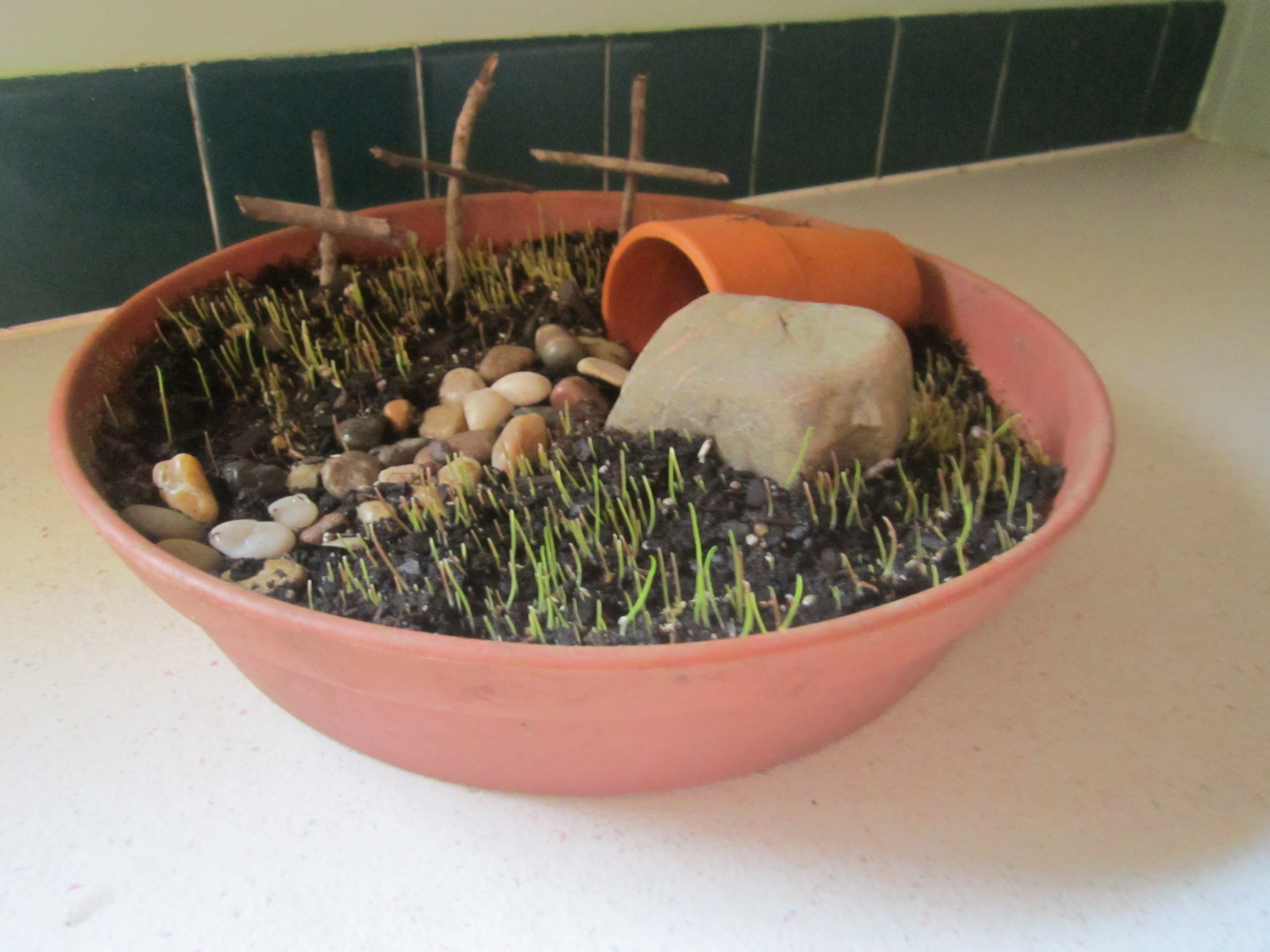
Easter garden:  This idea went viral on my Facebook and Pinterest feed this year and instead of just looking at it, I did a unique thing.  I decided to actually make it.  Shocking, I know!  My daughters and I had the best time setting up our little potted garden.  After all, it feels good to get your hands into a some potting soil in anticipation of spring!  The grass grew very quickly, though, so I’d likely wait until closer to Easter to plant our garden again next year.  I loved that my kids were asking questions about the three crosses, about the size of the stone covering the tomb, and how it was rolled away.Easter Garden

Of course, we don’t miss out on the basics.  We go to church and worship on Easter Sunday.  At night, we read from different children’s devotionals or the Bible, walking our kids through what Scripture says about the week of the Passion.

So, how do you teach your kids about Jesus’ death and resurrection during this season?

What Makes this Good?

She asked me why we call it “Good Friday.”  Why “good?”

Why “Happy Easter” or “Happy Resurrection Day?”

What makes this so “happy?”

How could we celebrate this death, this sacrifice, this sadness?  We should be so much more serious and sad, she tells me.P1040320

Like the disciples who mourned, like Mary Magdalene crying beside the tomb, surely we should remember this day with tears.

This she asks in confusion.

On Thursday, we ate the bread and drank the cup.

That’s what Jesus said that night in the upper room with disciples scattered around:  “This is my body given for you; do this in remembrance of me” (Luke 22:19 NIV).

So, we remember.

She is thinking of grape juice and crackers, a snack when you’re hungry, but I tell her it’s more than that.

And she asks, why do this?  Why talk about blood–so gross, so morbid and earthy?

It’s too corporeal for holiness and for the sacred places, the striking red against the purity of the righteous life.

Why Mom?

That’s yucky.

I think today about the remembrance of it all and why it matters.

Today is Good Friday.

It’s also the eight-year anniversary of my dad’s death.

This morning, I sat with my daughter brushing her hair and telling her about my dad: little remembrances here and there and what makes today special.

So, what makes this a day holy and set apart from other days?  Why Good Friday?

Because there’s beauty in the remembrance.  There’s honor and power in recollection.

I think this about my dad today.  Talking about him makes his life real here and now after death.  It makes it more tangible, relevant.

These daughters of mine who never knew him and only see the pictures in a photo album, mostly after he was sick and didn’t look like the dad I remember, what other way for them to know than for me to tell?

And you just don’t want this day to slip by forgotten because it would be forgetting him.

Is it any different remembering our Savior in this season?

In German, they don’t call this day Good.  They call it Mourning Friday.

But isn’t that the beauty of this day?  That even as we remember Christ’s death, even as we talk about the cross and give it true attention, even as we drink the cup so apt to stain white and we eat the bread broken, even as we tell our children the stories and we say:

This is what He did for us.  Not some pristine ritual, not something pure and clean.  It was bloody and painful.  It was death.  It was hard.  And sacrifice like that was suffering. 

It wasn’t pushed on Him because He was too weak.  Jesus “made himself nothing by taking the very nature of a servant, being made in human likeness. And being found in appearance as a man, he humbled himself by becoming obedient to death— even death on a cross!” (Philippians 2:7-8 NIV).

This is what He chose to do for us because of love so great. 

Love so good.  Love so amazing, so divine…

Even as we say this and tell this to our children, the beauty of remembering the cross isn’t just the Mourning of our Savior, it’s the Good News that the resurrection came.

Why Good?

Why Happy?

I tell her remembering is how we worship, how we give thanks, how we honor His gift to us.

And that gift wasn’t just a trinket wrapped in a package with a bow.

It was good.  Truly good.  The greatest gift at the highest price.

And the resurrection; that’s our joy.  What better reason to be happy than to know the cross was not the end and the tomb didn’t destroy our hope?

Because of this, we have life everlasting.

And because of that day, we can see any crisis as an opportunity for Him to shine with resurrection power, to resurrect the dead, to defy all expectations and trample all over the circumstantial evidence by doing the impossible.

Yes, this remembering is good.

Heather King is a wife, mom, Bible Study teacher, writer and worship leader.  Most importantly, she is a Christ follower with a desire to help others apply the Bible to everyday life with all its mess, noise, and busyness.  Her upcoming book, Ask Me Anything, Lord: Opening Our Hearts to God’s Questions, will be released in the Fall of 2013!  To read more devotionals by Heather King, click here.

Copyright © 2013 Heather King

In Times of Need

They gave her some string, a box, some tape and a few other odds and ends and told her group of second graders to design a leprechaun trap for St. Patrick’s Day.

If they’d thrown in a bar of soap and a paperclip, MacGuyver might have been able to break out of a sealed room packed with explosives on a timed detonator with two seconds to spare.020

As it was, these kids designed a contraption that would entice the leprechaun, and then stick him to the floor when he stood on the tape, and finally capture him inside the box.

My daughter described the process to me and I asked her—Did you use peanut butter to lure him in?  Did you have a stick that would hold the box up and then collapse down when you pulled on the string?

“No, mom,” she tells me, “we didn’t have any of that.  We had to use only the things on the desk.”

I could design a successful leprechaun trap, too, if I had more supplies available.  After all, I have experience from all those years as a kid with hamsters that could escape out of the most escape-proof cage and then skitter around the house…until, of course, we laid out our peanut butter trap.

It’s one of those lessons of life, though, the making do with what you have, the realization that sometimes you face circumstances where you feel oh-so-insufficient to meet the demand.

The days are hectic, the to-do list long, and we just don’t have enough time.

The relationships are stretched to breaking, and we don’t have enough patience.

The bills are too much and those unexpected expenses keep dumping themselves down on us, and we just don’t have the money.

The need is overwhelming, weighing down on our shoulders until we’re pressed to the ground, and we just don’t have the strength, or the wisdom, or the experience, or the training, or the spiritual gifts, or the manpower.

I am, after all, only one person and I only have these two hands. 
There are, undoubtedly, only so many hours a day. 
The dollar, sad but true, only stretches so far.

And even though we’ve said it so often before (God will provide) and sang it out so many times (You are more than enough for me), still we feel the lack and still it’s hard to see past the need.

Yet, when Jonathan stood with his armor bearer overlooking the Philistine camp, they were just two guys out scouting a more powerful enemy.  It was crazy to think they could actually win a fight.

But Jonathan knew that whatever the statistics said or however the odds might have stacked against them, “Nothing can keep the Lord from saving, whether by many or by few” (1 Samuel 14:6c).

Nothing can hinder our God from rescuing us and equipping us.  Not our lack of resources.  Not the strength of the enemy.  Not the circumstances or the “facts.”  Not our own weaknesses.

That’s why God’s people could walk away from slavery in Egypt without a battle.

Or why a teenage shepherd boy knocked a Philistine giant to the ground with a stone in a slingshot.

That’s why God built an army for David out of “men who were in trouble or in debt or who were just discontented—until David was the captain of 400 men.”  This rag-tag army came as they were, refugees, runaways, and rejects, and they managed to evade King Saul’s “3,000 elite troops from all Israel” (1 Samuel 22:2 and 24:2).

And that’s why Jonathan and his armor bearer led their nation to a great victory against the enemy that day.  It started with two men stepping out in faith and trusting that God could save them whether they had 10,000 soldiers or just themselves relying on God to rescue them.

Rescue them, He did: terrifying the enemy until they scattered in fear and sending an earthquake at just the right moment.

We just don’t know what resources God will use to provide and deliver.  We can look at our projected income all we want.  We can stare at our day planner and refine the to-do list as much as we please.

We can consider every possibility and take into account the likelihood of this or that.

But if God has decided to deliver us, then deliver us He will…whether by many or by few…and nothing will stand in His way.

Heather King is a wife, mom, Bible Study teacher, writer and worship leader.  Most importantly, she is a Christ follower with a desire to help others apply the Bible to everyday life with all its mess, noise, and busyness.  Her upcoming book, Ask Me Anything, Lord: Opening Our Hearts to God’s Questions, will be released in November 2013!  To read more devotionals by Heather King, click here.

Copyright © 2013 Heather King

This Little Kitty Stayed Home

One of our cats ran away last week for a 3o-hour trek into the woods.

Our other cat stayed home.003

In sympathy, my daughters talked about our large black cat missing his smaller orange “brother.”  He meowed and we thought it was a meow of sadness.  My three-year-old showed him extra affection out of concern for his worried feline heart.

Maybe he was just meowing because he was hungry.

Because when our orange cat finally sauntered home at 2 a.m., the stay-at-home cat seemed to care less at first.

Then the hissing started.

Here we are four days later, and there is still hissing.

The prodigal tries to eat food, or brush up close to the larger cat, or snuggle up on the bed where the stay-at-home cat is napping.

And we hear the ugliest, most evil hissing sound.  It’s hardly a warm reception for our runaway.

We have the classic case of the prodigal son and the older brother who remained at home working the fields.  It’s playing itself out between a behemoth black cat and a skittish orange cat in our very own home.

And this I understand just a tiny bit.

In Scripture, the prodigal son demanding his inheritance before his father’s death was more than just a young adult rebellion and a little bit of wandering and partying before responsible adulthood.

Sure it sounds so calm and level-headed at first glance when the younger son said to his dad, “Father, give me the share of the estate I have coming to me” (Luke 15:12).

Yet, it was really the ultimate rejection of a parent.  In essence, the prodigal son said, “I wish you were dead, so I’m going to take my inheritance and leave as if you had already died.”

We sometimes miss the enormity of the disrespect and insult and treat the prodigal as if he just had a wild stage that he needed to get out of his system or simply a little curiosity about the big wide world.

But it was so much more than that.  It was cutting off that relationship in what the son knew was a permanent, hurtful, totally destructive, rude, and unfeeling way.

“I don’t want to ever see you again.  I wish you were dead.  I hate you.”

That’s what the son said.

And here I am with this runaway cat, feeling the tiniest bit of rejection (and worry) that he would choose a frigid night outside in periodic snowfall over our warm home with food, fresh water, and places to stretch out for comfortable naps.

How much more the hurt of that father watching his son slamming doors and shouting in anger.

Of course, in their case when this same prodigal son crawled home, humbled and hurting, the father killed the fatted calf and threw a Welcome Home party.

And we haven’t done that.  No special treatment.  No canned tuna opened to celebrate our cat’s return.  It’s just business as usual for us.

But still our other cat hisses in annoyance like that older brother in the field, re-asserting his authority and his territorial rights. It’s more than a bit ugly.

It seems like a fitting time of year to talk about runaways and prodigals, the lost and the hurting.  Our churches are in full preparation for the Holy Week with egg hunts and sunrise services, special breakfasts and brunches.

The truth is that in the next week people we’ve never seen before or those we haven’t seen for a long time will walk through the doors of our church buildings.

In some cases, they will be simple visitors, passing through the sanctuary for only a brief time.  Others might be long-lost friends.  Still others might be the prodigals slipping into the pews, hoping not to draw too much attention to themselves.

And we have to choose how to welcome them.

With open arms.

Or with territorial hissing.

Or unforgiveness.

Or sanctimonious displays of righteousness and very little grace.

This past week, I read of a woman who slipped into the pews of a church before the service began one Sunday morning.  She bowed her head low and cried, mourning the death of her son.

A woman in the church walked over and stood looming over her while she prayed.

Finally, the visitor looked up expecting someone to pray for her or hug her or ask how to help her.

Instead, she was told, “I’ve been attending this church for 17 years and that’s my seat.”

That’s the ugly sound of hissing.

We do this in other ways, making 200 “older brothers” feel mighty cozy on a Sunday morning, and we’ll look polished and shiny on Easter Sunday, like we have it all totally together.

But perhaps we need the reminder to leave room–and not just pew space–for the younger brothers returning home, for the lost, and for the hurting.

Heather King is a wife, mom, Bible Study teacher, writer and worship leader.  Most importantly, she is a Christ follower with a desire to help others apply the Bible to everyday life with all its mess, noise, and busyness.  Her upcoming book, Ask Me Anything, Lord: Opening Our Hearts to God’s Questions, will be released in November 2013!  To read more devotionals by Heather King, click here.

Copyright © 2013 Heather King