Bible Verses on how God forgives us

verses-on-forgiveness

  • Psalm 32:5 ESV
    I acknowledged my sin to you,
        and I did not cover my iniquity;
    I said, “I will confess my transgressions to the Lord,”
        and you forgave the iniquity of my sin. Selah
  • Psalm 51:1-2 ESV
    Have mercy on me,O God,
    according to your steadfast love;
    according to your abundant mercy
    blot out my transgressions.
    Wash me thoroughly from my iniquity,
    and cleanse me from my sin!
  • Psalm 103:11-12 ESV
    For as high as the heavens are above the earth,
        so great is his steadfast love toward those who fear him;
     as far as the east is from the west,
        so far does he remove our transgressions from us.
  • Proverbs 28:13
    Whoever conceals his transgressions will not prosper,
    but he who confesses and forsakes them will obtain mercy.
  • Isaiah 1:18 HCSB
    “Come, let us discuss this,”
    says the Lord.
    “Though your sins are like scarlet,
    they will be as white as snow;though they are as red as crimson,
    they will be like wool.
  • Isaiah 43:25
    “I, even I, am he who blots out your transgressions, for my own sake, and remembers your sins no more.”
  • Daniel 9:9 NIV
    The Lord our God is merciful and forgiving, even though we have rebelled against him
  • Micah 7:18 HCSB
    Who is a God like You,
    removing iniquity and passing over rebellion
    for the remnant of His inheritance?
    He does not hold on to His anger forever,
    because He delights in faithful love.
  • Matthew 26:28 HCSB
     For this is My blood that establishes the covenant;it is shed for many for the forgiveness of sins.
  • Acts 2:38 ESV
    And Peter said to them, “Repent and be baptized every one of you in the name of Jesus Christ for the forgiveness of your sins, and you will receivethe gift of the Holy Spirit.
  • Acts 3:19 HCSB
    Therefore repent and turn back, so that your sins may be wiped out, that seasons of refreshing may come from the presence of the Lord
  • Acts 10:43 HCSB
    All the prophets testify about Him that through His name everyone who believes in Him will receive forgiveness of sins.
  • Ephesians 1:7 ESV
    In him we have redemption through his blood, the forgiveness of our trespasses, according to the riches of his grace
  • Colossians 1:13-14 NIV
     For he has rescued us from the dominion of darkness and brought us into the kingdom of the Son he loves, 14 in whom we have redemption, the forgiveness of sins.
  • Hebrews 10:17 ESV
    then he adds,“I will remember their sins and their lawless deeds no more.”
  • 1 John 1:7-9 HCSB
    But if we walk in the light as He Himself is in the light, we have fellowship with one another, and the blood of Jesus His Son cleanses us from all sin. If we say, “We have no sin,” we are deceiving ourselves, and the truth is not in us. If we confess our sins, He is faithful and righteous to forgive us our sins and to cleanse us from all unrighteousness.
  • 1 John 2:2 HCSB
     He Himself is the propitiation for our sins, and not only for ours, but also for those of the whole world.

prayerforgiveness


Accepting Christ’s forgiveness can be a struggle at times.  Maybe we try to hold ourselves to a perfect standard, trying ever so hard to be good enough and erase our sin on our own merit. Maybe shame makes us feel like God can’t use us because of our past and because of what we’ve done. anywhere-faith
But God’s grace and His forgiveness are perfect.  He doesn’t need our striving and all our effort to make grace happen.

And sometimes God doesn’t use us despite of our past; He uses us because of it.  The transformation work He does in us shows others what Christ can do when we give ourselves to Him.

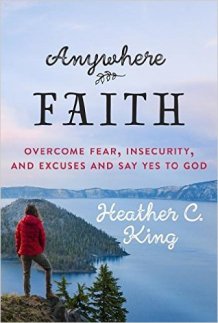
Want to learn more about how to overcome excuses, insecurity, and feelings of insufficiency and say “yes” to God?  My new book, Anywhere Faith, releases October 3, 2016.

What We Need is a Way Through the Impossible


isaiah 43

My son wrestles with two large toy trucks on our way into the orthodontist.  He’s determined to carry them both inside himself.

One falls to the ground.  He stoops to pick it up and as he grabs hold of the digging arm on the one truck, the other crashes down next to it.

But oh, Mommy cannot help carry these trucks.  I offer.  Really I do.  I even finally grip onto that yellow bulldozer as a sign that he didn’t need to handle both trucks at once.

Instead of letting go, my son silently holds on tighter and lifts that heavy machine out of my grasp.

These trucks are his treasures.  He is not letting go.

Finally, after several crashes to the pavement, the trucks arrive in the dental office where they make paths through blocks, scale the sides of chairs and roll across railings.

At home later, they do what big trucks should do.  They push tiny objects off the living room table and onto the floor.  They blaze trails through toys and flatten ground.

As an infant, my son learned the names of these vehicles as some of his earliest vocabulary:  “Truck.  Car.  Digger.”  Now, he speaks with infinite more expertise:  “Bulldozer, Dump Truck, Excavator, Crane, Cement Mixer, Delivery Van.”

If it’s big and makes noise, he loves it and knows what it’s called.

I don’t know what it is about these trucks that hold this little man’s attention so, but I know why suddenly, after a lifetime of not caring much about them, I find myself newly impressed.

They make ways.

They flatten obstacles.

They clear paths.

And maybe that appeals to me because I need some “ways” right about now.

I need some impossibilities cleared, some unlikely provisions, delivered, and some mountains moved.

Maybe you do, too?

We can look at circumstances: at bank accounts and how the numbers don’t add up, at agendas and jam-packed calendars, at job expectations and the number of hours in a day.

We can see that and think ,”There’s just no way.”

No way for hope.  No way for rescue.  No way for there to be enough.  No way for the good and the beautiful to come out of this rotten mess.

But here’s the good news: We serve a God who makes ways.

He parts waters so his people can walk straight across a sea  on dry ground.

He leads the nation through the wilderness and all its enemies.

He strikes down evil kings and raises up righteous ones, He rescues His people from annihilation over and over again.

The prophet Isaiah reminded his people that the Lord

... is the one who made a road through the sea
    and a path through rough waters.
17 He is the one who defeated the chariots and horses
    and the mighty armies.
They fell together and will never rise again.
    They were destroyed as a flame is put out.
18 The Lord says, “Forget what happened before,
    and do not think about the past.
19 Look at the new thing I am going to do.
    It is already happening. Don’t you see it?
I will make a road in the desert
    and rivers in the dry land. (Isaiah 43:16-19 NCV).

No way out of the mess you’re in?

No problem.  Not for our way-making God, the One who makes paths through the desert and springs up rivers from the dust.

Today, I read once again about the biggest impossibility of all.

Romans 3:20 tells us:

no one can be made right with God by following the law. The law only shows us our sin.

There’s the obstacle of our sin, that huge mounding imperfection blocking us from right-standing with God.

We can’t be good enough. Not ever.

So, what’s a sin-prone girl like me to do?  Try anyway?  Steep myself in rules, have-to’s, must-do’s, traditions, and legalism?

Or maybe give up?  Throw in the towel?  Just do whatever I want because I can’t ever attain that perfection?

Yet, Paul says in the very next verse:

21 But God has a way to make people right with him without the law, and he has now shown us that way which the law and the prophets told us about. 22 God makes people right with himself through their faith in Jesus Christ (Romans 3:21-22 NCV).

God has a way.

He bulldozes over the problem of sin.  He plows through the strictures of the law and he lifts into place the weighty foundation of grace in the form of a cross.

And if He can do that, if He can make this astoundingly miraculous path to forgiveness and grace even when I didn’t deserve such rescue, I know I can trust Him in my every impossibility, my every hopeless situation, my every closed door, my every mountain of a problem.

He can make a way.


A Little Library Misunderstanding

proverbs 19-11

It was a tiny bit of a library misunderstanding.

My son played quietly with the toy trains and the dinosaurs (who knew dinosaurs and toy trains went so well together?) so I sat quietly and read.

That’s when I heard two little girls nearby trip along into a conversation pit without realizing it.

They were only about three or four years old, sweet as can be, with ponytails and pink shoes.

Here’s the transcript of what they actually said:

Girl 1:  Can I play with you?

Girl 2:  (As she searches the Lego bin for the right block):  No, I’m playing Legos right now.  We can play later.

Girl 1 then pauses just as she was about to pull a chair up to the Lego table.  Her face reads surprise, then sadness and a little hurt.  She turns away and plays with the farm animals instead.

There were no tears and there was no conflict.  No one tattled or fought.  Each just went about doing her own little thing,  unaware of what the other little girl was truly thinking or feeling.

And, that’s the thing that gives me pause.  Neither of these girls really understood what the other one meant to say.  What each of them truly meant was:

Girl 1:  May I play Legos with you?

Girl 2:  Oh, sure!  I’m playing Legos right now and I’d love for you to join me.

But that’s not what happened.  Girl 1 was asking to join in the building fun.

Girl 2 thought she was being asked to stop her Lego building and go do something else with her little friend and by golly she was having a good old time making Lego animals right now.

Their conversation just missed a little.  It’s like they shot two arrows.  One went under the target and one went over the target, but no one hit the mark.

What resonates a bit with my heart today is when I’m offended or hurt and I let critical words sink deep into my soul,  what if I’m actually misunderstanding?

Sometimes people say hurtful things and they mean them.

Sometimes people say hurtful things without meaning it, but the pain is there just the same.

But sometimes people say things and we just miss.  We thought they meant one thing; they actually meant something else.

And we tote around that offense as a heavy burden, putting up walls of defensiveness in our relationships to protect us from future hurts.

Yes, they should be more careful.  What you say and how you say it matters.  Controlling our tongue and watching our words is a must.

What if we were slow to take offense, though?

I love the Amplified version of James 1:19:

Understand this, my beloved brothers and sisters. Let everyone be quick to hear [be a careful, thoughtful listener], slow to speak [a speaker of carefully chosen words and], slow to anger [patient, reflective, forgiving]

At times the best thing we can do in a conversation is pause.

Taking time to respond rather than react can keep us from misunderstanding, from holding onto hurt, and from escalating conflict.

I have an email sitting in my inbox right now and I’ll be honest, I’m offended.  It is critical of me in ways I feel are unfair.  My defenses are up.

But I’m choosing to pause.

I’ve taken some time to ask, “God, is this true about me?” and I’ve waited and listened for the Holy Spirit’s truth.

I’ve considered whether I truly know this person’s intentions.  Probably they didn’t mean it this way.  It’s most likely, since I don’t know them very well, that I just don’t understand their humor or perspective.

I read over Proverbs 19:11:

Good sense makes one slow to anger, and it is his glory to overlook an offense (ESV).

and even Ecclesiastes 7:21-22:

Do not take to heart all the things that people say, lest you hear your servant cursing you. Your heart knows that many times you yourself have cursed others (ESV).

We live in an easily offended world.  People curse you for simple mistakes and seek vengeance for misunderstandings and accidents.

We are so often quick to anger and quick to speak, leaving behind the wreckage of broken relationships and the ache of loneliness.

I want instead to say little and to listen much.

Sometimes I fail.  I am easily bruised by the criticism of others.

And yet, when I filter the comments of others through the gauze of grace, I can grab hold of truth and let the rest go.  I can respond with more love than I was shown.

Pausing gives us time to choose humility and wisdom, grace and gentleness, and it helps us hit the mark instead of missing and messing up.

21 Bible Verses about Putting the Past Behind You

verses-about-the-past

  • Genesis 41:51 ESV
    Joseph called the name of the firstborn Manasseh. “For,” he said, “God has made me forget all my hardship and all my father’s house.”
  • Psalm 25:7 ESV
    Remember not the sins of my youth or my transgressions;
        according to your steadfast love remember me,
        for the sake of your goodness, O Lord!
  • Psalm 51:10 ESV
    Create in me a clean heart, O God,
        and renew a right spirit within me.
  • Isaiah 40:1 ESV
    Comfort, comfort my people, says your God.
    Speak tenderly to Jerusalem,
        and cry to her
    that her warfare is ended,
        that her iniquity is pardoned,
    that she has received from the Lord‘s hand
        double for all her sins.
  • Isaiah 43:18-19 ESV
    “Remember not the former things,
        nor consider the things of old.
    19 Behold, I am doing a new thing;
        now it springs forth, do you not perceive it?
    I will make a way in the wilderness
        and rivers in the desert.
  • Isaiah 43:25 ESV
    “I, I am he
        who blots out your transgressions for my own sake,
        and I will not remember your sins.
  • Isaiah 65:16 ESV
    So that he who blesses himself in the land
        shall bless himself by the God of truth,
    and he who takes an oath in the land
        shall swear by the God of truth;
    because the former troubles are forgotten
        and are hidden from my eyes.
  • Lamentations 3:22-23 ESV
    The steadfast love of the Lord never ceases;
        his mercies never come to an end;
    23 they are new every morning;
        great is your faithfulness.
  • Luke 9:62 ESV
     Jesus said to him, “No one who puts his hand to the plow and looks back is fit for the kingdom of God.”
  • Romans 6:4 ESV
    We were buried therefore with him by baptism into death, in order that, just as Christ was raised from the dead by the glory of the Father, we too might walk in newness of life.
  • Romans 8:1 ESV
    There is therefore now no condemnation for those who are in Christ Jesus
  • 2 Corinthians 5:17-18 ESV
    Therefore, if anyone is in Christ, he is a new creation. The old has passed away; behold, the new has come. 18 All this is from God, who through Christ reconciled us to himself and gave us the ministry of reconciliation;
  • Galatians 2:20-22 ESV
     I have been crucified with Christ. It is no longer I who live, but Christ who lives in me. And the life I now live in the flesh I live by faith in the Son of God, who loved me and gave himself for me. 21 I do not nullify the grace of God, for if righteousness were through the law, then Christ died for no purpose.
  • Ephesians 4:22-23 ESV
     to put off your old self, which belongs to your former manner of life and is corrupt through deceitful desires, 23 and to be renewed in the spirit of your minds
  • Philippians 1:6 ESV
    And I am sure of this, that he who began a good work in you will bring it to completion at the day of Jesus Christ.
  • Philippians 3:13-14 ESV
    Brothers, I do not consider that I have made it my own. But one thing I do: forgetting what lies behind and straining forward to what lies ahead, 14 I press on toward the goal for the prize of the upward call of God in Christ Jesus.
  • Colossians 2:13-14 ESV
    And you, who were dead in your trespasses and the uncircumcision of your flesh, God made alive together with him, having forgiven us all our trespasses, 14 by canceling the record of debt that stood against us with its legal demands. This he set aside, nailing it to the cross.
  • Hebrews 8:12 ESV
    For I will be merciful toward their iniquities,
        and I will remember their sins no more.”
  • Hebrews 12:1-2 ESV
    Therefore, since we are surrounded by so great a cloud of witnesses, let us also lay aside every weight, and sin which clings so closely, and let us run with endurance the race that is set before us, looking to Jesus, the founder and perfecter of our faith, who for the joy that was set before him endured the cross, despising the shame, and is seated at the right hand of the throne of God.
  • 1 John 1:9 ESV
    If we confess our sins, he is faithful and just to forgive us our sins and to cleanse us from all unrighteousness.
  • 1 John 3:2 ESV
    Beloved, we are God’s children now, and what we will be has not yet appeared; but we know that when he appears we shall be like him, because we shall see him as he is.

Choosing Words that Heal

proverbs 12

As a girl, my dream height was 5 feet 8 inches.

I didn’t quite make it.

When I eventually made it to oh, about 5 feet 6 inches, though, I thought that was a nice, comfortable height, not tall, but not short either.

Then in my early 20’s, a doctor measured me for the first time in years.

Turns out I’m only 5 feet 4-1/2 inches.

That rocked my world a bit. That’s short.  Not extremely short.  But short.  It’s not tall or even a comfortable in-between.

I walked in and out of that doctor’s office exactly the same, but my perception of myself changed, and it felt a little disheartening.

Now, I have one daughter built long and lean and another daughter built more like me.

This is difficult.

My daughter complains about her lack of height all the time.  How she’s the shortest.  How EVERYONE in her WHOLE class is taller than she is.

I’ve navigated this body image issue for years, but it’s a tempestuous journey.

I ask her—So, you’re built like your mom.  Is that terrible?

I remind her she’ll grow.  It just takes time.

I tell her God made her beautiful, just right, totally lovely.

But this is the tender part of her soul, the soft-skinned place where Satan wreaks havoc and she’s easily bruised.

Any hint whatsoever about her size sends her into a 5-minute diatribe and withers her spirit.

A friend tells me what she said to her own daughter and I hold onto these words of wisdom until just the right moment.

It’s at church.  My daughter launches into another session of, “What’s wrong with me and why am I so short?”

I step in close, look into her eyes and say the words I’ve been storing up:  “The best things come in small packages. Diamonds come in the tiniest of boxes and yet they are a treasure.”

She blinks in surprise.  She never expected those words, this new thought to take hold of her heart.  It changes everything.

I haven’t mocked her or ignored her. I haven’t reasoned and rationalized.

I’ve cradled the most tender part of her soul in my hands and shown gentleness and unfailing love.

This is what we need to give and to receive from those we love most: our husbands, our children, the dearest friends whose secrets weaknesses we’re privileged enough to see.

They entrust us with their messes, weaknesses and failures.

We know their most honest struggles and their most common sins.

We know when the gray hairs arrive and when the scale numbers rise.

We know the flaws and the blemishes.

We know them at their grumpiest and saddest.

We know the things they dislike most about themselves and the things they wish other won’t see.

In fits of rage and bursts of anger, right in the most intense point of conflict, we have to choose:  Use our knowledge as a weapon and wound them where they are most sensitive….or lay it aside, choosing to protect the most tender parts of their soul.

Proverbs says:

Rash language cuts and maims,
    but there is healing in the words of the wise (Proverbs 12:18 MSG).

Our words can wound or they can heal.

Let us be healers.

We are the ones who can say: I  see you.  I love you.  I think you’re beautiful.

Jesus made that choice.

He was abrupt and forthright when necessary, confronting pharisees and those who lacked faith with blunt firmness.

But when he cradled a broken heart in the palm of His hand, it’s what He doesn’t say that is striking.

A sinful woman washed Jesus’ feet with her tears, dried them with her hair, and anointed Him with ointment from her alabaster box.

The pharisees criticized.  Jesus could have done the same.  Instead, he defends her, saying:

Therefore I tell you, her sins, which are many, are forgiven—for she loved much. But he who is forgiven little, loves little (Luke 7:47).

Her sins—her many sins—are forgiven.  He didn’t list them.  He didn’t drag them out for public examination.  He  protected her honor and gave her dignity.

He did the same for the woman caught in adultery and dragged out for public stoning.  She was likely thrown onto the ground naked, exposed, humiliated.

Jesus saw the weakest, most vulnerable moment of her life.

Instead of capitalizing on it and sermonizing about her sins, he covered her shame with His gentleness and grace:

Neither do I condemn you; go, and from now on sin no more (John 8:11).

When we entrust our hearts to Jesus, weak as they are, sinful as we are, He covers us with His gentle grace and unconditional love.

He sees the ugliest parts of our soul and says, “I love you.  I forgive you.  You are beautiful to me.”

How can we show this gentleness to those we love?

What to do when I’m tempted to criticize

ephesians 4-32

My friend was crying and telling me she felt like a total flake.  Life had been crazy, filled with mistakes and missed appointments, misplaced papers, forgotten promises, everything lost and mixed up and wrong.

I love my friend and I got it. Truly, I did.  I nodded my head and encouraged her while other shoppers pushed their carts past us in the grocery story.

But inside, in the secret places of my mind and heart, that compassion wasn’t complete.  It was hollow, pat-her-on-the-back kind of friendship–the kind that is sorry she had a bad week, but fell short of true understanding or free-flowing grace.

The truth was, deep down, I was judging her as much as she judged herself.  And it was ugly.

Forgetting, missing, losing, making mistakes? It sounded like a too-busy schedule and an absent organizational system.  Maybe a few files and a day planner could save the day.

Two weeks later, I was sobbing at my kitchen table.  It had been a week of misplaced papers and missing items—not little insignificant things—BIG things, like legal documents and DMV paperwork.

For someone generally in control and on top of things, the week had been devastatingly humbling.

Then, I felt the deeper challenge.

God never lets me get away with passing silent judgment or criticism on another.  Never.

Nor should He.

The very moment I start internally critiquing another mom or putting another friend in a labeled box based on her mistakes and weaknesses, I know God will be at work in my life, bringing me to my knees to ask for forgiveness.

Because I need a Savior.

Because I’m a mess, too!

I’m not perfect and my life isn’t perfect and the thing we all need as moms and as women and as flaw-filled humans is heaping loads of grace and compassion, not quiet judgment or silent criticism.

We stumble into the judge’s seat so easily, thinking we know the people around us:

The frazzled-looking momma with the crying baby in Wal-Mart.
The parents whose teenager disappeared from church.
The couple who met with the divorce lawyers last week.
The husband and wife holding the bankruptcy paperwork.
The family with the nice new car and large house.
Those who homeschool (or don’t).
Those who have large families (or small).
The mom who commutes every day to work (and the one who doesn’t.)
The highly fashionable woman next to you in church, with perfectly polished nails, a size 4 waist, and a wardrobe that looks like it costs more than your house (or the one in jeans and a t-shirt).

As long as we’re quiet about it, after all, there seems little harm.  It’s only in our heart, only our own private thoughts of criticism.

Maybe it spills over occasionally into snarky remarks and private jibes with like-minded friends, but mostly we control the collateral damage.

Yet, isn’t that the picture of the pharisees in Luke 5?

Scripture tells us: “One day Jesus was teaching and Pharisees and teachers of the law were sitting there” (Luke 5:17).

They had front row seats, a privileged view of the hurting crowd.

They watched four friends carrying a man on a mat and lowering him down through the ceiling.  They watched as Jesus healed him, saying, “Friend, your sins are forgiven” (Luke 5:20).

While the man and his friends rejoiced and the crowd marveled, others remained unmoved:

The Pharisees and the teachers of the law began thinking to themselves, “Who is this fellow who speaks blasphemy? Who can forgive sins but God alone?” (Luke 5:21).

They were just “thinking to themselves.”  They weren’t gossiping or heckling Jesus.  They didn’t hop up then and there to condemn Him.

It was just an internal dialogue, a private moment of judgment and condemnation.

But, “Jesus knew what they were thinking and asked, ‘Why are you thinking these things in your hearts?‘” (Luke 5:22).

Even our most secretive judgments of others have an audience—Jesus Himself.  

Would He also be disappointed about what I’m thinking in my heart?

After all, judgment that doesn’t appear on protest signs or Facebook posts or Twitter feeds is still judgment and it still hurts.

Instead of criticizing or labeling others when I see them struggling or hurting, I should be drawn to intense and consistent intercession, praying for them rather than picking at them.

As Oswald Chambers wrote:

‘God never gives us discernment in order that we may criticize, but that we may intercede.’

I should be slow to condemn and quick to pray for others.

The truth is I’m desperately in need of the grace Christ has poured out on me, and if I need that kind of grace, then I need to show that kind of grace: unhindered, unqualified, unmarred by an undercurrent of criticism and condescension.

Just grace.

Beautiful, pure, deep down honest grace.

(Author’s note: Of course, this doesn’t mean we can’t discern or judge right from wrong, sin from not-sin, etc.)

Today I can’t do perfect, but I can do good

psalm 37-1

Shhhh…don’t tell my daughter, but I let her down last month.

She just doesn’t know it.

Five years ago, I committed to having lunch at the school with each of my daughters every single month.

Now that I have three girls in elementary school, that’s three lunches a month or 27 lunches a year, plus an occasional extra lunch thrown in for a birthday or other special occasion.

My kids are typically on top of this, too.  If I haven’t had lunch with my youngest daughter within the first week of a new month, she starts nudging.

Mom, you know you haven’t had lunch with me this month, right?  When are you coming?

The very first day my kids went back to school after winter break—the very first day!!!!!–she came home from school and asked when I was coming for lunch.

But January zipped right past me.  I made it up to the school for my  youngest daughter (or I’d never have heard the end of that failure!), but not to eat with my two older girls.  Every time I planned a day for school lunch-time, we had a snow day.

When they actually had school, I was in a mad rush to make up for everything I didn’t get done because of those same snow days.

My husband says—You’re eating lunch with them at home.  Doesn’t that count?

No.  That does not count.

Finally, on the last day of January I resigned myself to the truth:  I’d failed: A five year streak of faithfulness broken by winter weather and a packed calendar.

Funny thing is, the one daughter who I thought would be bruised and destroyed forever by my failure never even noticed.  She didn’t pressure me about it, didn’t nag or pester.

So, I’m not telling her I missed out on January’s cafeteria lunch.  It’ll be our little secret. I just went early in February and hoped for the best.

At the beginning of this year, I set some goals in four areas of my life:  Marriage, Parenting, Ministry, and Self-Care.

I’ve been replacing soda with water or green tea.

I’ve been exercising and listening to podcasts while packing my kids’ school lunches.

But there’s one that’s harder to do. It’s not a box to check off or a physical habit to create.

It’s this:  Choose to be gentle with myself.

It means not letting Mom Guilt terrorize my like the tyrant it is.

It means not listening to my self-criticizing internal dialogue.

It means putting a Lunchable in my kids’ lunch box every once in a while.

It means not beating myself up if I occasionally have to order pizza for dinner or go for the quick-fix like boxed macaroni and cheese.

It means laughing instead of berating myself if I forget, and cutting myself off from chores in the evenings so I can spend some time with a cup of hot tea and a book.

And yes.  The struggle is real to let go and choose grace.

I still have this nagging sense of guilt that I didn’t make it to the school for those lunches in January.  It’ll probably plague me for a long time.  Because I can’t go back and fix it. I can’t make it all perfect.

Then I read what the Psalmist said:


Trust in the Lord, and do good;
    dwell in the land and befriend faithfulness.
Delight yourself in the Lord,
    and he will give you the desires of your heart.

Commit your way to the Lord;
    trust in him, and he will act.
(Psalm 37:3-5 ESV).

Trust Him and do good. That’s what it says.

It seems I spend a whole lot of time and effort trying to “do perfect” or “do all.”

But that’s not what God asks of any of us.

God doesn’t expect perfection because He knows we’re imperfect.

He simply asks us to trust Him, “do good” and keep doing good.  Choose the right things.  Show up day after day.  Be faithful.

Even more than that, don’t try to figure it all out or make it all work.

He’s not going to give us the desires of our heart because we worked like mad-women to make them happen.

He gives us the desires of our heart when our greatest desire is for Him.

And after Jesus, what is it that my heart desires?  It’s to love my kids to Christ.  One missed lunch isn’t going to change that.

You cannot be perfect today.  Neither can I.

But we can trust God and do good and leave everything in His hands.

And we can choose to be a little gentle with ourselves today.

Shrug off some shame and step into some grace.

Let go of some expectations and cling to the freedom Christ offers.


For the times you want to hide

psalm 139-1

My daughter tried a stealth move.

I set my cup down on the floor next to the sofa where I was sitting.

She crawled over and paused.

Out of the corner of my eye, I saw her glance my way without fully turning her head, just flitting her eyes up to see if I was watching.

The she made her move.  She swooped down, sucked on the straw and gulped down my drink.

And….

She grimaced.  Her whole body bounced back as she crawled to the other side of the room with a combination look of utter confusion and a little disgust.

She didn’t know I’ve been drinking green tea instead of Cherry Coke recently.

“Didn’t expect that, did ya?” I teased her and she laughs because she knows she deserved that little shock to her palate.

Since then, she’s been asking me, “Mom is that water in your cup or is it the other stuff?

She was surprised by what she found in my tumbler that day, and she doesn’t want it to happen again.

Her little encounter with my green tea has me thinking:

Others might be surprised by what’s within us sometimes.

We might be surprised by what’s within us sometimes, too.

We think we’ll find fresh water, and it’s something gross instead.

We think it’ll be a delight, and instead it’s disgust.

Not God, though.  God is never surprised by what He finds within our hearts and lives.

He knows.

Psalm 139:1 says:

O Lord, you have searched me and known me!  (ESV).

Some part of me wants to hide from that.

God, please don’t see the worst in me. 

I don’t want Him to see the mixed motives or the idolatry, the way I fight with perfectionism and feeling not-enough.

I don’t want Him to see me lose my temper or get annoyed or feel like giving up.

I want to bury that jealousy or coveting and hope he doesn’t notice the bump in my backyard.

I want to cover over the mistakes and mess-ups or fatigue or worry, the bad moments and the bad days.

If God sees my worst, surely He’ll give up on me.  He’ll use someone better, call someone purer, bless someone holier, because I’m such a broken vessel.

Then I think of Nathanael.

When Jesus called out to Peter, James, John and Andrew, they were hauling nets along the sea, just another day of work.  He said, “Follow me,” and they dropped the fishing gear and stepped into discipleship.

Jesus called Matthew and immediately the tax collector hopped up from his papers and pencils and followed.

It’s such a beautiful calling.  It’s the calling of the willing and the obedient, the receptive and ready.

Then there’s Nathanael.

When Philip saw Nathanael that day, he told his friend all about how they had found the Messiah, Jesus of Nazareth.

Nathaniel mocked the thought.  It was a joke, surely.  He asked:

“Can anything good come out of Nazareth?” John 1:46 ESV

It wasn’t a beautiful moment of faith or instant belief.  He didn’t seem receptive or ready.  He was doubtful and disdainful.

Then Jesus came along, saw Nathanael and said:

“Behold, an Israelite indeed, in whom there is no deceit!” 48 Nathanael said to him, “How do you know me?” Jesus answered him, “Before Philip called you, when you were under the fig tree, I saw you.” 49 Nathanael answered him, “Rabbi, you are the Son of God! You are the King of Israel!” (John 1:47-49 ESV).

How do you know me?

That’s what Nathanael asked.

Then, realizing that Jesus did in fact see into his very heart, Nathanael confessed faith.  He worshiped.

He followed Christ and became one of the 12 disciples of Jesus.

Even now, the Armenian church claims Nathanael as their founder.  Church tradition says he preached as far as India and was martyred there.

He became sold out for Jesus.

But here’s what I love.

Jesus knew everything about him right from the beginning, the skeptical side, his mocking jest with Philip, and still called him and commissioned him.

There are days when I’m surprised myself at the sin still clogging up my heart.

But not Jesus.

And then that shame ensnares me.  I think I need to clean myself up and fix myself and get to work on my sin problem before God could bless any offering I bring.

But that’s not what God says.

That’s not what Jesus does.

Jesus bids us come and follow here and now, just as we are, not as we ought to be.

He loves me now, the imperfect me, the me that wants to be like Jesus but isn’t there yet.

Jesus doesn’t know you and reject you or set you aside.

He knows you.

And He loves you.

He knows you.

And He calls you.


This is Mine. God said.

Ephesians 1

“Mine.”

My son drags his dark blue towel through the living room.  It’s not even bath night, so I’m not quite sure what inspired him to stake this claim.

But he pulls it along behind him and then holds it out so I can see his territory.

“Mine.”

And then to punctuate the point, he points to the “A” I sewed onto the towel and says, “A. Andrew’s towel.”

Now, sometimes he has this whole “mine” thing mixed up.

He says, “mine” as he snatches books out of his sisters’ hands, and their blankets, and their toys, and their toothbrushes and hairbrushes, and their jackets and hats, and their shoes.

If you listen to him some days, you’d think the whole world was his personal possession.

He’s territorial like that, more than any of my girls ever were.  He stakes claims.  He demands rights.

And he holds onto what he thinks is his with a He-Man grip and a warrior’s willingness to defend his belongings by any means necessary.

When you’re two years old, you just want what you want, I suppose.

So, I teach him.  I take stands against the tiny tyrant within him.  I defend his sisters from his raids through their stuff, and when he finds something that is his, I’m quick to agree, and then teach him to share.

Yet, while I’m working to expand his vision of the world, to remind him that others matter and we can’t just trample all over them (or bite them or hit them or pull their hair), and to be gentle, and to be giving and generous….I’m also feeling a different kind of soul-challenge myself.

I wonder if I have that same warrior within to defend what Christ says is mine.

Or do I too often let the world and let others and let Satan and let my own insecurities and fears snatch away what God has given me?

In Ephesians, I read:

 Blessed be the God and Father of our Lord Jesus Christ, who has blessed us in Christ with every spiritual blessing in the heavenly places (Ephesians 1:3 ESV).

Paul tells us what belongs to us in Christ, because of Jesus, not because we’ve earned it or worked hard to receive it.

Louie Giglio lays it all out in his book, The Comeback:

In Ephesians, the phrase ‘in Christ’ is used 10 times in the first 14 verses. That is,

You’re blessed in Christ.  You’re redeemed in Christ.  You have forgiveness of sins in Christ.  You were chosen in Christ to be holy and blameless. You have every spiritual blessing in Christ. You were included in Christ. You’ve been made aware of the plans of God in Christ. In Christ you’ve been sealed with the Holy Spirit.  In Christ you’ve been loved.  In Christ is where the hope comes (bold emphasis is mine).

God says all of this belongs to us when we are in Christ.

And yet I can live defeated and depleted.

I harp on my sins and mistakes, I beat myself up with what I did wrong.

That typo.  That stupid thing I said.  I should have called her and I forgot.  I lost my temper. I’m not a good enough wife.  I wasn’t gentle with my kids.  I was foolish with my time.  I haven’t prayed enough.  I’m not a good enough Christian.  I didn’t exercise today.  I haven’t been making my kids practice the piano.  I’m not a good enough mom.  I missed notes on the piano.  What I wrote isn’t as good as what she wrote.   A friend is depending on me and I’m sure I’m letting her down.  I forgot to send the card that I meant to send and even bought and wrote but just haven’t put in the mailbox.  I’m not a good enough friend.  I should spend more time in Bible study. I should spend less time on social media.  On the other hand, I’m not doing enough on social media as a writer.  I should drink more water and less everything else.   I wanted to do that project on Pinterest with my kids and I didn’t.  I’m just not good enough.

That could be just half an hour in my head.

I should.  I need to.  I didn’t. 

I failed.

God says in Christ I’m forgiven.

He says in Christ I’m loved.

Ephesians says in Christ, I’m chosen and made holy, blameless.

In Christ, I can live with hope instead of hopelessness.

In Christ, I am redeemed.  In Christ, I am blessed.

So I need to start claiming what’s mine and living in what’s mine and defending what’s mine instead of living without.

“This is Mine.  Heather’s.”

God says this belongs to me.


Have mercy on us

daniel 9

My oldest girl gave a speech that was bursting with righteous indignation.

Her class had misbehaved in the school lunchroom.

These fifth graders had been out of their seats, standing up on the little round chairs attached to the lunch tables.

They had been loud and obnoxious.

So they were punished.

It wasn’t just the misbehaving few, though, who bore the load of consequences.  Oh no, the whole class had to write a letter of apology to the lunchroom monitors.

And that wasn’t fair, my daughter said.

Why should she apologize for the bad choices of others, for their immaturity and out of control actions?  She had sat there quietly eating her lunch.

Yet, she had to write, “I’m sorry.”

So, she devised a plan: Write a letter that absolved her of responsibility.  “I’m sorry that others in my class were out of control.  I’m sorry that other students were so bad.”

That kind of thing, the kind of line-in-the-sand distinction between the righteous and the unrighteous, the right and the wrong, the worthy and the unworthy, the good and the bad.

We’re experts at these kinds of distinctions.  We draw lines politically.  We draw lines socially.  We draw lines at work and maybe at church more than anywhere else.

Our prayers are “us” versus “them.”

“Lord, please forgive those people who sin.  Please forgive those who really aren’t following you.”

We know those prayers don’t include us, of course, not the good and holy ones who clearly have earned God’s favor.

Yet, I challenge my black-and-white, rule-following, fairness-and-justice-demanding daughter with a prayer from the book of Daniel that’s a shock to pride and self-righteousness.

Israel had committed idolatry.

Not Daniel, of course, but masses of people had been traipsing after foreign gods and stone idols for generation after generation.

Israel had disobeyed the law and dishonored the temple.

Not Daniel, of course, but so many others had turned their backs on God, choosing blasphemy and rebellion instead.

God finally declared, “enough is enough!”  He disciplined his people by allowing them to be conquered, the temple destroyed, His people taken away from their homes.

Now Daniel was in Babylon, one of the first to be carted away from his home and taken into captivity in a foreign land.

He was now a subject of pagan kings, living and working in an environment often hostile to his faith.

Daniel bore the full weight of God’s punishment for his people, but he hadn’t done anything wrong.

He was a sinner, of course.  We all are.  Yet, he hadn’t committed idolatry.  He hadn’t defiled himself.  He hadn’t sacrificed children to Molech or bowed down to Baal.

Still, when he prayed for his people, Daniel said this:

“Alas, O Lord, the great and awesome God, who keeps His covenant and lovingkindness for those who love Him and keep His commandments, we have sinned, committed iniquity, acted wickedly and rebelled, even turning aside from Your commandments and ordinances. Moreover, we have not listened to Your servants the prophets… (Daniel 9:4-6).

We have sinned.

We have disobeyed.

We have not listened.

We.

I share this with my daughter and I ask her to consider what it would look like if she apologized for the “We” and not the “Them.”

She didn’t do anything wrong, yet could she humble herself enough to set aside the ‘fair’ and ‘just’ and choose the low and the merciful and the heart of intercession?

“I’m sorry that our class caused such a disruption.  I’m sorry that we didn’t behave in the lunchroom.”

Could she make that choice like Daniel did?

Can we?

When we pray for others and when we pray for our nation and for our churches and our communities, our husbands, our kids, our family, our friends, can we choose to pray with them instead of praying while looking down at them?

Not, “Lord, please forgive my husband for not praying like he should and leading our family like you want him to.”

Not, “Lord, please forgive my friends who gossip.”

Not, “Lord, please forgive the people in our country who are messing it all up.”

No, like Daniel, we drop down on our face before God and cry out, “God forgive us!!  We have messed up.  We have sinned.  We are unworthy.”

And we know this truth, that God doesn’t wash us clean because we deserve it, not because we’re good enough or holy enough or righteous enough to merit grace.

Daniel said it:

We do not make requests of you because we are righteous, but because of your great mercy (Daniel 9:18 NIV).

How could this change the way we pray for our marriages, families, churches and nation?