What Silence Means…

It’s when they’re quiet that you need to be worried.

That’s parental advice passed down through generations, usually learned from personal experience.

I learned my lesson, too.

My oldest girl did this thing when she was three years old called a “tantrum.”  Maybe you’ve heard of them?  Maybe you’ve seen one . . . or thrown one.

After a particularly rowdy tantrum on the car ride home one day, she stomped into the house still screaming, ran into my bathroom and slammed the door.

Unfazed, I took my time setting her baby sister down for a nap and tossing my keys and arm-full of papers and baby paraphernalia onto the kitchen counter.  I breathed in deep breaths of Mom sanity.

Then I realized that the banshee wail had subsided into silence, frighteningly loud silence.

Throwing open my bathroom door, I saw my red-faced preschooler crouched on the carpet, her hands covering her head as she sobbed.

On the floor next to her was her hair.

Her hair!

Her long, totally beautiful, golden curly hair.  In her rage, she had climbed onto my bathroom counter and dug through to the bottom of my makeup case where I hid the hair scissors.  Then she had systematically snipped off the two pig-tails on the tip-top of her head.

She was bawling.  I was bawling.  We raced to the local hair salon and plopped her up in the chair for a rescue mission.  Our superhero that day sported a comb and some clippers.

Sometimes we think silence means inactivity and stagnation, abandonment and loneliness, but instead it’s often a sign of focused activity.

With kids, that might mean trouble.

With God, though, as heart-wrenching and full of despair as His silence is, we needn’t fear the quiet.  It’s often a promise that He’s at work right there in the middle of your circumstances, deeply involved in your life.

This was me not long ago.  I thought I had it figured out, what God was doing and how He was at work and how He planned to bless and care for us, but I was wrong.

The thing about cramming God into boxes is that He shatters the confines of the cardboard.

So, when life didn’t go as I had planned, I cried out to Him: What are you doing?  What does this mean?

Why can’t I hear You?

The silence is so oppressive and filled with overwhelming sadness.  We just want to hear His voice, His quiet voice or His booming command, His encouraging cheer, or His tender whisper.  Whatever He wants to say, we’re desperate to hear it.

Because we feel afraid.

I drove off that night on an arbitrary errand, alone in my car, praying away in the quiet.  Then I hit the play button on the CD for our church Christmas cantata:

“Peace, oh my soul, weary from the struggle
Don’t be afraid, Love knows your deepest need.
There is a light shining in the darkness.
There is no shadow where it cannot reach.
Peace, peace, Jesus has come
O soul, be still, receive your King”

The song faded and one lone voice cut through the silence:

“The Lord is with you . . . Fear not, Mary ….For nothing is impossible with God….Joseph, fear not.  Fear not!  For unto us a child is born, to us a Son is given…Fear not; for, behold, I bring you good tidings of great joy…Fear not!  They will call Him Immanuel–which means, ‘God with us.’  Fear not, for I am with you”

My husband asked me when I flopped on the couch later, “Were you crying?”

How could I do anything but cry?

I had been desperate for the slightest trickle of His voice and He had drenched me in His Word.

But even when I didn’t hear Him, God was still there, still active, still with me. That hadn’t changed.

In his book, Greater, Steven Furtick writes:

God is often working behind the scenes of your life, orchestrating His destiny for you.  Even though you don’t have a clue what He’s up to.  Just because you haven’t heard God call your name or tell you specifically what to do with your life doesn’t mean He’s not conspiring great things for you.

Sometimes we feel like Job: “I cry out to you, God, but you do not answer; I stand up, but you merely look at me” (Job 30:20).

But even in the silence we can hold to the promise:

As for me, I call to God, and the Lord saves me.
Evening, morning and noon I cry out in distress,
and he hears my voice
(Psalm 55:16-17).

He hears you.  And when He chooses to speak, the wave of His voice might wash over you and knock you off your feet and carry you to safety.  For now, just keep listening, keep waiting, and don’t be afraid of the silence.

Heather King is a wife, mom, Bible Study teacher, writer and worship leader.  Most importantly, she is a Christ follower with a desire to help others apply the Bible to everyday life with all its mess, noise, and busyness.  Her upcoming book, Ask Me Anything, Lord: Opening Our Hearts to God’s Questions, will be released in the Fall of 2013!  To read more devotionals by Heather King, click here.

Copyright © 2012 Heather King

Sandals in the Grass: Time for a Change

“It is well for us that, amidst all the variableness of life, there is One whom change cannot affect; One whose heart can never alter, and on whose brow mutability can make no furrows.” ~ Charles Spurgeon

The weather changed in the night.

I mistakenly threw on sandals in our mad rush out the door on Sunday morning, not expecting frigid droplets to seep over onto my feet from the damp grass.  Climbing into the mini-van, I tucked my feet under me and pulled my arms through my “sanctuary sweater.”

My heart has always done cartwheels at the first signs of fall.  As a school girl walking home from the bus stop, I’d pass neighborhood porch displays of scare crows, pumpkins and bales of straw.  The lawns would be dotted and then covered with leaves turned gold and red.  The breeze carried the scent of fireplaces lit, perhaps for the first time of the season.

It’s the oddest thing about fall.  Even as everything moves inevitably toward the frozen death of winter, it feels like all is alive and fresh and new and wildly open to possibilities.

Maybe it’s the student in me, who still sees fall as a time of beginnings rather than of harvest.  Maybe it’s just that I hibernate in the summer when the heat of the day is suffocating.  In the fall, it feels like you can breathe in deep for the first time in months.

And that’s not the only oddity about the season.  How can I, someone who resists all change and dreads it as much as a boogeyman in the closet, revel in a season that is all about change?

It just doesn’t make sense.

Yet, there it is.  I love fall.  But I’ve also tossed and turned these past few weeks over my kids getting new teachers (I liked the old ones); about their new lunch schedule (I liked the old one); about my new weekly calendar with kids’ activities, and church meetings, and the like (the old one seemed to work so well.)

Maybe if I had sought these changes out, if I had felt stuck and needed rescue, if I had been languishing and needed new life, then I’d be celebrating instead of whining.

But as it is, I’m feeling like I was kinda happy back there and this change, well I just wasn’t ready for it:  No more ready than I was on Sunday morning when my feet froze in my sandals.

Life forces change on us, though.  God’s goal of transforming us into His Son’s likeness, of making us new and new again, requires constant life-revolutions and world adjustments.

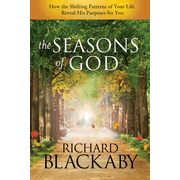
In his book, The Seasons of God, Richard Blackaby wrote:

“Newness is God’s specialty, a trademark of the abundant gifts He gives us—and as we traverse the unique succession of seasons He’s designed for us, we’ll find our way marked by fresh adventures, surprising encounters, and unprecedented fulfillment.”

So, it should be no more surprising than the cooling of the weather in September that God shakes things up in my life.  Yes, change is one thing in our lives that’s constant.

Unlike Blackaby, though, I’m less inclined to call that an “adventure” or look forward to “unprecedented fulfillment.”  I’m more likely to worry all along the way about what’s new and different and therefore out of my control.

Why is that?

I was reading this morning in 1 Corinthians 13 and noticing perhaps for the first time that love “always protects, always trusts, always hopes, always perseveres” (1 Corinthians 13:7).

Always.

I may adore my daughters and love my husband, but I can’t say my love for them always does anything.  Sometimes I lose my temper or forget or say the wrong thing or see the negative instead of the beauty.

But God’s love, that agape, holy and pure, tried-and-true, never-changing love of His is an Always kind of love.

Even the rays of the sun filter through my window in different ways on different days at different times, but God “does not change like shifting shadows” (James 1:17).

So all this fearful anxiety over the newness of it all is foolishness really, because even when every tiny thing in my life changes:

God does not. 

His love does not.

So, I pulled on one of my favorite sweaters this morning and opened the windows of the house to enjoy the breeze.  I’ve lit my pumpkin spice candle and readied my recipe file of Crock-pot soups and stews.  I’ve taken down the marriage prayer plaque and replaced it with my sign: “Bless This Harvest.”

I’ve settled in to enjoy the fall and maybe, just maybe, the change it brings.

What do you love about the fall?  How do you feel about change? 

You can read more devotionals about this here:

Christian Writers Blog ChainToday’s post is part of the September topic ‘Change’ by the ChristianWriters.com Blog Chain. You can click on the links on the right side of this page to read more articles in this series.

Heather King is a wife, mom, Bible Study teacher, writer for www.myfrienddebbie.com and worship leader.  Most importantly, she is a Christ follower with a desire to help others apply the Bible to everyday life with all its mess, noise, and busyness.  To read more devotionals by Heather King, click here.

Copyright © 2012 Heather King
Weekend Rerun: And Then What Happened, Part I

Originally posted on June 1, 2011

“Nothing, you see, is impossible with God”
(Luke 1:36, MSG)

I’m not a big fan of surprises and hate suspense.  With the end of the regular TV season, I recorded the season finales of a few shows and will let them sit unwatched until September.  That way I can watch the season finale in all of its suspenseful glory and then immediately watch the resolution that typically occurs in the first 5 minutes of the new season.

Spending an entire summer not knowing how a story ends is not my idea of a good time.

I do it with books, too.  If a character is in jeopardy, I’ll flip ahead a few pages to see if his name still occurs in the text (he must still be alive) and then turn back to continue the story from where I left off.  Removing the tension and nervousness helps me enjoy the story with leisure.

At least, that’s my excuse.  My husband, however, says “I destroy the dramatic integrity of the author.”

Outside of the fictional world, I’m still no fan of cliffhangers. As a believer in Jesus Christ, I can live with my eternal future already determined.  I can easily skip to the end of The Book, read the final chapters and then happily mosey through the rest of the story, looking forward always to the “blessed hope—the appearing of the glory of our great God and Savior, Jesus Christ” (Titus 2:13).

In some ways, though, my eternal destination is the easy part.  It’s the suspense of day-to-day living that makes me want to “skip to the end” at times.

Once in middle school I lost my math book for a few days.  Fearing my teacher’s wrath (this mild-mannered, soft-spoken Algebra teacher of mine), I prayed at night, letting God know that it would be a great time for Jesus to come back and requesting that He please end my misery by whisking me off to heaven.

The rapture obviously did not occur in order to meet my middle school needs.  Instead, I had to “fess up” and tell my teacher about my missing book, which he promptly discovered in the Lost and Found.

That night I spent without my math book, though, was a horror of suspense.

Maybe you, like me, have asked some of these questions, no longer about lost math books, but now about your children, your marriage, your finances, your job, your ministry, your future.  Is everything going to turn out okay?  What is going to happen next?  Will things work out the way I want them to?

When I find myself asking these questions, I’ve learned to stop and ponder these things:

Part I: Put It In Perspective:

As a teacher, I had occasional extra duties outside the classroom, including morning drop-off.  One morning, a petite third-grade girl ran up to me in hysterics.  I thought someone had died, certainly some horrible tragedy had occurred in her home.  It seemed like a true crisis.

She had forgotten her lunch.

“Oh, baby girl,” I said as I held her hand and dropped to my knees so I could look in her eyes, “it’s okay.  Maybe we’ll call your mom for your lunch.  Maybe we’ll get you lunch from the cafeteria.  Either way, you don’t need to worry.”

Immediately, I felt that deep prompting of the Holy Spirit: “How often have you cried in despair over a crisis that is as easy-to-fix in My sight as a forgotten lunch bag?” 

It’s not that God brushes aside our pain as childish or that the trials that leave us broken and hurting are foolish and unimportant to God.

Not at all.

Yet, it’s so easy to lose perspective because the issues we face in this world are sometimes big, certainly too much for us to handle and it’s hard to have hope when circumstances seem hopeless.

Consider some of the “cliffhangers” in Scripture:

  • Moses and the entire nation of Israel stood on the banks of the Red Sea, rushing water in front of them, Pharaoh’s army in hot pursuit behind them.  Would God rescue them from the enemy and bring them to freedom?
  • Daniel spent all night alone in a dark den of hungry lions and the king himself burst out of bed at the first light of dawn to see if Daniel had survived the night.  Was he still alive down there?
  • The three men stood before the fiery furnace, watching as the guards carrying them to the edge of the flames burnt to ashes.  Would God save them from the furnace?
  • Esther marched into the throne room uninvited by the king in order to beg for mercy for her people, knowing that her boldness could get her killed.  Would the king allow her to live and grant her request?

These aren’t scenarios of lost math books or forgotten lunches.  They are life and death matters in the worst possible physical circumstances.  So then what happened?

What happened was God.

What happens in our Christian walk will always be with God. 

When we stand on the precipice of unknown, feeling the knots in our stomach, fretting at night rather than sleeping, wondering what will happen next, we hand that situation over to God and then remember:

God can do anything, you know—far more than you could ever imagine or guess or request in your wildest dreams! He does it not by pushing us around but by working within us, his Spirit deeply and gently within us
(Ephesians 3:201-21, MSG).

Even in the biggest trials, we must remember how big our God is.

Heather King is a wife, mom, Bible Study teacher, writer for www.myfrienddebbie.com and worship leader.  Most importantly, she is a Christ follower with a desire to help others apply the Bible to everyday life with all its mess, noise, and busyness.  To read more devotionals by Heather King, click here.

Copyright © 2012 Heather King

Catching Fireflies on a Summer’s Night

For one who has died has been set free from sin.”
Romans 6:7

It’s what summer looks like to me.

Stepping out into the slightest hint of coolness in the final minutes of a hot summer’s day, we carry an empty Mason jar with a foil lid folded down over the edges of the glass.  The sun drifts down and the light dims so that we can see the fireflies at play.

Last night, I called them “lightning bugs” like we did as kids, and my daughter scrunched up her nose in confusion.

Lightning bugs.  Fireflies.  It’s the freedom of summer.  We stay up past bedtime and run around the yard swinging our arms and cupping our hands trying to catch one.  Unfortunately, I think we’ve scared off the fireflies in our particular area.  They hear us coming and taunt us by flying just a little too high and just a little too far into the woods.

Still, we manage to catch a few.  For those daughters who don’t succeed in the hunt, we gently ease a bug into their hand and they giggle because it tickles, of course.  Then we drop the firefly softly into the Mason jar and deftly replace the foil lid so none escape.

On TV, whenever you see a jar of fireflies, it’s lit up, a natural lantern for the evening jaunt.

But I haven’t seen this.  Last night as I watched the few captives in our jar, they remained dark.  They didn’t expend any energy for light.  Instead, their every effort remained focused on escape.  Most of them immediately scaled the jar and sat at the top, right up against the foil, just waiting for me to open the lid again so they could fly to freedom.

Usually, we manage to defeat their various tactics and keep them in the jar until the end of the night when one daughter whines because she didn’t catch one and another daughter begs to catch just one more.  Then they all ask if we can just keep them overnight or for an hour or just a few minutes.

Pleeeeease?   Pretty please?

But I’m sympathetic to the plight of our captives.  So, before we trudge inside we lift up the foil lid and let loose the fireflies.  They jump into the air and without hesitation light up—probably sending out a warning that predators are on the move.

Whatever their message, freedom helps them shine.

Their freedom comes at little cost to them really.  They’ve made attempts at escape, but most have failed.  Ultimately, their freedom flight simply requires me to lift the foil beneath my fingers.

Our freedom, however, is costly.  Physically, most of us receive the gift of freedom because of the sacrifice of others.  I read this week that Thornton Wilder, the famed American playwright and novelist, fought in both WWI and WWII.  People like him paid the price for people like us.

In the same way, our spiritual freedom carries a high price tag, one we could never pay.  Instead, we are the recipient of freedom because of another’s sacrifice.

Paul tells us:

“For freedom Christ has set us free; stand firm therefore, and do not submit again to a yoke of slavery” (Galatians 5:1).

Freedom is God’s design for us.  It has always been His intention and plan and Christ willingly paid the costly price on our behalf.

A girl in my online Bible study group reminded me of this verse:  “…God anointed Jesus of Nazareth with the Holy Spirit and with power. He went about doing good and healing all who were oppressed by the devil, for God was with him” (Acts 10:38 ESV).

Jesus is a freedom-giver, a defeater of oppression and freer of captives.

But Paul charges us with a task, as well. Christ offered us freedom and now it is our job to “stand firm” and refuse to submit to slavery again.

It seems silly, but we often choose prison over the freedom Christ offers.  We sit in the bottom of our Mason jar, unwilling to fly and light up the night.  Perhaps we want to do it on our own, scale the glass, escape the lid.  Perhaps the night air is too frightening and the jar too comfortable because it’s what we know.

Do you do this?

If anxiety is your jail, do you rebuild the prison walls by wallowing in fear, allowing your mind to travel where it shouldn’t, looking up information that you know will disturb you, inciting emotions and then letting them run wild?

When the rigors of legalism and the chains of people-pleasing threaten to oppress you, do you submit–check the boxes, follow the crowd, follow expectations, try not to rock the boat, don’t do anything crazy or radical?

If shame holds you captive, do you allow Satan to throw your past in your face, to call you names, to cover your eyes so you can’t see the totally loved, totally forgiven person Christ has made you?

God never meant for you to live oppressed. 
So, now that He’s offered you freedom . . . live free by living in truth (John 8:32).

Combat lies with the Word.
Feed on a diet of Scripture so that doubts and Satan’s schemes starve.
Be alert to the first sign of shackles and chains as Satan, the world, and even your old habits try to sneak them onto your wrists and feet.

Freedom is Christ’s gift to you, so refuse to accept captivity any longer.  He’s called you to shine and to fly and to share the message of sweet, sweet freedom with other prisoners.

Heather King is a wife, mom, Bible Study teacher, writer for www.myfrienddebbie.com and worship leader.  Most importantly, she is a Christ follower with a desire to help others apply the Bible to everyday life with all its mess, noise, and busyness.  To read more devotionals by Heather King, click here.

Who’s In Charge Here?

I drafted the letter carefully.

Nope, that’s not the word.

I drafted the letter meticulously, cautiously, prayerfully, thoughtfully, and s-l-o-w-l-y. I read it over in my head at least 20 times.  It took me about an hour to type out two paragraphs on my computer and I drank a whole cup of tea in the process.

Then I walked away.  Than I came back and read it again.  I changed some things.  Then I walked away.  Then I impulsively printed it up and signed my name, slipped it into an envelope, and addressed it.

Then I placed it in my dayplanner instead of the mailbox and carried it around for a while.

It was a letter to the principal of my daughter’s new school.  I wrote it last August and finally threw it away last September.

To say that I was stressed and worried over my daughter’s first year in the public school would be an award-winning understatement.  I asked every mom I knew with kids at that school who they thought should be my daughter’s first grade teacher.

Nine out of ten moms agreed that I needed to request one particular teacher to ensure my girl’s success and happiness.

In fact, I wasn’t really just thinking about first grade.  I was thinking about the power of this one teacher to encourage or destroy a love for learning FOR LIFE.  She could ruin my daughter’s entire educational future, career path, and self-esteem or she could positively influence my girl in ways that led to life-time motivation and success.

So, I explained in my letter to the principal how special my daughter was and how smart and how sensitive and how based on this teacher’s reputation in the community, I thought she would be the best fit to guide my daughter in her first grade year.

I kept trying to send the letter, really and truly.  But then I’d get that same nagging feeling—Did I trust God to take care of my girl or not?  Who did I really think was in charge of her development, character and future?  Me?  A principal?

Or God?

It was terrible to feel powerless over a decision of such magnitude.  I hate when the future of me or my family seems to depend on the choices of someone else.

And it so often seems that way, doesn’t it?  How much of your life seems to rest in the hands of others?

The human resources lady who decides whether to offer you the job.
The boss who determines whether you get a raise or promotion.
The lawyer who decides how to argue your case.
The judge who decides how much time you spend with your kids and how much time your ex does.
The church leadership who decide how you minister.
The committee that accepts or rejects your idea.
The loan officer who determines if your credit is good enough.

And so it goes.  Everyone making decisions everyday about our own personal life, and not arbitrary meaningless decisions either.  Big decisions that have real impact.

I finally decided to trust that if God wanted my daughter in a particular classroom, He could make that happen.  He could even direct the decisions of the principal.

So, we arrived at Open House at the end of August, all of us a little jittery and overwhelmed.  Stepping up to the table for people with last names starting with A through K, we waited to hear the big news.  Who was going to be the magical first grade teacher who would hold my daughter’s future in her hands?

The very teacher I wanted.  There was never any need to write that letter.  God had already made the decision for me and directed the path of those in charge.

Now that the school year is ending, I’ve already begun the inevitable fretting over next year’s teacher.  This never gets easy, does it?  The lesson that God is in control is a perpetual one.

David asked a tough question in the Psalms:

  The Lord is on my side; I will not fear.
    What can man do to me? (Psalm 118:6 ESV).

What can man do to me?  I’ll tell you what!  Fire me.  Pick the wrong teacher for my kids.  Pass judgment against me in a courtroom.  Put me on a bad work schedule.  Make my life miserable.  Cut off my funding.  Shut down my ministry.  Slice my paycheck.

It may seem that way at times, but David was right–there’s no need to fear.  Solomon explained why when he wrote that:

The king’s heart is a stream of water in the hand of the Lord;
    he turns it wherever he will (Proverbs 21:1).

God can direct the heart of a king if He chooses and set the course of a principal and open the eyes of a judge.

Because He alone is God.  No one else is or should be lord over our lives or god over our circumstances.  Scripture admonishes us to:

“know therefore today, and lay it to your heart, that the Lord is God in heaven above and on the earth beneath; there is no other” (Psalm 118:6 ESV).

He is God.  There is no other.  Your life isn’t in the hands of anyone but Him and while life isn’t always easy or perfect, we can trust that He’s in control and He’ll care for us and guide us at all times.

Heather King is a wife, mom, Bible Study teacher, writer for www.myfrienddebbie.com and worship leader.  Most importantly, she is a Christ follower with a desire to help others apply the Bible to everyday life with all its mess, noise, and busyness.  To read more devotionals by Heather King, click here.

Copyright © 2012 Heather King

Weekend Walk, 04/21/2012

Hiding the Word:

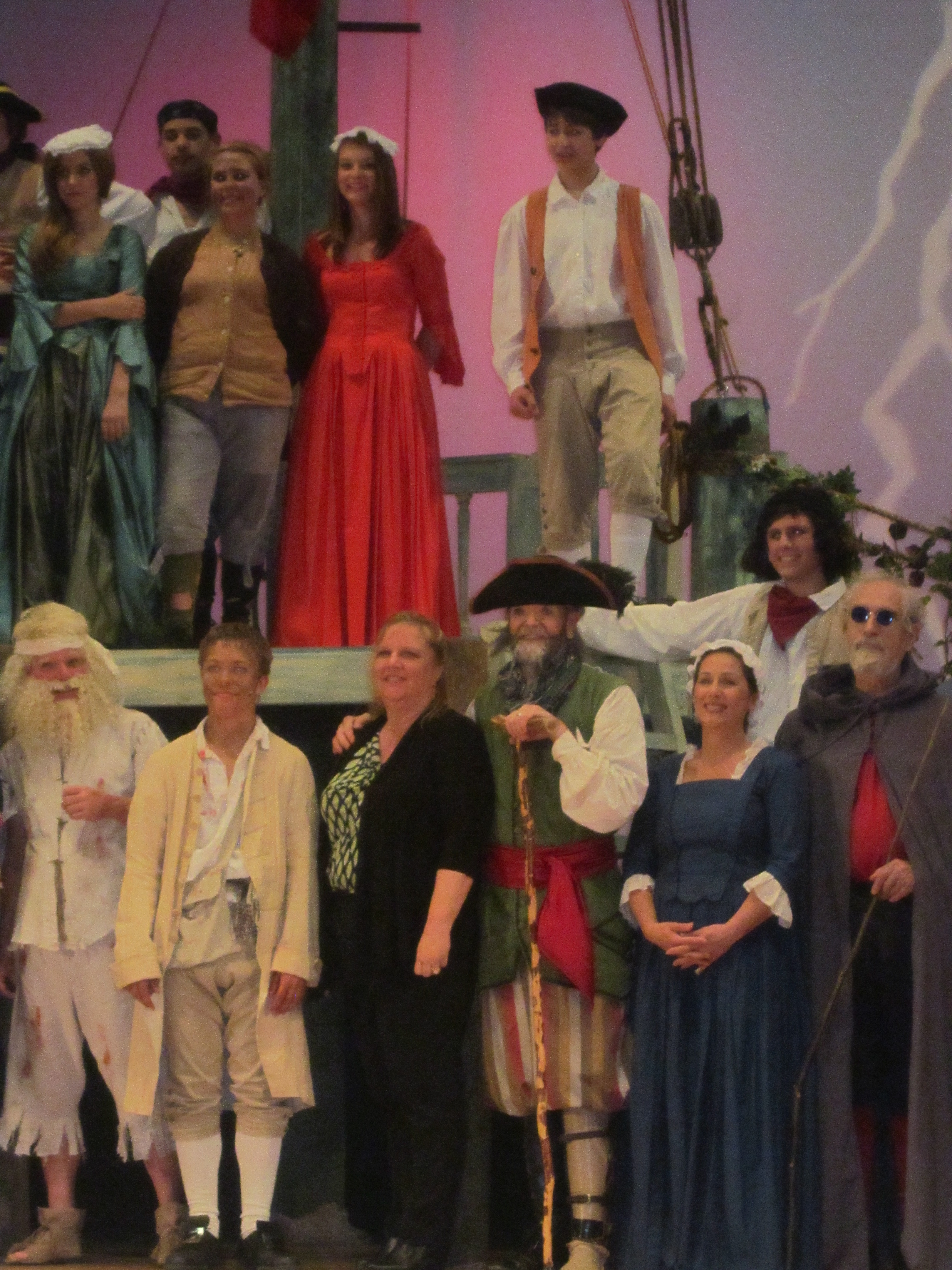
We made it a late night for the sake of theater.  The girls and I, along with Grammy and Grampy, went to see the local community theater group perform Treasure Island.

I was nervous about the night since the show didn’t start until their bedtime, but my daughters were entranced by the sea shanty-singing, sword-slinging, parrot-toting pirates, who scaled the heights of the ship, leapt overboard, and shot at each other in an attempt to capture the treasure.

From the moment Billy Bones dropped his treasure chest onto the floor of the inn, the girls were intent on classifying the pirates into two types:  Good pirates and bad pirates.  I heard my middle girl loudly “whisper” (she doesn’t really know that whispering involves lowering the volume of your voice) several times at the beginning, “Is he good or bad?”

Long John Silver, in particular, puzzled them.  Was he good, the way he was nice to Jim Hawkins and saved his life?  Was he bad, the way he led the mutiny against Captain Smollet?  He killed some and protected others.

This one-legged renegade was a moral enigma to my daughters.  They couldn’t box him up and fit him in a nice ethical category, so we talked about him and life and right and wrong most of the way home from the play.

Sometimes we too are intent on shoving people into ill-fitting categories and assigning them superficial labels.  We think we “know” someone as soon as we decide they are good/bad, smart/dumb, nice/mean, right/wrong, funny/dull . . .

I’m so thankful that God knows us as more than just a number, a nameless face in the crowd, or little more than a resume of good or bad deeds.

I’m choosing to meditate on this for the week, the promise that God knows me truly and deeply—no matter how complicated I may be.  It’s also the assurance that He loves others in the same way and challenges me to take the time to know them and love them without labels, boxes, and categories.

You have searched me, LORD, and you know me.
You know when I sit and when I rise;
   you perceive my thoughts from afar.
You discern my going out and my lying down;
   you are familiar with all my ways.
Before a word is on my tongue
   you, LORD, know it completely.
You hem me in behind and before,
   and you lay your hand upon me (Psalm 139:1-5)

Weekend Rerun:

Where is the Whole World?
Originally posted on 07/22/2011


I sought the LORD, and he answered me; he delivered me from all my fears.
Psalm 34:4

During my second pregnancy, I went happily to my 20-week ultrasound and learned we were having another girl (the joys of pink!) and that she was healthy and developing well.

Except she was small.  They said smaller than she should be and I’d need to go get a 3-D ultrasound at a specialized neonatal center.  But, not to worry, they were sure it was okay.  This was just to be safe.

One 3-D ultrasound later, the technician sent back the report.  She was healthy.  Good heart.  Good blood flow.  Organs just fine.  But she was small.  Too small.  It was probably okay, but just to be safe I had to go for weekly stress tests for the remainder of the pregnancy and some more ultrasounds.

Every stress test was fine.  She was moving (boy was she moving!) and she was growing, but not fast enough.  She was just too small.  But, no need to worry, they said, because she was probably just fine; it’s just that they needed to induce her a week early so they could figure out why she was so small (under 5 pounds they said) and help her grow outside the womb.

We packed a bag for the hospital and let the Pitocin get to work.  Induction was terrible; the worst of my three deliveries.  In the end, though, Lauren was born.  I didn’t have my glasses on.  I couldn’t see her.  Was she okay?  Was she too small?  Was she in danger or sick or worse?

My husband served as my eyes for me.  At first he said nothing; she was purple they told me later from the chord double-wrapped around her neck. But then she cried.  And my husband said, “She’s beautiful.  She’s perfect.”

The NICU pediatrician who had been on call to assist at the delivery of this at-risk baby peeked over the nurses’ shoulders and left the room without a word.  The nurse laid her on the scale.  She weighed 6 pounds 13 ounces, my one-week-early little one, too big for the preemie outfits we’d picked out for her.  God had brought her to us safe, healthy, and gorgeous and we praised Him, so tearfully thankful for His protection over our baby girl.

Between that first announcement that our baby was too small and the moment we saw her, we fought against fear.  My husband and I held hands and prayed for her each night.  We calmed our fears and shrugged off ultrasound results.  Then I’d sit at the next appointment and be told once again that she was just too small. All the anxiety we had kept at bay rushed in with renewed strength.

Someone asked me during that time, “You’re not freaked out about this, are you?”

I didn’t know.  Was I freaked out?  Was I okay?  It wasn’t the same from day to day or minute by minute.  I was fine.  I was scared.  I was trusting.  I was fearful.  I was relying on God.  I was unbelieving.

At that time, Tim Hughes was singing on the radio:
When all around is fading, and nothing seems to last
When each day is filled with sorrow
Still I know with all my heart
He’s got the whole world in His hands
I fear no evil, for You are with me
Strong to deliver, mighty to save

The whole world is nestled in the safety of His hands.  My world that I saw every day.  The world of my unborn baby girl, whose somersaults I could only envision and whose face I couldn’t wait to see.  Yes, her world was in His hands, too, and so I had to trust her to His care.

Isaiah wrote: “So do not fear, for I am with you; do not be dismayed, for I am your God. I will strengthen you and help you; I will uphold you with my righteous right hand” (Isaiah 41:10).

Held in His hands as I am, still there are so many reasons to tremble.

For bills and jobs and relationships, for school, health, my kids’ friendships, safety and their faith, for my daughter not getting lost, for school bus rides and mean girls, for conflict, for things I forgot to do, for the decisions I make as a mom and how often I mess it all up, for the future, for the unseen, for the nosebleed that I’ve blown up into a brain tumor, for what’s happening tomorrow and what’s happening ten years from now, for the divorces I’ve witnessed and how did it all happen anyway, for the things I said and the things I didn’t say.

But when I’ve lost my breath because of worry and fretted over a solution only to find no visible answer, nothing I can do, and no way to fix the problem or avert disaster, then I remember hope.

Oh yes, now I remember hope.

Fear says, “There is no way out of this.”
Hope says, “God is going to make a way.”

Fear tells me “You’ve messed this up so badly there’s nothing that can fix it.”
Hope says, “I have a Redeemer who can heal and restore even what is dead.”

Fear whispers, “What you can see is all there is and that’s not enough.”
Hope shouts, “The Lord created the universe with His words.  He can create something out of nothing.”

Fear argues, “You’ve been abandoned.  God doesn’t even care that you are under attack.”
Hope assures me, “You are held in His hand, carried through hardship by His open palm.”

This world, my life, the daily schedule, the care of my children, the bills and the doctor’s appointments, and all there is remains outside my control.  That’s why there is fear.  It’s ridiculous pride and foolish unbelief that makes me believe God can’t possibly care for me and that I could do better on my own.  So I worry because I’d like to control the uncontrollable.

Fear isn’t an enemy you defeat once and then mount on your wall like a trophy.  It’s a sneaky foe, inching it’s way into your life at the slightest provocation.  It creeps into your thoughts at night and asks to be your companion as 3:00 a.m. and then 4:00 ticks and tocks by on your nightstand alarm clock.

In the night as you rumple the covers with your constant turning, when the bill comes, when your child steps onto the school bus, when you sit in the doctor’s office, when the lawyer calls . . . remember hope.  It’s the ultimate weapon in this battle against fear.  We have hope because we’re in His hands and so is our whole world.  Our kids in His hands.  Our finances in His hands.  Our jobs, our marriages, our friendships, our ministries, our careers, our future—in His hands.

We say with the Psalmist, “Even though I walk through the darkest valley, I will fear no evil, for you are with me” (Psalm 23:4).

Heather King is a wife, mom, Bible Study teacher, writer for www.myfrienddebbie.com and worship leader.  Most importantly, she is a Christ follower with a desire to help others apply the Bible to everyday life with all its mess, noise, and busyness.  To read more devotionals by Heather King, click here.

Copyright © 2012 Heather King
Weekend Walk, 03/24/2012

Hiding the Word:

Last Wednesday night, one of our church’s Awana leaders asked me and another lady from our church choir to listen to a child recite John 3:16.

He did a great job.  He rattled it off with little effort and we each gave him a high-five to celebrate.

Then my fellow verse-listener asked, “Do you know what John 3:17 says?”

I didn’t!  I blanked completely, although I’m pretty sure my girls have learned it before for Awana, but in that moment I couldn’t tell you at all what it said.

So, she recited it for us.  Just as simple as that.  And it was beautiful, absolutely beautiful.

I’ve read several times recently about how early God-followers mostly recited or read aloud God’s Word and twice in one month I have listened to someone doing nothing more than quoting a verse or reading a passage from Scripture.  It’s uniquely powerful.

I still remember the very first time my oldest daughter quoted a Scripture verse she had learned from Awana.  “God loved us . . . and sent His Son.”  I cried when I heard her little voice speaking the Word of God.

So, for the verse of the week, I’m going to meditate on that precious Scripture my choir friend quoted for us on Wednesday night, and, to keep it in context, I’m going to study it together with John 3:16:

For God so loved the world that he gave his one and only Son, that whoever believes in him shall not perish but have eternal life. For God did not send his Son into the world to condemn the world, but to save the world through him (John 3:16-17). 

Weekend Rerun:

A Puzzle of Peace
Originally posted on 04/29/2011

You will keep him in perfect peace, him whose mind is steadfast, because he trusts in you”
Isaiah 26:3

Five days a week at noon I journey to the school and wait in the line of minivans to pick up my daughters from their classes.  By that time each day, my baby girl is tired and ready for lunch and a nap, so the lull of the car bounces her to sleep almost daily.  I have the joy of watching.  Have you ever watched a baby fall asleep?  Her breathing slows down ever so slightly.  My little one folds her blanket over and snuggles it against her cheeks.  Then the eyelids start to linger ever so slightly with each blink—closing for longer, and longer, and longer each time until finally  . . . sleep.

It’s peace demonstrated for me on an almost daily basis.  The quiet rest, the feeling of safety, the calm, the trust.  Doesn’t that sound heavenly?

Somehow over time, though, most of us lose that miraculous peace, the absolute trust that you are loved and cared for so you can rest and leave the driving to someone else.  It’s not present in my heart all of the time.  I may let God do the driving, but I’m usually the passenger holding a map and questioning the navigational choices of my Divine Driver.

Do You really want us to turn there, God?
Do You know where You are going, God?
Do You have a destination in mind for me, a plan, a hope and a future?
Do You know any shortcuts that can get us there faster?

This often-elusive fruit of the spirit—peace—-is not a fairy tale or a figment of our Christian imaginations.  It’s there available to us.  Yet, sometimes I reject the peace that God offers me by failing to discipline my emotions and thoughts.  I pray for peace for myself and others, the “peace of God, which transcends all understanding” (Philippians 4:7) and think that God’s peace is going to enter my heart miraculously and with little effort on my part.  It’s a prayer that we sometimes use as a magical spell instead of allowing God to change our hearts so that peace becomes possible.

The bottom line is some of our behaviors need to change, some of our thought patterns need to be stirred up a little bit and some of our emotions bossed around. 

Right before Paul talks about this incomprehensible peace that God offers, he tells the Philippian church “Do not be anxious about anything, but in every situation, by prayer and petition, with thanksgiving, present your requests to God” (Phil 4:5). Peace starts with a thankful heart.  In all of our anxieties, “in every situation,” begin by giving thanks.  The worries that infect and plague us cannot coexist with the antibiotic of gratitude.

Paul also tells the church that God’s peace will “guard your hearts and your minds in Christ Jesus.”  Peace requires the active discipline of standing guard over our hearts and minds and refusing admittance to whatever thoughts aren’t peace-full.  Paul wrote out a clear test for determining whether a thought should gain entry: “Finally, brothers and sisters, whatever is true, whatever is noble, whatever is right, whatever is pure, whatever is lovely, whatever is admirable—if anything is excellent or praiseworthy—think about such things” (Phil. 4:8).

It’s not that my thoughts are blatantly sinful or wrong, but I do have an internal dialogue of whining that certainly isn’t “lovely or admirable.”  And I have a tendency to dwell not on “whatever is true,” but instead on “whatever might be true.”  It’s when I allow myself to get caught up in “what if’s” that I trade in peace for worry and trust for anxiety.  “What if this happens?  What if that happens?  What would we do in this situation and in that situation?”  I sometimes live in hypotheticals that may never ever become a reality instead of focusing on what is true—-God is faithful; God promises to walk with me through everything; God loves me.  Dwelling on the truths of God’s promises instead of the questionable reality of our circumstances is our responsibility.  This discipline of taking “captive every thought to make it obedient to Christ” is what prepares our hearts to receive His perfect peace.

Paul gives us one final piece of this peace puzzle.  He says, “Whatever you have learned or received or heard from me, or seen in me—put it into practice. And the God of peace will be with you (Philippians 4:9).  Peace occurs when we follow God’s instructions.   We can’t choose to disobey God’s commands, live how we want to live, do what we want to do, and then wonder why our circumstances are difficult.  There are consequences to every choice and it’s by choosing righteousness—-doing what God would have us do—–that we enjoy the peace of God’s blessing.  Isaiah wrote, “The fruit of righteousness will be peace; the effect of righteousness will be quietness and confidence forever” (Isaiah 32:17).

Have you been longing for peace lately?  Maybe you’re in circumstances that have you fretful and anxious.  Maybe you are in the middle of tough decisions and you aren’t sure what to do.  Maybe you have taken a step out in faith and you are waiting in hopeful anticipation of what God is going to do.  Maybe you worry over whether you’re good enough at being a parent; are you making the right decisions, handling things the best way for your child?

I pray peace over you, a supernatural rest for your heart and mind.  Our God is faithful and trustworthy and you can relax knowing that He is the one doing the driving.  But, don’t neglect your responsibility to make yourself a vessel prepared to receive the peace He gives.  Are there some bad habits that you need to break, some misassumptions you need to relinquish?  Do you need to be more disciplined about your thought life and more in control of your emotions?  Do you need to cease the “what if’s” and put an end to planning out hypotheticals?  Do you need to change some of your behaviors and pursue righteousness instead?

It’s not necessarily going to be easy and it certainly won’t be a one-time event.  No, it’s a moment-by-moment choice to trust God or not, to rest in Him or take over from Him, to do it God’s way or to demand our own way, but in the yielding of our hearts, minds and choices there is God-given peace.

*****************************************************************************************************************

Heather King is a wife, mom, Bible Study teacher, writer for www.myfrienddebbie.com and worship leader.  Most importantly, she is a Christ follower with a desire to help others apply the Bible to everyday life with all its mess, noise, and busyness.  To read more devotionals by Heather King, click here.

Copyright © 2012 Heather King

It’s a Gift

I sought the LORD, and he answered me; he delivered me from all my fears.” (Psalm 34:4)
When I am afraid, I put my trust in you (Psalm 56:3)

We called her our Roller Coaster Baby.  My middle girl was a fearless climber and intrepid explorer in her younger days.  When she played with Daddy, she always wanted to go higher and faster.

We thought she’d be a mountain climber, an adventurer, a bold and brave pioneer, who wouldn’t be intimidated by peer pressure or life’s obstacles.

Then she learned the word “scared.”

From the first time that word rolled off her tongue, she changed.  Her reaction to every movie or TV show, every playground, every game was, “I’m scared.”  To emphasize it, she would clutch her arms around her body and tremble.

Now, she’s growing up afraid.  Even the Grover roller coaster at our Busch Gardens is off-limits.  No roller coasters for her.  No fast rides, high rides or anything that makes your belly flip flop.  She’s all about bumper cars and slow-moving swings.

Disney movies are off-limits and Pixar films a no-go.  They have bad guys and dramatic scenarios where the heroes and princesses are momentarily in jeopardy.

That’s too scary.  In fact, it’s hit the floor and scream in the middle of the movie theater scary.  It’s run out of the room crying and hide under your blankets frightening.

Unfortunately, this middle girl of mine is passing her fear on like a worn-out, unwelcome hand-me-down.

My youngest baby girl has discovered Tangled, the Disney movie about Rapunzel.  If I let her, she’d keep it on continuous play all day.  She acts out the scenarios, sings the songs, and calls her baby dolls, “Rapunzel” instead of Sally or Jane.

My toddler wasn’t afraid of the movie until she watched it with her older sisters the other day.  They hid their faces, fast-forwarded through tense scenes, and whined, “It’s too scary.”

Suddenly, my youngest learned that you were supposed to be afraid.  The movie that hadn’t given her the slightest quiver of fear now sends her to my side every few minutes to announce, “I’m scared.”

I’m discovering that fear is a cursed gift we sometimes pass on to one another.

At the very least, I know one thing with certainty–fear isn’t something given to us by God.  It’s never part of His plan for us.  He wants us all to be intrepid explorers, brave pioneers, and valiant defenders of what is right and true.

Instead, we are run-out-of-the-room afraid.  We are hide-our-heads-under-our-blankets scared.

How has this happened? Paul wrote so clearly that “God gave us a spirit not of fear but of power and love and self-control” (2 Timothy 1:7, ESV). 

When Jesus left the disciples, He gave them another precious gift:

Peace I leave with you; my peace I give to you. Not as the world gives do I give to you. Let not your hearts be troubled, neither let them be afraid (John 14:27, ESV)

So many of us sing the song Trading My Sorrows in our churches.  We proclaim, “I’m trading my sorrows.  I’m trading my shame.  I’m laying then down for the joy of the Lord.  I’m trading my sickness. I’m trading my pain.  I’m laying them down for the joy of the Lord.”

We sing that, but we do the opposite.  We trade in the gifts that God’s given, of power, love, self-control and peace, for a fear-filled life and anxious hearts.

It’s a learned trait.  At some point, someone we respect and believe in tells us to be afraid and suddenly the childlike fearlessness of our innocent days is tainted and torn.

Or we are hurt and abandoned, abused, or neglected and we learn what it means to be terrified.

Or circumstances just loom so impossibly over our shoulders and our practical minds assure us that destruction is imminent.

Or Satan, the father of lies, fills our hearts and heads with doubt and discouragement.  He tells us, “God’s not with you.  You’re alone.  You have no hope.  This is impossible.  Nothing can save you now.”

Whatever our story is and no matter who or what it was that first shoved fear into our hands, it’s time to stop agreeing to the exchange.  It’s time to stop accepting hand-me-down terror.  It’s time to start rejecting Satan’s offer to trade in peace for worry.

It’s time to fight for the gift God’s already given us—peace in His presence.

Remember that “with His love, He will calm all your fears” (Zephaniah 3:17) and even “though I walk through the darkest valley,I will fear no evil, for you are with me” (Psalm 23:4).

God’s Word also reminds us:

So do not fear, for I am with you; do not be dismayed, for I am your God. I will strengthen you and help you; I will uphold you with my righteous right hand (Isaiah 41:10)

Be strong and courageous. Do not fear or be in dread of them, for it is the Lord your God who goes with you. He will not leave you or forsake you” (Deuteronomy 31:6)

Have I not commanded you? Be strong and courageous. Do not be frightened, and do not be dismayed, for the Lord your God is with you wherever you go.” (Joshua 1:9)

We don’t know the future.  We don’t know all the reasons for evil and pain in this world.  We don’t understand everything that happens and we’re not guaranteed perfect lives of comfort and prosperity.

But we don’t have to be afraid.  God has lavished us with perfect gifts—peace, love, self-control, power.  He promises to be with us, wherever we go, whatever we face.  That’s a gift worth keeping.  Don’t trade in that promise for anything.

To find more verses on fear and worry, click here to read Verses on Fear and Worry.

You can read more devotionals on this topic here:

Heather King is a wife, mom, Bible Study teacher, writer for www.myfrienddebbie.com and worship leader.  Most importantly, she is a Christ follower with a desire to help others apply the Bible to everyday life with all its mess, noise, and busyness.  To read more devotionals by Heather King, click here.

Two steps forward and two steps back (or so it seems)

This was an unfortunate setback.

A few weeks ago, my husband gently suggested that it may be time for a serious attempt at potty training my two-year-old.

Now, to understand how I felt about this I first have to tell you potty training my two older girls was no easy task.  In fact, it’s fair to say that I’ve never felt as much like a failure in my life as when I was pleading with a toddler just to sit on the potty chair.

I laid awake at night designing reward charts and incentive plans.
I prayed for help from Almighty God so that my kids would be ready for preschool.
I bought books, movies, stickers, M&Ms, toys, and more to bribe them into success.
I avoided all moms who proudly announced their genius 18-month old had been perfectly trained with absolutely no effort in all of a day.

But my husband is a good husband and I’m a good wife.  So, when he asked me to start potty training my toddler, I plunged into what I was sure would be months and months of misery, stress and clean-up.

I pulled out the trusty movie, Potty Power.  I explained underwear to my daughter.  Every 15 minutes, I picked her up and carried her to the bathroom.

And a miracle happened.  A real live, genuine miracle of God.

She figured it out.  She wanted to learn.  She graduated to underwear in a matter of days.  I bet God never had anyone thank Him so much for help potty training her child.

And then.

Then there was the setback.  One week of sickness kicked my baby girl back into Pull-Ups and made her absolutely terrified of a trip to the bathroom.  Now my sanity is loosely held together by a can of Resolve and a bottle of Febreze.

I was discouraged.  She was scared and confused.  We’re baby-stepping our way forward, hoping to regain lost ground.

Have you ever encountered a setback that left you dazed, uncertain, and full of fear?

Perhaps you stepped out in obedience to what you believed was God’s call, but circumstances shifted, obstacles arose, and you’re not reaching the goal.  Perhaps you’ve even begun to question whether you heard God clearly and made the right decision in the first place.

Sometimes God’s plan just doesn’t make sense to us.

For the Israelites leaving slavery in Egypt, the most logical route to the Promised Land was straight along the shores of the Mediterranean Sea.  After a few battles with the Philistines, the Isrealites thought they’d march right into Canaan after no more than a month-long journey.

God had other plans.  Exodus 13:17 tells us: “When Pharaoh let the people go, God did not lead them by way of the land of the Philistines, although that was near. For God said, ‘Lest the people change their minds when they see war and return to Egypt.'”

Sometimes God takes us the long way around for our own benefit.  In her book One in a Million, Prisicllar Shirer writes that “the wilderness is often safer than the alternative” (p 73).  God chose the wilderness for His people.  Maybe He’s chosen it for you, as well, for your protection and personal growth.

Even after the Israelites followed the pillars of cloud and fire in the direction God had chosen to take them, there were still setbacks.  In Exodus 14:2, God said, “Tell the people of Israel to turn back.”

Turn back?

God led them one way only to turn them around and march them off in a different direction?  Did it seem like God had momentarily lost His compass in the desert?

And yet, this turning back placed the Israelites on the banks of the Red Sea and the only way across now was through His miraculous deliverance.

He turned them around so that He could save them.

So, what do we do as we make confusing desert tracks in the wilderness in our efforts to follow God’s lead?

We could give up.  We could question our listening skills.  We could doubt God’s leadership.  We could stomp off and follow our own course.

Or we could remain focused on our goal and the passion God has placed in our hearts.  That’s the only way the Israelites made it to the Promised Land.  It’s the only way we’ll receive all that God has promised us.

It’s also the only way Nehemiah saw the walls of Jerusalem rebuilt.  Kelly Minter in her book Nehemiah: A Heart That Can Break, writes:

“After verbal assaults, physical threats, discouraged laborers, abuses of power and economic distress, Nehemiah never diverted his focus from the wall.  The process may have been slowed and altered as a result of enemies and wayward citizens, but the goal never changed.”

In fact, Nehemiah himself writes, “I also persevered in the work on this wall” (Nehemiah 5:16, ESV).

He continued to build despite threats, fear, confusion, discouragement, distractions and disappointments.  He continued to build despite setbacks.   He never stopped placing brick on top of brick on top of brick in obedience to God.

What has God asked you to build?  Choose today to place another brick on this wall instead of giving up because of obstacles and disappointments.  Choose to “persevere in the work on this wall.”

Heather King is a wife, mom, Bible Study teacher, writer for www.myfrienddebbie.com and worship leader.  Most importantly, she is a Christ follower with a desire to help others apply the Bible to everyday life with all its mess, noise, and busyness.  To read more devotionals by Heather King, click here.

Copyright © 2012 Heather King

Devotions From My Garden: May the God of Hope

Today, I’m sharing with you another devotion from last spring to go with this year’s series Devotions From My Garden.  Enjoy!

*********************************************************************************

“May the God of hope fill you with all joy and peace as you trust in him, so that you may overflow with hope by the power of the Holy Spirit
Romans 15:13, NIV

Today, I walked close enough to my front garden to catch the strong perfume of hyacinth carried by the wind.  It was delicious and relaxing and full of hope.  Those early spring flowers remind me that spring and new life are coming and maybe even here!  That after months of dormancy, a seed buried deep within the frozen ground is now beautiful, colorful, fragrant and abundant.  They remind me that our God is the Creator—able to make something truly wonderful out of nothingness.

And all of these things give me hope.

It means that I am never trapped or stuck in the relentlessness of my everyday because God brings abundant new life and seasons of blessing.  His mercies “are new every morning” (Lamentations 3:23, NIV).

It means all of my time in the wildernesses of my faith when I saw no visible evidence of God’s plan for me were not wasted.  He has cultivated my heart and brought to life a beautiful “planting of the LORD for the display of his splendor” (Isaiah 61:3b, NIV).

It means that even when I am in an impossible situation, God, who created everything out of nothing, can create a rescue for me.

All day today, I’ve been meditating on and unpacking the truths in a verse that similarly brings me hope: “May the God of hope fill you with all joy and peace as you trust in him, so that you may overflow with hope by the power of the Holy Spirit” (Romans 15:13, NIV).

May the God of Hope: Our God is a God of hope.  Even when we feel that there is no rescue for us and no way out, we can trust in Him to save us.  We are never stuck, abandoned, lost or beyond His reach because our God “is able to do immeasurably more than all we ask or imagine, according to his power that is at work within us” (Ephesians 3:20-21, NIV).  When circumstances are at their most impossible, we have hope because “nothing will be impossible with God” (Luke 1:37, NIV).

Fill you with all joy and peace: Because we have hope, we can walk through disaster with joy and peace.  In the book of Nehemiah, Ezra reads the book of the law to the people for the first time in years. They had returned from exile away from their temple and homeland and now faced the long process of rebuilding.  The people wept with remorse over lost time and out of true regret for turning away from God, but Nehemiah and Ezra reminded them that “the joy of the LORD is your strength” (Nehemiah 8:10, NIV).

As you trust in Him:  My joy and peace come from my connection to God.  They aren’t fake or self-motivated.  I can’t wake up in the morning and determine in and of myself that “I’m going to be at peace today” or “today, I’m going to be joyful.”  Instead, I ask God to please fill me with joy and peace and to help me stay connected with Him every moment of that day, so that I don’t begin to replace joy and peace with discontent, worry, or shame.  God can keep me filled up only as I trust in Him.  When I trust in others, in circumstances or in myself, I will be disappointed and my faith shaken.  Instead, we must “trust in the LORD with all your heart and do not lean on your own understanding” (Proverbs 3:5).

So that you may overflow with hope: God doesn’t just fill us up for our benefit, but so that we can overflow for others.  He places us in community with other Christians so that we can journey together, encouraging one another and bringing hope to others when they need it.  He places us in the world so that we can offer hope to those who are hopeless.

Like the hyacinth in my garden, we are to let Christ manifest “through us the sweet aroma of the knowledge of Him in every place.  For we are a fragrance of Christ to God among those who are being saved and those who are perishing” (2 Corinthians 2:14-15, NASB).  We are like Christ in a perfume bottle!

By the power of the Holy Spirit: It is the Holy Spirit at work deep within us that allows us to be filled up to overflowing.  As Christians, the Holy Spirit is within us, constantly at work in our heart, and present as we face every life circumstance.  There is nothing in this life that we ever face alone and so we have hope, joy and peace.

I am always amazed by Paul and his prayers for others.  Most of the time when I pray for people, I ask God to meet their need, give them a job, heal their sickness, provide for their finances, direct their steps . . . it is always specific and practical.  These prayers are important and necessary, but I shouldn’t stop there.  The vast majority of Paul’s prayers for the churches in his letters were for spiritual blessings.  This verse in Romans 15:13 is just one example, in which he prays for hope, joy and peace and the power of the Holy Spirit at work in their lives.

So, today, I am taking my cue from Paul and praying for you:
Father God, I pray now for those reading this devotional.  Please let your Holy Spirit be at work in their lives, filling them to the point of overflowing with hope, joy and peace.  Help them know that whatever they are facing in life can be entrusted to You and that nothing at all is impossible with You, our Creator God.  You bring beauty and life out of darkness and dormancy.  Give them an excitement about Your work in their lives.  Help them live in joyful anticipation of what You are going to do next.
Amen.

More Devotions from My Garden:

  • Breaking Ground
  • Tomato Plant Prayers

    Heather King is a wife, mom, Bible Study teacher, writer for www.myfrienddebbie.com and worship leader.  Most importantly, she is a Christ follower with a desire to help others apply the Bible to everyday life with all its mess, noise, and busyness.  To read more devotionals by Heather King, click here.

    Copyright © 2012 Heather King