It’s not the End of the World as We Know It

She grumped into the mini-van after school, plodding along, keeping her hands folded across her chest as much as possible.  She was non-verbal, totally unresponsive to my cheerful queries about her day and her friends and her teacher.  Slumping down as low as she could go in her seatbelt, her chin touched her chest, her eyes glared down at the floor.

I got the message.  Bad day.

Slowly she explained with little bits of dialogue here and there, mostly in a whine, sometimes in anger.

“The cafeteria lady put baked fruit on my tray even when I told her I didn’t want it.”

Oh and her older sister tattled on her because she stood on the school’s grass at the end of the day instead of staying on the sidewalk.

What a day.

I found myself telling this Chicken Little of mine that the sky hadn’t fallen because of a tiny scoop of unwanted baked fruit and the world hadn’t ended because her sister ratted her out for straying onto the grass.

So, was it worth freaking out, crying, yelling, and ruining her Friday afternoon over this, just this?

Of course, it all did seem like a disaster to a six-year-old.

Just like an embarrassing mistake seemed like the end of the world to me yesterday.  I was scatter-brained and forgetful and I was frustrated and angry with myself.

My husband said, “It’s okay.  It’s not the end of the world.”

Maybe that’s where my daughter gets it from, from me and how I fret so quickly over things I could just shake off my back if I chose.

Sometimes we’re fretting about the foolish things and the minor details.  We worry over lamentations3ba mistake that’s done and over with and in the past already.  We stress over hypotheticals and what if’s that never even happen.  We toss and turn over situations that God’s already provided an answer for.
And it all seems foolish in hindsight.

But even when we’re not, even when it’s more than a six-year-old’s idea of “the end of the world,” even when it’s truly a crisis and we feel trapped and hopeless….even then we can breathe in and breathe out God’s grace.

Even then, we are not consumed.

That’s what Jeremiah wrote to the Jewish people when their city was destroyed by captors, and they had endured starvation and invasion and seen their best and brightest young people carried off into captivity in Babylon.  Even then, he wrote:

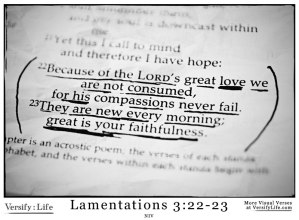
Because of the Lord’s great love we are not consumed,
    for his compassions never fail.
They are new every morning;
    great is your faithfulness (Lamentations 3:22-23).

Paul wrote it, too:

We are hard pressed on every side, but not crushed; perplexed, but not in despair; persecuted, but not abandoned; struck down, but not destroyed.
2 Corinthians 4:8

No stumbling block or obstacle is the hopeless end of the world it may seem.  Whether it’s a true crisis or an annoyance of the moment, still God is with us and because of His love, grace, and faithfulness, we can breathe in and breathe out.

We can rest in Him.

We can let it go.

At Women of Faith last summer, Patsy Clairmont reminded us that Moses wasn’t drawn to the burning bush because it was on fire.  Fires happened all the time in the heat of the desert sun.

Instead, he stepped away from his flock of sheep out of curiosity because “though the bush was on fire it did not burn up” (Exodus 3:2).

That’s our testimony also!  God allows us to walk through the fire without being burned and it is that constant faith in His care that shows others His glory.  It makes them turn aside out of curiosity and ask, “What does she have that helps her walk through these flames unscorched?”

How is it that we can move on after a hurt or show grace for a mistake?  How is it that we can look at the budget on paper and not be in despair?  How can we hear that news, accept that decision, face that tomorrow, wait what seems like forever without being thrown into crippling anxiety and overwhelming panic?

How can we stand in the middle of the fire and not be consumed?

It’s Jesus.  It’s God with us.  It’s His grace and His promise to care for us in all things whether big or small.  It’s choosing joy and choosing to trust in Him that saves us from the flames.

Heather King is a wife, mom, Bible Study teacher, writer and worship leader.  Most importantly, she is a Christ follower with a desire to help others apply the Bible to everyday life with all its mess, noise, and busyness.  Her upcoming book, Ask Me Anything, Lord: Opening Our Hearts to God’s Questions, will be released in the Fall of 2013!  To read more devotionals by Heather King, click here.

Copyright © 2013 Heather King

Weekend Walk: Choices, Choices

Playdates at our house are often the same.  My daughters give their guest a grand tour of the playroom and their bedroom…

Three girls’ worth of Barbies, baby dolls, princesses, Polly Pockets, ponies, Strawberry Shortcake, puzzles, games, art supplies, doll house furniture, Play Doh, and dress up….

And pretty soon we’re spinning from one activity to the next.  By the time my girls set up 039the Barbie house, their guest is ready to play with puzzles.  Halfway through the first puzzle, their guest is ready to play a game.  A few turns into the game, their guest is ready to play princess.  After a few minutes of assigning princess names and creating back story, their guest is pulling out the Play Doh.

Is it any wonder?  With so many choices and so little time, we happily jump from activity to activity and, after all, who can complain about how well everyone sleeps that night?  We all have fun and it’s all a joy.

But it can be a little like me, especially at the start  of a new year when I’m spinning from good thing to good thing and I really just want to do it all.

We do it with fitness programs, spiritual disciplines, diets and savings plans. Given a million wonderful choices, we can try to do a million amazing things…and end up failing at all of them.

This year, I’ve been given or discovered four prayer books, three Bible reading programs, four Scripture memory plans, five devotionals, and three Bible studies to begin the year.

The thing about me is that I’d press through every day and finish all of them, maybe exhausted, stressed, hyperventilating and skimming through pages just so I can mark it off on my to-do list, but I’d do it.

There wouldn’t be any joy, though.  I wouldn’t really breathe in and out the beauty of God’s Word. I’d set my love relationship with my Savior firmly on business-only terms, focusing on tasks and accomplishing and not relaxing and being.

The truth is that doing a million things doesn’t always get us very far, but paring it all down and asking God to focus our hearts on one thing (or at least less than a million) can bring us joy and growth in the new year.

I started last night with Scripture memory, choosing from all the plans and programs and suggestions.  Sitting at my computer, I read through four Scripture memory plans and prayed.  Then I chose just one way of meditating on God’s Word, soaking in it, breathing it in, chewing on the thoughts and making this Holy Scripture part of the core of me.

This year I’ll be using my verses for the week on the blog to participate in Beth Moore’s Siesta Scripture Memory Team (SSMT).  Her plan is simple.  You choose the verse you want to memorize, whatever God has placed on your heart, and you leruthgrahamscripturesarn one verse about every two weeks.  By the end of 2013, we’ll have committed 24 verses to memory.

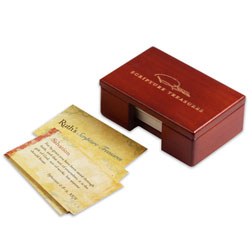
A dear friend brought me back Ruth Graham’s Scripture Treasures from her visit to Billy Graham’s library.  I was reading them through last night, pulling out beautiful verse after beautiful verse and many of my Scriptures for the year will come from these cards.

To begin, I’m reminding myself to keep it simple, keep the joy, give myself room to breathe and not suffocate myself with systems and plans that suck the air and the pleasure right out of this walk with God.

One thing I ask from the Lord,
    this only do I seek:
that I may dwell in the house of the Lord
    all the days of my life,
to gaze on the beauty of the Lord
    and to seek him in his temple (Psalm 27:4 NIV).

What about you?
How are you keeping it simple in the new year?  Did you choose one word to help focus your spiritual walk?  Did you find one Scripture memory plan or one Bible reading program to focus on?

Heather King is a wife, mom, Bible Study teacher, writer and worship leader.  Most importantly, she is a Christ follower with a desire to help others apply the Bible to everyday life with all its mess, noise, and busyness.  Her upcoming book, Ask Me Anything, Lord: Opening Our Hearts to God’s Questions, will be released in the Fall of 2013!  To read more devotionals by Heather King, click here.

Copyright © 2013 Heather King
Feeling Unloved

She was sobbing next to me and finally put all those unmanageable, messy feelings into four words.

“I feel so unloved.”

One fight with her sisters, one afternoon of correction and quiet discipline….and this totally loved daughter of mine told me she didn’t feel loved at all.

She sat with her tissue, snuggled against my side, my one arm hugging her shoulder, my other arm smoothing her wild hair that had been mussed by all the emotion.

But she felt unloved.

I had packed her lunch for the day, putting in her favorite snack and slipping a tiny paper with a joke on it into her bag of pretzels so she would smile and laugh and think of me.

She was wearing the outfit I had bought her and a ribbon in her hair that I (yes, the mom recovering from an allergy to crafts) had made for her with my own two clumsy hands.

Her favorite dinner was simmering on the stove.

Before bed the night before we had studied her Bible verses for the week and read together from books I ordered used online because they were out-of-print.  But they were her favorite, so I had happily spent an afternoon performing Google searches to find them.

I had combed out her long blond hair after her bath and sprayed it down to ease out the tangles and reminded her to brush her teeth.

And I had told her I loved her often, hugged her and kissed the top of her head throughout the day, then tucked her into bed under the blanket I had made for her myself.

But still she felt unloved.

I just finished reading an article about prison ministries and how many of the inmates come from homes where no one bothered to make sure they weren’t starving or had warm clothes to wear in the winter or a place to sleep.

No one really cared about them at all, but my daughter didn’t know the horrors of need and desperation.

So I told my crying girl how loved she is and how even when her emotions push their faulty lies into her heart and mind, she can shut them down with truth.

Doesn’t my Mom care for me?  Doesn’t she tell me she loves me?  Doesn’t she take care of my needs and even those extra things that I want?

We’re just as forgetful as my daughter is at times, feeling unloved because of a circumstance, a correction, a trial or sadness.  And we sit among our piles of blessings, of salvation and daily grace, and think, “God, don’t You love me?”

We meditate on the lies and feed them with our feelings, just like the Israelites did in the Old Testament.

Psalm 106 follows their long journey through forgetfulness and betrayal…

they gave no thought to your miracles;
they did not remember your many kindnesses (verse 7).

But they soon forgot what he had done
and did not wait for his plan to unfold (verse 13).

They forgot the God who saved them,
who had done great things in Egypt,
miracles in the land of Ham
and awesome deeds by the Red Sea (verse 21-22).

They didn’t just forget minor provisions of lunch box meals and some new outfits for school.

They forgot miraculous deliverance out of slavery in Egypt, the parting of an entire body of water so they could cross on dry land, daily provision of manna from heaven and the protection from war-loving enemies on every side.

But always God was faithful:

Yet he saved them for his name’s sake,
to make his mighty power known…

Yet he took note of their distress
when he heard their cry;
 for their sake he remembered his covenant
and out of his great love he relented (Psalm 106:8, 4-45).

They forgot.  He remembered.

“Yet, He….” it says in each verse. In my NKJV Bible, it says, “Nevertheless…”

That’s what God is...never at any moment less than good and powerful, mighty and merciful to us.  He is never less than His character or His faithfulness to His promises.

Even when our feelings tell us otherwise.

Even when we’ve believed the lies.

Beth Moore writes, “To live some semblance of victory, I’ve had to learn to be intentional and determined about where I would “set” my mind.  We can’t just depend on a good mood to get us through” (Esther).

That’s what I quietly tell my girl–how she’s always loved, even when she doesn’t feel like it, and how to conquer the lies by remembering the truth.

And that’s what I remind myself on the bad days and in the hard times, when I’m annoyed, frustrated, tired, or overwhelmed…that God loves me and cares for me.  Even when I mess up, never-the-less He is faithful.

That’s the truth.

Heather King is a wife, mom, Bible Study teacher, writer and worship leader.  Most importantly, she is a Christ follower with a desire to help others apply the Bible to everyday life with all its mess, noise, and busyness.  Her upcoming book, Ask Me Anything, Lord: Opening Our Hearts to God’s Questions, will be released in the Fall of 2013!  To read more devotionals by Heather King, click here.

Copyright © 2012 Heather King


Help!

They say knowledge is power, but language has its own particular potency.

After all, when you can finally cram all of your emotion, thoughts, and need into one or two perfect words, it helps relieve the pressure.

It was true for my oldest daughter when she was still wobbling between baby and toddler.  My job as a mom was to help harness some of her passion, help her direct some of that God-given strength—all by showing her how to put into words what she needed and how she was feeling.

But at little more than one years old, what is there to say?

So I taught her one powerful word to capture my attention instead of tantrums, screaming  514885-R1-24-24fits, and bouts with hysteria that turned her face red and plain wore mommy out.

“Help!”

When you can’t figure out the puzzle, when the toy isn’t working, when you can’t reach, when your buttons won’t fasten….. when life is difficult and you just can’t do it on your own and you’re collapsing into rage and tears of frustration and failure….”Help!” is all you need say.

It quickly became the favorite, most oft-used word in her vocabulary.  “Help, Mommy” I’d hear all through the day.

What I failed to teach her, though, was how to gauge the seriousness of the situation and adjust the volume and tone of her “help” accordingly.

Thus, friends on the phone would hear my little one screaming “Help! Help!” at the top of her lungs when all she needed was the top yanked off a marker or a new outfit buttoned on her baby doll.

I can’t say I’ve figured it out any more than she did, when to scream out “help” in desperation and when to quietly lift my hands high for assistance, when to whisper hushed pleas for intervention and when to just sob and let the Holy Spirit intercede for me.

But I know that sometimes, maybe lots of the time, what I need is help.  It’s not any more complicated than that.  I can pray at God (or nag at Him) for hours; I can explain and complain, whine and appeal.

Really, though, “Help” would do just fine.

The Psalmist knew this.  He asked, “I lift up my eyes to the mountains—where does my help come from?” (Psalm 121).

It’s a traveler’s Psalm, a song of ascension sung by the Israelite pilgrims on their journey to Jerusalem to worship.  The Psalmist literally lifts his eyes higher and higher along the skyline, a reminder of just how small he really is—just a regular guy on a valley trail beside the vastness of a mountain’s peak.

So, where to look for help?  To nature, to fellow travelers, to the material goods he’s packed neatly into his bags for the journey?  To false gods who weren’t even mighty enough to create the very mountains in his view?

No, he declares, “my help comes from the Lord, the Maker of heaven and earth” (Psalm 121:2).

God formed these very mountains.  He’s so grand, so magnificent, so creative, so capable. All of these other idols I’ve been looking to are weak, helpless, disappointing, and distracting. 

And if I’m screaming out for “help” or dropping to my knees in a confession of weakness, it’s a God that mighty I need to answer.

And He does answer.  That one word, “help,” always gets His attention.

The pilgrims explain it in metaphors from their journey.  How does God help?

He will not let your foot slip—
he who watches over you will not slumber;
  indeed, he who watches over Israel
will neither slumber nor sleep.

The Lord watches over you—
the Lord is your shade at your right hand;
  the sun will not harm you by day,
nor the moon by night.

Protection from scorching heat and the coolness of night, the rocks along the path and the obstacles in the road; this is what God gives them.  This is what He gives us.

In the original Hebrew, the Psalmist pushes His point in verses 7 and 8, saying essentially: “The Lord is your protector! The Lord will protect you from all harm! The Lord will protect your life! The Lord will protect your coming and going now and always!” (Beth Moore, Stepping Up).

Our translations soften the repetition, saying instead

The Lord will protect you from all evil;
He will keep your soul.
The Lord will guard your going out and your coming in
From this time forth and forever.

But the intent  of the repetition is to say it so clearly and so often, to repeat it so much that even a forgetful, wayward, worrier of a soul like me can’t miss this promise:

The Lord Will Protect You.

We only need lift our eyes to His face and ask for His help.

Heather King is a wife, mom, Bible Study teacher, writer and worship leader.  Most importantly, she is a Christ follower with a desire to help others apply the Bible to everyday life with all its mess, noise, and busyness.  Her upcoming book, Ask Me Anything, Lord: Opening Our Hearts to God’s Questions, will be released in the Fall of 2013!  To read more devotionals by Heather King, click here.

Copyright © 2012 Heather King

And In the End

Long ago and far away in my teen years, before the advent of all this newfangled technology, I spent the week or so before family road trips performing one of our favorite traditions: recording our own travel tapes.

Those were the days (am I so old already?) before MP3 players, iPods and all digital music.  We listened to music together in the car during the drives to my grandmother’s house in South Carolina: five kids and two parents all cramming our musical tastes onto a few homespun cassettes.

Every family member submitted song requests and then I sat on the living floor buried under towers of CDs and a handful of blank tapes to create the “mix.”

We reveled in the diversity of the playlist, placing songs from popular artists immediately after a selection from one of Wagner’s operas, which came after the Beatles, which followed Andrew Lloyd Weber, which followed Patsy Cline.  It was a curious weave of musical styles and statements and we loved it.

The ritual was never complete, though, without squeezing our traditional “Travel Tape Closing Song” onto the last 23 seconds of every single cassette.  Twenty-three seconds exactly.  That’s just enough time to fit in The Beatles’ song, “Her Majesty.”  No travel tape was complete without it.

It’s a quirky little tune thrown in as the final song on The Beatles’ final album, so it seemed a fitting end to our own musical creations.

Somehow the other day, in the same mysterious way that these things always happen, I thought of the song “Her Majesty” and sang it quietly to myself as I peeled potatoes in my kitchen.

Her Majesty’s a pretty nice girl, but she doesn’t have a lot to say.  Her Majesty’s a pretty nice girl, but she changes from day to day….

Then I thought of endings and the endings of travel tapes and childhood and the closing of a year before the beginning of something new.  Another Beatles’ song came to mind from the same album as I made the leap from one curious thought to another.

In that song, Paul McCartney sings, “And in the end, the love you take is equal to the love you make.”

And I thought, “That’s just not true.  Is it?”

All this life we live, all these daily graces, all this lavish mercy from God in ways we see and ways we don’t….well, there’s no way we could ever repay that. We’re perpetual debtors and yet God erases the account books and sets us free, saying we’re redeemed, paid for, no longer owing or lacking.

I’m no math whiz, but even I can tell you there’s nothing “equal” about it.

That’s the beauty of this story, that God’s always pouring out undeserved mercy, always faithfully giving even when we stubbornly refuse to trust, or obey, or drop to those knees and lift those hands in praise.

It’s the beauty of Elizabeth’s story in Luke 1.  All those married years of longing for a baby and remaining childless, month after month of hope unfulfilled.  Then God came in His extravagant glory and gave the barren woman a son. Not just any baby boy.  The forerunner of the Messiah, cousin to the Savior of mankind.

So much blessing must have knocked her to the floor in tear-filled worship.

After nine months, she cradled that newborn “and when her neighbors and relatives heard that the Lord had been very merciful to her, everyone rejoiced with her” (Luke 1:58, NLT).

The Message reads:  “Her neighbors and relatives, seeing that God had overwhelmed her with mercy, celebrated with her.”

Yes, “the Lord had been very merciful to her.”  He had “overwhelmed her with mercy,” making her life whole, healing brokenness, fulfilling promises, giving far more than she had ever asked or imagined.

It’s overwhelming mercy that people can’t miss.  Everyone saw.  Everyone rejoiced with her.  No one could mistake God’s mercy for coincidence or fluke or fate.  They couldn’t even imagine someone righteous and faithful like Elizabeth and her husband deserving such a miraculous gift.  It was all God’s mercy and nothing of their merit.

The people say it themselves in Luke 1:66: “Clearly, God has his hands in this.”

And in the end of an old year and the beginning of something new, that’s what I hope for, a story so amazing I can’t steal any glory away from God.  It has to be Him.  It’s so clearly His hand, so overwhelmingly full of mercy that there’s no mistaking the imprint of His hand.

It’s not about maintaining some cosmic balance, giving and receiving love in an equilibrium.

It’s about humbly confessing that as much as we pour out in responsive praise, God out-gives us.  By that, we are amazed. For that, we are grateful.  Because of that, we are saved.

Heather King is a wife, mom, Bible Study teacher, writer and worship leader.  Most importantly, she is a Christ follower with a desire to help others apply the Bible to everyday life with all its mess, noise, and busyness.  Her upcoming book, Ask Me Anything, Lord: Opening Our Hearts to God’s Questions, will be released in the Fall of 2013!  To read more devotionals by Heather King, click here.

Copyright © 2012 Heather King

Fear of Blank Calendars and A New Year’s Verse

Afraid.

That’s how I feel.  Maybe it’s pessimism or a sort of realistic pragmatism, but pulling out that blank calendar for the new year, all those empty spaces soon to be filled to overflowing with notes, events, appointments, due dates, and reminders, makes me nervous in an awkward and embarrassed kind of way.  It’s the kind of fear that you want to hide and cover over with nervous giggles and by abruptly changing the subject.

I’m no believer in superstition, and yet I battle this one mysterious fear-mongering belief that if the first few weeks of the new year begin poorly, I’m in for doom and dismay for the next twelve months.

Like the year I threw up on New Year’s Eve as a teenager.  Even I knew that seemed like a bad omen.

Truth be told, I don’t look at that empty dayplanner with excitement and anticipation about all the unknowns in the coming year.  I don’t like surprises and the unexpected makes me nervous.  I’d rather see the pages filled out in advance so I can brace myself for the ride with all its twists, turns, high rises and low points.

I guess I’d be a failure as a mountain climber or an adventurer of any kind.  I’d never really look forward to what’s over the next peak or around the next bend in the road.  Instead, I’d likely be trekking backwards, always back.  Even if the ground were difficult, at least it’d be familiar.

It’s a foolish thing really, this fear of mine coming so soon after Christmas.  The consistent message of the Christmas story, heard in the prophecies of Isaiah, the announcements of the angels, the pronouncements of Almighty God, is “Do not be afraid.”

All year I flip open my Bible to these words, returning again and again to take comfort in the promise of an angel to a virgin and the host of heaven to shepherds keeping a night-watch in the fields.  God with us.  Fear Not.  Do not be afraid.  Emmanuel has come.

And then I sit just days after Christmas staring at this white-paged calendar, worrying and fretting anxiously, preparing for the worst instead of expecting the best.

How quickly I forget the promise and stumble into this now-familiar pit.

And I need to stop.

I don’t want to be a backwards-traveler, confined by foolish superstitions and held captive by the sin—yes, sin—of fear and worry, refusing to trust my Almighty God who carries the the whole world in His palms and who loves me so passionately and lavishly that He’d sacrifice His Son to spend eternity with me.

It’s uncomfortable at first, awkward like a baby stumbling through those first few steps.  Maybe it’s even unnatural, me learning slow to walk by faith, letting go of the comforts of the known within my white-knuckled grasp.

So I’m choosing this week to meditate on a verse that reminds me to be excited about the new work of God in my life, the blessings and beauty He has in store for the year ahead.  I’m reminded to take joy in the promise of a new year in His presence and in His care.

Forget the former things;
    do not dwell on the past.
See, I am doing a new thing!
    Now it springs up; do you not perceive it?
I am making a way in the wilderness
    and streams in the wasteland
(Isaiah 43:18-19).

“Always Expect the Unexpected,” Christmas and December

Originally posted on December 14, 2011

My schedule is a delicate balance.

There’s a shopping day.  A scrub the bathrooms and the floors day.  Laundry days (one doesn’t cut it!).  Make bread day.  Ballet day.  Volunteer day.  Eat lunch with the kids at school day. Writing day.  Bible Study prep day.  Prayer meeting day.  Homework day and library day.

It’s an intricate design that took effort and some trial and error to develop, but by October it all settled into a perfect rhythm.

Then December arrived and stomped all over my perfectly balanced schedule like a giant through a flower bed.

Suddenly, my calendar has arrows swapping events in my week, items written in ink now crossed out and rewritten on different days and at different times.20931038_s

Oh yeah, can you fit in a class party?  And a holiday concert?  Could you make gifts for teachers and stop by the Christmas get-together?  Mom, what are we doing for my birthday?  Can we have an extra cantata practice?

Onto the calendar it goes.  I’ve begun color-coding the items. Red is for the really super important things that I absolutely cannot forget, but am certain I’m going to miss.  I add dark circles around those also.  And some stars and exclamation marks.  You can’t go wrong with stars.

Now my calendar has become illegible.  So, I switch to the daily agenda plus master to-do list that spans the next two weeks.

Add in the meal plan for family dinners up through Christmas and the shopping list that I had to restart the day after I just went to the grocery store and the planning is complete.

How euphoric it would be to keep the schedule in balance at all times!  For the expected activities to happen on the assigned days.

No doing laundry on shopping day.  No extra trip to the store when it is supposed to be writing day.  No third trip to the school on a day I’ve scheduled for cleaning house.

It would all be so expected.  So perfectly planned.  So in control.

That’s the problem, though, isn’t it?  I have a certain capacity for juggling and as long as I’m tossing around the same few balls, I’m a fairly competent performer.

But when God tosses an unexpected ball into my rhythm and routine, I’m liable to drop them all on the ground.

To a certain extent, I need to practice the “no” and guard the schedule.  Keep it simple.  Don’t try to do too much.  Don’t over-commit.

At other times, though, the schedule just is what it is.  The lesson isn’t about eliminating activity.  It’s about allowing God to shuffle our expectations and disrupt our plans so that we remember how much we need Him.

It’s His reminder that we can’t always package up our days with decorated wrapping paper and a shiny bow, oh so neat and perfect.  Life is messy at times.  Chaotic in some moments.  Fairly unexpected so many days.

The one constant is Him and even He has a way of surprising us. I think somehow it’s appropriate that December is the month when my calendar is left in tatters and all my perfect plans are shattered.  It’s a reminder that God has a way of shaking us up, mystifying us, and going far beyond our imagination.

Like the fact that the Savior of us all, the long-awaited Messiah, entered this world as a baby.

In Nativity scenes, we usually see the pristine image of well-groomed stable animals, fresh hay, perfect baby wrapped in bright white cloth.  Mary is already back to her pre-pregnancy weight and looking like she didn’t just labor and give birth.

But God chose to come to this earth the messy way.  It was childbirth.  It was pain.  It was blood.  It wasn’t even in the sterile white setting of a hospital, but all smelly and oppressive like the barn it was.

A newborn, a little Child came to save the world.

The Light of the World entered in darkness, while nocturnal shepherds were keeping the night-watch over their sheep.

The King of kings arrived in a stable.

The Eternal God, the Word who in the beginning was “with God, and the Word was God.  He was with God in the beginning”—lay in a manger with baby dimples and the red skin of a newborn (John 1:1).

Have you settled into a routine and rut with God?  Have you figured Him all out?  Have you gotten comfortable with what you can do and with what you believe He can do?  Have you scheduled Him and assigned Him portions of your life?

Don’t be too sure!

Just when we figure everything out and fit everything in, God often will interrupt and amaze, befudddle and change your direction.

As Paul writes: “God can do anything, you know—far more than you could ever imagine or guess or request in your wildest dreams! He does it not by pushing us around but by working within us, his Spirit deeply and gently within us.  Glory to God in the church! Glory to God in the Messiah, in Jesus! Glory down all the generations! Glory through all millennia! Oh, yes” (Ephesians 3:20-21, MSG)

Heather King is a wife, mom, Bible Study teacher, writer and worship leader.  Most importantly, she is a Christ follower with a desire to help others apply the Bible to everyday life with all its mess, noise, and busyness.  To read more devotionals by Heather King, click here.

Copyright © 2012 Heather King

Christmas Devotions: Remembering …The Neon Sign

Originally posted on December 19, 2011

Maps just aren’t enough for me.  I need some curious combination of maps plus highly specific step-by-step directions plus landmarks to get me anywhere.

I’m a hopeless case of lostness, the kind of girl who gets turned around in parking lots and shopping malls.  My life would be far simpler if my destinations were always marked with large neon red signs flashing, “This is it!  Turn here!!”

The prophet Isaiah knew that some day we would all see the flashing neon sign saying, “This is the Savior, the Messiah, the Christ.” He said:  “In that day they will say, ‘Surely this is our God; we trusted in him, and he saved us. This is the LORD, we trusted in him; let us rejoice and be glad in his salvation’” (Isaiah 25:9).

Indeed a day will come when “every knee should bow, in heaven and on earth and under the earth” at the very mention of Jesus’ name (Philippians 2:10).

We’re not there yet.  Many believe; many do not.

Even John the Baptist had a moment of questioning.

Years before, he had so confidently announced to a crowd around the Jordan River that Jesus was the Messiah, the Lamb of God who would take away the sins of the world.

But when John sat in prison, awaiting execution at the hands of a vengeful king and his devious wife, he sent his own disciples to Jesus with a question, “Are you the one who is to come, or should we expect someone else?” (Luke 7:20).

Scripture tells us:

At that very time Jesus cured many who had diseases, sicknesses and evil spirits, and gave sight to many who were blind.  So he replied to the messengers, “Go back and report to John what you have seen and heard: The blind receive sight, the lame walk, those who have leprosy are cleansed, the deaf hear, the dead are raised, and the good news is proclaimed to the poor”  (Luke 7:21-23).

How could John know that Jesus was indeed the Savior?  Because Jesus’ presence had made a difference.

Jesus’ answer to John’s question was a landmark.  It was the neon sign John needed to be comforted and reassured.  Yes, Jesus was the Messiah that Isaiah had foretold would come:

The Spirit of the Sovereign LORD is on me, because the LORD has anointed me to proclaim good news to the poor.
He has sent me to bind up the brokenhearted, to proclaim freedom for the captives and release from darkness for the prisoners, to proclaim the year of the LORD’s favor and the day of vengeance of our God, to comfort all who mourn, and provide for those who grieve in Zion—to bestow on them a crown of beauty instead of ashes, the oil of joy instead of mourning, and a garment of praise instead of a spirit of despair (Isaiah 61:1-3).

He wasn’t a Messiah who came just to be, to exist, to occupy earthly space for a time and then fulfill a checklist of requirements before returning to a heavenly throne.  He wasn’t punching some divine time clock and then zooming out the door at quitting time.

Isaiah had promised and Jesus fulfilled.  He came to kneel in the dirt, to touch lepers and heal them, to eat with sinners and to extend a hand of grace to a woman about to be stoned for adultery.  He challenged the legalism of the religious elite, called simple fishermen and tax collectors to be His closest followers, and told a crowd of listeners that the meek, the peacemakers, and the poor in spirit are the ones who will see God and inherit the earth.

And He came to die.  Not the painless and peaceful slipping away after a long life and a fulfilled old age.  He died the gross and horridly painful death of crucifixion and felt the full separation from God His Father as this perfect Lamb assumed all of the sins of mankind  . . . ever.

He lived. He died.  He rose again.  All because He loved us.  Because He loved you.  You and me, sinners steeped in sin, deserve a punishment that He endured on our behalf.  He did it because on our own, our goodness and morality could never achieve the perfection needed to enter into heaven.  We just can’t be good enough.

So, we head for destruction until the one day it gets personal for us.  It’s not just the angels and the shepherds, Mary and Joseph, and wise men from the East who bow down low and proclaim, “We have our savior.”

It’s us.

And we know it’s true because Jesus’ presence in our lives makes a difference.  At salvation and beyond, our encounters with Him change us.  His revolutionary impact on our hearts and minds transforms us bit by bit into His reflection.

We submit our lives to the Lordship of this Savior and allow Him to change us, totally and without reservation, because Jesus’ presence in our lives should still be making a difference.

Heather King is a wife, mom, Bible Study teacher, writer and worship leader.  Most importantly, she is a Christ follower with a desire to help others apply the Bible to everyday life with all its mess, noise, and busyness.  To read more devotionals by Heather King, click here.

Copyright © 2012 Heather King

Christmas Devotions: Christmas Eve and a Letter to a Savior

“But Mary treasured up all these things and pondered them in her heart”
(Luke 2:19)

I was eleven and my Bible Study teacher gave our class a homework assignment for Christmas break.

Write a letter to God, she said.  Make it a prayer, a re-dedication, an offering of my own treasures, not the gold, frankincense, and myrrh of wise men, but the very finest gifts I could lay at the feet of a worthy God.

It was my Christmas gift to Him.  I wrote it out on Christmas Eve, folded it up, tied it with a ribbon and placed it under the Christmas tree.

Two decades later, I have twenty years of Christmas Eve letters to God.  It’s my most intimate and holy Christmas tradition. This Christmas Eve, I fingered the packet of letters and marveled at God’s gracious work in me.

One of my “rules” is no peeking at the letters on any day of the year other than Christmas Eve.  Yet, on that one night a year, I can glance back at twenty years of me drawing near to God just as He drew near to us on the first Christmas of all.

Usually by about February each year I can see clear answers to the prayers I scribbled out on the page just months before.

In some ways, this prayer letter is my moment to lay gifts before the King as the wise men did.  It’s my re-commitment to serve Him in a new year and place at His feet the deepest desire of my heart to give Him praise.  I offer Him my very life, noting the places He is already at work in my character and asking Him for spiritual growth so I can bring Him glory.

Like the angels, though, I am also praising God and saying, “Glory to God in the highest heaven” (Luke 2:14), as I give thanks and specific praise for the blessings of the year drawing to a close.

Then, like the shepherds, I turn my attention away from the busyness of work and daily life to see what God is doing in the heavens.  I write my letter to God at night after my daughters are asleep, the dishes are done, the gifts are wrapped and under the tree. There, in near-darkness, illumined almost solely by Christmas lights, I pray and write.

I look away from the “sheep” in my care, lift my eyes and attune my heart to hear the announcement of good news, of promises for the future and the certainty of promises fulfilled.  I dwell not just on what God has done or what He is doing, but what He will do in the new year.  What burdens has He placed on my heart?  What directions has He asked me to travel?  What steps of obedience has He asked me to take?

Mostly though, my Christmas letter is a moment to be like Mary, who after the shepherds came “treasured up all these things and pondered them in her heart” (Luke 2:19).

Sometimes God’s work in our lives needs times of reflection and stillness.  What He reveals to us as we sit at His feet isn’t always meant for public announcements or official New Year’s resolutions, or campaigns or church-wide programs.

Sometimes God asks us to ponder and treasure, to reflect, pray, and wait for the appointed time.

So, I ponder.  I ask for God’s perspective on my marriage, my kids, my ministry and job and heart and mind.

Instead of monopolizing my conversation with an oh-so-patient God, I ask for His perspective.  Before I ever begin to write, I flip through my prayer journal and track the themes I see there.

How at times everything I read seems to be about grace.  Or prayer.  Or allowing Him to bring light into dark places. Or believing God for the impossible.  Or how He is a God who restores.

I follow the clear path of what He has already been doing in my life and then I join Him there in that place.  Yes, Lord, I pray, be at work here.  I will join You.  I will be submissive and receptive to what You want to do in me.

It’s not too late for you to sit in the stillness of a Christmas Eve and write your own letter this year.  What a perfect time to begin a holy and intimate tradition of your own.  A letter to Your Savior.

What gifts do you have to lay before the King?  What songs of thanks can you sing in the night?  What do you see in the spiritual places when you shift your focus off the physical daily routine of life?  What has God been doing in you and teaching you that you need to ponder in your heart?

Originally posted on December 26, 2011

Heather King is a wife, mom, Bible Study teacher, writer and worship leader.  Most importantly, she is a Christ follower with a desire to help others apply the Bible to everyday life with all its mess, noise, and busyness.  To read more devotionals by Heather King, click here.

Copyright © 2012 Heather King

Christmas Devotions: A Birthday Encounter and the Magi

Originally posted on December 21, 2011
Today is my oldest daughter’s eighth birthday.  Here’s the post I wrote last year when she turned seven about growth and how encounters with God change us.

“Having been warned in a dream not to go back to Herod, they returned to their country by another route” (Matthew 2:12).

Seven.

My oldest daughter turns seven today.  She asked me to stop calling her “Baby girl” this week.  She seemed to think that seven year olds are too big for a nickname as embarrassingly babyish as that.

Birthdays never seem to be what my “Big girl” expects.  We take a birthday trip.  We do presents.  She shares in time with friends and family.  We sing to her.  She picks out her favorite cake (spice with cream cheese icing) and her favorite dinner (tacos or chicken and dumplings).  We celebrate her that day and she’s sheepish and sweet and content.

But at night as she climbs back into bed, she wonders why she hasn’t grown six inches.  Why, if she’s now seven years old, is she still wearing some 6X clothing?

Somehow my girl thinks an annual encounter with a birthday candle should provide immediate change, as if it’s a fairy dust *poof* over her head.

I can’t say how these things happen.  I remember so clearly the night nurse bringing my newborn into my hospital room at 3 a.m. seven years ago to the day.  She was screaming inconsolably.  Didn’t want to cuddle.  Didn’t want food.  Just needed to scream in protest for a bit.  I looked up at the nurse with the fear of a brand new mom and asked, “What should I do?”  She shook her head at me and said, “I don’t know!”  Then she walked out leaving me with Victoria, still screaming at the top of her lungs.

She was strong from the beginning.  Sure of herself, demanding of others.  Determined.  Sensitive and full of big emotions that just didn’t fit all bottled up and contained in a little body.

I remember her crawling, walking, talking, reading, dancing, and her first day of preschool and kindergarten and first grade.  Her love of horses, princesses, tea parties, arts and crafts, sparkles, and dancing and the mystery she is to me.

And yet, I can’t say when she grew up.

When, after all, does change happen for any of us?

Surely we have that immediate moment of course redirection when we first choose to worship Jesus.  Paul describes it this way: “Therefore, if anyone is in Christ, the new creation has come:The old has gone, the new is here” (2 Corinthians 5:17).

One encounter with Jesus was enough to change the Magi’s travel plans also.

They had come from the east to Jerusalem and asked, “Where is the one who has been born king of the Jews?” (Matthew 2:1).

Their Messiah pursuit wasn’t popular.  It disturbed King Herod and “all Jerusalem with him” (Matthew 2:3).

Undeterred, the wise men followed the star and found Christ.  They were overjoyed, bowed down and worshiped him, presenting the gifts they had carefully toted along on their journey.

Then, “having been warned in a dream not to go back to Herod, they returned to their country by another route” (Matthew 2:12).

It was a practical decision for them.  To trick King Herod, they slipped quietly out of the country.

It’s spiritual for us.  We meet Jesus and from then on, we simply can’t travel back the same way we came.  We have to follow “another route.”

Nor is this a one-time course correction for us.  Just like my birthday girl who doesn’t magically grow six inches at each birthday, so we change gradually.  There’s the initial moment of commitment to Christ and we are a new creation.

Then there are seasons of growth spurts as God performs focused work on our character. Intense encounters with God cause us to drastically change course.

At other times, the change is slow and daily as we shed layers and layers of flesh.  It’s so gradual we can’t always see it until someone sees the change in us.

They see how we react differently now.  How our words are seasoned with grace.  How people have become our primary heart motivation.  How our hearts are broken for the lost. They see that the faith we profess now impacts our motivation and activity.

It’s the change God is working in our hearts, just as Paul said: “And we all, who with unveiled faces contemplate the Lord’s glory, are being transformed into his image with ever-increasing glory, which comes from the Lord, who is the Spirit” (2 Corinthians 3:18).

But the ever-increasing transformation in us requires us to drop the veil from our faces and “contemplate the Lord’s glory.“  Like the Magi saw Jesus after their relentless, focused, studious search for Him, we have to seek God in order to see God.

That’s our task, to “look for God like the watchmen looks for the morning” (Psalm 130:6).  We search.  We find Him.  We adjust our course to follow Him.

That’s how change happens.  That’s how we grow.

Heather King is a wife, mom, Bible Study teacher, writer and worship leader.  Most importantly, she is a Christ follower with a desire to help others apply the Bible to everyday life with all its mess, noise, and busyness.  To read more devotionals by Heather King, click here.

Copyright © 2012 Heather King