5 Simple Ways to Remember to Pray for Others

pray-for-others

“The first thing I want you to do is pray. Pray every way you know how, for everyone you know.”
1 Timothy 2:1 MSG

“I’ll pray for ya!”

That’s what we promise.

But do we really remember?  When life crowds in, do we keep our promise to pray for surgeries, doctor’s appointments, marriages, infertility, job interviews, ministry events, concerns about children, or direction….not for ourselves, but for others?

Because truth be told, so often we’re selfish, attending to our own needs and forgetting the needs of others.

Or maybe we’re distracted. Far too busy.  Simply forgetful.

We need, though, not just to say we’re going to pray, but to truly bow down at the throne of God and lift up our friends, family, and church members, interceding on their behalf. 

Oswald Chambers wrote:

“Your part in intercessory prayer is not to agonize over how to intercede, but to use everyday circumstances and people God puts around you by His providence to bring them before His throne and to allow the Spirit in you the opportunity to intercede for them.  In this way, God is going to touch the whole world with His saints.

God does not appoint one person in a group to pray for everyone else or call one person to intercessory prayer and give everyone else a “Get Out of Prayer” card.

He invites all of us to His throne room on behalf of the people we meet in “everyday circumstances and people God puts around you by His providence.”

Perhaps God sent you through that particular line at the grocery store so you could meet and pray for your cashier.

Maybe the hairdresser who checks your name off the list and calls you back to the shampoo bowl was God-appointed so that you could pray for her.

That interruption in your day that sent you to the store unexpectedly may have been so that you could meet up with a friend from small group who needs prayer.

So then, how do you combat forgetfulness and busyness and self-centeredness and make praying for others a consistent reality rather than a broken promise?

  1.  Mark it on your calendar: Mingled among doctor’s appointments, ballet lessons, and cookouts, prayer requests dot my calendar.  Surgery dates, job interviews, baby due dates, and court appearances are marked on the squares so that I will remember to pray on the very days necessary.
  2. Pray right away: If someone calls me with a prayer request, I may very well pray right there on the phone.  If not, I pray as soon as I  hang up.  I may be cutting onions, stirring pasta, washing dishes or folding clothes while I’m doing it, but I’m praying while it is fresh on my heart and mind.  If I receive an email with a prayer request, I pray over it as I read and as soon as I’m finished.
  3. Pray as you read Scripture:  As I read, I ask God to reveal Scriptures that I can pray for those on my prayer list and He does.  Right there in that moment, Bible in my hand, I pray for the person who has popped into my mind in association with that verse. ” God, place a new song in her heart” (Psalm 40).  “God, fill her with the knowledge of Your will through all spiritual wisdom and understanding” (Colossians 1:9).  Every time I open my Bible, I begin a conversation with God that often includes requests for others.
  4. Stop, Drop and Pray: We’ve all had those moments when we’re running through our day and a friend appears in our thoughts for a moment.  “I need to call her,” we might think.  Or, “I need to remember to pray for her later.”  I’ve learned to obey the prompting of the Holy Spirit and pray right then and there.  I don’t need to wait until my quiet time to lift up a friend to God.  I stop where I am, drop what I’m doing even if only for a few seconds, and pray—-before I forget and before urgent things distract me.
  5. Post It:  I’ve tried keeping a notebook of prayer requests before and it hasn’t worked for me.  What I have done, though, is find ways to post the prayer requests so I see them all day and pray for them often.  I have a prayer list for my kids on my refrigerator door.  I’ve posted index cards around my desk with prayer requests for others.  I have a prayer card in my Bible and another in my car.

Too often we try to confine prayer to specific times, meetings, sacred places and holy moments.  But prayer can happen right here and now.

As soon as the Holy Spirit nudges our heart, we can offer those prayers up to Him on behalf of others.

Originally posted 5/25/2011

Have mercy on us

daniel 9

My oldest girl gave a speech that was bursting with righteous indignation.

Her class had misbehaved in the school lunchroom.

These fifth graders had been out of their seats, standing up on the little round chairs attached to the lunch tables.

They had been loud and obnoxious.

So they were punished.

It wasn’t just the misbehaving few, though, who bore the load of consequences.  Oh no, the whole class had to write a letter of apology to the lunchroom monitors.

And that wasn’t fair, my daughter said.

Why should she apologize for the bad choices of others, for their immaturity and out of control actions?  She had sat there quietly eating her lunch.

Yet, she had to write, “I’m sorry.”

So, she devised a plan: Write a letter that absolved her of responsibility.  “I’m sorry that others in my class were out of control.  I’m sorry that other students were so bad.”

That kind of thing, the kind of line-in-the-sand distinction between the righteous and the unrighteous, the right and the wrong, the worthy and the unworthy, the good and the bad.

We’re experts at these kinds of distinctions.  We draw lines politically.  We draw lines socially.  We draw lines at work and maybe at church more than anywhere else.

Our prayers are “us” versus “them.”

“Lord, please forgive those people who sin.  Please forgive those who really aren’t following you.”

We know those prayers don’t include us, of course, not the good and holy ones who clearly have earned God’s favor.

Yet, I challenge my black-and-white, rule-following, fairness-and-justice-demanding daughter with a prayer from the book of Daniel that’s a shock to pride and self-righteousness.

Israel had committed idolatry.

Not Daniel, of course, but masses of people had been traipsing after foreign gods and stone idols for generation after generation.

Israel had disobeyed the law and dishonored the temple.

Not Daniel, of course, but so many others had turned their backs on God, choosing blasphemy and rebellion instead.

God finally declared, “enough is enough!”  He disciplined his people by allowing them to be conquered, the temple destroyed, His people taken away from their homes.

Now Daniel was in Babylon, one of the first to be carted away from his home and taken into captivity in a foreign land.

He was now a subject of pagan kings, living and working in an environment often hostile to his faith.

Daniel bore the full weight of God’s punishment for his people, but he hadn’t done anything wrong.

He was a sinner, of course.  We all are.  Yet, he hadn’t committed idolatry.  He hadn’t defiled himself.  He hadn’t sacrificed children to Molech or bowed down to Baal.

Still, when he prayed for his people, Daniel said this:

“Alas, O Lord, the great and awesome God, who keeps His covenant and lovingkindness for those who love Him and keep His commandments, we have sinned, committed iniquity, acted wickedly and rebelled, even turning aside from Your commandments and ordinances. Moreover, we have not listened to Your servants the prophets… (Daniel 9:4-6).

We have sinned.

We have disobeyed.

We have not listened.

We.

I share this with my daughter and I ask her to consider what it would look like if she apologized for the “We” and not the “Them.”

She didn’t do anything wrong, yet could she humble herself enough to set aside the ‘fair’ and ‘just’ and choose the low and the merciful and the heart of intercession?

“I’m sorry that our class caused such a disruption.  I’m sorry that we didn’t behave in the lunchroom.”

Could she make that choice like Daniel did?

Can we?

When we pray for others and when we pray for our nation and for our churches and our communities, our husbands, our kids, our family, our friends, can we choose to pray with them instead of praying while looking down at them?

Not, “Lord, please forgive my husband for not praying like he should and leading our family like you want him to.”

Not, “Lord, please forgive my friends who gossip.”

Not, “Lord, please forgive the people in our country who are messing it all up.”

No, like Daniel, we drop down on our face before God and cry out, “God forgive us!!  We have messed up.  We have sinned.  We are unworthy.”

And we know this truth, that God doesn’t wash us clean because we deserve it, not because we’re good enough or holy enough or righteous enough to merit grace.

Daniel said it:

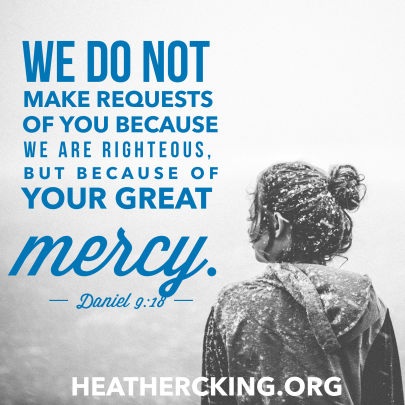
We do not make requests of you because we are righteous, but because of your great mercy (Daniel 9:18 NIV).

How could this change the way we pray for our marriages, families, churches and nation?


The Grace God Gives for the Wearied Soul

psalm 51-12

I could recognize the discouragement. The perpetual fatigue in the face and in the slumping of the shoulders, not extreme, but ever so slightly burdened down low.

It was clear in the mechanical activity, not the joyous friendliness of cheerful service like before. Now my friend moved from point A to point B, task one to task two, not smiling, just doing because doing is what needed to be done.

I recognized the discouragement because

I

Have

Been

There

Before.

We who have been weary can see the signs in others, the trudging, the exhaustion, the worn out soul fraying at every edge and held together with patches and slipshod stitchery.

So we come alongside our friends, our Christian sisters and brothers, those whose burdens we’re supposed to remove so they can walk free and unencumbered for a time.  We remind them of God’s goodness, His grace.  We encourage them in their efforts, cheering them on with reminders to persevere and not give up and yes, there will be a harvest in time, and no, it isn’t all in vain.

How do we know?  That’s what they might ask.

Oh my friend, how I know.

Because contrary to what you might have heard or expected, the Christian life isn’t all easy and Christian service isn’t all joyfully inspiring and pouring out to others out of an overflow.  Sometimes we’re emptying out the last few drops from our own parched souls, not knowing what to do when we’re dehydrated and depleted and still others hold out needy hands for more.

Yet, we know this also.

We pour out…everything….and He pours in anew.

You might think you’re alone in this, stumbling over your own weaknesses, serving to exhaustion, not seeing the reward or the gain or the purpose or the point.

Yet, the prayers of saints long before teach us that others have desperately needed to be renewed, revived, restored.

The Psalmists prayed:

Will You not revive us again
so that Your people may rejoice in You?
(Psalm 85:6 HCSB)

and

Restore our fortunes, Lord,
as streams renew the desert.
Those who plant in tears
will harvest with shouts of joy.
They weep as they go to plant their seed,
but they sing as they return with the harvest  (Psalm 126:4-6 NLT)

and

God, create a clean heart for me
and renew a steadfast spirit within me.
 Do not banish me from Your presence
or take Your Holy Spirit from me.
 Restore the joy of Your salvation to me,
and give me a willing spirit (Psalm 51:10-12 HCSB).  

Their prayers would be unnecessary, meaningless even unless they felt the need for the renewing, the reviving, the restoring work of God in us.

We need the grace again, the joy again, the steadfast spirit again, the life again.  That’s what they asked.

That’s what we need, too.

Eugene Peterson wrote:

Nothing suffers from time quite so much as religion.  The skeletal structure of obedience becomes arthritic, and the circulatory system of praise becomes sluggish.  The prayer ‘revive us again’ keeps the body of Christ youthful and responsive to every new mercy and grace in God (Praying With the Psalms).

So we offer to help carry the cross for a time through this valley and we remind them of the hope and the promise as we travel along together.

We tell the fullness of our testimony, not just the revival, the renewal, the restoration after the fact…not the destination without the journey or the end result without the in between.

No, we remember that we were worn out and limping and God renewed us.

We were dead and hopeless and God revived us.

We had lost everything and God restored us.

God did this for me, that’s what we say.  And He will do this work in you, too.

And we pray, of course we pray.

We ask God to fill them right up again, fill their own parched souls so they are overflowing. We ask for strength anew and energy for each day, for reminders of the vision and reassurance of the harvest.

God’s plan isn’t for us to walk through discouragement alone, not any of us. How could we ever survive it, after all, if we thought we were the only ones and that somehow we must be here because of our own fumbling and faltering?

But to know others have been there, have made it through, and have traveled back to tell us the good news and to pray for us along the way…that’s the grace God gives for a wearied soul.

My perfect future

Psalm 31-15

At least eight of them were going to live in big houses.

One of them wasn’t going to have a big house.  His house was going to be BIG.

They would compete in the Olympics, be world famous surgeons and vets and carpenters, play professional sports, write books, run businesses, and make a lot of money.

They would drive Jeeps or a Ford or a convertible.

They would all marry, have several children (whose names they already knew) and live incredibly happily ever after.

These were the futures my daughter and her fellow fifth graders described during their DARE graduation this week.

We parents in the crowd smiled and laughed and probably some of us cried.  What a wonderful, beautiful, sometimes humorous thing it is to hear eleven-year-olds dream.

My daughter jumped right in there, dreaming with the best of them about education, career, marriage, having kids, and making a difference in the lives of others.

Lovely thoughts, all of them.

But when they read her “My Future” paragraph at the graduation ceremony, I finally succumbed to the tears when I heard her concluding words: “My future is in God’s hands.”

Whatever happens…

Even when the plans don’t turn out the way she hoped or expected….

Even when life gets crazy or even just slightly uncertain…..

“My future is in God’s hands.”

I take this to heart.  Shouldn’t we all?

My eleven-year-old self never planned or expected all that God has done and all that He has planned for me.  My life has twisted itself up into a thing of beauty that I never could have created on my own.

There were seasons I thought God was messing it all up.

He told me ‘no.’

He changed my direction.

He made me wait ‘forever.’

He carried me through valleys of darkness when I couldn’t see the next step right in front of my face.

Maybe now I already know the answers to the questions these kids were asking:  Where would I go to college? What would I study?  Who would I marry?  How many kids would I have?  Where would I live?  What would I do?

Yet, still there’s that constant compulsion to lay the future all out clean, perfect, organized, and bullet-pointed with measurable goals and a five-year-plan of how to make it all happen.

My own daughter’s wisdom brings me back.

Do I need to know all that?

Or do I need to just know this:  ‘My future is in God’s hands’?

I think of Joseph, the perpetual Old-Testament dreamer.

God gave him so much more than a fifth-grade perfect-life wish-list.  God gave him prophetic visions of his parents and brothers bowing down to him in homage and respect.

Then he was trapped in a pit while his brothers plotted to murder him.  He was sold to slave traders and carried off to Egypt.  He was falsely accused and thrown into prison.  He was forgotten and left to rot in the jail while others were freed.

It might have looked like one great big hopeless mess.  How could Joseph ever make those God-given visions work out?

The truth is he couldn’t.

And he didn’t need to.

He just needed to keep living, day after day, moment by moment, obedient to God, trusting that God was in charge of his life story.

Louie Giglio writes in his book The Comeback:

Maybe your dream is to go to school or get a degree or accomplish a certain task or find a certain spouse or start a business or move to a certain place or create a movement or carry the gospel to people who’ve never heard it before. Those may be great dreams, but there’s a bigger dream that overrides everything else: it’s that your life counts for the glory of God.

This is the constant dream we can cling to at all times and in all situations:  May our lives bring glory to God.

Yes, in the prison.

Yes, in slavery.

Yes, even when all the dreams come true.

Ultimately, Joseph told his brothers:

And now do not be distressed or angry with yourselves because you sold me here, for God sent me before you to preserve life (Genesis 45:5 ESV).

Joseph knew nothing happened just for his own benefit, personal comfort or ultimate happiness.

Everything he endured was so God could ‘preserve life.’

His life was tucked into the grander story, the God-story, the story of salvation.

That’s true for us, as well.

We can dream, plan, plot and strategize, but ultimately we return to trust.

We trust that our lives can glorify Him. We trust that He has a grand, God-story for salvation, and we have a place within it.

We trust that our future is in His hands.

Having Hope When You’ve Been Stepped On

Acts2

My daughter was about two-and-a-half when she stepped on a butterfly.

We do this every spring as we prepare for Easter, order a cup of caterpillars and follow their journey to new life.  We watch the change, marvel again at the miracle: how the tomb doesn’t always mean death; maybe it means resurrection.

We remember that we are the ones who die to self and then gain new life in Christ, like caterpillars willingly spinning themselves into tight dormancy only to be made new.

We watched those caterpillars climb all over the tiny plastic cup for about a week.  Then they scaled the sides of the cup, flipped themselves upside down and wrapped themselves into a chrysalis.

They looked dead for a week.

One morning, I shuffled around the kitchen, moving through routine with my eyes barely cracked open.  Poured cereal. Made tea. Oversaw teeth-brushing and hair-brushing.

Then I saw the wings.

The chrysalis had cracked open and there in the morning light sat our first butterfly, fanning his wings slowly while the other caterpillars remained entombed.

Over the next day or so, the other new butterflies pushed their way out and flexed their wings.

We squeezed drops of sugar water on freshly cut chrysanthemums and watched the butterflies strengthen.  First they sat in stillness.  Then they hopped to the bottom and explored.  Then they started flying around in circles, eager for freedom.

So, we set them free.

We gathered into the garden in the warm sun of a spring Saturday and one by one released each butterfly.

But we forgot to explain the difference between butterflies and bugs to my youngest daughter, I suppose.

When one of the butterflies flew up and then back to the ground, she squashed it with her one tiny foot stomping down on the ‘pest’ just like we would crush any spider.

It was like a slow motion moment in a film, with us leaping to try to rescue the butterfly and prevent the impending doom, but failing in the end.

Amazingly enough, that butterfly still lived.  We eased him and his bruised wing onto a flower where he could enjoy some food without needing to fly.

Maybe you’ve been that butterfly.

Eager to fly.  Excited for freedom.  Hoping for beauty.

Then crushed, bruised, broken.

Maybe you’ve started this year with anticipation, holding your breath for that first sign of good news.

And you’ve already felt like a giant foot has squashed you to the ground.

Maybe it seems like nothing ever changes even though you desperately long for it to change.

Proverbs 13:12 says:

Hope deferred makes the heart sick, but a longing fulfilled is a tree of life.

Hope isn’t a fickle whim, a fanciful impression that maybe good things will come your way.

Hope is a steadfast knowledge, an anchor of truth that without a doubt you know: God is good and He will take care of you.

And when you feel a little bruised and battered, like a butterfly crushed at that first taste of freedom, hope can feel a little shaky, a little elusive, a little hard to see in the deep of the dark.

Surely Noah must have had those days, floating on that ark long, long after the rain had ceased.

How long, Lord?  When will this end, Lord?  Will we ever get off this ark, Lord?

He started sending out messengers of hope: ravens and doves.

He was desperate for the assurance of dry, solid ground.

Then one day, the dove brought him an olive leaf.  More than that, the dove brought him renewed hope.

Max Lucado writes:

“An olive leaf.  Noah would have been happy to have a bird but to have the leaf!  This leaf was more than foliage; this was promise.  The bird brought more than a piece of a tree; it brought hope.  For isn’t that what hope is?  Hope is an olive leaf—evidence of dry land after flood… (From A Love Worth Giving)

When we are weary and defeated, we can seek hope.  We can send out those doves and ravens and ask God for a sign of dry land after flood.

When we are strong, we can be the dove for another.  We can bring olive leaves to the hurting. We can bring reminders of hope and God’s faithfulness to those who can’t see the solid ground.

Do you need an olive leaf today?  Do you need to bring an olive leaf to someone else who is hurting?

Here are 30 Bible Verses on Hope to help.

Originally published 1/5/2015

Well, that was a failure

lamentations 3-22

Our morning routine on that first day back to school after winter break went flawlessly.  My kids were up, fed, dressed, and packed for school 20 minutes before the bus’s arrival.

We even added in the coats, hats, and gloves for the first time this winter and my kids still walked out the door early that Monday morning.  Someone pin a medal on us or something!

And then.

Only one word describes that afternoon: STRESS.

Before Christmas break, we had those Monday afternoons down to an exact science: Forty minutes between the time we get home from school and the time we need to walk out the door to ballet.

No problem.

In those 40 minutes, my kids changed out of school clothes and into dance attire.

I emptied the backpacks and lunchbags.  By the time we left for dance, I had their school folders cleared out; reading logs, behavior logs, agendas, and take-home folders signed; lunches packed for the next day and dinner made.

Wham.  Bam.  Thank you, ma’am.

But not this week.

Oh no.

We were a right awful mess.

Over the break, I washed all the dance clothes and thought I put everything back in the right dance bags.

On the contrary, my six-year-old couldn’t find her tights.

No problem, I found them.

Then, she had the wrong leotard in her bag.

A little more of a problem, but after some searching, I found it.

Then, her dance shoes felt tight and didn’t fit anymore.

Okay, I pulled down our bucket of dance shoes (I have quite the collection) and resized the child’s foot.

She put on her dance clothes, but forgot to take off her underwear first.  (For those who are not dance moms, underwear under your leotard is a no-no because it shows and looks embarrassing. I actually Googled that once to find out how ballerinas kept their underwear from showing.  Seriously.)

My baby girl and I had a good laugh at how much we’ve forgotten over the break and I asked her to change again.

Only then she put her stockings and leotard on inside out.

Bless her heart, I thought she’d cry for an hour over that one.  She was just so tired of changing her clothes already.

This time, I helped her into her dance clothes myself.

I loaded everyone into the minivan with five minutes to spare, plopped into the driver’s seat and realized I didn’t have my key.

Then I spent the next five minutes searching the house for the missing key only to find it on the key ring exactly where it’s supposed to be so I don’t lose it.

For real.

It was an all-out miracle because I didn’t lose my temper or explode.

But I did cry.  I sobbed a little around the house as I hunted for that key and called out a desperate cry over and over, “Jesus, help me.  I know I’m a mess and I’m just not making it today.”

But here’s the thing:  We arrived at the dance studio on time.

My daughter looked perfectly cute in her shoes, leotard, and tights (sans underwear).

I even remembered my checkbook to pay the tuition for the month.

It probably looked like we had sailed through that afternoon of craziness just fine.  Maybe it looked like I had it all together.

Nevermind that internally I had one grade to give myself for my afternoon’s performance: F as in Failure.  F as in good grief, Mom, could you possibly get yourself together already?

But oh such grace is this: We can try again.  I know we’ll get back to that smooth routine and it will go better next time.

And, even if it doesn’t, Jesus isn’t giving up on me because of a lost leotard and foolishness over my car keys.

I read this promise in Scripture:

While the earth remains, seedtime and harvest, cold and heat, summer and winter, day and night, shall not cease (Genesis 8:22 ESV).

The rhythms of creation itself are a reassurance of the rhythm of grace.

Day and night come ceaselessly.  I will wake up to a new day, a fresh start, an opportunity to try again and maybe even get it right this time.

More than that, whole seasons come and go with certainty.

One bad year of planting isn’t the end.  Spring will come anew and I can plow the field fresh, drop the seeds into the earth, and look forward to a better harvest.

I can count on it.

The failures of one day, one moment even, are only permanent if I choose to give up instead of going forward.

Fresh starts and new beginnings: That’s what God promises us, season after season, day after day.


That will never happen to me

Jeremiah 33

She bawled uncontrollably at the tragic news.

Her two older sisters had brought home five—-count them, five—–birthday party invitations within three weeks.

She had not.

I assured her: You will have parties to attend.  You will receive invitations.  Your social life has not collapsed, bit the dust, or ended in ruin at the ripe old age of five.

You will be the one bringing home the party invitation soon.  It will happen to you.  Moms know these things.  We’re smart that way.

I promise.

Meanwhile, she screamed with one long Lucy Ricardo-style wail at the total hopelessness of the situation.

“No, I won’t.”  She finally screeched out.  “I’ll never (wail) be invited (wail) to a party (wail) again (extended wailing).

As a mom, I know I should feel this deep compassion for her tiny broken heart, but really, I hid my smile behind the folder of school papers she handed me.

Five-year-old drama can be so amusing.

I sent her on her way to wash her face and to overcome her despair.  Then I opened up the yellow folder and sorted through all of the projects and worksheets.

Right on top sat a tiny white envelope: a birthday party invitation that had been there the whole time she’d been having a meltdown about a lack of birthday party invitations.

Oh mercy.

God sure can act quickly when He has the mind to.

I carried that invitation right over to my still-tearful child and I taught her right there:  Didn’t Momma promise?  Didn’t I say to have hope?

But I tuck this truth deep down in my own heart because sometimes I’m a five-year-old child wailing about a party invitation.

Oh, the crises get bigger with time.  My own adult life has trials and traumas of its own, but my reaction hasn’t altered so much with ‘maturity.’

I have grown-up ways of jumping headfirst into hopelessness instead of bringing my needs to the God of Hope.

We cling so often to the promise in Scripture:

 For I know the plans I have for you,” declares the Lord, “plans to prosper you and not to harm you, plans to give you hope and a future (Jeremiah 29:11 NIV).

But we miss out on so much in this verse if we overlook what was happening to God’s people when Jeremiah was writing this promise.

They weren’t headed into victory or into a promised land of rest and blessing.

God was declaring a season of enemy siege that would lead to utter famine, a time when they’d be tempted to eat the flesh of their own dead children.

God told His people that Jerusalem’s walls would be crushed and the Babylonian enemy would drag them off to a foreign land where they could no longer worship in the temple.

This was more than a childish meltdown about a birthday party.

This truly was desolation and despair.  It was the ugly of life at its ugliest.

And yet, here still God’s mercy covers all.

God tells His people, “Yes, it looks bad.  It’s going to hurt.  Discipline does that.  But I don’t have plans to harm you.  I have a hope and a future for you even as you face captivity and exile.”

He would never abandon them.

God’s mercy shines even in the darkest places.

Jeremiah pours out God’s promises.  He declares:

“After seventy years are completed at Babylon, I will visit you and perform My good word toward you, and cause you to return to this place”  (Jeremiah 29:10 NKJV).

“Behold I will bring it health and healing; I will heal them and reveal to them the abundance of peace and truth.  And I will cause the captives of Judah and the captives of Israel to return, and will rebuild those places as at the first. (Jeremiah 33:6-7 NKJV).

“Again there shall be heard in this place…..the voice of joy and the voice of gladness….” (Jeremiah 33:10-11 NKJV).

More than that, God assured His people:

‘In those days and at that time
I will cause to grow up to David
A Branch of righteousness;
He shall execute judgment and righteousness in the earth. (Jeremiah 33:15 NKJV).

Oh yes, He’d send the Savior.  The Messiah would come and rescue them indeed.

God’s promise to them wasn’t “if…”

If you make it out of captivity….”

If you ever get to come home again…..”

If you don’t all die off or get subsumed in the foreign culture while in exile….”

Gods promise was “When” and it was “I Will.”

And this is why we hold on in the dark, in the trials, in the moments we can’t see what God is doing, because God doesn’t abandon His people.

He carries them.  He rescues them.  He comes for them.

He does and He will.


Originally published 10/22/2014

Why you don’t have to be afraid

christmas

I remember thinking that I would have done the same thing.

At the National Holocaust Museum in Washington, DC, I picked up a tiny booklet with a name and a story inside.

My booklet told the story of a survivor.

My friend’s, however, did not.  Hers was a mom with a young daughter.  When the death train stopped outside the concentration camp, guards tried to push the crowd into two separate lines: Those who could work and those who could not.

The women could work.

But the kids were considered a burden without benefit, so they were immediately sent to the gas chambers.

This woman, though, refused to be separated from her daughter.  She must have clung insistently, desperately, stubbornly to that little hand.  I imagine her words, “Don’t be afraid.  Mommy’s with you,” even as they walked into death together.

I hope I would have done the same thing.  I’d want to be there with my kids for every frightening, fearful, terrifying thing they might face.

I’ve watched in the school parking lot on those scary days when a school shooting hits the news.  Moms pull the minivans right over, climb out and take a moment to squeeze their children.

We all fear.  I do it, too.  After the news headlines, I want so much to retreat with my kids to a secluded cabin in the woods, my pitiful attempt to protect them from the madness of sin in this world.

Yet, that’s the truth of it all: we live on a sin-scarred planet and while there are hints of beauty here, and there is mercy and grace, there is also pain and sorrow.

So, what hope do we have?

How can we wake day after day, not in defeat, resignation or anxiety, but with the joy of the Lord and the peace of salvation?

The gospel message is all about hope for the hopeless, light in the darkness, joy in sorrow and peace in turmoil.

It’s for those hopeless enough to feel like one more day alive is too much to bear.

It’s for those of us watching the clock at night, too worried about bills and our kids, our marriages, conflicts with family, or problems at work to sleep in peace.

It’s even for a worrier like me, anxious over the little things like birthday parties and church program.

It’s for the daily troubles that we turn into crises and for the life-and-death struggles we sometimes face.

It’s the reminder that God came here to be with us so we wouldn’t be alone, and He will not leave our side.

That’s the hope we have.  Not us alone in a crazy, mixed-up, broken world.  Not us alone facing bills and divorce, depression or stress.

Not us alone against any road-bumps ahead in the new year.

Emmanuel.  God with us.

As it says in Isaiah:

“Fear not, for I am with you; Be not dismayed, for I am your God.  I will strengthen you, Yes, I will help you, I will uphold you with My righteous right hand” (Isaiah 41:10).

Fear not.

That’s the loudest message from the Christmas story.  The one grand announcement over and over: “Do not be afraid.”

That wasn’t just God’s plan for our past.  It’s been His passion from the beginning of Creation—to be with us.  It was His driving desire all those years of patiently planning for our salvation through Christ’s coming, His death, His resurrection.

It’s the great passion of God’s heart even now.  In the book of Revelation, we’re told that when the battle is over and Christ establishes His forever kingdom, God will say:

“Look! God’s dwelling place is now among the people, and he will dwell with them. They will be his people, and God himself will be with them and be their God. ‘He will wipe every tear from their eyes. There will be no more death’ or mourning or crying or pain, for the old order of things has passed away” (Revelation 21:3-4).

We close another Christmas season.  We stop playing the carols.  We pack up the decorations.

We make resolutions and plans for the new year.

But this is what we carry with us; this is the hope we have every single day:

He chose to be with us so we could choose to be with Him.

So we do not need to be afraid of facing anything in this life alone.

God is with us.

A letter to my eleven-year-old daughter

letter-for-middle-school-daughter

Dear Victoria,

As a fifth grader, you probably feel like you and your friends rule the school.

You’ve worked hard in elementary school and now it’s your chance: Your chance to have the teachers who let you choose where you want to sit in the classroom.  Your chance to have no homework almost every day.  Your chance to get treats and have rewards.

This is your year.

We’ve talked about middle school as it inches close.  Here it is December, your eleventh birthday, during your last year in elementary school.  Middle school is a near-reality.

You’ve asked me all these questions and I don’t even know the answers.  What are the rules?  Are you allowed to sit wherever you want in the cafeteria?  Can you take band and chorus?

I don’t know.

But I know some things about middle school and being a tween.

Sometimes growing up hurts.

Sometimes it’s embarrassing.  You trip over yourself.  You say something silly.  You get a pimple right before picture day.

In middle school, it can feel like the whole world zeroes in on your failings and mistakes.

It’s awkward and unsettling.  It’s hard to know where you fit.

Girls get mean.  Boys get weird.  Teachers aren’t always as approachable as they were in the past.

And then there’s feeling a little more grown up, but still so very lost in a growing-up world.

Every process, every journey, every great accomplishment has ‘middle school years’—the season of in-betweens, of growing out of the old but not quite fitting into the new, seasons of waiting and messing up and learning through hard lessons.

But what every great journey teaches us is that the end will come and it will be worth it.

And you, my girl, don’t need to be afraid. 

You work harder than anyone I know.  Even when you’re just having fun reading a book, you set reading goals for yourself and track your progress.  You make plans and charts and set agendas.

And, that’s what you do for fun.

You juggle your busy schedule with grace and responsibility, always excelling, always giving the very best that is in you.  No one works harder than you.

Last week you asked me if I thought you should start studying now so you already have the periodic table of elements memorized for sixth grade science.

That’s you.  It was so very you.

Here’s my heart for you and some of the lessons you can tuck away for these middle school years:

Stop fretting and worrying that somehow you won’t be enough when the time comes.

You don’t need to study a year in advance for something you may need to know in middle school.

All of those details, all of those expectations, all of those adjustments and changes are for another day.

Today, just do your best and enjoy this moment.

It’s okay to mess up sometimes.

In middle school, it can feel like our every mistake and every flaw ends up on the nightly news.

Things get blown out of proportion.

The world feels like it’s going to end more nights than not.

Relax.

Mistakes happen sometimes.  You don’t have to win every competition, be the best in every class, or get every answer right.  We love you and treasure you and are proud of who you are.

So, give yourself some grace.

If we were perfect, we wouldn’t need Jesus.  We wouldn’t need a Savior.

But when you mess up, apologize and move on.

This is where true character begins—knowing you aren’t perfect, taking responsibility for your own mistakes, realizing that sometimes other people are right and you’re wrong.

Then, try again and do it differently this time.  Laugh at yourself.  Shrug off the condemnation and the internal dialogue telling you that you aren’t good enough or aren’t pretty enough or smart enough or capable enough.

Ignore all those lies and the haunting temptation of insecurity and just be comfortable with who you are—flaws and mistakes and everything.

And give that same grace to others.  Give them space to be human and room to be real.

This is the time when faith gets personal.

We’ve always done our devotions and Bible reading all together as a family, but this is the time for it to be real and to be your own.  This is your moment to engage with God’s Word and let it change you and guide you.

Kindness and character matter more than any popularity contest.

I watch you at church when they call all of the kids up to light the Advent candle.  You stand in the back and usher little ones to the front, making way for the smallest and the overlooked ones.

Never forget that kindness matters.

No one needs to be an easy target for cruelty, or annoyance, boundary crossing, or bullying.

But even in the toughest situations dealing with the most difficult people, choose kindness.

You can stand firm and stand up for yourself while still showing love and compassion, remembering that hurting people hurt other people.

Learn to listen well.

Listen to those you disagree with.  Listen to those who are smart.  Listen to those who are hurting.

So much of middle school drama is about people over-reacting to situations because they make it all about them and never consider the other person.  “ME” becomes the center of the tween/teen universe.

Stand out from the crowd by doing what so many people fail to do:  Really listen to others.

The world is full of people who have lots to say; what it needs is someone wise who knows how to truly listen.

Choose your friends wisely.

Choose friends who appreciate who you are and who encourage you to always be your best ‘you.’  Choose close friends who draw you to God and who never pressure you to do what you know isn’t right.

Friends don’t pull you down or hold you back. They don’t harp on your mistakes or rejoice when you fall.

Good friends catapult each other forward and have each other’s back when they stumble.  So, choose good friends and learn to be a good friend to others.

We are your safe place.

You never have to perform for us.  You don’t have to be perfect.

I can be reactive as a mom.  I know it.  But never forget this, you can come to me….always.  Maybe I’ll freak out for a moment, but I’ll get over it and we’ll get through anything together.

 We are your safe place.  We are the ones who will love you no matter what and help you always.  Come to us with the hard things and the hard days.

Be who you are because who you are is worth being.

You are the kind of beauty that comes from the inside-out.  You are deep-down lovely with your kindness and purity of heart.

Beauty like that isn’t even slightly impacted by the middle school explosion of hormones, awkward limbs, pimples, and braces.

We love you and value you and treasure you for who God has made you and we are so excited to see all that He has called you to be.

Love,

Mom

The Year of the Nintendo

christmas4

That year, my brothers wanted a Nintendo for Christmas, that original Nintendo system with Mario and maybe Tetris.

They felt like they were the last kids in the neighborhood to finally get a video game system.

But, my parents delayed.  Should we have video games in the home?  Would it rot our brains and catapult us into a life of crime?

Finally my parents decided that owning a Nintendo could open up a whole new world of discipline opportunities.  When they misbehaved, my brothers could lose video game privileges.  That’d get their attention.

So, my parents bought that Nintendo for Christmas and hid it under their bed until the big day.

Only, my brothers peeked.

And they got busted.

For their punishment, on Christmas morning, they had to open up that coveted Nintendo and then put it aside.  They couldn’t play it yet.  Oh no, they had to wait several months before they could actually maneuver Mario and Luigi around drain pipes and clouds to save the princess.

My sisters and I could play the Nintendo.

My parents could play the Nintendo (if they so chose).

But my brothers had to wait, and the wait was excruciating: to be so close and yet oh so far away.

Of course, we think we know how painful waiting is.

We groan about waiting on God.

We commiserate with other Christians who complain that they are just ‘waiting.’

Oh, waiting.

I hate waiting.

Who doesn’t hate waiting?

If only God would step things up a little and get a move on.  If only He would come through for us on our own timetable.  If only He would cram Himself into our agenda.

We are anxious and hurried, demanding and impatient when God delays.

Waiting physically hurts.  It steals sleep and turns stomachs.  We pace.  We fret.  We take control.  We lose control.  We take control again.  We demand and whine, cry and manipulate.

Yet, still He lingers.

God is never rushed or harried, stressed or overcome by deadlines or the impetuousness of His own people.

He didn’t skip the 40 years of desert training for Moses and just give him a one-month crash course in leading a nation.

He didn’t speedwalk those Israelites through the wilderness.

He didn’t clear out the Promised Land in a day or build Solomon’s temple overnight.

And He did not send His Son to earth to save us one century too early.

Do we even know what that wait was like?  

How could we endure centuries of silence from heaven?

The Israelites came face to face with their desperate need for the Messiah constantly:

The sacrifices.  The bleating of the lambs.  The stench of the blood.

They couldn’t overlook or forget the deadly consequence of their sin-state.

They’d watch the slaughter today and know that they were only pure before God for one brief moment.

And then they’d sin again.

And the sacrifice would have to be made anew.

It was perpetual and constant.  Day after day, year after year of the law and rules and punishment and sin and sacrifice.

They were oppressed and persecuted.

Still, God asked them to wait.


At Advent, we remember the intensity of the longing for our Savior.  We recall how the world ached with its need for redemption.

And then Jesus came.

He came!

No more searching and longing, no more unfulfilled expectation, no more prophecies hanging unfulfilled.

No more need for sacrificial lambs because the Perfect Lamb had come.

No more imprisonment by sin and by the law.

No more waiting.

Simeon in the temple saw it.  He had been “waiting for the consolation of Israel, and the Holy Spirit was on him” (Luke 2:25 NIV).

And when he saw Jesus, he lifted that infant Lord into his own arms and praised God:

For my eyes have seen your salvation (Luke 2:30 NIV).

He saw the promise fulfilled.

Christmas reminds us that God is at work even in the waiting and the seeming silence.

Advent tells us that God fulfills and completes His work at the perfect time, but He is ever-present, even in the interludes of expectation.

We learn here from shepherds and wise men, from prophets and priests, not to give up on God.

We take this to heart.

Yes, as we wait for marriages, for jobs, for restoration, for healing, for deliverance, for provision, for peace.

We choose expectant hope over disappointment and despair.

More than that, we live ever-ready and ever-longing for Christ’s return.

As the apostle John wrote:

The one who testifies to these things says, “Yes, I am coming soon!” Amen! Come, Lord Jesus!  (Revelation 22:20 NET).

Come, Lord Jesus!