She Left an Impression

2-timothy

She left a mark on me.

I mean a deeply beautiful impression, the trace of her fingerprints etched around my life and my heart and my future.

That’s what mentors do.  They don’t just listen and guide, teach and encourage, give advice and share experiences; they change who you are.

They say, “I see who you can be and I want to help you get there.”

And then they pour into you a little (or a lot!) of themselves.

By the time I met this one mentor of mine, she was already in her 80’s.  She had been directing music and teaching for over 60 years already and I was a baby in comparison.

Ann invited me over to her house.  She pulled out a basket of programs, one for each musical she’d ever directed.  That basket was a heavy load!

Then she showed me how she marked her music, how she made notes at auditions, how she ranged the singers.

In perhaps the most literal way possible on this earth, she passed the baton to me.

Last week, this dear lady with a fiercely spunky and loyal soul passed away.

And every single day since I’ve been meaning to write this post as a kind of tribute to her, a way to remember her long after we’ve said goodbye, cried at her funeral, and reminisced together about her.

But it’s hard.

She’s been on my mind all the time but I couldn’t quite collect all the words I’d like to say.  I miss her.  I will miss seeing her on the front row next week when our community theatre group performs their latest show.

While we do have forever with Jesus, we do not have forever to walk on this earth.  That is the way of things.

So I think of her and remember to live loyal, live love, and live with passion and gusto.

And I remember this: to live to be mentored and to mentor, to be taught and to teach others.  This is a legacy beyond compare.

At the same time Ann was saying goodbye to loved ones and farewell to friends, I was reading the book of 2 Timothy, the very last letter Paul wrote in the Bible before he died in Rome.

These are his farewell words.  His final thoughts poured out for his “beloved child” in the faith, Timothy.

(This is the beauty of God at work, how He was preparing my heart for a goodbye of my own by letting me listen in on Paul’s goodbye.)

As I read, I longed to be a Timothy.

I wanted to lean in close and listen to a faith giant tell me what’s what.  Mentor me.  Teach me, please!

Paul wrote,

I have fought the good fight, I have finished the race, I have kept the faith” (2 Timothy 4:7 ESV)

This is a life well-lived, a finish line crossed.  He didn’t give up along the way or chicken out when life got hard.  He pushed and persevered and kept on moving forward so that in those last days and those final moments, he could say with confidence that he had kept this faith and finished this race.

Amen.  I know people who teach me how to do that.

When we ache with weariness, may we all have others to lift us up.

When we’ve emptied ourselves out, may we know that Christ fills us anew and often He refills us through the overflow of others.

May we find mentors and teachers who will show us how to live life well and to live out faith.

But I don’t just want to be a Timothy, I also want to be a Paul.

I certainly know some people who need to hear me say,

“I am reminded of your sincere faith….fan into flame the gift of God…for God gave us a spirit not of fear but of power and love and self-control” (2 Timothy 1:5&6 ESV).

I want to pour into others and encourage them in their calling and their gifting.

Paul wrote to Timothy,

“You, however ,have followed my teaching, my conduct, my aim in life, my faith, my patience, my love, my steadfastness, my persecutions, and sufferings…” (2 Timothy 3:10 ESV).

This was no superficial friendship.

May I similarly leave a mark on their own hearts and their own ministries because I’ve been willing to make myself vulnerable with them, share the honest places of my heart and my struggles and how God shows so much grace.

May I be a spiritual mother to others in the way that Paul was a spiritual father to Timothy.

At any moment in our lives, we have this choice:To learn from another and to teach another.

May it be both.

May we always be humble enough to learn and gracious enough to give what we’ve learned away.

The First Thing I Want You To Do

1-timothy-2

My girl clambered into the minivan after school, heavy backpack on her shoulders, heavy thoughts in her heart.

She waited for my daily question, “How was your day?”

And then she spilled the news about “this boy in my class.”

“This boy” was loud and disruptive and didn’t follow the rules.  He cost them rewards in art class and never obeyed the teacher.  He did inappropriate things and wouldn’t stay in line.

She finished her story, pronounced a loud “harumph” and slammed her arms criss-cross around her chest in a sign of definitive anger.

So many of our conversations take place this way, me angling the rear-view mirror to see faces, shouting back Mom-ly words of wisdom from the driver’s seat.

The minivan is prime time for deep conversations.

“You know what we need to do,” I hollered to the back seat.  “We need to pray for him and for your teacher.”

I expected her to shrug off my advice as impractical and unhelpful, no immediate solution and no personal satisfaction guaranteed.

But she didn’t.

I watched as her eyes brightened and as she lifted her face so her eyes met mine in the mirror.  She nodded in wholehearted agreement.

Later, snuggled together on our overstuffed blue couch, I prayed for “this boy” and for their teacher and when I was through, this child of mine–who finds kisses too embarrassing and declines to even hug much of the time–tossed her arms without reservation.

We parents, grandparents, teachers and leaders show our children how to pray.  We begin with bowed heads over scraped knees and boo-boos on fingers.

We seek forgiveness for wrongs and take difficult situations to God.

And then we begin to pray for others, turning their hearts outward in ministry and compassion.

But it all begins with us, modeling the habit and discipline of “take it to the Lord in prayer.”  It’s bringing Jesus right there into the center of our everyday.

As Paul wrote,

“The first thing I want you to do is pray.  Pray every way you know how for everyone you know” (1 Timothy 2:1 MSG).

The first thing we do is drop to our knees, not after consultations, Google-searches, strategies, all-night worrying sessions, and Facebook posts.  Pray first.

Perhaps God had been preparing me for that moment in the car because I’d been on my knees consistently for weeks over my girl.

Please God show me how to be the Mom she needs me to be, how to encourage her, love her, shepherd her heart, discipline her, and protect her.

In life and in parenting, we can read books, seek counsel, collect advice, listen to sermons, and Google search to our hearts content.

All that might be helpful and good, but what we need to do first and what we need to do most is pray.


Maybe God draws us to pray for our kids so that they’ll see us and learn how to bring His presence into the midst of all situations.  They’ll see our faith practiced in the everyday situations and learn to talk about life and God—-not life or God and never the twain shall meet.

Yes, this is more than Sunday morning belief or pew-sitting faith.  This is down and dirty life with God at our side, available to help us in every situation, to give us wisdom, strengthen our hearts, teach us to obey and discipline our desires.

We pray for our children because we love them and want the best for them.

But we also pray for them so that they learn to pray…so that when they encounter “this boy,” they know they can carry his case to God.

And when their friend is hurt by teasing, they’ll give a hug, say a kind word, and petition God on her behalf.

When they don’t know what to do, they whisper to God a request for help and follow His lead.

When life is hard, when situations are uncertain, when they feel afraid, when a friend loses a mom or they see someone with cancer, our kids need to know exactly what to do.  They need to pray.

We pray first, pray about everything, pray every way we can, and pray for everyone we meet.

Welcome Home

psalm-90

We want to do “Home” here.

On the bad days, on the days you messed up or didn’t win, on the days the minivan breaks down and we all cram into the little car to shuttle around town….

On the days when we say the foolish thing and our tempers get the better of us…

On the day when we’re just crazy forgetful or running late and the ballet studio is calling me (again) because my daughter is waiting for me and I’m still two minutes away on Main Street….

On the nights when mom didn’t sleep because she was up all night stressing about a problem and then remembering to pray over it…

When we get bad news, when our feelings are hurt, when our friendships are tricky, when two girls keep fighting on the playground and that ruins our favorite recess game….

We want to come home.

I want my husband and my kids and surely myself to have this place of space and grace.

This is the place we celebrate with milkshakes and we commiserate with movie nights and freshly popped popcorn.

Life can sure be disappointing sometimes.  People can be cruel, trodding all over you when you’re already down in the dust.

But home is where the people are who genuinely celebrate your victories and accomplishments.

Home is also where you drag your disappointed heart with its hurt and sadness because it’s safe here.  You are hugged.  You are loved without conditions and expectations.  These are your people, the ones who are for you.  The ones who won’t mock your tears or tell you to ‘buck up and just get over it.’

Home should be the safe place.  The united place.  The place where being you is being enough.

Of course, Home isn’t that way for everyone.  And that’s the great tragedy.  It must break God’s heart to see how Home sometimes hurt instead of heals.

But at least here in my space, in my life, for my family, I want Home to be the refuge God meant it to be.

I read in Psalm 90:1, how Moses prayed to God.  He said:

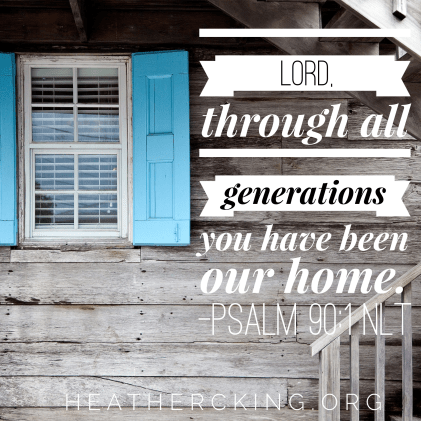
“Lord, through all the generations you have been our home” (NLT).

I’ve read this in other translations before.  The ESV says the Lord has been our “dwelling place” and the HCSB says the Lord has been our “refuge.”

But I let that word “home” echo a bit and think about what it means for God to be Home for me.

My safe place.

My refuge.

The place where I abide, live, dwell…where I relax and be myself, where I kick off my shoes and plod around in my cozy white socks, where the masks are off and people see the real me, where I wash off my makeup, where I mess up sometimes and ask for forgiveness from those who love me still.

God is my Home.

He’s celebrating our victories.

And He’s wrapping us up in arms so big when we unload the disappointment, hurt and sadness we’ve been carrying on our shoulders.

In a world where we can feel judged and criticized, like people are always jumping in with suggestions of how we should be, where bullies and mean girls set themselves against us, God is our Home.

He loves you as you are.  He says you’re beautiful.  He says you have value and worth and He’s proud of you and He’s seen it. All of it! All your hard work and effort–and He says it’s good.

I wonder what it was like for Moses to write that God was his home?

Moses–the slave baby sent into the river on a basket, raised by an Egyptian princess in a palace where he didn’t quite fit in.

Moses–the murderer turned fugitive, who spent 40 years out in the wilderness tending sheep and living outside his community.

Moses–the leader of a nation that spent another 40 years wandering around the desert, pitching tents, moving on and never lingering in one place for long.

FOR THE UNWANTED, FOR THE OUTSIDER, FOR THE BROKEN, FOR THE SINNER, FOR THE PRODIGAL, FOR THE WANDERER, FOR THE LEADER, GOD WAS HOME.

GOD IS HOME.

WELCOME HOME.

Trusting When Life Feels Shaky

anywhere-faith-quote-2-1

We were simply working on a piano lesson.  I didn’t anticipate crumbling her perspective on life, the world, and the ability to “know” truth.

But that’s what happened.

As a young music student, I learned the same lesson in music theory: a B sharp is the same exact note as a C on the piano.

Now, this was cool to me.  I thought I was “in the know” and had some incredible, deep music knowledge that only the truly initiated can possess. It was a sort of all-access pass to conversations with musicians who actually knew far more than I ever will.

That’s not what this felt like for my daughter.

I told her, “See that’s a B sharp, so you actually just play this C.  See it’s the same thing. See how cool that is?”

She did not see.

She accused me of rocking her world.  Everything she ever thought about life and existence could all be on shaky ground where B’s are really C’s and how are you ever supposed to know what’s really true?

Her whole reaction was shockingly unexpected, but I consider. I ponder what’s at stake.

Life can feel just that shaky at times.  There are things we take for granted, foundations we’ve been sure are rock-solid.

There are expectations we just know will be met.  There are promises we feel sure God will fulfill in a certain way.

Then something goes awry.

We can ride this intense roller coaster of emotions:  “Everything is great!  Everything is falling apart!  Today I definitely see everything working out!  Today everything is in despair!”

What can we truly know?

When life can shock you like that, when a moment that should be certain victory becomes defeat instead, when you trusted in God but got hurt anyway….when you look at the music and see a B sharp but you play a C….then what do we do?

Shakiness like that, doubts like that, disappointment like that may seem like they’re signs of weak faith.

We tell ourselves, “Pretend to have it all together.  Don’t admit that you’re struggling with doubt.  Don’t tell anyone you’re feeling defeated.”

But here’s what I wrote in Anywhere Faith about doubting:

“God is gracious. He knows exactly what’s in our heart in our weakest moments. He loves us and calls us anyway, not because we are worthy, but because He is worthy; not because we are able, but because He is able.

We need not exert ourselves and try to force ourselves to believe, or try to chase doubt out of our hearts. Both are just as useless. It begins to dawn on us that we can bring everything to Jesus, no matter how difficult it is; and we need not be frightened away by our doubts or our weak faith, but only tell Jesus how weak our faith is (O. Hallesby).

We can bring our doubts to Jesus. We don’t have to pretend they don’t exist or hide them away in embarrassment and shame. Instead, we can pour those doubts right out at His feet and choose to trust Him. Trust Him to answer prayer. Trust Him to do what He promises to do. Trust Him even with our doubts (#AnywhereFaith).

We can drag our confusion and hurt, our disappointment and doubts to the feet of God and ask Him to heal us and show us how to trust Him.anywhere-faith

Not trust in circumstances.

Not trust in others.

Not trust in ourselves.

Not trust in our own expectations or plans.

Not trust in what we think God will do.

But trust Him.  Trust His character.  Trust His love for us.

Jeremiah the prophet wrote:

Blessed is the man who trusts in the Lord,
whose trust is in the Lord.
He is like a tree planted by water,
that sends out its roots by the stream;
and does not fear when heat comes,
for its leaves remain green,
and is not anxious in the year of drought,
for it does not cease to bear fruit (Jeremiah 17:7-8).

Before these verses, he tells the people “Cursed is the man who trusts in man and makes flesh his strength….” (verse 5).

In other words, don’t trust in other people. Don’t trust in human strength.

After these verses, he says, “The heart is deceitful above all things…” (verse 9).

In other words, don’t trust your own heart and emotions.

But in the moments when nothing seems to make sense and when circumstances seem impossible, we can go back to the thing we know we know that we know.

We trust in the Lord.

We sink our roots deep down in Him and we allow Him to make us fruitful and strong despite heat and drought and the crazy world where B sharps are really C naturals.

How to Do the Thing You Don’t Want to Do

anywhere-faith-quote-5

This week, I’m having to do some things I don’t want to do.

Life is like that sometimes.

Eventually, you have to just go to the dentist or get the flu shots for your kids.  No more procrastinating.

You need to make that phone call…have that tough conversation…ask someone for help.

When we’re obeying God and following Him “Anywhere” He calls us to go, it’s sometimes exhilarating. Other days, obedience can be difficult, messy, frightening and overwhelming.

This week, as I do some of the hard things, I consider how Queen Esther did what she didn’t want to do.

When her cousin, Mordecai, asked her to speak to the pagan King about preventing the genocide of the Jewish people, she wrote back to him:

All the king’s servants and the people of the king’s provinces know that if any man or woman goes to the king inside the inner court without being called, there is but one law—to be put to death, except the one to whom the king holds out the golden scepter so that he may live. But as for me, I have not been called to come in to the king these thirty days (Esther 4:11).

Still, instead of hiding away in fear, putting off the task, or running away from God (all of which I’m tempted to do at times), Esther chose the hard obedience.

Here’s what we can learn from her:

Pray and ask others to pray

Esther asked the Jews in Persia to fast and pray for her before she finally went before the king.

Her story isn’t one of a lone heroine rising to face an enemy. She … depended on the intercession of her people.  #AnywhereFaith

I pray some specific things when I know God is asking me to do something I don’t want to do:

Please:

  • grant me favor (Proverbs 3:4)
  • give me courage (Isaiah 54:4)
  • bless the work of my hands (Psalm 90:17)
  • make me competent to do things I can’t possibly do on my own or in my own strength (2 Corinthians 3:5-6)

Like Esther, I also sometimes make myself vulnerable and share my request with someone else. Just knowing I’m not alone helps me move forward.

Just do it!

Esther set a deadline—fast and pray for three days and then she’d go before the king (Esther 4:16).

Deadlines can work for us, too. We can pray and think about it forever, but in the end, it’s time to just get the job done.

After the three-day fast ended, Esther walked into the throne room uninvited and faced the king on behalf of her people.

Leave the results in God’s hands

One of the hardest parts of my calling is asking.  I send out proposals and ask publishers if they’re interested.  I ask businesses about book signings.  I ask for input on my book from others. I  ask people to join my launch team.  I ask radio stations if I can come on the air.

I have to ask.  It’s part of being an author, but it’s the hardest part for me because I fear rejection. What if others say, “no?”

I’m learning, though, to leave the results up to God.

Esther made a famous declaration when she finally decided to go before the king, saying, “If I perish, I perish” (Esther 4:16).

These are words of submission to God’s big plan.

Whatever happens, no matter what the outcome, I’ve done what God wants me to do and He’s in control.

Sometimes I ask myself, “What’s the worst thing that could happen here?” And then I remember that any “worst thing” I face is still in God’s hands.

Success doesn’t depend on me, nor was it up to Esther to change public policy or the heart of the king.

Ultimately, we can walk in obedience and trust God with the outcome.  Even if the worst happens, He will carry us through.

Celebrate

When Esther obeyed, God saved her people.  As a result, the Jews celebrated, and they are still celebrating the Feast of Purim with “feasting and gladness” to this day! (Esther 9:22 ESV).

In a much smaller way, I celebrate even the smallest acts of obedience, too.

When I’ve made the phone call I didn’t want to make, talked to the person I was afraid to talk to, stood up for something when I was afraid to speak, or submitted a proposal when I feared rejection, I usually treat myself.

It’s not big or expensive. For me, it might be a a hot cup of tea or a piece of dark chocolate, maybe a morning off from normal work in order to rest and read.

Maybe your treat is a Starbucks coffee or a new book.

It’s not about going big; it’s about rejoicing over obedience and celebrating what God has done in us!

Want to learn more about Esther’s fears and how God helps us go “Anywhere” with Him, even when we’re terrified?  My new book, Anywhere Faith, is available now.anywhere-faith

When We’re Tempted to Pull In, Reach Out Instead

romans-12-12

My daughter was five at the time, and I put my hand gently on her back to usher her into the minivan.

She did not move.

But my lecture about wasting time and ‘please can you hurry because we don’t want to be late!’ caught in my throat when I glanced back at her.

Her head was bowed, her eyes squeezed shut.  Her hands were clasped and tucked under her chin.

She was praying.

I bowed my head to her and heard the whisper:

Dear God, please help the person who is hurt and help the fire truck make them safe and all better.  Amen.

That’s when I finally heard them: The sirens in the distance that I’d been blocking out with busy thoughts and Mom-instructions to “get your seatbelts on quickly” and “take turns sitting in the middle seat” and “make sure you have all your stuff.”

You know.  Life.

Life crowded out the need, crowded out others.  It tunneled my vision so I saw only my agenda, heard only my voice, pushed and shoved and crammed right up to the Father with only my own needy self in mind.

As parents, my husband and I have had our more spiritual moments.  We’ve hushed the general din of six people crowded in the minivan so we could pray about the fire truck or the ambulance passing us on the road.

So my girl took this to heart.  She tucked it into her soul and now she watches and listens and drops her head down the instant she senses the need to pray.

She even stopped the mad dash to the coveted middle seat of the minivan and let her sisters rush in to claim the prime spots in order to pause and pray.

She let go of self.  She focused on another.

My little prayer powerhouse reminded me to get down on my knees and beg for God to help me see.

Because somehow there’s this automatic pull of humanity back to self.  Somehow the noise within us drowns out the noise without….so we no longer hear the cries of need from a needy world.

Somehow we lose the eyes of God, the ears of God, the heart of God.

Moses also teaches me to see others with God’s vision.

He stood on a holy mountain preparing to die.  Moses was not to enter the Promised Land and he knew God’s intentions to take him up a mountain he would never climb down.

But his eyes were not on his own immediate need, but on the people of Israel instead.

He could have asked for a legacy.

He could have begged for forgiveness and the chance to step at least one weary foot onto Canaan’s soil.

But he didn’t.

Instead, he prayed:

Let the Lord, the God of the spirits of all flesh, appoint a man over the congregation who shall go out before them and come in before them, who shall lead them out and bring them in, that the congregation of the Lord may not be as sheep that have no shepherd (Numbers 27:16-17 ESV)

Long before Jesus, Moses stood overlooking the crowd and saw them with God’s eyes as sheep that have no shepherd.

Centuries later, Jesus Himself stood and saw this same need:

When he saw the crowds, he had compassion for them, because they were harassed and helpless, like sheep without a shepherd (Matthew 9:36 ESV).

Moses got right to the heart of the matter, right to the need before him and put aside his own affairs—he was, after all, moments from death—-in order to intercede on behalf of God’s people.

His heart matched God’s own heart.

He had 20/20 vision instead of cataracts of selfishness marring his perspective.

Selfishness takes up time and takes up space; it muscles out God and keeps us from loving others.

Today, let’s lay it down.

In the moments we’re tempted to focus our vision on our own need, our own circumstances, our own weariness, may we deliberately choose to prayerfully reach out to and lift up another.

Because it’s in our moments of deepest need that we can be most sensitive, most compassionate, most prayerfully passionate on behalf of others.

prayerlovingothers

Originally published 3/18/2015

God Gives us What We Need When We Need It #AnywhereFaith

anywhere-faith-quote-3

Sometimes we want to see the provision in advance.

Before we step out in “faith,” we want to know we have enough: time, money, strength, ideas, training, support.  We want our offerings to God and our ministry for Him to be perfect.

But in Hebrews, we’re told:

Therefore let us draw near with confidence to the throne of grace, so that we may receive mercy and find grace to help in time of need.

God helps us in our time of need—not as a stockpile for our seasons of neediness.

This is a lesson I’m learning inch by inch.

For just about a whole year before it ever happened, I worried over a “need.”  My oldest daughter started middle school this September and I’ve been running over questions about the transition since last September.

When will the bus come?  How will she adjust to earlier morning hours?  How do we get her to school on time without waking up all the other kids? Will she need to take showers in the morning or at night?  How will her after school activities fit into the schedule?  

Maybe it all sounds a bit extreme to you, but still I stressed, planned, and considered possibilities.

I prayed.

Here’s what happened.  On the first day of school, she got up, got ready, and went to school.  She’s done that every day this month.

Just like that.

A new ministry, a schedule adjustment, an extra activity thrown in, a needy friend, a season of pouring out to others—these aren’t opportunities to freak out; they are opportunities to see God come through.

God gives US what We need when WE need it, and not often before.

One of my favorite “callings” in Scripture is the moment God spoke to Jeremiah:

Then I said, “Alas, Lord God!
Behold, I do not know how to speak,
Because I am a youth.”
But the Lord said to me,
“Do not say, ‘I am a youth,’
Because everywhere I send you, you shall go,
And all that I command you, you shall speak.
“Do not be afraid of them,
For I am with you to deliver you,” declares the Lord (Jeremiah 1:6-8 ESV). 

On the surface, It sounds like Jeremiah thought he was too young for prophetic ministry.

But then I consider context:

the word of the Lord came in the days of Josiah the son of Amon, king of Judah, in the thirteenth year of his reign (Jeremiah 1:2 ESV).

Jeremiah began prophesying during the reign of Josiah, who became king when he was only eight years old.

So even if Jeremiah was in his teens or early 20s when God spoke to him, he had seen God use an eight-year-old king to lead the nation of Judah in one of its greatest spiritual revivals.

“I’m too young” doesn’t seem like a good excuse.

Maybe what Jeremiah really felt was unready and unprepared.

And that’s where I totally understand Jeremiah.

Sometimes I feel unready, too.

Like this whole transition to middle school, I wanted to know all the answers in advance and have the perfect plan already in place.

You too?

When God calls you, do you ask Him to wait until you feel “ready?”

Maybe if we train a little longer, stock up a little more, save a bit, work it all out on paper, and prepare, prepare, prepare, then we can follow God’s call.

We wait until we have extra money to give.

We wait until our gifts are perfected to offer them to others.

We wait for free time before we serve.

But the time to serve God isn’t when we feel ready; it’s when He asks us to follow.

After all, God told Jeremiah, “I am with you.”

He promises us His presence, too!

If we wait until we’re “ready,” until we’re prepared, until we’re fully trained, until our gift and our offering are perfect, until we feel like enough, we’ll wait and wait and never take that step of faith and obedience.

We’ll be trusting in ourselves rather than relying on God to be with us and to be enough for us.

Ecclesiastes 11:4 says:

If you wait for perfect conditions, you will never get anything done (TLB).

What is it you feel the Holy Spirit nudging you to do?  What season are you entering?  What task has He laid at your feet?

God will be enough for you.  He will give you everything you need exactly when you need it.  So, don’t pause until you feel ready or until you’re perfect and your gift is worthy.

Right now, right where you are, with what you have, you can follow Him where He’s calling you to go and trust Him for provision and strength for the journey.

To read more about what people in the Bible said to God when He called them, please check out my new book, Anywhere Faith (releasing October 3rd).  

Change is in the air (and I’m not always happy about it)

2-corinthians-3

Sometimes you come right up to a line and you have to choose:  Choose to change? Or cling to the old, the worn, the ill-fitting but the known and comfortable?

Me?  I usually fight change, ignoring it as long as I can until I’m finally forced into it.

Change is relentless, though, like the arrival of new seasons.

Funny how I can dislike change so much, but still love fall with its consistent reminder that change is necessary and change can be beautiful.

In a way, this has been the topic of much discussion at my house.

For one thing, there’s this unstoppable force at work–this act of growing up–that we can’t pause, hinder,  or slow down.

I took my girls shoe shopping before the new school year began and the sales lady made the grand announcement: My daughter’s feet are bigger than mine.

Not the same size.  Bigger.

She’s been nudging close to me in height for the last year, but I still have maybe 1/8 of an inch on her there.

I never expected, though, to break through some kind of barrier while standing in the middle of the shoe store. That one snuck up on me.

Changing and growing and transforming: That’s what my kids are doing every single day. It’s hard to see up close.  Each morning, they look the same as they did the day before.

But then there’s last year’s school pictures.

Or the snapshots from a few years ago.

That’s where you see the truth of just how much has changed over time.

And yet, even my kids, as proud as they are of new growth chart markings and new shoe sizes, seem to push hard against changes to situation or even changes within.

They begin to “own” their quirks, foibles, and, yes, even sin.  I hear them say, “I’m picky about food.”

And it’s not a confession. It’s not a request to do better or to grow in an area of weakness.

It’s said with pride, like “this is who I am and that’s who I’ll be forever.”

“I can’t help it,” they say, “I’m loud….I like to be in charge….I like to spend all my money”

The message lies just underneath the surface: “This is who I am and I can’t change.”

So one day, I lean in close to my daughter as she makes another declaration about who she is and I say:

There’s only One who cannot change.  That is God and you are not Him.  Not only can we as humans change, but sometimes we should.

I was preaching to myself a little there, too.

It’s true.  God is unchanging.  He is the same yesterday, today and forever.  He is the Alpha and Omega, the First and the Last.  We can fully rely on His character and faithfulness because Scripture tells us He always has been and always will be faithful.

God does not change.

But He wants to change us.

He loves us as we are; He loves who we are; but He wants to move in our areas of weakness, in our hang-ups, in our sin-tendencies.

Paul tells us:

And we all, who with unveiled faces contemplate[a]the Lord’s glory, are being transformed into his image with ever-increasing glory, which comes from the Lord, who is the Spirit (2 Corinthians 3:18 NIV).

The Message paraphrases this passage beautifully:

And so we are transfigured much like the Messiah, our lives gradually becoming brighter and more beautiful as God enters our lives and we become like him.

Maybe all these ways I’m trying to hold back change, are really ways I’m trying to keep God from doing the beautiful work of changing me.

Maybe the circumstances I don’t want to accept, the relationship I don’t want altered, the “new” that I feel pushed upon me are God’s ways of molding me and making me more like Jesus.

And, that’s what I want.  I want to be more like Jesus every single day until eternity makes the process complete.

That means change. I cannot stay the same way and still become more like Christ.

It means cleaning out the closet of old, worn-out, too-small shoes (even if they are my favorite) and stepping into what’s roomier and gives me space to grow.

It means not holding onto sin, the weaknesses I consider “just who I am” or “just how I was made.”

Instead, we can yield to the Holy Spirit and say:

Have thine own way, Lord.  Have thine own way.  Thou art the Potter; I am the clay.  Mold me and make me after thy will while I am waiting, yielded and still (Adelaide Pollard).

Maybe We Need to Rethink “Calling” #AnywhereFaith

img_8616

As a teen, I attended some huge youth conferences with my church and they tended to have something in common:

There was always a tremendously dynamic speaker who had a jaw-dropping testimony of God’s grace: He did drugs.  He was in a gang.  His girlfriend got pregnant and he made her have an abortion.  He was an alcoholic, who was addicted to pornography, and homeless.

Then He met Jesus.

By the time the testimony was over, the altars were flooded with teens crying and praying for God to save them and use them.

But my story didn’t seem to fit in.  They’d ask if anyone felt “called to ministry” and I’d raise my hand and pray that God use me “anywhere” and send me “anywhere.”

Only, how could He use a girl like me?  I’m relatively boring and surely the world truly needed displays of God’s grace and mercy on a grand scale.

I prayed and searched for God’s will for my life, but I didn’t end up in foreign missions or traditional full-time ministry.  So, does that mean God didn’t call me after all?

Now, that’s my story.  How I struggled to truly let grace seep deep in my soul.

How I searched so hard for one “big calling,” that I overlooked the impact of daily obedience and the calling to follow Him right here, right now, serving Christ by serving others in small ways every single day.

Your story might be like mine.  Maybe you desperately want to follow Jesus “anywhere,” but you can’t see where He wants you to go.

Or perhaps your story is entirely different.  Maybe you have that testimony of radical transformation, but you feel like an unworthy vessel, unfit for His use.

“Calling” is a tricky subject for Christians.  It sometimes trips us up into a mess of confusion.

We talk about God “calling” me to do this or “calling” me to do that, but we don’t always know what that looks like day in and day out.

And sometimes we miss it entirely.

When I wrote in my book, Anywhere Faith, about following God anywhere He calls us to go, I shared some truths about “calling” because God wants all of us to follow Him, whether that’s around the world, across the street, or in our own homes.

God calls all of us

Your past, your present and your future don’t have to look like anyone else’s in order for God to use you.  anywhere-faith

Maybe He called you to foreign missions or full-time ministry.  Maybe He called you to pray for the teachers at your kids’ school or to help young moms who need encouragement.

If we obsess over what someone else’s calling looks like, we can sometimes miss what He has planned for us.

God uses the ordinary. He uses the everyday and the mundane. He uses the untrained. He uses the sinner who repents and the prodigal who returns. He uses us despite our past and even sometimes because of our past (Anywhere Faith).

Callings don’t have to be (And often aren’t) glamorous or grand.

I’m not a speaker at conferences talking about deliverance from addiction.  Today, I have played Play Doh with my son, scheduled doctor’s appointments for my kids, prayed for my family, written to you, washed dishes and laundry, and performed a million small and seemingly insignificant tasks that are actually ministry.

Sure, the disciples traveled with Jesus, witnessed miracles, and even healed and performed miracles themselves in Christ’s name.

But the calling wasn’t all glitz and glamor.  They packed light and traveled far. They left families and jobs behind to pursue Jesus.

Jesus told them to bend low, to do the dirty jobs, to wash feet, to love outcasts, to touch lepers.

He asks us to humbly serve others every day, too.

Your calling might not be to a stage or arena; it may be to faithfulness at work, witness in your community, and ministry to your family.  Every “calling’ is significant to Him.

God can use you right where you are

We can get so caught up looking for big visions for our future that we miss the ways He asks us to serve today.  I’ve done it myself, praying desperately for God to show me “His will for my life” instead of His will for this moment.

Let’s ask God to show us the next right step and walk that way.  We can trust Him with our future.

 When we talk about calling, let’s remember this:

God isn’t looking for the flashiest vessels; He’s looking for yielded vessels…
He uses the humble, the willing and the obedient (Anywhere Faith).

May we be yielded today, humble today, and obedient today as we follow Him “Anywhere.”

To read more about how to overcome our excuses and insecurities and follow God “Anywhere,” i hope you’ll read my new book Anywhere Faith, which releases on October 3, 2016.

We are doing an eternal work (and we have help)

1-peter-4

At last year’s dance recital, I had two lovely ballerinas on the stage, one two-year-old son sitting on his dad’s lap, and one precious daughter who didn’t want to do ballet, but felt left out for not doing ballet.

She really preferred tap dance, but when our studio stopped offering that, she never picked up another activity.

And I wasn’t in a rush to fill the schedule.

After the recital’s grand finale, though, my non-dancing daughter said, “Everybody in this family is into dance except me.”

Now, I questioned the accuracy of this statement.  Neither her dad nor I could be considered “into dance” by any outrageous stretch of anyone’s imagination.

Still, she felt left out.

I started praying right then.  How can we encourage her to be active?  How we can find her “one thing” to enjoy and participate in, Something that is “hers”?

She gave me a list of possible interests:

  1. Basketball.
  2. Karate.
  3. Tap dance (at another studio if I could one one).

This list held a few surprises.

So, I prayed some more.  God, please give us clear guidance.  I know you love my daughter.  What is your best plan for her?

Schedules started rolling out and I checked them faithfully.  Every time a basketball activity was offered, she was already busy.

Karate, on the other hand, fit perfectly in the fall schedule. So karate it was.

I didn’t stop praying of course.  I signed her up and kept right on giving this to God–would she like it, like her teacher, like her class? Would she feel comfortable and have fun?

That first night of karate, I started getting the text messages from my husband as he sat with her before class began.

She knew a few kids in her class already.

Not only that, the very first thing the instructor said to her was, “You’re tall.  You’ll need a different t-shirt.”

This child is endlessly obsessed with her height and how much taller her sisters are and how she hates being short.

So, this guy pretty much made her day.  Maybe her whole year.

She ran over to her dad, “He says I’m tall!!!”

She burst through the door at home and told me, “Mom, he said I’m tall!!”

She told her friends at school the next day how the karate instructor said she was tall.

God knew the precise encouragement that would bless this girl-of-mine.

Will she be the next black belt in karate?  Who knows?  She’s only had one class that was “awesome” and we don’t know if that will change.

This I know, though: God is so faithful to care for our families when we turn them over to His care.

In his book, Hopeful Parenting, David Jeremiah writes:

Observe the instruction to families in the Bible and you will notice one recurrent theme…All these instructions to the family wrap around a core of faith in God and Jesus Christ.

Paul wrote in Ephesians:

  • Children, obey your parents in the Lord  (Ephesians 6:1)
  • Wives, submit to your own husbands, as to the Lord (Ephesians 5:22).
  • Husbands, love your wives, as Christ loved the church (Ephesians 5:25)

When I wrestle with how to love my husband well, how to be the wife I need to be…how to be more gentle as a mom, more patient, more willing to listen more and talk less, and when I seek how to pour into the hearts of my children, I am relying on Christ to build this home.

And He is reliable.

I can strive to love them on my own, but I am not enough for this job.  I am faulty and will fail.

He, however, is more than enough.

For some of you parenting through a tough season and praying for a prodigal, I know praying hasn’t seemed to work….yet.  Happy endings and fairy tale conclusions aren’t promised.  You’re not praying about after-school activities; you’re on your knees for so much more.

But don’t give up.  Even when you can’t see anything changing, please keep praying.

Your prayers matter.

And all of us, wives, grandmothers, parents of littles and parents of grown children, can shift our perspective when we remember this:

The person who sleeps next to you at night and eats across the table from you each day is eternal (David Jeremiah, p. 222).

We are doing far more than making meals, scrubbing toilets, packing lunches, or paying bills.

We are worshiping the Lord, and we are engaging in an eternal ministry by building into others in eternal ways.


And we are doing this “in Christ” and “like Christ” and with His help always because we can’t do this on our own.