He makes all things new (and new is what we really need)

christmas12

I found a $1 treasure at a summer yard sale, an oak step stool to solve my problem.

My kids had been scaling the counters to reach cups and bowls from the cabinets, a heart-stopping feat if ever there was one.

They carried the bathroom stool out to the kitchen and left it there where it didn’t belong.  It was a step stool in demand, actually.  Every time we needed the stool, it was inevitably hopelessly lost in whatever room in the house we didn’t think to look.

I spotted that “new-to-us” wooden stool in that yard sale and my heart skipped happy beats of victory and accomplishment.  With just a simple coat of paint, I’d have a sturdy new stool that belonged in the kitchen, kept my kids off the counters, and matched my home décor.

Score!

The first time it wobbled, we dismissed it as our own clumsiness.  That’s easy to do in our house.

But the offending stool failed us again and again, causing bruises, bumps, scrapes, tears and accusations.

I gave lessons to my kids on how to keep from smashing your head on the kitchen counter. Surely, they simply needed to know “How to Stand on the Stool” and “How Not to Stand on the Stool.”

The problem, though, wasn’t our technique. The stool itself was faulty in a way a coat of paint couldn’t cover. It was treacherous and off-balance.

Finally, I admitted defeat and threw it out with the morning garbage before I added an emergency room visit to my daily agenda.

My refurbishing failure reminded me that Christ doesn’t just make things over, He doesn’t just make things pretty, He makes all things new.

More than that white covering of snow that sparkles in the moonlight and hides the wilted grass and un-raked leaves, Christmas offers us a fresh start.

But do we believe it? Do we treat ‘newness’ as little more than cosmetic refurbishing? A coat of paint, perhaps, and God sends us on our merry way with a façade of Christian niceties covering over a truly treacherous human condition?

Scripture is radical in its promise:

 Therefore, if anyone is in Christ, he is a new creation. The old has passed away; behold, the new has come (2 Corinthians 5:17 ESV).

 I will give you a new heart and put a new spirit in you; I will remove from you your heart of stone and give you a heart of flesh (Ezekiel 36:26 NIV)

God’s work in us isn’t just life with a Christian ‘varnish.’ He promises to remove the diseased and petrified heart that plagues our life with sin and transplant in us a new heart of flesh, a heart where His Spirit dwells.

It’s complete.  It’s not refurbishing a $1 step stool and hoping you don’t gash your head open when you use it.  It’s not ‘settling’ for a little bit of God in a big pile of mess.

More than this.  Oh, so much more.

It isn’t God handing us a 12-step instruction sheet with complicated diagrams and a paint kit and telling us to go make a new heart.

That’s the law.  That’s us trying to get it all right.  Trying to be perfect.  Trying to reach heaven on our own tip-toes (maybe with a faulty step-stool).

That’s us landing on the ground again, worn and weary, exhausted from trying so hard to stop the wobbling, the failure, the mess the brokenness.

That’s us trying to hold it all together and still finding that it falls all apart.

But Christmas is God come down; not us reaching up high enough to touch Him. Christmas is God’s gift, God at work, God-with-grace, God-with us.

Too often, we make it all about us.  What we have to do to make Christmas perfect.  What we have to accomplish in our homes and in our hearts: The projects, the parties, the get-togethers, the programs, the traditions, the attempts to pack more meaning into something so deep-down meaningful.

And we almost miss it.  For all the to-do, we almost miss this:

Christmas is about Him.

He will take us as we are and He will make us new.  It’s all in His big hands, big enough to hold us all together, big enough to heal, strong enough to carry us right on through.

Originally published 12/15/2014

He Loves You So

christmas13

I cried when I read the story for the first time.

Then I cried when I told it to our church choir.

And I cried when I wrote about it.

In his book, A Lifelong Love, Gary Thomas told the story of Dr. Robertson McQuilkin, former president of Columbia Bible College and Seminary (now Columbia International University).

After decades of marriage, McQuilkin’s wife, Muriel, was diagnosed with Alzheimer’s.

Since she’d always loved art, her husband took her on a trip to London, hoping she’d enjoy seeing her favorite paintings in person—maybe for the last time she’d ever be able to truly appreciate them.

On the flight, whenever Muriel had to use the restroom, Dr. McQuilkin had to squeeze into the airplane’s bathroom with her (despite the embarrassingly critical looks from the other passengers).

Then, after all that effort, when they arrived at the museum, Muriel had one of her ‘bad days.’  She breezed passed her favorite art without even really seeing it.  They beauty and significance of it made no impression on her.

As they waited in the airport for the trip home, Muriel grew nervous and restless.  She hopped from seat to seat with her husband following along quietly behind her.  Yet, she kept returning to one particular chair next to a woman whose attire and demeanor said “all-business.”

Of all the people for his wife to hover around, she would choose someone who didn’t look like she’d appreciate being disturbed.

But as they boarded the plane, Dr. McQuilkin heard the stranger murmur something. Thinking she was talking to him, he asked her to repeat it.

“Oh,” she said, “I was just asking myself, ‘Will I ever find a man to love me like that?’”

Back home, they settled into something of a routine. Since their house was on campus, his wife would often wander out of her home to look for her husband.  She wanted to be near him always.  His presence calmed her.

But on the day Dr. McQuilkin walked her home from his office and saw her bloodied feet because she forgot to wear shoes before crossing the graveled path to look for him, he wrote his resignation letter.

Instead of running a respected university, he devotedly tended to the love of his life without regret.  Oh, such love.

Dr. McQuilkin said, “The decision to come to Columbia was the most difficult I have had to make; the decision to leave 22 years later, though painful, was one of the easiest.  The decision was made, in a way, 42 years ago when I promised to care for Muriel ‘in sickness and in health….till death do us part.”

Love like that in a world like this shocks us with its profound rarity.

We’re told to demand our own needs be met.  We’re to look out for ourselves, stand up for #1.

But here we see it, love in action, love poured out in sacrifice every single day.  It didn’t just mean giving up a career.  It meant the humbling work of a caregiver, cleaning up the mess and doing the lowest and ugliest tasks with gentleness and compassion.

Yet, we have known love like this and so much more: self-sacrificing, extravagant, astonishing love.

At Christmas, we remember that God Himself left more than a prestigious career for us—He left heaven itself—to come low as a baby in a cave, born among animals and cradled in straw, in order to live and to die because we needed rescue

Paul writes that Jesus:

…emptied himself, by taking the form of a servant, being born in the likeness of men (Philippians 2:7 ESV).

This is the love God has for us.

Jesus emptied Himself of glory because He loved us so.  He came small and low.  He came bloody and weak.

He lived poor.  He walked humbly.

He stepped into our mess and, fully aware of our sin and unworthiness, He died painfully.

Then He rose powerfully.

All because He loved us.

Can we fathom it?

How can we go on living like we haven’t known such love?

Worrying.  Fretting.  Rushing.  Stressing.  Fighting.  Not forgiving.

That’s how we act when we think everything depends on us and we’re all on our own down here.

But when we trust, when we rest, when we worship, when we forgive, when we love in return, that is when we live like we are loved.

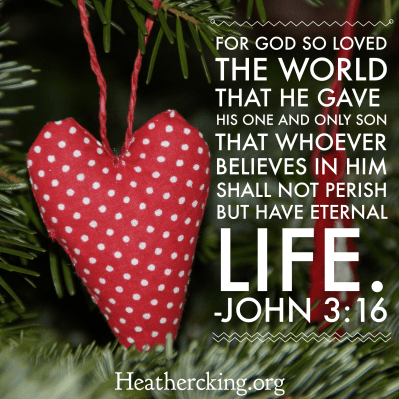
For God so loved the world that he gave his one and only Son, that whoever believes in him shall not perish but have eternal life (John 3:16 NIV).

To read more about Dr. McQuilkin’s story, you can read this article at Christianity Today: http://www.christianitytoday.com/ct/2004/februaryweb-only/2-9-11.0.html?start=5

The Year of the Nintendo

christmas4

That year, my brothers wanted a Nintendo for Christmas, that original Nintendo system with Mario and maybe Tetris.

They felt like they were the last kids in the neighborhood to finally get a video game system.

But, my parents delayed.  Should we have video games in the home?  Would it rot our brains and catapult us into a life of crime?

Finally my parents decided that owning a Nintendo could open up a whole new world of discipline opportunities.  When they misbehaved, my brothers could lose video game privileges.  That’d get their attention.

So, my parents bought that Nintendo for Christmas and hid it under their bed until the big day.

Only, my brothers peeked.

And they got busted.

For their punishment, on Christmas morning, they had to open up that coveted Nintendo and then put it aside.  They couldn’t play it yet.  Oh no, they had to wait several months before they could actually maneuver Mario and Luigi around drain pipes and clouds to save the princess.

My sisters and I could play the Nintendo.

My parents could play the Nintendo (if they so chose).

But my brothers had to wait, and the wait was excruciating: to be so close and yet oh so far away.

Of course, we think we know how painful waiting is.

We groan about waiting on God.

We commiserate with other Christians who complain that they are just ‘waiting.’

Oh, waiting.

I hate waiting.

Who doesn’t hate waiting?

If only God would step things up a little and get a move on.  If only He would come through for us on our own timetable.  If only He would cram Himself into our agenda.

We are anxious and hurried, demanding and impatient when God delays.

Waiting physically hurts.  It steals sleep and turns stomachs.  We pace.  We fret.  We take control.  We lose control.  We take control again.  We demand and whine, cry and manipulate.

Yet, still He lingers.

God is never rushed or harried, stressed or overcome by deadlines or the impetuousness of His own people.

He didn’t skip the 40 years of desert training for Moses and just give him a one-month crash course in leading a nation.

He didn’t speedwalk those Israelites through the wilderness.

He didn’t clear out the Promised Land in a day or build Solomon’s temple overnight.

And He did not send His Son to earth to save us one century too early.

Do we even know what that wait was like?  

How could we endure centuries of silence from heaven?

The Israelites came face to face with their desperate need for the Messiah constantly:

The sacrifices.  The bleating of the lambs.  The stench of the blood.

They couldn’t overlook or forget the deadly consequence of their sin-state.

They’d watch the slaughter today and know that they were only pure before God for one brief moment.

And then they’d sin again.

And the sacrifice would have to be made anew.

It was perpetual and constant.  Day after day, year after year of the law and rules and punishment and sin and sacrifice.

They were oppressed and persecuted.

Still, God asked them to wait.


At Advent, we remember the intensity of the longing for our Savior.  We recall how the world ached with its need for redemption.

And then Jesus came.

He came!

No more searching and longing, no more unfulfilled expectation, no more prophecies hanging unfulfilled.

No more need for sacrificial lambs because the Perfect Lamb had come.

No more imprisonment by sin and by the law.

No more waiting.

Simeon in the temple saw it.  He had been “waiting for the consolation of Israel, and the Holy Spirit was on him” (Luke 2:25 NIV).

And when he saw Jesus, he lifted that infant Lord into his own arms and praised God:

For my eyes have seen your salvation (Luke 2:30 NIV).

He saw the promise fulfilled.

Christmas reminds us that God is at work even in the waiting and the seeming silence.

Advent tells us that God fulfills and completes His work at the perfect time, but He is ever-present, even in the interludes of expectation.

We learn here from shepherds and wise men, from prophets and priests, not to give up on God.

We take this to heart.

Yes, as we wait for marriages, for jobs, for restoration, for healing, for deliverance, for provision, for peace.

We choose expectant hope over disappointment and despair.

More than that, we live ever-ready and ever-longing for Christ’s return.

As the apostle John wrote:

The one who testifies to these things says, “Yes, I am coming soon!” Amen! Come, Lord Jesus!  (Revelation 22:20 NET).

Come, Lord Jesus!


Christmas means God on the move

christmas15

Today, I plunked down $0.88 for a new address book.

Then, I laid its 13-year-old, well-worn predecessor to rest.

It was time.

In that old address book, I have crossed out.  I have drawn arrows.  I have swirled over old addresses and entered in new.  I have stuffed envelopes with corrected info into the pages.

This year during ‘Operation Christmas Cards,’ I flipped through that edited mess.  Seven more family members moved this year to new homes in new places.

Most of these are happy moves: The new-job, new-marriage, new-baby kind of celebration.

Others are moves of in-between, of change, of loss and sadness and finding new hope for the future.

Since I have an intense dislike, maybe even horror, of writing in pencil, though, I can’t just erase and start afresh at each new life event.

That’s when I realized the truth.  It wasn’t time for more corrections.  It was time for a completely fresh shart.

It was time to move on.

And it strikes me right at that moment as I fill in the blank pages A-Z, surrounded by Christmas decorations and Christmas cards, that Christmas itself is about moving.

God began that progress, journeying to us:

God’s love was revealed among us in this way: God sent His One and Only Son into the world so that we might live through Him (1 John 4:9 HCSB).

He makes the first move.  He steps into the void we can’t breach, the abyss of sin we can’t possibly cross, and He leaves the glory of heaven for our sake.

Jesus isn’t the only One who moved that first Christmas, though.

“The angel Gabriel was sent by God to a town in Galilee called Nazareth” (Luke 1:26).

Mary and Joseph loaded up the donkey and trekked slowly “from the town of Nazareth in Galilee, to Judea, to the City of David, which is called Bethlehem” (Luke 2:4 HCSB).

The angels arrived on the hillside to announce the Savior’s birth to shepherds and then “left them and returned to heaven” (Luke 2:15 HCSB).

Then, those shepherds in their excitement said, “Let’s go straight to Bethlehem and see what has happened” (Luke 2:15 HCSB).

Days later, a man named Simeon was guided by the Spirit and went straight to a GOd-appointed place:  “he entered the temple complex” (Luke 2:27 HCSB).

Wise men from the east searched the night sky and could no longer remain at home, complacent, apathetic, mildly interested but not engaged when they saw the mysterious star.

No, they moved.

They committed to the journey, packing camels, loading supplies, asking questions.

They must have left so much  behind:  Family, possessions, homes, a culture they knew and friends they loved.  Maybe they left position and power in the dust in order to arrive in a foreign land as strangers and outsiders searching for a King they couldn’t describe whose name they didn’t know.

Where were they going?  They did not know.  When would their journey end?  They could not say.

Just like Abram long before, the Magi left their homes to travel to an unknown destination for an uncertain amount of time.

Friends must have called them crazy.  Family might have questioned their sanity.

Yet, they kept moving because a star “led them until it came and stopped above the place where the child was ” (Matthew 2:9 HCSB).

Christmas is about the faith of movement, about faith in action.  No standing still.  No remaining the same.  No stubbornly refusing to leave the old in pursuit of God’s work anew.

In a season steeped in tradition, God shows us that He can do the surprising and unexpected.  He is at work.  He is in motion.

Christmas is angels and shepherds, sages and a teenage girl, the righteous and the ordinary, all abandoning their plans, agendas, comfort, and homes, leaving it all behind so they would not miss what God was doing.

Are we so willing to move?

When God calls, when He is active, when He is at work and He comes to us, will we also go to Him?

I’ve finished filling this new address book now and for a while at least everything is settled and set.

Yet, I’m hushed with expectancy.  I’m at the feet of Christ with anticipation.  I’m asking the question and I’m silent, breathlessly waiting for the answer He gives:

“God, what are you doing and how can I be there?  I don’t want to miss it by refusing to move when you move. Lead me this Christmas.”


Pa rum pum pum

Glory to God


Pa rum pum pum.

I am practicing for the church Christmas cantata.

So is my two-year-old son.

I hear him from the backseat of the minivan, singing along with the CD, instinctively drumming his hands to The Little Drummer Boy.

Then he wiggles and bobs his head and does a little toddler dance of intense motion.

Pum pum pum, he sings.

All this Christmas season, my son has been singing this song.  It’s his favorite.  He reacts the same way every time, with participation, with whole body involvement, with spontaneous joy.

And, besides all that, it’s the one song that he knows most of the words to.

Pum pum pum.  He belts it out.

It’s not a Christmas carol I’ve ever given much thought to.  Being the realist I am, I’ve always balked at an extra-biblical kid with a drum hovering near the manger scene, rapping out a rhythm for the newborn Savior.

But as a parable….as a story digging God-centered truth down deep within me…..it’s captured my attention.

Perhaps this is because I’ve played it over and over and over again for my son and then it gets stuck in my head and I pretty much cannot escape hearing this song all….day…..long….

It’s here, this line, that gets me every time: “I have no gift to bring…that’s fit to give a King…. Shall I play for you?”

What’s more fitting than our worship?

What’s more treasured and valued by God than our praise offering?

Some of you might be fighting for the joy this season.

You could rush yourself right past the purpose of Christmas, caught up in the busyness, buried in the rush, made breathless by the expectations and demands on your time, on your attention, on your wallet, on your soul.

Maybe it’s hard to see the Light of Christmas through the crushing darkness of your circumstances.

This year, though, I’m not fighting for joy; I’m fighting for worship.  For awe.  To be captivated anew by the weight of His glory.

I’m battling and warring against the ‘blahs’ of same-old, same-old.

It’s remembering that family movie nights with The Grinch, hot chocolate and popcorn, lights and wreaths, traditions, baking sessions, and picking that perfect present are fun, but they aren’t ‘it.’

It’s hearing that well-known Christmas story one more time and gasping in amazement that God came down for us.

Not rattling off Linus’s speech from the Peanuts’ Christmas movie (love that, by the way), but letting the truth sink, sink, sink into the hardened soil of my heart to  saturate me with Christ’s astonishing love.

And then responding like I should in the face of so much glory—on my knees, hands raised, heart expectant, worshipping Him as spontaneously and as wholeheartedly as a two-year-old crooning along to The Little Drummer Boy in the minivan.

My truest response to God’s greatest Gift should be an offering of praise.

That’s Mary.  She sings in worship:

“My soul magnifies the Lord,
   and my spirit rejoices in God my Savior (Luke 1:46 EV).

That’s Zechariah after 9 months of silence:

Blessed be the Lord God of Israel,
    for he has visited and redeemed his people (Luke 1:68 ESV).

That’s the angels who spontaneously exclaim in one unified voice, praising God:

 “Glory to God in the highest
 and on earth peace among those with whom he is pleased!” (Luke 2:13-14 ESV).

That’s the shepherds, who high-tailed it off of that mountain to see this Savior.  They left the infant Messiah that night:

“glorifying and praising God for all they had heard and seen” (Luke 2:20 ESV).

That’s the wise men, journeying with anticipation and finally arriving to see Jesus:

And going into the house they saw the child with Mary his mother, and they fell down and worshiped him. Then, opening their treasures, they offered him gifts, gold and frankincense and myrrh (Mathew 2:11 ESV).

At church, I tell the children playing wise men in the Christmas program to kneel and set their gifts (carefully) down as they bow.

But I tell them the truth, how those magi didn’t gingerly drop to one knee in the presence of Christ.

No, they hit their faces to the ground in adoration and humility.

In Unafraid, Susie Davis writes that the word really means:

They prostrated themselves and did him homage…laid out completely.  Hands in the dung.  Soiled robes.  Crowns knocked off.  Faces to the ground.

A poor girl from a small town.

A faithful priest.

Lowly shepherds.

Sages from afar.

The Christmas account is awash with praise: Spontaneous, heart-resonant, knees-to-the-earth surrendered worship to a Savior so worthy, to a Savior so compassionate, to a Savior so glorious.

What can I bring Him?  I am so small.

I bring Him my worship.  I give Him my all.


We Bring All the Pieces to Him

christmas-perfection

The first crash of that shattering glass hit and it was just the day after Thanksgiving.  We were only one day into the Christmas season and only about 1 hour into Operation Decorate the House.

‘Twas an accident of course.

The penguin soap dispenser hit that floor and ended in a puddle of hand soap and broken glass.

That’s decorating with kids.

Accidents happen, you know.

An hour later, another crash.  Our box of special, keepsake, treasured ornaments hit the floor and a daughter cried with remorse.

Still, a little sweeping, a little mopping, a little gluing, a little comforting and we slipped back into the decorating groove, crooning along with Bing Crosby to White Christmas.

Stuff is stuff.  Things break (especially when you’re clumsy like me, especially when you have four kids like us).

Look at our Christmas tree from afar and it still has that glow of perfect.

Look up close and you’ll see the ballerina’s feet are glued on, Noah’s ark is missing a dolphin leaping up out of the ocean waters, and the three kings no longer carry a sign: “Wise Men Still Seek Him.”

Brokenness can still be beautiful when we look with eyes of grace.

But when we squint up close to critique and criticize….when we look right past the glory and seek out the flaws…..suddenly that’s all we see.

Perfectionism is a bully.

It muscles in and takes over our perceptions.

It demands that we see only brokenness and faults.

It insists that we remain chained to the past, obsessing over mistakes, battering us over past sin, beating us up with shame.

Lysa TerKeurst writes:

My imperfections will never override God’s promises (The Best Yes).

The promise of Christmas is “God with us.”  The promise is that when we were farthest from Him, He came to us.

The promise is that we didn’t have to get it right on our own or check the boxes of the law until we’d met some prerequisite to grace.

We didn’t come worthy.

We came needy.

And He came down.

Our imperfections never negated the promise of Emmanuel’s presence.  Not then.  Not now.

He still promises us this, “And surely I will be with you always” (Matthew 28:20 NIV).

He is with us always, but not to leave us there in the brokenness.

Sometimes we stop right there at this thought: “Beauty in the brokenness.  We’re all a mess in need of a Messiah.”

Sometimes we stop right there and, dare I say it, glory in the broken?  We cling to our mess instead of releasing it to Him.

But the glory is in the Healer.  The glory is in the redemption.  The glory is in the One who puts His own pure robe of righteousness over our shaky shoulders.

He doesn’t leave us naked and ashamed.  He “has clothed me with garments of salvation and arrayed me in a robe of his righteousness” (Isaiah 61:10 NIV).

We’ll never be perfect in our own striving and strength.  True.  But we don’t have to remain stuck there in the mud.  He grips us with the hand of grace and pulls us out of that pit so we can move forward with Him.

Those disciples on the road to Emmaus after the resurrection didn’t have it all right.  They didn’t have perfect understanding.  Their belief was delicately trembling and about to topple their whole foundation of faith.

They thought Jesus had been the Messiah, yet He had died.  These rumors from ‘crazy women’ about an empty tomb left them confused and alarmed.

But Jesus walked alongside without them recognizing him, going back to the beginning, telling the story start to finish.

When He was about to leave, “they urged him strongly, ‘Stay with us, for it is nearly evening; the day is almost over.’ So he went in to stay with them.”

There at the dinner table, He broke the bread and their eyes opened wide to the truth: This was Jesus.  This was God in their midst.

God’s presence doesn’t depend on my perfection.

God’s presence doesn’t demand perfect understanding or faith without fail.

But if I want God’s presence, then I have to invite Him in, urge Him strongly, “stay with me…..”

He can only make us whole when we trust Him with the pieces, all of them:

God made my life complete
    when I placed all the pieces before him. Psalm 18:20 MSG

We bring all the pieces.  We don’t hold any back.

We lay them at His feet, not running away or hiding from Him.  We come into His presence, broken as we are, and He makes us whole and holy, and He stays with us.

Originally published 12/10/2014

I have wrestled with light

John 1-5

I have wrestled with light against darkness this year and I have won.

It was a hard-earned victory, though, so while I have conquered, I am weary.

For a start, I slipped together the parts of our pre-lit Christmas tree, plugged it in and noticed burnt-out bulbs dotting the tree here and there.

Only, I couldn’t find the replacement bulbs.  Anywhere.

So, I gave up.  Most of the lights still worked, so I loaded that tree full of colorful beads and family ornaments.

Then, deep down in the bottom of the Rubbermaid ornament container, I discovered the baggy holding the new light bulbs.

(Note to self:  It’s easier to replace lights on a tree when it doesn’t have ornaments all over it.  Next year, make sure the lights are on top of the ornaments in the box.) 

I finish the tree and move on to new things.

We have lived in our home now for 11 years.  I have the Christmas decorating pretty much down to a well-rehearsed performance.

The garlands and lights are already strung together.

The strategically placed bows tell me where the corners sit when they are hung.

So, I just lift this Christmas greenery onto the nails that are in the same place as last year and the year before that and years and years back.

I plug the lights in.

And, voila.  Christmas beauty in our home.

Only some years I am not so lucky.  I plug in the strand of lights and it is dark.  Dead.

Then I have to decide. Fight the fight?  Hunt relentlessly for the bulb I need to replace to get this light strand shining again?

Or concede defeat from the beginning, untangle the dead lights from the garland and replace it with a new strand?

For years, I chose the hunt.

But usually I ended a thirty minute wrestling match with the light strand with my hands cut to pieces, broken fingernails galore, and absolutely drained of Christmas cheer plus this:  a still-broken string of lights because I never found the offending bulb.

So, now, I choose to protect my joy and replace the lights instead.  For about $5, I am a happier mom at Christmas time.

This year, though, my struggle has taken on new forms.

It was all of 40-some degrees out this morning with a bone-chillingly cold rain falling and I stood there in my heavy sweatshirt battling the light.

Somehow this year when I hang that same-old garland in the same-old place with those same-old lights, it didn’t fit.  I either had too many lights or too few.

I do not know how this happened.

So, I have been working at this for days now because of our insanely busy schedule and the uncooperative weather.

Today, I have decided, is the day that I end this.  I will win.  In the rain.  In the cold.  I do not care.

So, I stretch and twist and wind that light around the garland, get to the end, plug the lights in….and half the lights don’t work.

These are the lights I just tested three days ago when they worked just fine.

So, I fight.  I dig around the Christmas boxes until I find the replacement lights and I begrudgingly search for the burned out bulb because this year….this year, I will not be defeated.

Finally, I win.

I do not have the most beautifully or elaborately decorated home by anyone’s standard, but I do have light, and I am pleased.

Because light is worth fighting for.

And how we have had to fight this year.  

Have you?

I have attended the funerals.

I have prayed for those who lost their children.

I have listened to the bitter hurt of mourning and sadness.

I have reminded myself over and over of this: first things first–in the crushing busyness of the schedule, I choose Christ before all, and this is hard and it is yet another fight.

I have calmed my daughter down again and again and again when she frets over ISIS and terrorists and whether she is safe.

And right there in the midst of all that darkness, I look for His Light.

Because this is what God promises.

John tells us:

The light shines in the darkness, and the darkness has not overcome it (John 1:5 ESV).

Later in his life, John writes it again:

This is the message we have heard from him and proclaim to you, that God is light, and in him is no darkness at all (1 John 1:5 ESV).

Even in the pitchest black of the darkest night one shiny bulb can split through that darkness with fierce determination.

Even in the pitchest black of your darkest night, God can split through that darkness because Light is Who He Is.

This Christmas, seek His light.


This Christmas Eve Tradition

“But Mary treasured up all these things and pondered them in her heart”
(Luke 2:19)

I was eleven and my Sunday School teacher gave our class a homework assignment for Christmas break.christmas letter

Write a letter to God, she said.  Make it a prayer, a re-dedication, an offering of my own treasures, not the gold, frankincense, and myrrh of wise men, but the very finest gifts I could lay at the feet of a worthy God.

It was my Christmas gift to Him.  I wrote it out on Christmas Eve, folded it up, tied it with a ribbon and placed it under the Christmas tree.

Two decades later, I have twenty years of Christmas Eve letters to God.  It’s my most intimate and holy Christmas tradition. This Christmas Eve, I fingered the packet of letters and marveled at God’s gracious work in me.

One of my “rules” is no peeking at the letters on any day of the year other than Christmas Eve.  Yet, on that one night a year, I can glance back at twenty years of me drawing near to God just as He drew near to us on the first Christmas of all.

Usually by about February each year I can see clear answers to the prayers I scribbled out on the page just months before.

In some ways, this prayer letter is my moment to lay gifts before the King as the wise men did.  It’s my re-commitment to serve Him in a new year and place at His feet the deepest desire of my heart to give Him praise.

I offer Him my very life, noting the places He is already at work in my character and asking Him for spiritual growth so I can bring Him glory.

Like the angels, though, I am also praising God and saying, “Glory to God in the highest heaven” (Luke 2:14), as I give thanks and specific praise for the blessings of the year drawing to a close.

Then, like the shepherds, I turn my attention away from the busyness of work and daily life to see what God is doing in the heavens.  I write my letter to God at night after my daughters are asleep, the dishes are done, the gifts are wrapped and under the tree. There, in near-darkness, illumined almost solely by Christmas lights, I pray and write.

I look away from the “sheep” in my care, lift my eyes and attune my heart to hear the announcement of good news, of promises for the future and the certainty of promises fulfilled.

I dwell not just on what God has done or what He is doing, but what He will do in the new year.  What burdens has He placed on my heart?  What directions has He asked me to travel?  What steps of obedience has He asked me to take?

Mostly though, my Christmas letter is a moment to be like Mary, who after the shepherds came “treasured up all these things and pondered them in her heart” (Luke 2:19).

Sometimes God’s work in our lives needs times of reflection and stillness.  What He reveals to us as we sit at His feet isn’t always meant for public announcements or official New Year’s resolutions, or campaigns or church-wide programs.

Sometimes God asks us to ponder and treasure, to reflect, pray, and wait for the appointed time.

So, I ponder.  I ask for God’s perspective on my marriage, my kids, my ministry and job and heart and mind.

Instead of monopolizing my conversation with an oh-so-patient God, I ask for His perspective.  Before I ever begin to write, I flip through my prayer journal and track the themes I see there.

How at times everything I read seems to be about grace.  Or prayer.  Or allowing Him to bring light into dark places. Or believing God for the impossible.  Or how He is a God who restores.

I follow the clear path of what He has already been doing in my life and then I join Him there in that place.  Yes, Lord, I pray, be at work here.  I will join You.  I will be submissive and receptive to what You want to do in me.

It’s not too late for you to sit in the stillness of a Christmas Eve and write your own letter this year.  What a perfect time to begin a holy and intimate tradition of your own.  A letter to Your Savior.

What gifts do you have to lay before the King?  What songs of thanks can you sing in the night?  What do you see in the spiritual places when you shift your focus off the physical daily routine of life?  What has God been doing in you and teaching you that you need to ponder in your heart?

Originally posted on December 26, 2011

Heather King is a wife, mom, Bible Study teacher, writer and worship leader.  Most importantly, she is a Christ follower with a desire to help others apply the Bible to everyday life with all its mess, noise, and busyness.  Her book, Ask Me Anything, Lord: Opening Our Hearts to God’s Questions, is available now!  To read more devotionals by Heather King, click here.

Copyright © 2014 Heather King


Christmas devotions: When preschoolers ask ‘why?’

I am cutting out flannel board figures today and pulling out my Jesus Storybook Bible.  I am choosing simple carols that repeat….a lot.  Like Angels We Have Heard on High (Glo-ooooo-ooooo-oooooo-ria) and Go Tell It on a Mountain.titus3

And Jingle Bells.  That’s a carol, right?

Today, I head into a sanctuary of preschoolers to present a Christmas program for them and I want to cut through all that they hear about Christmas—Santa and reindeer and cookies and presents and colorful lights and an elf with a crazy nightlife.

I want to get one message out loud and clear, though, through all that noise:

Jesus.

I know preschoolers.  I’ve had my fair share.  Just last year, my own four-year-old quizzed me all season long:

She asked me:  Why?

Why was the serpent bad in that garden?

Why did Eve give the fruit to Adam, too?

Why did God choose Mary to be Jesus’ mom?

Why did the people shout to kill Jesus when He didn’t do anything wrong?

Why did they slam that crown of thorns down on Jesus’ head and why did they lash His back again and again and again?

Why did He die on that wooden cross?

Why did the women put burial spices on His body and why did they wrap Jesus in those cloths?

Why did Jesus walk on out of that grave?

I tried to break it all down, this Gospel, and explain it in a way she could understand.

I tried to keep it simple.

But I stumbled and tripped, and got tangled up in complicated explanations.

Start, stop, start over.  That’s how it went.

In the minivan, at the dinner table, as we turned the pages of her children’s Bible, as she held my hand and walked out the door, she asked.  “Why.”

Over and over we walk through the Gospel, letting it sink down deep into her heart and mind.

We adults tend to complicate this Good News, fumbling to unwrap the beautiful simplicity with our overgrown paws.

Wasn’t that part of the trouble for the Pharisees, too?  They piled on laws, rules, legalism and judgment, tripping people up with their obstacle-ridden path to redemption.  They took something simple and made it so difficult.In the same way, we can tangle the Christmas story in details and asides, but God unravels the mess and says it clear:

 This is how Jesus the Messiah was born. His mother, Mary, was engaged to be married to Joseph. But before the marriage took place, while she was still a virgin, she became pregnant through the power of the Holy Spirit.  Matthew 1:18

In the Women of Christmas, Liz Curtis Higgs writes, “He summarized the main characters and their plight in a single sentence.”Wreath of Snow_cvr.indd

That’s what we need.  We need our God to free us from complicated explanations and tricky religious routines.

Because when salvation gets complicated, we lose sight of grace.  It becomes about us instead of all about Him.

What a mess we are on our own.  Paul tells us:

Once we, too, were foolish and disobedient.  We were misled and became slaves to many lusts and pleasures.  Our lives were full of evil and envy, and we hated each other.  (Titus 3:3 NLT).

That’s what we are without God.

“But…”

Paul writes that one three-letter word of hope and freedom for all of us chained to sin.

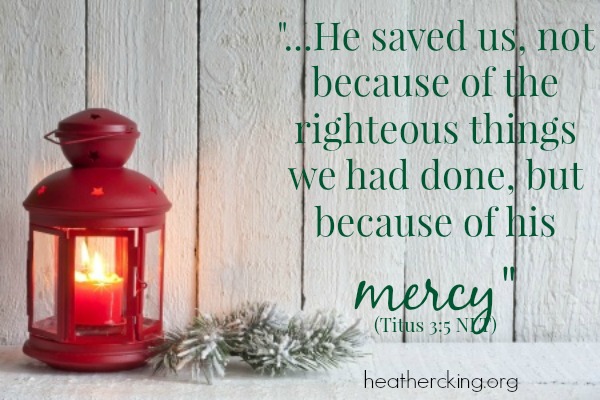
But—“When God our Savior revealed his kindness and love, he saved us, not because of the righteous things we had done, but because of his mercy. He washed away our sins, giving us a new birth and new life through the Holy Spirit.He generously poured out the Spirit upon us through Jesus Christ our Savior. Because of his grace he declared us righteous and gave us confidence that we will inherit eternal life.”  (Titus 3:4-7 NLT)

We bring mess.

He brings mercy.

It’s as simple as that.

All of those “Why’s” preschoolers ask and all of the “why’s” I ask myself when life seems complicated and confusing find their answer here:  “because of his mercy.”

And Christmas, oh how we can tangle it right up with confusion and busyness, but here is the clear and simple truth:

It was at Christmas that God gave us a Savior we didn’t deserve and a sacrifice we didn’t merit.

Why did God send a Savior?

Why did He come as a baby?

Why did He take that crown of thorns, endure that lashing of the whip, die there on that cross?

Why did He walk out of that tomb, alive anew?

Because of His mercy.

Yes, because of His grace.

Heather King is a wife, mom, Bible Study teacher, writer and worship leader.  Most importantly, she is a Christ follower with a desire to help others apply the Bible to everyday life with all its mess, noise, and busyness.  Her book, Ask Me Anything, Lord: Opening Our Hearts to God’s Questions, is available now!  To read more devotionals by Heather King, click here.


Christmas Devotions: Try Not To Gash Your Head Open on the Kitchen Cabinet

I found a $1 treasure at a summer yard sale, an oak step stool to solve my problem.

christmas12

Picture by daphoto; 123rf.com

My kids had been scaling the counters to reach cups and bowls from the cabinets, a heart-stopping feat if ever there was one.

They carried the bathroom stool out to the kitchen and left it there where it didn’t belong.  It was a step stool in demand, actually.  Every time we needed the stool, it was inevitably hopelessly lost in whatever room in the house we didn’t think to look.

I spotted that “new-to-us” wooden stool in that yard sale and my heart skipped happy beats of victory and accomplishment.  With just a simple coat of paint, I’d have a sturdy new stool that belonged in the kitchen, kept my kids off the counters, and matched my home décor.

Score!

The first time it wobbled, we dismissed it as our own clumsiness.  That’s easy to do in our house.

But the offending stool failed us again and again, causing bruises, bumps, scrapes, tears and accusations.

I gave lessons to my kids on how to keep from smashing your head on the kitchen counter. Surely, they simply needed to know “How to Stand on the Stool” and “How Not to Stand on the Stool.”

The problem, though, wasn’t our technique. The stool itself was faulty in a way a coat of paint couldn’t cover. It was treacherous and off-balance.

Finally, I admitted defeat and threw it out with the morning garbage before I added an emergency room visit to my daily agenda.

This year in our church cantata, we sang that “Christmas Makes Everything New.”

More than that white covering of snow that sparkles in the moonlight and hides the wilted grass and un-raked leaves, Christmas offers us a fresh start.

But do we believe it? Do we treat ‘newness’ as little more than cosmetic refurbishing? A coat of paint, perhaps, and God sends us on our merry way with a façade of Christian niceties covering over a truly treacherous human condition?

Scripture is radical in its promise:

 Therefore, if anyone is in Christ, he is a new creation. The old has passed away; behold, the new has come(2 Corinthians 5:17 ESV).

 I will give you a new heart and put a new spirit in you; I will remove from you your heart of stone and give you a heart of flesh (Ezekiel 36:26 NIV)

God’s work in us isn’t just life with a Christian ‘varnish.’ He promises to remove the diseased and petrified heart that plagues our life with sin and transplant in us a new heart of flesh, a heart where His Spirit dwells.

It’s complete.  It’s not refurbishing a $1 step stool and hoping you don’t gash your head open when you use it.  It’s not ‘settling’ for a little bit of God in a big pile of mess.

More than this.  Oh, so much more.

It isn’t God handing us a 12-step instruction sheet with complicated diagrams and a paint kit and telling us to go make a new heart.

That’s the law.  That’s us trying to get it all right.  Trying to be perfect.  Trying to reach heaven on our own tip-toes (maybe with a faulty step-stool).

That’s us landing on the ground again, worn and weary, exhausted from trying so hard to stop the wobbling, the failure, the mess the brokenness.

That’s us trying to hold it all together and still finding that it falls all apart.

I’ve been spending this month learning to Abandon Perfection in my 12-month Pursuit of the Presence of Christ.  And here’s what I find while standing on a church stage with a choir singing away:

Christmas is God come down; not us reaching up high enough to touch Him. Christmas is God’s gift, God at work, God-with-grace, God-with us.

Too often, we make it all about us.  What we have to do to make Christmas perfect.  What we have to accomplish in our homes and in our hearts.  The projects, the parties, the get-togethers, the programs, the traditions, the attempts to pack more meaning into something so deep-down meaningful.

And we almost miss it.  For all the to-do, we almost miss this:

Christmas is about Him.

He will take us as we are and He will make us new.  It’s all in His big hands, big enough to hold us all together, big enough to heal, strong enough to carry us right on through.

To read more about this 12-month journey of pursuing the presence of Christ, you can follow the links below!  Won’t you join me this month as I Abandon Perfection?

Heather King is a wife, mom, Bible Study teacher, writer and worship leader.  Most importantly, she is a Christ follower with a desire to help others apply the Bible to everyday life with all its mess, noise, and busyness.  Her book, Ask Me Anything, Lord: Opening Our Hearts to God’s Questions, is available now!
To read more devotionals by Heather King, click here.