Garden Devotions–It’s Crowded In Here

Originally published April 27, 2012

My daughters and I reached a compromise.

I announced that I didn’t want to grow a vegetable garden this year.  It was too much work for too little result.  It didn’t save money.  It started out fun in April and ended up a horrible, rotten, ugly chore by the middle of July.  Various ravenous insects destroyed and devoured my plants.

Their response was unanimous.  “But Ma—awm.  We like to grow our own food.”

So we narrowed down the lists of vegetables we would grow and planted a container garden on our deck.

We filled large wooden crates with garden soil, vegetable food and the tiny plants of tomatoes, cucumbers and peppers we had chosen.  Then we dropped the carrot seeds into the dirt, following exact directions on how far down to push them and how far apart they needed to be spaced.

After a while my daughters disappeared to work on their own project. They held out the result to me with pride.  It was a small planter with dirt in it.

“We planted radishes,” they announced, “all by ourselves.”

I shrugged.  The radish seeds were leftovers from last year.  It seemed unlikely they’d grow.  Yet, the girls faithfully watered that pot for days and surprisingly they were rewarded by the first hints of green.

A day later, the pot was crowded by infant radishes.  The girls must have dumped 20 seeds all into the same tiny space in the miniature pot.
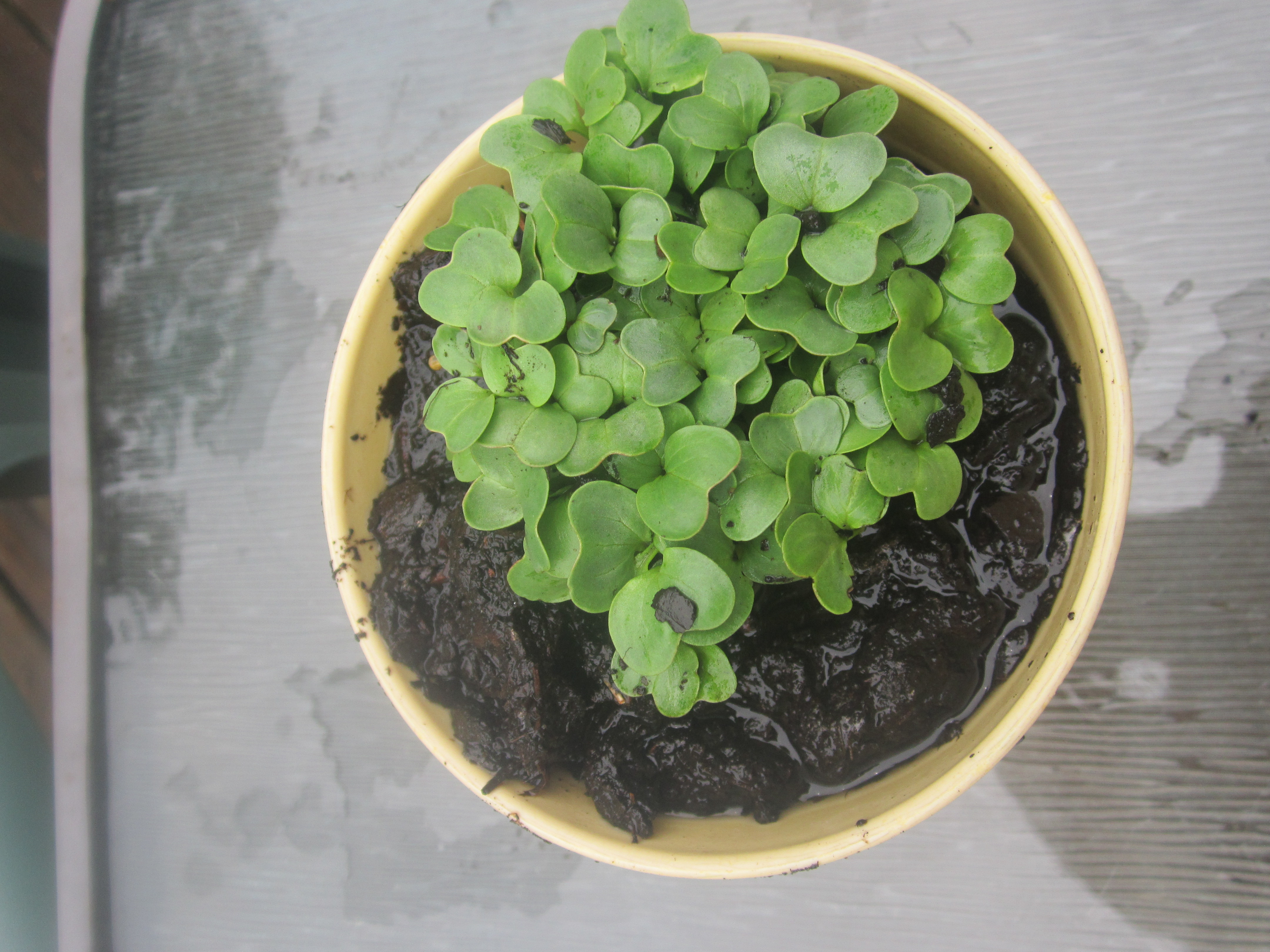
It was going to be really crowded in there.

Unfortunately, even though it is hard and a little sad, we now have to make some tough choices.  If all the radish plants remain in that pot, none of them will grow correctly.  Some of them have to come on out of there.

Sometimes our lives are just as crowded as that tiny radish pot.  Every single seedling may have potential for beauty, growth, and produce, but nothing can grow when they are all shoved into the small space of one simple life and the restriction of 24-hour days.

Even though it’s hard and a little sad, there are times when some things have got to go so that other areas of your life can grow to their full potential.

It’s not always a mystery when choosing what to toss.

When Jesus walked into the temple and saw the vendors hocking their wares–doves for sacrifices and loans for people needing money for their offering–He responded immediately.  It didn’t take a second’s thought for Jesus to overturn their tables and chase the mercenaries out of the holy space of the temple courtyard.

He threw out sin, contaminated worship, and the profanation of the holy.

As soon as Jesus cleared the place, the blind and the lame came to him at the temple, and he healed them” (Matthew 21:14).

The only reason they could seek healing in the temple, the only reason there was room for the blind and lame to worship, was because Jesus had thrown out the tainted and unholy.

The Message emphasizes this when it says, “Now there was room for the blind and crippled to get in.”

Until Jesus cleaned house, there hadn’t even been room in the temple for those who needed God the most.

Will we allow Jesus to overturn the tables in our heart where sin and the unholy have set up shop?  Will we clear out the trash and the disgusting, so that we have room to come to Jesus—and to bring others along who need Him the most?

Of course, it’s not always so easy to tell what has to go in our lives.  We have a million choices of how to invest our time, energy, talents, and money, and all of them could be good.  We could lead hundreds of crusades against a world of evil.

But if we crowd out our lives with too much that is good, nothing will grow as it should.

Jesus Himself exhibited the kind of focus we need, to hone in on our purpose and refuse to be distracted by every demand and need.

During His ministry, mobs of people sought out Jesus for healing, and He frequently healed those who sought out His help.

But He didn’t heal everyone.

In fact, when the crowds grew too large and people sought Him out for healing alone, He moved onto another town or escaped the masses to pray alone on a mountain or by the sea.

Healing was fine.  Miracles were part of His ministry.  But it was not His main purpose for coming and He never wanted that to be the focus of His presence.  Instead, He had come to “seek and to save the lost” (Luke 19:10) and “to save the world” (John 3:17).

Maybe it’s time for you to pull out some of the extra radishes from your pot.  The first ones to go are easy—yank out the sprouts of sin, the unholy habits and the remnants of the flesh life.

Then prayerfully ask God to help you focus.  What seedlings should you tend and invest in until you harvest their potential?  What seedlings need to be set aside so that other areas of your life can grow?


Heather King is a wife, mom, Bible Study teacher, writer and worship leader.  Most importantly, she is a Christ follower with a desire to help others apply the Bible to everyday life with all its mess, noise, and busyness.  Her upcoming book, Ask Me Anything, Lord: Opening Our Hearts to God’s Questions, will be released in the Fall of 2013!  To read more devotionals by Heather King, click here.

Copyright © 2013 Heather King

Unsweetened Iced Tea

Therefore, if anyone is in Christ, the new creation has come: The old has gone, the new is here!
2  Corinthians 5:17

Unsweetened iced tea.

That’s what the quiz said my personality resembled.  Not sweet tea or peach tea or even a little wild raspberry tea or health-conscious green tea.

Unsweetened iced tea, as in bitter, plain, strong, and unfriendly.054

During our family trip to Pennsylvania, we spent a morning at the Turkey Hill Experience where my kids learned how to make ice cream, created their own flavors, starred in their own ice cram commercials, sampled some of the delicious treats, and more.  It was a great family day.

Before we left, though, my oldest daughter discovered a touch screen display with a little personality quiz.

What flavor of tea are you?

So, I gave it a little try, just for fun.  After a few questions about what I liked to do in my free time, how I handled conflict and what I was like around my friends, it made its deep psychological assessment of my character:

Unsweetened iced tea.

Underneath that was a paragraph about how I’m blunt and can hurt people’s feelings, but I get the job done no matter what the cost.  I sounded a little like Donald Trump.

I turned to my husband with a questioning look and he shrugged it off.  “Nah, that’s not you.”

Silly machine, I thought.  It’s just a foolish test that probably isn’t ever right about anybody.

So, of course I made my daughter take it just to prove my point.

She read through the questions and gave her own answers, and then it popped up with her flavor personality.

Peach Tea.

The read-out said she is smart, creative and a kind and compassionate friend.  They even recommended she pursue a career in making greeting cards.

That is so her.

If I had to write up my own assessment of this child, that is exactly what I would say about her, and this machine figured her out with only about five questions.

Silly machine?

It seems like it should be so much easier to ignore the accusations and judgments of just-for-fun personality games or even those of other people.

So what if they think we’re unsweetened iced tea?  Does it really matter what they think?  Should I care about what a machine says based on my answers to a few multiple choice questions?

It’s not rational or logical, but it did matter to me a little.  Unsweetened iced tea….that’s who I used to be.

Sixteen years ago, I was bitter and hurtful, strong, unrelenting, and essentially unconcerned about who got knocked over or bruised when I focused on accomplishing tasks and reaching goals.

Maybe I was a miniature Donald Trump without the hair-do or bank account.

But God.

God took that teenage mess of a girl, who seemed so in control and together, and broke her in ways she needed to be broken.  He shattered pride and the hardness I had built in my relationships with people.  He reached in and kneaded my heart until it became soft and pliable in His hands.

He taught me how to receive grace…and then how to give it.

Yes,  He re-formed me.

Maybe in seasons of pressure or stress, I still have that capacity to revert to who I used to be.  Maybe my tongue can still slash through people like the sharpest of weapons.

But today I am thinking as I cut through the butter with the tines of the fork and smash it to the bottom of the bowl, crack open the eggs, and watch the sugar pour in grain upon grain.  I mix with the spoon at first and then finally reach in with my hands to do the work needed.

And as the dough pulls together, I realize—hadn’t God done this to me?

Paul wrote:

 For by the grace given me I say to every one of you: Do not think of yourself more highly than you ought, but rather think of yourself with sober judgment, in accordance with the faith God has distributed to each of you (Romans 12:3 NIV).

That means seeing the truth about me—not who I was, not who others say I am, or how I measure up on personality quizzes.  It means looking deep and seeing “this is how God has made me and this is who I am in Christ”—no better or worse than that.

If God’s grace did this, smashing and breaking me until I could be pulled together again into something He could use, then why still think of myself in that old way?  Why hold myself to labels from the past and an identity formed oh-so-long-ago before grace bruised me and healed me in the way that grace does?

Some machine still saw me as unsweetened iced tea.

But God’s sweet grace had poured into my soul and I’m not the same.

Heather King is a wife, mom, Bible Study teacher, writer and worship leader.  Most importantly, she is a Christ follower with a desire to help others apply the Bible to everyday life with all its mess, noise, and busyness.  Her upcoming book, Ask Me Anything, Lord: Opening Our Hearts to God’s Questions, will be released in the Fall of 2013!  To read more devotionals by Heather King, click here.

Copyright © 2013 Heather King

What I’m Complaining About…

I’ve been trying to teach her just to say, “No, thank you.”

It’s simple.  It’s polite.

Really, I don’t need an Oscar-worthy performance every time I serve mashed potatoes.

“EEEEEWWWWWW.  I HATE potatoes.  They are GROSS.  This is DISGUSTING.  Don’t put ANY on MYYYY plate!”

I’m beginning to wonder if the child has ever even eaten a single potato.  I have this sneaking suspicion that she just screams about hating potatoes because she’s decided to hate potatoes and because the rest of the family happily eats them.

The complaints are always prolonged, noisy, and accompanied by a pantomime of a wrinkled nose and contorted face.  When she’s really inspired, she might even gag a little.  Just for effect.

I’ve gone the spiritual route with her.  “Do everything without complaining and arguing,” I quote (Phil 2:14 NLT).

Everything?

Yes, everything.

Eat potatoes without the side show?

Yes.  Or at the very least, give a simple “no, thank you,” as you pass the potatoes on to the next person.

So far, that has been unsuccessful.

So, I tried the empathy route.

How would it feel if you shared something you made and people publicly whined and complained for at least 5 minutes about how terrible it was?

The empathy route isn’t working either. Lately, she’s taken to shrugging her shoulders and lying to my face: “I wouldn’t care.  My feelings don’t get hurt like that.”

Right.  Whatever.

But the spiritual route and the empathetic route work for me.  Her mealtime complaint festivals make me realize just how grating and ungrateful whining really is.

And unfortunately, I’ve been thinking about how often I’m the one doing the complaining.

We all have our weaknesses, the things that set us off and the people who get stuck listening to us complain.

You can ask my husband to be sure, but I don’t think I’m a complaining wife, per se.  It’s not really like me to nag or pester or pick him apart and I don’t really complain about him.

But it might be to him.

And it’s usually about truly annoying things:

Like the dentist’s office forgetting to send reminder cards out about our appointments so I completely forgot when I had to drop everything else in my insanely busy schedule to get my teeth picked at by sharp metal objects.

Like our house phone and Internet connection constantly cutting out on me at the most inconvenient times.

Or the store not keeping their shelves stocked so week after week after week I go to buy what I need and it’s not there AGAIN and how hard is it anyway to order more of something when the shelf is empty for goodness sake?!

Things like that.

Too often, though, we’re fooled into thinking that as long as our complaints are justified, then they’re allowed.  Or that “venting” is acceptable, even if it involves calling friend after friend not for wisdom or prayer, but so they can fuel our anger and annoyance.

It’s complaining, but it’s justified complaining.  That’s how we explain it.

Yet, when I’m being honest, I have to confess that if I’m continually complaining …then I’m a complainer.

And when we think about the negative and talk about the negative, pretty soon all we can see is the negative…in people, in life, in situations.

God knows that sometimes life is painful.  We’re not always complaining about grocery store shelf-stocking policies or bad drivers.  Sometimes our hearts are filled with deeply painful disappointment, even betrayal.

And He’s not asking us to fake it or shrug it off our shoulders and paste on happy-faced masks.

But he does ask that we bring it to Him.

Like David, we don’t complain about everything and we don’t complain to everyone around us.  Instead, we drag that cumbersome burden of cares and troubles to the feet of the only One who can carry it for us:

I cry aloud to the Lord;prayer
I plead aloud to the Lord for mercy.
I pour out my complaint before Him;
I reveal my trouble to Him.
Psalm 142:1-2

Maybe we need a trusted friend or counselor (or husband) at times to listen well, but “they should not be where we go first” (Linda Dillow, What’s It Like to Be Married to Me?)

We run to God before any other, and even when we bring these needs to Him, C.H. Spurgeon reminds us:

We do not show our trouble to the Lord that He may see it, but that we may see Him.  It is for our relief and not for His information, that we make plain statements concerning our troubles.

When I’m complaining, is it just to be heard?  Or is it so I can see God more clearly in my circumstances?

I can’t truly say that all my complaining is an invitation for God to show me His glory,

But, oh Lord, may it be so today.

Heather King is a wife, mom, Bible Study teacher, writer and worship leader.  Most importantly, she is a Christ follower with a desire to help others apply the Bible to everyday life with all its mess, noise, and busyness.  Her upcoming book, Ask Me Anything, Lord: Opening Our Hearts to God’s Questions, will be released in November 2013!  To read more devotionals by Heather King, click here.

Copyright © 2013 Heather King

Single Mom for a Week

I was a single mom for a week, kind of.  With a husband away on a business trip, I was the parent on-call for all children’s needs, desires, wishes, wants, tantrums, crises, and cuddles.

I was the homework master, the bath overseer and hair washer, the bedtime manager, the school issue overseer, the household servant, head chef and personal shopper, the sole chauffeur, and more.

And really, we did just fine.  All those tasks and mom jobs weren’t so different from my normal mom resume and daily agenda.

Besides, I knew I still had an emergency fallback position: I could threaten children with a phone call to dad for ridiculous misbehavior.  I also had the gift that technology gives, conversations with my husband in between his conference sessions and the ability to spill out, if only for a few minutes, the news and adventures from the home front.

And I had people every day asking how I was doing, making sure I had the help I needed, and reminders that they were just a phone call away.

It was mostly my husband’s presence that I missed.  Just being with him calms me.  I’m a grumpier mom when he’s away and more apt to cry tears over the eventual build-up of tiny annoyances that swarm the day like gnats.

Things like:

Children forgetting homework.
A child having a tantrum in the school library.
Sibling fights.
A dentist appointment I didn’t remember I had scheduled during an insanely inconvenient week.
A preschooler who took an unexpected nap and is therefore unable to fall asleep anywhere close to the vicinity of bedtime.
A package on my doorstep that I didn’t order.
People sending me forms for an event without filling them out correctly.
Extra phone calls to be made.
Unexpected conflict.112339-20130114

And so it was, when the week was over and my husband walked through that door, I felt the burdens ease somewhat.  I was calmer, more cheerful, more relaxed, better able to sleep.

During the earlier days of our marriage, my husband had to be away from me for 3-4 months at a time, living in another state for job training or job transfers or while I was on-site for grad school.  I’ve been there, done that several times.

What it taught me then was that time with this man is precious. 

Taking it for granted or spending it like the quarrelsome, nagging, contentious, vexing wife in Proverbs (Proverbs 21:9, Proverbs 25:24) makes me no better than water torture to live with: “An endless dripping on a rainy day and a nagging wife are alike” (Proverbs 27:15).

These annual one-week stints apart from each other just remind me anew to value my marriage and this man, who is a God-gift to me.  It resets my priorities and readjusts my expectations.  It gives me reason to pray for him with focus and attention and re-establishes the habit of covering my husband’s daily walk, work and ministry in prayer.

This year, though, I was reminded of something else—-that we minister to others out of our own experiences (2 Corinthians 1:4).  Just as others have served me during my short-term single mom moments, so I should take the time to serve another.

And these women who need us are everywhere: Divorced moms, widows, military wives with husbands on deployment and other wives with husbands away.  They may not have the safety net of a call from dad to threaten unruly children.  Their single mom reality might not end with a plane trip home after a week away.

All last week, as I hung up the phone from my final conversation with my husband for the night, I didn’t just think about me.

I thought about these women going it alone and how to love them:

  1. Write them a note and tell them, “you are doing a great job and you are an amazing mom.”  They may never hear those simple words of praise and encouragement.
  2. Pray for them daily.
  3. Send them a gift card for pizza, Chic-Fil-A or some other restaurant so they can take a night off from cooking.
  4. Take them out for coffee, tea, or dinner.  So often what they miss is just adult companionship.
  5. Don’t ask them to let you know if they need anything.  They probably won’t.  Be proactive (without being pushy or invasive) by offering specific help or (if appropriate) surprising them with a helping hand.
  6. Call them on the phone just to chat.
  7. Let them know when you will watch their kids or hire a babysitter for them so they can go out with friends.
  8. Personally invite them to ladies’ nights out at church and don’t let them feel excluded from women’s ministry (which so often focuses only on married women with kids).
  9. Pamper them a little, maybe with a gift card for a manicure or to a hair salon, flowers, or an anonymous present of lotion and bath salts.
  10. Care about their kids.

This one week of missing my husband makes me a better wife and can make me a better friend.

How would you minister to single moms, divorced women, widows, military wives and other women whose spouses are away?

Heather King is a wife, mom, Bible Study teacher, writer and worship leader.  Most importantly, she is a Christ follower with a desire to help others apply the Bible to everyday life with all its mess, noise, and busyness.  Her upcoming book, Ask Me Anything, Lord: Opening Our Hearts to God’s Questions, will be released in the Fall of 2013!  To read more devotionals by Heather King, click here.

Copyright © 2013 Heather King

Tap-Dancing and Life

She tossed open the box from Payless and snatched out the two shiny black shoes with metal plates on the bottom.

Tap shoes: Her little six-year-old heart’s great desire! She slipped her feet in and immediately started performing.

Then my eight-year-old crammed her feet into the shoes and put on a grand show.  My three-year-old even stepped into the shoes and shuffled round the kitchen a bit.012

They were like magic shoes, all shiny and loud, and they transformed any girl into a superstar on a grand stage.

On the first day of tap lessons, my girl clip-clopped her way into the dance studio along with the other excited students. I heard them take those first steps onto the wooden floor, hesitant at first, and then heard them break into freestyle tap routines of their own.

How could they resist?  This studio and those magic shoes made them all feel like Gene Kelly or Fred Astaire.  It was inspiration and joy and visions of grandeur accompanied by tip-tapping rhythm.

Then the lessons began, and the order to contain the disorder…the structure, the routine, the method to the madness.

It’s a slow realization for a kid, but eventually it comes: tap dancing doesn’t just mean slamming your feet on the floor in any combination of athletic flailing you choose.

You have to practice.

Bummer.

You have to watch and listen and then move in just the right way.  You have to drill and rehearse and repeat.

For a week, I asked my daughter to “shuffle” and “flap,” and practice, practice, practice.  Then, because I know absolutely nothing at all about tap dancing, I asked her if she was doing it right (because, after all, how was I to know?).

She rolled her eyes at me occasionally and huffed loudly at times, blowing her bangs up off her forehead in exasperation.

Reluctantly or not, though, she practiced.  When she returned to class and shuffled correctly and the teacher announced, “You all must have been practicing,” that was the reward.  My daughter beamed.

She loves tap, she declares.

Life and tap-dancing, they can convince us all at times that inspiration is all we need.  They can woo us into running on spiritual and emotional highs.  We’re at our best.  It’s fun and grand (and noisy perhaps).  And the lessons and the practice come easy.

Quiet times are easy, too, when God is speaking so clearly we can hear His voice ringing in our ears. When that time with Him is overflowing, it’s no great discipline to carry our bucket to the Well.

And we have these seasons with Him, where we’re hearing and learning and it’s thrilling to be used and useful, to see ministry grow and faith deepen, to see prayers answered and miracles happen, to read God’s Word and actually feel it tingling in our souls.

It’s a slow realization for us, perhaps, but eventually it comes: This walk with God isn’t always easy and the emotions and the highs and the results we expect aren’t always immediate or obvious.

Truly, it’s discipline.

It’s waking up, pouring that cup of tea and opening up that Bible not because it feels so good, but because this is how we grow over time.

It’s going to church even when the sermon isn’t about your needs and singing even on days when it’s hard to really mean the words on the screen.

It’s praying even when you don’t sense the connection and it feels like silent heaven and empty air.

It’s committing to Bible study even when you’re busy, tired, distracted, complacent and just downright don’t feel like it.

Yes, it’s practice and rehearsing, repeating, growing slow and steady, committing and then choosing not to give up–not today, not tomorrow, not a week from now.

It’s feeling the desperation of the deer panting after water and heading to the stream even when it’s elusive and difficult to find.

And like, Elijah, it’s listening for God’s voice even in despondency, depression and despair.  He stood on that mountain and listened for God.  Even after the mighty wind passed by, the earthquake ceased shaking, and the fire abated, still Elijah listened.

He could have given up: God’s not speaking.  I couldn’t see Him in the big and the obvious, the glorious and spectacular, the emotional or the ear-shattering.

He could have headed back into the cave and abandoned the effort.

And then he would have missed it.

No, Elijah continued to stand, waiting, listening, still.

And God spoke.

Sometimes it’s there in the quiet that we hear God simply because we haven’t given up.  We’ve continued to stand in His presence beyond the silence, faithfully and determinedly waiting…listening…still.

Beyond the point of inspiration, fun, glory, and ease, we discipline ourselves to listen.  And so we hear.

Heather King is a wife, mom, Bible Study teacher, writer and worship leader.  Most importantly, she is a Christ follower with a desire to help others apply the Bible to everyday life with all its mess, noise, and busyness.  Her upcoming book, Ask Me Anything, Lord: Opening Our Hearts to God’s Questions, will be released in the Fall of 2013!  To read more devotionals by Heather King, click here.

Copyright © 2013 Heather King

Altars of Uncut Stones

Originally published April 16, 2012

I picked up my daughter’s yellow spring jacket and felt weight, heaviness where it shouldn’t be.  Clearly she had stuffed her pocket at the park with her latest treasure.

Curious, I slipped my hand into her pocket and pulled out . . . a rock.  Two rocks actually, one for each pocket.

They weren’t gems, either.  No sparkles or beauty.  No monetary value.020

They were plain ordinary gravel, no different than the layer of rock on my driveway.  In fact, the one crumbled into my fingers with the slightest pressure.

I sighed.  She had been toting home rocks for about two years now.  Everywhere we went, some pebbles, gravel, or smooth stones caught her attention and ended up in her pockets.

She has even tried to remove stones from the paths at Colonial Williamsburg and the zoo and once tried to haul away a cement block from the local museum where its grand function was to hold open the door.

I put my foot down about those.

But if it fits neatly into the pocket of her jacket, she’s likely to tuck it away and add it to her “rock collection.”  Perhaps she’ll even give it a name, which usually ends up being something like “Rocky” or another equally creative moniker.

To me, they are plain, ordinary, maybe even ugly rocks.  To her, they are treasured collectibles.

She’s not the only one who finds beauty in simple stones.  God loves them, too.

As they crossed over the Jordan River, the Israelites obeyed God’s instruction, picking up 12 stones from the river bed and lugging them up the embankment onto dry land.  God told them to use those stones to build an altar.

More specifically,

“an altar of stones.  You shall wield no iron tool on them; you shall build an altar to the Lord your God of uncut stones. And you shall offer burnt offerings on it to the Lord your God, and you shall sacrifice peace offerings and shall eat there, and you shall rejoice before the Lord your God” (Deut. 27:5-7 ESV)

Their peace offerings and sacrifices, their worship and rejoicing before the God who had carried them into the Promised Land, may have seemed more fit for an altar of finest gems.

Perhaps their greatest artisans could have finely cut diamonds, emeralds and rubies into an altar fit for worship of the Most High God.

Or, if they had to use river rocks, at the very least they could have chiseled and carved until the altar looked like a marble statue.

Yet, God was clear.  Stones, simple stones, uncut by any human tool, formed the altar fit for the offerings of His people.

Why did God even care about a detail so small?  According to Him, “If you make an altar of stone, you shall not build it of hewn stones, for if you wield your tool on it you profane it” (Exodus 20:25).

To God, human construction on the altar stones made them unholy and profane.

That’s because God knew the danger implicit in cut stones and man-made bricks.  The moment we begin to adorn altars with human effort is the moment we shift the focus off of the God we praise.

We become idolaters.  Our worship becomes profane, admiring the human talent that made the vessel or cut the stone.

This is what God accused the people of doing in Isaiah:

I spread out my hands all the day to a rebellious people, who walk in a way that is not good, following their own devices;a people who provoke me to my face continually, sacrificing in gardens and making offerings on bricks” (Isaiah 65:2-3 ESV).

Israel ignored God’s mandate and chose instead to offer their sacrifice among garden flowers.  They had rejected simple stones in favor of brick constructions.

Israel wanted to worship God their own way and on their own terms.  His instructions seemed superfluous and unnecessary.

In the same way, God sometimes overturns our expectations of adequate offerings and suitable worship.

He desires the simplicity of an obedient heart.

We think He needs more.  

So, we hold back our offerings until they are “fit” for Him.  We hide in the sanctuary pews until we have more to give.  We think other worshipers, who are more talented and more rehearsed, give gifts more worthy.

It isn’t, however, about being the best, most talented, or most qualified; it’s about being called.  Yours is the offering He desires.

There is beauty in the uncut stones of our worship.  It’s never about the show, never about our own talent or training; it’s not about looking good or fitting in, or processing our worship into acceptable forms—all human additions that shift focus off God and onto human ability.

Instead, it’s about responding to God in pure uncut adoration.

Heather King is a wife, mom, Bible Study teacher, writer and worship leader.  Most importantly, she is a Christ follower with a desire to help others apply the Bible to everyday life with all its mess, noise, and busyness.  Her upcoming book, Ask Me Anything, Lord: Opening Our Hearts to God’s Questions, will be released in the Fall of 2013!  To read more devotionals by Heather King, click here.

Copyright © 2013 Heather King
Not the Other Mom

Her Other Mom cooks yummy pancakes.

Her Other Mom bought all of her clothes (although I clearly remember shopping myself).012

Her Other Mom has a big house with a pink toilet in it.

Her Other Mom owns a dog.

Her Other Mom tells her when to eat, when she can have a snack, when she can go outside to play, what shows to watch on television, and whether or not it’s bedtime.

Her Other Mom has that book, that Kindle app, that game, that movie, and every toy that’s ever been advertised on television…ever.

We’re not exactly sure when it happened or how, but at some point my three-year-old transitioned from a mini-van full of fairly typical imaginary friends to an imaginary “Other Mom.”

Eventually the Other Mom had an Other Dad and Other Sisters and even Brothers, and she chats about this entire Other Family all day long.

We laugh most of the time (quietly to ourselves, of course) and let her chatter on about this pretend family.

Once I mistakenly corrected her, reminding her at dinner that it wasn’t the cape-wearing superhero Other Mom who gave her a birthday gift, but it was in fact me.

She cried.

So, I mostly leave it be and certainly don’t use the words “pretend” or “imaginary,” “not real” or “fake” whenever she launches into one of her Other Mom fairy tales.

But the other day, I leaned in close to my little one and whispered, “Who loves you?”

Without a second’s breath, she blurted out “My Other Mo……” and then she stopped.  She put down the crayon she was coloring with and let it roll on the table, concentrating on my question.  She pushed back the flyaway hairs escaping from her ponytail.

Then she looked right into my eyes and said, “You!” and giggled at me like we had just shared the best knock-knock joke ever heard by a preschooler.

“And who else loves you?” I asked her, pressing in on the moment.

“My cats….and Lauren and Victoria and my Dad.”

Not her Other Dad, not those Other Sisters, or the Brothers or the imaginary dog…

We love her, this real family who takes care of her real needs and buys her real clothes and cooks her real food.

It’s innocent, of course, this imagination of hers.  Most days, I try to marvel at it rather than question too much whether deficiencies in me gave her reason to create an Other Mom (I don’t, after all, have a pink toilet in my home).

But then there’s God and then there’s us and it really isn’t innocent much of the time, forgetful, yes…apathetic at times…generally oblivious in some moments.

Like Israel just a short hike from Egypt, not long enough for a generation to develop spiritual amnesia about their miraculous deliverance out of slavery, still they were forgetful beings.  Moses delayed on the mountain with the Lord, so Aaron threw some gold into the fire and pulled out a golden cow.

The people looked at that man-made object and declared, “Israel, this is your God, who brought you up from the land of Egypt!” (Exodus 32:4).

And they did it again generations later.  King Jeroboam decided it was too difficult for the people to trek to Jerusalem to worship in the temple.  It required too much sacrifice, too much effort.

So, “he made two golden calves, and he said to the people, ‘Going to Jerusalem is too difficult for you. Israel, here is your God who brought you out of the land of Egypt.'” (1 Kings 12:28).

How?

How could they give any fake god or false idol the credit for miraculous salvation?

How could worship be so fickle?

How could they forget who God is and what He had done?

How could we?

We’re not three-year-olds with active imaginations.  We’re His children who forget to thank Him, forget to worship Him, forget to give Him glory for what He’s done, forget today what miracle He did for us yesterday, forget to look for Him in the middle of our everyday lives.

We too often just accept the gifts without pausing to see, really see, the way they drip with grace.

Praising Him one day; forgetting the next; overlooking His goodness; blaming Him for what is wrong and not thanking Him for what is good….so we fall and so we fail, and so we end up worshiping golden calves of our own making.

But God reminded His people: “I am the Lord your God, who brought your out of the land of Egypt, out of the place of slavery” (Exodus 20:2).

Yes, He is the God worthy of our praise.  He is the God who rescued us.  He is the God who loves us.

Yes, He is God and God alone.

Heather King is a wife, mom, Bible Study teacher, writer and worship leader.  Most importantly, she is a Christ follower with a desire to help others apply the Bible to everyday life with all its mess, noise, and busyness.  Her upcoming book, Ask Me Anything, Lord: Opening Our Hearts to God’s Questions, will be released in the Fall of 2013!  To read more devotionals by Heather King, click here.

Copyright © 2013 Heather King

My Addiction

Originally posted April 13, 2012

“So here’s what I want you to do, God helping you: Take your everyday, ordinary life–your sleeping, eating, going-to-work, and walking-around life–and place it before God as an offering” (Romans 12:1, MSG).

I love routine.

I plod around my house each morning with my eyes barely open, doing the same tasks I did the day before. I follow a schedule day by day, week by week.

Each night, I drink a cup of hot tea in one of my favorite mugs before I go to bed.  Every night.  Summer, winter, makes no difference.

So, a few weeks ago when my whole schedule was off and it was far too late for a reasonable cup of tea before bed, I felt a little shaky and definitely “off.”  I couldn’t do it.  I couldn’t settle in under the covers and turn out the light without at least a few sips from my teacup.

It’s not that I’m a tea addict. 

I’m a routine addict.

Given my love for the routine of daily life, I was not at all surprised when my six-year-old brought me a neon orange paper that read (and I quote):

Lauren:003
eat Breckfest
Brush teeth
Go to school
Play Victoria’s games
Play hide and seek
eat lunch
watch TV
take a Nap
eat Dinnr.
Brush teeth
Go to bed

The basic reality of daily life, of routine, and of the mundane is that we all live it in some way or another—me in my adult world, my daughter in her child world.

We commute to work.  We go to school.  We walk the dog.  We make phone calls.  We volunteer.  We give baths and make dinners.  We run errands.  We clock in; we clock out.

There’s beauty in the resurrection appearances of Jesus as He invited himself into the daily and mundane routine of the disciples. 

Sure He appeared to them in the upper room where they were gathered for worship and prayer. That’s to be expected.

But then He did something unexpected.  He showed up on the shore of the Sea of Galilee and watched them wrestle with fishing nets and bring emptiness up from the water.

Yes, Jesus went to their workplace.

Early in the morning, maybe as the first flickers of sunlight skipped over the Galilean waters, Jesus called out to his tired friends.  They didn’t recognize his voice; he was just some curious bystander sticking his nose into their own personal business, giving them instructions as if He knew more about fishing than they did—a bunch of expert fisherman.

He told them to “‘Throw your net on the right side of the boat and you will find some.’ When they did, they were unable to haul the net in because of the large number of fish” (John 21:6).

That’s when they recognized the Lord.

In A Year With Jesus, Eugene Peterson wrote:

“Work that was futile apart from Christ becomes successful in His presence . .. Your resurrection life, Lord Jesus, is like a sunrise in work that has lost meaning and in routines that have become pointless.  Whatever my work today, I will do it in the recognition of Your presence and under Your command” (p. 594).

and

“The resurrection transforms Monday work as much as Sunday worship” (p. 596).

Jesus made it clear in those 40 days following His resurrection that He wasn’t just looking to be part of our sacred lives and in the religious moments we schedule on the calendar.

He wanted us to live with a curious mesh and entwining of sacred and secular, where He’s with us during every part of our day.

He sets our routine.  He is our routine.  He shakes up our routine.  He designs our routine. He redesigns our routine.

You’d think we fairly intelligent people could get by on our own living out our daily lives.  But, I’ve decided that I can’t and I’m okay with that.

That’s why you’ll find me in the Wal-Mart parking lot once a week with my head bent low in the few minutes before I exit my car.  It’s because I’m a mess on my own—making stupid decisions about what to buy and what not to buy, forgetting what I need, falling for advertising gimmicks and sales tricks, traveling back and forth across the whole store because I forgot something on my list, making a list and then leaving it in my car or at home, trying to use outdated coupons and failing to use perfectly good coupons that I spent perfectly good time cutting out.

Why should God care about my budget and my meal plan for the week and for the items on my list and my own personal sanity?  Because He loves me, that’s why.  Because the grocery store is where I lay out my nets and hope for an abundance of fish.

You have your own Galilean place, where Jesus is trying to invite Himself and where He’s waiting to give you input and advice.

Perhaps it’s the routine that makes you feel so comfortable and that you think you can handle all on your own.  Perhaps it’s the place you feel most capable and expert.  Maybe it’s a place where you experience failure and emptiness.

You haven’t seen abundance until you’ve felt the blessing of His presence in the midst of your routine.  It’s time to invite Him into the boat with you.

You can read more devotionals on this topic here:

Heather King is a wife, mom, Bible Study teacher, writer and worship leader.  Most importantly, she is a Christ follower with a desire to help others apply the Bible to everyday life with all its mess, noise, and busyness.  Her upcoming book, Ask Me Anything, Lord: Opening Our Hearts to God’s Questions, will be released in November 2013!  To read more devotionals by Heather King, click here.

Copyright © 2013 Heather King

Please Break My Heart…Really and Truly

Originally posted March 23, 2012

It’s the drill, the sound if it screeching unnaturally close to your face.

Plus there’s the smell of sterilized tools and latex gloves.dentistchair

There’s the tooth-shaped clock on the wall and the charts portraying healthy and not-so-healthy gums hanging here and there.

It’s the dentist’s office and I don’t love the place, but I had to be there for a filling—easy and routine, my dentist tells me.  He asks me how I’m doing today.  “Nervous,” I confess with a conversational giggle.

Still, I like him.  He’s pleasant and efficient.  His degrees and certifications adorn the walls, assuring me that he knows what to do.  He’s the kind of doctor I prefer, one who explains to you what’s going on and assumes you’re intelligent enough to understand.

So, he glances at my chart and sees the note written in large letters, “Needs extra anesthetic.”

He asks me about it and I tell him the gruesome story of another dentist starting to drill and me feeling it.  I tried to fake it and pretend like I was numb just for the sake of expediency, but my flinches and the pain in my eyes apparently gave me away.

When you’re numb, you ironically can’t help but feel it.  You feel that your face is heavy and your speech difficult.  They ask you to rinse and it takes effort.

It’s a simple filling and yet here I sit at my computer five hours later, feeling the last remaining bit of numbness around my mouth.  I’m a poster child for the old Bill Cosby standup routine about a dental patient.

Numbness takes time to fade, but thankfully it eventually does.  Truly, I’m grateful for the fact that two shots of medicine helped me not to feel the dentist’s drill.  It’s a comfort of the modern age that I’m happy to enjoy.

Yet, as I sit in the chair waiting for the drilling to start, I wonder if I’ve grown too numb in other areas of my life.  And sadly, the numbness of our hearts and minds doesn’t fade away as assuredly as a dentist’s shot.

Hillsong sings in their song Hosanna:

Break my heart for what breaks Yours
Everything I am for Your Kingdom’s cause
As I walk from earth into
Eternity

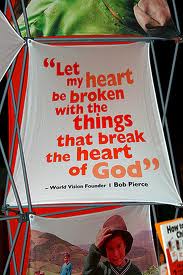
worldvisionThis was the prayer of World Vision founder, Bob Pierce: “Let my heart be broken by the things that break the heart of God.”

So I wonder…is my heart too numb?  Has it become an unfeeling organ?  Or, am I only slightly bruised occasionally, crying for a moment and then resuming life as normal, patching up momentary sorrow with practicalities and emotional distance?

What actually breaks the heart of God anyway?

Surely it’s our sin, our breaking faith with God and causing Him disappointment and sadness (Numbers 5:6, Hosea 11:8b).

Yes, David’s heart broke after his devastating sin of adultery and murder, and he desired restoration and forgiveness (Psalm 51).

Are you grieved over your sin and the times you’ve broken faith with God?  Do you shake it off with excuses and acceptance, compromising because it’s “normal” and just “who you are?”  Or do you humbly bow at His feet and ask for His help and His forgiveness?  Do you hate your sin enough to do whatever it takes to change?

Surely the lost break God’s heart, the “sheep not having a shepherd,” who stirred Jesus’ heart to compassion and self-sacrifice (Mark 6:34). 

Are you broken-hearted over those who do not know Jesus and moved to compassion and boldness by their presence in the world and in your community?

But it’s also the hurting and needy.  When Israel complained that God wasn’t overly impressed by their fasting rituals and legalistic religiosity, God told them exactly what kind of fasting He desired: freeing the oppressed, sharing bread with the hungry, caring for the homeless (Isaiah 58:6-7).

James agreed when he wrote, “Religion that is pure and undefiled before God, the Father, is this: to visit orphans and widows in their affliction, and to keep oneself unstained from the world” (James 1:27, ESV).

Is your heart broken by the orphaned, the widowed, the hungry, and the oppressed?  Do you do more than shed a tear at an Internet video and actually advocate for those who need a voice?

We have a God whose heart is broken over sin, over unbelief, over the hurting, oppressed, defenseless and hungry.

What about our hearts?

It’s a strange thing, this spiritual numbness.  While a shot at the dentist’s office fades over time, our hearts respond in opposite ways to hurt.  We may begin compassionate and then grow numb from forgetfulness.  We may grieve over sin at first and then slowly grow accustomed to it.

Instead of needing extra doses of anesthetic, we must go to God continually and ask for more of His broken heart.

To listen to Hillsong’s Hosanna, you can click the link here or watch the video posted below on the blog:

Heather King is a wife, mom, Bible Study teacher, writer and worship leader.  Most importantly, she is a Christ follower with a desire to help others apply the Bible to everyday life with all its mess, noise, and busyness.  Her upcoming book, Ask Me Anything, Lord: Opening Our Hearts to God’s Questions, will be released in the Fall of 2013!  To read more devotionals by Heather King, click here.

Copyright © 2013 Heather King

Do I Look Dead to You?

Originally posted April 11, 2012

It’s Spring Break here in the King house and we’re enjoying time together and starting each morning slow.
This week, I’ll be sharing some devotions from the past as I take time for my family.

After we’ve packed the cooler, dressed everyone in bathing suits and sandals, double-checked the bag for diapers, towels, tissues, Band-Aids (for blisters), sunscreen, and more, and then loaded every last item and person into the mini-van, we have the same-old chat with our girls as we drive to Busch Gardens, the amusement park near our home.003

First we begin with the safety reminders, about strangers, about wandering away from us, and what to do if you get lost.

Then we remind them that we aren’t buying every snack, toy, or novelty item strategically scattered along our path through the park.  And no whining when it’s time to go home.

We finish up with the “friends speech.”   It goes something like this:  You are sisters.  God designed you to be best friends.  Don’t ditch your sister so that you can ride in a boat or car or dragon or whatever with some random stranger who you’ll never see again.

This last speech generally elicits the most protests.  My girls are friendly people.  They like to meet new kids and form what they are certain are life-long bonds of friendship while standing in line at Busch Gardens.

So, it was no surprise that during our spring break outing, my middle daughter stood in line for a ride and then announced, “Mom, I made two new best friends!”

Not just friends.  Best friends.

And how did she know these two new girls were now her bosom buddies for life?

“They told me their names, Savannah and Julia.”

That was it.  The loyal bond formed simply by exchanging names.

Friends, best friends, nice people you’ve only just met, a stranger whose name you’ve learned, sisters, the person you thought was your close friend but who gossips about you behind your back  . . . it’s a mesh of relationships they haven’t quite figured out yet.

As difficult as this is, even though life is busy, complicated, hectic, and hard, and investing time in those loyal friendships seems an impossible task, still Scripture tells us this is one investment that’s worth making.

We need a friend who loves sacrificially, and for whom we likewise will sacrifice.  Jesus commanded us to “love one another as I have loved you. Greater love has no one than this, that someone lay down his life for his friends”  (John 15:12).

We need a friend who remains faithful even when we’re at our ugliest, worn-outest, saddest, and yuckiest, just as it says in Proverbs 17:17 “A friend loves at all times, and a brother is born for adversity.”

And we need a friend who is not afraid to get dirty with us as we live this resurrection life.

Jesus stood at the entry to the tomb of his close friend, Lazarus.  He heard the weeping of others around him.  His own tears trailed down his cheek.  The crowd scolded him for not coming earlier and healing his friend while there was still time.  The pragmatic folks complained about the stink of death and decay wafting out of a reopened tomb.  Mary and Martha shot hopeless, hurt-filled glances in Jesus’ direction.

Undeterred, Jesus demanded, “Lazarus, come out!”  (John 11:44).  The shocked crowd watched as the dead man emerged from the grave, living, breathing, and walking—alive.

But he moved slowly, maybe a little like a mummy in a sci-fi horror flick that plays on Saturday afternoon television.  He didn’t leap out from the tomb and dance before the Lord with all the joy of a resurrected worshiper.

Instead, “the dead man came out, his hands and feet wrapped with strips of linen, and a cloth around his face.  Jesus said to them, ‘Take off the grave clothes and let him go” (John 11:44 NIV).

Chris Tiegreen reminds us in One Year At His Feet “When Jesus raises us out of our sinful state of death, there is something left to do before we run free.  The grave clothes must go”  (p. 21).

That’s something Lazarus couldn’t do on his own.  Jesus instructed others to come alongside him and unwrap the linen bindings, the remnants of death and the grave that still had him hindered, trapped, and blinded.

That’s the church’s job.  That’s the job of a loyal friend, who patiently strips away all the habitual sins, guilt, shame, false beliefs, hang-ups, terrors from the past, and hurts that trip us up and slow us down.

Sometimes we simply require a love that doesn’t give up on us.

Sometimes it takes someone holding us accountable with truth and lovingly showering us with grace when we struggle with the ugliness of sin.

Only a true friend skips the flattery and digs past the superficial chicanery of niceness in order to challenge us with a truth and encourage us to change.

Only a friend tells us when they see some of the grave clothes stubbornly stuck to our skin and then lovingly and patiently unbinds us so we can live in the freedom of new life.

We need a friend like that.  We need to be a friend like that, who brings grace and freedom to another.

You can read more devotionals on this topic here:

Heather King is a wife, mom, Bible Study teacher, writer and worship leader.  Most importantly, she is a Christ follower with a desire to help others apply the Bible to everyday life with all its mess, noise, and busyness.  Her upcoming book, Ask Me Anything, Lord: Opening Our Hearts to God’s Questions, will be released in November 2013!  To read more devotionals by Heather King, click here.

Copyright © 2013 Heather King