Is this what Mercy looks like?

She screamed almost the entire way home from church.

It was a shock to me.  After church ended, my preschooler bounced out of the nursery cheerful and excited.  We had just marched in the town Christmas parade the day before, so she practiced her “parade wave” all the way down the halls of the church, greeting every single person that passed us by.

But when my daughters climbed all over each other to claim seats in the mini-van for the 12-minute ride home from church—as if they were choosing their positions for a round-the-world tour—my three-year-old hopped in the back seat.

She knows better.  No booster seat until her fourth birthday.  For now, she’s restricted to the five-point harness-equipped seats in the middle of the van.  Normally, she’s just joking, hopping into the back and giggling hysterically until I motion her to her normal place.

Not yesterday.  Apparently she decided that enough was enough.  This waiting until her fourth birthday thing was totally overrated.  No ballet classes until she’s four.  No back seat until she’s four.  No three-day-a-week preschool until four.  No Children’s Church until she’s four.

Sheesh.  It’s a hard life being just three years old.047

The thing is, I love her and it’s my job not just to give her what she wants, but to give her what she needs.  Protection, limits, boundaries, rules, bedtimes, baths, healthy meals, love and affection.  That’s my job.  Making sure she’s in the car seat is part of the parental package.

So I made her move seats.  And she screamed herself to sleep on the drive home from church.

Perhaps to her my restrictions were unreasonable, even mean,

Really, though, it was love and it was grace.  It was looking out for her best no matter what.

We don’t always know what grace and mercy really look like either, do we?

We think that promotion, that dream-guy, that check in the mail, that recovery, that hugely successful ministry event, that healthy child—yes, that’s picture perfect grace.  Those actions that don’t fit our Grace Template are the mysteries of God, the painfully chafing rub of disappointed religious expectations.

In The Book of Common Prayer these last two mornings, I prayed:

“Show us your mercy, O Lord”

“And, we pray, give us such an awareness of your mercies,
That with truly thankful hearts we may show forth your praise,
not only with our lips, but in our lives”

“Have mercy on us, Lord, have mercy.
Lord, show us your love and mercy;
For we put our trust in you.”

Not only have I prayed for mercy, but I’ve prayed for the awareness of it, the ability to see with a truly thankful heart how God is graciously caring for me.

Even when it doesn’t look much like grace at the time.

Even when I’d rather have the easy and obvious mercy, the kind you pop up out of your pew on testimony Sunday to share, the kind that others applaud and rejoice with you about.

I’ve prayed to see with new eyes, looking through a filter of trust in God.  That means trusting in His character, trusting in His love, trusting in His timing, trusting Him no matter what.

The apostle Peter encountered people just like me, those who thought if God wasn’t quick to fulfill His promises, if they had to wait too long or endure too much pain along the way, then God wasn’t fulfilling His end of the “bargain.”

God didn’t move when I thought He would move.  God didn’t provide the way I thought He’d provide.  God didn’t come through for me the way I wanted.

Sometimes we immediately assume the problem is with God.  Maybe He isn’t really good!  Maybe He isn’t really gracious.

That’s what the people in 2 Peter were questioning.  Christ hadn’t returned right away as they expected and life was hard for the persecuted church and waiting was difficult.

Really, though, the problem isn’t with God.  The problem is with our expectations.  The problem is we’ve stopped looking at Him with eyes of trust.

Peter wrote to these struggling believers:

 The Lord isn’t really being slow about his promise, as some people think. No, he is being patient for your sake. He does not want anyone to be destroyed, but wants everyone to repent (2 Peter 3:9 NLT).

God wasn’t being delinquent; He was being patient for their own sake.  It wasn’t deficiency, apathy, or cruelty that caused His delay.

It was mercy, to give people time to accept Jesus Christ as Savior.

Sometimes mercy is “yes” and sometimes mercy is “no.”  Sometimes grace is instant and sometimes it’s waiting and waiting and waiting.

But it is always for our sake.  It is because He loves us that God cares for us the way He does.

Heather King is a wife, mom, Bible Study teacher, writer and worship leader.  Most importantly, she is a Christ follower with a desire to help others apply the Bible to everyday life with all its mess, noise, and busyness.  Her upcoming book, Ask Me Anything, Lord: Opening Our Hearts to God’s Questions, will be released in the Fall of 2013!  To read more devotionals by Heather King, click here.

Copyright © 2012 Heather King
A Pentecostal Girl in a Baptist Church Reads the Book of Common Prayer

“Look, girls, this is Abraham Lincoln’s hat!  Isn’t that amazing?  His actual hat that he wore on his actual head!  Cool, huh?”

“Yeah, mom, cool!  Wow” and then they skipped off to the side where a touch screen terminal allowed you to pull up videos on almost every historical subject ever.

“Oh….my….goodness…” I exclaimed. “It’s Kermit!  It’s THE ruby slippers!”  “Look at this!  It’s George Washington’s desk and his field kit.  Wow!  George Washington touched this.”  Incredible, huh?”

“Cool!” my daughters said as they turned back to the museum’s electronic history mini-game.

On a recent trip to the National Museum of American History I learned that young kids don’t really share my appreciation for relics of the past.  They liked history well enough and enjoyed the trip.

Yet, they were drawn like magnets to all the electronic gadgets and doo-dads the museum had added to make the exhibits more interactive.

I, on the other hand, could have just stood in front of a hat, a cane, a chair, and a medical kit and marveled all day.

Perhaps one day, when they’ve learned how quickly time rushes us through life and how people matter, when they discover that it’s hard to make an imprint on this world and leaving a legacy long after death is a marvel, then maybe they’ll treasure relics, artifacts and heirlooms–the physical reminders of people from the past.

For now, though, it’s just “stuff” and the people are little more than black and white photographs on a history book page.

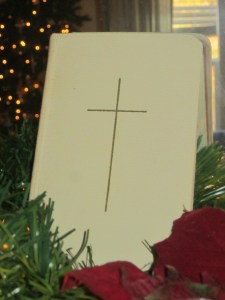
I’ve been thinking recently about the heirlooms of faith, not just salvation itself and the handing down of the Gospel.  But the prayers and readings that unite us to a long history of Christians, centuries and centuries of believers on their knees echoing the same thoughts and words before God’s throne.BookofCommonPrayer

One of the family “heirlooms” I keep on my fireplace mantle is my Grandmother’s Book of Common Prayer.  I’ve had it there since her death years ago, but I’ve never once opened it up.

The tradition of her faith was so very different than mine. I grew up in a Pentecostal church that taught me valuable faith-lessons, doctrinal foundations, daily Bible reading, personal, intimate and honest prayer, and passionate worship.

My faith is alive and vibrant today because I was taught and encouraged to be personal and interactive with God. I wouldn’t trade or change that foundation for anything.

I feel like I’m drawn to the idea of liturgy, though, much like a museum visitor gazing at Lincoln’s hat and thinking about how this “thing,” this “physical object” connects us to living and breathing people from the past.

I’m not changing churches, denominations, or my personal statement of faith.

Yet, how important it is to remember that salvation isn’t new to 21st century Christians.  Connecting with the past reminds us anew that “Jesus Christ is the same yesterday, today, and forever” (Hebrews 13:8). It reminds me that God cared for His people since the creation of the world and that my testimony of His faithfulness joins with the testimonies of believers for thousands of years.

God is bigger than me and bigger than my brief time on this earth. 

I’m curious about this prayer book sitting unopened on my shelf.  First published in the 1500s, it was meaningful for centuries, uniting the hearts of God’s people to pray and read Scripture together.

It was a way of ordering your spiritual walk, not based on your own personal whims, emotions or circumstances, but on the life of Jesus Himself—beginning with the first Sunday of Advent and the account of Christ’s birth.

The object itself isn’t holy, isn’t to be worshiped and isn’t inerrant other than the Scripture readings themselves.

Yet, there’s something breathtaking about opening a prayer book on the first Sunday of Advent and reading the same Scripture passages that Christians have read on this very same day for hundreds and hundreds of years.

And while these pages may be oft-read and well-worn for many who have followed those traditions year after year, for me—for a Pentecostal girl attending a Baptist church in the year 2012—opening the Book of Common Prayer is a wild act of discovery.

Usually each December, I choose my Bible reading plan for the year ahead.  I’m typically a One Year Bible-kind of girl.  This season, though, starting this first Sunday of Advent (Dec. 2nd), I’ll be following the two year-Scripture and prayer plan in The Book of Common Prayer.

It’s a long-held tradition, an heirloom that I’m taking down off a shelf and making new and fresh for me.

What will be you be doing to keep your faith alive and growing in 2013?

*********************************************************

For more information on the history of the Book of Common Prayer, what it’s all about, and how to use it, you can visit this site or watch this video on why it can be used along with spontaneous and personal prayers to build our faith.  The daily Bible reading schedule is provided here.

Christian Writers Blog Chain

Today’s post is part of the November topic ‘Heirloom’ by the ChristianWriters.com Blog Chain. You can click on the links on the right side of this page to read more articles in this series.

Heather King is a wife, mom, Bible Study teacher, writer and worship leader.  Most importantly, she is a Christ follower with a desire to help others apply the Bible to everyday life with all its mess, noise, and busyness.  Her upcoming book, Ask Me Anything, Lord: Opening Our Hearts to God’s Questions, will be released in the Fall of 2013!  To read more devotionals by Heather King, click here.

Copyright © 2012 Heather King
