Bad Boy

“No, no, no.  Bad boy.  Bad.  Boy.”

I’m in the back room of our house and I hear my oldest daughter chastising someone in the living room.

We don’t have a dog and it’s useless to lecture cats about their behavior.  So, I’m curious and concerned.  Who could she be talking to?

I see her in the living room sitting with her eight-month-old baby brother, who apparently is grabbing at her long Rapunzel-style hair while she holds him.

“Bad boy,” she says again.

I scoop him right up and then I explain it to her gentle:ephesians2-8
“Babe, we don’t call him ‘bad boy.’  He’s beautiful and wonderful and curious.  You can teach him, ‘no’ and you can give him other things to grab than your hair, but we don’t label someone as a ‘bad boy.’  Ever.”

But then the next day, I’m changing the baby’s messy diaper and I hear my four-year-old behind me.

“Oh, Andrew.  Bad boy.”

I explain it all again to her and my other daughters listen in.  I hope they don’t miss out on the truth of what I’m saying here because this is just plain important.

We do not call him Bad Boy. 

I just don’t know where it comes from.  I’ve never talked to my children like dogs.  I’ve never changed a diaper or disengaged my hair from the pudgy hands of an infant and said, “Bad girl” or “Bad boy.”  I can correct their behavior without the hurtful labeling.

So, what is this natural inclination to legalism and to guilt-ridden, shame-filled name-calling?

Isn’t this Christian walk this difficult balance of knowing we are depraved sinners in desperate and absolute need of a Savior?  Prone to evil.  Apt to sin.  Not worthy of heaven on our own merit or labor.

And yet we are also dearly loved and covered by the heavy blanket of grace.  And the God who loves us, He knows we’re not perfect.  He knows our clumsy way of tripping right into messes of our own making.

If He thought we were perfect, He wouldn’t have sent His Son to redeem us.  We wouldn’t have needed it.

Ephesians says it right there:

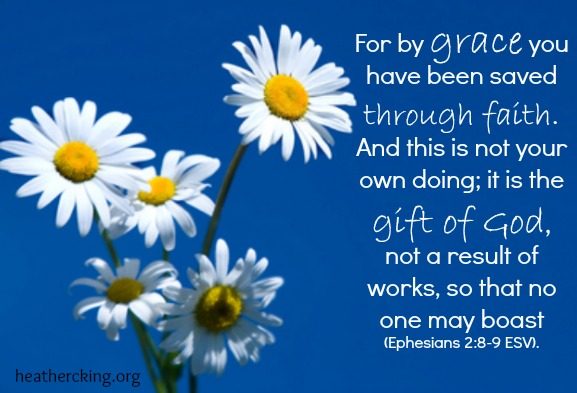
For by grace you have been saved through faith. And this is not your own doing; it is the gift of God,  not a result of works, so that no one may boast (Ephesians 2:8-9 ESV).

So, I want to be holy to please the God I love.  But when I mess it all up, I never seem to accept the forgiveness He offers.  I just keep apologizing and rehashing the disappointment.  I expect the discipline and the punishment.

This is because I let Him down.  This is because I did something wrong.

This is because I’m a ‘bad girl.’

In an article called How to Rise a Pagan Kid in a Christian Home, Barret Johnson talks about Phil Vischer, the creator of Veggie Tales, who said, “I had spent 10 years trying to convince kids to behave Christianly without actually teaching them Christianity.”

Johnson asks:

 Do you teach your kids “be good because the Bible tells you to” or do you teach your kids that they will never be good without Christ’s offer of grace? There is a huge difference. One leads to moralism; the other leads to brokenness. One leads to self-righteousness; the other leads to a life that realizes that Christ is everything and that nothing else matters.

So, do I want to strong-arm my children into good, moral behavior?  Do I discipline them so their hearts are turned to Christ and the desire to be like Him?  Or do I discipline so they will act respectful, tell the truth, sit still in church, not embarrass me in public, and stop hitting their sister in the back of the minivan?

I’m reading, The Good Dad, by Jim Daly and he pins me right down because I’m too often a woman who expects perfection from myself and a mom who expects perfection from my kids:

We all fall short of God’s standard of perfection….This understanding of our own imperfections helps us avoid the modern-day legalism that endangers so many Christians…It’s okay for your kids to fail sometimes.  Because that’s often how they learn best.

Nobody’s perfect.  That’s why we need Jesus.

That doesn’t mean we can do whatever we want, sin however we feel like it, no consequences, no worries.

It just means that while we strive for holiness, we know it’s not all on our own.  We rely on Him to help us.  And when we fail, God isn’t yelling at us, “bad girl.”  So we can stop yelling it at ourselves.

We live thankful for the grace.

We rest in His love.

We stop looking back and keep moving forward.


Heather King is a wife, mom, Bible Study teacher, writer and worship leader.  Most importantly, she is a Christ follower with a desire to help others apply the Bible to everyday life with all its mess, noise, and busyness.  Her book, Ask Me Anything, Lord: Opening Our Hearts to God’s Questions, is available now!  To read more devotionals by Heather King, click here.

Copyright © 2014 Heather King

 

Drop the stuff to take a picture of the butterfly (and maybe climb a tree)

She saw him there first, sunning himself on those purple flowers, showing off his yellow and black wings.

We hadn’t taken even two steps out of my front door when she shouted and rushed right over.

Two steps out the door?  I was still shifting the weight of the baby carrier against my knee with the diaper bag slung over my shoulder and a bag of library books weighing down my other hand with my keys between my teeth.10170989_696172120430028_1187591291338040542_n

And she’s spotting butterflies.

We stopped.  We emptied our hands so we could take pictures and enjoy one spring butterfly in the warmth of the sun.

But if she hadn’t been there, would I have even seen?  Would I have paced right by that flower bed from front door to minivan in 0.3 seconds?

And, if after a month of looking for beauty I’m still so apt to miss it, then what exactly am I missing?

I go back to the beginning, back to what I know.

God is both Beautiful and the Creator of Beauty.  The Psalmist said:

From Zion, perfect in beauty, God shines forth (Psalm 50:2).

So when I seek out the beauty of what He has made, I worship Him, I enter into His presence, and I can glimpse those hints of eternal perfection—the scent of Eden in the here and now.

David wanted this, too.  He wanted to seek out the presence of God and if he could have just one thing, it’d be this:

One thing I ask from the Lord, this only do I seek: that I may dwell in the house of the Lord all the days of my life, to gaze on the beauty of the Lord and to seek him in his temple (Psalm 27:4).

I want His presence, His beauty, to be my ‘one thing,’ my passionate pursuit, my eyes-on-the-prize, single-minded, totally focused, never-wavering-for-a-moment ‘thing.’

So why then do I walk out of my front door and need my eight-year-old daughter to see that butterfly on those purple flowers?image by Rudy Bagozzi;

Because my hands are full?

Because my mind is busy?

Because my heart is heavy?

Yes and yes and sometimes (but not always).

What if there’s something more?  I have to at least ask the question.

Isaiah said:

 “Your iniquities have made a separation between you and your God, and your sins have hidden his face from you” (Isaiah 59:2).

What if something blinds us to His face?  What if we’re trying to see and trying to see, but it’s just impossible?

Don’t you love Zaccheus, though?  This tax collector tried to see Jesus and tried to see Jesus, but he was too short to see over the crowd.

He could have given up, called it a day, headed on home, took a raincheck on a visit to the Messiah.

But no.  He hiked up his robe and scrambled up a tree.

I’m no tree climber.  Never really was.  But now?  A 30-something mom of 4 kids?  What a mess of clumsiness I’d be grabbing branches and hoping they’d hold my weight.

Yet, what if Jesus stopped and looked at that tree and called Zaccheus down because it was just that crazy?  He knew that this sin-filled tax collector was the one man in the crowd who was willing to make an utter fool of himself and do any wild bit of craziness just to see Jesus.

Face-to-face with so much grace, standing right there in Jesus’ presence, Zacchaeus could do nothing less than repent and change (Luke 19).

In Acts it says,

Therefore repent and return, so that your sins may be wiped away, in order that times of refreshing may come from the presence of the Lord (Acts 3:19 NASB).

If I want the refreshing of His presence, then it starts with the repenting and the returning.

So, what am I willing to do to see Him?  Skin my knees on tree bark and climb on up there?

And when I’m there at His feet, is there anything I need to lay down and be willing to change?

A bad attitude?

Bitterness?

Self-pity?

Selfishness and Self-focus?

Pride?

Jealousy?

Disobedience?

Unforgiveness?

It’s not legalism or getting all tangled up in reminders about how sinful I am.

It’s about seeing the beauty of His face when we discover the beauty of His grace.

To read more about this 12-month journey of pursuing the presence of Christ, you can follow the links below!  Won’t you join me this month as I ‘Enjoy Beauty’?

Heather King is a wife, mom, Bible Study teacher, writer and worship leader.  Most importantly, she is a Christ follower with a desire to help others apply the Bible to everyday life with all its mess, noise, and busyness.  Her book, Ask Me Anything, Lord: Opening Our Hearts to God’s Questions, is available now!  To read more devotionals by Heather King, click here.

Copyright © 2014 Heather King


Even When I’m Disappointed, I’ll Love You Anyway

Suffice it to say, hiding the evidence didn’t work.

I found her hidden stockpile, proof of mistakes that she’d stuffed into a corner of her bedroom.  I suppose she thought somehow that it’d eventually disappear or I’d just never notice.

But she underestimates a mom’s ability to discover truth (she never did figure out those two eyes in the back of my head)….so we stand there in that corner confronting the reality.

She had done something wrong and I had proof.lamentations3

But instead of bringing all that trouble straight to my feet and asking for help, she’d hidden it away and hoped I wouldn’t notice.

I tell her I’m disappointed, tell her I expected better, tell her she needs to overcome.

But then, when she’s tearful and we’ve retreated to the sofa, we pray for God’s help.

I hope she’s really listening, deep-down-take-this-to-heart listening, because I don’t want the words to just shoot through her before pushing their impression down into the soft clay of her heart.

When you’re in trouble, when you mess up, when you’re hurt, when something is wrong….

come

to

me.

Yes, your first impulse will be to run and hide, no different than Adam and Eve crouching among the garden leaves.

Yes, I’ll be sad at first.  Yes, I’ll be disappointed.  Yes, we’ll have to deal with it and that might be messy and hard and it seems easier in the moment to just avoid that pain.

I understand this.  Haven’t I stashed sin before, as well, desperately hoping that no one would notice—that HE wouldn’t notice?  I’ve been Eve in that Garden before, too, and I know how it feels to hold my breath and hope that God walks on by.

But God picked me to be your mom and that means sticking with you and helping you learn and overcome  That means loving you right on through the tough times.

Mary Kassian tells me:

When we face trouble, we are to pour out our hearts to him.  Everybody trusts something; we must learn to trust the Lord, our eternal rock (In My Father’s House).

Trust.

Is that what this is about?

If she trusted me enough to love her through anything, wouldn’t she come to me even when she’s done something wrong because she knew I’d help her?

If I trust His love that much, wouldn’t I run breathlessly to His feet, just run, no looking back, no hesitation, because He is the only One who can handle the mess I’ve made?

Yes, He’ll be disappointed.

Yes, He’ll be sad.

But what hurts His Father-heart most of all is when we trust in ourselves, trust in others, trust in programs, trust in Google searches and advice columns and friends and substances and self-help books, but we don’t trust Him.

The Israelites in that wilderness fretted over destination, clothing, enemies, food, water.  They whined.  They strategized.  They rebelled.  They wheeled and dealed.

The Psalmist writes

they did not believe God
    or trust him to care for them (Psalm 78:22 NLT).

Troubles rose up, maybe even just minor annoyances like dietary preferences, and they never did just learn to run to God right away.

He was angry.  The Psalm says, “When the Lord heard them, he was furious” (Psalm 78:21 NLT).

BUT

He still loved them.  And even when they abandoned Him time after relentless time, He always stayed faithful.

God’s love for them, His love for us, isn’t feeling love, temporary love, conditional love.  The Hebrew word that Scripture uses over and over is “Chesed”—it’s the loyal, steadfast, covenant mercy and love God has for His people.

They didn’t trust Him, didn’t bring their troubles to Him and they messed it up over and over and over, but He still went on caring for them abundantly, miraculously, faithfully.

He rained down manna for them to eat;
    he gave them bread from heaven.
They ate the food of angels!
    God gave them all they could hold. Psalm 78:24-25

He rained down meat as thick as dust—
    birds as plentiful as the sand on the seashore!  Psalm 78:27

So, I rest there with my daughter, my arms wrapped all the way around her and I say it one last time:

Come to me.  Do not hide away or lie or run.  Bring it all to me.

And I hear God rustling the leaves in my life, calling to me just as He did Adam and Eve, asking me to trust Him enough to bring everything, bring the sin, the mess, the worry, the fear, the troubles big and small, bring it all to Him.

Heather King is a wife, mom, Bible Study teacher, writer and worship leader.  Most importantly, she is a Christ follower with a desire to help others apply the Bible to everyday life with all its mess, noise, and busyness.  Her book, Ask Me Anything, Lord: Opening Our Hearts to God’s Questions, is available now!  To read more devotionals by Heather King, click here.

Copyright © 2014 Heather King

Don’t expect a laptop or an iPad for your birthday

Laptop, iPad, video game, cell phone.

This isn’t my wish list.  This is what my about-to-be-eight-year-old daughter will tell you she wants for her birthday if you ask her.

Seriously.

Her little second grade friends ask her for birthday present suggestions, and this is what she tells them.  Not, “Oh, a Barbie would be nice.  Maybe some new markers and Play-Doh.  I like Legos.”

No, not reasonable requests.

Crazy expensive requests.

So, I tell it to her straight yesterday.  Not even mom and dad will get you a laptop, an iPad or a cell phone for your birthday….so when someone other than your loving parents asks you for birthday ideas, think of something far, far, far, far, far…..less expensive.

To be fair, if I take her to pick out a present for her friends when they have a birthday, she always holds up the most expensive item on the shelf (an $80 Lego set or the $40 complete Disney princess collection or a $50 Xbox game) and declare that this is what her friend would like.

I explain that there are presents parents buy you.  There are presents other family members might buy you.  There are presents friends from school might buy you.

And there are presents so expensive, ain’t nobody gonna buy them for you.psalm66

You have to match the request with the giver.  You have to know whom to ask.

And sometimes, don’t we all get this wrong?  Don’t we carry needs to friends, carry worries to Facebook and Twitter, carry sadness to the phone and bitterness to the coffee shop?

But do we carry it all to Christ?

He’s the only One who can forgive and wash clean.  He’s the only One who can care for our every need, deliver us, redeem us, heal us, and restore us.

Yet, there we go, turning to others first and Jesus last.

Why is it that prayer is so often our final act of desperation instead of our first response to trouble?

Why do we so often try every other possible means of escape besides God?  And only after we realize that we have no hope in this hopeless and impossible situation do we finally give it over to Him?

Judas, that betrayer, collected his 30 silver coins.  Maybe he counted each one, stacking the silver into a pile, planning his financial future.

But Scripture tells us there was regret.  There was the deep conviction of sin.

 When Judas, who had betrayed him, realized that Jesus had been condemned to die, he was filled with remorse. So he took the thirty pieces of silver back to the leading priests and the elders. “I have sinned,” he declared, “for I have betrayed an innocent man”  (Mathew 27:3 NLT).

He took that blood money right back, hoping to be absolved of the heavy guilt.

And he confessed his wrong.  “I have sinned….for I have betrayed an innocent man.”

There, he said it.  He was a sinner.  Jesus didn’t deserve that cross.

Shouldn’t confession have shaken the conviction right off his shoulders?  Hadn’t he tried to take it all back, hand the coins over, and smooth right over that sin-laden path he’d traveled?

But the thing about taking our burdens to anyone but Christ is that no one else can handle them.

Those chief priests and religious elite took one look at Judas’s stack of coins and said,

“What do we care?” they retorted. “That’s your problem” (Matthew 27:4 NLT).

He’d rejected, denied, and handed over to death the only One who could have forgiven the very sin he now carried.  No Pharisee or religious leader could cleanse or absolve such guilt.

Only Jesus.

No only that…they didn’t even care.

Do we do this?  Do we expect worldly goods and other people to assuage our guilt, to calm our fears, to satisfy our hearts, instead of taking everything to the only One who can save and redeem and fill us?

The Psalmist gave this testimony:

For I cried out to him for help,
praising him as I spoke.
If I had not confessed the sin in my heart,
the Lord would not have listened.
But God did listen!
He paid attention to my prayer.
Praise God, who did not ignore my prayer
or withdraw his unfailing love from me (Psalm 66:17-20 NLT).

God doesn’t turn us away.  He doesn’t reject our requests or shrug us off like they did for Judas,’ What’s that to Me?  That’s not my problem.”

No, He listens to our prayers and does not withdraw His unfailing love from us.

So, we bring our sin to Him.  We bring our needs to Him.  We bring to Him our worries, fears, messes and mistakes, our everyday struggles, and the stress that keeps us up in the night.

He alone can save.

Heather King is a wife, mom, Bible Study teacher, writer and worship leader.  Most importantly, she is a Christ follower with a desire to help others apply the Bible to everyday life with all its mess, noise, and busyness.  Her book, Ask Me Anything, Lord: Opening Our Hearts to God’s Questions, is available now!  To read more devotionals by Heather King, click here.

Copyright © 2014 Heather King

Maybe you’re in a tropical paradise…but I’m looking at snow

It may be warm where you are today.  Maybe you’re all toasty and sitting out on your back deck to soak up some sunshine.

But not here.

So, don’t make us all jealous with your stories of tropical heaven.

We’re having a snow day. That means taking it slow, enjoying relax time.

It also means huge piles of dripping wet outerwear piled on my laundry room floor and frequent requests from my children that we make snow cream.

While I go play winter mom for the day, I hope you’ll enjoy these 10 Bible verses about snow in the Bible and the reminder that God uses this world of ours, this daily life, this freshly fallen snow to reveal Himself to us.  We look out the window at the sun making the snow glisten and remember this:

God forgives His people, shows mercy, washes that sin right out of a repentant heart.

God washes the world with His Word and refreshes the weary.

The Son of God will gleam so bright when we see Him, that whitest of whites and we’ll fall down in awe of His glory.

  • Psalm 51:7 NASB
    Purify me with hyssop, and I shall be clean;
    Wash me, and I shall be whiter than snow.psalm 51
  • Psalm 147:16-18 NASB
    He gives snow like wool;
    He scatters the frost like ashes.
    He casts forth His ice as fragments;
    Who can stand before His cold?
    He sends forth His word and melts them;
    He causes His wind to blow and the waters to flow.
  • Psalm 148:7-8 NASB
    Praise the Lord from the earth,
    Sea monsters and all deeps;
    Fire and hail, snow and clouds;
    Stormy wind, fulfilling His word
  • Proverbs 25:13 NASB
    Like the cold of snow in the time of harvest
    Is a faithful messenger to those who send him,
    For he refreshes the soul of his masters.
  • Proverbs 31:21 NASB
    She is not afraid of the snow for her household,
    For all her household are clothed with scarlet.isaiah1
  • Isaiah 1:18 NASB
    “Come now, and let us reason together,”
    Says the Lord,
    “Though your sins are as scarlet,
    They will be as white as snow;
    Though they are red like crimson,
    They will be like wool.
  • Isaiah 55:10-11 NASB
    For as the rain and the snow come down from heaven,
    And do not return there without watering the earth
    And making it bear and sprout,
    And furnishing seed to the sower and bread to the eater;
     So will My word be which goes forth from My mouth;
    It will not return to Me empty,
    Without accomplishing what I desire,
    And without succeeding in the matter for which I sent it.
  • Lamentations 4:7 NASB
    Her consecrated ones were purer than snow,
    They were whiter than milk;
    They were more ruddy inbody than corals,
    Their polishing was like lapis lazuli.
  • Daniel 7:9 NASB
    “I kept looking
    Until thrones were set up,
    And the Ancient of Days took His seat;
    His vesture was like white snow
    And the hair of His head like pure wool.
    His throne was ablaze with flames,
    Its wheels were a burning fire.
  • Revelation 1:14 NASB
    His head and His hair were white like white wool, like snow; and His eyes were like a flame of fire.

Heather King is a wife, mom, Bible Study teacher, writer and worship leader.  Most importantly, she is a Christ follower with a desire to help others apply the Bible to everyday life with all its mess, noise, and busyness.  Her book, Ask Me Anything, Lord: Opening Our Hearts to God’s Questions, is available now!  To read more devotionals by Heather King, click here.

Copyright © 2014 Heather King

Broken for you

I always break the cracker myself.

Always.

I can’t even quite remember when I started.  As a kid, I think, maybe even still in elementary school.Image credit: <a href='http://www.123rf.com/photo_16530775_taking-communion.html'>jordachelr / 123RF Stock Photo</a>

The deacons silently handed out the plate of crackers or bread or wafers or whatever they used for communion that day.

No matter how small it already was, when the pastor read the verse, “This is my body, broken for you.  Do this in remembrance of me…” I folded that tiny white sliver in half and then slipped it into my mouth with my eyes squeezed tight.

The King James says this, “Broken for you….”

My Bible now reads “Given for you….”

Scripture translation doesn’t impact how personal this is, how personally I should take it sitting there in my comfortably cushioned chair in a carpeted sanctuary.

Because Jesus’ brokenness wasn’t just for someone, for all of us, for mankind, for her, for him, for them, for those in the past…..

It was:

for you.

It was:

for me.

That’s why I smash that wafer into two with my own fingers and cradle the pieces in my own palm before we eat the bread together: because this was Christ’s sacrifice for me and it was because of me, because of my own sin in a world of sinners.

It’s too easy to feel rising self-righteousness, thinking that my redeemed self isn’t so bad, my sin not so ugly, my life not so messy.

And then that creeping lie of merit demolishes the truth of grace.  Even when I sing the words, “Amazing grace, how sweet the sound that saved a wretch like me,” I’m not meaning it.  Not truly.  I’m singing about other wretches maybe, but surely not me, surely not my own good-girl self.

Holding two slivers of a broken symbol of Christ’s sacrificial body, though, reminds me that He chose the brokenness.

And why?

Because I was hopelessly broken.

It’s not a romanticized brokenness, this need of mine for a Savior.  It’s not that I’m just slightly messy or flaky or flighty, scatter-brained, forgetful, overwhelmed, rushed, busy, or humorously real in a world that tends to pretend perfection.

Sure, we’re all human.  We don’t always keep our houses clean.  Sometimes we lose our temper with our kids.  There are bad days and mistakes.

But I’m not talking the kind of brokenness we laugh about in blog posts, where we confess not so much sin as just life in all its crazy reality.

I’m talking about the kind of brokenness where we drop to our knees in repentance, true repentance, where we face the fact that we’re sinners and that there is ugliness in us.

And we don’t just accept that with apathetic shrugs of our shoulders.

That’s just how I am.  That’s how everyone is.  That’s what is realistic.  That’s how God made me.  That’s just how people will have to accept me.  Nobody’s perfect.

Sometimes that’s what we say.  We commiserate with lost tempers and jealousy in small group conversations and we act as if it doesn’t matter.

But just because that’s normal, doesn’t mean it’s right.  Doesn’t mean it’s acceptable to God or holy or pure or righteous.

I never really choose brokenness myself. It’s not something I seek out or glorify or want.  Yet, God reveals the broken places not so I can connect with others with a funny story, but so I don’t forget that:

He is perfect; I am not.

He deserves glory; I don’t.

He paid the price for my salvation; I didn’t earn it.

He doesn’t use me because of my skills, abilities, training; He can use me in my weakness so that others see His strength.

The humbling makes us usable, makes us dependent on Him, makes us desire His work in us, the kind that doesn’t leave us broken and sin-invaded forever, but inspires us to intimacy with Him that brings life-revolutionary change.

And while I don’t usually choose this brokenness—more like I run away from it, hide from it, try to escape it and pretend it doesn’t exist–it’s beautiful the way He uses it, beautiful the way it’s transformed in His hands.

Beautiful the way I remember that while I avoid brokenness, Jesus chose it for me.

Here the King James version falls short.  Yes, his body was “broken for you”–but not because others were more powerful or Satan overcame Him or He wasn’t able to save Himself.  This wasn’t passive.

Instead, I read today in my Bible:

And He took bread, gave thanks, broke it, gave it to them, and said, “This is My body, which is given for you. Do this in remembrance of Me (Luke 22:19 HCSB).

Jesus gave His body over to us.

This I remember.  This I bow my head and give humble thanks for.  This is why I break the bread with my own hands, because  He chose the brokenness and He chose it for me.

Heather King is a busy-but-blessed wife and mom, a Bible Study teacher, writer and worship leader.  Most importantly, she is a Christ follower with a desire to help others apply the Bible to everyday life with all its mess, noise, and busyness.  Her upcoming book, Ask Me Anything, Lord: Opening Our Hearts to God’s Questions, will be released in November 2013!  To read more devotionals by Heather King, click here.

Copyright © 2013 Heather King

Orange Makeup/White Shirt and Forgiveness

“I’m so grateful we never have to stand at a distance from Christ. Not only is He incapable of catching our ‘disease,’ but also He is never reluctant to embrace us”
(Beth Moore, Jesus: the One and Only, p. 242)

I love my kids.  Normally, I’m eager to accept their hugs and I’ll wrap them up in my arms at the slightest whim.

The other night, though, my daughter was fully decked out in her costume as an Oompa Loompa in a production of Willy Wonka, Jr, complete with thick, bright orange makeup all the way to her hairline and down to her neck.

…And she wanted to hug me.006

…While I was wearing a white shirt.

…A really, really white shirt.

Did I mention she was orange?  Really, really orange.  In fact, I think Crayola should consider naming a new color “Oompa Loompa Orange” in her honor.

So, I hugged her at first with an intricately choreographed dance, making sure her orange head never made contact with my clothing. She bobbed; I weaved.

Then, I stood still for a moment and tilted her face to the side so that only the top of her head touched me.  (Her hair, thankfully, wasn’t orange!)   I gave her what I’ve decided to call “the sideways head hug.”

My goal here was a kind of sterile affection: Showing love without staining my clothes.

I’ve learned this dance over years of practice as a mom.  Kids, after all, come at me every day with Oreos on their hands and spaghetti sauce oozing from their fingers. More paint makes it onto them than every makes it onto paper and then they reach out and touch me to get my attention.

In fact, most of my clothes bear the marks of their hands on my thighs (where they could reach when standing up as toddlers) and on my shoulders (from the times I picked those little ones up).

When I read through the Gospels, I’m amazed at how Jesus essentially wore a white shirt and yet never failed to hug, squeeze, lift up, and cherish all those who came to him—even when they were covered in stains of sin, death, and all that was unclean.

He never dodged them in attempts to escape the messiness of their lives.

When the woman who had been bleeding for 12 years braved the disapproving crowd in order to reach Jesus, she was unclean.  Continual bleeding meant continually being cut-off from public worship and physical contact with others.

One brush of her skin against your arm and you’d be unclean, as well.

Yet, she touched Jesus and He didn’t flinch or condemn her.  He didn’t sidestep her presence.  He healed her and set her free.

When Jesus saw the coffin of a widow’s only son pass by surrounded by wailing mourners and his mother in despair, Jesus could have slipped away and ignored it all.  Touching a dead body was a guaranteed mess, making you unclean by the law’s religious standards.

Jesus did it anyway, though, telling the dead boy to arise and then watching this only son embrace his mother again.

Jesus ate with the rabble, touched the eyes of the blind, and laid hands on the demon-possessed.  His was a physical affection, the real and true fingerprints of God placed on undeserving lives and unclean situations.

Yet, instead of being tainted or stained Himself, He brought purity to others.

Paul put it this way:

God made him who had no sin to be sin for us, so that in him we might become the righteousness of God (2 Corinthians 5:21).

Too often we miss the significance of this fact: Jesus did what was unclean and yet nothing could penetrate the purity of the Son of God.

He was sinless, blameless, totally righteous before God, but He didn’t use that as an excuse to separate Himself from others.  Instead, it was His joy to absorb their stains of sin, now bleached white when laid at the feet of the Messiah.

It’s what He did on the streets of Galilee and Judea and Samaria.

It’s what He did on the cross.

It’s what He does even now when we let Him get involved in the dirtiest, muckiest, and most sin-plagued aspects of our lives.

That’s what John assures us when he writes: “If we confess our sins, he is faithful and just and will forgive us our sins and purify us from all unrighteousness” (1 John 1:9).

This means we don’t need to hide away or shun his society.  We don’t need to pretend the unclean blots on our lives don’t exist.

It also means that we can follow his example by no longer worrying about our clean white shirts and start doling out affection without restraint, not avoiding the mess of others when it makes us uncomfortable.  Like Jesus, we “walk in the way of love, just as Christ loved us” (Ephesians 5:2).

Sometimes real love means getting messy, maybe even orange.

Originally published as Orange Makeup/White Shirt on August 15 2012

Heather King is a wife, mom, Bible Study teacher, writer and worship leader.  Most importantly, she is a Christ follower with a desire to help others apply the Bible to everyday life with all its mess, noise, and busyness.  Her upcoming book, Ask Me Anything, Lord: Opening Our Hearts to God’s Questions, will be released in the Fall of 2013!  To read more devotionals by Heather King, click here.

Copyright © 2013 Heather King

Garden Devotions–It’s Crowded In Here

Originally published April 27, 2012

My daughters and I reached a compromise.

I announced that I didn’t want to grow a vegetable garden this year.  It was too much work for too little result.  It didn’t save money.  It started out fun in April and ended up a horrible, rotten, ugly chore by the middle of July.  Various ravenous insects destroyed and devoured my plants.

Their response was unanimous.  “But Ma—awm.  We like to grow our own food.”

So we narrowed down the lists of vegetables we would grow and planted a container garden on our deck.

We filled large wooden crates with garden soil, vegetable food and the tiny plants of tomatoes, cucumbers and peppers we had chosen.  Then we dropped the carrot seeds into the dirt, following exact directions on how far down to push them and how far apart they needed to be spaced.

After a while my daughters disappeared to work on their own project. They held out the result to me with pride.  It was a small planter with dirt in it.

“We planted radishes,” they announced, “all by ourselves.”

I shrugged.  The radish seeds were leftovers from last year.  It seemed unlikely they’d grow.  Yet, the girls faithfully watered that pot for days and surprisingly they were rewarded by the first hints of green.

A day later, the pot was crowded by infant radishes.  The girls must have dumped 20 seeds all into the same tiny space in the miniature pot.

It was going to be really crowded in there.

Unfortunately, even though it is hard and a little sad, we now have to make some tough choices.  If all the radish plants remain in that pot, none of them will grow correctly.  Some of them have to come on out of there.

Sometimes our lives are just as crowded as that tiny radish pot.  Every single seedling may have potential for beauty, growth, and produce, but nothing can grow when they are all shoved into the small space of one simple life and the restriction of 24-hour days.

Even though it’s hard and a little sad, there are times when some things have got to go so that other areas of your life can grow to their full potential.

It’s not always a mystery when choosing what to toss.

When Jesus walked into the temple and saw the vendors hocking their wares–doves for sacrifices and loans for people needing money for their offering–He responded immediately.  It didn’t take a second’s thought for Jesus to overturn their tables and chase the mercenaries out of the holy space of the temple courtyard.

He threw out sin, contaminated worship, and the profanation of the holy.

As soon as Jesus cleared the place, the blind and the lame came to him at the temple, and he healed them” (Matthew 21:14).

The only reason they could seek healing in the temple, the only reason there was room for the blind and lame to worship, was because Jesus had thrown out the tainted and unholy.

The Message emphasizes this when it says, “Now there was room for the blind and crippled to get in.”

Until Jesus cleaned house, there hadn’t even been room in the temple for those who needed God the most.

Will we allow Jesus to overturn the tables in our heart where sin and the unholy have set up shop?  Will we clear out the trash and the disgusting, so that we have room to come to Jesus—and to bring others along who need Him the most?

Of course, it’s not always so easy to tell what has to go in our lives.  We have a million choices of how to invest our time, energy, talents, and money, and all of them could be good.  We could lead hundreds of crusades against a world of evil.

But if we crowd out our lives with too much that is good, nothing will grow as it should.

Jesus Himself exhibited the kind of focus we need, to hone in on our purpose and refuse to be distracted by every demand and need.

During His ministry, mobs of people sought out Jesus for healing, and He frequently healed those who sought out His help.

But He didn’t heal everyone.

In fact, when the crowds grew too large and people sought Him out for healing alone, He moved onto another town or escaped the masses to pray alone on a mountain or by the sea.

Healing was fine.  Miracles were part of His ministry.  But it was not His main purpose for coming and He never wanted that to be the focus of His presence.  Instead, He had come to “seek and to save the lost” (Luke 19:10) and “to save the world” (John 3:17).

Maybe it’s time for you to pull out some of the extra radishes from your pot.  The first ones to go are easy—yank out the sprouts of sin, the unholy habits and the remnants of the flesh life.

Then prayerfully ask God to help you focus.  What seedlings should you tend and invest in until you harvest their potential?  What seedlings need to be set aside so that other areas of your life can grow?


Heather King is a wife, mom, Bible Study teacher, writer and worship leader.  Most importantly, she is a Christ follower with a desire to help others apply the Bible to everyday life with all its mess, noise, and busyness.  Her upcoming book, Ask Me Anything, Lord: Opening Our Hearts to God’s Questions, will be released in the Fall of 2013!  To read more devotionals by Heather King, click here.

Copyright © 2013 Heather King

Please Break My Heart…Really and Truly

Originally posted March 23, 2012

It’s the drill, the sound if it screeching unnaturally close to your face.

Plus there’s the smell of sterilized tools and latex gloves.dentistchair

There’s the tooth-shaped clock on the wall and the charts portraying healthy and not-so-healthy gums hanging here and there.

It’s the dentist’s office and I don’t love the place, but I had to be there for a filling—easy and routine, my dentist tells me.  He asks me how I’m doing today.  “Nervous,” I confess with a conversational giggle.

Still, I like him.  He’s pleasant and efficient.  His degrees and certifications adorn the walls, assuring me that he knows what to do.  He’s the kind of doctor I prefer, one who explains to you what’s going on and assumes you’re intelligent enough to understand.

So, he glances at my chart and sees the note written in large letters, “Needs extra anesthetic.”

He asks me about it and I tell him the gruesome story of another dentist starting to drill and me feeling it.  I tried to fake it and pretend like I was numb just for the sake of expediency, but my flinches and the pain in my eyes apparently gave me away.

When you’re numb, you ironically can’t help but feel it.  You feel that your face is heavy and your speech difficult.  They ask you to rinse and it takes effort.

It’s a simple filling and yet here I sit at my computer five hours later, feeling the last remaining bit of numbness around my mouth.  I’m a poster child for the old Bill Cosby standup routine about a dental patient.

Numbness takes time to fade, but thankfully it eventually does.  Truly, I’m grateful for the fact that two shots of medicine helped me not to feel the dentist’s drill.  It’s a comfort of the modern age that I’m happy to enjoy.

Yet, as I sit in the chair waiting for the drilling to start, I wonder if I’ve grown too numb in other areas of my life.  And sadly, the numbness of our hearts and minds doesn’t fade away as assuredly as a dentist’s shot.

Hillsong sings in their song Hosanna:

Break my heart for what breaks Yours
Everything I am for Your Kingdom’s cause
As I walk from earth into
Eternity

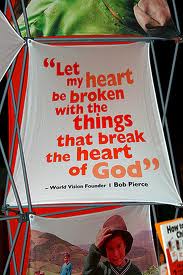
worldvisionThis was the prayer of World Vision founder, Bob Pierce: “Let my heart be broken by the things that break the heart of God.”

So I wonder…is my heart too numb?  Has it become an unfeeling organ?  Or, am I only slightly bruised occasionally, crying for a moment and then resuming life as normal, patching up momentary sorrow with practicalities and emotional distance?

What actually breaks the heart of God anyway?

Surely it’s our sin, our breaking faith with God and causing Him disappointment and sadness (Numbers 5:6, Hosea 11:8b).

Yes, David’s heart broke after his devastating sin of adultery and murder, and he desired restoration and forgiveness (Psalm 51).

Are you grieved over your sin and the times you’ve broken faith with God?  Do you shake it off with excuses and acceptance, compromising because it’s “normal” and just “who you are?”  Or do you humbly bow at His feet and ask for His help and His forgiveness?  Do you hate your sin enough to do whatever it takes to change?

Surely the lost break God’s heart, the “sheep not having a shepherd,” who stirred Jesus’ heart to compassion and self-sacrifice (Mark 6:34). 

Are you broken-hearted over those who do not know Jesus and moved to compassion and boldness by their presence in the world and in your community?

But it’s also the hurting and needy.  When Israel complained that God wasn’t overly impressed by their fasting rituals and legalistic religiosity, God told them exactly what kind of fasting He desired: freeing the oppressed, sharing bread with the hungry, caring for the homeless (Isaiah 58:6-7).

James agreed when he wrote, “Religion that is pure and undefiled before God, the Father, is this: to visit orphans and widows in their affliction, and to keep oneself unstained from the world” (James 1:27, ESV).

Is your heart broken by the orphaned, the widowed, the hungry, and the oppressed?  Do you do more than shed a tear at an Internet video and actually advocate for those who need a voice?

We have a God whose heart is broken over sin, over unbelief, over the hurting, oppressed, defenseless and hungry.

What about our hearts?

It’s a strange thing, this spiritual numbness.  While a shot at the dentist’s office fades over time, our hearts respond in opposite ways to hurt.  We may begin compassionate and then grow numb from forgetfulness.  We may grieve over sin at first and then slowly grow accustomed to it.

Instead of needing extra doses of anesthetic, we must go to God continually and ask for more of His broken heart.

To listen to Hillsong’s Hosanna, you can click the link here or watch the video posted below on the blog:

Heather King is a wife, mom, Bible Study teacher, writer and worship leader.  Most importantly, she is a Christ follower with a desire to help others apply the Bible to everyday life with all its mess, noise, and busyness.  Her upcoming book, Ask Me Anything, Lord: Opening Our Hearts to God’s Questions, will be released in the Fall of 2013!  To read more devotionals by Heather King, click here.

Copyright © 2013 Heather King

Today, Not Tomorrow

“I tell you, now is the time of God’s favor, now is the day of salvation”
(2 Corinthians 6:2b NIV).

“I don’t always obey Mom and Dad, but I do obey God.”

It made sense to her six-year-old mind.  Well, sure I might not obey my parents, but at least I’ve got the God-thing covered.

What’s a little family Bible time without some lessons on what this all means?  So, it didn’t take two seconds for my husband and me to jump on this one with a little Scripture quoting: “Children obey your parents.”

That’s what God says, we tell her, so you can’t obey Him without obeying us.

Oh.

I understand what she’s going through because most of us grow too comfy with our own sins and misbehaviors.  We try to justify or ignore, or create some arbitrary system of categories and hierarchies.

Well, I might gossip…..but I don’t lie.I might tell white lies….but I don’t tell all out whoppers.
I might lie….but I don’t steal.
I might steal….but I don’t murder.

The truth, of course, is that we’re all sinners, and sinners don’t just make mistakes, accidentally mis-step, or suffer from minor character flaws.

We sin.

And while we might try to dilute the definition a bit to take the sting out of the conviction, Scripture says, “…everything that does not come from faith is sin” (Romans 14:23b NIV).

We know what sin does, don’t we?  We know because so many of us have dragged that heavy burden along with us, refusing, forgetting, or just plain failing at leaving it behind.  It holds us back.  It keeps our hands encumbered instead of free to raise in worship and to extend in service.

Hebrews 12:1 describes it this way:

Therefore, since we are surrounded by such a great cloud of witnesses, let us throw off everything that hinders and the sin that so easily entangles. And let us run with perseverance the race marked out for us (NIV).

Before we can run forward and make progress in this race, we’ve got to begin by leaving some things behind.  We’ve got to throw everything off that hinders.  We’ve got to un-knot the tangle of sins that are tripping us up.

We’ve got to ditch the load and then run free.

In a new year, so many of us are looking forward to goals and expectations, but we won’t go far without throwing over what has entangled, encumbered and ensnared.

Angie Smith writes, “Part of moving forward is always letting go of what has held us back, and it is never less than a battle.”

The truth is we can’t drag it all along after us and still expect to move forward with God.  We’re inhibited and stuck.

So that worrying….that gossiping….that perpetual busyness and never resting….that sharp tongue…that lack of grace….that lack of faithfulness to our commitments…that pride…that jealousy…that disobedience…that bitterness…that unforgiveness…that fear.

Whatever it is, it’s got to go.

Why not begin letting it go today?

At Women of Faith last summer, Christine Caine taught on the plague of frogs that struck Egypt in Exodus.  The nation was overrun by frogs, just as Moses had warned Pharaoh:

“The Nile will teem with frogs. They will come up into your palace and your frogbedroom and onto your bed, into the houses of your officials and on your people, and into your ovens and kneading troughs.The frogs will come up on you and your people and all your officials” (Exodus 8:3-4).

Imagine frogs everywhere, between the sheets of your bed when you lie down to rest and in your kitchen, jumping all over your food.

That’s too many frogs for anybody!

So when Pharaoh begged for Moses and Aaron to pray that God would end the plague and remove the frogs, they agreed.  They even went beyond that.  Moses said Pharaoh could choose the exact day and time when the frogs would disappear.

Shockingly, he didn’t say, “Right this very second!”  or “Before I go to bed tonight and have to sleep with another creature in my bed.”  He didn’t want it “over with by dinner so I can eat my food without it tasting like frog.”

He wanted the frogs gone, “tomorrow” (Exodus 8:10).

Why did he do this?

Why do we do this?

If God has promised us deliverance, if He’s asked us to leave something behind, if He’s challenged us to lay it down and move forward, why do we linger here?

Why do we endure one more day and another and then again of hindrances and snares instead of letting go?

Today is the day of salvation.  Let it be today—not tomorrow—that we ask God to search our hearts, to know us, to reveal the anxious thoughts and the waywardness and help us lay it down, let it go, so we can move on (Psalm 139:23-24).

Heather King is a wife, mom, Bible Study teacher, writer and worship leader.  Most importantly, she is a Christ follower with a desire to help others apply the Bible to everyday life with all its mess, noise, and busyness.  Her upcoming book, Ask Me Anything, Lord: Opening Our Hearts to God’s Questions, will be released in the Fall of 2013!  To read more devotionals by Heather King, click here.

Copyright © 2013 Heather King