Weekend Walk: A Wayward Cat

We have a wayward cat.

He started dashing out the door for periodic jaunts around the neighborhood long ago.  Whenever we found him crouched in the woods with his bright eyes shining back at us, he’d run into the house and hide for an hour or two under the bed.

Those experiences in the wild scared him to pieces.

Still, he ran away again.  And again.  Today’s adventure is the longest he’s had.  Escaping this afternoon, he’s still not home and it’s long past his bedtime as I write this.

We can never understand why he leaves.  He’s clearly terrified of whatever is out there in the wild.  He’s clearly spoiled here in our home.

And yet he runs.

A man once told me that once a cat experiences the smallest bit of life in the wild, you can never successfully keep him indoors again.

It made me wonder if the prodigal ever thought about running away again after he’d returned to life on the farm and celebrated his homecoming.

When Jesus told the woman, “Go and sin no more,” I wonder if it was as simple as that (John 8:11).  Did her memory of extravagant grace sustain her?  Was it as simple as walking away or did she have to fight for change, falter, repent, and run to Christ again and again?

Paul described exactly this struggle in Romans 7.  He did what he didn’t want to do.  He didn’t do what he knew he should do.  This is the continual battle with our flesh.

Like the hymn writer said, we’re “prone to wander, Lord, I feel it, prone to leave the God I love.”

Why do we wander?  Why do we dash out the door at the slightest opportunity and leave the safety and provision of God’s care?  Why risk treacherous territory rather than rest in His love?

After all, as soon as our cat did return home (at 4:00 a.m.) he ran in from the rain to our dry house and was greeted with a can of tuna fish.  You’d think he would understand that home is a better place to be than gallivanting around the woods in the rain sans tuna.

Paul made our choice clear in this same way and that’s my verse to meditate on this week:

The mind governed by the flesh is death, but the mind governed by the Spirit is life and peace” (Romans 8:6).

You’d think given the choice between death on the one hand and life and peace on the other, this decision would be a no-brainer.  Unfortunately, though, we slip into flesh-thinking so easily—-choosing to dwell on worry and anxiety, jealousy, fear, anger, bitterness, selfishness, greed, and more—everything that leads to death.

This week, let’s focus on having a Spirit-governed mind.  We must choose not to let our thoughts run wild into flesh territory.  We must choose if we want life and peace.

How do you take control of your thought-life?

Heather King is a wife, mom, Bible Study teacher, writer for www.myfrienddebbie.com and worship leader.  Most importantly, she is a Christ follower with a desire to help others apply the Bible to everyday life with all its mess, noise, and busyness.  To read more devotionals by Heather King, click here.

Remembering: I’ve Fallen and I Can’t Get Up

Hi all!  I’m still enjoying time away with my family and am just logging on to share an old post with you about prayer initially and fervently about all things—without worrying and fretting first.  Enjoy!

********************************************************************************************

I’ve Fallen and I Can’t Get Up!

Originally posted on August 19, 2011

“Three times a day he got down on his knees and prayed, giving thanks to his God, just as he had done before” (Daniel 6:10)

Bam!
Waaaaaaaaaaaaaaa!
Thump, thump, thump, thump, thump.
Sniffle, sniffle, sniffle.
Mom!  Mom mom!!

With my genes, my girls didn’t have much of a chance at grace and my baby girl is no different. So these are the sounds heard in my home multiple times any given day.

It’s the immediate reaction of any child to trouble, the crying out to mom and the running to her side to tell her all about the tragedy and pain.

There’s little I can do most of the time to fix the problem.  My baby’s fallen and hurt (maybe even angry) and while I can’t change the fact of her fall and no Band-Aid is going to alleviate the temporary soreness, I can kiss her, cuddle her close and tell her I love her. And so I do.

Then I fall down, tripping over my own sin, or another person who invaded my space, or an obstacle I didn’t foresee, or an unexpected pit in my road.

To whom do I run?  What is my immediate response, my instantaneous reaction to pain?  What is yours?

For some, it’s to hold our bruises close for a while and to snap at any bystanders who offer to help us stand back to our feet.  Maybe even hide our heads in embarrassment for the spectacle of the fall in the first place.

For some, it’s to call out for help from those nearby, asking them to both hoist us up and even bear the burden of our weight for a while as we wobble around on a weakened leg.

For some, it’s to haul out our own first aid kit and apply ice and bandages to our own wounds and refuse the expert care so readily available.

For some, it’s to sit without moving, paralyzed by fear.  What if our leg is broken?  What if we never walk again?  What if . . . what if . . . what if . . . ?

In Beth Moore’s study, Daniel, she notes how his immediate response to the king’s edict prohibiting prayer was to go “to his upstairs room where the windows opened toward Jerusalem. Three times a day he got down on his knees and prayed, giving thanks to his God, just as he had done before” (Daniel 6:10).

He didn’t worry first and then pray.  He didn’t try to fix the situation through his political abilities and then pray. He didn’t even concede defeat and stop his public prayer habits, choosing instead to silently petition God at night while others slept.

Daniel prayed.  It was his initial reaction; it was his only solution.

Then there’s the matter of what he prayed.  Sure, some of us have indeed trained ourselves to “take it to the Lord in prayer” without hesitation.  We run to his side and bury our noses in the hem of His robe, sniffling out our requests to Him.  But are we giving thanks amidst those tears?

Daniel was.  Scripture says he “got down on his knees and prayed, giving thanks to God” (Daniel 6:10).  When I’m smarting from an injury, I’m more likely to complain about the pain than sing hymns of thankful praise.

Not Daniel. Political enemies, a manipulated king, a dangerous edict, his faith attacked, his life on the line—still Daniel gave thanks.

Paul made the same connection when he wrote,

Do not be anxious about anything, but in every situation, by prayer and petition, with thanksgiving, present your requests to God. And the peace of God, which transcends all understanding, will guard your hearts and your minds in Christ Jesus (Philippians 4:6-7).

Peace in the midst of pain is there for the taking sometimes, and yet we choose anxiety instead.  We opt for fear by trying to control our own problems rather than running to God’s side and dumping them at His feet.  We allow worry to reign in our hearts and minds by refusing to pray with thanksgiving at all times and in every situation.

I confess I’m a rebel at times.  Even though I know I should shove aside my grumbling and choose to be thankful—even when it takes struggling and squinting to see that sparkle of light in a dark place– still I decline.

I dusted off my thankfulness journal this morning after two weeks of shoving it aside. I didn’t want to be thankful.  I wanted to feel wronged.  I didn’t want some secret formula to maintaining joy in trials; I wanted no more trials!  I wanted God to feel pity for me and feel sorry for letting me be hurt.  Perhaps what I wanted was an apology from Him.

It’s like emotional manipulation of the Almighty God.  “I’m not going to praise You or worship You or give You thanks or hand over my fears to You until You rescue me in the way I desire.”

It’s handing God a sheet and pillow and pointing to the couch.
It’s ignoring His phone calls and giving Him the silent treatment at the dinner table.
It’s holding my breath until he gives me what I want.

And it’s just about as effective as all those tactics.  So when my tantrum is done, I pray and I give thanks.  Reluctantly at first, perhaps, and yet I try.  Maybe the next time I trip and fall, I pray with thanksgiving immediately because I have learned that gratitude shifts my focus off my need and onto the face of my Deliverer.

Heather King is a wife, mom, Bible Study teacher, writer for www.myfrienddebbie.com and worship leader.  Most importantly, she is a Christ follower with a desire to help others apply the Bible to everyday life with all its mess, noise, and busyness.  To read more devotionals by Heather King, click here.

Copyright © 2012 Heather King

Orange Makeup/White Shirt

“I’m so grateful we never have to stand at a distance from Christ. Not only is He incapable of catching our ‘disease,’ but also He is never reluctant to embrace us”
(Beth Moore, Jesus: the One and Only, p. 242)

I love my kids.  Normally, I’m eager to accept their hugs and I’ll wrap them up in my arms at the slightest whim.

The other night, though, my daughter was fully decked out in her costume as an Oompa Loompa in a production of Willy Wonka, Jr, complete with thick, bright orange makeup all the way to her hairline and down to her neck.

…And she wanted to hug me.

…While I was wearing a white shirt.

…A really, really white shirt.

Did I mention she was orange?  Really, really orange.  In fact, I think Crayola should consider naming a new color “Oompa Loompa Orange” in her honor.

So, I hugged her at first with an intricately choreographed dance, making sure her orange head never made contact with my clothing. She bobbed; I weaved.

Then, I stood still for a moment and tilted her face to the side so that only the top of her head touched me.  (Her hair, thankfully, wasn’t orange!)   I gave her what I’ve decided to call “the sideways head hug.”

My goal here was a kind of sterile affection: Showing love without staining my clothes.

I’ve learned this dance over years of practice as a mom.  Kids, after all, come at me every day with Oreos on their hands and spaghetti sauce oozing from their fingers. More paint makes it onto them than every makes it onto paper and then they reach out and touch me to get my attention.

In fact, most of my clothes bear the marks of their hands on my thighs (where they could reach when standing up as toddlers) and on my shoulders (from the times I picked those little ones up).

When I read through the Gospels, I’m amazed at how Jesus essentially wore a white shirt and yet never failed to hug, squeeze, lift up, and cherish all those who came to him—even when they were covered in stains of sin, death, and all that was unclean.

He never dodged them in attempts to escape the messiness of their lives.

When the woman who had been bleeding for 12 years braved the disapproving crowd in order to reach Jesus, she was unclean.  Continual bleeding meant continually being cut-off from public worship and physical contact with others.

One brush of her skin against your arm and you’d be unclean, as well.

Yet, she touched Jesus and He didn’t flinch or condemn her.  He didn’t sidestep her presence.  He healed her and set her free.

When Jesus saw the coffin of a widow’s only son pass by surrounded by wailing mourners and his mother in despair, Jesus could have slipped away and ignored it all.  Touching a dead body was a guaranteed mess, making you unclean by the law’s religious standards.

Jesus did it anyway, though, telling the dead boy to arise and then watching this only son embrace his mother again.

Jesus ate with the rabble, touched the eyes of the blind, and laid hands on the demon-possessed.  His was a physical affection, the real and true fingerprints of God placed on undeserving lives and unclean situations.

Yet, instead of being tainted or stained Himself, He brought purity to others.

Paul put it this way:

God made him who had no sin to be sin for us, so that in him we might become the righteousness of God (2 Corinthians 5:21).

Too often we miss the significance of this fact: Jesus did what was unclean and yet nothing could penetrate the purity of the Son of God.

He was sinless, blameless, totally righteous before God, but He didn’t use that as an excuse to separate Himself from others.  Instead, it was His joy to absorb their stains of sin, now bleached white when laid at the feet of the Messiah.

It’s what He did on the streets of Galilee and Judea and Samaria.

It’s what He did on the cross.

It’s what He does even now when we let Him get involved in the dirtiest, muckiest, and most sin-plagued aspects of our lives.

That’s what John assures us when he writes: “If we confess our sins, he is faithful and just and will forgive us our sins and purify us from all unrighteousness” (1 John 1:9).

This means we don’t need to hide away or shun his society.  We don’t need to pretend the unclean blots on our lives don’t exist.

It also means that we can follow his example by no longer worrying about our clean white shirts and start doling out affection without restraint, not avoiding the mess of others when it makes us uncomfortable.  Like Jesus, we “walk in the way of love, just as Christ loved us” (Ephesians 5:2).

Sometimes real love means getting messy, maybe even orange.

Heather King is a wife, mom, Bible Study teacher, writer for www.myfrienddebbie.com and worship leader.  Most importantly, she is a Christ follower with a desire to help others apply the Bible to everyday life with all its mess, noise, and busyness.  To read more devotionals by Heather King, click here.

Abracadabra: The Magical Mom Trick

He made rabbits appear out of nowhere.  He seemed to read minds.  He pulled colorful bouncy balls out from behind children’s ears.

The magician at our local library amazed my kids, particularly my middle daughter who checked out four books on magic that day and altered her future career plans.

“I want to be a magician who tells jokes,” she declared.

Today, I am feeling a little like a magician without the recognition and the jokes.  No fabulously mysterious cape, no collapsible magic wand hiding a bouquet of flowers, no long flowing sleeves to stash cards and colorful scarves, and no top hat from which bunnies appear.  My Mom-attire is much less impressive.

And yet, every year at about this time, I perform a seemingly magical feat that defies all explanation, a trick that doesn’t necessarily astonish audiences, but probably should.

I set the family calendar for the new school year.

Astonished? Amazed? Flabbergasted? Speechless?

Maybe you should be.

Or maybe you’ve been waving your own Mom magic wand over the calendar and performing your own special trick for years.  You deserve a round of applause, too.

Even those of you without kids or with grown children can easily find your calendar as overstuffed as ours.

Of course, there are things outside of my control, like the school schedule and when ballet classes are offered.  So, I wait for official announcements and postings, hoping God performs the necessary miracle to make it all fit just right.

Then I sit down and scan the mess.

There are non-negotiable activities that instantly earn a place on the weekly agenda.

There are the things I believe God has asked me to do this year, which I choose to obey.

There are requests from my kids like, “Please will you pick us up from school each day so we don’t have to take a 45-minute bus ride to our home, which is only 7 minutes from the school.”

There are the “Oh please, mommy . . . .” activities like gymnastics, soccer, swimming lessons, 4H, Girl Scouts, fencing (yes, fencing), art and sewing classes.  This we carefully narrow down, allowing each child one activity at a time.

Then there are the 50 other possibilities that are wonderful and good: The Bible studies, prayer meetings, committees, volunteering, and classes I’d do.

When we think we’ve made it all fit, unexpected birthday parties and get-togethers, after school activities, and events squeeze into the corners of Saturdays and evenings.

Of course, it’s all good.  And maybe, just maybe, if I don’t let my kids take swim lessons every time they are offered my daughter won’t make it to the 2024 Olympics.  That would obviously be the world’s loss.

But today, as I was reading in 1 Corinthians, I was reminded of the one thing that sometimes gets nudged out of our lives by the incessant activity we magically jam, cram, and squeeze into our calendars until they burst.

Paul wrote:

“If I speak in the tongues of men and of angels, but have not love, I am a noisy gong or a clanging cymbal. And if I have prophetic powers, and understand all mysteries and all knowledge, and if I have all faith, so as to remove mountains, but have not love, I am nothing.  If I give away all I have, and if I deliver up my body to be burned, but have not love, I gain nothing” (1 Corinthians 13:1-3 ESV).

Even if we invest our time in everything good and noble, we might be mis-managing our calendars.

Ultimately, speaking God’s language, knowing God’s Word, giving away to the poor, and sacrificing our very lives are all worthy, but even they are utterly meaningless if we don’t do them in love.

So then, what about committee meetings and weekly groups and gymnastics lessons?

Yes, meaningless without love.

Thus, I’ve been praying this year about leaving room for God’s love in our family calendar.

We’ll do what is necessary, what God has asked us to do, and we’ll love our children by allowing them to (within reason) develop gifts and talents God has given them.

And then I’ll refuse to feel guilty for declining to do every other good thing that comes my way.

I want to leave some breathing room for taking meals to the sick and for hospital visits.   Nights off as a family so I can enjoy my kids’ character, not just their hobbies.  Time in my day for last-minute ministry opportunities and helping a friend.

I want the freedom to love others without it destroying a to-do list or rigid schedule.  I don’t want official “ministry” to prevent me from ministering to those in need.

After all, in the end, Paul tells us that “the greatest of these is love” (1 Cor. 13:13). Love doesn’t require magic, but it does require time.

How do you manage your busy calendar and decide what to do and what not to do?

Heather King is a wife, mom, Bible Study teacher, writer for www.myfrienddebbie.com and worship leader.  Most importantly, she is a Christ follower with a desire to help others apply the Bible to everyday life with all its mess, noise, and busyness.  To read more devotionals by Heather King, click here.

An Origami Failure Learns to Fold

I am a failure at origami.

My oldest daughter, crafty soul that she is, begged me to help her with some origami projects.  Knowing my handicap for all things artsy, crafty, and based on following a pattern, I decided that our best option was to purchase an origami book for kids, complete with simple step-by-step instructions and special papers.

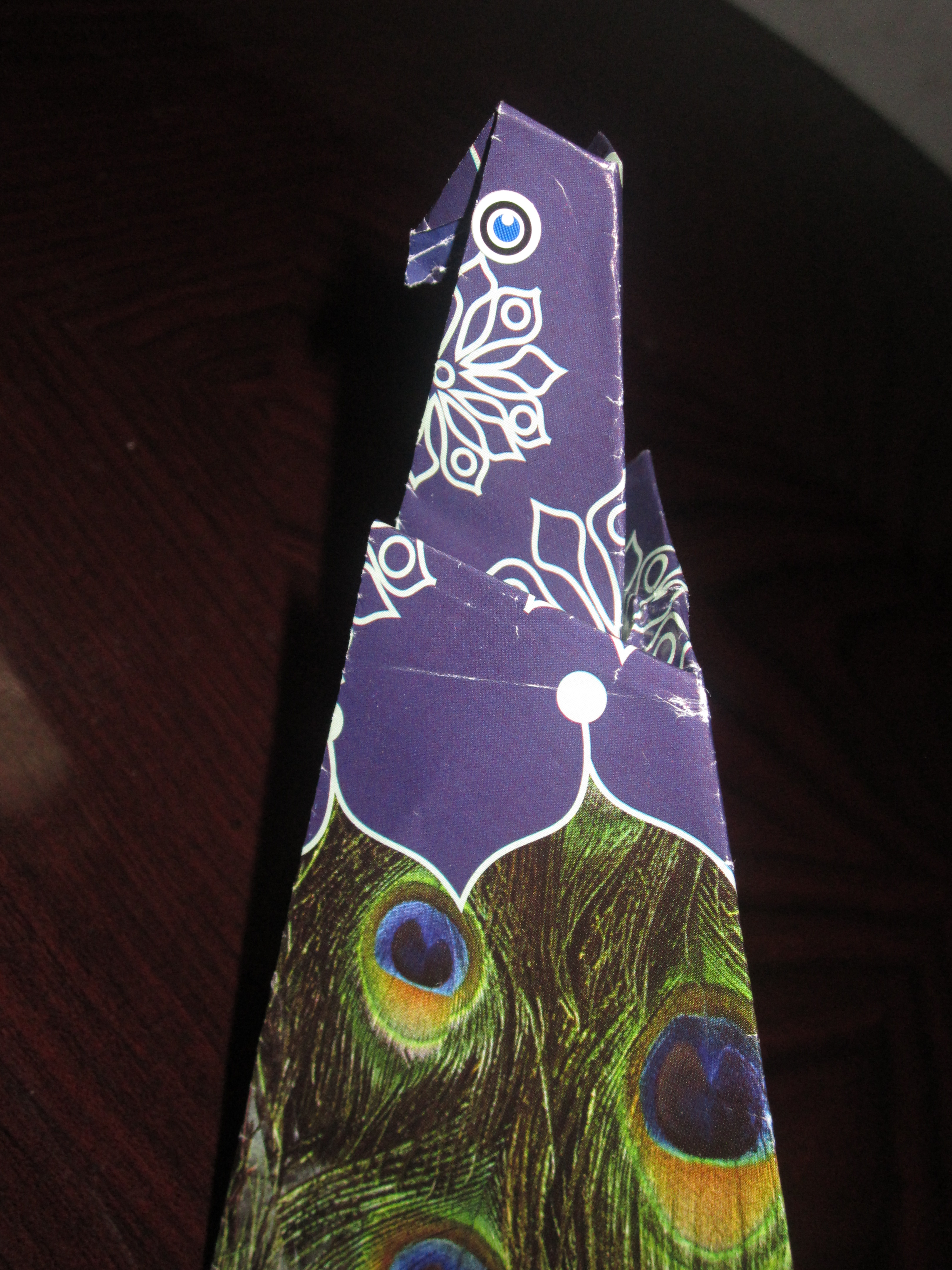
Surely if children can supposedly follow these directions and magically fold panda bears and peacocks, I in all my grown-up wisdom could also understand and succeed in folding a paper zoo.  I can, after all, read, and that seemed to be the minimal requirement here.

I was wrong (of course).

Our origami sessions together typically go like this:

Open book, choose the simplest pattern we can find and then select an appropriate paper.

Fold the paper in half.  Then open it back up.

Fold it in half the other way.  Then open it back up.

Crease here, flip the paper, crease there.

Smile in confidence at one another in the assurance that we have finally mastered this whole origami thing.  Look at us!  Our paper absolutely totally matches the diagram in the book.
We return to the instructions with renewed confidence.

Reverse internal fold, flip, crease, outside reverse fold, open up, fold to center, reverse, flip, spin around, repeat, pull out the flap, push in and squash, inflate, rotate, fold and unfold, mountain fold.

Wait, what?

Pretty soon I’m sputtering in frustration and my daughter is just randomly folding and flipping her paper.  I’m talking to the book as if it could answer me, “What does that mean?  How do you do that?  How come you don’t show a picture of the step in between this and that?  Is this what it is supposed to look like?”

I begin sighing those deep-shoulder heaving sighs that say, “Oh, I should never have bought her this origami book for Christmas.”

Then I declare with supreme Mom-wisdom that what we really need here is a YouTube video with step-by-step instructions.  We Google search.  We find a video.  We pause it after each step and make our paper look like the paper on the computer screen.

We fold.  We create.  We conquer (sort of).

The fact is that I’m not adept at following picture patterns in books and matching my every move to the instructions given, not with origami, sewing, knitting or crafts of any kind.

I have too many questions that the pattern doesn’t answer and too many places where I can go wrong.  I can’t visualize the finished product and the steps needed to get there.

What’s true for me in arts and crafts is sometimes true in life also.  We all can choose the patterns for our lives and then we make continual choices, daily decisions, to yield, bend and fold . . . or not.

Paul tells us:

Do not conform to the pattern of this world, but be transformed by the renewing of your mind. Then you will be able to test and approve what God’s will is—his good, pleasing and perfect will (Romans 12:2 NIV).

The pattern of the world isn’t meant for us.  The world’s priorities, its pursuits, its dialogue and messages, and its destination all fold us into a crazy mess of disorder and frustration.

We can choose instead to “follow the pattern of the sound words . . .in the faith and love that are in Christ Jesus” (2 Timothy 1:3 ESV) and to “obey from your heart the pattern of teaching that has now claimed your allegiance” (Romans 6:17 ESV).

Yes, Scripture is our pattern to follow and Christ is our model: the picture in the book that tells us what we should look like in the end.

Yet, while we may choose which pattern to follow, the world or the Word, God Himself takes a hands-on approach to our lives.  “We are God’s handiwork,” after all—the result of His efforts, the creation He forms and reforms daily (Ephesians 2:10).

So, He is at work folding and unfolding—sometimes moving us forward and then back again.

He creases us now, teaching us and working on us in ways that we won’t understand until years later when He uses those grooves as part of His plans for us and our ministry.

He flips us around.  He pushes us beyond what we thought were our limits.  Sometimes He trims our edges.

Sometimes we complain and balk at the confusing pattern as it unfolds.  We look at the folds He has made in us and think He must be getting it all wrong.  Surely this can’t become that.  It’s confusing and we don’t see and understand.

But He does.  He knows what it takes to transform a piece of paper into a penguin or a peacock.  He knows how to conform us “to the image of His Son” (Romans 8:29).

Heather King is a wife, mom, Bible Study teacher, writer for www.myfrienddebbie.com and worship leader.  Most importantly, she is a Christ follower with a desire to help others apply the Bible to everyday life with all its mess, noise, and busyness.  To read more devotionals by Heather King, click here.

Copyright © 2012 Heather King

Weekend Rerun: Becoming a Zucchini Farmer

Last year, I had an abundance of zucchini in our garden.  This year, I’m overwhelmed by jalapeno peppers!   Here’s a weekend rerun devotional all about what to do with abundance.

Weekend Rerun:

Becoming a Zucchini Farmer
Originally posted on July 7, 2011

I’ve found my calling, my true gift and talent—growing zucchini.  So, I’m contemplating a new life as a zucchini farmer.

When we planned this mini-garden of ours, my daughters announced that they must grow and eat their own food.

Not knowing how well we could produce food we actually eat like tomatoes and cucumbers, I planted two spindly little zucchini sprouts in the garden.

I’d seen many fellow church-goers hand out this cucumber-wannabe to worshipers leaving the sanctuary.  “Would you like some?  Please, take it home!  We’re drowning in the stuff.”  So, I thought this must be one sure-fire vegetable to grow in our garden in case our other plants didn’t do well.

I didn’t expect that much success, just a guaranteed one or two veggies that my daughters could pose with in pictures and be proud about growing.

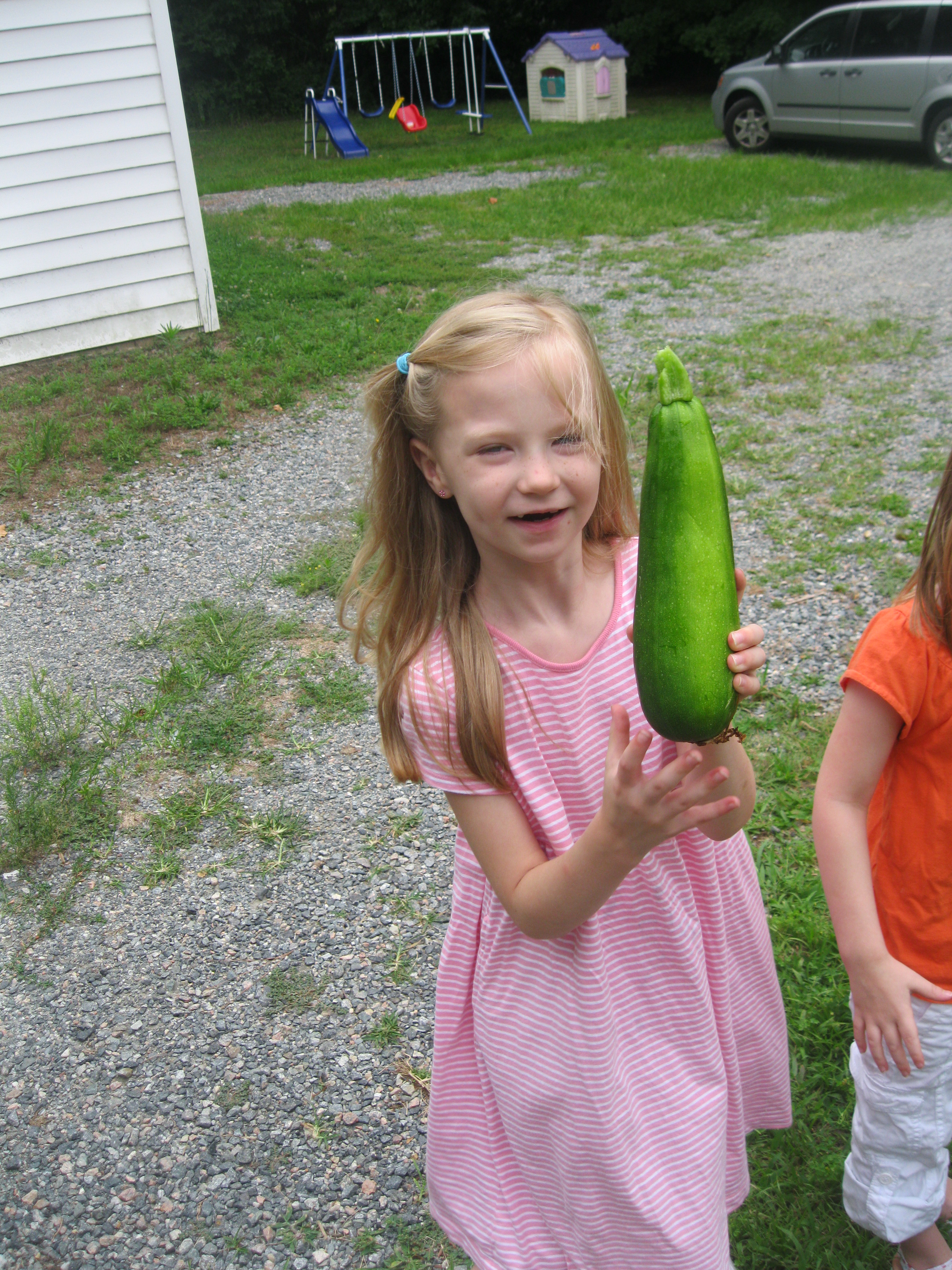
Then this one plant grew to monumental proportions and began producing mammoth zucchini.  I frantically began asking everyone I met, “How do you actually eat this stuff?”  Because we didn’t eat it, not often anyway.  I had no recipes for zucchini and whenever anyone said, “zucchini bread,” I stared at this zucchini the size of my daughter’s torso and wondered how that gets mixed up in a way appropriate for the bread pan.

This zucchini overload has me asking one question—what’s the point? What’s the point of having abundance if you don’t use it?  Sitting in my refrigerator or on my counter looking green and huge, this zucchini is pointless.  It is designed and intended for nourishment. Unused, it will rot and go to waste.

My question extends out to issues of faith.  What’s the point of spiritual gifts buried deep and hidden away?  God gives them to us, perhaps we even cultivate and harvest them. Then we let them sit unused.  Or perhaps we grow mystery vegetables in our garden, never actually identifying them.  Yes, we have gifts, but not knowing what they are, we simply pick the fruit, place it on the counter and toss into the garbage the rotten results over time.

While building the tabernacle, Moses instructed the Israelites: “Come, all of you who are skilled craftsmen, having special talents, and construct what God has commanded us” (Exodus 35:10 TLB).  That remains God’s desire—we apply our talents to God’s service, to the building of His ministry, His dwelling place, and His body.

Then there is also knowledge and discipleship.  What’s the point of study without application and life change?

There’s danger in notes and study and knowledge if our focus is on learning and not on our Savior.  Danger that knowledge itself will actually become our god.  Danger that we’ll fill our heads full of fascinating facts and never once experience life-change in the down and dirty areas of our heart and life.

What we study must become what we do.

Paul wrote to the Colossians, a church that had fallen into the danger zone, pursuing knowledge and learning to the exclusion of God:

See to it that no one takes you captive through hollow and deceptive philosophy, which depends on human tradition and the elemental spiritual forces of this world rather than on Christ (Colossians 2:8).

They had become so excited about gaining knowledge, they had failed to filter what they were “learning.”  Not every book you read that quotes Scripture is actually scriptural.  It takes discernment rooted in God’s Word to determine the difference.

In his letter to Timothy, Paul declared that people had devoted

“themselves to myths and endless genealogies.  Such things promote controversial speculations rather than advancing God’s work—which is by faith. The goal of this command is love, which comes from a pure heart and a good conscience and a sincere faith. Some have departed from these and have turned to meaningless talk. They want to be teachers of the law, but they do not know what they are talking about or what they so confidently affirm  (1 Timothy 1:3-7).

So, what’s the point?  When we’ve written down the original Greek of a word in Scripture and we’ve taken notes on our favorite preacher’s sermon, when we’ve copied whole devotionals into our journal and highlighted our book . . . then what?

We grow.  We know God rather than just know ABOUT God.  That’s the point.  Paul prayed for the Colossians that God would “fill you with the knowledge of His will through all the wisdom and understanding that the Spirit gives” (Colossians 1:9).

If we’re reading without changing, listening without growing, learning without transformation, then it’s pointless abundance–a garden full of unusable fruit gone to waste as it rots on the vine.

Heather King is a wife, mom, Bible Study teacher, writer for www.myfrienddebbie.com and worship leader.  Most importantly, she is a Christ follower with a desire to help others apply the Bible to everyday life with all its mess, noise, and busyness.  To read more devotionals by Heather King, click here.

Copyright © 2012 Heather King

The Big Clean

Originally posted as Quiet Time With a Mop and a Bucket, Lesson 1
on June 6, 2011

Today, I did the “Big Clean.”  Some of you may wash behind your refrigerator and stove every time you sweep the kitchen floor, but since that doesn’t happen here at my house, I occasionally have to do this super scrub-down.  

Normally, I would sit down at this computer to write and share with you from my time spent studying the Bible.

But, today, I have primarily spent my quiet time with a scrub brush in hand, squeezing into corners on my hands and knees and sponging up the bucket of water that my baby girl has spilled onto the floor while “helping.”

I’ve cleaned and prayed, cleaned and thought, cleaned and worshiped, and this is what I have brought to our time together today—-lessons from a quiet time with a bucket and mop.

Lesson 1: You Are Not the Only One

I walked into my daughters’ room and spotted a tiny blob of jelly on one of her dresser drawers (was that jelly or some other mystery purple substance?).

I washed all the walls down in my home with a wet rag and felt mystified by the unidentifiable splatters.  It could be a game show—Name That Mess!  Is it cat hair, dust, marker, crayon, pencil, food, or drink?

I rescued a dozen stuffed animals from the prison under my daughters’ bed, collected up about 20 missing hair clips and ponytail holders and returned five books to their appropriate shelves.

And I thought, “I’m the only one.”

That’s right—the only woman whose kids leave behind remnants of food and sticky fingerprints as they move from room to room in the house.  I’m the only one who has a bag of socks to be matched and paired.  I’m the only one who has dirty baseboards and mystery marks on the walls.

I’m the only one.  And if every other woman keeps her home spotless and I do not, that makes me a failure.

But then the epiphany moment—what if I think I’m the only one because I only see the homes of others after they’ve just cleaned and not while they are still covered in the messyness of family life?

After all, if someone visited my home right this second (before my children have a chance to make more mess), they’d think, “She has it all together.  She does all of these things and keeps her home spotless.  I’m a failure for not being like her.”

Yet, if someone visited me this morning before I had washed the jelly off the dresser (yes, I definitely think  it must have been jelly), they would be thinking, “She’s a mess.  I’m a mess.  That means I’m normal.  I’m not the only one.  Other people don’t have it all together while I struggle with the daily juggling of life.  We’re all imperfect together.”

And they’d be right.

In life, we have a tendency only to share with people the areas of our heart, mind, experience and attitudes that have been through the “Big Clean.”  So, it’s easy for us all to look outwardly perfect and yet inside be feeling like a disastrous mess.

This is one of the things I love about the apostle Paul, though: his willingness to share from his struggles as much as from his strengths.  He wrote:

Therefore, in order to keep me from becoming conceited, I was given a thorn in my flesh, a messenger of Satan, to torment me.  Three times I pleaded with the Lord to take it away from me.  But he said to me, “My grace is sufficient for you, for my power is made perfect in weakness.” Therefore I will boast all the more gladly about my weaknesses, so that Christ’s power may rest on me.   That is why, for Christ’s sake, I delight in weaknesses, in insults, in hardships, in persecutions, in difficulties. For when I am weak, then I am strong.  (2 Corinthians 12:7-10).

Paul told others that he had problems, that he wasn’t perfect, that he had been the chief of sinners and that it was only God’s grace that saved him and now allowed him to preach the gospel to those who had never heard it.

More than that, he boasted in his weakness because it allowed God to shine through

He let people see his life in the messy places so that they could marvel at God’s grace and rejoice in the fellowship of journeying to Christ together.  That’s one of the greatest encouragements we can give one another, the message that we’re not alone, but that we all are in need of Christ’s redemptive and purifying work.

Other lessons from Quiet Time with a Mop and a Bucket:

Heather King is a wife, mom, Bible Study teacher, writer for www.myfrienddebbie.com and worship leader.  Most importantly, she is a Christ follower with a desire to help others apply the Bible to everyday life with all its mess, noise, and busyness.  To read more devotionals by Heather King, click here.

Copyright © 2012 Heather King

Catching Fireflies on a Summer’s Night

For one who has died has been set free from sin.”
Romans 6:7

It’s what summer looks like to me.

Stepping out into the slightest hint of coolness in the final minutes of a hot summer’s day, we carry an empty Mason jar with a foil lid folded down over the edges of the glass.  The sun drifts down and the light dims so that we can see the fireflies at play.

Last night, I called them “lightning bugs” like we did as kids, and my daughter scrunched up her nose in confusion.

Lightning bugs.  Fireflies.  It’s the freedom of summer.  We stay up past bedtime and run around the yard swinging our arms and cupping our hands trying to catch one.  Unfortunately, I think we’ve scared off the fireflies in our particular area.  They hear us coming and taunt us by flying just a little too high and just a little too far into the woods.

Still, we manage to catch a few.  For those daughters who don’t succeed in the hunt, we gently ease a bug into their hand and they giggle because it tickles, of course.  Then we drop the firefly softly into the Mason jar and deftly replace the foil lid so none escape.

On TV, whenever you see a jar of fireflies, it’s lit up, a natural lantern for the evening jaunt.

But I haven’t seen this.  Last night as I watched the few captives in our jar, they remained dark.  They didn’t expend any energy for light.  Instead, their every effort remained focused on escape.  Most of them immediately scaled the jar and sat at the top, right up against the foil, just waiting for me to open the lid again so they could fly to freedom.

Usually, we manage to defeat their various tactics and keep them in the jar until the end of the night when one daughter whines because she didn’t catch one and another daughter begs to catch just one more.  Then they all ask if we can just keep them overnight or for an hour or just a few minutes.

Pleeeeease?   Pretty please?

But I’m sympathetic to the plight of our captives.  So, before we trudge inside we lift up the foil lid and let loose the fireflies.  They jump into the air and without hesitation light up—probably sending out a warning that predators are on the move.

Whatever their message, freedom helps them shine.

Their freedom comes at little cost to them really.  They’ve made attempts at escape, but most have failed.  Ultimately, their freedom flight simply requires me to lift the foil beneath my fingers.

Our freedom, however, is costly.  Physically, most of us receive the gift of freedom because of the sacrifice of others.  I read this week that Thornton Wilder, the famed American playwright and novelist, fought in both WWI and WWII.  People like him paid the price for people like us.

In the same way, our spiritual freedom carries a high price tag, one we could never pay.  Instead, we are the recipient of freedom because of another’s sacrifice.

Paul tells us:

“For freedom Christ has set us free; stand firm therefore, and do not submit again to a yoke of slavery” (Galatians 5:1).

Freedom is God’s design for us.  It has always been His intention and plan and Christ willingly paid the costly price on our behalf.

A girl in my online Bible study group reminded me of this verse:  “…God anointed Jesus of Nazareth with the Holy Spirit and with power. He went about doing good and healing all who were oppressed by the devil, for God was with him” (Acts 10:38 ESV).

Jesus is a freedom-giver, a defeater of oppression and freer of captives.

But Paul charges us with a task, as well. Christ offered us freedom and now it is our job to “stand firm” and refuse to submit to slavery again.

It seems silly, but we often choose prison over the freedom Christ offers.  We sit in the bottom of our Mason jar, unwilling to fly and light up the night.  Perhaps we want to do it on our own, scale the glass, escape the lid.  Perhaps the night air is too frightening and the jar too comfortable because it’s what we know.

Do you do this?

If anxiety is your jail, do you rebuild the prison walls by wallowing in fear, allowing your mind to travel where it shouldn’t, looking up information that you know will disturb you, inciting emotions and then letting them run wild?

When the rigors of legalism and the chains of people-pleasing threaten to oppress you, do you submit–check the boxes, follow the crowd, follow expectations, try not to rock the boat, don’t do anything crazy or radical?

If shame holds you captive, do you allow Satan to throw your past in your face, to call you names, to cover your eyes so you can’t see the totally loved, totally forgiven person Christ has made you?

God never meant for you to live oppressed. 
So, now that He’s offered you freedom . . . live free by living in truth (John 8:32).

Combat lies with the Word.
Feed on a diet of Scripture so that doubts and Satan’s schemes starve.
Be alert to the first sign of shackles and chains as Satan, the world, and even your old habits try to sneak them onto your wrists and feet.

Freedom is Christ’s gift to you, so refuse to accept captivity any longer.  He’s called you to shine and to fly and to share the message of sweet, sweet freedom with other prisoners.

Heather King is a wife, mom, Bible Study teacher, writer for www.myfrienddebbie.com and worship leader.  Most importantly, she is a Christ follower with a desire to help others apply the Bible to everyday life with all its mess, noise, and busyness.  To read more devotionals by Heather King, click here.

VBS Lessons: No Matter What People Do

All week long I’m thinking about the Bible points for our Vacation Bible School and what they mean for adults.  This week will be a mix of some old and some new as I share these lessons.

Tonight at Sky VBS! (Group Publishing), we’re learning: No Matter What People Do…Trust God!

****************************************************************************

In high school, Carl didn’t score touchdowns like the sports star Norman.  Instead, Carl served as the sports manager for the team—close to the action, but never quite getting the glory.

One day in the locker room, Norman played a teenage prank on Carl and then they went their separate ways.  Norman played football and studied education in college, earning his master’s degree and returning to the high school to teach and coach for over 30 years.

Carl took a different path.  More than 50 years after that initial locker room prank, Carl showed up at Norman’s house and shot him with a pistol.  At 73 years old, Carl is now starting a life term in prison.

Not exactly the best way to spend your retirement years.

I read this new story last week and it troubled me in a deep-down unshakeable way.  It’s partly because the story dismisses that teenage prank.  Of course, it couldn’t possibly be worth killing someone over 50 years after the fact.  Of course it makes no sense to murder a 70-year old man for something he did in high school.

Yet, bullying, teasing, and publicly embarrassing others seem to be the signature traits of our society and they aren’t easily shrugged off, even by the strongest and most confident among us.  It’s a reminder to us all how how lives can be destroyed by what we say and do.

The story, though, also illustrates something else.  It shows how what people do to us usually determines our character far more than it impacts theirs.

Carl—the 73-year-old killer over a high school grudge—lived an embittered life, entangled in jealousy and unforgiveness.  Norman lived a full life that sounded successful and happy.

We have a similar choice when people intend evil for us.  Like Joseph staring across an Egyptian banqueting table at the brothers who sold him into slavery decades before, we must choose what to do with our offenders.

The Lord’s Prayer instructs us clearly: “forgive us our trespasses as we forgive those who trespass against us.”

If you look at most modern translations of this passage, they read something like: “And forgive us our debts, as we also have forgiven our debtors” (Matthew 6:12 HCSB).

That’s because we perceive wrongs against us as a debt that someone needs to pay.  Someone owe us because they took something from us–our innocence, our purity, our dignity, our job, our financial security, our husband, our self-esteem . ..

Pretty soon we’re wrapped up in unforgiveness and anger so tight that our whole life is hindered.  We’re tripping all over ourselves when we try to get anywhere.

In his book, Enemies of the Heart, Andy Stanley reminds us that the only way to break free from the snare of anger and unforgiveness is to cancel the debt.

We need to forgive.  Why?  Because we’ve been forgiven.

Stanley writes:

In the shadow of my hurt, forgiveness feels like a decision to reward my enemy.  But in the shadow of the cross, forgiveness is merely a gift from one undeserving soul to another (129).

Jesus Himself, tortured and crucified by a jeering mob when he had done nothing at all to deserve it, still looked down from the cross and prayed: “Father, forgive them, for they do not know what they are doing” (Luke 23:34).

In “You Want Me To Pray What?” I wrote:

“In the same way, Stephen, the first Christian martyr, prayed, “Lord, do not hold this sin against them” just as the final stones pelted his body and killed him (Acts 7:59).

Have you considered who Stephen was praying for in that moment?  One of the men standing by the coat rack cheering on the crowd was Saul—later the apostle Paul.

Stephen asked for God to forgive his persecutors and shortly afterward this same Saul sat on a roadside blinded by Jesus Christ himself, experiencing repentance and conversion.

Satan fully intends to tangle us up in bitterness and jealousy.  He wants to defeat our ministry and make us thoroughly unusable because we’re so riled up and distracted by dissension and arguments.

He just doesn’t know what to do when we pray shockingly humble prayers on behalf of others, particularly our enemies.  There’s power there.”

No matter what people do to us, we can trust God to use it for His glory and to help us through.  More than that, we can ask him to help us forgive so we can move forward in freedom and blessing, no longer hindered by the bitter entanglements of our past.

Heather King is a wife, mom, Bible Study teacher, writer for www.myfrienddebbie.com and worship leader. Most importantly, she is a Christ follower with a desire to help others apply the Bible to everyday life with all its mess, noise, and busyness. To read more devotionals by Heather King, click here.

Copyright © 2012 Heather King

One of the King Girls

“A sterling reputation is better than striking it rich;
a gracious spirit is better than money in the bank
” 
(Proverbs 22:1 MSG
).

“The King girls.”

That’s the name people give my daughters.  At school, at church, and at ballet, they have their individual personalities, but together they have a group identity, like a famous trio or a girls’ band.

We should make t-shirts.

Over the weekend, we recognized a teacher from their school and introduced ourselves.  “Hi, I’m Heather King,” I said.  “My daughters are Victoria and Lauren King . . . ”

“Oh yes,” she said quickly, “The King girls!  The AR (Accelerated Reader) superstars!”

We said goodbye to her and walked into a lobby area to register for auditions for a children’s theater production of Willy Wonka.  My older girls stepped up to the table and the lady there made the inevitable announcement, “The King girls!”

Yes, that’s us!

Even I call them that, but then I tell them why.  It’s one of my speeches.

I say: Our reputations and our names are never just our own.  We never represent only ourselves.

All of us have taken on the role ambassadors in some capacity, so we must always remember how our choices impact, not just our own reputation, but the reputation of others linked to us.

I tell them they are “King girls” in two ways.  They are daughters of James and Heather King and representatives of our family.  People look at them and make judgments about our family, our parenting, and about our faith.

But they are also Daughters of the King, the Most High God, and it is this connection that matters most.  They are living, breathing, walking-around representatives of God at home, at school, at church, at ballet, and in their community activities.  Yes, even at Wal-Mart.

When people hear my daughters’ names, they think of our family and hopefully of our faith.

What happens when people think of you?  What images pop into their heads in the instant someone pronounces your name?  When they see you step up, with whom do they associate you?

Without knowing God personally, what can they deduce about Him when they look at your life?

We might want to shirk this responsibility, preferring instead a determined independence.

Yet, it’s impossible.  People are people.  We humans make judgments, assumptions, connections.  We peer into each other’s lives and try to understand how it all fits.

It’s the way of life for sojourners.  If we packed our bags and flew around the world, shopkeepers and taxi drivers, cafe owners and villagers would watch us and decide, “That’s what Americans are like.”

So we earthly travelers, always foreigners far from our heavenly home, meet people every day who don’t know Christ.   They watch us and think, “That’s what Christians are like.  This is what it means to know God.”

It’s something David experienced even as a young shepherd boy playing his harp while the sheep grazed in the pasture.  King Saul, tormented by an evil spirit, wanted someone to soothe him with music and commissioned his court to find just the right fellow.

One of the young men answered, ‘Behold, I have seen a son of Jesse the Bethlehemite, who is skillful in playing, a man of valor, a man of war, prudent in speech, and a man of good presence, and the Lord is with him‘ (1 Samuel 16:18 ESV).

That was David’s reputation—the essentials of his character and skill, but more importantly God’s presence in his life.  This is what people said about him in town and talked about in the king’s court.  “The Lord is with Him.”

In the same way, after Paul’s conversion from Christian persecutor to defender of the Gospel, word got back to the leaders of the Jerusalem church.

“‘He who used to persecute us is now preaching the faith he once tried to destroy.’ And they glorified God because of me” (Galatians 1:23-24).

There’s the point of it all.  David’s talent and his communion with God weren’t for his own personal benefit and gain.  Paul’s astounding testimony and life revolution weren’t to receive accolades and adoration.

People saw their lives and glorified God.

Paul urged the church to keep this responsibility in mind:

Only let your manner of life be worthy of the gospel of Christ
(Philippians 1:27a ESV).

and

Go out into the world uncorrupted, a breath of fresh air in this squalid and polluted society. Provide people with a glimpse of good living and of the living God. Carry the light-giving Message into the night so I’ll have good cause to be proud of you on the day that Christ returns (Phil. 2:15-16 MSG).

That is what we desire.  As we meander through this life of ours, running errands, working at our jobs, leading our kids through grocery store aisles, meeting with teachers, sitting by hospital beds . . . we pray that others will glorify God because of us.

Don’t you want this?  I so do.  It’s my passionate desire that with one glance at my life people will see Jesus and say, “She’s a Jesus girl.  She loves God.  She’s crazy in love with the Bible and bubbling over with God’s Word.  It’s her favorite thing to talk about–the thing that makes her come alive.”

Let us all be “breaths of fresh air in this squalid and polluted society” so that people can glimpse “the living God” when they watch us.  And they are watching; that’s a given.

Heather King is a wife, mom, Bible Study teacher, writer for www.myfrienddebbie.com and worship leader.  Most importantly, she is a Christ follower with a desire to help others apply the Bible to everyday life with all its mess, noise, and busyness.  To read more devotionals by Heather King, click here.

Copyright © 2012 Heather King