Recalibrating the Measure

I had been wooed by the digital display and the sleek design, but I should have stuck with the tried and true older model.

The new scale promised to be scientifically accurate because of some high-quality triple sensory design. It could track the weight gain and loss of two different people by storing the weigh-in results in its memory.

So I brought it home from the store, opened the package, read the instructions, dropped it down on the floor and stepped on. Then I scowled.

This didn’t seem right.

I tried again a few days later and then after a few more days, I tried again.

According to this handy dandy super scale, I was gaining about a pound a day despite snacks of yogurt and granola, exercise sessions and water.

I could rail about the injustice of the world or blame the metabolism shifts in my 30s, but how could I argue with such a scientifically accurate device?

Finally, I carried out two scales from the cabinet: The old one with the tiny arrow that scalescrolled through the numbers and eventually landed on a miniature line and the new one with the flashing white numbers against a black display.

They were different.  A lot different.  I pushed the digital one around a bit and stepped on and off a few times.

I’d been using a faulty measure.

What else am I using as a faulty basis for my thoughts and emotions, my plans, my faith?

A.W. Tozer wrote: “What comes into our minds when we think about God is the most important thing about us.

This, after all, is our foundation, our measure by which we weigh the world, and the filter through which we understand our circumstances.

But it’s not just what we think that matters, certainly not what we say.  We can confess:

I believe God is faithful.
I believe God can provide.
I believe God forgives me.
I believe God is all-powerful.
I believe God is with me.
I believe God will never abandon me.

All that sounds good and right.  We say what we’re supposed to say.  Sing the words we’re supposed to sing.

We might even think we mean it.

But sometimes we’re really looking at the world through circumstances and emotions.  Slowly, without changing what we’re saying, we’ve still changed what we believe.

The Israelites wandering around the wilderness outside of Egypt professed belief in the God who had led them out of slavery.

When Pharaoh’s army chased them to the edge of the Red Sea, however, they complained: ”Was it because there were no graves in Egypt that you brought us to the desert to die?” (Exodus 14:11).

When they realized they could no longer shop at the Egyptian grocery stores, they whined:  “you have brought us out into this desert to starve this entire assembly to death” (Exodus 16:3).

And when the desert diet proved restrictive, they remembered: “The fish we ate in Egypt at no cost—also the cucumbers, melons, leeks, onions and garlic” (Numbers 11:5).

They said they believed in God and His miraculous power, but, as Kelly Minter writes in her study on Nehemiah:

“whenever the Israelites faced difficulty in the desert they chose to believe something false about God.  Three of the biggies were that he had abandoned them, withheld from them, or wouldn’t meet their needs” (p. 125).

It is Nehemiah’s prayer, centuries later, that reminds the people of the truth:

You did not abandon them in the wilderness
because of Your great compassion….

You did not withhold Your manna from their mouths,
and You gave them water for their thirst.

You provided for them in the wilderness 40 years
and they lacked nothing (Nehemiah 9:19-21).

But in the middle of the wilderness, with Egypt behind them and the unknown ahead, without a meal plan or a guaranteed buffet, Israel believed false things about God.

And I get that.

It’s hard to see the truth when our eyes are shut tight to the wonder of God or our bad attitude is crowding out the glory from our field of vision.

We’ve decided we’re stuck.
We’ve determined to feel unhappy.
We’ve felt cheated and gypped out of what we really want.

So we just rack up more and more circumstantial evidence, cementing what we feel.

And we believe it.  God can’t use this situation.  God abandoned me here.  God is withholding from me.  God can’t rescue, save or provide.  God doesn’t know what He’s doing.

That’s false evidence, a faulty measure, a shaky foundation.

Today, let’s pray for God’s eye-opening grace, for His perspective, for a reminder of His goodness, for revelations of truth.  Just like Nehemiah did, let’s recount the goodness of God rather than letting our dissatisfaction or hurt determine what we see and what we believe.

Heather King is a wife, mom, Bible Study teacher, writer and worship leader.  Most importantly, she is a Christ follower with a desire to help others apply the Bible to everyday life with all its mess, noise, and busyness.  Her upcoming book, Ask Me Anything, Lord: Opening Our Hearts to God’s Questions, will be released in November 2013!  To read more devotionals by Heather King, click here.

Copyright © 2013 Heather King

Packing a Bag for the Homeless

He shuffled over to the line of women waiting to enter the arena for the first night of Women of Faith in Washington, DC.

He asked us for food.  I rifled through my bag because I had fully intended to pack snacks for just such an occasion.

I had nothing.

He asked for money.  I had none to give.homelessbag

He walked away.

I was angry at myself, frustrated that I had failed to prepare for compassion and service.  I had good intentions and no follow-through.

Hadn’t I just read a book I had discovered on the shelves of our church library called Under the Overpass: A Journey of Faith on the Streets of America?

A young college student chronicled the six months he and a friend lived as homeless men on the streets of America’s cities.  They played their guitars to earn money for food and went days without a single meal and weeks without a shower.  They had no access to running water or even a bathroom at night.  People avoided them and glared at them and they felt shame and knew they were unwanted.

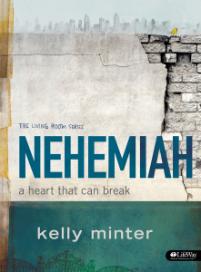
Hadn’t I just finished Kelly Minter’s study, Nehemiah: A Heart That Can Break and been reminded continually that “the Lord always has the poor on His mind, often paired with the widow, alien, and fatherless in Scripture’s pages”?  She wrote that “tangibly involving ourselves for the sake of justice is a biblical command” (p. 69).

After all, Isaiah 1:17 says:

Learn to do right; seek justice.
    Defend the oppressed.
Take up the cause of the fatherless;
    plead the case of the widow.

It can’t get much clearer than that.

And before I studied Nehemiah, hadn’t I completed Beth Moore’s study: James: Mercy Triumphs? If ever there was a Biblical writer who echoed Christ’s heart for the poor and oppressed it was his half-brother James.

James asked:

Suppose a brother or a sister is without clothes and daily food. If one of you says to them, “Go in peace; keep warm and well fed,” but does nothing about their physical needs, what good is it? (James 2:15-16).

James summed our faith up this way:

Religion that God our Father accepts as pure and faultless is this: to look after orphans and widows in their distress and to keep oneself from being polluted by the world (James 1:27).

God cares passionately about the poor, the homeless, the oppressed, the overlooked, the widow, the orphan, the lost and the lonely.

He expects us to do the same.

I knew it.  I had read about it in book after book, study after study all year long.  I meant to bring food for the homeless to the streets of Washington, DC .

I forgot.

So the homeless man in faded clothes and a dusty face shuffled past me to another woman in line and another.

The day after I arrived home, I took my oldest daughter to the dollar store and we tossed soap and wash cloths into the cart.  We grabbed a box of small bottled waters, two packs of peanut butter crackers, and some canned peaches.

We packed our bags for a family vacation.  Then I packed some bags for the homeless.  I didn’t know if anyone else would shuffle over to me and ask for food, but I wanted to be ready.

I carried those Ziplock bags in a backpack all through our family vacation and it seemed like unnecessary weight.  We didn’t hand out a single one.

Until we were driving home, that is.  We stopped at a traffic light and I was busy thinking about the end of our vacation and the drive home and what happens next.  My husband saw the man with the sign:  “Homeless.  Please help.”

He grabbed one of our bags, motioned the man over and handed it out through the window.

The best part is that I now have a tangible reminder to pray for one particular man in need.

I have a lot to learn still.  My prayer is that God will open my eyes (clearly I need His vision) and prod my heart to prepare for ministry to “the least of these.”

Do you have ideas on how to minister to the poor and needy?

What I Want to Do Differently Next Time:

I had this brainstorm for the bags for the homeless and put it together based on ideas we picked up at the dollar store.  Then, I read a book that week called Cleaning House about a mom who lives in Dallas and encounters the homeless regularly while driving her kids around town.  She makes up bags of care items for the homeless, too!  I felt so excited that we had the same idea.

I loved some of the other items she adds, though.  Based on her thoughts and some of the ideas in the book Under the Overpass, my new care packages would look like this:

  • Wash cloth
  • Bar of Soap
  • Peanut Butter Crackers
  • Bottled Water
  • Other nonperishable food item
  • $5 gift card to a place like Subway, Wendy’s, McDonald’s or even an area grocery store
  • Pocket Bible or maybe a personal note with a Scripture verse
  • Information on a local homeless ministry

Heather King is a wife, mom, Bible Study teacher, writer for www.myfrienddebbie.com and worship leader.  Most importantly, she is a Christ follower with a desire to help others apply the Bible to everyday life with all its mess, noise, and busyness.  To read more devotionals by Heather King, click here.

Copyright © 2012 Heather King

Rigging Candy Land

Trust God from the bottom of your heart;
   don’t try to figure out everything on your own.
Listen for God’s voice in everything you do, everywhere you go;
   he’s the one who will keep you on track.
Don’t assume that you know it all
(Proverbs 3:5-6 MSG).

When my kids were younger, I used to rig the Candy Land cards.

Not so they could win, you understand, because I don’t believe in just letting a child win at games.

I simply hated the cruelty of the setback.  The thing about Candy Land is that you could be two rainbow-colored squares away from the magic candy castle and then draw the card for the Gingerbread Man.

At first, this seems harmless enough.  Who doesn’t want the Gingerbread Man?  Then you realize that it’s just evil fate and lessons in the futility of life sugar-coated and handed to your three-year-old child.

That’s because the Gingerbread Man is all the way back at the beginning of the game.

So, you have to watch this sweetly innocent toddler who was an inch away from cheering in victory move her red Candy Land piece all the way back to a position of certain defeat.

Sometimes life seems just as sadly confusing with unexpected twists and turns and a few disappointments and setbacks.

Yet, surely these are lessons best learned when you’re a little older and wiser?

My solution was simple.  As I shuffled the cards before setting up the game, I made sure the dreaded Gingerbread Man and the peppermint stick guy and sometimes even the gumdrop were in the front of the stack.

Thus, anyone who drew one of those cards would never have to fall back more than a few squares.

Sometimes I wish God would rig the cards every once in a while so life never involved steps backwards or feeling stuck in place (on something less soothingly delicious as a licorice stick).

While He’s at it, wouldn’t it be nice if He gave the game board a big yank and straightened the path?  No more zigzags across the board.  Geometry tells us the shortest distance between two points is a straight line.  How about a straight line, God?

Yes, it’s true, sometimes the directions God takes us and the interruptions, setbacks, and seemingly pointless diversions we experience just don’t make sense.

In her book Nehemiah: A Heart that Can Break, Kelly Minter shared: “…I have a friend who regularly says to me, ‘Lean not Gal!’  As in, ‘Lean not on your own understanding, but all your ways acknowledge Him, ‘Gal!'” (p. 97).

I love this.  I certainly have the tendency to lean on my own understanding and raise a ruckus of discontentment when God leads me in unexpected directions.

Jonah also needed someone to tell him, “Lean not, Guy!” when he, a highly successful, well-respected prophet of encouragement to God’s holy people got God’s disturbing message: Go preach repentance to an enemy nation that has persecuted and killed your neighbors and family friends.

The disciples similarly needed a “lean not” reminder when Jesus told them they were going up to Jerusalem where He would be persecuted, imprisoned and crucified.

In the same way, Paul challenged his friends and followers to “lean not” when he traveled to Jerusalem, despite being warned that he would be placed in chains and taken captive there (Acts 21).

Jonah, the famous runaway, tried to avoid the path that didn’t make sense.

What if he had succeeded? Nineveh would have missed out on experiencing what “many historians cite …as the greatest revival in human history” (Priscilla Shirer, Jonah, p. 114).

In fact:

When Jonah chose to walk in obedience to the word of the Lord, the result was a harvest of amazing fruit he’d probably never seen coming.  Not just one community in the city or even a handful of the city’s important people believed in God.  Every citizen of Nineveh, from the greatest to the least, immediately believed.  Conviction was so complete that even the animals were made to participate in the government-mandated fast.  ‘Even the great Apostle Paul never experienced anything comparable to what Jonah saw.  Paul never saw an entire city turn to God'” (Shirer, p. 118-119).

Yes, and without Jesus’ journey to the cross, we would not have the resurrection or a plan for salvation.

And if Paul chose the easier road away from Jerusalem, he would never have preached about Christ in Rome—even to Caesar himself (Acts 28).

It’s frightening not to know exactly where we’re going.  It’s terrifying not to know what will happen when we get there.

It’s disappointing when God asks you:
to step aside
to stop
to walk away
to turn around
to go back
to take a break
to cease activity
and to put aside our own plans and visions and understanding of how this crazy life should work out and make sense.

Yet, even when we spend some time standing still or making the disheartening trip apparently backwards, we can trust that God has a plan—a better plan (yes, even better than the magical candy castle!) and maybe a surprising plan (to us, not to Him)—as long as we obey.

Heather King is a wife, mom, Bible Study teacher, writer for www.myfrienddebbie.com and worship leader.  Most importantly, she is a Christ follower with a desire to help others apply the Bible to everyday life with all its mess, noise, and busyness.  To read more devotionals by Heather King, click here.

Dumbo Always Makes Me Cry

Dumbo gets me ever time.  It’s the one Disney movie I remember bawling at as a kid. I haven’t gotten over it either, not after all these years.

Once one of my girls found a storybook at the library about Dumbo.  She checked it out and then climbed up in my lap at home so I could read it to her. At first it was easy.  Baby elephant with big ears . . . Blah blah blah . . .

Everyone makes fun of him, mocking and taunting (sniffle, sniffle).

The mommy tries to defend him and they lock her up.  Dumbo gets dragged away from her, their trunks locked in embrace until the last possible second . . .

Someone please pass the tissues!  I just can’t do this story without tears.

In fact, it’s hard for me to do this story at all.  I sent the book back to the library ahead of time and I can’t bring myself to watch the movie.  My response is always so intense.

Sure it’s a cartoon elephant who ultimately flies and makes friends, but it’s still a child hurt by the cruelty of others and taken away from his mama!

In Scripture, we see people reacting even more intensely than how I snatch at tissues at the slightest Dumbo provocation.  Not because of a fictional scenario, though.

They are hearing God’s Word.

Eighteen-year-old Josiah, for example, was king of Judah when a member of his court went to the temple to perform some administrative tasks.  There he met the High Priest, who announced that he “happened” to have found the Book of the Law.

So, the royal secretary read it and then read it aloud to King Josiah:

“When the king heard what was written in the book, God’s Revelation, he ripped his robes in dismay. And then he called for Hilkiah the priest, Ahikam son of Shaphan, Acbor son of Micaiah, Shaphan the royal secretary, and Asaiah the king’s personal aide. He ordered them all: “Go and pray to God for me and for this people—for all Judah! Find out what we must do in response to what is written in this book that has just been found!” (2 Kings 22:11-13 MSG).

Josiah knew that God’s Word requires a response.

In the same way, when the exiles returned to Jerusalem and stood inside the rebuilt walls of the city, Ezra the High Priest read the Book of the Law of Moses to everyone.  Men and women and kids old enough to understood stood from morning until lunch time listening to him read Scripture aloud.

Just God’s Word.  And nothing else.  For hours and hours.

They didn’t yawn, tune it out, roll their eyes, poke their neighbor, or skip attending so they could do chores or kick back with the latest release of ancient Middle-eastern epic poetry.

Instead, “Ezra blessed the Lord, the great God, and all the people answered, ‘Amen, Amen,’ lifting up their hands. And they bowed their heads and worshiped the Lord with their faces to the ground” (Nehemiah 8:5-6).

At first, the people were filled with remorse and driven to repent.  Yet, Nehemiah (their governor) and the Levites (their priests) encouraged them to celebrate instead: “And all the people went their way to eat and drink and to send portions and to make great rejoicing, because they had understood the words that were declared to them” (Nehemiah 8:12 ESV).

Their response to Scripture was emotional and intense.

There was true repentance and grief over how their sins had broken the heart of God.

There was a hunger for more and the willingness to stay as long as it took to hear what God had to say.

There was passionate worship with shouts of “Amen” and bowing low to the ground in awe of Mighty God.

There was joy and celebration because “they had understood the words that were declared to them.”

 How do you respond to God’s Word?

If we pick it up and read it with unemotional disinterest or with a bored and distracted mind we are missing it!

We are missing out on all the power of Scripture to revolutionize our hearts and minds, driving us to repentance, inciting us to intensely passionate worship and filling us with the kind of joy that makes us want to tell everyone what we’ve learned.

Scripture can’t be a mandatory item on our to-do list or an occasional emotional pick-me-up we drag off the shelves and dust off anytime life gets hard.

It’s got to be life and breath and food and drink to us because it holds God’s very own words, so active and relevant in our lives!  As you read, pray and ask God, “How do you want me to respond to this?”

Maybe you’ll need some of my tissues or maybe you’ll dance, but either way you’ll be giving God’s Word the response it deserves.

Heather King is a wife, mom, Bible Study teacher, writer for www.myfrienddebbie.com and worship leader.  Most importantly, she is a Christ follower with a desire to help others apply the Bible to everyday life with all its mess, noise, and busyness.  To read more devotionals by Heather King, click here.

Copyright © 2012 Heather King

One Week Without a Voice: Lesson Two

Eight days after I woke up squeaking and sputtering air instead of greeting the start of a new day with my normal cheerful voice . . . (okay, maybe I don’t wake up like Cinderella, singing to birds with a smile ever morning) . . . but still, eight days after I woke up and couldn’t talk, I still sound like an alien in my own body.

My voice scratches a bit and I’ve taken a step down from a normal alto range into a definitive tenor.

Still, it’s an improvement.  I can sit and hold a conversation with friends.  I read about ten books to my toddler this morning while she sat on the potty.  I can call out to my older girls reminders to “Be nice.  Don’t be unkind.  Stop being nasty to each other.  If you can’t get along, I’m going to pack up your game so you can’t play.”

These are important and necessary skills for me, a busy wife and mom and friend.  Today, I’m thankful for the voice I have, scratchy and low as it is, because the essential truth is I’m no longer voice-less.

And there are others who never feel that freedom.  Some people never seem to gain a voice, not after years of anguished pleas.  Not after infant’s tears in a forlorn and overlooked makeshift bed, crying out to an unresponsive mama or parents that simply aren’t there.

Living one week without a voice reminded me that there are some people who are perpetually voiceless.  No amount of cough drops, hot tea with lemon and honey, or throat spray is going to tune the world into the sound of their need.

Our God, though, is a hearer of silenced cries.  When Bartimaeus, a blind beggar sitting hopeless by a roadside, yelled out to Jesus as he passed by, the crowd tried to hush him up.    “They rebuked him, telling him to be silent” (Mark 10:47).

What could Jesus care for a blind beggar?  Why stop and heal someone so clearly overlooked by every . . . other . . . person.

Refusing to be silenced, though, Bartimaeus screamed louder and Jesus stopped the mob of fawning followers so he could listen to a man in need.

“What do you want me to do for you?”   That’s all Jesus asked.  That’s all he needed to ask in order to assure a blind beggar that finally someone had heard his cry for help.  Bartimaeus, voiceless no longer, presented his clear and simple request: “Rabbi, let me recover my sight” (Mark 10:51)

More than just a miracle of sight for a blind man occurred there that day.  It was the miracle of God hearing the pleas of a voiceless one amidst a noisy crowd.

In the same way, when a woman who had been bleeding for 12 years ducked her head in shameful desperation and slipped into the crowd surrounding Jesus, she was a voiceless one.  Her society and culture, the laws of her faith, declared her unclean.  Unfit for human contact.  Unable to live among her people.  Cut off from public worship.

In faith, she ran her hand along the hem of Jesus’ robe, trusting that the tiniest touch could heal her.

Jesus could have let her slip away from the crowd unnoticed.  No need for her to risk discovery in a mob who thought her very presence would taint them and stain their purity.

But he didn’t.  Jesus gave voice to the voiceless.  He asked, “Who touched me” and waited for her to speak up, to declare her presence and give testimony.  It was as if he was telling her, “You haven’t just received physical healing.  You are welcome in this place.  These people need to hear what you have to say.  No more sneaking into a crowd and then slipping out the back.”

Even she recognized the impact of Jesus’ question, realizing “that she was not hidden” (Luke 8:47).  No, not hidden anymore.  Instead, “trembling, and falling down before him (she) declared in the presence of all the people why she had touched him”

It was likely her first act of public worship and her first unashamed speech in 12 years.

Don’t you love this about our Lord?  That He hears when no one else will hear?  That His passion and heart are for the neediest and weakest among us?  That He’s given us a voice and He listens when we call for Him?

This is His character.
More than that, this is supposed to be the character of his people.

In the book of Nehemiah, this cup-bearer to a foreign King, a man with responsibility and high position, asked his brother for reports about his homeland and the people who had returned to Jerusalem.

Kelly Minter in Nehemiah: A Heart That Can Break notes this about Nehemiah’s character:  “He wanted to know.  Sometimes I shield myself from finding out what’s really going on with people for fear I’ll be held responsible.  Because with information often comes responsibility; if we know, we might be required to do something”(p. 13).

We may want to remain blind and deaf to need, but Nehemiah wanted to know.  And when he heard about the state of his people, he responded with prayer and action.

All because he served a God who hears and cares about those with no voice.  We serve that same God—do we hear and care?

You can read more devotionals on this topic here:

Heather King is a wife, mom, Bible Study teacher, writer for www.myfrienddebbie.com and worship leader. Most importantly, she is a Christ follower with a desire to help others apply the Bible to everyday life with all its mess, noise, and busyness. To read more devotionals by Heather King, click here.

Copyright © 2012 Heather King


Weekend Walk, 05/19/2012—Go and Do Video Response!!

Sometimes you just have to do something different.

Like today.  Normally during our weekend posts I share with you a verse for the week and a weekend rerun, but I have some really exciting news and items to share with you, so I just couldn’t do the same old-same old this weekend!

Go and Do Video Response:

Not long ago, I posted a review of a challenging book by Jay Milbrandt called Go and Do: Daring to Change the World One Story at a TimeI hope you’ll read my whole review here since the book gave me a lot to think about and it may be something to add to your summer reading list.

Today, I received an email saying that the author was willing to answer any questions I and other reviewers might have about the book.

I felt a little crazy, but I typed up my question and hit the submit button on my email program before I could change my mind. I asked him how people like me, young moms on a tight budget who can’t hop a plane to Thailand, can respond to his challenge to “go and do.”

Within a few hours, I received an email back with a link to a video Jay Milbrandt had made in response to my question.

Wow!  Is there anything else to say?  How amazing that this author and the director of Pepperdine University’s Global Justice Program took time out of his busy schedule to answer my question!

You can click here or click on the video image on the blog to hear Milbrandt’s thoughtful and considerate response and if you do read my whole review, you’ll see his written comment to my post.

Summer Bible Study:

Last summer, we ran an online Bible study here at the blog and I loved it!  I’ve had several requests for another online study, but this year my small group is reading through the Bible together.  I don’t want to ask them to take a break from that in order to do a different study in this space.

However, I have a really exciting opportunity to share with you!  I’ve been serving as a small group leader for an online Bible study over at Women’s Bible Cafe and enjoying the opportunity to study God’s Word with women from around the world who may never meet face to face this side of heaven.

The Women’s Bible Cafe folks have just announced that they’ll be starting a summer study on June 26th of Kelly Minter’s book Nehemiah: A Heart That Can Break.  It gets even better . . . Beth Moore kicked all this off by deciding to run an online study this summer of this very same book on her blog.

Do you know what that means?  If you participate in this study at Women’s Bible Cafe, you could be one of several thousand women all studying the very same book of the Bible at the very same time.  Now that’s a powerful way to study Scripture!

If you’d like to participate, you need to get a copy of the book (early because they sell out quickly when there are mass online studies) and head on over to the Women’s Bible Cafe page to register.  They’ll assign you a small group when the study begins and you’ll be on your way to spending a summer with Nehemiah.

Making a List and Checking It Twice:

Have you checked out my Bookshelf recently on the blog?  It’s up to date with some of the books, studies, devotionals and prayer guides I’ve been reading and thinking about recently.  Not only that, but I’ve posted 18 book reviews that could help you make some of your summer reading selections.

I’m making my own summer reading list, but before I make any plans I’d like to hear from you.  What are your best book recommendations?  I can’t wait to read them myself!  I’ll be collecting ideas from now until the end of May and then I’ll try to share the final list of ideas with everyone.

Heather King is a wife, mom, Bible Study teacher, writer for www.myfrienddebbie.com and worship leader.  Most importantly, she is a Christ follower with a desire to help others apply the Bible to everyday life with all its mess, noise, and busyness.  To read more devotionals by Heather King, click here.

Copyright © 2012 Heather King

Broken Crayons And Other Things That Drive Me Crazy

Restore us, O God; let your face shine, that we may be saved!”
(Psalm 80:3, ESV).

Things that drive me crazy:

Procrastination, disorganization, messing with “the plan” and the schedule, slow pokes, Play Doh colors all mixed together, shoes and jackets dropped in the middle of the kitchen floor, crowds, wet towels left on the sink and toothpaste stuck to the bathroom walls, markers with no tops.

Oh, and something else, too: Broken crayons. Even worse, crayons with the paper torn off. I mean, if you rip the paper off, the crayons are more susceptible to breaking. Plus, it’s difficult to tell whether you are holding blue, purple or black in your hand.

It’s enough to give a mom fits.

When my kindergartener told me that Show & Tell this week needed to be something recycled or reused, we started brainstorming.  There was the orange juice carton we turned into a birdfeeder.  The paper towel roll my oldest daughter made into Snow White.  The Popsicle stick my middle girl turned into a pig.  The Mason jar painted over and made into a candle holder.

Or we could find something to do with those pesky broken and naked crayons that drive me so crazy.

Jackpot!

I spent this morning collecting the remnants of Crayola.  Once beautiful, bright, pointy crayons fresh from the box—now broken, bespeckled, faded, and unwrapped.

We filled a tray of heart-shaped silicone with the jumble of brokenness, melted the wax, cooled it and then popped out beautiful new rainbow heart crayons.

We made something fun, colorful, and unique out of the old, broken, and worn out.

God’s plan for restoring us in life is so often like melting down broken wax and transforming it into a uniquely colorful treasure with a beauty all its own.

We pray for restoration, hope for it, long for it with desperate hearts.  We need the fixing, mending, healing power of God in our relationships, in our worship, in our churches, in our sick and hurting bodies, in our grief, in our finances, and more.

David needed it emotionally and knew that the Lord His Shepherd, “restores my soul” (Psalm 23:3).  Later, He needed spiritual restoration after he committed adultery and murderer, as he prayed, “Restore to me the joy of my salvation” (Psalm 51:12).

What we usually long for in the midst of brokenness is full-circle restoration.  We want what we once had, what Satan took from us, or what we’ve lost along our journey.

That’s what Israel prayed for when they were beseiged, starved, and taken captive:  “Restore us to yourself, O Lord, that we may be restored! Renew our days as of old” (Lamentations 5:21 ESV).

Give us back the good old days!

And it seemed like that’s exactly what God did.  When Nehemiah returned to rebuild the ruins of the Jerusalem walls, he began at the Valley Gate (Nehemiah 2:13).  Then, 52 days later, they finished the job and celebrated with choirs, corporate praise, rededication, and a procession that marched out through the gates they had rebuilt, starting with what scholars believe was the Valley Gate.

In Nehemiah: A Heart That Can Break, Kelly Minter writes: “If God began Nehemiah’s journey at the broken Valley Gate and completed it at a restored one, we have reason to hope He will work with the same restorative power in our lives” (p. 151).

They had, after all, come full circle.  This surely renews our hope.

And yet, this wasn’t exactly the same as what they had lost, and that’s also reason to rejoice!  These were rebuilt walls, walls with a testimony.  They showed God’s faithfulness to His people, bringing them back from captivity and helping them rebuild their land.

The rebuilt walls in our lives are also a testimony of God’s faithful lovingkindness and mercy.  They can’t possibly be misunderstood or misinterpreted as walls pounded into place by our own ability and strength.

They are all about how God brought us back and helped us stand.

The best thing about God’s restoration is that He often does more than we expect.  We want the same as the good old days.  Many times, however, He gives us more than we had before or even something better.

He did this for Job, giving him “twice as much as he had before” (Job 42:10).

He does this for us, as Peter tells us:

“And after you have suffered a little while, the God of all grace, who has called you to his eternal glory in Christ, will himself restore, confirm, strengthen, and establish you” (1 Peter 5:10, ESV).

He doesn’t just give us back the pieced-together remnants of our past; He restores us in a way that makes us stronger, and He does it Himself, stitching us back together with His own patient hand.

God doesn’t give up on the broken crayons in our lives or toss away those of us who’ve come unpeeled.  He may melt us down and it may hurt, but He makes us new, beautiful, different, stronger, unique—restored for His glory and with a story to tell of His goodness.

Want to transform your broken crayons into something fun and new?  There are some great “recipes” online, including this one here.

*******************************************************************************************

I don’t just have things that drive me crazy.  Things can make me happy, too!  Like:

Family time, baking with my girls, heartfelt worship, chocolate, hot tea with sugar, time with God at my kitchen table, words that are fun to say, holding my husband’s hand, triple word tiles in Scrabble, honeysuckle candles, free concerts on the beach in the summer time, my daughters giggling, the smell of fireplaces burning in autumn air, pumpkins, my small group, crossword puzzles, the perfect coupon, Masterpiece Classic and Masterpiece Mystery, brand new pointy crayons, fresh Play Doh, the Beatles, comfy white socks, Dickens and Shakespeare, British comedies, when the lights dim and the play starts, listening to my daughters read, a blank computer screen and the clicking of the keys as I fill it up with words.

Heather King is a wife, mom, Bible Study teacher, writer for www.myfrienddebbie.com and worship leader.  Most importantly, she is a Christ follower with a desire to help others apply the Bible to everyday life with all its mess, noise, and busyness.  To read more devotionals by Heather King, click here.

Copyright © 2012 Heather King

One Minute Devotional – Devotions from My Garden: Season of Prayer

Therefore, confess your sins to one another and pray for one another, that you may be healed. The prayer of a righteous person has great power as it is working (James 5:16)

We’re captivated by butterflies at my house.  The elegance and beauty of them, the colors and patterns, the transformation they go through—it all enlivens our imaginations.

We’re big fans.

So, last year my daughters begged me, real, true, actual begging, for the five caterpillars you order through the mail and then watch transform into butterflies.  Thank you, TV commercials.

Our cup of painted lady caterpillars arrived and we enjoyed watching them transform and releasing them into our garden in the spring.

This year, the begging commenced again, although my daughters mentioned how nice it would be to grow monarch butterflies because they were, in fact, my oldest daughter’s favorite.

It turns out, however, that they won’t send you monarch butterfly caterpillars unless you have milkweed growing in your garden to feed them.  Seems fair that you feed the butterflies after you grow them.

Here’s the thing, milkweed seeds have to lie dormant in the ground all through the cold of winter before they’ll grow in the spring.  Just like many spring bulbs, they require a season of germination.  So, I can’t –say–magically grow milkweed in two weeks to feed baby monarch butterflies.

Thus, our cup of painted lady caterpillars arrived last week.
And I’ll be planting milkweed seeds in November.

Now, during those winter months, those milkweed seeds will seem utterly useless and far from life.  Yet, water is penetrating the outer shell and ultimately the new life will crack the dead casing and push through into the soil.

When God has given us a season of waiting, perhaps even what looks like death and cold, it doesn’t mean we do nothing.  Instead, we can fill ourselves with God.  We can immerse ourselves in prayer, until life breaks through.

In his book, Nehemiah tells us that when he heard about the ruin of the Jerusalem walls, he “sat down and wept and mourned for days, and I continued fasting and praying before the God of heaven” (Nehemiah 1:4).  Ultimately, he invested three to four months in what Kelly Minter terms the “pre-work of prayer,” before ever acting on his passion.

My husband probably cringes every time he hears me say these few words: “I’ve been thinking . . . ” or “I have an idea.”  For all my ideas, though, I find that God isn’t often in a rush.  He gives me the time I need to pray, sometimes for months, sometimes even longer.  He gives me the assurance that this is right.

It’s not doing nothing; it’s doing the most important thing needed to make any ministry or project successful.  It’s the season of prayer that precedes the season of growth.

More Devotions From My Garden:

Heather King is a wife, mom, Bible Study teacher, writer for www.myfrienddebbie.com and worship leader.  Most importantly, she is a Christ follower with a desire to help others apply the Bible to everyday life with all its mess, noise, and busyness.  To read more devotionals by Heather King, click here.

It’s A Miracle!

The LORD is good to those whose hope is in him,
to the one who seeks him (Lamentations 3:25)

Years ago, the sweet man who led our choir then leaned back in his stool at the front of the choir room.  He told us in a slow southern drawl what he remembered about his mother. I think about his story often.

On the dark and stormy nights of his childhood, when the thunder raged and lightning struck close enough to illuminate his room, he would awaken to find his mom sitting in a chair at the foot of his bed.  She sat with him through the storms, praying over him, even while he continued to sleep.

That’s what he remembered about her: her presence in the stormy nights.

Last night, I supervised the brushing of teeth and the donning of pajamas, packing lunches and backpacks, and laying out clothes for the new day.  We read bedtime stories.  We prayed as a family.

This morning, I poured cereal and buttered toast.  I placed ice packs in the lunches and zipped up the backpacks, all full for the day.

I helped with shoes and socks, combed hair, and reminded my daughters (too many times) to brush their teeth and to do it well because they don’t want cavities or bad breath and, by the way, we’re going to the dentist next week.

Sticking my head out the door for a moment, I checked the weather.  Then I held jackets open for each girl to slip in her arms.  I broke up a fight and gave a crying daughter a hug, calmed her down, and then placed the two sisters on a school bus.

And the day went on with more little tasks and routine activities.

I don’t remember these moments from my childhood.  Do you?  I don’t remember my mom tying my shoes or helping me put on my jacket.  I don’t remember her supervising bath time or pulling my hair into pigtails.

Even though I don’t remember those things, she did them.  I was clean, fed, dressed, and groomed.  My life must have been filled with years and years of everyday love that I don’t remember.

Usually these acts of love remain unnoticed and undervalued . . . unless they’re missing.  Those children who aren’t fed well, bathed, read to, hugged, kept safe, and tucked into their own cozy beds at night feel the lack.  Only they perhaps really know how important the small things are.

What will my kids remember about this time with me? It’s not likely they’ll remember the moments of jackets and breakfasts and backpacks.  They don’t lack for these things.  They likely take them for granted, just as I did.

But they might remember something unique or big, just like the man who recalls his mom sitting with him through stormy nights.

I wonder, then, what do I remember about God, my Father?  When I tell about His presence in my life, what has become part of my story? Usually, it’s the stormy times when I awaken in fear only to find His presence by my side.  It’s the times He’s kept me safe and delivered me from danger.

Yet, we so often overlook the miracles of everyday grace, the simplest signs of His affection and the fact that He cares for our needs and yes, sometimes even our desires.

When we always look for the glorious miracle, the immediate and the extraordinary, we miss thanking God for the gradual, the expected, and the small.

C.S. Lewis wrote, “A slow miracle is no easier to perform than an instant one.”

Yet, we revel in the answers to prayer that come fast. The ones that don’t require interminable waiting and inconvenient patience.

We pray, “Give us this day our daily bread” and then miss the miracle of everyday provision—until it seems in jeopardy.

In the book of Nehemiah, the exiles who returned to Jerusalem skipped sleep, fended off enemies, prayed, and labored with a sword in one hand and a trowel in the other.  They hefted bricks until the walls of Jerusalem were complete, all in just 52 days.  It was a miracle.  Even their enemies knew that:

When all our enemies heard about this, all the surrounding nations were afraid and lost their self-confidence, because they realized that this work had been done with the help of our God (Nehemiah 6:16).

How easy it would be to forget that, though, because God chose not to build the walls with a word from His lips or destroy their enemies with an earthquake or flood.

As Kelly Minter writes in Nehemiah: A Heart That Can Break:

“It’s worth noting that so far we’ve read nothing of angels, burning bushes, or talking donkeys.  Instead, we’ve seen God use what we might consider ordinary to bring about extraordinary transformation: prayer, repentance, willingness, hard work, sacrifice, humility, faith.  Though miraculous displays of God’s power are to be desired and cherished, I’m equally impressed with God speaking silently to Nehemiah’s heart in the most ‘normal’ of circumstances.  Be encouraged that the common, everyday realities are ideal environments for God to put something in our hearts to do” (Minter 116).

Take time to thank God today for the daily bread, for forgiving our trespasses, for His mercies made new every morning, for His great faithfulness, and because He is good to you (Lamentations 3:23-26).  Thank Him for answered prayers and ministry opportunities.  Thank Him for the quiet ways He speaks to your heart and for the encouragement He brings you day after day.

It may not be spectacular, like fireworks in the night sky.  Still, it’s love.  That’s worth remembering.

Heather King is a wife, mom, Bible Study teacher, writer for www.myfrienddebbie.com and worship leader.  Most importantly, she is a Christ follower with a desire to help others apply the Bible to everyday life with all its mess, noise, and busyness.  To read more devotionals by Heather King, click here.

Copyright © 2012 Heather King

Two steps forward and two steps back (or so it seems)

This was an unfortunate setback.

A few weeks ago, my husband gently suggested that it may be time for a serious attempt at potty training my two-year-old.

Now, to understand how I felt about this I first have to tell you potty training my two older girls was no easy task.  In fact, it’s fair to say that I’ve never felt as much like a failure in my life as when I was pleading with a toddler just to sit on the potty chair.

I laid awake at night designing reward charts and incentive plans.
I prayed for help from Almighty God so that my kids would be ready for preschool.
I bought books, movies, stickers, M&Ms, toys, and more to bribe them into success.
I avoided all moms who proudly announced their genius 18-month old had been perfectly trained with absolutely no effort in all of a day.

But my husband is a good husband and I’m a good wife.  So, when he asked me to start potty training my toddler, I plunged into what I was sure would be months and months of misery, stress and clean-up.

I pulled out the trusty movie, Potty Power.  I explained underwear to my daughter.  Every 15 minutes, I picked her up and carried her to the bathroom.

And a miracle happened.  A real live, genuine miracle of God.

She figured it out.  She wanted to learn.  She graduated to underwear in a matter of days.  I bet God never had anyone thank Him so much for help potty training her child.

And then.

Then there was the setback.  One week of sickness kicked my baby girl back into Pull-Ups and made her absolutely terrified of a trip to the bathroom.  Now my sanity is loosely held together by a can of Resolve and a bottle of Febreze.

I was discouraged.  She was scared and confused.  We’re baby-stepping our way forward, hoping to regain lost ground.

Have you ever encountered a setback that left you dazed, uncertain, and full of fear?

Perhaps you stepped out in obedience to what you believed was God’s call, but circumstances shifted, obstacles arose, and you’re not reaching the goal.  Perhaps you’ve even begun to question whether you heard God clearly and made the right decision in the first place.

Sometimes God’s plan just doesn’t make sense to us.

For the Israelites leaving slavery in Egypt, the most logical route to the Promised Land was straight along the shores of the Mediterranean Sea.  After a few battles with the Philistines, the Isrealites thought they’d march right into Canaan after no more than a month-long journey.

God had other plans.  Exodus 13:17 tells us: “When Pharaoh let the people go, God did not lead them by way of the land of the Philistines, although that was near. For God said, ‘Lest the people change their minds when they see war and return to Egypt.'”

Sometimes God takes us the long way around for our own benefit.  In her book One in a Million, Prisicllar Shirer writes that “the wilderness is often safer than the alternative” (p 73).  God chose the wilderness for His people.  Maybe He’s chosen it for you, as well, for your protection and personal growth.

Even after the Israelites followed the pillars of cloud and fire in the direction God had chosen to take them, there were still setbacks.  In Exodus 14:2, God said, “Tell the people of Israel to turn back.”

Turn back?

God led them one way only to turn them around and march them off in a different direction?  Did it seem like God had momentarily lost His compass in the desert?

And yet, this turning back placed the Israelites on the banks of the Red Sea and the only way across now was through His miraculous deliverance.

He turned them around so that He could save them.

So, what do we do as we make confusing desert tracks in the wilderness in our efforts to follow God’s lead?

We could give up.  We could question our listening skills.  We could doubt God’s leadership.  We could stomp off and follow our own course.

Or we could remain focused on our goal and the passion God has placed in our hearts.  That’s the only way the Israelites made it to the Promised Land.  It’s the only way we’ll receive all that God has promised us.

It’s also the only way Nehemiah saw the walls of Jerusalem rebuilt.  Kelly Minter in her book Nehemiah: A Heart That Can Break, writes:

“After verbal assaults, physical threats, discouraged laborers, abuses of power and economic distress, Nehemiah never diverted his focus from the wall.  The process may have been slowed and altered as a result of enemies and wayward citizens, but the goal never changed.”

In fact, Nehemiah himself writes, “I also persevered in the work on this wall” (Nehemiah 5:16, ESV).

He continued to build despite threats, fear, confusion, discouragement, distractions and disappointments.  He continued to build despite setbacks.   He never stopped placing brick on top of brick on top of brick in obedience to God.

What has God asked you to build?  Choose today to place another brick on this wall instead of giving up because of obstacles and disappointments.  Choose to “persevere in the work on this wall.”

Heather King is a wife, mom, Bible Study teacher, writer for www.myfrienddebbie.com and worship leader.  Most importantly, she is a Christ follower with a desire to help others apply the Bible to everyday life with all its mess, noise, and busyness.  To read more devotionals by Heather King, click here.

Copyright © 2012 Heather King