Remembering: Even If He Does Not


Originally posted on February 20, 2011


Today, the sermon at our church was on miracles and how God uses them to bring glory to Himself and to grow faith in us.  It is always exciting to recount what God has done and give testimony, both Biblical and current, to His might and majesty.

But, today was a hard day for me to talk about miracles.  I’ve been praying for two years for a sweet baby girl, born terribly premature.  She’s fought so hard for so long, receiving a liver transplant, undergoing open heart surgery, and more.  Yesterday, though, I got the phone call saying she had passed away in the night.

Yes, it’s a hard day to think about miracles.

It’s not that I think this was too much for God or that He didn’t love this little girl enough to give her another miracle in her already miraculous life.

The hard thing for me is that I’m a question-asker.  In any room at any time, I am usually the one asking the most questions.  I am willing, sometimes even with people I hardly know, to ask them far more than the superficial sanctioned small-talk.  I’m not a “How are you doing?  Where do you live?  How’s the weather been?” kind of person.

Thus, as I’m praying for the family of this tiny girl, I’m bold enough to ask God some tough questions.  It’s at times like these I’m thankful that He is such a big God, that He allows us to lift our pain-filled faces up to His, look straight into His eyes, and ask Him, “Lord, why?  What are you doing in this situation?”

When one of Jesus’s closest friends fell sick, his sisters, Mary and Martha, sent word to Jesus, “Lord, the one you love is sick” (John 11:3, NIV).  Surprisingly, Jesus didn’t rush to their home to heal Lazarus.  In fact, by the time Jesus arrived, Martha greeted him along the path:  “Lord,” Martha said to Jesus, “if you had been here, my brother would not have died.”  Then Mary went out, fell at His feet and said exactly the same thing,  “Lord, if you had been here, my brother would not have died” (John 11:21, 32, NIV). Some of the bystanders even bluntly asked, “Could not he who opened the eyes of the blind man have kept this man from dying?” (Luke 11:37, NIV).

These sisters didn’t hide their confusion and hurt and Jesus didn’t rebuke them for confronting Him.  In this case, Jesus quickly answered their questions.  He called Lazarus up from the tomb and displayed His power over life and death.  He asked a question in return ,“Did I not tell you that if you believe, you will see the glory of God?” (John 11:40, NIV).

The prophet, Habakkuk, wasn’t like most of the other Old Testament prophets, who delivered messages from God.  Instead, much of what Habakkuk wrote is full of questions for God, just as Mary and Martha asked questions of Jesus. In his brief book, Habakkuk asked:

  • How long, LORD, must I call for help, but you do not listen? Or cry out to you, “Violence!” but you do not save?  Why do you make me look at injustice? Why do you tolerate wrongdoing? (Habakkuk 1:2-3)
  • Why then do you tolerate the treacherous? Why are you silent while the wicked swallow up those more righteous than themselves? (Habakkuk 1:13)

After presenting a chapter-long list of complaints to God, Habakkuk says, “I will stand at my watch and station myself on the ramparts; I will look to see what he will say to me, and what answer I am to give to this complaint” (Habakkuk 2:1).  And God answered Him.

For us, sometimes it does become clear why God chooses to answer “no” or “wait” to our heartfelt pleas for a miracle.  I can look back now and see how God used my husband’s job loss and temporary unemployment not just for God’s glory, but ultimately for our blessing and benefit.  What seemed like harm, was actually salvation for us!

In other cases, though, our questions remain unanswered this side of heaven.

When the three Hebrew men, Shadrach, Meshach and Abednego refused to bow down to and worship King Nebuchadnezzar, they faced instant death in the fiery furnace.  The king offered them one last chance to deny their faith and worship him instead.  To this, they replied:

“King Nebuchadnezzar, we do not need to defend ourselves before you in this matter. If we are thrown into the blazing furnace, the God we serve is able to deliver us from it, and he will deliver us from Your Majesty’s hand.  But even if he does not, we want you to know, Your Majesty, that we will not serve your gods or worship the image of gold you have set up.”

What faith!  The miracles aren’t what we should be seeking; we should be seeking God and hoping for whatever brings Him glory.  If He rescues us, then we praise Him.  Even if God doesn’t give us the miracle we’re looking for or provide for us in the way we expect, we can, like the three men in the fiery furnace, still worship God alone.  We can trust His hand.  We can know that somehow He will be glorified even in our tragedies.

When God answered Habakkuk’s tough questions, the prophet was moved to write what my Bible notes is a “hymn of faith” (Habakkuk 3:17-19, NIV).  It’s one of my favorites:

Though the fig tree does not bud
and there are no grapes on the vines,
though the olive crop fails
and the fields produce no food,
though there are no sheep in the pen
and no cattle in the stalls,
yet I will rejoice in the LORD,
I will be joyful in God my Savior.

The Sovereign LORD is my strength;
he makes my feet like the feet of a deer,
he enables me to tread on the heights.

Habakkuk says, “Even when we’re starving and we have no hope of a harvest, we’ll choose to praise God.”  The Message translates verse 18 as: “Counting on God’s Rule to prevail, I take heart and gain strength.” It’s when we walk through the hard times with God, counting on His rule to prevail, pouring out our questions to Him and learning to trust Him, that He gives us the toughened, sure “feet of deer” and trains us how to “tread on the heights.”

******************************************************************************************************

Heather King is a wife, mom, Bible Study teacher, writer for www.myfrienddebbie.com and worship leader.  Most importantly, she is a Christ follower with a desire to help others apply the Bible to everyday life with all its mess, noise, and busyness.  To read more devotionals by Heather King, click here.

Copyright © 2012 Heather King
And Then There’s Cancer

“God must have a better plan.”
“God always works things out for the best.”
“You can’t out-give God.”
“God always provides.  Look at the birds and the flowers.  He’ll take care of your needs, too.”
“God always comes through.”
“God’s timing is perfect.”
“God never gives you more than you can handle.”

They’re the fairy tale endings of the Christian faith, the trite promises and pat religious phrases we find ourselves spewing out simply when we don’t know how else to explain it when life is hard and overwhelming and scary.

Like when there’s cancer.

Like when there’s starvation and bloating hunger in villages where there simply is no food—not in anyone’s home, not in a local church running a food pantry, not at a grocery store where you can beg for a loaf of bread from other shoppers.

How do we dare make life sound simple, flowery, and easy when it’s not?  This is the conversation I had with a friend this week.

A few days later, in a sanctuary filled with mourners, corporately grieving the loss of a beautiful Christian woman to breast cancer, a few stood up to share their memories and thoughts about her life.  The rest of us passed tissues down the rows and echoed sniffles.

One woman stood and said something I don’t think I’ll ever forget.  In one of their last conversations together, sitting across from a woman so ill from the cancer recurrence filling her lungs with fluid and sapping strength from her limbs, they agreed that they felt beaten down by the promises in Scripture.

They knew death was near and they did not think they’d see the healing, deliverance, restoration, and happy ending they had so longed for, they had prayed for, and that the “happy filter” of God’s promises would make you expect.

So now what?

I remember the moment also when I sat by my dad’s death bed.  He was decrepit, a large man shrunken down to frail bones.  He was living in a sick shell of a body.  Once so witty and smart, boisterous and just plain big in his personality and manner, now he was a trapped soul, mostly in a coma, no longer in control of his body or mind—totally dependent on others, mostly unaware, mostly unresponsive.

I believed and I still believe that the God who could call Lazarus to step out of a tomb, throw off grave clothes and come to life again could have healed my dad at any time, even when death seemed imminent, as in any second near.

But He didn’t.  God chose not to heal that time.  He chose not to heal the woman we remembered at her memorial service this weekend.

What then?

In tears, the woman sharing at the memorial service said that when they felt totally beaten down, like their faith had just been battered and bashed, her friend facing death said, “Then we must pray and ask God to make us more tender.”

Please make me tender, Lord.  Use these times of sadness and the seasons we don’t understand, the moments when faith is so hard to stand on and the promises of Scripture seem too simple to hold true, please then make my heart tender again. 

What other response can there be at times but bitterness?

It’s something I’d never considered before, but both Paul and Peter urged believers to be tenderhearted:

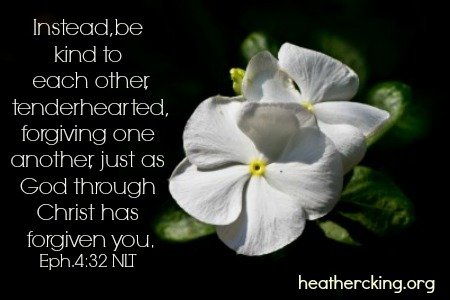
“Be kind to one another, tenderhearted, forgiving one another, as God in Christ forgave you” (Ephesians 4:32).

and

Finally, all of you, have unity of mind, sympathy, brotherly love, a tender heart, and a humble mind” (1 Peter 3:8).

This tender heart so often develops when we ourselves feel broken and beaten down and we are made soft and receptive in the process.ephesians4

If our faith depends on quick answers to prayer and fairy tale lives with superficially happy endings, we’ll be hardened to the needs of others, uncomprehending when they share out of their pain and unmoved by compassion when we see their brokenness.

Not only that, but if our faith doesn’t depend on the Rock of God and His character, but instead stands only on happy (and often misquoted and taken out of context) Christian catch-phrases, we’ll watch the wind and waves of the storm demolish and destroy our houses on the sand (Matthew 7).

We don’t necessarily need enough faith to calm any storm, to walk on the water in the midst of a tempest or sit unmoved and unafraid when our boat seems ready to sink. We just need enough faith to stretch out our hand to Jesus as we sink and cry out, “Lord save me” (Matthew 14:30).

Even that is enough for Jesus to hold us up out of the waves.

Let’s be honest today.  It’s not always easy to sing, “‘Tis so sweet to trust in Jesus.”  Sometimes it’s downright difficult.  It’s murky and hazed over and difficult to see.  Sometimes it’s desperately painful.

But we don’t have to have all the answers.  In fact, we don’t really need to say much of anything at all.  Certainly, we don’t have to pretend that it’s easy or shrug mourning off our shoulders with little more than, “it’s all for the best.”

Instead, we can ask for God to make our hearts tender, soft and pliable in His hands because of the pain we’ve endured.  And we can reach out one desperate hand and cry out, “Lord, save me.” Sometimes, that’s all we can honestly say and that’s enough.

Heather King is a wife, mom, Bible Study teacher, writer for www.myfrienddebbie.com and worship leader.  Most importantly, she is a Christ follower with a desire to help others apply the Bible to everyday life with all its mess, noise, and busyness.  To read more devotionals by Heather King, click here.

God, Are You Crying?

“In all their distress he too was distressed, and the angel of his presence saved them.
In his love and mercy he redeemed them;
he lifted them up and carried them all the days of old”

(Isaiah 63:9).

It was my third pregnancy and I sat across from my midwife at my 37-week check-up.  “I don’t think the baby has turned,” I told her.  “I think she’s still breach.”

I saw her face change from “easy-breezy check-up” to “let’s investigate this issue”.  She expertly prodded my massive pregnant belly with her hands and then popped the baby up on the ultrasound machine to be sure.  Breach baby.  Thirty-seven weeks.

Maybe the doctor will turn her, I thought?  Maybe she’ll turn herself (I hoped)?  Anything sounded good if I could avoid a C-section.

She said, “I’ll call you.  I need to tell the doctor what’s going on, but I’d start preparing for surgery.”

I trusted her.  During both of my other pregnancies, she had cared for me frequently.  She was a strikingly lovely woman, an inside-out kind of beauty, so open and full of joy.  Her hair was just beginning to grow back into small bouncy curls after a fight with breast cancer years before and it was so like her to pour herself out for others even during chemo treatments and cancer recovery.

Just as she promised, she called me later that day.  She treated me like I was the only patient in the world, taking more than 20 minutes to tell me how serious the baby’s position was because she was sitting on her umbilical cord.  How turning the baby could kill her and if I went into labor on my own, she’d probably suffocate.

C-section it was.

But she gave me great reassurance, how good the doctor was, how she had seen him work and knew he would take good care of me and I would heal well.  “Don’t be afraid,” she said.

That was the last time I talked to her.

The doctor delivered my baby via C-section and he was expert and wonderful and my daughter was healthy and beautiful and safe.  When I returned for my check-up weeks later, they told me that my midwife’s breast cancer had returned and she was starting treatments again.

Any time I had an appointment at the office over the last 3 years, I asked about her.  She popped into my head periodically, and I prayed for her and we prayed in my small group, as well.

She passed away this weekend.

It’s a part of the human condition on this broken planet to grieve.  I am sad for her struggle, for years and years of fighting, for losing the battle to breast cancer, for her pain, for those who worked with her, for her dear friends, and most of all for her family and her two children who watched their mother fight and then die.

This world of sorrow isn’t a place of God’s design.  It’s the mess mankind made through disobedience and sin, ushering in death.  One day, we have the opportunity to see what God’s perfect design is really like.  Heaven is the ideal place, where death, crying, pain, and disease have no place because sin has no place.

But here we are, facing sorrows in the here and now because good people die, people of faith hurt, babies don’t make it, children are abused.

When Jesus stood outside of Lazarus’s tomb, he was surrounded by mourners in the midst of their own loss.  Martha was weeping.  Mary was weeping.  The entire crowd was weeping.

My commentary tells me they weren’t just sniffling quietly into their tissues in the good old Western style.  They were “wailing” (klaiontas).

Seeing their distress, Jesus “was deeply moved in his spirit and greatly troubled . . . Jesus wept” (John 11:33, 35).

The crowd took it as a sign of Jesus’s own grief over losing a great friend and said, “See how he loved him!”

But is that why Jesus cried on the edge of Lazarus’s tomb?  He wasn’t wailing in the same way they were; he was quietly shedding tears (edakrysen).john11

Anyway, what was there for him to mourn?  He knew he could raise Lazarus from the dead.  In fact, Jesus was just seconds away from doing just that and watching Lazarus stumble out of the tomb still wrapped up in his grave clothes.

It couldn’t have been his own grief.

It had to be the sadness at the sorrow of others.  That’s why he was “deeply moved” and “greatly troubled,” not when he knew Lazarus was dead or when Mary and Martha confronted him over it, but when he heard “her weeping, and the Jews who had come with her also weeping” (John 11:33).

He felt sorrow over their sorrow, sadness over their sadness, and compassion because they experienced death, loss, the grave, pain, and sickness.

In the same way, when Jesus saw a widow following behind the coffin of her only son, “He had compassion on her and said to her, ‘Do not weep'”  (Luke 7:13) before touching her son’s body and raising him from the dead.

This is the Savior we serve, who saw the sorrow of death, who faced it Himself, and who comforts us when life is hard, when loved ones die, when we grieve the loss of people, the loss of hope, and the loss of dreams.

Even though I know He doesn’t always intervene with miracles, resurrecting in the places we grieve, it’s somehow helpful to know He isn’t ignoring us either.  Jesus isn’t cold-hearted, looking down stone-faced and unmoved by our sorrow.

Instead, when we’re hurting, He’s moved by compassion for us and ministering to us with His Spirit.  He’s comforting those who mourn (Matthew 5:4).

I use the Bible Knowledge Commentary, New Testament Edition, edited by John Walvoord and Roy Zuck.

Heather King is a wife, mom, Bible Study teacher, writer for www.myfrienddebbie.com and worship leader.  Most importantly, she is a Christ follower with a desire to help others apply the Bible to everyday life with all its mess, noise, and busyness.  To read more devotionals by Heather King, click here.

Copyright © 2012 Heather King

Take Two: Kaleidoscope Moment: An Eternal Perspective


Friends, tomorrow is the seventh anniversary of my dad’s death, so today I’m going to share with you my post about his passing from last year’s anniversary. I hope it’s a blessing to you!

Kaleidoscope Moment 2: An Eternal Perspective

Posted on March 29, 2011


On this day six years ago, my dad died of malignant melanoma.  I miss him, but I’m okay.

Mostly I miss him in unexpected moments throughout the year.  Like when I hear Mussorgsky’s Pictures at an Exhibition (his favorite) or some jazz music.  Or when I visit the firehouse with my daughter on a field trip (he was a firefighter).  When I see a really good drummer (my dad was the best) or watch the military band concerts on evenings in the summer (he was an Army musician).

I miss him when we look through pictures and my daughters ask me all about him.  I’m sad because the last year of his life, he was so sick and really didn’t look the way I remember him best.  Those pictures are strange distortions of someone I knew and loved.

I miss him, but I’m okay.

His death was one of those kaleidoscope moments for me.  God took my perspective with the patterns I was used to seeing, and shifted it a little.  He showed me something beautiful.

Up until that moment, I had believed in heaven.  I heard the stories in Sunday School and saw the pictures in my Beginner’s Bible as a kid.  We sang songs at church about heaven and I believed what I sang.

But, when my dad died, heaven was suddenly real.  Not some hazy and nebulous concept we teach at church, but a real place where my dad now lived.  The outer shell that we buried in that casket was most definitely not him anymore.  Suddenly, when I envisioned what heaven would be like, I personally knew someone who was there–a face in the crowd that was waiting expectantly for me to join him.

My mom chose this verse for my dad’s funeral bulletin:

Therefore we do not lose heart. Though outwardly we are wasting away, yet inwardly we are being renewed day by day. For our light and momentary troubles are achieving for us an eternal glory that far outweighs them all.  So we fix our eyes not on what is seen, but on what is unseen, since what is seen is temporary, but what is unseen is eternal (2 Corinthians 4:16-18, NIV).

For the first time, God taught me how to have an eternal perspective.

I had a friend in college whose mother had a degenerative disease and was ever so slowly worsening.  It was difficult and devastating, but I have never in my life met anyone whose eyes were more firmly fixed on heaven than my friend.  She saw heaven as the soon-to-be home for her mom—a place where her mom would be healed and whole and hurting no longer.  She would talk about heaven in casual conversation and she didn’t care about earthly possessions, worldly success, or what other people thought of her.  Instead, her eyes were fixed on the unseen and the eternal.

I forget sometimes to keep an eternal perspective and then God nudges my heart and holds the kaleidoscope back up for me to see the pattern of beauty He created in the light of eternal hope.

I get angry about something stupid and forget that little petty annoyances mean nothing in the end.  I worry and fret about the small details of my life and forget that in the grand scheme of things, they really don’t matter. I long for a bigger home or at least new carpeting and forget that this world really isn’t my home and what I have here isn’t going to last.

Chris Tiegreen wrote:

When your feet are planted in heaven, you can quit chasing status in this world.  You can live with a godly sense of abandon because you aren’t attached to possessions or even your own life.  You can take risks, although nothing God calls us to do is really risky by eternal definitions.  You can follow Him without fear.

The other day I took my daughters to a festival we have in our town.  We toured the booths, saw some skits, watched the parade and then headed home.  When she got to the car and realized we weren’t paying $5 per child for a 2-minute pony ride, my daughter bawled.  She cried most of the way home, saying, “You don’t understand me or what I like and what is important to me.  You never ever, ever, ever, ever, ever give me the things I want.  I’m not going to eat or clean my room or do anything at all until you take me back to ride the horses.”

We arrived home and she sat in time-out.  I checked my emails and other messages and found an updated post for the little girl named Kate McRae that I’ve been praying for.  She’s seven years old.  She has metastatic brain cancer.

My daughter climbed into my lap, face still a little red from tears, and asked me about the little girl whose picture was now on my computer screen.  I told her all about Kate.  How she’ll be losing her hair because of the treatments she has to have.  How she has to take medicine that makes her terribly sick so she can’t eat.  How she can’t be with her brother and sister and can’t go to school.  How she has to live far from home and stay in a hospital.  How her body is weakened by the radiation treatments to her brain.

Pony rides didn’t seem so important anymore.  God turned the kaleidoscope and changed my daughter’s heart by revealing a new perspective, an eternal one.

Paul wrote:

Their mind is set on earthly things. But our citizenship is in heaven. And we eagerly await a Savior from there, the Lord Jesus Christ, who, by the power that enables him to bring everything under his control, will transform our lowly bodies so that they will be like his glorious body (Philippians 3:17-21, NIV).

How would your life change if you lived as a citizen of heaven in the here and now of earth?

Would you be more bold in your faith?  Invest more time in worship and prayer?  Build into your relationships more?  Whine less about the things you have or don’t have?  Abandon the pursuit of earthly status in order to gain heavenly reward?  Spend less time worrying about the things you can’t control?  Love people more and be willing to overlook more of their faults?  Be more thankful?  Enjoy the little blessings in life?

So much of my attitude about life, so many of my everyday reactions are tainted because I lose that eternal perspective.  That’s why I need reminders like today.  Reminders that “this world is not my home; I’m just passing through.  My treasures are laid up somewhere beyond the blue.”

*************************************************************************************************************

Heather King is a wife, mom, Bible Study teacher, writer for www.myfrienddebbie.com and worship leader.  Most importantly, she is a Christ follower with a desire to help others apply the Bible to everyday life with all its mess, noise, and busyness.  To read more devotionals by Heather King, click here.

Copyright © 2012 Heather King