Have Mess, Need Mercy

“But this I call to mind, and therefore I have hope:
The steadfast love of the Lord never ceases; his mercies never come to an end;

they are new every morning; great is your faithfulness”
Lamentations 3:21, 22

We all have mess.  I surely do.

When I was a young girl, my mom handed me the book, Old Yeller, and told me, “you’re going to cry when you read this.”

I didn’t.  It was a spiteful hardness, the determination that no matter how intensely sad the story became, I wouldn’t cry simply because she said I would.

This hasn’t changed much over time.  I can generally keep an open mind until someone tells me, “You WILL, you WON’T you CAN’T, you MUST, you HAVE to . . . ”  Anything that pushes me into a corner receives a (sometimes unwarranted) push back.

I have other stuff, too.  Like the fact that I ALWAYS get lost and the directions that make so much sense to everyone else on the planet become a jumbled mass of confusion to me.

I have an organized mind that sees the world in a perpetual outline with points I, II and II and subpoints A, B, and C, but I desperately need a personal secretary to keep me from losing papers and to clean through my desk and help me remember where I put my keys, the library book, the document, the super important thing that I absolutely cannot lose but have managed to misplace.

It doesn’t end there.  I’m a people-pleaser in daily need of encouragement and too easily crushed by constructive criticism.  I’m not always patient with failure, especially in myself, and even sometimes with my kids.  I have a problem with jealousy, not so much for “stuff,” but maybe for success or impact.

There’s more.  The longer I sit here typing away, the more mess I’ll probably discover.

And while in any and all of these areas God has been at work, digging out junk, sometimes with a gentle gloved hand and sometimes with a pick-axe, still there is mess.  There are days where it’s a little overwhelming. Or maybe a lot.

When my house is too disorderly, I can’t think, I can’t concentrate, my stress level rises.  It’s the same with my heart when I see the junk drawers overflowing or discover trash hiding in corners that I hadn’t noticed before.

How is there any room left for what is good and pure and lovely? 
How is there any possibility of inviting God in amongst junk? 
How can anyone feel welcomed and loved into this place of distracting trash?

Once when she was out driving, Ruth Graham noticed that a stretch of highway that had undergone road work for far too long was finally finished and reopened.  They had even posted a sign: “End of Construction.  Thanks for Your Patience.”

She wanted that message to be on her tombstone, a reminder that it’s only in heaven, at the feet of God and clothed in the forgiveness of Christ, that construction on our hearts and minds will be complete.

Until then, we need people–and God–to be patient with us.  Yes, we even need to be a little patient with ourselves.

God is able to transform us and make us new as long as we give over sin, faults, idols, foibles, weakness and failures to Him.  This is part of our salvation story, not a one-time dip in the cleansing blood of Christ’s sacrifice.  It’s the journey of our faith, the sanctification or making holy over time.

And it does take time.

This is what Paul promises, “And I am sure of this, that he who began a good work in you will bring it to completion at the day of Jesus Christ” (Philippians 1:6 ESV).

In the meantime, we have grace, precious grace, and the reminder that our mess is never too heavy to bring to God.

My own efforts are little more than attempts at self-control, self-direction, self-justification, self-perfection, self-reliance and self-confidence.

Then, SELF just becomes part of the mess that we lug to the feet of Jesus.

Ultimately, our own efforts fail.  Giving up completely hinders our relationship with God.  Wallowing in self-loathing means we reject His grace as insufficient to cover our sin.

All that’s left is to bring our mess to God and rejoice in His mercy.  Like the woman who poured out her tears and expensive perfume on Jesus’ feet, we find ourselves moved to passionate worship of and service for a God who has forgiven our many sins (Luke 7:47).

Paul wrote, “I urge you, brothers, in view of God’s mercy, to offer your bodies as living sacrifices, holy and pleasing to God” ( Romans 12:1).

We aren’t holy and pleasing sacrifices to God because we’re finished, perfected, construction complete.

Instead, we offer ourselves up, mess and all,  “in view of God’s mercy.”

His grace covers us, cleanses us and, in His compassion, He transforms us.  He’s big enough and gracious enough to tackle our mess until the day He decides that construction is complete and He takes us home.

Heather King is a wife, mom, Bible Study teacher, writer for www.myfrienddebbie.com and worship leader.  Most importantly, she is a Christ follower with a desire to help others apply the Bible to everyday life with all its mess, noise, and busyness.  To read more devotionals by Heather King, click here.

Catching Fireflies on a Summer’s Night

For one who has died has been set free from sin.”
Romans 6:7

It’s what summer looks like to me.

Stepping out into the slightest hint of coolness in the final minutes of a hot summer’s day, we carry an empty Mason jar with a foil lid folded down over the edges of the glass.  The sun drifts down and the light dims so that we can see the fireflies at play.

Last night, I called them “lightning bugs” like we did as kids, and my daughter scrunched up her nose in confusion.

Lightning bugs.  Fireflies.  It’s the freedom of summer.  We stay up past bedtime and run around the yard swinging our arms and cupping our hands trying to catch one.  Unfortunately, I think we’ve scared off the fireflies in our particular area.  They hear us coming and taunt us by flying just a little too high and just a little too far into the woods.

Still, we manage to catch a few.  For those daughters who don’t succeed in the hunt, we gently ease a bug into their hand and they giggle because it tickles, of course.  Then we drop the firefly softly into the Mason jar and deftly replace the foil lid so none escape.

On TV, whenever you see a jar of fireflies, it’s lit up, a natural lantern for the evening jaunt.

But I haven’t seen this.  Last night as I watched the few captives in our jar, they remained dark.  They didn’t expend any energy for light.  Instead, their every effort remained focused on escape.  Most of them immediately scaled the jar and sat at the top, right up against the foil, just waiting for me to open the lid again so they could fly to freedom.

Usually, we manage to defeat their various tactics and keep them in the jar until the end of the night when one daughter whines because she didn’t catch one and another daughter begs to catch just one more.  Then they all ask if we can just keep them overnight or for an hour or just a few minutes.

Pleeeeease?   Pretty please?

But I’m sympathetic to the plight of our captives.  So, before we trudge inside we lift up the foil lid and let loose the fireflies.  They jump into the air and without hesitation light up—probably sending out a warning that predators are on the move.

Whatever their message, freedom helps them shine.

Their freedom comes at little cost to them really.  They’ve made attempts at escape, but most have failed.  Ultimately, their freedom flight simply requires me to lift the foil beneath my fingers.

Our freedom, however, is costly.  Physically, most of us receive the gift of freedom because of the sacrifice of others.  I read this week that Thornton Wilder, the famed American playwright and novelist, fought in both WWI and WWII.  People like him paid the price for people like us.

In the same way, our spiritual freedom carries a high price tag, one we could never pay.  Instead, we are the recipient of freedom because of another’s sacrifice.

Paul tells us:

“For freedom Christ has set us free; stand firm therefore, and do not submit again to a yoke of slavery” (Galatians 5:1).

Freedom is God’s design for us.  It has always been His intention and plan and Christ willingly paid the costly price on our behalf.

A girl in my online Bible study group reminded me of this verse:  “…God anointed Jesus of Nazareth with the Holy Spirit and with power. He went about doing good and healing all who were oppressed by the devil, for God was with him” (Acts 10:38 ESV).

Jesus is a freedom-giver, a defeater of oppression and freer of captives.

But Paul charges us with a task, as well. Christ offered us freedom and now it is our job to “stand firm” and refuse to submit to slavery again.

It seems silly, but we often choose prison over the freedom Christ offers.  We sit in the bottom of our Mason jar, unwilling to fly and light up the night.  Perhaps we want to do it on our own, scale the glass, escape the lid.  Perhaps the night air is too frightening and the jar too comfortable because it’s what we know.

Do you do this?

If anxiety is your jail, do you rebuild the prison walls by wallowing in fear, allowing your mind to travel where it shouldn’t, looking up information that you know will disturb you, inciting emotions and then letting them run wild?

When the rigors of legalism and the chains of people-pleasing threaten to oppress you, do you submit–check the boxes, follow the crowd, follow expectations, try not to rock the boat, don’t do anything crazy or radical?

If shame holds you captive, do you allow Satan to throw your past in your face, to call you names, to cover your eyes so you can’t see the totally loved, totally forgiven person Christ has made you?

God never meant for you to live oppressed. 
So, now that He’s offered you freedom . . . live free by living in truth (John 8:32).

Combat lies with the Word.
Feed on a diet of Scripture so that doubts and Satan’s schemes starve.
Be alert to the first sign of shackles and chains as Satan, the world, and even your old habits try to sneak them onto your wrists and feet.

Freedom is Christ’s gift to you, so refuse to accept captivity any longer.  He’s called you to shine and to fly and to share the message of sweet, sweet freedom with other prisoners.

Heather King is a wife, mom, Bible Study teacher, writer for www.myfrienddebbie.com and worship leader.  Most importantly, she is a Christ follower with a desire to help others apply the Bible to everyday life with all its mess, noise, and busyness.  To read more devotionals by Heather King, click here.

Devotions from My Garden: What Are You Waiting for?

So let’s not allow ourselves to get fatigued doing good. At the right time we will harvest a good crop if we don’t give up, or quit (Galatians 6:9 MSG).

We planted in pots and crates on our deck, tiny seedlings of cucumbers, tomatoes in three varieties and jalapeno peppers.

Then we waited.

And waited.

And waited.

We watered.  We tended.

But mostly we waited.

From one day to the next, the leaves didn’t appear to expand and the stems didn’t seem to reach any higher than the day before or the day before that.

It took standing back and surveying growth over time for us to notice we had plants and not seedlings any longer.  Then there were the first tiny yellow flowers on the cucumber plant.

The day we spotted the tiniest baby tomato, I called all three of my daughters over to see.  There we stood, a mom and three girls gently pushing aside green leaves to marvel at the promise of growth.

And then we waited some more.

And waited.

And waited.

For signs of ripeness and readiness for harvest.

Gardening, like life, is so often about waiting.  The difference, though, is that we waited for our first vegetables with anticipation and excitement.  We tracked the progress and closely watched the physical signs of a promising future because we knew the day would come when we sat down to salad and salsa from our garden.

But in life we often wait with a hopeless aggravation and a frustrating impatience.

We wait on God, tapping our foot and glancing often at our wrists with urgency.

Perhaps, though, we should wait for God, watching the signs of growth, rejoicing over every bud and clapping our hands with joy every time we see a reminder that the harvest is coming.

This is how the crowds prepared for Jesus’ arrival:

“Now when Jesus returned, the crowds welcomed him, for they were all waiting for him” (Luke 8:40). 

Can you imagine the crowd watching the road for the first glimpse of Jesus’ sandal?  Perhaps kids ran back and forth bringing news of Jesus’ journey.  “He’s coming.  He’s near.  He’s closer.  He’s just around the corner.”

He’s here!

Imagine the hush of the people.  They weren’t whining about the wait or postulating that perhaps Jesus wasn’t coming after all.

No, they were likely listening intently for the first sound of His voice chatting with His followers as He traveled on the road.

This is how we wait for God–we look forward with excited anticipation and uncontainable joy for the moment we see God at work.

And while we wait, we prepare to receive all that He’s bringing our way.

Like the kings who faced the overwhelming enemy might of Moab, we wait for God’s promise.  He said He would “fill the ditches in the dry streambed with water” overnight and without wind or rain.  Yes, He would bring the refreshment and victory they needed (2 Kings 3:16-18).

In the very next chapter, Elisha tells the destitute widow to gather “empty vessels and not too few” and then the Lord filled as many as she gathered with rich oil, saving her from starvation and poverty (2 Kings 4:3).

In two back-to-back passages, God miraculously fills His people up to the brim, giving them all they had prepared to receive.

I feel this now, this urge to prepare, to grab as many jugs and cups and bowls and pots and buckets as I can so I don’t miss out on one drop of God’s provision. 

I stand at the foot of the dry streambed and rather than complaining about my parched throat, I want to dress in my swimsuit, ready to dive into the pools overflowing with His miraculous water-without-rain.

It’s waiting, surely.  I’m not there yet.  But I see the signs.  I see the growth, the buds, the tiniest hint of vegetables to come.  I see God-movement here and there, projecting change and something new.

Part of me is scared.  Waiting is what I know.  Change, even good change, frightens me and stresses me out.

So what’s a girl to do?

See the signs of God on the move, the promises of harvest, and yet refuse to budge?  “No thanks, God, I’ll stick with what I have and what I know because at least I’ve dug into a trench of trusty comfort and reliability.”

Or do I hang my shoulders in defeat and stomp away, not seeing the harvest quickly enough?  Tired of waiting, I dump over the vessels waiting for oil, I walk away from the streambed thirsty for water . . . I turn away from those waiting for the first sight of Jesus and choose instead to complain at home that He didn’t come.

Or I could wait, joyfully and with excitement, nervous perhaps but ready nonetheless.  Jumping up and down trying to see Jesus over the heads of the crowd, I’m waiting for God, not waiting on Him.

This is how we reap the harvest, when “we don’t give up, or quit” (Galatians 6:9).  This is how we don’t miss out on one drop of what God has planned.

More Devotions From My Garden:


Heather King is a wife, mom, Bible Study teacher, writer for www.myfrienddebbie.com and worship leader. Most importantly, she is a Christ follower with a desire to help others apply the Bible to everyday life with all its mess, noise, and busyness. To read more devotionals by Heather King, click here.

Copyright © 2012 Heather King

Weekend Walk, 06/30/2012: Life in Slow Motion

Hiding the Word:

Five puzzles, six books (or more), one game of Memory, word searches, and some tricycle training . . .

That’s what happens when we lose power or Internet at our house.  Life slows down.  When a daughter appears with board game in hand and a pleading look on her face, I have no excuse to give, no busyness to distract, nothing to prevent me from sitting  . . . and playing . . . and resting with my kids

I complain and whine with the best of them about the loss of conveniences and comfort and I’d prefer running water with temperature control and the ability to cook meals and refrigerate food any day of the week.

But a day without email and the telephone . . . well, that’s a welcome vacation sometimes.

So, after an unexpected extreme thunderstorm hit our area last night, I’m thinking about rest and all that it means and I’m choosing a verse to meditate on this week that compels me to be refreshed in Christ.

“Then, because so many people were coming and going that they did not even have a chance to eat, he said to them, ‘Come with me by yourselves to a quiet place and get some rest'” (Mark 6:31).

In Jesus: The One and Only, Beth Moore notes that “the original word for rest in this verse is anapauoPauo means “to cease, give rest.”  Guess what ana means?  “Again!”  We don’t need this kind of rest just once.  We need it again and again” (p. 116).

And again  . . . and again . . . and again.

Weekend Rerun:

The Holy Act of Doing Dishes

Originally posted on September 2, 2011

You will seek me and find me when you seek me with all your heart.
Jeremiah 29:13

A week ago to the day, I was escaping the mundane and the daily to retreat to Women of Faith.  Even with the interruption and distraction of a hurricane, I managed to get away for one of the intended two days and it was uplifting, encouraging, and challenging.

I walked away from that trip with some verses and thoughts that I’m deeply weighing, considering and praying through.  It’s trite to say that a conference or speaker or book “changed my life.”  Yet, it happens all the time.  I read a new perspective and alter my behavior.  I listen to a speaker and adjust my thinking.

Life-changing events can happen more often than we realize.  Shouldn’t we be transforming daily into the image of God’s Son? Life changes don’t necessarily require “bigness.”  It’s not just choosing whom to marry or deciding to change careers that qualifies.  Instead, it means trimming this, discarding that, washing away this, and adding that so every day we’re making the changes that bring us one step closer to Jesus.

So, I can truly say that the speakers at Women of Faith this year changed my life.  And so did being without power for 5-1/2 days following Hurricane Irene.  And so has having the power restored last night. I’m different today than I was a week ago.

You see, last Thursday I was longing to escape from the repetitiveness of my everyday—the dishes, the laundry, the sweeping and mopping, the cleaning up and vacuuming and more.

Today, I was thanking God all morning.  For what?

For safety in the storm, surely.  But also that today I can wash my dishes with running water and a dishwasher.  And I scrubbed my counters with a rag dumped in soapy water instead of a Clorox wipe.  I vacuumed instead of picking up large pieces of child-debris by hand.  Praise God for the chance to vacuum!  All morning I have listened to the humming and spinning of the washer and dryer.  I’m thankful that I can use these machines to give my family clean clothes.

If only they had a machine to fold the clothes and put them away.  But, that’s another story . . . and probably heaven.

I truly believe in the value of spiritual retreating.  Christ Himself called His disciples away from the crowds and busyness of their lives to spend time with him alone.  Often, Jesus would send His disciples on ahead of Him while He remained to pray alone long into the night.

Sometimes we need to go away, to escape all that distracts us here so we can fix our attention on Him there.

And then the real work begins. Meeting God when we have set aside time for Him is expected.  We listen to speakers, we pray, we worship, or maybe we even head for a private retreat into the mountains where we pour out our hearts to Him and then sit in silence as He speaks to us.

We anticipate seeing God in the specifically designated portions of our lives we call “Spiritual” and the times we have set aside as “Holy.”

Then we must return to the daily life in all its mundane activity and we must carry into that everyday behavior all that we learned in the holy moments we had set aside.

Can mopping the floor be spiritual?  Can folding clothes be a God-moment? Can doing dishes be part of my quiet time?

If we deny Him a place in the mundane day-to-day life, confining Him instead to a corner of our hearts designated “God stuff,”  then we miss Him and what He’s doing in us and through us.

It’s what the prophet Jeremiah wrote: “You will seek me and find me when you seek me with all your heart.”  Not spiritual heart pieces and holy corners, but all that is in our heart searches after God.

Naaman almost missed finding God.  He was a big-shot, who commanded the army of the king of Aram.  “He was a great man in the sight of his master and highly regarded, because through him the Lord had given victory to Aram. He was a valiant soldier, but he had leprosy” (2 Kings 5:1).

Hearing about Elisha the prophet, Naaman traveled to him to receive healing.  Elisha didn’t even come out of his house to meet with the big, important army commander.  Instead, Elisha sent out a messenger with some simple instructions: “Go, wash yourself seven times in the Jordan, and your flesh will be restored and you will be cleansed.”

This was so . . . .basic.  So unimpressive.  So nonspiritual.  So, “Naaman went away angry and said, ‘I thought that he would surely come out to me and stand and call on the name of Lord his God, wave his hand over the spot and cure me of my leprosy” (2 Kings 5:11).

Naaman wanted a magic show with special effects rather than an order to take seven baths in the Jordan.  But, his servants challenged him: “My father, if the prophet had told you to do some great thing, would you not have done it? How much more, then, when he tells you, ‘Wash and be cleansed!’” (2 Kings 5:13).

A few dips in the Jordan later, Naaman’s leprosy was totally healed.  All because he obeyed God in something simple and unimpressive.

If we have our eyes set only on the spectacular, we will miss God’s healing and cleansing work in our everyday lives.

Will I manage to keep this perspective over time?  Probably not.  I will likely grow weary and burdened with the stresses of daily busyness.  I’ll need to retreat again, stepping away from it all to focus solely on God.

But then I’ll come back home where dishes and laundry and homework is what happens here and that, yes even that dailyness, changes my life bit by little bit.

Heather King is a wife, mom, Bible Study teacher, writer for www.myfrienddebbie.com and worship leader.  Most importantly, she is a Christ follower with a desire to help others apply the Bible to everyday life with all its mess, noise, and busyness.  To read more devotionals by Heather King, click here.

Copyright © 2012 Heather King

One Week Without a Voice: Lesson Three

“If one gives an answer before he hears, it is his folly and shame”
(Proverbs 18:13 ESV).

Everyone has a particular Mom-style and special God-given Mom-talents.

I do, too.  I have a talent for Mom-speeches.

There’s the “Your sister is your best friend.  Other friends will come and go, but God gave you a sister for life” speech.

The “If you can’t say anything nice, don’t say anything at all” speech.

There’s the “Behave like a lady, talk like a lady, eat like a lady, sit like a lady” speech on manners and the “Don’t embarrass me in public” speech for family outings.

I give an “Always do your best and strive for excellence so you can be proud of your work” speech and the “God gave you special talents for you to develop and use” speech and also a “The best things in life are worth working hard for, so don’t ever give up” speech.

Also the “You made a commitment, so you have to fulfill your promise” speech for when my kids get tired out half-way through activities.

My kids also know the “I love you no matter what, even if I’m disappointed in you” speech and a “you’re totally beautiful inside and out—and the inside is what matters most” speech, which is often followed up by a discussion of boys and the “you are so smart and so talented and God has such big plans for you; worrying about boys is just a distraction (and no dating until you’re 30)” speech.

We also have the “You are a King girl.  You represent our family and you represent God, so keep that in mind in what you say and do” speech and a speech on “You don’t have to be best friends with everyone you meet, but you do have to treat others with kindness.”

Yes, I can hop up on a Mom soapbox at the slightest provocation.  Fortunately, I have one daughter who seems to listen.

And I have one that. . . well, doesn’t.  By the time I am finishing up one of my epic declarations, she’ll look me in the eye and ask something totally random, like “Why does Batman wear a mask?” or “Can I have ice cream now?”  Clearly the whole time I’ve been waxing eloquent she’s been thinking about superheroes and dessert.

Last week, I could barely tell my kids it was time for dinner much less deliver one of my famous orations.  My throat was a scratchy mess and the loudest I sounded was when I was coughing.

And a week without speechifying was good for me.  It’s not that any of the things I say are bad.  Who knows?  Maybe my girls really do hear me and take my treasures of wisdom to heart.

Maybe when they are 35 and looking in the face of their own daughter, they’ll find themselves repeating the speeches they learned by heart from me.

But just as important as what I say . .. probably more important really . . . is whether I’m listening to what they have to say.

A lady in a Bible Study with me years ago said, “Listening is an act of love.”

This is true for us; we can show love to others by listening, really listening, to what people have to say.  It’s looking them in the eye when they talk rather than shuffling papers, multi-tasking, glancing at our watches and texting on our phones.

It’s asking deep questions to show we care and want to hear more and are interested in their thoughts.

It’s controlling our own thoughts—our own tendency to think up things to say while they “chatter”—and instead actually focusing on what the other person is expressing.

It’s redirecting conversations to be about them instead of always us.  Yes, we all have “stuff,” we all have life to share and stories to tell.  But for a few minutes, you can make another person feel loved just by letting them be the one to talk.

Then there’s God.  Listening to Him is an act of love also.  It shows we value what He has to say and aren’t rushing through our time with Him, dumping our problems at the altar and rushing off into our day like He’s a personal assistant.

Instead, we can pray that, like He did for Isaiah, God “wakens me morning by morning, wakens my ear to listen like one being instructed” (Isaiah 50:4).  He can tune our hearts and our ears to listen to His voice and the hearts of others all through our day.

Partway through my week without a voice, I loaded my daughters into the mini-van with a whispered, “Let’s go somewhere” and drove them to the movie theater to see Brave, the story of a Scottish princess trying to escape arranged marriage.

There in that darkened icebox of a theater, I watched a mom make speeches to a daughter who was tired of hearing them.  Both of them were talking; no one was listening and understanding.

But then the mom couldn’t talk at all.  Her only form of communication was a pointing finger and some pantomime and charades.  Yet, somehow mother and daughter never understood each other so well as when there was forced silence and purposeful listening.

As I sat there watching an animated Disney/Pixar film, I thought of James’s words: “Know this, my beloved brothers: let every person be quick to hear, slow to speak, slow to anger” (James 1:19 ESV) and I remembered that speeches are fine, but I’m too quick to make them.

It’s much better to be quick to hear, prone to listen, talented at understanding . . . and slow to speak.

Who needs you to listen to them today?

You can read other devotionals on this topic here:

Heather King is a wife, mom, Bible Study teacher, writer for www.myfrienddebbie.com and worship leader.  Most importantly, she is a Christ follower with a desire to help others apply the Bible to everyday life with all its mess, noise, and busyness.  To read more devotionals by Heather King, click here.

One Week Without a Voice: Lesson One

I woke up last Tuesday, my throat ablaze with scratchy, swollen soreness, and when I opened my mouth to respond to breakfast requests from my kids–there was nothing but squeaky attempts at language.  I pushed out the word, “Breakfast?” and then handed around the cereal bowls as requested.  Thus ended our morning conversation.

This was a problem.  Having only finished one night of our five-night long Vacation Bible School, I had a week of speaking and singing ahead of me.  A week of object lessons and praise songs. A week of yelling out our Bible point for each night and a week of rallying excitement among the kids.

And no voice.

I gargled and drank tea.  I used throat spray and became a chain sucker of cough drops.  I drank enough water to float away and faithfully popped vitamins every night.

But my chief strategy became rest.  All day, every day I didn’t speak.  If necessary, I whispered, but mostly I was a silent member of my household.

A week as one of the voiceless got me thinking about what we say and how we say it, how our words reflect our heart, how we’re called to be listeners, and more.

Lesson One: What I Say Is Who I Am

By the end of each hushed day last week, I stepped onto the stage at church and spoke the first full-voiced words in about 24 hours.  “Welcome to VBS!  We’re so glad you’re here tonight . . . ”  My only normal vocalizations each day were lessons about God’s Word to children.

That week reminded me of the story about a woman who sought closeness to God, so she joined a convent and took a vow of silence.  One day each year, each woman was allowed to speak just two words to the Mother Superior.  After one year, the woman stood in the long line and spoke just two words when it was her turn:  “Bed hard.”  A year later, she stood in line again to say, “Food bad.”  The third time around, she stood before the Mother Superior to say, “I quit.”

“I’m not surprised,” said the Mother Superior.  “You’ve been complaining since you got here.”

I wonder, at the end of a normal day when my voice is unrestricted and I can chatter on at will, what is it that I’ve been talking about?

Complaining and whining?

Criticizing others?

Gossiping?

Correcting my kids?

Waxing eloquent about myself?

Praising God and sharing from His Word?

Encouraging others?

What about you?  How do you put your voice to use each day?

Out of necessity last week, the only way I could really use my voice was talking about God.  The moment that Vacation Bible School ended and I climbed into the minivan with my kids, I returned to a life of silent listening and, if necessary, whispered prompts to get others talking.

Words have power and impact.  They can build others up, fill their spirit with strength and courage, and point them to Christ.  But words can also rip people apart, tearing their spirits down to tiny shreds of defeated nothingness.  Indeed, “death and life are in the power of the tongue, and those who love it will eat its fruits” (Proverbs 18:21 ESV).

With such weaponry in our arsenal, with such power housed in a simple voicebox, you would think we’d be more cautious about what we say.  Like the nun who could only speak two words a year or like me who had 30 minutes to talk in a 24-hour day, we could prioritize and speak only what is necessary, true, and God-honoring.

But I’m not always so careful.  I sometimes forget that my voice is a precious gift and that my words have impact.  It’s too easy just to babble off whatever pops into my head sans filter.

The real issue here isn’t just speaking without thinking.  It’s that ultimately, “out of the abundance of the heart his mouth speaks” (Luke 6:45b ESV).

Essentially, at the end of the day if we’ve used most of our words to gossip—then we’re a gossip.

And if we’ve spent most of our day complaining—then we’re a complainer.

If our conversation has mostly been about criticizing other people—then we’re negative.

If we’ve monopolized conversations with our own opinions and thoughts—then we’re selfish and self-focused.

The words we toss about with little thought and no constraint are peeling back the covers of our heart and showing what’s really in there.  And sometimes it’s ugly.

That means we don’t just need to filter our words; we need God to do some heart changing, too.

This isn’t advocacy for fake living, pasting cardboard smiles onto our faces and pretending everything is fine when it’s not.

Even with God, we can speak with honesty.  Job, steeped in tragedy, said, “Therefore I will not keep silent; I will speak out in the anguish of my spirit, I will complain in the bitterness of my soul” (Job 7:11).  David, Asaph and other Psalmists clearly felt freedom to express hurt and anger to God.

Yet, we can survey the overall tone and content of our daily speech and discover the tone and content of our heart.  Then, we can let God change us from the inside out.

If you could only talk for 30 minutes today, what would you use that time to say?

You can read more devotionals on this topic here:

Heather King is a wife, mom, Bible Study teacher, writer for www.myfrienddebbie.com and worship leader. Most importantly, she is a Christ follower with a desire to help others apply the Bible to everyday life with all its mess, noise, and busyness. To read more devotionals by Heather King, click here.

Copyright © 2012 Heather King

Weekend Walk, 06/23/2012

Hiding the Word:

Last night, our kids colored their last craft, ran around the gym for the last game, and tasted their last snack of Vacation Bible School.  All week long, we taught the kids to trust God . . . no matter what.

Whoever they are . . .
However they feel . . .
Even when people hurt them . . .
Even when bad things happen . .  .
And anywhere they go . . .
Trust God

Sounds so simple.  Sounds so childlike.  Sounds so easy.

But of course we know the truth.  Most of us need the constant reminder, encouragement and challenge to trust Him.  We need a perpetual bright red string tied around our finger.

So, this week I’m choosing to meditate on a verse that speaks truth about that trust.

It’s not based on anything I do or whatever I muster up in my own strength.  We trust God because of His steadfast, unfailing, loyal, everlasting covenant love for us.

But I have trusted in your steadfast love;
    my heart shall rejoice in your salvation (Psalm 13:5)

Weekend Rerun:

After a week of lessons on Group’s Sky VBS!, I’m reminded of the lessons I wrote last year on the Group PandaMania VBS.  This was one of my favorites that week:

God Loves You, No Matter What
Originally posted June 23, 2011

After a conversation with a friend this week, I recalled the first time I had to turn over my green card on the classroom behavior chart and leave the yellow card on top.  I was in third grade and had forgotten my math homework.  The teacher asked us to hand it in and I quickly zipped open my backpack to grab up my finished paper.

Only it wasn’t there.  So, I pushed things around gently and then more energetically.  I scrambled through the papers and then yanked everything out.  Slowly I realized my paper wasn’t in there.  I had nothing to turn in.

So, I had to shuffle over to the behavior bulletin board and take my punishment.  A yellow card for Heather.  Bright yellow so everyone in the class could see I messed up.  I forgot.  I was careless and irresponsible.

Embarrassed, I slinked back to my desk and slumped down hoping to become invisible in my chair.  My face was burning red hot, the kind of shame that makes your ears sear into the sides of your head.

But, when I sheepishly glanced at the bulletin board the next morning, I saw a green card next to my name again.  It was a new day and with it came a rush of joy that the mistakes of yesterday could be so simply erased and forgotten.

It was the astonishing grace of a fresh start.

That’s what Christ did for us.  Raising us up from the dead.  Taking our place on the cross and erasing the record of our wrongs so that we could stand before the Most Holy God and look . . . holy and pure.

He saw you and me as worth saving even when we were splattered with the mud of sins and caked in the foul dirt of this world. “But God demonstrates his own love for us in this: While we were still sinners, Christ died for us” (Romans 5:8).

So, what should we do with this amazing grace?

I know what I do most of the time—forget it, take it for granted, or, even worse, nullify it by trying to be perfect.  I begin to live in a spiritual world of musts, shoulds, do’s, don’ts, shalls and shall nots.

The Psalmist wrote, “If you, Lord, kept a record of sins, O Lord, who could stand?  But with you there is forgiveness; therefore, You are feared” (Psalm 130:3-4).

Yes, we would be pounded into the ground if we carried the weight of our sins on our wimpy shoulders.  We couldn’t stand in His presence much less crawl face to the ground before His throne.

But.

But with Him there is forgiveness.  Praise God!

The Psalmist ends that thought with, “Therefore, You are feared.”  Not the fright of might, though.  Not the run and hide kind of fear.  Not obeying God to escape His wrath.  Not surrendering to Him in order to earn His love.

The Old Testament Bible Knowledge Commentary says this is the fear of “worship and obedience.  The Scriptures state that many results come from fearing the Lord; the most notable is that the person keeps himself from sin.”

In January of this year, I felt the heavy nudging of the Holy Spirit asking me two questions, one of which was, “Are you ready for where I want to take you next?”  The God who loved me passionately was asking me to walk in worship and obedience—holy fear in response to abundant grace.

“That depends,” I answered.  “Where are we going?  How long will it take?  What is the expense-to-benefit ratio?”

It sounds mercenary, but those are the questions that rumbled around in my head and heart for weeks.  Was it safer to stay where I was?  Was safer necessarily better?

His question sounds so simple and easy when we belt out “I surrender all” in a church service.  Then there’s that moment when God takes you up on your offer and asks you to surrender your plans for the future, your comfort, your life, and you wonder how much “all” actually is.

And then I felt it, the pull of performance and the tug on my heart to just do what God wants so He’ll love me, so I won’t let Him down, so I can live up to what a Bible Study girl should do.  It was a works-based response of duty rather than the bride’s response of affection to the overwhelming passion and love of her Groom.

So I waited to answer God.  I waited until I truly believed that God would love me no matter what.  That the choices I make here may affect God’s plans for me, may affect my impact on others, may affect how I am blessed, but they will never affect His unconditional and unending love.

Only then, in the light of so much grace, knowing that I answered Him out of love and not duty, I bashfully answered, “I do.”  I do want to go with You.  I do want whatever you desire for me.

Why do we obey Him?  Why do we whisper “I do” when He asks us to surrender?  Why do we choose the difficult right over the much easier wrong?

So He will love us?  No—because He loves us. 

We ask Him to “lead me along the path of everlasting life”  because there’s no other place where we can walk next to Him, our tiny palm nestled inside His nail-scarred hand (Psalm 139:24).

Heather King is a wife, mom, Bible Study teacher, writer for www.myfrienddebbie.com and worship leader.  Most importantly, she is a Christ follower with a desire to help others apply the Bible to everyday life with all its mess, noise, and busyness.  To read more devotionals by Heather King, click here.

VBS Lessons: No Matter Where You Are

All week long I’m thinking about the Bible points for our Vacation Bible School and what they mean for adults.  This week will be a mix of some old and some new as I share these lessons.

Tonight at Sky VBS! (Group Publishing), we’re learning: No Matter Where You Are…Trust God!

*********************************************************************************

Originally posted as “My Addiction”
April 13, 2012

“So here’s what I want you to do, God helping you: Take your everyday, ordinary life–your sleeping, eating, going-to-work, and walking-around life–and place it before God as an offering” (Romans 12:1, MSG).

I love routine.

I plod around my house each morning with my eyes barely open, doing the same tasks I did the day before. I follow a schedule day by day, week by week with shopping days, volunteering days, writing days, cleaning days, and such.

Each night, I drink a cup of hot tea in one of my favorite mugs before I go to bed.  Every night.  Summer, winter, makes no difference.

So, a few weeks ago when my whole schedule was off and it was far too late for a reasonable cup of tea before I climbed into bed, I felt a little shaky and definitely a little off.  I couldn’t do it.  I couldn’t settle in under the covers and turn out the light without at least a few sips from my teacup.

It’s not that I’m a tea addict.  I’m a routine addict.

It was late.  It was silly and ludicrous. I should have just plopped my head on the pillow and been done with it, but instead I stayed up an extra 15 minutes so I could sip at my tea just like I do every night.  It was wonderful, peaceful, calming, just right.

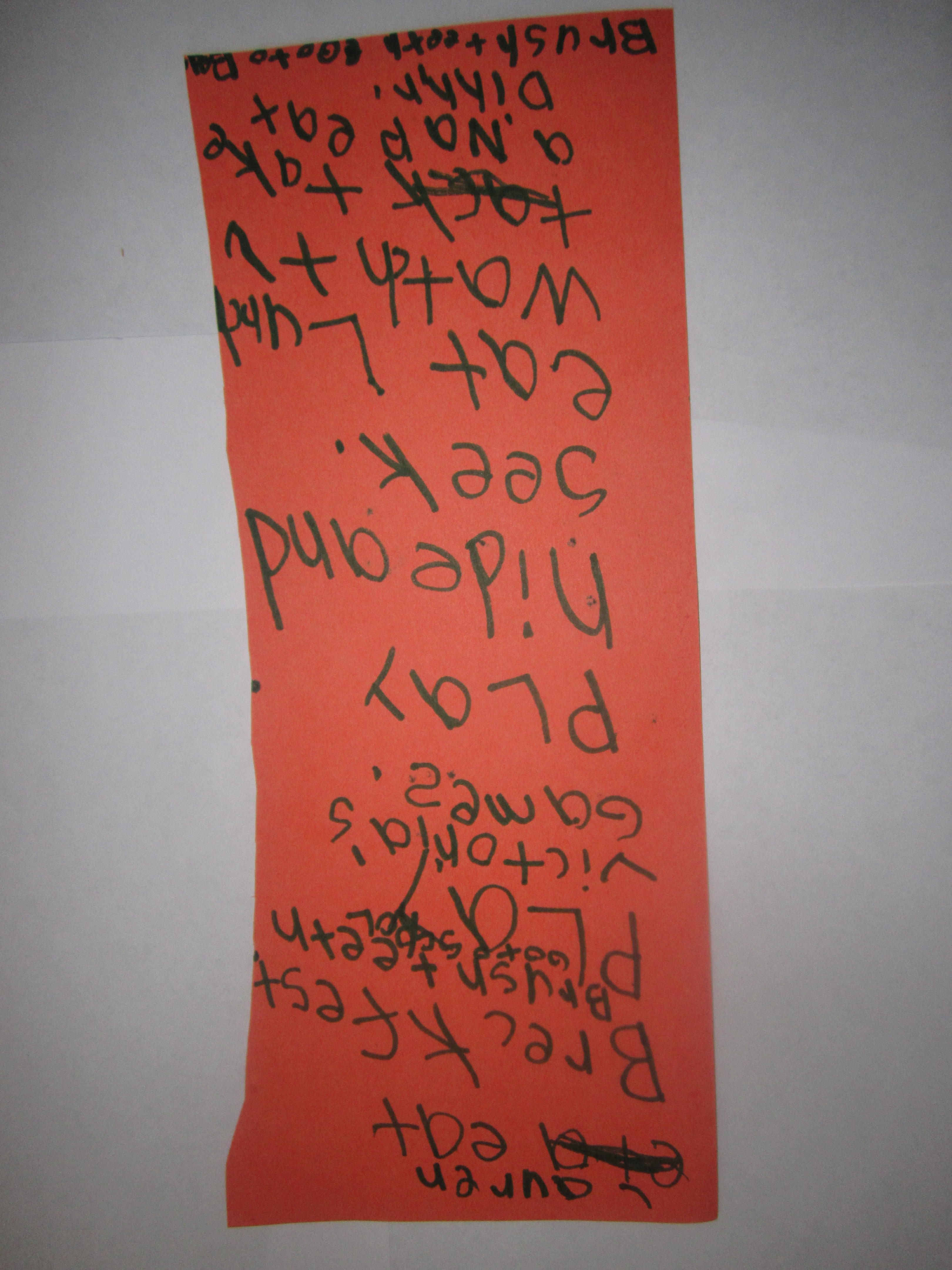
Given my love for the routine of daily life, I was not at all surprised when my six-year-old brought me a neon orange paper that read (and I quote):

Lauren:
eat Breckfest
Brush teeth
Go to school
Play Victoria’s games
Play hide and seek
eat lunch
watch TV
take a Nap
eat Dinnr.
Brush teeth
Go to bed

The basic reality of daily life, of routine, and of the mundane is that we all live it in some way or another—me in my adult world, my daughter in her child world.  We commute to work.  We go to school.  We walk the dog.  We make phone calls.  We volunteer.  We give baths and make dinners.  We run errands.  We clock in; we clock out.

What I love about the resurrection appearances of Jesus is that He surprised the disciples by inviting Himself into their daily routine.  Sure He appeared to them in the upper room, where they were gathered for worship and prayer. That’s to be expected.

But then He did something totally different.  He showed up on the side of the Sea of Galilee and watched them wrestle with fishing nets and bring nothing up from the water.

He went to work with them.

Early in the morning, maybe as the first flickers of sunlight skipped over the Galilean waters, Jesus called out to his tired friends.  They didn’t recognize his voice; he was just some curious bystander sticking his nose into their own personal business, giving them instructions as if He knew more about fishing than they did—a bunch of expert fisherman.

He told them to “‘Throw your net on the right side of the boat and you will find some.’ When they did, they were unable to haul the net in because of the large number of fish” (John 21:6).

That’s when they recognized the Lord.

In A Year With Jesus, Eugene Peterson wrote:

“Work that was futile apart from Christ becomes successful in His presence . .. Your resurrection life, Lord Jesus, is like a sunrise in work that has lost meaning and in routines that have become pointless.  Whatever my work today, I will do it in the recognition of Your presence and under Your command” (p. 594).

and

“The resurrection transforms Monday work as much as Sunday worship” (p. 596).

Jesus made it clear in those 40 days following His resurrection that He wasn’t just looking to be part of our sacred lives and in the religious moments we schedule on the calendar.  He wanted us to live with a curious mesh and entwining of sacred and secular, where He’s with us during every part of our day.

He sets our routine.  He is our routine.  He shakes up our routine.  He designs our routine. He redesigns our routine.

You’d think we fairly intelligent people could get by on our own living out our daily lives.  But, I’ve decided that I can’t and I’m okay with that.

That’s why you’ll find me in the Wal-Mart parking lot once a week with my head bent low in the few minutes before I exit my car.  It’s because I’m a mess on my own—making stupid decisions about what to buy and what not to buy, forgetting what I need, falling for advertising gimmicks and sales tricks, traveling back and forth across the whole store because I forgot something on my list, making a list and then leaving it in my car or at home, trying to use outdated coupons and failing to use perfectly good coupons that I spent perfectly good time cutting out.

Why should God care about my budget and my meal plan for the week and for the items on my list and my own personal sanity?  Because He loves me, that’s why.  Because the grocery store is where I lay out my nets and hope for an abundance of fish.

You have your own Galilean place, where Jesus is trying to invite Himself and where He’s waiting to give you input and advice.   Perhaps it’s the routine that makes you feel so comfortable and that you think you can handle all on your own.  Perhaps it’s the place you feel most capable and expert.  Maybe it’s a place where you experience failure and emptiness.

You haven’t seen abundance until you’ve felt the blessing of His presence in the midst of your routine.  It’s time to invite Him into the boat with you.

You can read more devotionals on this topic here:

Heather King is a wife, mom, Bible Study teacher, writer for www.myfrienddebbie.com and worship leader.  Most importantly, she is a Christ follower with a desire to help others apply the Bible to everyday life with all its mess, noise, and busyness.  To read more devotionals by Heather King, click here.

VBS Lessons: No Matter What Happens

All week long I’m thinking about the Bible points for our Vacation Bible School and what they mean for adults.  This week will be a mix of some old and some new as I share these lessons.

Tonight at Sky VBS! (Group Publishing), we’re learning: No Matter What Happens…Trust God!

*********************************************************************************

“I am convinced that nothing can ever separate us from God’s love”
Romans 8:38

There are times when I take prayer requests at the close of a meeting almost reluctantly, not because I don‘t care or because I don‘t want to pray.  It’s just that the requests seem so big and I feel the heaviness of them.

That perpetual litany of need, of cancer; mystery illnesses; the death of babies, husbands–and marriages; lost jobs and shattered finances seems like darkness with light, pain without hope.

I feel an affinity for the disciples in the three dark days between the cross and the resurrection, a silent understanding of their pain.  In “Valleys Fill First,” Caedmon’s Call sang: “It’s like that long Saturday between your death and the rising day, when no one wrote a word and wondered is this the end.”

Yes, that was the terror of looking at the cross and standing at a grave and thinking it was all over.

Days after riding through the streets of Jerusalem cheered by the crowd, Jesus had been captured, put on trial, crucified, and shut up in an impenetrable tomb, leaving the disciples overwhelmed, confused, and without hope.  They questioned everything they had seen, heard, and believed about Jesus just days before.

Then, they had confessed Him as Messiah.
Now, their Messiah was dead.

Then, they had seen Him raise Lazarus and others from the dead.
Now, His own death seemed unconquerable.

They had been catapulted into darkness and all of God’s promises and even their personal testimonies were called into question.

In the dark places, we too forget.  Surrounded by pain and despair, we allow circumstances to determine our view of God.  The physical “reality” of death, sickness, financial insecurity, and broken relationships tells us God isn’t loving, God won’t provide, God isn’t at work on our behalf.

When faced with tough circumstances, David also asked God some tough questions: “Will the Lord reject forever?  Will He never show His favor again?  Has His unfailing love vanished forever?  Has His promise failed for all time?  Has God forgotten to be merciful?  Has He in anger withheld His compassion?”  (Psalm 77:7-9, NIV).

Ultimately, though, David fought against these doubts by returning to what He knew was truth: “I will remember the deeds of the LORD; yes, I will remember your miracles of long ago.  I will meditate on all your works and consider all your mighty deeds.” (Psalm 77:11-12, NIV). 

In the same way, we remember who our God is.  No matter what happens, we trust God.

Because He is a Creator, who can bring forth something altogether new out of nothingness.

Because He has Resurrection Power, the ability to take what is utterly dead and bring new life.

Christ’s resurrection gave the disciples new hope, real hope, true absolute belief and confirmation that their faith was more than a fairy tale, whim, emotional crutch or delusion.

So often, we use “hope” to mean little more than “good luck” or “best wishes.”  We give a friend a hug and say, “I hope you have a good day” or pat them on the back and say, “I hope you get that job you want” or “I hope your treatments work.”

We might as well be calling “heads” as we toss a coin.

Instead, because of Christ’s resurrection we have real hope for eternity.  We can have full, confident assurance in what Titus 2:13 calls “the blessed hope–the glorious appearing of our great God and Savior, Jesus Christ” (NIV).  

Because of the Resurrection, we also have hope in the present.  After all, nothing is too big for a God who has power over life and death.  Jesus proved that no matter how bleak our physical reality looks and how much our five senses tell us God is not in control, He is still Lord and He can do all things.

Fortunately, our hope is in His strength and not our own.  It’s too much for us to carry around the weight of our problems and our dead circumstances.  We’re not creators. We don’t have resurrection power.  A world that relies solely on us is a hopeless place indeed.

Yet, no matter how dark our circumstances, even when we are in the closed tomb with every sign of death, we can have hope in Christ.

God, who conquered death and the grave, is working on your behalf in the here and now and also in preparation for our eternity with Him.

Instead of struggling to handle things on our own, we need to do something that is sometimes far more difficult–yield.  Cry out to Him that this weight is more than you can handle, allow Him to carry the load, and have renewed hope in God’s ability to care for you no matter how insurmountable the circumstances appear.

Would you like to hear the Caedmon’s Call song, Valleys Fill First?  Click here to follow the link or play it directly from the blog:

Heather King is a wife, mom, Bible Study teacher, writer for www.myfrienddebbie.com and worship leader.  Most importantly, she is a Christ follower with a desire to help others apply the Bible to everyday life with all its mess, noise, and busyness.  To read more devotionals by Heather King, click here.

Copyright © 2012 Heather King

VBS Lessons: No Matter What People Do

All week long I’m thinking about the Bible points for our Vacation Bible School and what they mean for adults.  This week will be a mix of some old and some new as I share these lessons.

Tonight at Sky VBS! (Group Publishing), we’re learning: No Matter What People Do…Trust God!

****************************************************************************

In high school, Carl didn’t score touchdowns like the sports star Norman.  Instead, Carl served as the sports manager for the team—close to the action, but never quite getting the glory.

One day in the locker room, Norman played a teenage prank on Carl and then they went their separate ways.  Norman played football and studied education in college, earning his master’s degree and returning to the high school to teach and coach for over 30 years.

Carl took a different path.  More than 50 years after that initial locker room prank, Carl showed up at Norman’s house and shot him with a pistol.  At 73 years old, Carl is now starting a life term in prison.

Not exactly the best way to spend your retirement years.

I read this new story last week and it troubled me in a deep-down unshakeable way.  It’s partly because the story dismisses that teenage prank.  Of course, it couldn’t possibly be worth killing someone over 50 years after the fact.  Of course it makes no sense to murder a 70-year old man for something he did in high school.

Yet, bullying, teasing, and publicly embarrassing others seem to be the signature traits of our society and they aren’t easily shrugged off, even by the strongest and most confident among us.  It’s a reminder to us all how how lives can be destroyed by what we say and do.

The story, though, also illustrates something else.  It shows how what people do to us usually determines our character far more than it impacts theirs.

Carl—the 73-year-old killer over a high school grudge—lived an embittered life, entangled in jealousy and unforgiveness.  Norman lived a full life that sounded successful and happy.

We have a similar choice when people intend evil for us.  Like Joseph staring across an Egyptian banqueting table at the brothers who sold him into slavery decades before, we must choose what to do with our offenders.

The Lord’s Prayer instructs us clearly: “forgive us our trespasses as we forgive those who trespass against us.”

If you look at most modern translations of this passage, they read something like: “And forgive us our debts, as we also have forgiven our debtors” (Matthew 6:12 HCSB).

That’s because we perceive wrongs against us as a debt that someone needs to pay.  Someone owe us because they took something from us–our innocence, our purity, our dignity, our job, our financial security, our husband, our self-esteem . ..

Pretty soon we’re wrapped up in unforgiveness and anger so tight that our whole life is hindered.  We’re tripping all over ourselves when we try to get anywhere.

In his book, Enemies of the Heart, Andy Stanley reminds us that the only way to break free from the snare of anger and unforgiveness is to cancel the debt.

We need to forgive.  Why?  Because we’ve been forgiven.

Stanley writes:

In the shadow of my hurt, forgiveness feels like a decision to reward my enemy.  But in the shadow of the cross, forgiveness is merely a gift from one undeserving soul to another (129).

Jesus Himself, tortured and crucified by a jeering mob when he had done nothing at all to deserve it, still looked down from the cross and prayed: “Father, forgive them, for they do not know what they are doing” (Luke 23:34).

In “You Want Me To Pray What?” I wrote:

“In the same way, Stephen, the first Christian martyr, prayed, “Lord, do not hold this sin against them” just as the final stones pelted his body and killed him (Acts 7:59).

Have you considered who Stephen was praying for in that moment?  One of the men standing by the coat rack cheering on the crowd was Saul—later the apostle Paul.

Stephen asked for God to forgive his persecutors and shortly afterward this same Saul sat on a roadside blinded by Jesus Christ himself, experiencing repentance and conversion.

Satan fully intends to tangle us up in bitterness and jealousy.  He wants to defeat our ministry and make us thoroughly unusable because we’re so riled up and distracted by dissension and arguments.

He just doesn’t know what to do when we pray shockingly humble prayers on behalf of others, particularly our enemies.  There’s power there.”

No matter what people do to us, we can trust God to use it for His glory and to help us through.  More than that, we can ask him to help us forgive so we can move forward in freedom and blessing, no longer hindered by the bitter entanglements of our past.

Heather King is a wife, mom, Bible Study teacher, writer for www.myfrienddebbie.com and worship leader. Most importantly, she is a Christ follower with a desire to help others apply the Bible to everyday life with all its mess, noise, and busyness. To read more devotionals by Heather King, click here.

Copyright © 2012 Heather King