Weekend Walk: 08/20/2011

Hiding the Word:

Welcome to the weekend, my verse memorizing friends!  The other day I came across a devotional on Philippians 2:13, so I’m choosing that for my verse this week.  It’s going on index cards on my stove and bathroom mirror and it’s already copied into my journal.  The very act of writing it down three times helps me hide these words in my heart.

“for it is God who works in you to will and to act in order to fulfill his good purpose.”
Philippians 2:13

In his Worship the King devotional,. Chris Tiegreen wrote:

The comforting part of this promise is that when we have deep internal desires to do something entirely consistent with the stated purpose and plan of God, those desires are probably God-given.  And when we are driven to act on those desires with a strategy and a worthwhile agenda, we are likely driven by God Himself . . . That means, of course, that He will see it through.  The sovereign God, who sees the future, doesn’t abandon projects midway through.  If He started His work in you, He’s committed to it.

Two Book Reviews for You!
Instead of a Weekend Rerun, this week I’m posting something different!

Stained Glass Hearts: Seeing Life from a Broken Perspective by Patsy Clairmont

If you’ve seen Patsy on stage at a Women of Faith conference, you couldn’t forget her.  She’s a bouncy spitfire who is essentially joy in human form.  And yet, she’s traveled a difficult personal journey, including years trapped in her home as an agoraphobic who was addicted to nicotine and sedatives.  Many days, she didn’t make it out of her bed and into clothes.

So, I was excited to read her perspective on how God forms beauty out of brokenness in her book Stained Glass Hearts.  That’s what He did for her. When God takes broken shards of glass, He can piece them together to reflect His grace, just as artists work to create stained glass art.

There were parts of this book that were so honest, vulnerable, and wise.  She writes: “At times, trusting God in the minutia of life is as difficult as trusting him for a walking-on-water miracle.”  She got that right!

I’m a lover of the arts and I do believe that art, poetry, books, museums, and songs feed parts of our spirit and allow us to connect with the heart of our Creator.  So, I enjoyed her concluding each chapter with suggestions of art to view or books to read and more.

Still, by the end of the book, I couldn’t say that I saw the underlining theme or overarching lesson.  She had whole chapters devoted to why books are important or music and, while I agree, I didn’t see their place in the big picture of brokenness.  The spiritual lessons were valuable, but mostly stayed in the comfortable realm of the superficial.  That made this a sweet book and an enjoyable read, but not a life-changing one.

I received this book free from the publisher through the BookSneeze®.com book review bloggers program. I was not required to write a positive review. The opinions I have expressed are my own.
The Hour That Matters Most: The Surprising Power of the Family Meal
by Les & Leslie Parrot with Stephanie Allen and Tina Kuna
This year, for the first time ever, ballet runs through our family dinner time.  Not once a week, but twice a week.  What’s a mom to do?  Frantically rush through a fast food line and order up burgers and fries for the fam?  Les and Leslie Parrott with their coauthors offer a solution in this book.  They advocate strongly for the power of the family dinner hour and give practical tips on how to make that happen even for busy moms, working moms, families with multiple kids in various activities and families with teens.

The good news is there’s no guilt trip in this book for those whose dinners are served up out of the microwave and on TV trays in the living room. The authors write from the perspective of people who’ve been there and done that and have found the answer in the fix-and-freeze method.  They prepare 12 meals in advance once a month with a bunch of friends, which they can then pull out and reheat for the crazy busy nights that occur several times a week.
This book gives you a back-to-basics approach to eating dinner around the dinner table.  This is great for those who need a walk through kitchen utensils and conversation starters with your kids, but for those already making this family time happen, you’ll be encouraged more than educated.  There are also some recipes that I know I’d like to try out in the kitchen and any family could enjoy–even the long-term devotees of eating together as a family.
While they cover things such as why eating together matters, how to navigate the kitchen, table manners and other practical topics, the book really is less about dinner time and more about parenting.  The authors include chapters on how to talk to one another, how to laugh together, how to empathize with your kids, and how to avoid conflict at the table, etc.  So it’s still a helpful read even if you don’t struggle with getting everyone around the table at the same time for the evening meal.
I received this book free from the publisher, Tyndale House . I was not required to write a positive review. The opinions I have expressed are my own.

 
Heather King is a wife, mom, Bible Study teacher, writer for www.myfrienddebbie.com and worship leader.  Most importantly, she is a Christ follower with a desire to help others apply the Bible to everyday life with all its mess, noise, and busyness.  To read more devotionals by Heather King, click here.
Copyright © 2011 Heather King

I’ve Fallen and I Can’t Get Up!

“Three times a day he got down on his knees and prayed, giving thanks to his God, just as he had done before” (Daniel 6:10)

Bam!
Waaaaaaaaaaaaaaa!
Thump, thump, thump, thump, thump.
Sniffle, sniffle, sniffle.
Mom!  Mom mom!!

With my genes, my girls didn’t have much of a chance at grace and my baby girl is no different. So these are the sounds heard in my home multiple times any given day.

It’s the immediate reaction of any child to trouble, the crying out to mom and the running to her side to tell her all about the tragedy and pain.

There’s little I can do most of the time to fix the problem.  My baby’s fallen and hurt (maybe even angry) and while I can’t change the fact of her fall and no Band-Aid is going to alleviate the temporary soreness, I can kiss her, cuddle her close and tell her I love her. And so I do.

Then I fall down, tripping over my own sin, or another person who invaded my space, or an obstacle I didn’t foresee, or an unexpected pit in my road.

To whom do I run?  What is my immediate response, my instantaneous reaction to pain?  What is yours?

For some, it’s to hold our bruises close for a while and to snap at any bystanders who offer to help us stand back to our feet.  Maybe even hide our heads in embarrassment for the spectacle of the fall in the first place.

For some, it’s to call out for help from those nearby, asking them to both hoist us up and even bear the burden of our weight for a while as we wobble around on a weakened leg.

For some, it’s to haul out our own first aid kit and apply ice and bandages to our own wounds and refuse the expert care so readily available.

For some, it’s to sit without moving, paralyzed by fear.  What if our leg is broken?  What if we never walk again?  What if . . . what if . . . what if . . . ?

In Beth Moore’s study, Daniel, she notes how his immediate response to the king’s edict prohibiting prayer was to go “to his upstairs room where the windows opened toward Jerusalem. Three times a day he got down on his knees and prayed, giving thanks to his God, just as he had done before” (Daniel 6:10).

He didn’t worry first and then pray.  He didn’t try to fix the situation through his political abilities and then pray. He didn’t even concede defeat and stop his public prayer habits, choosing instead to silently petition God at night while others slept.

Daniel prayed.  It was his initial reaction; it was his only solution.

Then there’s the matter of what he prayed.  Sure, some of us have indeed trained ourselves to “take it to the Lord in prayer” without hesitation.  We run to his side and bury our noses in the hem of His robe, sniffling out our requests to Him.  But are we giving thanks amidst those tears?

Daniel was.  Scripture says he “got down on his knees and prayed, giving thanks to God” (Daniel 6:10).  When I’m smarting from an injury, I’m more likely to complain about the pain than sing hymns of thankful praise.

Not Daniel. Political enemies, a manipulated king, a dangerous edict, his faith attacked, his life on the line—still Daniel gave thanks.

Paul made the same connection when he wrote,

Do not be anxious about anything, but in every situation, by prayer and petition, with thanksgiving, present your requests to God. And the peace of God, which transcends all understanding, will guard your hearts and your minds in Christ Jesus (Philippians 4:6-7).

Peace in the midst of pain is there for the taking sometimes, and yet we choose anxiety instead.  We opt for fear by trying to control our own problems rather than running to God’s side and dumping them at His feet.  We allow worry to reign in our hearts and minds by refusing to pray with thanksgiving at all times and in every situation.

I confess I’m a rebel at times.  Even though I know I should shove aside my grumbling and choose to be thankful—even when it takes struggling and squinting to see that sparkle of light in a dark place– still I decline.

I dusted off my thankfulness journal this morning after two weeks of shoving it aside. I didn’t want to be thankful.  I wanted to feel wronged.  I didn’t want some secret formula to maintaining joy in trials; I wanted no more trials!  I wanted God to feel pity for me and feel sorry for letting me be hurt.  Perhaps what I wanted was an apology from Him.

It’s like emotional manipulation of the Almighty God.  “I’m not going to praise You or worship You or give You thanks or hand over my fears to You until You rescue me in the way I desire.”

It’s handing God a sheet and pillow and pointing to the couch.
It’s ignoring His phone calls and giving Him the silent treatment at the dinner table.
It’s holding my breath until he gives me what I want.

And it’s just about as effective as all those tactics.  So when my tantrum is done, I pray and I give thanks.  Reluctantly at first, perhaps, and yet I try.  Maybe the next time I trip and fall, I pray with thanksgiving immediately because I have learned that gratitude shifts my focus off my need and onto the face of my Deliverer.

Heather King is a wife, mom, Bible Study teacher, writer for www.myfrienddebbie.com and worship leader.  Most importantly, she is a Christ follower with a desire to help others apply the Bible to everyday life with all its mess, noise, and busyness.  To read more devotionals by Heather King, click here.

Copyright © 2011 Heather King

In Search Of . . .

Bunk Beds.  I need some.  Not just any bunk beds.  Twin over twin wooden bunk beds without a ladder that sticks out.

Taking Philippians 4:6 to heart, I prayed.  After all, Paul said, “in every situation (even when needing bunk beds), by prayer and petition, with thanksgiving, present your requests to God.”

“Dear Lord, we need bunk beds fairly soon and they have to be exactly the right bunk beds. Please consult my necessary dimensions and materials for more information. Thank you. Amen.”

Now with that prayer done, I began to keep an eye out for bunk beds.  I drove past the local thrift store as often as possible to eye their new furniture inventory.  Even though I’m not typically a yard saler, I shopped on Saturday mornings in other people’s yards, making awkward conversation with strangers about their stuff, in the chance I’d find a set.  I joined local online groups where people sell their unwanted things and checked frequently for what I needed.

So when a pair of bunk beds showed up on one of those lists for under $100, I thought, “This is it, God!  Thanks so much for answering my prayer!”  I had the lady drive them by in her farm truck and unload them into my back yard.  They were . . . well . . . okay.  Wooden.  Twin over twin.  They weren’t amazing, but they were okay and they fit the baseline request I had made to God.

Then the mattresses came off the truck.  Shoo!  All of the Febreze I had in the house and some good time airing out in our backyard didn’t help them one bit.  My husband stowed the mattresses in the garage until they could be hauled off to the dump.  No way were they allowed in the house, he announced.

I was a bit disappointed with God’s provision, but resigned to deal with it.  I mean—I asked for bunk beds and never really specified mattresses, so I was going to let Him off the hook on this one.

The next day a friend posted a message about having twin beds she’d be getting rid of in a few weeks.

Were they bunk beds?  Yup.  Wood?  Uh huh.  Right size?  They sure were.  I haven’t smelled the mattresses, but I’m pretty sure they’ve got the ones in my garage beat.

If I had waited one more day, I’d have a better gift available to me for free, but instead I settled for second best because I didn’t leave the whole matter in God’s hands.  I prayed about it and then changed my whole lifestyle to help Him provide for me.

Because obviously the Almighty God who made the heavens and the earth needs my help looking for some bunk beds.

Zechariah struggled to believe God would answer his prayers, too.  After many years of praying for a baby and never receiving one, Zechariah entered the temple to serve as priest before the Lord.  There an angel showed up and Zechariah dropped the incense and hit the ground.  “The angel said to him: ‘Do not be afraid, Zechariah; your prayer has been heard” (Luke 1:13).

Zechariah had been praying and God heard those heaven-directed pleas and answered him.  Yet, when this incredible angel finished telling all about how Elizabeth would have a son named John who would go before the Messiah “in the spirit and power of Elijah,” Zechariah didn’t believe him.

Now, I confess I struggle with believing sometimes, but I’m pretty sure that if an angel miraculously appeared and promised me something, I’d likely have a smidgen of faith.  I’m just saying.

But, Zechariah questioned the angel.  It wasn’t the prophesy about John’s ministry that he doubted; he didn’t believe they could have a baby at all, despite praying all these years for one. He said, “How can I be sure of this?  I am an old man and my wife is well along in years?” (Luke 1:18).

So, he had been praying without believing?  Or praying up to a certain point when it still seemed possible, but now that he and his wife were old, he no longer believed God could do this work.  Either way, what he lacked was prayer with faith.

How often do I pray for things and not really believe that God can do them?  Or I pray and try to help Him out by suggesting my own answers to the problem?  If I give something over into God’s hands, can’t I indeed trust Him with it?  Or will I settle for the second best solutions I come up with in my own finite abilities?

James wrote: “But when you ask, you must believe and not doubt, because the one who doubts is like a wave of the sea, blown and tossed by the wind” (James 1:6).  Are you ever a little seasick in your prayers?  Ask.  Try to make it happen on your own.  Pray.  Do things in your own effort.  Make a request to God.  Work things out on paper.

We rock back and forth, placing problems in His hand and snatching them back up just as quickly.  This isn’t God’s intention for us.  He intends blessing and we choose instead anxious fretting and frantic effort.  How much better to jump off the ship and stand on the solid ground of faith, leaving in God’s hands all that we need?

Heather King is a wife, mom, Bible Study teacher, writer for www.myfrienddebbie.com and worship leader.  Most importantly, she is a Christ follower with a desire to help others apply the Bible to everyday life with all its mess, noise, and busyness.  To read more devotionals by Heather King, click here.

Copyright © 2011 Heather King

Online Bible Study: Week Seven (Chapters 13 & 14)

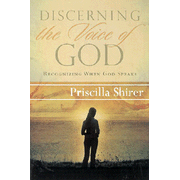
Welcome to week seven in the study of Priscilla Shirer’s Discerning the Voice of God.  I applaud you all for sticking with us this summer as we read through her book together.  I know you’re busy; I know you have a million other things vying for attention.  And yet, you have set aside time for this book and I am praying for God’s blessings for you as a result.

If I can give one piece of encouragement, it’s don’t give up!  Don’t leave the book half-read or this study partly done.  If you’ve fallen behind, please jump back in as you are able because I don’t want you to miss some of these great chapters at the end.  You can comment on any older post as you catch up on the reading.

My Thoughts:

“Hello. Thank you for calling heaven, where your eternal destiny is secure.  Our menu options have recently changed . Please listen closely to all of the options before making a selection.

Para Espanol, por favor pulse dos.

Please speak or press your 10-digit salvation account number.

Thank you!  Did you know that you can access God’s perspective on many things at any time from the comfort of your own home?  Your heavenly user guide or Bible is available 24 hours a day, 7 days a week.

To check your good deeds account, please press one.
To request forgiveness, please press two.
For automated guidance about your account questions, please press three.
For doctrinal information, please press four.
For help with health, finances, and relationships, please press five.
For all other prayer requests, please press six.

If this is an emergency, please hang up and call your pastor.

To repeat this menu, please press zero.  If you would like to speak to a customer representative, please press nine now.

All of our customer representatives are currently busy.  Due to abnormally large call volume, your wait may be delayed.  Please hang on the line and we’ll be with you shortly.

Elevator music.  Cheerful ads.  More music to which you drum your fingers.  The doodles on your paper have now progressed from swirls and cubes to intricate designs and flowers.

We’re sorry.  All of our customer representatives are currently busy.  Please hang on the line and we’ll be with you shortly.”

I’ve been on hold with companies a lot lately and the routine is the same with each call.  Press buttons.  Answer questions.  Listen to annoying music and assurances that they will be with you as quickly as possible.

Priscilla Shirer writes this week that God’s “entire goal, since the beginning of time, is to have a personal, intimate, loving fellowship between the two of you.”  That means that He longs for us to commune with Him all the time about everything we’re facing and He responds to us both by listening and answering with love and grace.

He isn’t putting us on hold.  He isn’t creating go-betweens to filter out calls until we really prove we need to talk to the Supervisor on Duty.  He wants to spend time in relationship with us both in the times that we experience joy and the moments we feel pain and He’s always listening as we cry out to Him.

All that we experience is subject for prayer.  In her study on Daniel, Beth Moore notes that Paul encourages us to pray and give thanks “in every situation” (Philippians 4:6).  We’re compartmentalizers some times.  We think, this I can handle, but this I can’t so I’ll pray about it  This I can think through, but this I’m lost on so I’ll pray about it.  This is too small to pray about, but this is big enough to mention in the Sunday School prayer time. This the doctor will answer, but this I’m going to have to leave to God.

There’s not some stuff that fits into a God category and other stuff that doesn’t.  In the sorting bins of our needs, emotions, and thoughts, there’s just one basket and it’s got a big fat label on it marked “God’s.”  Praise God that He is responsive, loving, gracious, and accessible.

Chapter Outlines:

Chapter 13: A Fatherly Voice

  • God has a personal message for us and we cannot assume that He has the same plan for others that He has for us.  Obviously, on basic doctrinal issues, on the matters of sin that His Word clearly addresses, the standard is consistent.  But, on questions of personal choices–who to marry, where to work, whether to work or stay home, and more, we must remember that we “run the risk of becoming legalistic and placing other believers in bondage” if we believe what God has told us applies to everyone (p. 153).
  • God’s voice may be convicting, but it is not condemning.  He doesn’t harp on your sins of the past.  “He desires to bring healing and restoration by forgiving my sin and throwing it into the sea of forgetfulness” (p. 155).

Chapter 14: A Challenging Voice

  • God isn’t always talking about how to make us feel comfortable.  In fact, He’s pretty frequently asking us to step out of comfort and into faith.
  • The quote from Oswald Chambers on p. 163 is pretty challenging: “Have you ever heard the Master say something very difficult for you? If you haven’t, I question whether you have ever heard Him say anything at all.”
  • We may feel ill-equipped for the task God has called us to, but “it is through your inability that He reveals His power” (p. 164).

Your Thoughts:

  • What were your favorite, quotes, passages or Scriptures from these two chapters?
  • Have you ever made a choice that you knew was God’s will for you, but also knew it wasn’t God’s will for everyone?
  • Do you ever struggle with feelings of condemnation versus conviction?  Is it easy for you to accept Christ’s forgiveness and move on or are you sometimes trapped by guilt?
  • When has God called you out of comfortable and into faith?  What has God taught you in those situations where He asked you to do something that was beyond your natural ability, experience, training, gifting, etc.?

Heather King is a wife, mom, Bible Study teacher, writer for www.myfrienddebbie.com and worship leader.  Most importantly, she is a Christ follower with a desire to help others apply the Bible to everyday life with all its mess, noise, and busyness.  To read more devotionals by Heather King, click here.

Hot Enough For You?

One night years ago my daughters discovered popcorn.

At first, we did our popping in microwavable bags, but we soon switched to a popcorn popper.  On that first exciting day when I pulled the contraption out of the cabinet and set it on the counter, the girls stood on stools so they could watch what would happen.  The kernels tumbled into the popper and I plugged it in.  One daughter covered her ears with her hands and the other shouted, “What’s going to happen?” over the roar of the machine.

And then that first kernel popped.  They squealed in surprise!  And then more kernels began popping in quick succession until there was a constant stream of fluffy white popcorn pouring down the shoot and into the bowl.

The girls danced, laughed and shouted and kept calling our attention to the popcorn as if we’d never seen such a magic trick.  My husband and I watched the girls more than the popcorn; their excitement was joy-giving.

It does seem like magic.  Dump into an inauspicious machine a hard, dried up tiny little crackle of corn and with heat, it transforms into a new texture, color, shape, consistency and taste.  Who would have ever thought looking at the original kernel that the wonders of popcorn lie within?

Likewise, who would look at us much of the time and fully realize all that God has placed in our hearts and all that He has planned for our lives?  Others might see a brittle surface with no flavor.  We might look useless or dried up.  We might simply look un-fun and plain old ordinary.

Yet, God is the Master of transformations.  Although He sees us and fully knows who we are in this moment, He also always sees what we can become.  And He’s willing to turn up the heat to change us.

Because heat is what it takes to break us down, cracking our exterior and softening our insides so that we’re receptive and usable.

To the untrained popcorn popper, it might seem like waste, like the Master is burning His kernels over the flame and they’ll be ruined and tossed aside.  Or that this process is pointless and no good will come from the heat; nothing will ever change.

God, however, never takes us through the fire without purpose and never leaves us in the flame a moment longer than necessary to achieve transformation.  He isn’t reckless or thoughtless.  He’s not cruel or forgetful, blind or oblivious.

Paul wrote in Romans:

Not only so, but we also glory in our sufferings, because we know that suffering produces perseverance; perseverance, character; and character, hope. And hope does not put us to shame, because God’s love has been poured out into our hearts through the Holy Spirit, who has been given to us (Romans 5:3-5).

Over the years, I’ve read these verses often and just as often shrugged them off as an impossible standard.  “Glory in our suffering?”  Not hardly.  Truth be told, I’m more of a whiner than a perpetual rejoicer.

But as a toughened kernel who’s experienced at least a bit of transformation from my own sessions in the heat, I’m looking at these verses anew.

My commentary says:

This is more than mere Stoic endurance of troubles, even though endurance or steadfastness is the first result in a chain-reaction outgrowth from distress. This is spiritual glorying in afflictions because of having come to know (as in “to know by intuition or perception”) that the end product of this chain reaction (that begins with distress) is hope.

This gives me pause.  Have you really considered how hope fits into this picture?  Perhaps I can begrudgingly endure a trial here or there because some periodic heat produces perseverance and fixes flaws in my character.  But how does that stir up hope?

For the Christian, hope is confident expectation that God will do what He says He will do.  The only way we know that is through experience, the kind of experience that develops perseverance and strengthens our character.  We have hope because we’ve seen God deliver us time and time again and we’re confident that He will never fail.

Paul finishes those verses by telling us “And hope does not put us to shame, because God’s love has been poured out into our hearts through the Holy Spirit, who has been given to us” In other words, we won’t be disappointed or shamed by unfulfilled promises.  The commentary continues:

“The reality of God’s love in a believer’s heart gives the assurance, even the guarantee, that the believer’s hope in God and His promise of glory is not misplaced and will not fail.”

It all comes down to the reality of God’s love for us.  He loves us enough to know that we’re more than a golden kernel with a tough exterior.  He knows that sometimes it takes heat to reveal, refine and transform, but He also knows just how hot it needs to be and just how long it needs to last.  He’s not out to singe us or blacken us with despair.  He’s lovingly and expertly making us new.

I use The Bible Knowledge Comentary, New Testament Edition, by John F. Walvoord and Roy B. Zuck.

Heather King is a wife, mom, Bible Study teacher, writer for www.myfrienddebbie.com and worship leader.  Most importantly, she is a Christ follower with a desire to help others apply the Bible to everyday life with all its mess, noise, and busyness.  To read more devotionals by Heather King, click here.

Shedding 5 Pounds With Yogurt

“Sanctify them by the truth; your word is truth”
(John 17:17).

While my daughters munched on morning toast and cereal, I toted a yogurt around the house, eating an occasional spoonful in between changing diapers, putting away blankets, feeding the cats and all the normal start-the-day chores.

My daughter wide-eyed in innocence asked me, “Mom, are you trying to lose your weight?”

My weight?!

“Well,” she explained, “I saw that commercial on TV and they said you could eat that yogurt and lose your weight like even 5 pounds maybe and it would be easy.”

Thanks Mr. advertiser, sir, for making my six-year-old a personal diet coach.

Truth hurts a little sometimes, doesn’t it?

At least it should.  When Jesus prayed for the disciples, He asked God to “sanctify them by the truth; your word is truth” (John 17:17).  Sanctify means to make holy and that’s what this Bible with all of its packed-in and sometimes painful truth is supposed to be working out in our lives–our sanctification, our holiness, our transformation into Christ-likeness.

While the truth sometimes comforts us, it also shakes us up a bit.  It reminds us of ways we need to change and calls us to repentance.

When I read God’s Word quickly, glossing over the Scripture passages just so I can check off my Bible reading for the day, I miss out on the conviction and also the power of God to change me.

Sometimes reading the Bible should make me squirm a bit in my chair or turn my face hot with sorrow at revealed sin.  Because I’m not perfect.  Because I don’t want to stay this way.  Because I want people to look at me and see Christ and as I am now, I’m an imperfect reflection.

Oswald Chambers wrote:

When Jesus drives something home to you through His Word, don’t try to evade it.  If you do, you will become a religious impostor.  Examine the things you tend simply to shrug your shoulders about, and where you have refused to be obedient, and you will know why you are not growing spiritually.

The author of Hebrews said:

For the word of God is alive and active. Sharper than any double-edged sword, it penetrates even to dividing soul and spirit, joints and marrow; it judges the thoughts and attitudes of the heart.

The Word of God is wielded as a scalpel by a Master Surgeon, cutting into our wounded and broken places, separating out what is healthy flesh from what is diseased, dead, and necrotic.  The Surgeon doesn’t dissect in order to hurt and bring pain; He cuts deep to bring health, healing and wholeness.

And if we never feel the sting of the knife’s blade or run our hands over a scar left in place of the wound, then we’ve never allowed His Word to clean out the pockets of sin buried in hidden places of our life.

It’s not that the Bible becomes a club of accusation or that it’s never an encouraging or comforting word.  It’s not just that Scripture points a finger in our face and dumps burdens of shame on our back. Not at all.  Romans 8:1 promises us: “Therefore, there is now no condemnation for those who are in Christ Jesus.”

No, Scripture reminds us of our mistakes, but accompanies that with the offer of grace.  It’s always a package deal.

Ezra, the high priest of Israel, and Nehemiah finally finished rebuilding the temple and walls of Jerusalem after returning from exile.  They gathered “all who could understand” into the square while Ezra read aloud the Book of the Law of Moses.  The crowd listened in silence, except for their weeping as God’s Word uncovered their disobedience.

The people stood for hours, morning until noon, each day while he read, and they fasted and donned sackcloth and dumped ashes on their head in sorrow for their sin.  Theirs was the natural response of people who were attentive to God’s Word.

In the midst of their distress, their hearts brought low in shame, they declared, “But you are a forgiving God, gracious and compassionate, slow to anger and abounding in love” (Nehemiah 9:17).

Oh yes, truth hurts sometimes.  If it’s never painful or uncomfortable, maybe we’ve tuned it out or accepted watered-down adaptations.  Even as we wince with pain, though, we know that the one yielding the scalpel does so with grace and compassion, pouring out a healing balm of forgiveness that washes away the signs of sin.

Heather King is a wife, mom, Bible Study teacher, writer for www.myfrienddebbie.com and worship leader.  Most importantly, she is a Christ follower with a desire to help others apply the Bible to everyday life with all its mess, noise, and busyness.  To read more devotionals by Heather King, click here.

Copyright © 2011 Heather King

Online Bible Study: Week Six, Chapters 11 & 12

Welcome to Week six in this eight-week study on Priscilla Shirer’s Discerning the Voice of God.  Ladies, we are just about to enter the home stretch and these two chapters this week are well-underlined in my book, so let’s get to the good stuff!

My Thoughts:

The enemy has a voice, too.

We talk, study, meditate, read and brainstorm about discerning God’s voice, but the enemy isn’t silent. He’s busy spewing lies and stirring up storms of cacophonous noise to block out what our Shepherd is saying to us. Knowing the sound of Satan’s slimy lies is just as necessary in this walk of faith as recognizing the Holy Spirit’s tug on our soul.

Sometimes Satan’s voice can sound so reasonable compared to the faith God asks us to have. This I know personally. Earlier this year, I began writing in my journal the verses and prayers that clearly directed me to quit my job. With confirmation after confirmation, I obeyed and moved in the direction I saw God working.

And then came this summer.  Our air conditioner broke in our home.  Our car experienced catastrophic demise.  The keys on my piano were sticking and then the pedals broke. The air conditioner in my minivan stopped working and my tire collected a nail.

Those are just some of the battle highlights.

For some reason, most of my emotional breakdowns occur while vacuuming and this time was no different.  While sucking up dirt from my carpet, I was spraying dirt back God’s way:  “I’m done.  I’m done, done, done.  I’m over the attacks and to be honest I’m looking for the easy way out now.”

So, I started planning out a workable schedule and plotting out job options.  I took my eyes off what God told me to do and contemplated the Enemy’s offer for a while.

God’s voice cut through the roar of the vacuum and my sobbing, “Is that what I told you to do?”

In the book of Nehemiah, the returning exiles faced great opposition from enemies of their own as they worked on rebuilding the Jerusalem walls.  Sanballat and his cronies ridiculed the Jews and launched attacks on the work crews.  This enemy was consistent in his attacks and crafty in his distractions.

Finally, Sanballat sent a message to Nehemiah, “Come, let us meet together in one of the villages on the plain of Ono.”

It sounded so reasonable, maybe even hinting at peace.

But Nehemiah immediately identified the voice of the enemy. He sent a messenger to say, “I am carrying on a great project and cannot go down.  Why should the work stop while I leave it and go down to you?” (Nehemiah 6:3). Despite repeated messages from the enemy, Nehemiah didn’t even alter the rhythm of his hammer to answer the enemy’s barbs.

Undaunted, Sanballat charged Nehemiah with false reports.  It’s something that would have kept me up nights in a row, worrying about my reputation and lies and how it wasn’t fair.  Nehemiah didn’t react in the slightest: “I sent him this reply: ‘Nothing like what you are saying is happening; you are just making it up out of your head.'”  (Nehemiah 6:8).

Satan’s a liar.  He’s making stuff up and throwing obstacles in our path.  He’s launching attacks and spreading doubt.  He’s laying traps and giving us “reasonable solutions” to our problems that don’t include God’s will.

We need to be like Nehemiah, so certain of and focused on what God wants us to do that we don’t waste hours or days or life seasons defeated and confused.  Instead, we tell Satan, “I can’t waste time in order to step down to your level and worry about what you’re doing.  I’m busy and you’re just making up stuff in your head anyway.”

Nehemiah’s focus and unwavering obedience to God didn’t just mean the walls were built successfully.  It meant they were built in record time.

In just 52 days, his work crews closed the last gap and laid down their hammers.  “When all our enemies heard about this, all the surrounding nations were afraid and lost their self-confidence, because they realized that this work had been done with the help of our God” (Nehemiah 6:16).

When we overcome the attacks of the enemy, ignore his lies, shut down his schemes and avoid his traps, we will receive the blessing that comes with obedience.  More than that, our lives will give testimony to God’s mighty strength.  No one could look our way and see our own accomplishments; it’s clear that the work will have “been done with the help of our God.”

Chapter Outlines:

Chapter 11, An Invitational Voice

On pages 132-133, she notes that “the beauty of Jesus’ life on earth is not that He did His Father’s will but that He did His Father’s will and nothing else.”  I conjure up lots of seemingly great ideas, but in essence I’m doing what God told me to do PLUS some other good stuff.  Do we really want to see what God is doing and only that?

On page 135, she begins a discussion on why God’s plan for us includes the church.  I love how she described living life as a solo Christian with Christian media as our only food is a problem because “it allows you to act like an only child.”

The church needs all of us with the spiritual gifts Christ has given us in order to function.  But, that doesn’t mean every need we see means we need to fill it (p. 137).  Sometimes it means we’re to pray and wait on God for the answer.

And if God calls us to something in the church, “believe that He has already equipped you to do it” (p. 138).  Our weaknesses will just give Him more opportunity to show off His strengths.

Chapter 12, A Timely Voice

Waiting.  Who likes waiting?  What Christian in history has ever found waiting easy?  And yet God asks us to do it and most of us hate it and often rush ahead of God’s will.

On page 143, she notes that John 16:13 “paints the picture of the Holy Spirit as our ‘guide.’  The term used actually means to guide while one is on one’s way.” So, God gives us “continuous direction on a need-to-know basis.”  Now, God and I don’t always agree on when I “need to know,” but the bottom line is His timing is perfect and I’m simply impatient.

My other favorites from this chapter (oh so many to choose from!!):

  • “”Don’t try to make your time constraints God’s” (p. 144)
  • “Until you know plainly what to do next, keep obediently doing what you are sure of” (p. 144)
  • “Habakkuk had to climb above the ground level of his life in order to focus his eyes on God and tune his ears to hear His voice” (p. 147).
  • “Is God only God when we hear Him speaking or see Him moving?  Or will we still trust that He is still our Father, even if we hear no voice from heaven and see nothing happening?”  . . . We must believe that He is working on our behalf even when He chooses not to say a single word.  In His silence, He speaks volumes to us.  He commands us to wait on Him and focus our attention on His holiness” (p. 148-149).

Your Thoughts:

  • What passages, verses and quotes in these chapters were your favorites?
  • How good are you at doing the Father’s will and nothing else?
  • How have you seen God equip you for ministry when you, in your own strength, were not up to the task?
  • How would you answer her question: “Is God only God when we hear Him speaking or see Him moving?  Or will we still trust that He is still our Father, even if we hear no voice from heaven and see nothing happening?”

  • Heather King is a wife, mom, Bible Study teacher, writer for www.myfrienddebbie.com and worship leader.  Most importantly, she is a Christ follower with a desire to help others apply the Bible to everyday life with all its mess, noise, and busyness.  To read more devotionals by Heather King, click here.
    Copyright © 2011 Heather King

Packing Up the Tiara

There I sat, cuddling my oldest daughter as she sobbed disappointed tears into her pillow.  Sitting in the minivan that night as we drove home, she had suddenly realized that God wasn’t going to make her a fairy tale princess when she grows up.

Her little life dream had been dashed.

After her sad announcement, my husband tried to shout back persuasive logic to her from the front seat, explaining that princesses don’t really live such great lives.  They can’t choose where to go, what to eat, how to dress, or even who to marry.

Somehow the lack of freedom was overshadowed by Disney ballgowns, glass slippers and tiaras.  And so after the pajamas were on, the teeth brushed, the prayers prayed, there we sat in her bed and she cried and we talked about feeling disappointed.

How life doesn’t always turn out the way we expect.
How sometimes we can’t have what we really want.
How movies and fairy tales rarely represent the reality of life.
How it’s hard to trust God when He tells us, “no,” but that we need to leave our future in His hands.
How our job is to work hard to develop the gifts He’s given and His job is to direct and guide our service.

No matter how you chat and philosophize sometimes, though, disappointment hurts.  For a while, we can hope that despite all odds, God is going to miraculously give us what our hearts desire.

But it doesn’t always happen that way and that’s the truth.

Sometimes God says, “no.”  He may do it so gently and with grace, and it’s not because He hates us or wants to see us sob ugly tears on our pillows.

In most cases, He does it for the same reason I tell my child “no” she can’t wear her favorite skirt that is now too short for her, “no” she can’t have cookies and milk at 5:30 p.m. as I’m dishing up dinner on the table, “no” she can’t watch that movie even if her friends have all seen it, “no” she can’t have a cellphone and laptop for first grade.  “No” is for people we love enough to protect.

Then there are other cases where the “no” is so He can be glorified and our faith refined.  In Beth Moore’s study, Daniel, she notes that there are always three scenarios:

  • God delivers us from the fire.
  • God delivers us through the fire.
  • God delivers us by the fire into His arms.

For the three men who refused to bow down to the towering image of King Nebuchadnezzar, there was no question of whether God could keep them out of the furnace that was blazing in front of them.  They declared:

If we are thrown into the blazing furnace, the God we serve is able to deliver us from it, and he will deliver us from Your Majesty’s hand.  But even if he does not, we want you to know, Your Majesty, that we will not serve your gods or worship the image of gold you have set up.

They had to go through the fire, but Christ showed up in all His magnificent glory and walked them right on out of there.  God said, “no, I won’t deliver you from the fire, but I’ll take you through.”

For others of you, God has said, “no” and it’s not clear why.  Maybe we’ll never know the reason this side of eternity.  You can’t see how this is protection.  You can’t see how He is being glorified.  Maybe it’s disappointing, this waiting for the healing or rescue that doesn’t ever seem to come.

Have you ever wondered how Stephen did it, the first martyr in the church, the first one to take stand up for Christ to the death?  Were he and his friends disappointed that God didn’t rescue him from the riotous Sanhedrin?  Were they waiting for the earth to open up and swallow the mob now raising their stones in murderous rage?

How disappointed and confused did they feel as God didn’t deliver Stephen from or through the onslaught of rocks, but instead delivered him home to heaven?  There was no last-minute rescue or miraculous intervention.

Acts 7:6-7 says:

At that point they went wild, a rioting mob of catcalls and whistles and invective. But Stephen, full of the Holy Spirit, hardly noticed—he only had eyes for God, whom he saw in all his glory with Jesus standing at his side. He said, “Oh! I see heaven wide open and the Son of Man standing at God’s side!” (MSG).

Stephen “hardly noticed” the deafening noise of those about to kill him because “he only had eyes for God.”

Whatever disappointments we face, a fairy tale dream that never came true, a furnace God asks us to walk through, a definitive “no” instead of miraculous intervention, we are victorious by “fixing our eyes on Jesus, the pioneer and perfecter of faith” (Hebrews 12:2).  Just like Stephen.  Just like Jesus Himself looked to His Father as He suffered painfully on the cross for our sake.

We’re not looking at the enemy, the storm or the overwhelming circumstances.  We’re not looking at the hoped-for miracle or the anticipated rescue.  We’re looking at Jesus “standing at God’s side,” knowing that even when God chooses not to give us what we want or hope for, He never leaves nor forsakes us (Hebrews 13:5).

Heather King is a wife, mom, Bible Study teacher, writer for www.myfrienddebbie.com and worship leader.  Most importantly, she is a Christ follower with a desire to help others apply the Bible to everyday life with all its mess, noise, and busyness.  To read more devotionals by Heather King, click here.

Copyright © 2011 Heather King

One Lump or Two?

My soul, wait in silence for God only,
For my hope is from Him.
Psalm 62:5

It’s my nightly routine.

Place favorite mug on the counter.
Heat up the water.
Lay tea bag in the mug.
Pour steaming hot water in and let it steep.
Add spoonfuls of sugar.  (Yummy and sweet).
Splash in some milk.

Evening tea.  It’s been years since I’ve gone to bed without drinking it and it’s become a sort of security blanket.  I’m not sure if I could sleep without a cup.

Even worse, maybe I’d lie awake just because the tea wasn’t in my favorite mug and instead dumped into some random coffee cup grabbed from the cupboard.  That’d be like someone trying to swap a precious teddy bear for some unfamiliar spare stashed at the bottom of the toy box.

Last night, I sat down to my steaming cup, took a sip,  . . .

gulped and grimaced.

Instead of sweet tea, I tasted bitterness.  I’d filled the sugar canister, but never put any sugar in my mug.

Have you ever been a little disappointed?  You hope for something sweet and taste undrinkable bitterness instead?

The Israelites wandered through the desert for three days, searching for water.  Each day, their hunt must have grown more desperate.  How long could they survive out there, moving through endless wilderness without water to drink?  And then they arrived at Marah and there was water and they felt that rush of joy that accompanies salvation!

But the water was bitter and undrinkable.  It seemed like cruel disappointment considering their true need.  They weren’t asking at that point for luxury; they were asking for necessary provision and it seemed like God had failed them.

Yet, there at Marah, “Moses cried out to the LORD, and the LORD showed him a piece of wood. He threw it into the water, and the water became fit to drink” (Exodus 15:25).

The Israelites placed their hope in their water-finding abilities.  They hoped for an oasis or a stream in the desert. And when they found what they had been looking for all along, they also discovered disappointment.

Moses placed his hope in God instead, knowing that even bitterness can be transformed into water for the thirsty.

When we place our hope in God, we will never be disappointed. But when we instead look for what we think we need, we misplace our hope in:

the job we think is secure
the financial answer to our bills
the debt program that’s going to transform our life
the 401K that’s going to make our retirement comfortable
the weight loss program that is going to make shedding the pounds easy
the husband who is going to make us feel loved and not lonely any more

the ministry that we can put our energies into
the friendship that makes us feel connected
the church with the programs we think will fit our needs

There are oh so many places to deposit our hope and each could yield bitter disappointment.  But the Psalmist wrote: My soul, wait in silence for God only,
For my hope is from Him” (Psalm 62:5).

We wait for God only.  Not God plus the answer to our problem.  Not God and the life preserver from some friendly bystander who sees us drowning from the shore.

God.  And if He what He offers to us is a program or plan or a friend, then we accept His gift, but we never depend on the gift itself. 

We hope in God alone.  Only He can provide what we truly need.  And if it’s insufficient or bitter, He can transform it into plentiful abundance and sweet blessing, making “everything beautiful in its time” (Ecclesiastes 3:11).

Heather King is a wife, mom, Bible Study teacher, writer for www.myfrienddebbie.com and worship leader.  Most importantly, she is a Christ follower with a desire to help others apply the Bible to everyday life with all its mess, noise, and busyness.  To read more devotionals by Heather King, click here.

Online Bible Study: Week Five, Chapters 9 & 10

We’re starting week 5, which means we’re over halfway into the Bible Study!  This is about the point where with busyness and stress it’s easy to miss a chapter or lag behind.  Please be encouraged and don’t give up!  Just read where you are and post when you can so that you don’t miss out on the lessons God wants to share with you and so that we don’t miss out on what you have to add to the discussion.

Chapters 9 & 10:  My Thoughts

It was loud in here this morning.

My youngest had discovered the volume button on the television and was sharing the sounds of Max and Ruby with all our neighbors.  My middle girl pulled out an entire town worth of toys and was neighing for the horses and vrooming for the cars.  My oldest was playing the piano and, in order to compensate for the rising residual noise, she played each note louder and louder.

Sometimes life is noisy.  Sometimes we can do something about it.  We can simplify our schedule, eliminate activities we shouldn’t be doing, take it slow, turn off the electronics for a bit and sit on the back porch on a summer evening and enjoy the silent night sky.

Sometimes, though, the volume of life is outside our control.  There are seasons where no matter how many activities we trim off the calendar, we’re just busy.  We have kids.  We have jobs.  We have carpools and doctor’s appointments, meetings and ministry, caregiving to perform or we’re trading in sleep for 3 a.m. feedings.

There are also seasons of storms, like the hurricane season we’re approaching.  One violent tempest after another shakes our simple fishing boat.  The winds are screaming.  The waves are roaring.  And it’s loud on the sea and no matter what we do, hearing the voice of God is difficult.

The disciples on the boat in the middle of the storm must have been shouting instructions to one another over the wind and waves.  It was loud, frightening and chaotic and there was little they could do about it.

For Elijah, God spoke in a still small voice at the Mountain of God.  But, for Job and for the disciples, God’s powerful voice cut through the din of wind and rain.  Job 38:1 says, “Then the LORD spoke to Job out of the storm.”  And Mark 4:37-39 tells us:

A furious squall came up, and the waves broke over the boat, so that it was nearly swamped. Jesus was in the stern, sleeping on a cushion. The disciples woke him and said to him, “Teacher, don’t you care if we drown?”  He got up, rebuked the wind and said to the waves, “Quiet! Be still!” Then the wind died down and it was completely calm.

Jesus, Jehovah-Elohim, the All-Powerful God, spoke through the storm and the terrified ones in the middle of the tempest heard Him clearly and they witnessed His power over their circumstances. His is indeed a powerful voice.

And the point of it all, when His voice commands calm in the loudest of our life’s hurricanes, is that He be glorified.  The disciples were “terrified and asked each other, ‘Who is this? Even the wind and the waves obey him!'”  (Mark 4:41).  On page 125, Priscilla Shirer wrote: “Jesus often chose the option that gave Him the greatest opportunity to demonstrate God’s power.”

He’ll be glorified in your storm.  Let that be what we seek—not rescue for our own sake and safety, but miraculous salvation for the glory of His name and so that we can “focus our attention on Him, learn more about Him,and praise Him” (p. 124).

Chapter Outlines:

Chapter 9: A Truthful Voice

On page 111, she notes that Jesus consistently told His disciples, “I am telling you the truth” and that after His ascension, He sent to them the Holy Spirit who would “guide you into all truth.”  What the Holy Spirit says to us will always be borne out in the unquestionable truth of God’s Word.

That truth should shake us up at times because we should allow it to challenge our traditions, feelings, and actions (pp. 112-113).

She also talks about the power of God’s Word to demolish strongholds in our lives, noting on p. 116: “The lies were quieting and His truth was ringing loudly.”

Chapter 10: A Powerful Voice

Please see “My Thoughts” above this week, as I covered much of what she wrote in this chapter.

Your Thoughts:

  • As always, what were some of your favorite quotes, passages, or verses from this week’s reading?
  • Do you have a Scripture that God has used to break down a stronghold in your life?  Maybe a verse that you go to time and again to fight against the attacks of Satan.
  • Tell about a time that you heard God’s voice clearly in a life storm.
  • On p. 126, she asked, “Do you truly believe there is enough power in God’s voice to do these kinds of things in your life today?”  Would you share with us your answer to that question?

Heather King is a wife, mom, Bible Study teacher, writer for www.myfrienddebbie.com and worship leader.  Most importantly, she is a Christ follower with a desire to help others apply the Bible to everyday life with all its mess, noise, and busyness.  To read more devotionals by Heather King, click here.

Copyright © 2011 Heather King