Devotions for Thanksgiving: Secret Messages, Whispered Thanks

I wanted to write.
She wanted to paint together.
I sat down to answer emails.
She wanted to do puzzles together.
I vacuumed and washed and folded.
She dragged the Play-Doh bucket from the playroom so we could make pizza Play-Doh…together.

Writing projects, church projects, house projects, studying, filling out forms, answering emails, drafting letters, returning phone calls…I had my agenda.

And she had hers, as she handed me a game she couldn’t play on her own and asked for help.  Maybe we could do it together?

Somehow I managed to perform periodic cleaning sweeps through the house in between requests for “together” this or that.  We ate lunch at the school with her older sisters together (of course) and took a trip to the library after school with everyone.

Bedtime arrived and I kissed them all sweetly and patted their heads, read the book(s), prayed the prayer and tucked them into beds.  Then I flopped down into the chair, glad that somehow the house had ended the day clean-ish so I could work on other projects now in my “free time.”

One brief moment of peace passed before I heard the sounds of fighting, ending in screams and tears.

Following that, the post-fight therapy with daughters began, about whether they are loved as much as their sisters, and how come she gets away with this and didn’t I hear the mean things she said?

Even the time that’s supposed to be free really isn’t when you’re a mom.  Sometimes the whole idea of achieving balance seems like dreaming the impossible dream.  When you’re truly responsible for other people, little people whom you love completely and utterly, you’ll be emptied out over and over again.  Where’s the balance in that?

The truth is life isn’t about balance at all.  It’s about putting people first.

I can’t say that I’m ending this day feeling very accomplished or on top of things, but then usually the most important things in life can’t be crossed off a to-do list.

Yet, as we sat there having lunch at the school, my three-year-old climbed up in my lap and curled up tight.  Her breathing slowed and drew in deeper and deeper until her head flopped forward into the crook of my arm.

I scooped her up, carried her to the car and then into the house after the drive.  If it’s possible for a tiny girl to coo, she did when I settled onto the sofa with her in my arms.

Then I whispered into her ear what I’ve said to my children hundreds of times since their birth: “I love you and I’m so thankful to God that He let me be Your mom.  You are God’s great gift to me.”

Sometimes I’m telling that to wiggly daughters who have zoomed by me in their dash from the kitchen to the bedroom.  I’ve reached out my hand, pulled them close and told them the secret message again and again.1corinthians1
Other times, I’m whispering it to sobbing girls, upset, angry, hurt or feeling unloved.

“I’m thankful to God for you.”

We all have people who need to hear those words from us: Teachers, friends, moms, sisters, dads, children, mentors, caregivers, coworkers, husbands….

Paul teaches us this in his letters to the churches.  He writes with encouragement and challenges, correction, doctrine, and personal testimony, but also with thanks for the very people reading these words.

To the Corinthians he wrote:

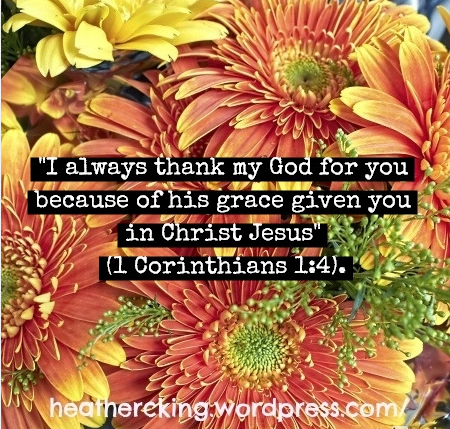
“I always thank my God for you because of his grace given you in Christ Jesus” (1 Corinthians 1:4).

To the church at Thessalonica, he said:

“We always thank God for all of you and continually mention you in our prayers. We remember before our God and Father your work produced by faith, your labor prompted by love, and your endurance inspired by hope in our Lord Jesus Christ (1 Thess 1:2-3).

So often, we skim through the beginning and end of Paul’s letters, rushing through the personal notes so we can dig into meaty questions of doctrine and theology.

But people mattered to Paul. That’s clear when you actually read his thoughtful recounting of the service, ministry, teaching, faithfulness, and generosity of individual people and the church as a whole.

Even when he was tired out from ministry and abandoning his own plans or agenda in order to jot off a letter to a beloved church in need, Paul always took the time to say, “I thank God for you.”

During this week of Thanksgiving, don’t just post a Facebook status thanking God for your husband and kids.  Don’t be satisfied with saying just one word of gratitude before you pass the turkey and mashed potatoes.

Tell others how thankful you are for them here and now.  That’s more important than anything else on your agenda for the day.

Who needs to hear you say, “I’m thankful for you” today?

Originally posted on 11/19/2012

Heather King is a wife, mom, Bible Study teacher, writer and worship leader.  Most importantly, she is a Christ follower with a desire to help others apply the Bible to everyday life with all its mess, noise, and busyness.  Her book, Ask Me Anything, Lord: Opening Our Hearts to God’s Questions, is available now!
To read more devotionals by Heather King, click here.

Copyright © 2013 Heather King

Thanksgiving thoughts while watching the Antiques Roadshow

“He satisfies the thirsty and fills the hungry with good things”
Psalm 107:9, NIV

There’s that moment on every Antiques Roadshow when the appraiser pushes his glasses back on his nose and leans in with excitement.  “So, as to value . . .” he starts.  And the item’s owner looks up with cautious anticipation.

This expert, who has spent all day telling people their precious items aren’t really rare or one-of-a-kind, that their genuine treasures are copies and fakes, that grandmother’s fascinating brush with fame never really happened—this expert places a breathtaking value on an object.

A thing.

A material substance made a treasure because it is unique, somehow special because of the famous person who owned it, or so wrapped up in story and history that the ordinary, everyday is transformed into a retirement fund.

I’ve seen rugs on that show worth more than my house.

At times, I watch that “thing” now deemed a treasure and I wonder—what is hidden in my garage and stuffed in my closets?  What bookshelf conceals my children’s college education?  In what closet could I discover my dream home?

But, I’ve been through all my stuff and it is actually just stuff, perhaps priceless to me and valuable in my life for its utility or the way it connects me to the past, but nothing an appraiser would lose his breath over or call his buddies about.

So then I wonder, how is it that we human creatures can look at tangible objects formed of wood or stone or cloth and so arbitrarily place on them a price tag?thanks8

This one picture costs as much as feeding a village of people in Africa.

The cost of this antique toy could build a well in a village with no clean water.

Seems like something’s wrong here.  Seems like the way we assign value is a little off.

That’s one of our problems, really.  We don’t really know value when we see it most of the time.

And so when God pours Himself out for us and blesses us with good gifts, we sometimes mistake them for not enough and seek out everything that is “other” to fill us up instead.

We keep telling Him we are empty and hold our hands out to Him for more, more, more.  He offers us all that is good and true wrapped up in His presence, but it seems so simple and plain.  Not enough.

Meanwhile, we gorge ourselves on everything we believe will satisfy the deep yearnings and cravings in our hearts.

We pour into our hearts:

success
possessions
romance
position
friendships
successful kids
knowledge
food
entertainment

And it just seeps out of our souls, flowing out as quickly as we can dump it in.  We don’t value what God offers as much as this worldly buffet of good eats around us.  It’s ingratitude.  It’s sin.

Ann Voskamp writes in One Thousand Gifts:

Satan, he wanted more.  More power, more glory.  Ultimately, in essence, Satan is an ingrate.  And he sinks his venom into the heart of Eden.  Satan’s sin becomes the first sin of all humanity – the sin of ingratitude.  Adam and Eve are, simply, painfully, ungrateful for what God gave . . . Our fall was, has always been, and always will  be, that we aren’t satisfied in God and what He gives.  We hunger for something more, something other.

It’s like the Israelites trekking through the desert.  God rained down on them wafers of honey they named manna,  miraculously, faithfully and abundantly every night as they sleep.  It’s tasty and satisfying, nutritionally able to sustain them through long desert marches for 40 years.

And yet, they complained.  “We remember the fish we used to eat for free in Egypt. And we had all the cucumbers, melons, leeks, onions, and garlic we wanted” (Numbers 11:5, NIV).

Nothing they owned, used or ate in Egypt was free.  Everything came at high cost to them–they exchanged hard labor and 370+ years of bondage in slavery for fish and a salad bar.

Seems like something’s wrong here.  Seems like the way they assigned value was a little off.

Adam and Eve were not satisfied with the fruit God had given them for food.

The Israelites were not satisfied with the manna God miraculously laid at their feet every day.

We aren’t always satisfied with God’s Word, with His promises to us, with His provision, with His direction.

Yet, Scripture assures us that God is fully satisfying.

“And God is able to bless you abundantly, so that in all things at all times, having all that you need, you will abound in every good work”  (2 Corinthians 9:8, NIV).

“These all look to you to give them their food at the proper time.  When you give it to them, they gather it up; when you open your hand, they are satisfied with good things” (Psalm 104:27-28, NIV).

He “satisfies your desires with good things so that your youth is renewed like the eagle’s” (Psalm 103:5, NIV).

Have you felt empty, thirsty, hungry, plagued with holes that never allow you to be filled—not with joy, not with peace, not with hope?  We are offered the Bread of Life and buckets of Living Water drawn up from a well that will quench our thirst eternally.

We are offered Christ.  Christ abundantly sufficient for our needs.  Christ the once-for-all sacrifice to cover all our sins.  Christ our Peace.   “Thanks be to God for His indescribable gift!” (2 Corinthians 9:15, NIV).

Originally published as God’s Indescribable Gift on 4/11/2011

Heather King is a wife, mom, Bible Study teacher, writer and worship leader.  Most importantly, she is a Christ follower with a desire to help others apply the Bible to everyday life with all its mess, noise, and busyness.  Her book, Ask Me Anything, Lord: Opening Our Hearts to God’s Questions, is available now!  To read more devotionals by Heather King, click here.

Copyright © 2013 Heather King

The Discipline of Resting Not Rushing

I’m tempted to rush.

This one day I have this time and the temptation is there to fill it right up with more activity, more going and more doing.

Most days, I don’t have this luxury, of course.  It’s the mad morning scramble of toothbrushes, hair brushes, ribbons, bows, socks, shoes, lunches and backpacks to send two older girls out to the bus stop.

Then, buckle a preschooler and a newborn into the minivan for the drive to school and errands or meetings or Bible studies or appointments or whatever busyness has etched itself onto the day.

But this day.  This one day.psalm27

After I watch my oldest girls step onto that school bus, I return to my home and breathe in and out this uncertain freedom.  I don’t have to drive to the preschool.  I don’t have to meet an external agenda or deadline until the afternoon.

So what to do?

Rush through my home, stuffing laundry into the washing machine and another load in the dryer?  Frantically move cereal bowls from sink to dishwasher and then grab the broom (maybe the mop if I’m inspired).  Respond to messages.  Catch up on the to-do list.  Fill out the forms.

So it goes, me filling up this one little space of time with too much, cramming in activity and sitting on the lid in hopes it will fit.

My tea, poured hot this morning turns cold.

My morning devotions, rushed through just to be done, leave me unfilled, uninspired, unopened to what God wants to say.

Too busy…too busy…just always too busy.

But today  I consider Joshua.

Moses met with God face-to-face in a tent.  A pillar of cloud covered the entrance while the Israelites looked on from the flaps of their own tent dwellings, bowing in worship in the doorways.

When Moses finished talking with God, he returned to the camp to share the message with others.

Not Joshua, though.

“his assistant, the young man Joshua son of Nun, would not leave the inside of the tent” (Exodus 33:11 HCSB).

He wouldn’t budge from the glory and the presence, lingering there stubbornly while others moved along.

What if I chose to linger here….chose to be Joshua refusing to leave the tent as long as God’s glory electrified the air….chose for this one day to be Mary at the feet of Jesus rather than Martha slamming pots in the kitchen?

Because serving perpetually means serving empty and that means dying of spiritual starvation and dehydration.

We need the Mary moments so we can re-enter the kitchen as Martha and care for others cheerfully and ably until we have that opportunity once again to lay down the dish towel and sit at Jesus’ feet.

It’s not practical, of course.

That crowd of more than 5000 who sat on the hillside listening to Jesus hour upon hour should have been watching the clock.  They should have known what time it was and how long they had to travel back for food.  They should have abandoned the sermon and packed up their blankets and lawn chairs at a reasonable time so they could eat dinner at a reasonable hour.

Yet, Jesus rewarded their time in His presence.

Had they left early, they would have missed the miracle.

In order to witness God’s glory, they had to wait, they had to sit patiently and linger there until they received.

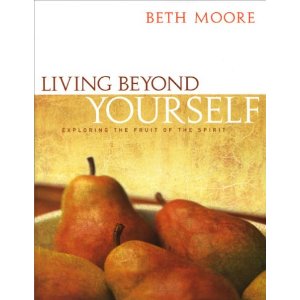
In Living Beyond Yourself, Beth Moore writes:

“He placed them in a posture to rest in His provision.  He commanded them to “sit down” and fed only those who were “seated” (vv. 10-11) . . .”Are you ‘sitting down’ in a posture of trust and sitting quietly to receive it?  If so, prepare the baskets!”

For me, it’s just this one day a week to take my morning slow before the afternoon and evening wave of stress and busyness crashes down again.livingbeyond

For you, it may be a morning, a day….even a season of sitting and waiting on that hillside so you can see His glory, or a season at Jesus’ feet instead of in the kitchen, or a season of lingering in the tent.

Whatever the length of the wait and the stillness, it’s a discipline to rest rather than rush.

When we remain there, though, insistent on lingering where His presence is, we see His glory displayed and He fills us up with the sustenance of His presence and His Word.

But only when we wait until He says it’s time to move on.

Heather King is a wife, mom, Bible Study teacher, writer and worship leader.  Most importantly, she is a Christ follower with a desire to help others apply the Bible to everyday life with all its mess, noise, and busyness.  Her book, Ask Me Anything, Lord: Opening Our Hearts to God’s Questions, is available now!
To read more devotionals by Heather King, click here.

Copyright © 2013 Heather King
Ask Me More….Do You Believe This?

“Don’t let your hearts be troubled.  Trust in God” John 14:1

For some reason when I clean, I clean fast.  No slow and methodical wiping of the rag or scrubbing of the dish for me.

So, yesterday I snatched up the trash bag with an upwards yank, dropped it on the floor, tied it up in record time and dashed out the front door, hopped down the front steps, tossed open the trash can lid, plopped the trash bag in, released the lid so it crashed down and kept on walking in one nearly unbroken stride.

Unbroken, that is, until I stepped down on what I thought was solid ground, but was really a sink hole courtesy of our friendly front yard mole.  My ankle twisted in an unexpected direction.  I felt the wince of pain as I almost hit the ground.

Now, fortunately, it was just a momentary shock of pain.  In a few seconds I was limping down the driveway for the mail.  A minute later I was back to the sport of Extreme Cleaning with no long-term damages.

But life in its way is no less unexpected and sometimes no less shockingly painful.

It can be as simple as the surprise pitfalls in a single day.  Like the fact that my house was passably clean when we awoke this morning.  Then my three daughters painted beautiful artwork, and each other, and the chairs, the table, the carpet, their clothes.  After an unplanned mid-morning bath, all of the paint flecked off their bodies onto the bathtub.

Surprise!  Suddenly my day became a whole-house scrub-down and laundry marathon.

It can be as paralyzing as a life-changing twist.  The phone call with bad news.  The hack to your budget.  The visit to the doctor.  The sputter of a car.  The removing of a wedding ring.

Somehow in the middle of this topsy-turvy, always uncertain, shake-up of a world, the Psalmist wrote:

“My heart, O God, is steadfast, my heart is steadfast; I will sing and make music” (Psalm 57:7, NIV). 

Reading the preceding verses makes it clear, David wasn’t treading on a comfortable path when he penned this Psalm.  He wrote these particular words “when he had fled from Saul into the cave.”john14-1

So, how then, could his heart be steadfast?  How could he be “firmly fixed in place, immovable, not subject to change, firm in belief” while running for his life from the powerful king of an enemy? (Merriam-Webster).

And what about us?

Those minor unexpected annoyances in my morning left me cranky and quick-to-snap.

Major upsets to my plans and life cost me a night of sleep.

Steadfast?  Not me.  Not hardly.

The trouble is that the steadiness of my belief seems utterly dependent on the ease of the path I trod.

It’s not dependent enough on Him, My God, My Firm Foundation, My Solid Rock.

Martha sank deep into an unexpected pit when Jesus didn’t heal her brother, Lazarus.  Instead, she left the place of mourning over his death in order to confront Jesus about it privately.  “’Lord,’ Martha said to Jesus, ‘if you had been here, my brother would not have died.’” (John 11:21).

Jesus knew just what to ask her:  “I am the resurrection and the life. The one who believes in me will live, even though they die; and whoever lives by believing in me will never die. Do you believe this?” (Luke 11:25-26).

Did she believe this?  Did she believe that Jesus was more than a nice friend and successful religious teacher?  Did she believe in Him was resurrection and life?

Could she put aside her emotions and declare that no matter how she felt, she could trust God?

Martha regained her footing on this shaky ground by stating her belief: “Yes, Lord,” she replied, “I believe that you are the Messiah, the Son of God, who is to come into the world” (John 11:27).

Yesterday, I felt the familiar suffocation of fear at some unexpected news.

Today, I experienced the all-too-familiar bad attitude over some twists in my day.

And Jesus asks me, “What do you believe?”

He asks the same of you.

You may be tempted to spout off the Nicene Creed or fall back safely on the answers of a good Christian girl.

Really, though.  Truly.  Honestly.

What do you believe?

Shaky ground and a loss of footing are always signs of belief problems.

It means:

we’ve been putting our faith in ourselves, in others, in our circumstances.
we’re relying on our own plans.
we’re depending on our own strength.
we’ve bought into lies somewhere along the way.

As you catch your breath after a fall, steady yourself by reaffirming the truth.

I believe God loves me, always, unconditionally, fully.
I believe that God’s grace covers over all my sins.
I believe that I will never go through any circumstance alone; God will never leave me nor forsake me.
I believe that He can do anything, even more than I could ever imagine.
I believe that even when I see tragedy, God is working on my behalf and for my good.
I believe that God will be glorified in every situation.
I believe God will provide for my every need.

This is what we know is true, no matter what we may feel.  Therefore, we can trust God.

Originally published as Twisted Ankle, Twisted Truth on 11/7/2011

Heather King is a wife, mom, Bible Study teacher, writer and worship leader.  Most importantly, she is a Christ follower with a desire to help others apply the Bible to everyday life with all its mess, noise, and busyness.  Her book, Ask Me Anything, Lord: Opening Our Hearts to God’s Questions, is available now!  To read more devotionals by Heather King, click here.

Copyright © 2013 Heather King
“The Bad One”

“I’m the bad one in the family.”

She announces that at lunch as she munches on some strawberries.

I lean in close, thinking I misheard.  We were, after all, sharing this deep, meaningful moment in a crowded school cafeteria with the background noise of about 80 other second graders.

“The bad one?”

Who has ever called her this or slammed this ill-fitting and utterly cruel label onto this beautiful and loved daughter of mine?  Like an over-sized dunce cap on a child in the corner, this identity reeks of shame.

I wait for her to identify the name-caller, the bully that’s been filling her head with these lies.  Surely, it’s not me.  I review seven years of my Mom-speeches and Mom-conversations to see if I’m the culprit.

But she claims that role for herself, telling me, “I’m the one who gets the most punishments.  I don’t have self-control.  So, I’m the Bad One.”

It’s little more than a logic exercise for her as she shrugs her shoulders and delivers the explanation all matter-of-fact and void of any emotion.

This is the internal dialogue she’s been having, the way she has accused herself, identified herself, classified and labeled herself, gathered the evidence and declared herself guilty all on her own.

What’s a mom to say?  I feel the pressure of a moment, how to explain love, grace, discipline, and salvation all right then and there as she unwraps her granola bar?romans8

But I can’t.  I can only start the dialogue, open it up right there and begin the surgery, then return to that wound over and over to clean out the infection, the festering pus of lies, until she’s healed and whole.

So I begin.

No more calling yourself “The Bad One.”  You are loved, totally loved, no more or less than any other member of this family.  You sin.  We all sin.  You need to be disciplined sometimes.  We all do.  But Mom and Dad always, always love you.

I consider the self-condemning lies and slander I fill my own head with and I think about the whispered and anguished confessions of my friends struggling with their own self-hatred.

You’re the Flaky One.

You’re the Stupid One.

You’re the Ugly One.

You’re the Fat One.

You’re the Mess-Up.

You’re the Failure.

You’re the Awkward One.

We shackle ourselves in this way even though:

“There is no condemnation for those who belong to Christ Jesus” (Romans 8:1 NLT).

Christ offers us the freedom of grace and we choose the imprisonment of self-hatred.  We are, far too often, are harshest critics.

How Satan loves to use that against us, keeping us from obeying God’s call and preventing us from resting easy in grace by preying on our weaknesses.

As Mary Demuth writes in The Wall Around Your Heart:

It’s time to recognize, stark as it may seem that when you abuse yourself, you participate in the same kind of destruction that Satan wants for you (p. 73).

And, just like the conversation with my daughter, this isn’t something fixed in two minutes, five, or an hour or more.  It takes time, this gradual healing and move toward wholeness.

It begins by rejecting the labels we’ve placed on ourselves and the lies Satan has shackled us with, choosing instead to accept that Christ calls us:

Friends…His Children…and Beloved.

We’re not worthy.

Maybe that’s what we think.

Yet, even as Judas trudged into the Garden of Gethsemane and betrayed the Savior with a kiss, still Jesus said:

“My friend, go ahead and do what you have come for”  (Matthew 26:50 NLT).

Even then, He chooses “friend”–not “betrayer,” or  “backstabber” or “The Bad One.”

Later that evening, I scan the aisles at a thrift store and stop periodically to remind this child:

Don’t take your shoes off and try on the 50 pairs of high-heeled shoes.

Do not crawl underneath the clothes and skip from aisle to aisle.

Do not pounce on the couches and jump on the cushions.

Do not touch every ceramic, glass, crystal, porcelain, or other thoroughly breakable item you see on every shelf we pass.

I tell her the truth: This behavior is unacceptable and I will discipline you if it continues.

BUT….

I love you.  I want to help you learn to make better choices because of that love.

I try to teach this to my daughter, beginning right there at a school cafeteria table.

I try to teach this to myself.

Sometimes we mess up, make mistakes, and sin.  But we are saved, redeemed, transformed and wholly loved by the very God who created us and uniquely designed us for a calling and a purpose.

God doesn’t label us, abuse us, condemn us, shame us, or hate us.

He made us.

He calls us.

He equips us.

Yes, He loves us.  That’s the truth.

Heather King is a wife, mom, Bible Study teacher, writer and worship leader.  Most importantly, she is a Christ follower with a desire to help others apply the Bible to everyday life with all its mess, noise, and busyness.  Her book, Ask Me Anything, Lord: Opening Our Hearts to God’s Questions, is available now!  To read more devotionals by Heather King, click here.

Copyright © 2013 Heather King
Ask Me More: When Anger is Justified But Not ‘Right’

One of the hardest parts of writing a book isn’t always choosing what to put in; it’s choosing what to leave out.

So, when I wrote Ask Me Anything, Lord, I had to choose which questions God asked in Scripture that I would include in the book and which ones I couldn’t.

That was tough.  In the end, I trusted God to lead me and even had to cut out some of my very favorite questions in favor of others I felt He wanted me to cover.

But now, I’d like to share some of the other questions with you in a series on the blog: Ask Me More.

And, if these questions intrigue you, please check out my book, Ask Me Anything, Lord: Opening Our Lives to God’s Questions for a deeper study on how we can let God search our hearts with the very questions He asked others in the Bible.

****************************************************************************************************************************

She’s angry, that’s obvious.

Anger transforms my blond beauty into a furious mess.  Her face burns red hot and tears sting her eyes and cheeks.  Her long hair escapes hair clips and ponytail holders and frizzes out all wild and untamed.  She stomps around as if her feet alone weigh 50 pounds each and her whole body closes in—her fists clenched, her arms crossed, her chin buried into her chest.

It’s her sense of justice that typically sends her into a fit.

This is right.

That’s wrong.

And I’m going to fight to prove it.

She gets that from her dad.  It’s one of the reasons I fell in love with him.

And, normally it’s the beauty in her, too: this absolute willingness to defend justice and truth no matter what it takes or costs.  One day maybe she’ll advocate for orphans and for the oppressed and she’ll be a mighty force on their behalf.

But sometimes, she doesn’t see the whole picture.  She is, after all, only eight years old, and when you’re eight, you don’t know as much as you think you know.

That’s why she assumes a fighting stance when her four-year-old sister munches on an ice cream sandwich.  How come she gets a treat?  That’s not fair!  I talk my crusader down off the ledge and remind her that she hadn’t even asked.  Why get angry when my answer would be yes?

And why rage over whether or not I punish her younger sister often enough?  It must be that she doesn’t trust me as a mom to discipline well, to show grace when needed, and to teach my children what is right.

I understand.  Don’t I sometimes rage myself over my own causes?

Don’t you?

Lord, why are you blessing them and I’m struggling?  I’m the one trying to be obedient and live the righteous life and they aren’t following you at all.  That’s just not fair!

Lord, did you see what they did to me?  Did you see how cruel and unfair, how they slandered and lied and spread the muck to others? Can’t you strike them with lightning or something?

Anger isn’t wrong in itself. We can fight with that same righteous indignation of Jesus cleansing the temple grounds of con men and scam artists.

But sometimes what we claim is righteous indignation really is not trusting God to see truth, to defend us, to care for us, to show mercy when mercy is needed and justice in its time.

That was the prophet Jonah, sitting on the outskirts of Nineveh in a foul mood all because God showed mercy to an entire nation when they repented following Jonah’s hellfire and brimstone proclamation.

This change of plans greatly upset Jonah, and he became very angry. So he complained to the Lord about it: “Didn’t I say before I left home that you would do this, Lord? That is why I ran away to Tarshish! I knew that you are a merciful and compassionate God, slow to get angry and filled with unfailing love. You are eager to turn back from destroying people. Just kill me now, Lord! I’d rather be dead than alive if what I predicted will not happen’ (Jonah 4:1-3).

He raged about God’s character, spitting out the words that should be worship as angry accusations instead:  I knew it.  You’re merciful, compassionate, slowly angered, abounding in love.

God could have defended Himself.  He could have given Jonah his wish and killed the frustrated prophet on the spot.jonah4

Instead, he used a question to dig out the mess of unforgiveness in Jonah’s heart and reveal God’s own character of compassion for the lost.

God asked:

 “Is it right for you to be angry about this?”  Jonah 4:4

It did seem right and just.  Nineveh was the enemy of God’s people!  They had destroyed Jonah’s friends and family! Surely they deserved revenge, not grace!

But God didn’t let the prophet linger there in hatred.  He caused a plant to grow overnight to shade Jonah’s hot head (in more ways than one!).  Then, when Jonah rejoiced over that plant, feeling somehow that he deserved God’s favor and blessing, God sent a worm to chomp that plant right down to nothing.

Jonah raged again.

And again God asked the question:

“Is it right for you to be angry because the plant died?”
“Yes,” Jonah retorted, “even angry enough to die!”  (Jonah 4:9)

God pressed in, challenging how Jonah cared more for a plant than for a nation of 120,000 lost people.  He shifted Jonah’s perspective and He urged Jonah to trust Him.

That’s what’s at stake for us, as well.

When we’re angry, can we still trust?

When anger seems justified, can we still lay our right to rage down at God’s feet and leave it all in His hands?

And as we do, we worship: You are merciful, compassionate, slow-to-anger, full of unfailing love.

Yes, Amen, Lord.  Your will be done even in this.

Heather King is a wife, mom, Bible Study teacher, writer and worship leader.  Most importantly, she is a Christ follower with a desire to help others apply the Bible to everyday life with all its mess, noise, and busyness.  Her book, Ask Me Anything, Lord: Opening Our Hearts to God’s Questions, is now available!  To read more devotionals by Heather King, click here.

Copyright © 2013 Heather King

The Letters You Are Writing

I wonder what she would have called my baby boy.

Peanut.

That’s what I decide.

My youngest daughter would approve.  She likes to call him Andrew “Peanut” King and whenever she does I think, “Yes, Ms. Shirley would like that.”

Ms Shirley called my first baby, “Princess.”  It was premonition, I think, knowing this tiny newborn would be a ballerina princess who only wore dresses from the ages of two to six.

Week after week, Ms. Shirley spoiled my daughter rotten in our church nursery, earning her own nickname: “Church Grandma.”Victoria Picture 001

Later, when I gently handed my second daughter to Ms. Shirley at the nursery door, our Church Grandma announced that her name would be “Precious.”

Then one Wednesday night my oldest daughter clung to Ms. Shirley while screaming in hysterics, wanting to stay in the nursery with her rather than come home with us—her very own parents!

That was the last time we really saw Ms. Shirley other than a hospital visit after her car accident on Veteran’s Day weekend all those years ago.

I guess Victoria knew in her Spirit that God was calling her Church Grandma home and didn’t want to leave her side one second too soon.

I think of Ms. Shirley all the time, certainly when I walk away from the nursery door and always on Veteran’s day weekend…

And when I held my third daughter as a newborn and thought, “Pumpkin.  Ms. Shirley probably would have called you Pumpkin.”

Now my son.  Surely she would have called him “Peanut.”

She left this deep imprint on our lives, so deep I can still feel the tenderness of her memory years after she last held my children and gave them nicknameLegacys.

This is the power of legacy.

And I think, as I sit here now, that legacies so rarely involve fame on a grand scale or power or high position.

They involve people.

Ms. Shirley loved my children.  That’s how she poured out a generous abundance of blessing on me, a young mom trying to serve in the church.

Yesterday, I sat in our church library overwhelmed by God’s goodness and the sweetness of our church family.  Next to me sat a pile of my very own books on a table.

I signed copy after copy of that book for others, fully aware each time as I put the tip of that pen to the paper to sign my name:

How humbled I am.

How this is God’s grace.

Writing a book is a special God-blessing, but I fully realize as I cuddle my baby boy and as I kiss my daughters as they head off to school:

I’ve been writing all along.

The apostle Paul told the church in Corinth:

 Your lives are a letter written in our hearts; everyone can read it and recognize our good work among you. Clearly, you are a letter from Christ showing the result of our ministry among you. This “letter” is written not with pen and ink, but with the Spirit of the living God. It is carved not on tablets of stone, but on human hearts.  (2 Cor. 3:2-3).

No matter how much I write in my life, no matter how successful (or not), no matter how much or how little impact my words may have, my greatest writing is written on human hearts.

So it is for you, as well.

Anne Ortlund wrote:

You know, the longer I live the more I realize that all that’s important in this life is God, and people, and connecting the former with the latter.  I’m willing to shed a lot of things to strive after the Important (Disciplines of a Beautiful Woman).

I read this, too, in The Love Dare for Parents:

Your body will age.  Your clothes will become dated…..But the waves of your life and influence will continue to live on and ripple through the hearts, minds, and faith of your children (p. 198).

We are so often glorifiers of fame and students of worldly success, but impact always trumps personal glory.

Ms. Shirley taught me that by serving in a church nursery.

I’m learning that every day as a wife, mom, and friend.

We all are writers on human hearts and the messages we imprint on the lives of others are the greatest ‘work’ we will ever produce and the most beautiful offering we could give to God.

Never forget what matters, not while you care for a newborn, potty train a toddler, answer a preschooler’s questions, help a child with homework, love them through the difficult days and the joyful moments.

Never forget it as you serve in the church for little glory or recognition that the letter you are writing is beautiful, precious to God, and worth more than any bestseller.

Heather King is a wife, mom, Bible Study teacher, writer and worship leader.  Most importantly, she is a Christ follower with a desire to help others apply the Bible to everyday life with all its mess, noise, and busyness.  Her book, Ask Me Anything, Lord: Opening Our Hearts to God’s Questions, is available now!  To read more devotionals by Heather King, click here.

Copyright © 2013 Heather King

A Reflection of Faith

He wasn’t but a few hours old when the questions began.

“Who does he look like?”

I wonder.  These eyes, this nose, his little round face and fuzz of light brown hair…do I see a reflection of me or are these my husband’s features in our newborn son?069

The debate is familiar.  I’ve swaddled three daughters and one son in hospital blankets and visitors have glanced into their faces and declared each time:

Just like dad.

Just like mom.

The opinions differ, this person…that person….there’s no consensus here.

So they ask me and what to say?  I fail at this every time, not seeing all him, all me.  Seeing only “our baby.”

That’s what we decide, not so much that my son looks like dad or mom.  Instead, he looks like a “King baby” and the comparisons are less with his parents and more with his sisters—these sibling counterparts with shared DNA.

I think of my own reflection and how people have told me my whole life that I look exactly like my mom.

But this light brown hair, my blue eyes, my fair skin, my (unfortunate) chin….those aren’t my mom’s features.  Those belong to my father.

What they see in me isn’t a physical copy of my mom, but a personality, a laugh, a voice and a spirit that make me her “spitting image.”

So maybe the essence of who we are truly overcomes the external and influences—maybe even determines—the way others see us.

People can look right at me and yet see past all that is physical to the spirit within.

And so the apostle Paul could see past body frailty to find faith in a man.

In Lystra there sat a man who was lame. He had been that way from birth and had never walked. He listened to Paul as he was speaking. Paul looked directly at him, saw that he had faith to be healed and called out, “Stand up on your feet!” At that, the man jumped up and began to walk (Acts 14:8-10). 

How many people had looked directly at that man and seen only external limitation?  From his birth, he’d been crippled and all through childhood he’d been defined by disability.

Yet, his faith was so great, so overpowering, as to be his greatest noticeable characteristic when Paul looked his way.  How could it be so clear, so definitive in one lame man among a mob of many?2corinthians

What does such faith look like?  What are its features?

If someone looked at me in a crowd, would they see this faith above all else in me?

It must have been mountain-moving faith the man had.  The kind that makes room for miracles and doesn’t crowd them out with doubt rooted in practicalities and self-reliance.

Me?

Could I have faith so bold?

And daily faith, what about that?  Would Paul have seen faith in me amidst the most minor of daily annoyances, the stresses of the schedule, the disappointments of the moment and the way I have to face up to my very own mistakes and failings?

Doesn’t that take faith also?

To choose not to make a forgotten phone call a crisis or a lost library book or the 5 minutes on the clock screaming at me that we’re late or my mistake from rushing too much (yet again).  How we react in the most mundane of stressors reflects our faith or lack of it.

Do we trust that God has everything under control?

Everything?

Yes, the overwhelming issues we can’t possibly handle, but can we trust Him even with our calendar and our kids’ homework and our grocery bill?

And, if He is so trustworthy, why then fret and fear instead of relax easy into the trust that is faith in a God so mighty and so merciful?

The Proverbs 31 woman “can laugh at the days to come” (Proverbs 31:25).

She has no fear of tomorrow or any days after that and no worries over what-if’s and hypotheticals.

She has faith.  And it shows up in her demeanor, in her belly of laughter instead of a wrinkled face of worry.

Proverbs also tells me this:

As a face is reflected in water, so the heart reflects the real person (Proverbs 27:19 NLT).

This reflection of mine should radiate faith, confident assurance that God is who says He is and He will do what He says He will do.  It’s the firm, unshakeable belief that whatever I face any day in this world is in His hands and never beyond His control or His caring.

Who do I look like, then?

Oh, I hope it’s a woman of deep, unshakeable faith and that it’s written all over my features and in every part of my being so you could pick me out in a crowd and know I belong to my God.

Heather King is a wife, mom, Bible Study teacher, writer and worship leader.  Most importantly, she is a Christ follower with a desire to help others apply the Bible to everyday life with all its mess, noise, and busyness.  Her book, Ask Me Anything, Lord: Opening Our Hearts to God’s Questions, is now available!  To read more devotionals by Heather King, click here.

Copyright © 2013 Heather King

10 Bible Verses to Pray for Election Day

She wanted us to stop eating and pray.

Just like that.  Just put our forks down and bow our heads then and there.

For our “boo boos” of all things, that’s what had our four-year-old inspired to lead a family prayer meeting in the middle of the evening meal.

So, we did, taking turns around our kitchen table, praying for a scratch, a C-section recovery, a splinter, a bruised shin.  In Jesus’ name, Amen.

I felt the difference the next day.  My recovery post-C-section had gone smoothly, gone well, but I still felt that tender reminder of surgery if I moved too fast, too long, too far.  We prayed at the whim of a preschooler, though, and my healing progressed overnight.

Why then?

Why is it I forget to pray for the big things, the commanded things?

When prayer works, when it’s real and responsive, when I see the answers clearly with my own two eyes and feel the results in my own body, and when a tiny blond-headed girl prompts me to pray…why then do I fail so often to pray as I should?

Because I do.  I forget.  I pray about a million problems and worries and issues I encounter every single day for me, for my family, for my friends, for the people I see driving around my little town, for my kids’ school and my husband’s workplace and the people at church.

Yet, Scripture tells me I need to pray for those in authority, for the government leaders, and I confess this truth:  Other than an occasional quick “help the president and congress, Lord” I forget to pray for them most of the time….at least until our paychecks take the hit and suddenly I’m the one inspired to lead prayer meetings.

This election day in the United States, though, let us commit to pray and really do it, not just mean to do it or start to do it and never finish.

Let ….us….pray:

For us as citizens and for our nation:

Lord, forgive us as a nation:

If my people, who are called by my name, will humble themselves and pray and seek my face and turn from their wicked ways, then I will hear from heaven, and I will forgive their sin and will heal their land (2 Chronicles 7:14 NIV).

Turn our hearts to You so that we walk in righteousness:

Righteousness exalts a nation, but sin condemns any people (Proverbs 14:34 NIV)electionday

Lord, help us revere You and respect those in authority.  Show us how to be good citizens.

Make the Master proud of you by being good citizens. Respect the authorities, whatever their level; they are God’s emissaries for keeping order. It is God’s will that by doing good, you might cure the ignorance of the fools who think you’re a danger to society. Exercise your freedom by serving God, not by breaking the rules. Treat everyone you meet with dignity. Love your spiritual family. Revere God. Respect the government (1 Peter 2:13-17 MSG).

Be a good citizen. All governments are under God. Insofar as there is peace and order, it’s God’s order. So live responsibly as a citizen. If you’re irresponsible to the state, then you’re irresponsible with God, and God will hold you responsible. Duly constituted authorities are only a threat if you’re trying to get by with something. Decent citizens should have nothing to fear. (Romans 13:1-3 MSG).

Then render to Caesar the things that are Caesar’s; and to God the things that are God’s. Matt. 22:21 NASB

For those in authority:

Thank You, Lord, that all authority is subject to You:

For kingship belongs to the Lord, and he rules over the nations (Psalm 22:28 ESV).

He makes nations great, and he destroys them; he enlarges nations, and leads them away. He takes away understanding from the chiefs of the people of the earth and makes them wander in a pathless waste. They grope in the dark without light, and he makes them stagger like a drunken man (Job 12:23-25 ESV).

We ask that You guide and direct our leaders:

I urge, then, first of all, that petitions, prayers, intercession and thanksgiving be made for all people— for kings and all those in authority, that we may live peaceful and quiet lives in all godliness and holiness (1 Timothy 2:1-2 NASB)

Give them wisdom as they lead us:

He changes times and seasons; he sets up kings and deposes them. He gives wisdom to the wise and knowledge to the discerning (Dan. 2:20-21)

For lack of guidance a nation falls, but victory is won through many advisers (Proverbs 11:14 NIV).

In Jesus’ name, Amen.

Heather King is a wife, mom, Bible Study teacher, writer and worship leader.  Most importantly, she is a Christ follower with a desire to help others apply the Bible to everyday life with all its mess, noise, and busyness.  Her book, Ask Me Anything, Lord: Opening Our Hearts to God’s Questions, is available now!  To read more devotionals by Heather King, click here.

Copyright © 2013 Heather King

Empty Promises, Book Review

Empty Promises: The Truth About You, Your Desires, and the Lies You’re Believing
by Pete Wilson

A preacher who tells the congregation that an idol is anything more important to us than God probably wouldn’t shock (or enlighten) anyone. Most of us have heard this before . . . countless times . . . in many different ways . . . in Sunday morning sermons, small group lessons, radio preacher segments, and more.emptypromises

So, we might shrug it off.  Is anything more important to me than God?  Nah.  Not me.  Yawn and start doodling on the back of the bulletin.

Pete Wilson, knowing our tendency to bored complacency on this issue, gives his own definition: “idolatry is when I look to something that does not have God’s power to give me what only God has the authority and power to give” (p. 5).  Ahh, now he has our attention.

Of course this isn’t about statues of stone or bronze.  Most likely, this is internal idolatry, a problem in our hearts.  It doesn’t have to be the idol of materialism (although it can be), or physical appearance (although that’s possible, too).  Wilson covers other potential idols that are more elusive and harder to identify, like power, religion and dreams.

He writes with vulnerability and a touch of humor, making it an easy and interesting read.  He’s also organized and challenging–including in each chapter some benchmarks to consider when deciding whether or not you struggle with this or that.

The most insightful moments of the book for me were actually quotes from commentaries  and other classic and modern writers like C.S. Lewis, Timothy Keller, and John Piper.  I don’t mind this.  It shows the breadth of Pete Wilson’s reading and his ability to present truth in an organized and challenging way.

This wasn’t a particularly life-changing book for me at the moment, but it has the potential to be so.  I did, however, discover some fresh descriptions and explanations that I’ve been thinking about even after finishing the book.  This is fitting since, as Wilson, says, “I don’t think being mature Christians means getting to a place where we never deal with idolatry.  Rather, maturity comes when we become aware that this is going to be a lifelong battle…and we make up our minds to engage in it on a daily basis (p. 196).

That makes the book worth a re-read whenever we’re struck again by feelings of emptiness and dissatisfaction, if only for the reminder that some longing won’t be fulfilled until heaven, but it is always fulfilled in Christ.

I received this book free from the publisher. I was not required to write a positive review and the opinions I have expressed are my own. I am disclosing this in accordance with the Federal Trade Commission’s 16 CFR, Part 255 : “Guides Concerning the Use of Endorsements and Testimonials in Advertising.”