Have Mess, Need Mercy

“But this I call to mind, and therefore I have hope:
The steadfast love of the Lord never ceases; his mercies never come to an end;

they are new every morning; great is your faithfulness”
Lamentations 3:21, 22

We all have mess.  I surely do.

When I was a young girl, my mom handed me the book, Old Yeller, and told me, “you’re going to cry when you read this.”

I didn’t.  It was a spiteful hardness, the determination that no matter how intensely sad the story became, I wouldn’t cry simply because she said I would.

This hasn’t changed much over time.  I can generally keep an open mind until someone tells me, “You WILL, you WON’T you CAN’T, you MUST, you HAVE to . . . ”  Anything that pushes me into a corner receives a (sometimes unwarranted) push back.

I have other stuff, too.  Like the fact that I ALWAYS get lost and the directions that make so much sense to everyone else on the planet become a jumbled mass of confusion to me.

I have an organized mind that sees the world in a perpetual outline with points I, II and II and subpoints A, B, and C, but I desperately need a personal secretary to keep me from losing papers and to clean through my desk and help me remember where I put my keys, the library book, the document, the super important thing that I absolutely cannot lose but have managed to misplace.

It doesn’t end there.  I’m a people-pleaser in daily need of encouragement and too easily crushed by constructive criticism.  I’m not always patient with failure, especially in myself, and even sometimes with my kids.  I have a problem with jealousy, not so much for “stuff,” but maybe for success or impact.

There’s more.  The longer I sit here typing away, the more mess I’ll probably discover.

And while in any and all of these areas God has been at work, digging out junk, sometimes with a gentle gloved hand and sometimes with a pick-axe, still there is mess.  There are days where it’s a little overwhelming. Or maybe a lot.

When my house is too disorderly, I can’t think, I can’t concentrate, my stress level rises.  It’s the same with my heart when I see the junk drawers overflowing or discover trash hiding in corners that I hadn’t noticed before.

How is there any room left for what is good and pure and lovely? 
How is there any possibility of inviting God in amongst junk? 
How can anyone feel welcomed and loved into this place of distracting trash?

Once when she was out driving, Ruth Graham noticed that a stretch of highway that had undergone road work for far too long was finally finished and reopened.  They had even posted a sign: “End of Construction.  Thanks for Your Patience.”

She wanted that message to be on her tombstone, a reminder that it’s only in heaven, at the feet of God and clothed in the forgiveness of Christ, that construction on our hearts and minds will be complete.

Until then, we need people–and God–to be patient with us.  Yes, we even need to be a little patient with ourselves.

God is able to transform us and make us new as long as we give over sin, faults, idols, foibles, weakness and failures to Him.  This is part of our salvation story, not a one-time dip in the cleansing blood of Christ’s sacrifice.  It’s the journey of our faith, the sanctification or making holy over time.

And it does take time.

This is what Paul promises, “And I am sure of this, that he who began a good work in you will bring it to completion at the day of Jesus Christ” (Philippians 1:6 ESV).

In the meantime, we have grace, precious grace, and the reminder that our mess is never too heavy to bring to God.

My own efforts are little more than attempts at self-control, self-direction, self-justification, self-perfection, self-reliance and self-confidence.

Then, SELF just becomes part of the mess that we lug to the feet of Jesus.

Ultimately, our own efforts fail.  Giving up completely hinders our relationship with God.  Wallowing in self-loathing means we reject His grace as insufficient to cover our sin.

All that’s left is to bring our mess to God and rejoice in His mercy.  Like the woman who poured out her tears and expensive perfume on Jesus’ feet, we find ourselves moved to passionate worship of and service for a God who has forgiven our many sins (Luke 7:47).

Paul wrote, “I urge you, brothers, in view of God’s mercy, to offer your bodies as living sacrifices, holy and pleasing to God” ( Romans 12:1).

We aren’t holy and pleasing sacrifices to God because we’re finished, perfected, construction complete.

Instead, we offer ourselves up, mess and all,  “in view of God’s mercy.”

His grace covers us, cleanses us and, in His compassion, He transforms us.  He’s big enough and gracious enough to tackle our mess until the day He decides that construction is complete and He takes us home.

Heather King is a wife, mom, Bible Study teacher, writer for www.myfrienddebbie.com and worship leader.  Most importantly, she is a Christ follower with a desire to help others apply the Bible to everyday life with all its mess, noise, and busyness.  To read more devotionals by Heather King, click here.

Weekend Walk, 06/23/2012

Hiding the Word:

Last night, our kids colored their last craft, ran around the gym for the last game, and tasted their last snack of Vacation Bible School.  All week long, we taught the kids to trust God . . . no matter what.

Whoever they are . . .
However they feel . . .
Even when people hurt them . . .
Even when bad things happen . .  .
And anywhere they go . . .
Trust God

Sounds so simple.  Sounds so childlike.  Sounds so easy.

But of course we know the truth.  Most of us need the constant reminder, encouragement and challenge to trust Him.  We need a perpetual bright red string tied around our finger.

So, this week I’m choosing to meditate on a verse that speaks truth about that trust.

It’s not based on anything I do or whatever I muster up in my own strength.  We trust God because of His steadfast, unfailing, loyal, everlasting covenant love for us.

But I have trusted in your steadfast love;
    my heart shall rejoice in your salvation (Psalm 13:5)

Weekend Rerun:

After a week of lessons on Group’s Sky VBS!, I’m reminded of the lessons I wrote last year on the Group PandaMania VBS.  This was one of my favorites that week:

God Loves You, No Matter What
Originally posted June 23, 2011

After a conversation with a friend this week, I recalled the first time I had to turn over my green card on the classroom behavior chart and leave the yellow card on top.  I was in third grade and had forgotten my math homework.  The teacher asked us to hand it in and I quickly zipped open my backpack to grab up my finished paper.

Only it wasn’t there.  So, I pushed things around gently and then more energetically.  I scrambled through the papers and then yanked everything out.  Slowly I realized my paper wasn’t in there.  I had nothing to turn in.

So, I had to shuffle over to the behavior bulletin board and take my punishment.  A yellow card for Heather.  Bright yellow so everyone in the class could see I messed up.  I forgot.  I was careless and irresponsible.

Embarrassed, I slinked back to my desk and slumped down hoping to become invisible in my chair.  My face was burning red hot, the kind of shame that makes your ears sear into the sides of your head.

But, when I sheepishly glanced at the bulletin board the next morning, I saw a green card next to my name again.  It was a new day and with it came a rush of joy that the mistakes of yesterday could be so simply erased and forgotten.

It was the astonishing grace of a fresh start.

That’s what Christ did for us.  Raising us up from the dead.  Taking our place on the cross and erasing the record of our wrongs so that we could stand before the Most Holy God and look . . . holy and pure.

He saw you and me as worth saving even when we were splattered with the mud of sins and caked in the foul dirt of this world. “But God demonstrates his own love for us in this: While we were still sinners, Christ died for us” (Romans 5:8).

So, what should we do with this amazing grace?

I know what I do most of the time—forget it, take it for granted, or, even worse, nullify it by trying to be perfect.  I begin to live in a spiritual world of musts, shoulds, do’s, don’ts, shalls and shall nots.

The Psalmist wrote, “If you, Lord, kept a record of sins, O Lord, who could stand?  But with you there is forgiveness; therefore, You are feared” (Psalm 130:3-4).

Yes, we would be pounded into the ground if we carried the weight of our sins on our wimpy shoulders.  We couldn’t stand in His presence much less crawl face to the ground before His throne.

But.

But with Him there is forgiveness.  Praise God!

The Psalmist ends that thought with, “Therefore, You are feared.”  Not the fright of might, though.  Not the run and hide kind of fear.  Not obeying God to escape His wrath.  Not surrendering to Him in order to earn His love.

The Old Testament Bible Knowledge Commentary says this is the fear of “worship and obedience.  The Scriptures state that many results come from fearing the Lord; the most notable is that the person keeps himself from sin.”

In January of this year, I felt the heavy nudging of the Holy Spirit asking me two questions, one of which was, “Are you ready for where I want to take you next?”  The God who loved me passionately was asking me to walk in worship and obedience—holy fear in response to abundant grace.

“That depends,” I answered.  “Where are we going?  How long will it take?  What is the expense-to-benefit ratio?”

It sounds mercenary, but those are the questions that rumbled around in my head and heart for weeks.  Was it safer to stay where I was?  Was safer necessarily better?

His question sounds so simple and easy when we belt out “I surrender all” in a church service.  Then there’s that moment when God takes you up on your offer and asks you to surrender your plans for the future, your comfort, your life, and you wonder how much “all” actually is.

And then I felt it, the pull of performance and the tug on my heart to just do what God wants so He’ll love me, so I won’t let Him down, so I can live up to what a Bible Study girl should do.  It was a works-based response of duty rather than the bride’s response of affection to the overwhelming passion and love of her Groom.

So I waited to answer God.  I waited until I truly believed that God would love me no matter what.  That the choices I make here may affect God’s plans for me, may affect my impact on others, may affect how I am blessed, but they will never affect His unconditional and unending love.

Only then, in the light of so much grace, knowing that I answered Him out of love and not duty, I bashfully answered, “I do.”  I do want to go with You.  I do want whatever you desire for me.

Why do we obey Him?  Why do we whisper “I do” when He asks us to surrender?  Why do we choose the difficult right over the much easier wrong?

So He will love us?  No—because He loves us. 

We ask Him to “lead me along the path of everlasting life”  because there’s no other place where we can walk next to Him, our tiny palm nestled inside His nail-scarred hand (Psalm 139:24).

Heather King is a wife, mom, Bible Study teacher, writer for www.myfrienddebbie.com and worship leader.  Most importantly, she is a Christ follower with a desire to help others apply the Bible to everyday life with all its mess, noise, and busyness.  To read more devotionals by Heather King, click here.

VBS Lessons: No Matter What People Do

All week long I’m thinking about the Bible points for our Vacation Bible School and what they mean for adults.  This week will be a mix of some old and some new as I share these lessons.

Tonight at Sky VBS! (Group Publishing), we’re learning: No Matter What People Do…Trust God!

****************************************************************************

In high school, Carl didn’t score touchdowns like the sports star Norman.  Instead, Carl served as the sports manager for the team—close to the action, but never quite getting the glory.

One day in the locker room, Norman played a teenage prank on Carl and then they went their separate ways.  Norman played football and studied education in college, earning his master’s degree and returning to the high school to teach and coach for over 30 years.

Carl took a different path.  More than 50 years after that initial locker room prank, Carl showed up at Norman’s house and shot him with a pistol.  At 73 years old, Carl is now starting a life term in prison.

Not exactly the best way to spend your retirement years.

I read this new story last week and it troubled me in a deep-down unshakeable way.  It’s partly because the story dismisses that teenage prank.  Of course, it couldn’t possibly be worth killing someone over 50 years after the fact.  Of course it makes no sense to murder a 70-year old man for something he did in high school.

Yet, bullying, teasing, and publicly embarrassing others seem to be the signature traits of our society and they aren’t easily shrugged off, even by the strongest and most confident among us.  It’s a reminder to us all how how lives can be destroyed by what we say and do.

The story, though, also illustrates something else.  It shows how what people do to us usually determines our character far more than it impacts theirs.

Carl—the 73-year-old killer over a high school grudge—lived an embittered life, entangled in jealousy and unforgiveness.  Norman lived a full life that sounded successful and happy.

We have a similar choice when people intend evil for us.  Like Joseph staring across an Egyptian banqueting table at the brothers who sold him into slavery decades before, we must choose what to do with our offenders.

The Lord’s Prayer instructs us clearly: “forgive us our trespasses as we forgive those who trespass against us.”

If you look at most modern translations of this passage, they read something like: “And forgive us our debts, as we also have forgiven our debtors” (Matthew 6:12 HCSB).

That’s because we perceive wrongs against us as a debt that someone needs to pay.  Someone owe us because they took something from us–our innocence, our purity, our dignity, our job, our financial security, our husband, our self-esteem . ..

Pretty soon we’re wrapped up in unforgiveness and anger so tight that our whole life is hindered.  We’re tripping all over ourselves when we try to get anywhere.

In his book, Enemies of the Heart, Andy Stanley reminds us that the only way to break free from the snare of anger and unforgiveness is to cancel the debt.

We need to forgive.  Why?  Because we’ve been forgiven.

Stanley writes:

In the shadow of my hurt, forgiveness feels like a decision to reward my enemy.  But in the shadow of the cross, forgiveness is merely a gift from one undeserving soul to another (129).

Jesus Himself, tortured and crucified by a jeering mob when he had done nothing at all to deserve it, still looked down from the cross and prayed: “Father, forgive them, for they do not know what they are doing” (Luke 23:34).

In “You Want Me To Pray What?” I wrote:

“In the same way, Stephen, the first Christian martyr, prayed, “Lord, do not hold this sin against them” just as the final stones pelted his body and killed him (Acts 7:59).

Have you considered who Stephen was praying for in that moment?  One of the men standing by the coat rack cheering on the crowd was Saul—later the apostle Paul.

Stephen asked for God to forgive his persecutors and shortly afterward this same Saul sat on a roadside blinded by Jesus Christ himself, experiencing repentance and conversion.

Satan fully intends to tangle us up in bitterness and jealousy.  He wants to defeat our ministry and make us thoroughly unusable because we’re so riled up and distracted by dissension and arguments.

He just doesn’t know what to do when we pray shockingly humble prayers on behalf of others, particularly our enemies.  There’s power there.”

No matter what people do to us, we can trust God to use it for His glory and to help us through.  More than that, we can ask him to help us forgive so we can move forward in freedom and blessing, no longer hindered by the bitter entanglements of our past.

Heather King is a wife, mom, Bible Study teacher, writer for www.myfrienddebbie.com and worship leader. Most importantly, she is a Christ follower with a desire to help others apply the Bible to everyday life with all its mess, noise, and busyness. To read more devotionals by Heather King, click here.

Copyright © 2012 Heather King

VBS Lessons: No Matter Who You Are

Every year at Vacation Bible School I watch as adults lead the excited children around the church from station to station, sing the songs (maybe we even do the accompanying motions), shout and laugh.  Do we also, though, compartmentalize? Do we box up the VBS messages and declare they are just for kids and not relevant for us?

But is there any message in Scripture that God delivers just for people under 18? We older and wiser ones sometimes make faith so complicated and fail to recognize or really consider the beautiful truths in these simple messages. So, this week, I’m thinking about VBS and what the lessons for children mean for you and me.  Our church is doing Group’s Sky VBS, so that’s what I’ll be sharing about here.

************************************************************************************************

No Matter Who You Are….Trust God

I’m easily duped.

I view another person’s life from afar:

Big house, family vacations, nice cars: Finances are solid.

Posts on Facebook about a husband bringing home flowers and how often he cleans up the house, makes dinner and does bath night with the kids: Their marriage is strong and the husband is divinity in human flesh who puts all mere mortal husbands to shame.

Reports of kids’ school achievements, activity accomplishments and cute parenting stories about bedtime prayers and how much they love Jesus: They are perfect parents.

Then their life implodes.  The marriage crumbles seemingly overnight with pain that’s been ripping away the threads of their home for years.  They teeter on the cliff’s edge of bankruptcy and foreclosure or fall right on over into a financial pit.  Their kids rebel.  They disappear from church.  Perhaps they seek solace in suicide.

And we all are catapulted into shock.  We just didn’t know.

It’s true that a life without Jesus can’t be truly fruitful and that “a good tree doesn’t produce bad fruit; on the other hand, a bad tree doesn’t produce good fruit” (Luke 6:43).

Sometimes, though, we’re terribly accomplished counterfeiters, building a facade of happy perfection that belies the truth of what happens in the hidden places of our lives . . . . our marriages . .. our homes . . . our families . . . even more pointedly our hearts.  Maybe it’s just wax fruit that we’ve been surreptitiously tossing onto our branches all these years, but it looked so real.

It’s just impossible to know sometimes what goes on behind the closed doors of another person’s life.

But we try.  In the same way, we might quickly glance at a person’s clothes, makeup or hair and decide whether or not they love Jesus or whether or not they are close to salvation.

Maybe we’re the ones making judgments about others or maybe we’re the ones playing pretend.

God can give us a spiritual discernment to help us see truth in these situations, but often times we finite-minded humans only have what we see–the outward appearance–to help us form judgments and make our minds up about people.

To quote from my favorite movie, The Philadelphia Story, though, “The time to make your mind up about people is never.”

Consider how God’s story would change if He was fooled by outward appearances as we often are:

He would have overlooked the prostitute Rahab as a potential savior for the Israelite spies.

He would never have chosen the teenage shepherd boy, David, to rule Israel.

Jesus would have selected pharisees and teachers of the law to be his disciples instead of a tax collector, a bunch of burly fisherman, and a guy so prone to doubt it became part of his name, good old Doubting Thomas.

A raging bull of a man bent on the destruction of the New Testament church would never have become the apostle to the gentiles, the great advocate for salvation by grace alone, and the predominant writer of the New Testament

And when a centurion burst through the mob surrounding Jesus and asked this miraculous healer to save his ailing servant, Jesus would have turned in disgust.  This Roman soldier was an enemy.  A Gentile.  An occupier.  Instead, Jesus, amazed by his faith, heals the ailing servant with a simple command.

Scripture confirms that “people judge by the outward appearance, but the Lord looks at the heart” (1 Samuel 16:7, NLT).  Aren’t you thankful for that?

King David shared this same wisdom with his son Solomon: “the Lord searches every heart and understands every motive behind the thoughts(1 Chronicles 28:9).  In Hebrews, we read that “Nothing in all creation is hidden from God’s sight. Everything is uncovered and laid bare before the eyes of him to whom we must give account” (Hebrews 4:13).

God always knows our motivations and the condition of our heart.  He’s not duped as I am by the Kodak moment snapshots of our lives, where the makeup is perfect, the hair in place, the smiles just right.

He sees all the photos we rejected, not just the one we framed on the wall for all to see.

Yes, God knows the truth about us all—and the truth that God sees ever so clearly—-is that we all need a Savior.

And He is there ready to receive us, whether we’re joyful or broken with sorrow, whether our marriages are strong or crumbling, whether we live in massive new homes or tumbledown shacks, whether we’re church girls from way back or partyers who’ve discovered the emptiness of indulgence.

No matter who you are . . . trust God.

He doesn’t require us to have it all together before we stroll into His presence cocky and self-assured.  He accepts us crawling in on our knees seeking grace, sweet grace, unmerited and undeserved salvation.

Then He lifts our heads up so we can gaze on His glory, covers us with forgiveness, redeems us and makes us new, uses us for His kingdom purposes, and invites us continually into His presence, where we don’t need to pretend or hide any more.

And He reminds us that others need to know this grace-giving Savior, too, not just those who look broken and needy, but even those who seem to have it all together.  No matter who we are, we all need a Savior.

Heather King is a wife, mom, Bible Study teacher, writer for www.myfrienddebbie.com and worship leader.  Most importantly, she is a Christ follower with a desire to help others apply the Bible to everyday life with all its mess, noise, and busyness.  To read more devotionals by Heather King, click here.

Weekend Walk, 06/16/2012: Happy Father’s Day

Hiding the Word:

Happy Father’s Day weekend!

One of the things my husband and I have learned (and perhaps are still learning) in this whole parenting life is that each of our daughters is a unique original.  Her gifts, talents and weaknesses don’t mimic her sisters’.

They don’t respond to the same discipline strategies either.

With our youngest, we’ve discovered that even the slightest remonstrance, a serious look and the word no, can catapult her into deep sobs.  She’s just that sensitive.

The other night, she was perky and giggly at bedtime instead of the tired and obedient toddler we’d prefer to see at 8:00 or 9:00 or even 9:30 at night.  Even her older sisters complained.

My husband called her out of the room and she emerged with a sheepish grin.  He looked her in the eye and practically whispered the words, “It’s time to sleep.  You need to go into your bed quietly. No more playing around or talking.”

She bawled.  It was perhaps the most tragically despairing cry I’ve ever heard.  So, he scooped her up and hugged her, stroked her hair and promised that he loved her, but that she needed to obey. Slowly, she progressed from sobs to sniffles to calm and toddled off to her bed . . . laid down quietly . . . and went to sleep.

Aren’t you thankful that God our Father has compassion on us, knowing exactly the grace, the guidance, the blessing, the provision, and the discipline we need?

Here’s a Father’s Day verse to meditate on this week that reminds us of God our Father’s abounding love for us:

‘As a father has compassion on his children, so the LORD has compassion on those who fear him” (Psalm 103:13 NIV)

Weekend Rerun:

The Writing on The Wall
Originally posted on October 5, 2011

 ”There is no one on earth who does what is right all the time and never makes a mistake”
(Ecclesiastes 7:20, Good News Translation).

My two-year-old created a masterpiece with a purple marker and a piece of paper.

Then she made a masterpiece on my kitchen wall.

I caught her standing back to admire her mural, giggling with pride.

Walking her back to the paper, I reminded her where art belongs without yelling or even raising the volume of my voice a decibel.  She took one look at my stern face, listened to my firm “no” and burst into truly remorseful tears.

I scooped her up to hold her, but she ran out of the room and I found her lying face down on a pillow, pouring out heavy sobs of brokenness.

All because she had made a mistake and done something wrong.  All because she wasn’t perfect and because I had to correct her.

Surely we all can shrug our shoulders and say, “We all make mistakes sometimes.”  Some of us can even get theological about it and quote “For all have sinned and fall short of the glory of God” (Romans 3:23).

But then there is that moment when you need grace because it’s not “all” who sinned or “all” who made a mistake.

It’s you.

It’s me.

Please don’t tell me you missed that part of the blog where you discover I’m not perfect.  The part where I sin.  The part where I have a bad attitude sometimes.  The part where I make silly mistakes and stupid decisions and act like I’m in an I Love Lucy episode.

And every time I’m the one in need of grace, I react like my two-year-old—-run away, bury my face and sob.

Grace sounds so wonderful when you’re explaining it to someone else or extending it to another. But when you are the one who needs grace, oh, how painful it is sometimes

Grace addresses sin.  Forgiveness always requires a wrong.  Erasing always requires a mistake.  Strength always highlights weakness just like perfection always reveals imperfection.

Admitting that we need a Savior requires personalizing the message of redemptive grace.

Ecclesiastes 7:20 says, “There is no one on earth who does what is right all the time and never makes a mistake” (Good News Translation).

So, that means we’re doomed to imperfection sometimes?  Guaranteed to need forgiveness?  Certain of mistakes and assured of being wrong occasionally (or often)?

Yup, that’s us.  That’s you.  That’s me.

So, when we mess up, we can engage in the horrors of self-condemnation.  We can become weighed down by shame and guilt—

that we are a mess
that we’re stupid
that we’re an idiot
that we never do anything right
that we deserve whatever punishment we get
that God can’t ever use someone so broken

Or we can accept the gift extended to us by a God who specializes in forgiveness. As Emerson Eggerichs wrote, “Mistakes can’t be undone, but they can be forgiven.”

But how do we move on after a mistake?  How do we walk humbly, yet not live paralyzed by shame?  How do we serve gratefully rather than withdraw altogether, unworthy as we are? How do we let the past shape us and not destroy us?

David experienced this same struggle.  He was a godly king turned adulterer and murderer.  Faced with the magnitude of his sin, still he continued serving on the throne of Israel, still he wrote Psalms of praise to God.

It wasn’t easy.  In Psalm 51:3, he says, “For I know my transgressions, and my sin is always before me.”

But David acknowledged the need for grace, accepted forgiveness and moved forward in joy.

He brought to God the only acceptable sacrifice: “My sacrifice, O God, is a broken spirit; a broken and contrite heart you, God, will not despise” (Psalm 51:16-17).

God doesn’t desire our brokenness because He rejoices in our shame or needs our degradation.  He wants us to remember that He is God, not us.

We can begin to feel perfect, strong, capable, worthy in our own strength. But if we really are all those things, then who needs grace?  Who needs a savior?  Our worship and ministry can become tainted with self-exaltation. It becomes all about us and not at all about Him.

But when we accept grace, we acknowledge that we’re never worthy, not now, not ever.  Thomas Merton said,

“God is asking me, the unworthy, to forget my unworthiness and that of my brothers, and dare to advance in the love which has redeemed and renewed us all in God’s likeness.  And to laugh, after all, at the preposterous ideas of ‘worthiness.’ ~Thomas Merton~

Yes, we advance in His love.

We don’t need to be shamed by our sin, by our foolishness, by our scattered-brains and accident-prone clumsiness.  We should be humbled.  We are reminded that even though we are not perfect; He is.  Though we are not good enough; He is always sufficient.  Even though we are never worthy, He is worthy of all our praise.

And so we ask Him to forgive us.  We accept His grace.  And then we, like David, ask him to help us move on.

David prayed:

“Create in me a pure heart, O God, and renew a steadfast spirit within me.
Do not cast me from your presence or take your Holy Spirit from me.
Restore to me the joy of your salvation and grant me a willing spirit, to sustain me.   Then I will teach transgressors your ways, so that sinners will turn back to you”
(Psalm 51:10-13).

We pray this as well.

Heather King is a wife, mom, Bible Study teacher, writer for www.myfrienddebbie.com and worship leader.  Most importantly, she is a Christ follower with a desire to help others apply the Bible to everyday life with all its mess, noise, and busyness.  To read more devotionals by Heather King, click here.

Copyright © 2012 Heather King

I’m Sorry: Lessons in the Art of Apologizing

As a girl, I think I read Lucy Maud Montgomery’s whole Anne of Green Gables series at least ten times.  My friends and I used to watch the movies together and even gave each other nicknames from the story.  To this day, my friend still writes notes addressed to me as “Anne” that are signed, “Diana.”

There’s a moment in the movie when Gilbert pleads for Anne’s forgiveness and says, “I’m sorry” in his Canadian accent with a puppy-dog look in his eyes.  That always sent us into giggles, a whole room full of middle school girls just tickled to pieces by his apology.

I can’t say for sure why the story of Anne has been on my mind so much lately or why I’ve been dying to watch the movies again after more than a decade.  But maybe it’s because of Gilbert’s, “I’m sorry” and the fact that those are words we’ve been hearing and saying around my house a lot lately.

Now that my baby girl is two-and-a-half, we’ve been trying to teach her the principles of personal responsibility and forgiveness. She’ll stomp her way out of her bedroom with her arms crossed tightly across her chest and her eyebrows crinkled in anger.  Then she’ll tattle.  “Lauren jumped and hit me on my arm.  Victoria dropped her book and it hit me on the head.”

Usually, it’s all just an accident, a mishap resulting from too much silliness at bedtime.

Whatever the circumstance, purposeful hurt, accident, or misunderstanding, my toddler feels the need to receive justice and isn’t in the mood to give grace.

So, we make a big deal out of demonstrating a proper apology to her.  The offender looks her in the eye and says very clearly, “I’m sorry for . . . ” and then hugs her to seal the reconciliation, which she normally rejects.  She’d prefer to feel angry for a while.

The goal, ultimately, is to teach her that when she pushes others or knocks over her sister’s Lego tower or messes up their projects, she needs to say, “I”m sorry” in just that same way.

We’re still working on that part.

This is all a matter of grace. It’s learning that sometimes we mess up and hurt others and we need to own up to that.  There are few things more humbling—and downright hard—then saying, “That was my fault.  I was wrong.  I’m sorry.”

Yet, grace is much easier to give when we’ve been the recipient of grace ourselves.  Likewise, it’s a little bit easier to apologize when we realize we aren’t the only ones who make mistakes sometimes.

It’s all a matter of remembering what’s been done for us already.

God makes this point throughout Scripture, reminding the nation of Israel often to remember where they came from, what they’d been through, and how God had rescued them.  That national memory needed to impact how they treated others, particularly the poor, oppressed, and weakest among them.

God said:

“You shall not wrong a sojourner or oppress him, for you were sojourners in the land of Egypt” (Exodus 22:21).

“You shall treat the stranger who sojourns with you as the native among you, and you shall love him as yourself, for you were strangers in the land of Egypt: I am the Lord your God” (Leviticus 19:34).

“You shall remember that you were a slave in the land of Egypt, and the Lord your God redeemed you; therefore I command you this today”
(Deuteronomy 15:15)

“Love the sojourner, therefore, for you were sojourners in the land of Egypt
(Deuteronomy 10:19).

God reminded them all the time that they were slaves in Egypt, toiling hopelessly with no freedom or self-determination.  Their sons were murdered at birth.  Their worship hindered.  For 400 years, they had been the oppressed people.

Then God rescued them and blessed them.  He led them to the Promised Land and gave them victory.

So, remember, He said, to treat foreigners, the poor, widows, and orphans well by blessing them and loving them.  Why?  Because that used to be you.

It’s no surprise, then, that Paul picks up a similar theme in the New Testament, this time reminding new believers to forgive others because Christ had delivered them and forgiven them in the same way.

Paul wrote:

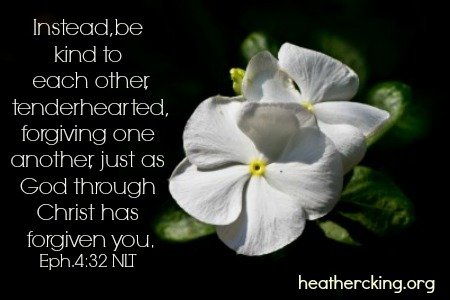
Be kind to one another, tenderhearted, forgiving one another, as God in Christ forgave you” (Ephesians 4:32).

and

bearing with one another and, if one has a complaint against another, forgiving each other; as the Lord has forgiven you, so you also must forgive
(Colossians 3:13).

The nation of Israel had no excuse for treating foreigners poorly, because they had spent centuries being mistreated as foreign slaves in Egypt.

In the same way, we who were once slaves to sin, who have been forgiven, who Christ died for so graciously, have no excuse for not forgiving others.  God overlooked the fact that we didn’t deserve it.  He put aside the issue of whether some would even accept it, and He chose to give grace any way.  So must we.

We model apologizing and forgiveness for my two-year-old, hoping that she’ll learn these principles of grace.  That’s a modeling job we all should be taking on in our homes, at our jobs, with our friends, in our ministries, and in the community.  We show others that we’ve received grace, so we give grace.  We forgive, just as God in Christ forgave us.

Heather King is a wife, mom, Bible Study teacher, writer for www.myfrienddebbie.com and worship leader.  Most importantly, she is a Christ follower with a desire to help others apply the Bible to everyday life with all its mess, noise, and busyness.  To read more devotionals by Heather King, click here.

Copyright © 2012 Heather King

God in Muddy Boots

 Who is like the Lord our God, the One who sits enthroned on high,
  who stoops down to look on the heavens and the earth?
He raises the poor from the dust
and lifts the needy from the ash heap;
  he seats them with princes, with the princes of his people (Psalm 113:5-8).

“Mom, can you tie my shoe?”

I kneel down, slightly off balance, and whip the laces into loops and knots.

“Mom, can you wash my hair?”

Bending over a daughter with her eyes pinched tightly shut, I scrub with shampoo and rinse the suds away carefully.

“Mom, can you show me how to play this on the piano?”

I stoop to press the keys, one hand pointing to the music, the other playing notes, showing melody, showing tempo, showing dynamics.

“Mom, can you hold my hand?”

Tilted to one side, I lean over to entwine our fingers and we swing our arms together to the rhythm of our pace.

“Mom, I’m hurt!”

Dropping to the ground, I clean the wound and press on the miraculous Band-Aid that instantly heals all hurts whether or not blood is involved.

Life with children is a life bent low.  It’s the ministry of kneeling down, stooping over, leaning, and bending to wipe, scrub, heal, hold, read, listen–to love.  So often, it’s the movement down to hug a child and lift her up.

God bends low to reach His children, too.

He could have sat, poised on His righteous throne, holy and unresponsive to our need, drumming His fingers while waiting for us to reach up to Him.

But He didn’t.  Seeing that we could never be righteous enough, He came to us instead, abandoning glory to take up the humble life in human flesh.  Jesus Christ, our Savior, our Sacrifice, is the great Love of God as He bent low in order to raise us up.

And He continued that ministry as He healed and forgave.  Finding Peter’s mother-in-law sick in bed with a fever, Jesus “bent over her and rebuked the fever, and it left her” (Luke 4:39).  Petitioned by a leper for healing, Jesus “reached out his hand and touched the man” (Luke 5:13).  Confronted by an angry mob prepared to stone a woman caught in adultery, Jesus “stooped down and wrote on the ground” (John 8:8).

Jesus could have simply spoken words of healing and forgiveness over anyone.  He had the power to heal with words alone, and sometimes He did.

But other times He chose to make it physical, and it so often required Him to bend low, to stoop, to reach out.  How else can a perfect and holy God touch us who are broken, sick, or dirty from sin?

Jesus didn’t mind the mess.  He touched people even when they were religiously “unclean,” when it was against the rules for them to have contact with other humans because they were so tainted that they’d stain the holiness of others.

This week, at an end-year celebration of a Bible Study group, a woman shared what she learned by studying David’s life.  She described putting on her muddy boots, the sweat pants she doesn’t care about and the raggedy t-shirt that means nothing to her and thinking nothing of getting down into the dirt.

Jesus got down in the dirt with people.  In the same way, this woman said, God didn’t mind getting down into the dirt with King David and He’s willing to do this for us, as well. 

God is not waiting for us to get cleaned up, to overcome, to fix it all up, to climb and clamber to success.   He isn’t put off by our faces smudged with dirt, our hands caked with mud, our fingernails lined with soil from trying to claw our way out of the pit we’re in.

Instead, David tells us:

“He lifted me out of the slimy pit, out of the mud and mire;
he set my feet on a rock and gave me a firm place to stand (Psalm 40:2).

In order to lift David up, God had to reach down low, stretching a hand deep into the darkness to pull the shepherd-king on out to safety and firm ground and light and life.

For those who find themselves in the pit now, remember that God will reach low to you and He will lift you up.  You cannot be so deep in the darkness to be beyond His ability to save you. You cannot be so covered in dirt that He’s scared away or disgusted.

God puts on His muddy boots at times to wade in and rescue us.

Then He calls us to engage in this same ministry of bending low to reach others.  We don’t walk by friends in caverns and potholes and chasms, pretending that everything is all right or hoping for another bystander to reach down and rescue them.

We don’t turn up our noses at the dirt on another’s face,  refusing to stoop down to hold their hand and pull them up.

God wants us to be willing to kneel, stoop, bend, lean, and drop to the ground in all of the humility and love that naturally flows out of people who have been saved themselves.

It’s the ministry of a mom.  It’s the ministry of a child to an aging parent.  It’s the ministry of teachers and a ministry to the wayward and the lonely, the lost and the hurting.  It’s the ministry to the broken and a ministry to the least of these.

It’s the ministry of bending low to love another just as God has done for us.

Heather King is a wife, mom, Bible Study teacher, writer for www.myfrienddebbie.com and worship leader.  Most importantly, she is a Christ follower with a desire to help others apply the Bible to everyday life with all its mess, noise, and busyness.  To read more devotionals by Heather King, click here.

Copyright © 2012 Heather King

And Then There’s Cancer

“God must have a better plan.”
“God always works things out for the best.”
“You can’t out-give God.”
“God always provides.  Look at the birds and the flowers.  He’ll take care of your needs, too.”
“God always comes through.”
“God’s timing is perfect.”
“God never gives you more than you can handle.”

They’re the fairy tale endings of the Christian faith, the trite promises and pat religious phrases we find ourselves spewing out simply when we don’t know how else to explain it when life is hard and overwhelming and scary.

Like when there’s cancer.

Like when there’s starvation and bloating hunger in villages where there simply is no food—not in anyone’s home, not in a local church running a food pantry, not at a grocery store where you can beg for a loaf of bread from other shoppers.

How do we dare make life sound simple, flowery, and easy when it’s not?  This is the conversation I had with a friend this week.

A few days later, in a sanctuary filled with mourners, corporately grieving the loss of a beautiful Christian woman to breast cancer, a few stood up to share their memories and thoughts about her life.  The rest of us passed tissues down the rows and echoed sniffles.

One woman stood and said something I don’t think I’ll ever forget.  In one of their last conversations together, sitting across from a woman so ill from the cancer recurrence filling her lungs with fluid and sapping strength from her limbs, they agreed that they felt beaten down by the promises in Scripture.

They knew death was near and they did not think they’d see the healing, deliverance, restoration, and happy ending they had so longed for, they had prayed for, and that the “happy filter” of God’s promises would make you expect.

So now what?

I remember the moment also when I sat by my dad’s death bed.  He was decrepit, a large man shrunken down to frail bones.  He was living in a sick shell of a body.  Once so witty and smart, boisterous and just plain big in his personality and manner, now he was a trapped soul, mostly in a coma, no longer in control of his body or mind—totally dependent on others, mostly unaware, mostly unresponsive.

I believed and I still believe that the God who could call Lazarus to step out of a tomb, throw off grave clothes and come to life again could have healed my dad at any time, even when death seemed imminent, as in any second near.

But He didn’t.  God chose not to heal that time.  He chose not to heal the woman we remembered at her memorial service this weekend.

What then?

In tears, the woman sharing at the memorial service said that when they felt totally beaten down, like their faith had just been battered and bashed, her friend facing death said, “Then we must pray and ask God to make us more tender.”

Please make me tender, Lord.  Use these times of sadness and the seasons we don’t understand, the moments when faith is so hard to stand on and the promises of Scripture seem too simple to hold true, please then make my heart tender again. 

What other response can there be at times but bitterness?

It’s something I’d never considered before, but both Paul and Peter urged believers to be tenderhearted:

“Be kind to one another, tenderhearted, forgiving one another, as God in Christ forgave you” (Ephesians 4:32).

and

Finally, all of you, have unity of mind, sympathy, brotherly love, a tender heart, and a humble mind” (1 Peter 3:8).

This tender heart so often develops when we ourselves feel broken and beaten down and we are made soft and receptive in the process.ephesians4

If our faith depends on quick answers to prayer and fairy tale lives with superficially happy endings, we’ll be hardened to the needs of others, uncomprehending when they share out of their pain and unmoved by compassion when we see their brokenness.

Not only that, but if our faith doesn’t depend on the Rock of God and His character, but instead stands only on happy (and often misquoted and taken out of context) Christian catch-phrases, we’ll watch the wind and waves of the storm demolish and destroy our houses on the sand (Matthew 7).

We don’t necessarily need enough faith to calm any storm, to walk on the water in the midst of a tempest or sit unmoved and unafraid when our boat seems ready to sink. We just need enough faith to stretch out our hand to Jesus as we sink and cry out, “Lord save me” (Matthew 14:30).

Even that is enough for Jesus to hold us up out of the waves.

Let’s be honest today.  It’s not always easy to sing, “‘Tis so sweet to trust in Jesus.”  Sometimes it’s downright difficult.  It’s murky and hazed over and difficult to see.  Sometimes it’s desperately painful.

But we don’t have to have all the answers.  In fact, we don’t really need to say much of anything at all.  Certainly, we don’t have to pretend that it’s easy or shrug mourning off our shoulders with little more than, “it’s all for the best.”

Instead, we can ask for God to make our hearts tender, soft and pliable in His hands because of the pain we’ve endured.  And we can reach out one desperate hand and cry out, “Lord, save me.” Sometimes, that’s all we can honestly say and that’s enough.

Heather King is a wife, mom, Bible Study teacher, writer for www.myfrienddebbie.com and worship leader.  Most importantly, she is a Christ follower with a desire to help others apply the Bible to everyday life with all its mess, noise, and busyness.  To read more devotionals by Heather King, click here.

Weekend Walk, 04/07/2012

Hiding the Word:

Last night, our family sat at the Good Friday service at church.  We sang hymns about the cross. We read Isaiah 52-53.  My girls nailed papers with their sins written on them to a wooden cross in the front of the church sanctuary with the help of their Daddy and their grandparents.

We remembered the cross and the sacrifice Jesus made there.

Afterward, when we had arrived home, stripped off our jackets and plopped down our belongings, we glanced at our five caterpillars in a cup.  In our short absence, two of them had climbed to the top and tipped themselves upside down.

It’s time.  They know exactly when to spin the silk and form the chrysalis, just as they will know when to emerge as butterflies.

We are waiting with expectation now.  We know the end of their story and it doesn’t stop with upside down caterpillars or bugs entombed in the cocoon of their own design.  New life is the beginning that starts with the end.

In the same way, knowing as we do that Jesus didn’t stay in the tomb, we celebrate Good Friday with hopeful expectation–because Sunday is coming.  His resurrection day is near.

Jesus’ close friends and family, however, hadn’t understood His messages to them.  They didn’t fully expect His death.  They didn’t look forward with hopeful anticipation for His resurrection.  They got it all wrong.

Don’t we get it all wrong so much of the time?  Don’t we expect God to act a certain way, and when He doesn’t, we lose hope?  We grow weary and depressed, perhaps even angry.

We look at circumstances and we pronounce death over them.  We think surely this is over.  Surely nothing can be done.

Jesus defied all of our plans and expectations through His death and resurrection, providing the perfect way of salvation for the entirety of mankind.  He continues to do that today.  When He declares that the time is at hand, He can speak life into every circumstance and situation, and His plan is perfect.

Our verse for the week:

“O death, where is your victory?
    O death, where is your sting?”
The sting of death is sin, and the power of sin is the law. But thanks be to God, who gives us the victory through our Lord Jesus Christ
(1 Corinthians 15:55-56).

You can listen to Matt Maher’s song, Christ is Risen, by clicking on this link or viewing the video from the blog:  http://youtu.be/IExdrZGQVeI

Weekend Rerun:

Surprise!
Originally posted July 27, 2011

All day long people were singing at her.  Smiling and singing.  They tickled her belly, kissed her cheek, hugged her, and said two magic words that she didn’t even understand, “Happy Birthday!”

At first, my now-two-year-old reacted to all this attention with nothing more than a puzzled expression.  By the afternoon of her second birthday, she smiled a sweetly confused grin when we scooped her up for birthday hugs and kisses.  After dinner, she enjoyed the visit from her grandparents, but it wasn’t until I brought out the birthday cupcakes and we sang to her that she really began to understand that this special day was about her.

As soon as I lit the candle, she knew what to do.  She started blowing at the air while I still stood across the room with her birthday cupcake in my hands.  And then after she was covered in icing and Mickey Mouse-shaped sprinkles, I brought out wrapped presents and gift bags.

Her face said it all.  “For me?”  She unwrapped each gift and immediately played with it, read the book, put the puzzle pieces in place, and fed the baby doll.

My little one had been surprised by joy.

How I love that age when the simple fact of a birthday is enough to bring laughter and excitement.  My older daughters now anticipate their big days all year long.  Within a week of turning six, my eldest began telling people she was, “Almost seven.”  I’ve heard all their big plans for birthday parties (despite being told that we’re skipping this year), and yet they plan anyway.

But for my baby girl, there was no anticipation.  She had no idea we were planning for her joy.  She was oblivious to me stashing presents in the closet.  She had no clue I wrapped them during her nap the day before the big day.  She did know that I made cupcakes (she has a sixth sense for finding cupcakes), but she didn’t see me decorate them or pop two candles onto the top of the one just for her.

During those final days before her birthday, her sisters and I were the excited ones.  We looked forward to showering her with special treats and signs of love, even more because we knew she wouldn’t be expecting it.

Matthew 7:11 says, “If you, then, though you are evil, know how to give good gifts to your children, how much more will your Father in heaven give good gifts to those who ask him!”

When we’re feeling broken, just emptied out or filled with fear . . . when we look ahead to an uncertain future, not even knowing what tomorrow will look like for us . . . when we’ve been attacked into the ground, pounded on by trials and Satan and circumstances and one bad event after another . . .

. . . then we remember that God is at work in invisible ways, even when we cannot see His hand, His activity, or His plans.  He gives us the good gifts of salvation, His Holy Spirit, His peace, yes.  But even more, He pours out on us surprises of joy, presents of grace in the unexpected places, an oasis in the midst of our wilderness, and a shooting star of hope across a midnight black expanse of our future.

Angela Thomas in her book Do You Know Who I Am? wrote:

“there is always a hidden work of God.  When you think that God is distant or that maybe God has turned against you, I want you to remember that in the unseen God is plotting for your joy.  He is planning the redemption of your brokenness.”  Angela Thomas

Does it tickle you to think of God in heaven wrapping presents for you, sending down cupcakes with sprinkles just for you–when you least expect it and on a day that seems so ordinary or worse, filled with despair?

That’s what He did for Mary Magdalene, sitting at the tomb of her dead Savior, weeping for the loss of Him and the seeming loss of all He had promised.  In her sorrow, she had traveled to the tomb while it was still dark.  Perhaps she couldn’t sleep, so throwing back her blankets she had simply gotten up and started walking to the place of His burial.

But the stone was gone.  The tomb empty.  She called for the disciples and they searched through scraps of linen for any answer to the mystery of the missing Savior.

There was despair and confusion and hurt.  There was anger and defensiveness about grave robbers and defilers. It was a day that had started out bad enough and was quickly getting worse by the second.

Mary didn’t see Jesus “plotting for her joy.”  He had been at work in the hidden places, descending into hell and snatching the keys of death out of Satan’s hands.  He had risen on that third day and exited the tomb already, but she hadn’t seen any of that.

While God planned her surprise, she: “stood outside the tomb crying” (John 20:11).

It’s not until she sees Jesus herself—not even then, not even when she talks with Him, but only when He calls her by name—that she realizes the victory before her, the amazing miracle of resurrection.

The angels asked her why she was crying.  Jesus Himself asked the reason for her tears.  She cried because the brokenness was all she knew and the evidence of loss and grief was overbearingly present.  An empty tomb, grave clothes in a pile, Savior’s body gone.  That’s what she saw.

Isn’t that what we sometimes see, too?  We see here and now.  Bills due.  Relationships broken.  Uncertainty about the next day and the next.  Unanswered questions.  Danger for our kids.  Loss and mourning.  Difficult ministry.

We see the grave.

God sees the resurrection.

He’s your Father who loves you, who knows how to give you good gifts and is wrapping presents for you, rejoicing “over you with singing” (Zeph. 3:17), and working “for the good of those who love him, who have been called according to his purpose”” (Rom. 8:28).

Heather King is a wife, mom, Bible Study teacher, writer for www.myfrienddebbie.com and worship leader.  Most importantly, she is a Christ follower with a desire to help others apply the Bible to everyday life with all its mess, noise, and busyness.  To read more devotionals by Heather King, click here.

Copyright © 2012 Heather King

Weekend Walk, 03/31/2012

Hiding the Word:

It’s the first full day of Spring Break for us and my kids were up early.  My oldest daughter announced that one of her friends plans to “sleep all day” for spring break.  “How boring!” she said.

My kids plan to pack in as much activity as possible.

So, it wasn’t even 8 a.m. yet when one of my girls was inspired to start singing.  She pulled out a travel CD of Bible songs that Grammy gave them a few Christmases ago and popped it into the CD player in her bedroom.  I started hearing the chorus of “Deep and Wide” emanate through the house . . . loudly.  This daughter of mine always sings with passion.

Inspired, my baby girl ran into the playroom and pulled out the entire plastic drum of instruments.  The harmonica was humming, the cymbals crashing, the sleigh bells jingling, the clackers clacking, the triangle jingling.  Yes, even the kazoo was buzzing.

It was an early morning symphony of praise in my tiny house and it may have sounded like pots and pans at times down here.  To God, though, it’s spontaneity and passion must have sounded beautiful.

We are preparing to enter the Passion Week, the time when we remember Good Friday when Christ died for us and Resurrection Day when He conquered death and the grave.  When Jesus entered Jerusalem for that final week, the people filled the air with waving palm branches and shouted, Hosanna! Blessed is he who comes in the name of the Lord, even the King of Israel!” (John 12:13).

They shouted praise to Him because of false expectations and misplaced excitement.  They didn’t praise Him for being a Savior, for laying down His own life to provide redemption for their sins.

No, they hailed Him as a conqueror, rebel, and over-thrower of the earthly kingdoms.  When they realized that’s not what He was doing, they mostly abandoned Him. The palm branches stopped waving.  The people stopped shouting “Hosanna” and started shouting “Crucify Him.”

My praise can be tainted by misplaced expectations also.

So, this week, I am meditating on a verse that reminds me to praise God when He behaves the way I expect and when He doesn’t.  It’s my hope to sing praise to God with the passionate simplicity of children crooning with their Bible songs CD and clanging together toy instruments.

It seems appropriate to prepare for the Passion Week with praise:

I will bless the Lord at all times;
    his praise shall continually be in my mouth.
My soul makes its boast in the Lord;
    let the humble hear and be glad.
 Oh, magnify the Lord with me,
    and let us exalt his name together!  (Psalm 34:1-3 ESV)

Weekend Rerun:

Am I the One, Lord?
Originally posted on April 5, 2011

“Examine yourselves to see whether you are in the faith; test yourselves.”  2 Cor. 13:15

Twelve disciples, one Savior, reclined and relaxed, celebrating Passover together in an Upper Room.  Thirteen share in a meal of remembrance that they would always remember and that we continue to remember.   The Last Supper.  Communion.  “Do this in remembrance of me.”

Together they have eaten and laughed, declared “For His mercy endures forever” and sung hymns in worship.  They are jovial, anticipatory, expecting Christ’s triumph in Jerusalem.

Jesus leans in, “While they were eating, he said, ‘I tell you the truth, one of you will betray me’ (Matthew 26:21, NLT).

Silence.  Stillness.  Seriousness.

If Jesus said this at the end of a church service today and the pianist played the quiet first notes of the closing hymn, many of us would be nudging our neighbor or making concerted efforts NOT to stare at the person across the room.  (Or, perhaps, making lunch plans and quieting the rumbles in our stomachs.)  It’s you, it’s you, it’s you—we might think.  That sermon is for you!  That heaviness of the Holy Spirit—it’s for you!  I’ve seen your sin.   I know your need to repent.

And yet, 12 disciples, “greatly distressed, each one asked in turn, ‘Am I the one, Lord?’” (Matthew 26:22, NLT).

Am I the one, Lord?

This seeking is our salvation.  We ask the dangerous question and we allow the Holy Spirit to turn over our hearts and reveal our own true need to be at the altar and lay it down.  Or the Holy Spirit searches, finds purity of heart, and invites us to pray for those around us still struggling.

It’s our complacency and satisfaction with our spiritual dwelling place that leads to our downfall.  It’s when we stake our claim to land and decide we’ve traveled enough in this road to Christ that we edge our way to danger.  I’m pure enough.  Good enough.  I’m not lukewarm.  I’ve conquered the “big” sins.  I read my Bible.  I pray.  I’m close to God.  I have a strong ministry.

I’m good.  Right here, in this place, I’m good here.

But this journey to Christ is ongoing.  As long as we are alive on this planet, we are imperfect creatures in need of an ever-closer intimacy with our Savior.

This moving to Christ requires moving away from something else.  It’s a necessity of the road.   In order to go forward, we must leave something behind.

That was true for Israel.  God called them to Canaan when He beckoned Abram out of Mesopotamia and its many gods and idols.  God called them back to the Promised Land when He led them out of Egypt and they left slavery for freedom.

They walked towards promise, but it involved rejection—rejecting the old definition of “normal.”  It was “normal” for those in Abram’s home town to pray to statues and worship bits of stone and wood.  It was “normal” in Egypt for male babies to be slaughtered simply for population control.

It’s “normal” for us to be too busy for God, to lose it with our kids, to be selfish, to feel jealousy, to cheat, to lie, to overindulge , to worry, to rebel, to gossip. . .  We think these sins are acceptable because everyone does them and no one can be perfect.

Yet, God calls us out of “normal” and into radical.  He doesn’t ask us the hard questions to shame us or humiliate us.  He does it to draw us close to Him so that we are “being transformed . . .from glory to glory” (2 Corinthians 3:18, NKJV).

Eugene Peterson wrote, “Repentance, the first word in Christian immigration, sets us on the way to traveling in the light.  It is a rejection that is also an acceptance, a leaving that develops into an arriving, a no to the world that is a yes to God.”

Peter sat at that Passover table and asked the dangerous question, “Am I the one, Lord?”  He allowed the searching of his heart.  It wasn’t him.  Eleven of those at the table endured their souls being turned over and could say that they were innocent of this betrayal.

Yet, then they stopped asking.  That’s our weakness, too.   When we stop asking the Holy Spirit to search us, when we become complacent and self-assured, it’s when we will betray.

Like Peter.  Jesus predicted Peter would deny Him.  “Peter answered and said to Him, ‘Even if all are made to stumble because of You, I will never be made to stumble.’  Jesus said to him, ‘Assuredly, I say to you that this night, before the rooster crowd, you will deny Me three times.’  Peter said to Him, ‘Even if I have to die with You, I will not deny You!’  And so said all the disciples” (Matthew 26:33-35, NKJV).

But, he was wrong.  Jesus arrested.  Jesus taken away in chains.  Jesus bullied, beaten, spat on, and mocked.  Peter in the courtyard answering the questioning accusations of others by the fire.  “I never knew the fellow.  I wasn’t one of his disciples.  I didn’t follow Him.”

He stumbled into betrayal because he was complacent.  Peter thought he knew what was in his heart, that he was right with God and strong in his faith.  So, he stopped asking, “Am I the one, Lord?” and started saying, “Not I.”

And so we must ask and keep on asking, “Search my heart, search my soul.  There is nothing else that I want more.  Shine Your light and show Your face.  In my life, Lord, have Your way, have Your way” (Hillsong United).

*******************************************************************************************************

Heather King is a wife, mom, Bible Study teacher, writer for www.myfrienddebbie.com and worship leader.  Most importantly, she is a Christ follower with a desire to help others apply the Bible to everyday life with all its mess, noise, and busyness.  To read more devotionals by Heather King, click here.

Copyright © 2012 Heather King