Online Bible Study: Week Five, Chapters 9 & 10

We’re starting week 5, which means we’re over halfway into the Bible Study!  This is about the point where with busyness and stress it’s easy to miss a chapter or lag behind.  Please be encouraged and don’t give up!  Just read where you are and post when you can so that you don’t miss out on the lessons God wants to share with you and so that we don’t miss out on what you have to add to the discussion.

Chapters 9 & 10:  My Thoughts

It was loud in here this morning.

My youngest had discovered the volume button on the television and was sharing the sounds of Max and Ruby with all our neighbors.  My middle girl pulled out an entire town worth of toys and was neighing for the horses and vrooming for the cars.  My oldest was playing the piano and, in order to compensate for the rising residual noise, she played each note louder and louder.

Sometimes life is noisy.  Sometimes we can do something about it.  We can simplify our schedule, eliminate activities we shouldn’t be doing, take it slow, turn off the electronics for a bit and sit on the back porch on a summer evening and enjoy the silent night sky.

Sometimes, though, the volume of life is outside our control.  There are seasons where no matter how many activities we trim off the calendar, we’re just busy.  We have kids.  We have jobs.  We have carpools and doctor’s appointments, meetings and ministry, caregiving to perform or we’re trading in sleep for 3 a.m. feedings.

There are also seasons of storms, like the hurricane season we’re approaching.  One violent tempest after another shakes our simple fishing boat.  The winds are screaming.  The waves are roaring.  And it’s loud on the sea and no matter what we do, hearing the voice of God is difficult.

The disciples on the boat in the middle of the storm must have been shouting instructions to one another over the wind and waves.  It was loud, frightening and chaotic and there was little they could do about it.

For Elijah, God spoke in a still small voice at the Mountain of God.  But, for Job and for the disciples, God’s powerful voice cut through the din of wind and rain.  Job 38:1 says, “Then the LORD spoke to Job out of the storm.”  And Mark 4:37-39 tells us:

A furious squall came up, and the waves broke over the boat, so that it was nearly swamped. Jesus was in the stern, sleeping on a cushion. The disciples woke him and said to him, “Teacher, don’t you care if we drown?”  He got up, rebuked the wind and said to the waves, “Quiet! Be still!” Then the wind died down and it was completely calm.

Jesus, Jehovah-Elohim, the All-Powerful God, spoke through the storm and the terrified ones in the middle of the tempest heard Him clearly and they witnessed His power over their circumstances. His is indeed a powerful voice.

And the point of it all, when His voice commands calm in the loudest of our life’s hurricanes, is that He be glorified.  The disciples were “terrified and asked each other, ‘Who is this? Even the wind and the waves obey him!'”  (Mark 4:41).  On page 125, Priscilla Shirer wrote: “Jesus often chose the option that gave Him the greatest opportunity to demonstrate God’s power.”

He’ll be glorified in your storm.  Let that be what we seek—not rescue for our own sake and safety, but miraculous salvation for the glory of His name and so that we can “focus our attention on Him, learn more about Him,and praise Him” (p. 124).

Chapter Outlines:

Chapter 9: A Truthful Voice

On page 111, she notes that Jesus consistently told His disciples, “I am telling you the truth” and that after His ascension, He sent to them the Holy Spirit who would “guide you into all truth.”  What the Holy Spirit says to us will always be borne out in the unquestionable truth of God’s Word.

That truth should shake us up at times because we should allow it to challenge our traditions, feelings, and actions (pp. 112-113).

She also talks about the power of God’s Word to demolish strongholds in our lives, noting on p. 116: “The lies were quieting and His truth was ringing loudly.”

Chapter 10: A Powerful Voice

Please see “My Thoughts” above this week, as I covered much of what she wrote in this chapter.

Your Thoughts:

  • As always, what were some of your favorite quotes, passages, or verses from this week’s reading?
  • Do you have a Scripture that God has used to break down a stronghold in your life?  Maybe a verse that you go to time and again to fight against the attacks of Satan.
  • Tell about a time that you heard God’s voice clearly in a life storm.
  • On p. 126, she asked, “Do you truly believe there is enough power in God’s voice to do these kinds of things in your life today?”  Would you share with us your answer to that question?

Heather King is a wife, mom, Bible Study teacher, writer for www.myfrienddebbie.com and worship leader.  Most importantly, she is a Christ follower with a desire to help others apply the Bible to everyday life with all its mess, noise, and busyness.  To read more devotionals by Heather King, click here.

Copyright © 2011 Heather King

Surprise!

All day long people were singing at her.  Smiling and singing.  They tickled her belly, kissed her cheek, hugged her, and said two magic words that she didn’t even understand, “Happy Birthday!”

At first, my now-two-year-old reacted to all this attention with nothing more than a puzzled expression.  By the afternoon of her second birthday, she smiled a sweetly confused grin when we scooped her up for birthday hugs and kisses.  After dinner, she enjoyed the visit from her grandparents, but it wasn’t until I brought out the birthday cupcakes and we sang to her that she really began to understand that this special day was about her.

As soon as I lit the candle, she knew what to do.  She started blowing at the air while I still stood across the room with her birthday cupcake in my hands.  And then after she was covered in icing and Mickey Mouse-shaped sprinkles, I brought out wrapped presents and gift bags.

Her face said it all.  “For me?”  She unwrapped each gift and immediately played with it, read the book, put the puzzle pieces in place, and fed the baby doll.

My little one had been surprised by joy.

How I love that age when the simple fact of a birthday is enough to bring laughter and excitement.  My older daughters now anticipate their big days all year long.  Within a week of turning six, my eldest began telling people she was, “Almost seven.”  I’ve heard all their big plans for birthday parties (despite being told that we’re skipping this year), and yet they plan anyway.

But for my baby girl, there was no anticipation.  She had no idea we were planning for her joy.  She was oblivious to me stashing presents in the closet.  She had no clue I wrapped them during her nap the day before the big day.  She did know that I made cupcakes (she has a sixth sense for finding cupcakes), but she didn’t see me decorate them or pop two candles onto the top of the one just for her.

During those final days before her birthday, her sisters and I were the excited ones.  We looked forward to showering her with special treats and signs of love, even more because we knew she wouldn’t be expecting it.

Matthew 7:11 says, “If you, then, though you are evil, know how to give good gifts to your children, how much more will your Father in heaven give good gifts to those who ask him!”

When we’re feeling broken, just emptied out or filled with fear . . . when we look ahead to an uncertain future, not even knowing what tomorrow will look like for us . . . when we’ve been attacked into the ground, pounded on by trials and Satan and circumstances and one bad event after another . . .

. . . then we remember that God is at work in invisible ways, even when we cannot see His hand, His activity, or His plans.  He gives us the good gifts of salvation, His Holy Spirit, His peace, yes.  But even more, He pours out on us surprises of joy, presents of grace in the unexpected places, an oasis in the midst of our wilderness, and a shooting star of hope across a midnight black expanse of our future.

Angela Thomas in her book Do You Know Who I Am? wrote:

“there is always a hidden work of God.  When you think that God is distant or that maybe God has turned against you, I want you to remember that in the unseen God is plotting for your joy.  He is planning the redemption of your brokenness.”  Angela Thomas

Does it tickle you to think of God in heaven wrapping presents for you, sending down cupcakes with sprinkles just for you–when you least expect it and on a day that seems so ordinary or worse, filled with despair?

That’s what He did for Mary Magdalene, sitting at the tomb of her dead Savior, weeping for the loss of Him and the seeming loss of all He had promised.  In her sorrow, she had traveled to the tomb while it was still dark.  Perhaps she couldn’t sleep, so throwing back her blankets she had simply gotten up and started walking to the place of His burial.

But the stone was gone.  The tomb empty.  She called for the disciples and they searched through scraps of linen for any answer to the mystery of the missing Savior.

There was despair and confusion and hurt.  There was anger and defensiveness about grave robbers and defilers. It was a day that had started out bad enough and was quickly getting worse by the second.

Mary didn’t see Jesus “plotting for her joy.”  He had been at work in the hidden places, descending into hell and snatching the keys of death out of Satan’s hands.  He had risen on that third day and exited the tomb already, but she hadn’t seen any of that.

While God planned her surprise, she: “stood outside the tomb crying” (John 20:11).

It’s not until she sees Jesus herself—not even then, not even when she talks with Him, but only when He calls her by name—that she realizes the victory before her, the amazing miracle of resurrection.

The angels asked her why she was crying.  Jesus Himself asked the reason for her tears.  She cried because the brokenness was all she knew and the evidence of loss and grief was overbearingly present.  An empty tomb, grave clothes in a pile, Savior’s body gone.  That’s what she saw.

Isn’t that what we sometimes see, too?  We see here and now.  Bills due.  Relationships broken.  Uncertainty about the next day and the next.  Unanswered questions.  Danger for our kids.  Loss and mourning.  Difficult ministry.

We see the grave.

God sees the resurrection.

He’s your Father who loves you, who knows how to give you good gifts and is wrapping presents for you, rejoicing “over you with singing” (Zeph. 3:17), and working “for the good of those who love him, who have been called according to his purpose”” (Rom. 8:28).

Heather King is a wife, mom, Bible Study teacher, writer for www.myfrienddebbie.com and worship leader.  Most importantly, she is a Christ follower with a desire to help others apply the Bible to everyday life with all its mess, noise, and busyness.  To read more devotionals by Heather King, click here.

Copyright © 2011 Heather King

Online Bible Study, Week Four: Chapters 7 & 8

It’s Week 4 in our 8-week study of Priscilla Shirer’s Discerning the Voice of God!  Can you believe we’re about half-way through?

Even last week we had ladies introducing themselves to the group and continuing to post in previous weeks.  Please read back through their comments so you don’t miss anything.

My Thoughts

Life is like . . .”A box of chocolates; you never know what you’re gonna get.”

Well, maybe, but for many of us life seems more like standing in the woods with 20 paths to choose and only one way is the will of God.  You eeny, meeny, miney moe, cross your fingers, travel down a road and hope it’s the one God wanted you to choose.

Someone said to me this week, “I just want to make sure this is God’s will.”

Have you heard that?  Have you said that? About a job, who to marry, where to go to college and what to study, what car to buy, where to live, about a million choices you’ve had to make over time?

A few weeks ago, I wrote: “Sometimes we envision God’s will for our lives as a hit or miss discovery.  We occasionally stumble into God’s will and then other times trip right out of it.

When we worry and fret over God’s will in that way, we are saying that God is fickle and demanding, that He removes His love and favor at whim if we fail to choose the right answer in the multiple choice test of life.

As long as our hearts are set on obedience and the desire of our heart is to be in God’s will, we can trust the God who created communication to communicate His desires to us.”

Should we desire to do God’s will?  Most definitely.  Walking with Him is always the best place to be.  Are there things we can do to help us discern God’s will?  Sure.  Know the Word.  Seek Godly counsel.  Pray. And then trust Him.

On page 97, Priscilla Shirer writes:

David concluded Psalm 119:10 (NASB) with these words: “Do not let me wander from Your commandments.”  Notice that he puts the responsibility for staying in the will of God on God Himself.  He says, “You, God—please don’t let me wander from Your will!”  Our responsibility is to get to know God.  His is to keep us from wandering from His will for our lives.

That’s incredible freeing for me, to know that my job is to know Him; His job is to direct me.  We won’t just fall out of God’s will one day.  We actually have to climb out in purposeful disobedience.

Chapter Outlines:

Chapter Seven

On page 92, she writes, “He moves your relationship with Him from a mental one to an experiential one that reveals even more about Him.  As you move from knowing about God, to experiencing God, to knowing God, the more clearly you will discern His voice.”

She highlights over the course of both chapters several of God’s attributes revealed in His names:

  • Jehovah-Jireh, God our Provider, p. 92
  • Jehovah-Rohi, God our Shepherd, p. 93
  • El-Shaddai, the All-Sufficient God, p. 94
  • Jehovah-Shalom, God of Peace, p. 102

She notes on p. 95 that, “As hard as he (Satan) tries to imitate the voice of God, he will never sound exactly like the real thing; and the more intimate we are with God, the more quickly we’ll be able to tell who is really speaking.”

On p. 95, she challenges us to make sure we are not “voice hunting more than God hunting.”

Chapter Eight:

On p. 103, she notes that peace shouldn’t just “be a part of our lives; it is to rule in our lives.”  Having peace in a situation is a powerful way to discern God’s direction.

Not only that, but she reminds us that relational peace should help us decide what to do.  “Peaceable relationships are important to God.  Therefore, we can conclude that the Holy Spirit will not lead us to do anything that in any way hinders peace and unity in the body of Christ” (p. 105).

Your Thoughts:

  • What name of God is most precious to you right now and why?  (She gives some examples, but you don’t need to confine yourself to the names she chooses).
  • What do you think about the idea that “it is God’s responsibility to cause you to hear and recognize His voice”? (p. 98).
  • How does peace factor into how you make decisions?

    Heather King is a wife, mom, Bible Study teacher, writer for www.myfrienddebbie.com and worship leader.  Most importantly, she is a Christ follower with a desire to help others apply the Bible to everyday life with all its mess, noise, and busyness.  To read more devotionals by Heather King, click here.

Where is the Whole World?

I sought the LORD, and he answered me; he delivered me from all my fears.
Psalm 34:4

During my second pregnancy, I went happily to my 20-week ultrasound and learned we were having another girl (the joys of pink!) and that she was healthy and developing well.

Except she was small.  They said smaller than she should be and I’d need to go get a 3-D ultrasound at a specialized neonatal center.  But, not to worry, they were sure it was okay.  This was just to be safe.

One 3-D ultrasound later, the technician sent back the report.  She was healthy.  Good heart.  Good blood flow.  Organs just fine.  But she was small.  Too small.  It was probably okay, but just to be safe I had to go for weekly stress tests for the remainder of the pregnancy and some more ultrasounds.

Every stress test was fine.  She was moving (boy was she moving!) and she was growing, but not fast enough.  She was just too small.  But, no need to worry, they said, because she was probably just fine; it’s just that they needed to induce her a week early so they could figure out why she was so small (under 5 pounds they said) and help her grow outside the womb.

We packed a bag for the hospital and let the Pitocin get to work.  Induction was terrible; the worst of my three deliveries.  In the end, though, Lauren was born.  I didn’t have my glasses on.  I couldn’t see her.  Was she okay?  Was she too small?  Was she in danger or sick or worse?

My husband served as my eyes for me.  At first he said nothing; she was purple they told me later from the chord double-wrapped around her neck. But then she cried.  And my husband said, “She’s beautiful.  She’s perfect.”

The NICU pediatrician who had been on call to assist at the delivery of this at-risk baby peeked over the nurses’ shoulders and left the room without a word.  The nurse laid her on the scale.  She weighed 6 pounds 13 ounces, my one-week-early little one, too big for the preemie outfits we’d picked out for her.  God had brought her to us safe, healthy, and gorgeous and we praised Him, so tearfully thankful for His protection over our baby girl.

Between that first announcement that our baby was too small and the moment we saw her, we fought against fear.  My husband and I held hands and prayed for her each night.  We calmed our fears and shrugged off ultrasound results.  Then I’d sit at the next appointment and be told once again that she was just too small. All the anxiety we had kept at bay rushed in with renewed strength.

Someone asked me during that time, “You’re not freaked out about this, are you?”

I didn’t know.  Was I freaked out?  Was I okay?  It wasn’t the same from day to day or minute by minute.  I was fine.  I was scared.  I was trusting.  I was fearful.  I was relying on God.  I was unbelieving.

At that time, Tim Hughes was singing on the radio:
When all around is fading, and nothing seems to last
When each day is filled with sorrow
Still I know with all my heart
He’s got the whole world in His hands
I fear no evil, for You are with me
Strong to deliver, mighty to save

The whole world is nestled in the safety of His hands.  My world that I saw every day.  The world of my unborn baby girl, whose somersaults I could only envision and whose face I couldn’t wait to see.  Yes, her world was in His hands, too, and so I had to trust her to His care.

Isaiah wrote: “So do not fear, for I am with you; do not be dismayed, for I am your God. I will strengthen you and help you; I will uphold you with my righteous right hand” (Isaiah 41:10).

Held in His hands as I am, still there are so many reasons to tremble.

For bills and jobs and relationships, for school, health, my kids’ friendships, safety and their faith, for my daughter not getting lost, for school bus rides and mean girls, for conflict, for things I forgot to do, for the decisions I make as a mom and how often I mess it all up, for the future, for the unseen, for the nosebleed that I’ve blown up into a brain tumor, for what’s happening tomorrow and what’s happening ten years from now, for the divorces I’ve witnessed and how did it all happen anyway, for the things I said and the things I didn’t say.

But when I’ve lost my breath because of worry and fretted over a solution only to find no visible answer, nothing I can do, and no way to fix the problem or avert disaster, then I remember hope.

Oh yes, now I remember hope.

Fear says, “There is no way out of this.”
Hope says, “God is going to make a way.”

Fear tells me “You’ve messed this up so badly there’s nothing that can fix it.”
Hope says, “I have a Redeemer who can heal and restore even what is dead.”

Fear whispers, “What you can see is all there is and that’s not enough.”
Hope shouts, “The Lord created the universe with His words.  He can create something out of nothing.”

Fear argues, “You’ve been abandoned.  God doesn’t even care that you are under attack.”
Hope assures me, “You are held in His hand, carried through hardship by His open palm.”

This world, my life, the daily schedule, the care of my children, the bills and the doctor’s appointments, and all there is remains outside my control.  That’s why there is fear.  It’s ridiculous pride and foolish unbelief that makes me believe God can’t possibly care for me and that I could do better on my own.  So I worry because I’d like to control the uncontrollable.

Fear isn’t an enemy you defeat once and then mount on your wall like a trophy.  It’s a sneaky foe, inching it’s way into your life at the slightest provocation.  It creeps into your thoughts at night and asks to be your companion as 3:00 a.m. and then 4:00 ticks and tocks by on your nightstand alarm clock.

In the night as you rumple the covers with your constant turning, when the bill comes, when your child steps onto the school bus, when you sit in the doctor’s office, when the lawyer calls . . . remember hope.  It’s the ultimate weapon in this battle against fear.  We have hope because we’re in His hands and so is our whole world.  Our kids in His hands.  Our finances in His hands.  Our jobs, our marriages, our friendships, our ministries, our careers, our future—in His hands.

We say with the Psalmist, “Even though I walk through the darkest valley, I will fear no evil, for you are with me” (Psalm 23:4).

Heather King is a wife, mom, Bible Study teacher, writer for www.myfrienddebbie.com and worship leader.  Most importantly, she is a Christ follower with a desire to help others apply the Bible to everyday life with all its mess, noise, and busyness.  To read more devotionals by Heather King, click here.

Copyright © 2011 Heather King

Well-Hunting in the Desert

“Water will gush forth in the wilderness and streams in the desert. The burning sand will become a pool, the thirsty ground bubbling springs”
(Isaiah 35:6-7).

When we first moved into this house, we quickly discovered something unnoticed during the walk-through or inspection.  The water smelled like rotten eggs. As a result, I was brushing my teeth with bottled water and holding my breath while taking a shower.

Like any good 21st century homeowners, we Google-searched our way into solutions and scoured the Internet for answers.  Which we found.  Simply open the top of our well and shock the water with a $1 jug of bleach.

Sounded easy.  Until we realized that somewhere on this half acre of land is the top to a well that we could not find.  We knew it had to be there.  We had running water and didn’t pay the city for it.  We consulted drawings of our property and sheepishly hinted to the water specialist (whom we had to call since we couldn’t fix the stinky water ourselves, having not found the well), that we really would like to know where the well was hidden on this land of ours.  He wasn’t helpful.

We have a guess as to where it might be, but we are in some ways still well-hunters, searching for the source of our water, assuming its presence without seeing it ourselves.

I’ve been well-hunting recently in real life, too.  Like Hagar, wandering in the wilderness, running low on provisions, hopelessly lost and not able to go back and yet not certain where to go instead. Out there in her wilderness, “God opened her eyes and she saw a well of water” (Genesis 21:19).

“Open my eyes,” I’ve prayed, “to the well of your provision, to the fountain of Your presence, to the water of sustenance and hope. I want to see the well You have provided in this desert place.”

Because I’m parched and yet I feel like I’m drowning.

It’s so often God’s way to bring water and with it so much more to those in His care.

To Hagar, a well in the desert that she hadn’t seen before.

To Elijah, “bread baked over hot coals, and a jar of water” to sustain him on a 40-day walk to the Mountain of God (1 Kings 19:6).

To the Israelites who complained, “there is no water to drink!,” He brought forth water from rock.

For the redeemed, He promises that “water will gush forth in the wilderness and streams in the desert. The burning sand will become a pool, the thirsty ground bubbling springs” (Isaiah 35:6-7).

To the woman sitting next to a well with a jar on her shoulder, living water drawn up even without a bucket (John 4:10).

Out of nothing, amidst wilderness and desert, even burning sand, He brings water that heals, sustains, provides, and gives life eternal.  He brings it in abundance with bubbling springs, streams filled so quickly that they are pooling, water we could drink that would satisfy us forever.  All out of nothing.

We could spend our lives sitting by clear-running streams of water, never risking the travel through the valley.  We could pitch our tents there by the known source of water and never lose sight of the well, never grow uncomfortable, never walk far enough away to be uncertain of provision, never venture one step into the wilderness.

But we’d never make it to the Mountain of God like Elijah and the Israelites.  Never know the God Who Sees like Hagar.  Never know the Giver of Living Water like the woman at the well.

So, as we scan the horizon and see only barren land, rocks of gray and dusty earth cracked from lack of rain, we search for the well.  It’s there.  Maybe hidden now so that we cannot see, but God works in the hidden places to bring us provision at the exact moment of our need.

David searched for the well in the desert.  He wrote:

“You, God, are my God, earnestly I seek you; I thirst for you, my whole being longs for you, in a dry and parched land where there is no water” (Psalm 63:1).

and

“As the deer pants for streams of water, so my soul pants for you, my God.
My soul thirsts for God, for the living God” (Psalm 42:1-2)

David, my fellow well-hunter, knew the best way to find the hidden water, even when his soul was downcast, even when he thirsted for God’s presence like a deer dehydrated after too long a journey away from the stream.

  • Put your hope in God.
  • Praise Him even in sorrow.
  • Remember what God has done.

He says: Why, my soul, are you downcast? Why so disturbed within me? Put your hope in God, for I will yet praise him, my Savior and my God.  My soul is downcast within me; therefore I will remember you (Psalm 42:5-6).

Years ago, Caedmon’s Call sang these words: “Down in the valley, dying of thirst.  Down in the valley, it seems that I’m at my worst.  My consolation is that You baptize this earth when I’m down in the valley.  Valleys fill first.”

Valleys fill first, my friend.  When God brings the water, when He rains down “showers of blessing” in their season (Ezekiel 34:26), the valley is where you will want to be so that you can fully receive all that He pours over your head.

Heather King is a wife, mom, Bible Study teacher, writer for www.myfrienddebbie.com and worship leader.  Most importantly, she is a Christ follower with a desire to help others apply the Bible to everyday life with all its mess, noise, and busyness.  To read more devotionals by Heather King, click here.

Online Bible Study: Week 2, Chapters 3 and 4

Welcome back Bible study friends!  I’m glad to see you here for week 2 of our time together reading Priscilla Shirer’s Discerning the Voice of God.  Some quick notes before we begin this week:

Thanks so much to all who shared in last week’s discussion. I learned so much from you!

Some of you were still getting the book as of the end of last week.  I want to reassure you that there is time for catching up and no need to feel overwhelmed. These posts of mine will fall at the beginning of each section.  That means you can start the week’s reading on Monday morning and post comments whenever you feel ready (or as you feel ready) all week long.  You can also easily go back to old posts by clicking here: Online Bible Study.

The comments can be short!  You don’t have to answer every question and certainly not all at once unless you want to.  If you only have time to write a sentence or two, that’s perfectly fine.

Here goes week two!

My Thoughts

My family used to have several Magic Eye books, each page filled with bright colors and wavy lines.  If you stared long enough and in just the right way (they say don’t cross your eyes, but I usually did), then a 3-D image would pop off the page for you to see.

I occasionally managed to manipulate my eyes and the book and see the hidden pictures.  What I’ve never been able to do, though, is stare at a close-up photograph of an object and decipher the whole image from just a tiny piece.  (Like the pictures along the side).

In the same way, most of us can see the amazing, gloriously evident work of God in our lives.  When He’s big, awesome, miraculous, life-changing and writing words on hearts in neon, we notice.  We see the “Magic Eye” pictures of God.

But it’s much harder when we look close-up at the images of life to determine the big picture view.  What exactly are we looking at?  A cornflake?  A spider web?  A temptation?  God’s will?  A trial?  A blessing?

We can’t tell because we can’t walk far enough away from our daily lives to scan the entirety of the picture—past, present, future—and see the true image that God sees.

Oh, how simple this faith-walk would be if the magic pictures always popped off the page for us, if the 3-D image of God’s plan was ever before us, magnificent, amazing and clear.  This is what we so often ask for.  We look for signs and wish for physical manifestations of our Mighty God.

Priscilla Shirer says:

We want God to show us His will in a tangible way–a sensational way . . . What we want is for God to speak today the same we He spoke in Old Testament times.  It seemed much easier to discern God’s voice back then (p. 45).

While God is ever-creative and able to speak to us in any way He chooses, since the time of Christ’s ascension:

the primary way God has spoken to His people has been through the person of the Holy Spirit, who confirms God’s written Word and applies it to our life.  The Holy Spirit and the Bible go hand in hand (p. 50).

We so often overlook the powerful gift of the Holy Spirit living in us!  Do we truly understand what it must have been like not to have God with us and in us all the time, whenever and wherever we went?

In the Old Testament, people traveled to a physical building where God’s Spirit dwelt and the Holy Spirit “only came to specific people at a specific time in order to achieve a specific task.  When that task was accomplished (or when those people sinned or rebelled), the Holy Spirit withdrew” (p.49).

We feel jealous of those who saw God intermittently.  Sure it was unmistakable and flashy, but it was not ever-present.  Wouldn’t those same people be jealous of us, having the very Spirit of God with us at all times, guiding and directing us in our moment-to-moment lives?

Even when we cannot see the big picture, we can trust that the Spirit within us does and He’s leading us in the way we need to go.  There’s power in the presence of God if only we learn to listen.

(I’ll post the answers to the pictures at the bottom of the page.)

Walking Through the Book:

Chapter 3: A Marvelous Voice

On pages 48-50, she walks us through primary ways God has spoken over time:

  • Old Testament: The person of a prophet confirmed usually through a visible sign.
  • The time of Christ: The person of His Son confirmed through miracles.
  • After Christ’s ascension: The person of the Holy Spirit confirmed through God’s written Word, the Bible.

That’s not to say God cannot or does not ever use miraculous means to speak to us today.  As she notes, though, “if God chooses to speak in miraculous ways today, these ways do not lay the foundation for us to hear from Him.  Rather they just provide confirmation of the messages we receive through the Holy Spirit’s leading and the guidelines of Scripture” (p.51).

We must always go back to God’s Word as our touchstone of truth.

Chapter 4: A Guiding Voice

Because we fellow-Bible study participants aren’t all from the same denomination, we might disagree about some issues, like how and when we experience the Holy Spirit.  Let’s not get distracted by that discussion because on the foundational, salvation-dependent doctrinal issues we have agreement.

Here’s what we do know: the Holy Spirit within us allows us to hear God’s voice and understand His truth more clearly (p. 57).

She also notes that “our human conscience is not the voice of God.  It isn’t infallible” (p. 59).  Our moral guidelines and consciences can be deceived and deformed.

Over time, though, as we transform into being more Christ-like, there is an agreement between our conscience and the Holy Spirit (p. 67).  Eventually our conscience becomes a method our “control tower” uses to direct our “pilot” as we make decisions.  “He is steering us into God’s will” (p. 61).

This transformation by the renewing of our minds is gradual.  “So, as you listen to your Spirit-led conscience, we must always confirm what we hear” and as she notes, He will graciously confirm it (p. 62-63).

The guidelines she gives us for discerning God’s voice (p. 63):

  • Look for the MESSAGE of the Spirit.
  • Search the MODEL of Scripture for guidance.
  • Live in the MODE of prayer.
  • Submit to the MINISTRY of Eli (counsel of a mature believer).
  • Expect the MERCY of confirmation.

Your Thoughts:

  • Can you give an example from your own life or in Scripture when God graciously confirmed His word?
  • Do you have “Eli’s” in your life—mature believers who give Godly counsel?  How did you choose them and in what ways have they helped you?
  • Have you ever been confused by what God is doing in the here and now only to have Him reveal the big picture much later on?
  • What are some of your favorite quotes/Scriptures/passages from chapters 3 and 4 that you’d like to talk about?

What were those close-up pictures above?  Some of you may be better at this than me and have been able to guess–a pinwheel and a flyswatter. 

Heather King is a wife, mom, Bible Study teacher, writer for www.myfrienddebbie.com and worship leader.  Most importantly, she is a Christ follower with a desire to help others apply the Bible to everyday life with all its mess, noise, and busyness.  To read more devotionals by Heather King, click here.

Copyright © 2011 Heather King

Becoming a Zucchini Farmer

I’ve found my calling, my true gift and talent—growing zucchini.  So, I’m contemplating a new life as a zucchini farmer.

When we planned this mini-garden of ours, my daughters announced that they must grow and eat their own food.  They wanted to plant and watch it grow, pick it with pride and then serve it up with dinner.

Not knowing how well we could produce food we actually eat like tomatoes and cucumbers, I planted two spindly little zucchini sprouts in the garden.  I’d seen many fellow church-goers hand out this cucumber wannabe to worshipers leaving the sanctuary.  “Would you like some?  Please, take it home!  We’re drowning in the stuff.”  So, I thought this must be one sure-fire vegetable to grow in our garden in case our other plants didn’t do well.

I didn’t expect that much success, just a guaranteed one or two veggies that my daughters could pose with in pictures and be proud about growing.

And then this one plant grew to monumental proportions and began producing mammoth zucchini.  I frantically began asking everyone I met, “How do you actually eat this stuff?”  Because we didn’t eat it, not often anyway.  I had no recipes for zucchini and whenever anyone said, “zucchini bread,” I stared at this zucchini the size of my daughter’s torso and wondered how that gets mixed up in a way appropriate for the bread pan.

Apparently others are having this problem.  I’ve begun noticing little carts loaded down with zucchini and squash just pushed out to the roadside in front of people’s houses.  These aren’t farmers trying to earn a living off their land.  These are women like me who have run through the entire Food Network recipe book on zucchini and still have some to spare.

This zucchini overload has me asking one question—what’s the point? What’s the point of having abundance if you don’t use it?  Sitting in my refrigerator or on my counter looking green and huge, this zucchini is pointless.  It is designed and intended for nourishment. Unused, it will rot and go to waste.

My question extends out to issues of faith.  What’s the point of spiritual gifts buried deep and hidden away?  God gives them to us, perhaps we even cultivate and harvest them. Then we let them sit unused.  Or perhaps we grow mystery vegetables in our garden, never actually identifying them.  Yes, we have gifts, but not knowing what they are, we simply pick the fruit, place it on the counter and toss into the garbage the rotten results over time.

While building the tabernacle, Moses instructed the Israelites: “Come, all of you who are skilled craftsmen, having special talents, and construct what God has commanded us” (Exodus 35:10 TLB).  That remains God’s desire—we apply our talents to God’s service, to the building of His ministry, His dwelling place, and His body.

What’s the Point of Knowledge?

Then there is also knowledge and discipleship.  What’s the point of study without application and life change?

I’m a student at heart.  To me, learning is fun simply in its own right.  I never in my life sat in a college class and tuned the teacher out because, “it was a pointless class that I’d never need in real life.”

Thus, it’s tempting for me to study and study and study the word of God, writing notes and filling my brain with knowledge.  There’s danger there, though.  Danger that my focus will be on learning and not on my Savior.  Danger that knowledge itself will actually become my god.  Danger that I’ll fill my head full of fascinating facts and never once experience life change in the down and dirty parts of my heart that need cleaning out.

It’s why at the beginning of almost every Bible Study I look around the group and say the same thing, “My goal here is application.  If we talk about not worrying and then go home and worry just as much as ever, we’re not achieving anything.”  What we study must become what we do.

Paul wrote to the Colossians, a church that had fallen into the danger zone, pursuing knowledge and learning to the exclusion of God:

See to it that no one takes you captive through hollow and deceptive philosophy, which depends on human tradition and the elemental spiritual forces of this world rather than on Christ (Colossians 2:8).

They had become so excited about gaining knowledge, they had failed to filter what they were “learning.”  Not every book you read that quotes Scripture is actually scriptural.  It takes discernment rooted in God’s Word to determine the difference.

In his letter to Timothy, Paul declared that people had devoted

“themselves to myths and endless genealogies.  Such things promote controversial speculations rather than advancing God’s work—which is by faith. The goal of this command is love, which comes from a pure heart and a good conscience and a sincere faith. Some have departed from these and have turned to meaningless talk. They want to be teachers of the law, but they do not know what they are talking about or what they so confidently affirm  (1 Timothy 1:3-7).

So, what’s the point?  When we’ve written down the original Greek of a word in Scripture and we’ve taken notes on our favorite preacher’s sermon, when we’ve copied whole devotionals into our journal and highlighted our book . . . then what?

We grow.  We know God rather than just know ABOUT God.  That’s the point.  Paul prayed for the Colossians that God would “fill you with the knowledge of His will through all the wisdom and understanding that the Spirit gives” (Colossians 1:9).

If we’re reading without changing, listening without growing, learning without transformation, then it’s pointless abundance–a garden full of unusable fruit gone to waste as it rots on the vine.

Heather King is a wife, mom, Bible Study teacher, writer for www.myfrienddebbie.com and worship leader.  Most importantly, she is a Christ follower with a desire to help others apply the Bible to everyday life with all its mess, noise, and busyness.  To read more devotionals by Heather King, click here.

Copyright © 2011 Heather King

Take Heart, Daughter

Jesus turned and saw her. “Take heart, daughter,'” he said, “your faith has healed you”
(Matthew 9:22).

My daughters believe their daddy is a superhero with an amazing super power.  He can fix anything.  For years, they have brought me broken toys and pages ripped from books and announced that it was okay because “Daddy could fix it!”  They stand amazed as he pops wheels back on plastic strollers, adjusts the height of swings, and, even more impressive, repairs our broken dishwasher.

Then there was the day that my daughter, then just two years old, came to me, her hands outstretched and holding a DVD split completely into two separate pieces.  Her tiny fingers gripped something totally irreparable.

“Oh, baby,” I said, “It’s broken.  Really broken.”

“It’s okay,” she announced with confident faith, “Daddy can fix it.”

“Most of the time, sweetie, but not this one time,” I whispered.

We’ve all experienced the limited fix-it abilities of others and ourselves.  We can apply glue to relationships and duct tape to careers, we can piece together finances and snap hopes and dreams back into place after countless cracks and rips.

But then there’s the day—we’ve all had those moments—-when we grip in our fingers something irreparable.  No amount of gluing, taping, splicing, snapping, tying, pinning or sewing can undo the damage, fix the broken or resurrect the dead.  Not this time.

So, we bring what is diseased and dead to the God who has power over life and death. My commentary says: “Life in this world will be better if it is lived by a power beyond this world, the power of the resurrected, ascended, glorified Christ.”   We live in resurrection power when we trust Him even in the midst of impossible, overwhelming, hopeless circumstances.  We hold up to Him a mess of shattered pieces and declare, “Abba, Father, My Daddy can fix this.”

Because we know He healed what no one could heal.  Because we know He created a universe, a planet, and life with the power of His Words.  Because we know He even conquered death and overcame the grave.

Just like the woman who had bled for 12 years pushed through a crowd so she could touch Christ’s cloak.  For twelve years, she had been walking dead.  Her sickness made her unclean and cut off from community life, from marriage relationships, and from the ability to worship in the temple.  She shouldn’t have been in the crowd, wasn’t allowed to have contact with people for fear she would spread her uncleanness to them.  Her very presence there was risky.  Anyone could have condemned and publicly shamed her.

My husband reminds me that her story is one of salvation.  Her healing foreshadowed the cross as she transferred years of uncleanness and impurity onto Him with one touch.  He absorbed her uncleanness.  She now, for the first time in 12 years, was made clean, purified, holy, new—–once she was lost, but now she was found.  Then she made public confession when she, “knowing what had happened to her, came and fell at his feet and, trembling with fear, told him the whole truth.” (Mark 5:32-33).  Yes, the whole ugly truth of it all.

Our own redemption stories all echo hers.  Christ miraculously fixes what is unfixable.  He assumes our guilt so that we may receive forgiveness.

There’s something else, here, though, something about her faith that I need to learn.

Her healing didn’t happen by accident, an unexpected brushing against Jesus in the middle of a mob.  No, she had to decide to push through the crowd; she had to choose to reach out a shaking hand to grab the dusty hem of His robe.

So, it is with us.  We could stand on the outskirts of faith, not truly trusting God to heal and redeem us, but we would remain broken. Maybe we feel insignificant, maybe our problem doesn’t seem big enough or maybe it even appears too big for God to handle.  Regardless, until we bring the pieces to the throne and lay them at His feet, we cannot expect healing.

This reaching out for Jesus wasn’t just bold, it was also full of hope when things seemed hopeless.  “She had suffered a great deal under the care of many doctors and had spent all she had, yet instead of getting better she grew worse” (Mark 5:26).  Doctor after doctor, remedy after remedy, year after year, medical bill after medical bill, all leaving her now destitute, hopeless, and still bleeding.

But then our compassionate Savior reassured and comforted her, not just fixing a physical problem, but speaking peace into her fearful heart: “Jesus turned and saw her. ‘Take heart, daughter,’ he said, ‘your faith has healed you’” (Matthew 9:22).

There’s a message for you also in the broken places.  God asks you to “take heart, daughter.” Don’t despair.  Don’t give up hope.  Bring your burdens to Him.

What is it about her faith that healed her? She believed so much more than that He was a medicine man with some effective healing aura.

She believed He could give her new life.
She believed He could remove her impurity and make her clean again.
She believed He would not condemn her for approaching Him in all of her dirty unholiness.
She believed she could come to Him just as she was.
She believed He could bring hope to the hopeless.

Her faith made her well.

Then, she gave testimony to what He had done and announced to the crowd of onlookers that Christ had healed her.

Are you facing brokenness or losing hope? “Take heart, daughter,” and trust Him with the impossible.

And when He has delivered you, fall at His feet in worship and give testimony to His grace. Tell “the whole truth” about what God has done for you.

If you have not received the answer yet, pray for that testimony.  Pray for the glory of His name.

Pray that you will be like the captives brought back to Zion, “who were like men who dreamed.  Our mouths were filled with laughter, our tongues with songs of joy.  Then it was said among the nations, ‘The Lord has done great things for us, and we are filled with joy” (Psalm 126-13).

Lord, fill us with laughter, fill us with joy in these circumstances.  Allow us to declare, “The Lord has done great things for us.”  Give us a testimony for Your glory, so that we can be a walking display of Your healing, resurrecting power and Your deeply compassionate mercy and love.

“God can do anything, you know—far more than you could ever imagine or guess or request in your wildest dreams! He does it not by pushing us around but by working within us, his Spirit deeply and gently within us” (Ephesians 3:20, MSG).

Heather King is a wife, mom, Bible Study teacher, writer for www.myfrienddebbie.com and worship leader.  Most importantly, she is a Christ follower with a desire to help others apply the Bible to everyday life with all its mess, noise, and busyness.  To read more devotionals by Heather King, click here.

Copyright © 2011 Heather King
Christian Blog Topsites

And Then What Happened? Part II

“Lord, You have heard the desire of the humble; You will strengthen their hearts.  You will listen carefully”
Psalm 10:17

You can read “And Then What Happened? – Part I” here

Part II: Fretting Is Not the Same as Praying

I have some things in my life even now that I find myself pleading with God about.  Some suspense-filled situations, some impossible dreams that I’d like to see God miraculously fulfill, some questions about what will happen next.  Is everything going to work out the way I desire?  Will God take care of this need?  What is it that God has planned for me?

The suspense is killing my suspense-hating heart.

So, my prayers begin to take on some urgency.   More than that, when I pray, my words sound more like a child begging for candy in the checkout line rather than the trusting requests of a content child.  “Please, please, pleeeeeeeease, may I have this?  Please will You answer this request the way I would like?  It would all be so perfect if You would work out all these details so this could happen.”

What I am asking for is not as selfish as a chocolate bar or as petty as a $2 Princess camera that does little more than click when you press a button—the novelty items that my children find oh-so-tempting.  I’m asking out of need and out of a weighty burden for someone else.  It’s not what I’m requesting that’s the problem; it’s how I’m asking.

Then, changing my praying attire from pig-tailed toddler to business-suit lawyer, I present my case to God.  “This is the evidence showing why the verdict should go my way.  I have exhibits A, B and C to back me up here. Please decide in my favor.”

As a backlash to my heart’s desires, my rational side gets involved in this debate.  Attempting to protect myself from disappointment, I say to my heart, “These situations are impossible.  Period.  End of Story.  There is no way that things will work out the way you desire.  The circumstantial evidence against you is just too overwhelming.  You’ll just have to settle for less.”

I accept those highly logical arguments for a time, but knowing that God can do anything, even the impossible, I fall down to my knees, squint my eyes, clasp my hands together and go back to pleading.  “Oh, please, please, please, please . . . ”

Years ago, I found myself “praying” this way most of the night every night.  Begging and arguing and explaining to God.  I talked and talked and talked some more to Him.  When I’d said everything I had to say, I just said it all over again.

Was this truly prayer?  Or was it instead simply fretting in front of God’s throne?

It’s not that God requires us to pretend we’re all right even when we’re not, to hide our disappointment or anger or fear and act like faith-filled super-Christians.  David and Job and Habakkuk all poured out ugly truth in their conversations with Him.  Psalm 51:6 tells us, “Behold, You desire truth in the inward parts” (NKJV).  With God, we can always be honest.   He knows what’s hidden in the dark corners of our heart anyway.  Telling Him how we feel, however, invites Him to do something about it, to speak truth back to our hearts.

I wasn’t just being honest with God, though,  I was begging and pleading.  I was doing all the talking.  As Chris Tiegreen writes, “Don’t confuse pleading with God and believing God.  Both are appropriate, but only one qualifies as faith.

Instead of having faith that God heard my request, that He would work on my behalf, always working things out for my good and for my benefit, that He was not only able to do the impossible, but He was also willing, even desirous, to bless me and shower me with affection—instead of praying with that faith, I was pacing back and forth at His feet, more focused on my request than on my Answer.

That explains why Philippians 4:16 wasn’t working out for me: “Be anxious for nothing, but in everything by prayer and supplication, with thanksgiving, let your requests be made known to God.”  I was making prayer and supplication, I was letting my requests be made known to God, but I prayed out of anxiety and worry rather than with gratitude and worship.  Chris Tiegreen also wrote, “Faith allows us to rest,” and this certainly wasn’t resting.

I had justified my pleading, telling God I was willing to be the persistent widow, presenting my case to the Judge day after day after day until He granted my request.  Yet, somehow persistence for me had become inextricably linked with a lack of faith.

So, I followed a suggestion and created a penny cup.

Needing a physical way to move prayers out of my heart and into God’s hands and then leave them there, I placed an empty mug on my desk.  Every time I found a penny (which happens more often than you might realize!), I placed the penny in the cup and prayed for that one specific request.  I didn’t spend hours repeating my petition every night.  I really only prayed about it when I moved the penny out of my hand and into the pile of other coins.  And I was persistent.  My pile of copper grew as I laid my request at His feet time after time.  Yet, I didn’t pick any of those pennies back up.  I left them there.  I didn’t linger, arguing, explaining or pleading.  I said a simple prayer, “God, please work the miracles necessary in this situation.  I need Your help.  Thank You that You work on my behalf.  Amen.”   Clink went the penny into the cup.  Away I walked, trusting that God could take care of my need.

Somehow, even though what’s going to happen is still unseen, even though the circumstances I’m in still remain unresolved, I feel less plagued by suspense.  Instead, I feel reassured.  I will likely continue to groan at to-be-continued television episodes and I will surely still flip to the back of the book to see how it ends before reading the first page.  I hate cliffhangers and suspense and dramatic tension as much as ever.

About our Christian walk, however, Paul wrote, “So then, just as you received Christ Jesus as Lord, continue to live your lives in him” (Colossians 2:6).  He tells us what will happen next.  It ends the suspense and resolves all cliffhangers.  We will keep living our lives in Christ today, tomorrow, and the day after that.  All of the specifics may be unclear, but the bottom line remains the same.  We live in Emmanuel, God With Us.  And when I pray in faith rather than begging and pleading, I remember that the God who is with me will take care of it.  He’ll walk me through.   It may or may not be what I’ve desired or planned, but it will always be in His capable, trustworthy, compassionate hands.  “The Lord is good to those whose hope is in Him, to the one who seeks Him; It is good to wait quietly for the salvation of the Lord” (Lamentations 3:25-26).

Heather King is a wife, mom, Bible Study teacher, writer for www.myfrienddebbie.com and worship leader.  Most importantly, she is a Christ follower with a desire to help others apply the Bible to everyday life with all its mess, noise, and busyness.  To read more devotionals by Heather King, click here.

Copyright © 2011 Heather King

The Sincerest Form of Flattery

Follow God’s example, therefore, as dearly loved children and walk in the way of love, just as Christ loved us and gave himself up for us as a fragrant offering and sacrifice to God
Ephesians 5:1

Today, a story in pictures.

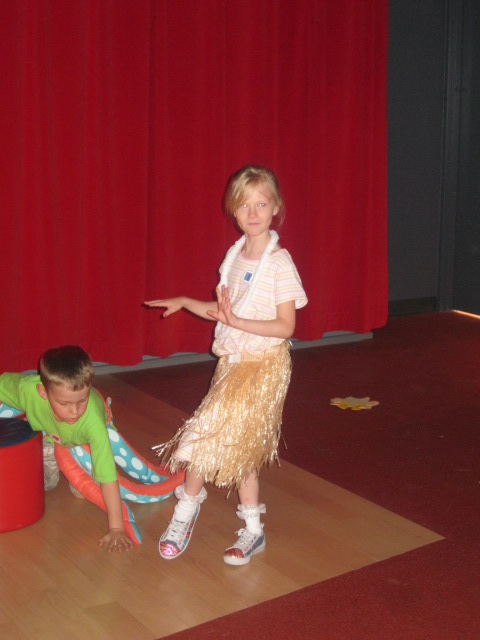
To celebrate the first day of summer vacation, my girls and I with Grammy along to help, hopped in the van and made the trip to the newly opened Children’s Museum of Virginia.  We had toured every exhibit, played with every experiment, explored every room and we arrived at the final destination—a room set up as a stage with costumes in the corner, lighting and sound effects, and a puppet theater.

My oldest daughter first tries an octopus costume and then abandons it for a grass skirt and lei.  Then, like a superstar, she steps on the stage and begins to dance.  Grammy tells her to, “Use your hands to tell a story.”

Concluding her puppet show, my next daughter drops the prince and princess off her hands and runs to the costume corner.  Climbing into her own grass skirt, she then pops a lei over her head, steps on the stage and begins to dance just like her big sister.

Grammy and I watch the show and I snap pictures.  In the stroller sits my baby girl, tired and hungry.  She’s cuddling with her blanket now and ready for lunch and a nap.  We didn’t realize she was watching sisters one and two, but she was.  Climbing out of the stroller, she dashes over to the last grass skirt in the pile of costumes and wraps it around her little self.  I help tie it on her too-tiny waist and she then scoots away from me so that she can also step on the stage and dance.  She sways from side to side, waving her hands gently to the left, now to the right.   Hula dancing with the big girls.

Grammy tells the older sisters, “Look how she followed you even when we didn’t think she was really watching.  She wants to do what you girls do.  You always need to choose the right thing so that you set an example for her.”

They danced and hardly appreciated the wisdom in those words.  Make good decisions so those watching can follow your example.

To the Corinthian church, Paul wrote, “Therefore I urge you to imitate me” (1 Corinthians 4:16).  “Do what I do,” he says.  It seems prideful at best, almost blasphemous, surely dangerous to set himself up as a model for others. It’s context that brings clarity here.  In the same letter, Paul later writes, “Follow my example, as I follow the example of Christ” (1 Corinthians 11:1) and that’s the key really.  Paul strove to be a living, breathing, walking around, interacting with others example of Christ and because of that, others could see Christ in Him, follow Christ in Him.  He practiced what he wrote to the church in Ephesus, “Follow God’s example, therefore, as dearly loved children and walk in the way of love, just as Christ loved us and gave himself up for us as a fragrant offering and sacrifice to God” (Ephesians 5:1).

Yesterday, our Pastor asked the congregation, “Who has been an example of faith to you?”  Around the sanctuary, people called out names.  I thought of many who model Christ to me and then I remembered Mama Zello, one of the first life-examples to me besides my mom, a woman I remember to this day and who I consciously think of often as I read my Bible.  I remember the church service when I was about 11 years old during which the pastor of our fairly large congregation asked his momma to stand up.  She stood delicately to her feet, a “seasoned” woman of the faith whom I had seen many times.  She was so faithful to be at church even as age and sickness could have made it difficult.  She gave hugs and smiles to others generously.  On that Sunday, the Pastor asked in his microphone from his pulpit, “Mom, how many times have you read the Bible all the way through?”   And she answered—one time for every year she had lived.  In her later years, she had read the Bible through two times in a year to make up for the years before she could read as a child.

Just ponder that for a moment.  Imagine on your 80th birthday having read the Bible 80 times.

I was inspired.  Not by Biblical scholarship.  Mama Zello’s Bible reading was not head knowledge without life change.  She read the Bible over and over not to show off, not to stuff more information into her brain, not to attain some worldly success or make it into the Guinness Book of World Records.  She did it because she loved God and wanted to know Him more intimately so that her life could reflect Him.  Now, her son had risen “up and called her blessed” (Proverbs 31:28).  For me sitting in that sanctuary seat, it meant that the Bible mattered, really mattered in life, that when I stood up as a woman of 80, my greatest life accomplishment should be that I loved God’s Word that passionately and let it stir up in me a love for others.

She lived a life of example to me even when she didn’t know I was watching.  I was just a preteen girl sitting next to her parents in church on a Sunday morning and yet seeing and knowing this woman of faith impacts my life even now.

Do you live like that?  Do you imitate Christ so closely that others can imitate you—not worship you, idolize you, or adore you—-but see and follow Christ in you?  Does knowing you make others want to know more about God?

And, do you have an example like that in your life?  Someone whose life you can look at and say, “By following her, I am following a mentor who will teach me about God” or “that’s what I want to be like when I grow up.”   Certainly we must be careful not to place these examples on impossible pedestals and treat them as demigods.  Instead, we remember that in all their humanness, they have traveled with Christ a little farther than we’ve made it so far on our journey.  So, we can place our toes confidently into the impressions in the sand their feet have made and know we are simultaneously journeying to Christ-likeness.

***************************************************************************************************

Heather King is a wife, mom, Bible Study teacher, writer for www.myfrienddebbie.com and worship leader.  Most importantly, she is a Christ follower with a desire to help others apply the Bible to everyday life with all its mess, noise, and busyness.  To read more devotionals by Heather King, click here.

Copyright © 2011 Heather King