Present and Accounted For

“Where are you going, Mom?”

My three-year-old has a radar system that rings alarms and sets off alerts if there is a possibility that I am going out…and leaving her at home.

That morning, she had caught me slipping on my socks.  I reassured her, though, “Just putting on my socks because my feet are cold, baby girl.  I’m not going out.”

“You’re staying here?”
“Yes.”
“You’re not leaving?”
“No, sweetie. Mommy’s staying with you today.”

Seeing as how a hurricane raged off the coast of Virginia that morning, staying in seemed like a good idea.  We had stocked up water, canned food, and batteries and hunkered down until the storm passed.

She didn’t understand all that, though.  Snuggling in close to me, she pressed her cheek against mine and cooed, “Mommy, I stay with you.”

Of course, she can’t, not all the time, not forever, not every minute and each second of day after day after day.  But for this moment and surely in this storm, here I was snuggling with her and remaining present.

We sang it at church Sunday morning, leaving the weather reports and streaming satellite images about the approaching hurricane behind for a short time.  We gave praise, declaring, “You are My Shield, My strength, My Portion, Deliverer, My Shelter, Strong Tower, My very present help in time of need.”

This is our way of singing Psalm 46 back to God:

God is our refuge and strength,
an ever-present help in trouble.
  Therefore we will not fear, though the earth give way
and the mountains fall into the heart of the sea,
  though its waters roar and foam
and the mountains quake with their surging (Psalm 46:1-3). 

Normally, I sing this song imagining God as my Tower, my Shelter in the most fearsome storms.

But what good is a tower-of-brick if it isn’t nearby when you need to hide?  And what is the point of a refuge that is too far away to reach in times of distress?

It is God’s constant, faithful presence that makes Him effective as our Refuge and our Strength, our Defense and our Deliverer.

That is why “we will not fear,” not during storm or raging sea, or mountains crumbling or news reports of flooding and fire and disaster.

Because He is present.  Not just here in this moment and maybe leaving us later in the care of others while He slips out for a meeting or relaxes with friends or fills a cart with groceries at the local store.  We needn’t trip to His feet in alarm when He pulls on His socks or takes His jacket down from the pegs in the closet.

He is always, ever, constantly, faithfully, never-changing, perpetually, every second of every day present with us.

This means He didn’t close His eyes, turn His head, blink, snooze, or simply grow too distracted to care when the mountains crumbled and the waters roared.

No, our God doesn’t promise us a world without frightful shaking and uncertainty.  It’s a sin-plagued planet, aching and groaning for the perfection of eternity.  Hurting and death and sickness and tears are part of life here.

But He promises to be with us and be the strength and shelter we need for whatever rages outside.

Moses plead with God simply for this presence.  Days on that holy mountain, shining with reflected glory, and Moses still longed for more of God.

The Lord Himself promised:  “My Presence will go with you, and I will give you rest.” (Exodus 33:14)

His presence.  Our rest.  Without Him, turmoil and worrying and stress.

Then Moses said to him, “If your Presence does not go with us, do not send us up from here. How will anyone know that you are pleased with me and with your people unless you go with us? What else will distinguish me and your people from all the other people on the face of the earth?” (Exodus 33:15-16).

Like Moses, we pray, knowing that without God’s presence, we are a mess and a disaster, and we are alone and lost, no different than those who don’t know Him at all.

His presence is what sets us apart.  That’s what gives us hope for each new day and peace and that’s what others should notice about us–Christ in us, the hope and glory.

Today is a day to praise God for His presence:

You Never Let Go (David Crowder* Band): “When clouds brought rain, And disaster came…When waters rose, And hope had flown.. Ever faithful, Ever true.  You I know.
You never let go

Made Me Glad (Hillsong): “He has delivered me from all fear; He has set my feet upon a rock. I will not be moved! I’ll say of the Lord, You are my Shield, my Strength, my Portion, Deliverer, my Shelter, Strong Tower, my very present help in time of need!”

Heather King is a wife, mom, Bible Study teacher, writer for www.myfrienddebbie.com and worship leader.  Most importantly, she is a Christ follower with a desire to help others apply the Bible to everyday life with all its mess, noise, and busyness.  To read more devotionals by Heather King, click here.

Copyright © 2012 Heather King

Lowering the Hands, Releasing the Fists

“Mom, why do turtles have shells?”

My preschooler draped herself across the sofa, seemingly inert and bored, but truly thinking about the great mysteries of the world.

“The shell keeps their soft body safe and protected.”

“Oh.  Okay, mom.”

So far, so good.  Her questions simple, her mind and heart trusting and easily satisfied by easy answers.

My middle daughter was never so quick to accept and move on.  A conversation with her could go something like this:

“Mom, why do turtles have shells?”
“To protect their soft bodies from harm.”
“Why are they in danger and need protection?”
“Other animals might try to catch and eat them, or they might be stepped on or run over…
“Why do some animals like to eat turtles?
“Some animals are herbivores and eat only plants and some are carnivores and eat meat.  Turtles are meat.”
“Why do animals eat other animals?”
“Because after the fall in the garden of Eden, one of the curses was the destruction of the peace between animals in the animal kingdom and now some animals would be food and others would eat other animals.”

Falling back on theology or “because God said so” became my frequent defensive position.

This curiosity about the world, I love.  This exploring and questioning and wondering “what if” and “how come”–while it occasionally makes me explode and bluster out  “because God made it that way” or “because I said”– ultimately I appreciate.

Ultimately I understand.

Because I’m a questioner, too.  I want to know “why” and “how come” and “what about” and “why not?”  I want to pester God with question after question like a three-year-old first discovering the world around her.

More than that, more than asking God true and honest questions, I nag and whine and push and nudge.

Oh, and it’s even more than that.  I’ve been Jacob up all night wrestling the angel of the Lord.  I’ve locked my grip with God’s and fought hard for what I thought constituted a blessing, for a victory, for triumph over circumstances and over the Enemy who’s been battering at the walls of my life.

Yes, I’ve pummeled the chest of Christ with my fists, fighting and demanding, manipulating even, making promises, issuing threats, and crying for mercy, help, deliverance—for rescue.

I’m being honest with Him, I tell myself, and honesty is something God treasures in us.  He never asks us to fake it or play happy-faced Christian when life is a mess and this mask we wear becomes increasingly ill-fitting.

God desires truth.  Job, Habakkuk, David, Asaph, Elijah, Jonah, Mary and Martha laid their complaints before God, plead their case, and He listened and answered with awe-inspiring mercy.

He didn’t strike them down with lightning.  He let them empty out hearts filled with fear, hurt and anger and then He answered, not always in the way they expected or wanted, but still He met them in the place of pain and questioning and carried them on out.

Now, though, I’ve been studying the fruit of the Spirit and found I didn’t really get it before.

But the fruit of the Spirit is love, joy, peace, forbearance, kindness, goodness, faithfulness,gentleness and self-control (Galatians 5:22-23, NIV).

Gentleness is on that list.  All those years of sermons and Sunday school lessons and I thought this meant “being nice, not hurting others with our words, kindness and tact.”

The Message translation however, describes gentleness as: “not needing to force our way in life.”

Is this Gentleness?

In Living Beyond Yourself: Exploring the Fruit of the Spirit, Beth Moore defines the root word here “praotes” as “the complete surrender to God’s will and way in your life.  The term basically means to stop fighting God” (p. 178).

Gentleness is submission to God, His will and His way, His plan and His timing and all He has determined for us.

It means dropping to our knees and pouring out the honest struggles of our heart, but deciding at last, “Not my will, but yours be done.”

It’s singing with true conviction, “Have Thine own way, Lord,” and “I surrender all.”

No more fighting God.

How then can I still be honest with Him?  How can a prize-fighter like me lower the hands and open the fists, cease fighting and nagging and choose instead to trust?

Does this require me to be fake after all?

There is my answer in the verse itself, “but the fruit of the Spirit is…” not the fruit of my own discipline or maturity, strength or ability.

This is what the Spirit at work and alive within me does—the impossible, the new, the Christ-like—As I yield and grow in the Spirit, so slowly I trust more, believe more, fall in love with Jesus more and understand how much He loves me more.

And I stop fighting Him.

I drop the knee, I bow the head, I cry the tear, I confess the pain, I trust my God and the Spirit works out Gentleness in me.

Heather King is a wife, mom, Bible Study teacher, writer and worship leader.  Most importantly, she is a Christ follower with a desire to help others apply the Bible to everyday life with all its mess, noise, and busyness.  Her upcoming book, Ask Me Anything, Lord: Opening Our Hearts to God’s Questions, will be released in the Fall of 2013!  To read more devotionals by Heather King, click here.

Copyright © 2012 Heather King

Pocket Discovery

It’s an annual surprise.

Some afternoon, usually in March, I hang up my gray winter coat for the last time.  I never know which day will be the very last of the cold season. We’ve even had freak winter snowstorms in April. There’s no official ceremony or anything and the groundhog’s shadow predictions never prove perfectly accurate.

It’s just a simple thing.  One day I casually drape my coat across the hook in my closet and there it stays through spring, summer and fall.

Then on a morning usually in November I stop deceiving myself into thinking that sweaters are enough to keep my teeth from chattering.  I reach past my fall jacket in the closet, pull down that same wool coat from its trusty hook, slip my hands into the sleeves and dip my hand into the pocket.

Whatever I left there eight months before is what I’ll discover on that first pocket search of the winter season.

I’ve pulled out Mom-things, like pacifiers and baby socks (don’t all moms pop baby socks into pockets)?  Grocery store receipts unfold like magician’s handkerchiefs—always one more emerges from hidden corners.  There are pens and paper clips, ticket stubs, rocks for my daughter’s collection, hair clips and ponytail holders, cough drops, and maybe even tissues (unused, thankfully).

There’s generally little treasure among the trash.  Mostly my life out and about with my kids consists of guiding them, protecting them, and holding their stuff, periodically dumping the overflow into my pockets when my hands are full.

Occasionally, though, I reach into that winter coat for the first time in November and pull out coins.  Better yet, a dollar or two or three….or even ten.

That’s enough to make this girl happy dance in the middle of my closet.

Then, pulling myself together, I announce the news to my kids, post a happy-face announcement on Facebook and tell my husband the story later that night.

Discoveries, after all, are meant for sharing.  They’re the kind of spill-all-over joy that we can’t keep quiet about.

Maybe that’s how the Shepherds felt standing on that darkened hillside with snoring sheep.  Perhaps it even explains what the angels were doing, singing their praise songs in the night sky to an audience of somnolent herdsman about a Savior being born.

All of heaven exploded with the “good news that will cause great joy for all the people!” (Luke 2:9), the Messiah, the Lord.  They couldn’t contain the excitement!

One angel made the announcement, but others crowded the sky and joined in the chorus: “Suddenly a great company of the heavenly host appeared with the angel, praise God” (Luke 2:13).

The angel’s joyful news sent the shepherds tumbling all over themselves to see “this thing that has happened, which the Lord had told us about” (Luke 2:15).

When we hear good news, don’t we long to see with our own eyes, to experience this joy ourselves? 

Won’t you, after hearing my story, dip your hand into your winter coat with a little more anticipation this year?

That’s what sharing our testimony of discovery does, it ignites passion, it incites curiosity, it encourages a searching and finding of the truth, the Savior, of salvation.

Then, when the shepherds found the manger and peered over the corners at the baby-King, “they spread the word concerning what had been told them about this child and all who heard it were amazed at what the shepherds said to them” (Luke 2:17-18).

They had discovered Jesus and no way could they keep that quiet.

No matter how many times Jesus asked those he healed in his ministry to keep quiet about it, still they rushed home and called up the local newspaper to tell their story.  The blind can see, the lame can walk—how to hold that in?

Jesus himself finally told one man to, “Go home to your friends and tell them how much the Lord has done for you, and how he has had mercy on you”  Mark 5:19.

Isn’t that the story for all of us?

Our testimonies of what God has done, the discoveries of how He’s been so good to us, those moments of amazing grace and unexpected mercy in the middle of the daily grind, are all meant to be shared with others.

That’s part of the joy, extending the celebration and encouraging others to go seek our God themselves, dig in His Word, trust in His promises.  What they discover there will be worth shouting about and more cause for a happy dance than whatever treasures I pull from my coat pocket this November.

Christian Writers Blog Chain

Today’s post is part of the October topic ‘Discovery’ by the ChristianWriters.com Blog Chain. You can click on the links on the right side of this page to read more articles in this series.

Heather King is a wife, mom, Bible Study teacher, writer for www.myfrienddebbie.com and worship leader.  Most importantly, she is a Christ follower with a desire to help others apply the Bible to everyday life with all its mess, noise, and busyness.  Her upcoming book, Ask Me Anything, Lord: Opening Our Hearts to God’s Questions, will be released in the Fall of 2013!  To read more devotionals by Heather King, click here.

Copyright © 2012 Heather King

Praying for them and praying with them

My girl clambered into the minivan after school, heavy backpack on her shoulders, heavy thoughts in her heart.

She waited for my daily question, “How was your day?”

And then she spilled the news about “this boy in my class.”

“This boy” was loud and disruptive and didn’t follow the rules.  He cost them rewards in art class and never obeyed the teacher.  He did inappropriate things and wouldn’t stay in line.

She finished her story, pronounced a loud “harumph” and slammed her arms criss-cross around her chest to demonstrate her anger.

So many of our conversations take place this way, me angling the rear-view mirror to see faces, shouting back Mom-ly words of wisdom from the driver’s seat.  “You know what we need to do,” I hollered to the back seat.  “We need to pray for him and for your teacher.”

I expected her to shrug off my advice as impractical and unhelpful, no immediate solution and no personal satisfaction guaranteed.

But she didn’t.  I watched as a look of epiphany brightened her eyes and she lifted her face so her eyes met mine in the mirror.  She nodded in wholehearted agreement.

Later, snuggled together on our overstuffed blue couch, I prayed for “this boy” and for their teacher and when I was through, this child of mine–who finds kisses too embarrassing and 1timothy2declines to even hug much of the time–tossed her arms around me freely and tightly.

We parents, grandparents, teachers and leaders show our children how to pray over time, beginning with bowed heads over scraped needs and boo-boos on fingers.  We seek forgiveness for wrongs and take difficult situations to God.  And then we begin to pray for others, their hearts turning outward in ministry and compassion (and maybe sometimes frustration).

But it all begins with us, modeling the habit and discipline of “take it to the Lord in prayer.”  It’s bringing Jesus right there into the center of our everyday.

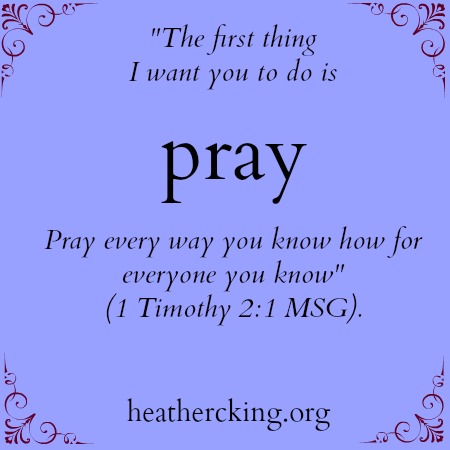
As Paul wrote, “The first thing I want you to do is pray.  Pray every way you know how for everyone you know” (1 Timothy 2:1 MSG).

The first thing we do is drop to our knees, not after consultations, Google-searches, strategies, all-night worrying sessions, and Facebook posts.  Pray first.

Perhaps God had been preparing me for that moment in the car because I’d been on my knees consistently for weeks over my girl.

Please God show me how to be the Mom she needs me to be, how to encourage her, love her, shepherd her heart, discipline her, and protect her.

I hadn’t just prayed, of course.  I’d tried the usual sources, asking for advice. Looking up some behavior issues on reliable Christian family resources.  Scrolling through resources from online sites, hoping to find that perfect book that would explain it all to me and box up my child into an understandable psychological package.

Nothing seemed quite right for my girl.  No formula or strategy was “it.”

What else to do BUT pray?  What else was truly needed but prayer?

Maybe God draws us to pray for our kids so that they’ll see us and learn how to bring His presence into the midst of all situations.  They’ll see our faith practiced in the everyday situations and learn to talk about life and God—-not life or God and never the twain shall meet.

Yes, this is more than Sunday morning belief or pew-sitting faith.  This is down and dirty life with God at our side, available to help us in every situation, to give us wisdom, strengthen our hearts, teach us to obey and discipline our desires.

We pray for children because we love them, still believing that God loves them so much more than we do.  We know them, but He knows them more.  He formed their hearts and personalities, gave them those gifts and talents that amaze us.  He knows the plans He’s laid out for them and how to guide them along “paths of righteousness for His name’s sake” (Psalm 23).

And we also pray for them so that they learn to pray.  So that when they encounter “this boy,” they know they can carry his case to God.  And when their friend is hurt by teasing, they’ll give a hug, say a kind word, and petition God on her behalf.  When they don’t know what to do, they whisper to God a request for help and follow His lead.

Letting our children see us on our knees and hear our prayers for them teaches them how to pray—pray first, pray about everything, pray every way they can, pray for every one they meet.

You can read other devotionals on this topic here:

Heather King is a wife, mom, Bible Study teacher, writer for www.myfrienddebbie.com and worship leader.  Most importantly, she is a Christ follower with a desire to help others apply the Bible to everyday life with all its mess, noise, and busyness.  Her upcoming book, Ask Me Anything, Lord: Opening Our Hearts to God’s Questions, will be released in the Fall of 2013!  To read more devotionals by Heather King, click here.

Copyright © 2012 Heather King

Weekend Walk: It’s Better With a Friend

It’s 61 degrees outside right now and the sun shines down on the girls playing in the backyard. Folks along the street are raking and leaf-blowing.  Last night, I stepped out of my car into the chill and breathed in deep the smell of chimney smoke from fireplaces being lit the first time this fall.

Perfect weather for the pumpkin patch.

We go every year and have taken pictures of my oldest out in the pumpkin field way back when we could barely gather her hair into a ponytail.

This year, though, I surprised the girls by secretly inviting a friend to join us on our family field trip.  We stopped by to pick her up and when I opened the minivan door to present her to my daughters, the squeals of joy were fit for any celebrity popstar or princess.

Today we did all of the normal fall faire.  We climbed on tractors and scaled hay mountains, ran through a corn maze, oohed and aahed over fluffy ducklings, laughed at the rooster’s rockstar hair-do, sat still for face painting, and searched an entire pumpkin field for the one perfect prize—for painting, carving, or pumpkin pie baking.

This year, though, we did it all with a friend and, while we’ve always enjoyed our trips, that made it even better.

About a year ago, a good friend of mine pointed out the tiniest passage in Scripture to me.  Following a long litany of King David’s advisors and assistants, including men in charge of the vineyards and the treasury, his sheep and goats, donkeys, camels, olives, grapes and olive oil, as well as men appointed as his wise counselors and as tutors for his sons . . . one name stands out:

Hushai the Arkite was the king’s friend (1 Chronicles 27:33).

He must have been a special and trustworthy friend indeed to be named among all those who were valued for their position, knowledge, and responsibility.  He was valued for relationship.

Shouldn’t we all build into a friendship like that?

Thus, my verse for the week reminds us that in a world that pushes and races us through to-do lists and accomplishments and an ever-hectic dash from here to there and from this to that, sometimes what God really wants us to be is a friend.

Two are better than one because they have a good reward for their efforts. For if either falls, his companion can lift him up; but pity the one who falls without another to lift him up (Ecclesiastes 4:9-10 HCSB)

Heather King is a wife, mom, Bible Study teacher, writer for www.myfrienddebbie.com and worship leader.  Most importantly, she is a Christ follower with a desire to help others apply the Bible to everyday life with all its mess, noise, and busyness.  Her upcoming book, Ask Me Anything, Lord: Opening Our Hearts to God’s Questions, will be released in the Fall of 2013!  To read more devotionals by Heather King, click here.

Copyright © 2012 Heather King

Soul-Suffocating: When Good Things Become Bad Things

Most of the children in our town don’t watch the Christmas parade from the sidewalk.  They are proud participants in the parade itself.  Almost every child ends up on a float of some kind, for church or school, daycare, ballet, karate, Scouts, band, or chorus.

It’s the moms, dads and grandparents who wave from the sidelines.

Two years ago, my oldest daughter rode all the way down the Main Street of our town, pulled behind Cinderella’s carriage.  Mostly her view of the parade itself was limited to either the folks lining the street or the few floats before and behind her in the line that she could see.

It was enough.

After we had climbed into the car and turned the heat on full blast to thaw the chill we felt deep in our spines and down through our toes, she asked a question that had apparently been on her mind during the whole parade route.

“Mom, there were Boy Scouts in the parade, right?”

“Yup.”

“So….does that mean there are GIRL Scouts.”

I sucked in my breath.  “Yes, absolutely there are Girl Scouts and yes, they are totally wonderful and great and fun.  But you can’t do everything, my love.  Some things we have to let go.”

Even good things can become bad things.  Like when your five-year-old child wants to do ballet, piano, Awana, theater, Girl Scouts, gymnastics, horse-riding and anything and everything else represented by a float in our town’s Christmas parade.

We’re soul-suffocators, too, cramming so much into our lives we don’t have room to breathe.

And it’s not just time.  It’s things, and media, and noise, and friendships and just about everything that’s not necessarily bad, but which ultimately crowds out room for Jesus in the heart that’s supposedly His cozy and welcoming home.

I’ve grown sadly familiar with the phrase, “Everybody else ….” or “My friend has…” and “The other girls at school watch this TV show…”

Sometimes, I’m not just listening to this mantra, I’m the one delivering the whiny sermon to God.

“If others can have this, couldn’t I?”  “If she can do this, it’s okay for me, too, right?”

We’re sold by the advertisers and the infomercials and wooed by the parade of life that incessantly marches past good causes and activities and projects and the latest and greatest in home kitchen gadgetry.

And sometimes God asks us to lay it down.

These aren’t “Issacs,” we’re talking about, the areas of radical obedience that require us to trust and exercise extreme faith.

As Kelly Minter writes in her book, No Other gods: Confronting Our Modern Day Idols, “before Abraham could ever offer up the child born of the miraculous, he first had to offer up the child born of his flesh” (p. 128).

Obedience to God begins with Ishmael.

Long before Abraham’s heart-wrenching journey to the mountain where he lifted his knife over his beloved son Isaac, Abraham had to let his other son go: Ishmael—the baby boy of Abraham and the maidservant Hagar.  For 13 years, Ishmael had been Abraham’s only child and while it turned out that he wasn’t the heir of promise, still he was loved.

And when Sarah demanded that her maidservant Hagar and the teenage boy, Ishmael, be thrown out into the wilderness, Abraham begged God, “If only Ishmael might live under your blessing!” (Genesis 17:20).

Our prayers echo his at times.  “If only you’d bless this, God!”  “If only this would be okay with you.  Isn’t this great and good and wonderful and won’t you bless it?”

We ask God to bless or at least tolerate our “Ishmaels,” those good things that aren’t holy things or the extras and objects of our affection that have never been part of God’s plan or design for us, but that we love and hold on to so very tightly.

Or maybe our Ishmael is the way we’ve tried to force God’s promises into being, impatiently rushing ahead of God’s timing and doing things our own way.

Kelly Minter reminds us, “He has grace on our Ishmaels, and yet he is unwilling to allow them to ever take the place of Isaac.  No, what is born of flesh can never substitute for what is born of the Spirit” (p. 127).

That’s no less a step of obedience than the radical sacrifice of Isaac.  It’s the letting go of Ishmael.

It’s submitting to Him our habits, our committees, our involvement, our activities, our parenting, our expectations for our kids, our relationships, our spending, our eating, our five-year-plan for our lives, our ministry, and the way we are pursuing His call.  Even if it’s good or right for others, even if it seems necessary or like it will help us reach his promises faster, even if we love it…we let it go if He asks.

We’re holding out for God’s best here; not missing out on the promise because we’re distracted and satiated, tired out, filled up, and content with everything else–everything less.

Heather King is a wife, mom, Bible Study teacher, writer and worship leader.  Most importantly, she is a Christ follower with a desire to help others apply the Bible to everyday life with all its mess, noise, and busyness.  Her upcoming book, Ask Me Anything, Lord: Opening Our Hearts to God’s Questions, will be released in the Fall of 2013!  To read more devotionals by Heather King, click here.

Copyright © 2012 Heather King
What Silence Means…

It’s when they’re quiet that you need to be worried.

That’s parental advice passed down through generations, usually learned from personal experience.

I learned my lesson, too.

My oldest girl did this thing when she was three years old called a “tantrum.”  Maybe you’ve heard of them?  Maybe you’ve seen one . . . or thrown one.

After a particularly rowdy tantrum on the car ride home one day, she stomped into the house still screaming, ran into my bathroom and slammed the door.

Unfazed, I took my time setting her baby sister down for a nap and tossing my keys and arm-full of papers and baby paraphernalia onto the kitchen counter.  I breathed in deep breaths of Mom sanity.

Then I realized that the banshee wail had subsided into silence, frighteningly loud silence.

Throwing open my bathroom door, I saw my red-faced preschooler crouched on the carpet, her hands covering her head as she sobbed.

On the floor next to her was her hair.

Her hair!

Her long, totally beautiful, golden curly hair.  In her rage, she had climbed onto my bathroom counter and dug through to the bottom of my makeup case where I hid the hair scissors.  Then she had systematically snipped off the two pig-tails on the tip-top of her head.

She was bawling.  I was bawling.  We raced to the local hair salon and plopped her up in the chair for a rescue mission.  Our superhero that day sported a comb and some clippers.

Sometimes we think silence means inactivity and stagnation, abandonment and loneliness, but instead it’s often a sign of focused activity.

With kids, that might mean trouble.

With God, though, as heart-wrenching and full of despair as His silence is, we needn’t fear the quiet.  It’s often a promise that He’s at work right there in the middle of your circumstances, deeply involved in your life.

This was me not long ago.  I thought I had it figured out, what God was doing and how He was at work and how He planned to bless and care for us, but I was wrong.

The thing about cramming God into boxes is that He shatters the confines of the cardboard.

So, when life didn’t go as I had planned, I cried out to Him: What are you doing?  What does this mean?

Why can’t I hear You?

The silence is so oppressive and filled with overwhelming sadness.  We just want to hear His voice, His quiet voice or His booming command, His encouraging cheer, or His tender whisper.  Whatever He wants to say, we’re desperate to hear it.

Because we feel afraid.

I drove off that night on an arbitrary errand, alone in my car, praying away in the quiet.  Then I hit the play button on the CD for our church Christmas cantata:

“Peace, oh my soul, weary from the struggle
Don’t be afraid, Love knows your deepest need.
There is a light shining in the darkness.
There is no shadow where it cannot reach.
Peace, peace, Jesus has come
O soul, be still, receive your King”

The song faded and one lone voice cut through the silence:

“The Lord is with you . . . Fear not, Mary ….For nothing is impossible with God….Joseph, fear not.  Fear not!  For unto us a child is born, to us a Son is given…Fear not; for, behold, I bring you good tidings of great joy…Fear not!  They will call Him Immanuel–which means, ‘God with us.’  Fear not, for I am with you”

My husband asked me when I flopped on the couch later, “Were you crying?”

How could I do anything but cry?

I had been desperate for the slightest trickle of His voice and He had drenched me in His Word.

But even when I didn’t hear Him, God was still there, still active, still with me. That hadn’t changed.

In his book, Greater, Steven Furtick writes:

God is often working behind the scenes of your life, orchestrating His destiny for you.  Even though you don’t have a clue what He’s up to.  Just because you haven’t heard God call your name or tell you specifically what to do with your life doesn’t mean He’s not conspiring great things for you.

Sometimes we feel like Job: “I cry out to you, God, but you do not answer; I stand up, but you merely look at me” (Job 30:20).

But even in the silence we can hold to the promise:

As for me, I call to God, and the Lord saves me.
Evening, morning and noon I cry out in distress,
and he hears my voice
(Psalm 55:16-17).

He hears you.  And when He chooses to speak, the wave of His voice might wash over you and knock you off your feet and carry you to safety.  For now, just keep listening, keep waiting, and don’t be afraid of the silence.

Heather King is a wife, mom, Bible Study teacher, writer and worship leader.  Most importantly, she is a Christ follower with a desire to help others apply the Bible to everyday life with all its mess, noise, and busyness.  Her upcoming book, Ask Me Anything, Lord: Opening Our Hearts to God’s Questions, will be released in the Fall of 2013!  To read more devotionals by Heather King, click here.

Copyright © 2012 Heather King

Naming, Name Changes, and Being Made New

Her name suits her.

She asks us about it all the time and we’ve told her the story over and over.

Why is she named Victoria Eileen and what does it mean anyway?

You’re named after your grandmothers, we tell her, Godly women who are strong in their faith. We prayed over our first baby, prayed about naming her just right— a name that was clearly feminine and clearly strong, a name for an overcomer, a fighter, a stand-up-for-what-is-right kind of woman of God.

Victoria—“Victorious One.”

It fits this feisty little person, the perfect name from the first day I held her in my arms in the hospital and she screamed and screamed, trying desperately hard in her newborn way of making her needs known. She befuddled nurses and her first-time momma.

Yet, submitted to God, believing in Jesus, with His Spirit in her, she’s a mighty force to be reckoned with underneath her princess exterior of swirly skirts and long blonde hair.

When she asks us about her name, we tell her the whole story of what it means, and why we picked it and what we hope it says about her future and her character.

I can’t imagine how that conversation went in Hosea’s house.

God told the prophet Hosea to marry a “promiscuous woman.”  His marriage was to be a living testimony of how the long-suffering God remained faithful to His people Israel, despite their ongoing adultery with foreign gods and idols.

That sounds hard enough.  Yet, in obedience, he married Gomer, a frequent runaway lover.

Then God told Hosea to have children with this faithless wife.

When she had a daughter, God told them to name her “Lo-Ruhamah (which means “not loved”), for I will no longer show love to Israel, that I should at all forgive them” (Hosea 1:6 NIV).

Then she had a son and God said, “Call him Lo-Ammi (which means “not my people”), for you are not my people, and I am not your God” (Hosea 1:9 NIV)

The Message translates these names as “No-Mercy” and “Nobody.”

Every time moms in the marketplace cooed over these precious babies and asked, “What’s the baby’s name?” the answer came back as a label and message from God.

No-Mercy.

Nobody.

Have you ever felt labeled and even condemned by your name, your heritage, a nickname, a curse, the hurtful words of others that you can’t seem to erase from memory?

Has your past held you captive?

Surely these two children could relate to your pain.

But the beautiful thing about Jesus is that He doesn’t leave us untouched by His presence.  He’s a Creator God, making things new, making US new.

He changes us and renames us, giving us a new identity in Him.  Paul tells us:

Therefore, if anyone is in Christ, the new creation has come:The old has gone, the new is here! (2 Corinthians 5:17 NIV).

In Hosea 2:1, God tells the prophet:

Say of your brothers, ‘My people,’ and of your sisters, ‘My loved one.’

Or as the Message says:“Rename your brothers ‘God’s Somebody.’  Rename your sisters ‘All Mercy.’”

Eugene Peterson asks: Under what circumstances have you seen “No Mercy” turned into “All Mercy?”  How about “Nobody” changed to “God’s Somebody?”

That’s our story, yours and mine!  Our story of redemption and transformation, how we’re shedding who we used to be and stepping into new clothes of righteousness—new names, new lives.

Hosea’s kids probably had to fight for their new identity.  Townsfolk likely slipped up time after time.  “No-Mercy,” they’d say, and she’d reply, “That’s not my name anymore!  Haven’t you heard the good news?  My name is “All Mercy” now.  God changed it!”

And her brother, “Nobody,” likely had to correct friends and neighbors and the school teacher who always treated him like a fool: “God says I’m no longer, “Nobody!”  I’m “God’s Somebody” now!”

God says that about you, too.  He says, “You’re mine.  I’ve given you my name and called you my child.  You are a sign of my mercy, you are loved, you are important to me.”

Yet, just like Hosea’s poor children, who likely had to stand up for their name change time and time and time again . . . so we must continually refuse Satan the prerogative of defining us by our past.

Instead, those names from our past, those identities are just part of our testimony now, a reminder of how God redeems, renews, and recreates, how He makes “beautiful things out of us.”

Heather King is a wife, mom, Bible Study teacher, writer for www.myfrienddebbie.com and worship leader.  Most importantly, she is a Christ follower with a desire to help others apply the Bible to everyday life with all its mess, noise, and busyness.  Her upcoming book, Ask Me Anything, Lord: Opening Our Hearts to God’s Questions, will be released in the Fall of 2013!  To read more devotionals by Heather King, click here.

Copyright © 2012 Heather King