That Time When She Ripped Me To Pieces on Facebook

galatians5-22

She ripped me to pieces on Facebook.

This person I didn’t know called me a “so-called Christian” who demonstrated absolutely “no love” in my answer to her question.

I read over what I had written that pushed her buttons.  It seemed pretty straightforward.  Something like, “If you click on this post here, you’ll find everything you need to know about what we’re reading this month and how to join in.  Hope that helps!”

So-called Christian?  No love?

Even if she didn’t like my answer, I’d say attacking my personal faith seemed pretty out-of-line.

I’m a people-pleaser.  My love language is words of affection.  So, when someone vomits criticism all over me like that, I’m pretty much a mushy puddle of disaster on the floor.

Clean up on aisle 5.  That’s me.

This time I at least had the gumption to try to let it go.  But it’s been a few months since that post and it still gets my heart racing when I think about it.

Sadly, we’ve entered some bizarre dimension of space and time where we can hack at people from the distance and anonymity of our computer.

People don’t feel personally responsible anymore for what they say because there’s no immediate or relational consequence to verbal abuse.  We just click ‘send’ or ‘reply’ and cyberspace takes care of the rest.

I’d like to say that as Christians we’re known for rising above these drive-by slanders, but we’re not.

Paul wrote, “Let your gentleness be evident to all” (Philippians 4:5 NIV).

And yet, are Christians known for gentleness?  I’d say not likely.

We’re not even known for treating one another with gentleness.

Too often, we’re quick to condemn, mock, judge, criticize, and ostracize one another instead of obeying Scripture and learning how to  correct our “opponents with gentleness” (2 Timothy 2:25 ESV).

Maybe it’s because we think gentleness is synonymous with wimpy or weak.  But that’s not the biblical definition at all.

We model true gentleness after that of Christ, who showed restrained strength and self-control even when responding to attackers.

Those who are spewing harshness are the ones who lack self-control.  Gentleness is like holding back the full force of the ocean with quiet determination.

Maybe we think we’re just not gentle people. It’s not our personality.  Other people are gentle; but we’re outspoken and frank and that’s just who we are.

Last year, I interviewed Mary Ann Froehlich about her book Courageous Gentleness and she said

 “the fruit of the spirit is not a personality trait.”

It’s not like God made some people to be loving and some people to be peaceful and some people to be gentle.

The fruit of the spirit isn’t another biblical catalog of spiritual gifts.  It’s what every believer should have at work in us because the Holy Spirit is at work in each of us.

No Christian is exempt from the biblical mandate of gentleness even when handling those with whom we disagree.

In her new book, If I Plug My Ears, God Can’t Tell Me What To Do, Jessie Clemence writes:

Disagreement and discernment are both acceptable. But criticizing people’s efforts to serve God to the best of their ability is totally not fine. Romans 14:4 says, “Who are you to condemn someone else’s servants? Their own master will judge whether they stand or fall. And with the Lord’s help, they will stand and receive his approval” (NLT).

Who are we to condemn the service of another?  Who are we to cut down the Lord’s anointed?

But we do it.  Sadly we do just that.

Even in cases of doctrinal error, a private conversation or intense prayer can be far more meaningful than public denunciation and mockery.

In Scripture, David made the choice twice not to lay hands on King Saul.

God had abandoned Saul and anointed David to be King.  Saul was in error.  He was in sin.

If anyone deserved to be confronted publicly, condemned publicly, and punished publicly, it seems like it should be him.

And if anyone deserved to put Saul in his place, it seems like it should be David.

But David wouldn’t do it.  Instead, he told his men

“The LORD forbid that I should do this to my lord the king and attack the LORD’s anointed one, for the LORD himself has chosen him” (1 Samuel 24:6 NLT).

David trusted God to handle Saul.

God forbid that I attack the Lord’s anointed.

God forbid that I criticize them, mock them, or try to destroy their ministry.

God forbid that I stand on my own platform and use it to judge their offering or pounce on their every word in order to pull it apart, take it out of context and denounce them.

I choose gentleness.

Brothers, if anyone is caught in any transgression, you who are spiritual should restore him in a spirit of gentleness (Galatians 6:1 ESV)

Heather King is a wife, mom, Bible Study teacher, writer and worship leader.  Most importantly, she is a Christ follower with a desire to help others apply the Bible to everyday life with all its mess, noise, and busyness.  Her book, Ask Me Anything, Lord: Opening Our Hearts to God’s Questions, is available now!  To read more devotionals by Heather King, click here.

Copyright © 2015 Heather King


Announcing a Winner and Redefining Gentleness

Last week, I announced that I’d be giving away a copy of Mary Ann Froehlich’s book, Courageous Gentleness, and today I’m announcing the winner!  I used a random number generator to chose the winner from the comments you shared and the winner is:  Lisa Preuett.  Congratulations!  I’ll get the book on out to you!

*******************************************************************************************

“Mom, why do turtles have shells?”

My youngest daughter draped herself across the sofa, seemingly inert and bored, but truly thinking about the great mysteries of the world.

“The shell keeps their soft body safe and protected.”

“Oh.  Okay, mom.”

So far, so good.  Her questions simple, her mind and heart trusting and easily satisfied by easy answers.

My middle daughter was never so quick to accept and move on.  A conversation with her could go something like this:

“Mom, why do turtles have shells?”
“To protect their soft bodies from harm.”
“Why are they in danger and need protection?”
“Other animals might try to catch and eat them, or they might be stepped on or run over…
“Why do some animals like to eat turtles?
“Some animals are herbivores and eat only plants and some are carnivores and eat meat.  Turtles are meat.”
“Why do animals eat other animals?”
“Because after the fall in the garden of Eden….”

Falling back on theology or “because God said so” became my frequent defensive position.

This curiosity about the world, I love.  This exploring and questioning and wondering “what if” and “how come”–while it occasionally makes me explode and bluster out  “because galatians5-22, photo by Wacharaphong Sakoolwongveroj; God made it that way” or “because I said”– ultimately I appreciate.

Ultimately I understand.

I’m a questioner, too.  I want to know “why” and “how come” and “what about” and “why not?”  I want to pester God with question after question like a three-year-old first discovering the world around her.

More than that, more than asking God true and honest questions, I nag and whine and push and nudge.

Oh, and it’s even more than that.  I’ve been Jacob up all night wrestling the angel of the Lord.  I’ve locked my grip with God’s and fought hard for what I thought constituted a blessing, for a victory, for triumph over circumstances and over the Enemy who’s been battering at the walls of my life.

Yes, I’ve pummeled the chest of Christ with my fists, fighting and demanding, manipulating even, making promises, issuing threats, and crying for mercy, help, deliverance—for rescue.

I’m being honest with Him, I tell myself, and honesty is something God treasures in us.  He never asks us to fake it or play happy-faced Christian when life is a mess and this mask we wear becomes increasingly ill-fitting.

God desires truth.  Job, Habakkuk, David, Asaph, Elijah, Jonah, Mary and Martha laid their complaints before God, plead their case, and He listened and answered with awe-inspiring mercy.

He didn’t strike them down with lightning.  He let them empty out hearts filled with fear, hurt and anger and then He answered, not always in the way they expected or wanted, but still He met them in the place of pain and questioning and carried them on out.

Now, though, I’ve been studying the fruit of the Spirit and found I didn’t really get it before.

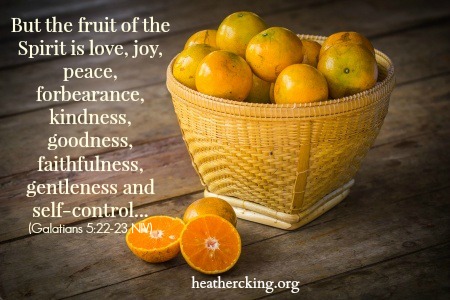
But the fruit of the Spirit is love, joy, peace, forbearance, kindness, goodness, faithfulness,gentleness and self-control (Galatians 5:22-23, NIV).

Gentleness is on that list.  All those years of sermons and Sunday school lessons and I thought this meant “being nice, not hurting others with our words, kindness and tact.”

The Message translation however, describes gentleness as: “not needing to force our way in life.”

Is this Gentleness?

In Living Beyond Yourself: Exploring the Fruit of the Spirit, Beth Moore defines the root word here “praotes” as “the complete surrender to God’s will and way in your life.  The term basically means to stop fighting God” (p. 178).

Gentleness is submission to God, His will and His way, His plan and His timing and all He has determined for us.

It means dropping to our knees and pouring out the honest struggles of our heart, but deciding at last, “Not my will, but yours be done.”

It’s singing with true conviction, “Have Thine own way, Lord,” and “I surrender all.”

No more fighting God.

How then can I still be honest with Him?  How can a prize-fighter like me lower the hands and open the fists, cease fighting and nagging and choose instead to trust?

There is my answer in the verse itself, “but the fruit of the Spirit is…” not the fruit of my own discipline or maturity, strength or ability.

This is what the Spirit at work and alive within me does—the impossible, the new, the Christ-like—As I yield and grow in the Spirit, so slowly I trust more, believe more, fall in love with Jesus more and understand how much He loves me more.

And I stop fighting Him.

I drop the knee, I bow the head, I cry the tear, I confess the pain, I trust my God and the Spirit works out Gentleness in me.

Heather King is a wife, mom, Bible Study teacher, writer and worship leader.  Most importantly, she is a Christ follower with a desire to help others apply the Bible to everyday life with all its mess, noise, and busyness.  Her book, Ask Me Anything, Lord: Opening Our Hearts to God’s Questions, is available now!  To read more devotionals by Heather King, click here.

Copyright © 2014 Heather King

Chatting about Gentleness and a Book Giveaway!!

Thank goodness for my Kindle because my book shelves are sagging in the middle despite me repeatedly cleaning out the books I can ‘do without’ and still survive.

I’m a bookworm from way back, so it’s perfect that one of the ‘perks’ of being a writer is getting to read and review books from other authors.courageousgentleness

When I saw the title of Mary Ann Froehlich’s new book, Courageous Gentleness, I knew I wanted to read it, review it, and give a copy away to someone else.  You can read my book review here.

I’ve felt my own spiritual toes stepped on before when reading this verse, “Let your gentleness be evident to all” (Philippians 4:5).  Because we too often treat gentleness like a personality trait.  You have it, or you don’t, either way is fine.

But it says it right there—our gentleness should be visible to everyone around us. It’s Christ in us, the Holy Spirit doing the work of producing spiritual fruit.

So, today, I have a little extra treat for you.  Mary Ann was kind enough to let me ask her some questions and share her answers with  you!

And wait, there’s more!

Just for being such a wonderful bunch of blog readers, today at the end of my interview with Mary Ann, I’ll give away a copy of her book.  Stay tuned to find out how to qualify for this special offer…

Okay, my friends, over to Mary Ann:

  1.  What’s your favorite holiday and why?

I love Thanksgiving because all my adult children come home for this celebration and it kicks off the holiday season.

  1. You are a musician, so I’m wondering if you could pick one instrument to learn that you’ve never learned to play, what would it be?

I enjoy listening to cello music so that is the instrument I would pick.

  1. Lots of times when we think of ‘gentleness,’ we think of ‘weak,’ ‘wimpy,’ ‘a doormat,’ or a ‘pushover.’  How is the biblical definition of gentleness different from that?

The biblical definition is quite the opposite. Gentleness embodies restrained strength. Unleashing harsh words or actions is weakness and evidences a lack of self-control. Our best example of restrained strength is Christ’s response to attackers during the days leading to his death.

  1. You have a successful career as a music teacher and you talk in your book a lot about practice.  What are your best tips on how to practice anything from a musical instrument to a spiritual trait like gentleness?

My best tip for practicing is to isolate the most difficult sections of a piece you are learning. Practice those first and multiple times until you are comfortable. Then you can play the piece from the beginning and avoid struggling through the tough sections. This same approach works for any skill we are learning that requires practice, which includes biblical behaviors such as gentleness and other fruit of the spirit. We will benefit if we first focus on improving the areas we struggle with most in life instead of avoiding them.

  1. You share in your book about Christianity having an “image problem” in the United States and you ask the question, “Are Christians Known for Being Gentle?”  What do you think the answer to that question is ?  How can we change that?

In my personal experience (and the research backs it up), Christians are not known for being gentle. The world knows Christians more for what they stand against instead of who they are for. As a body, we have an angry, intolerant reputation. What saddens me more is when Christians tell me that their fellow Christians do not treat them with gentleness. Through the years, I have had several friends who needed to remove themselves from the church when they were going through a tough season of life (a divorce, child on drugs, teen pregnancy, etc.). The church should be our safest place when we are in pain but too often fellow believers rub salt in our wounds.

  1. What’s your encouragement for someone who says, “I’m just not a gentle person. I’m outspoken.  That’s just who I am.”

I would say that the fruit of the spirit is not a personality trait. Every believer is called to mirror Christ. Practicing those biblical behaviors is hard work for all of us.

Thanks so much to Mary Ann Froehlich for sharing with us!

I’ll be giving away a copy of her book Courageous Gentleness using a random number generator.  All you need to do to enter is comment on this post (not on Facebook, here on the blog please) with the answer to this question:

Do you think Christians are known for being gentle?  If not, what can we do about our ‘image problem?’

I’ll close the giveaway on Thursday, July 17th at 11:59 p.m. and announce the winner in the blog for Friday, July 18th.

Heather King is a wife, mom, Bible Study teacher, writer and worship leader.  Most importantly, she is a Christ follower with a desire to help others apply the Bible to everyday life with all its mess, noise, and busyness.  Her book, Ask Me Anything, Lord: Opening Our Hearts to God’s Questions, is available now!  To read more devotionals by Heather King, click here.

Copyright © 2014 Heather King

Courageous Gentleness, Book Review

I loved the slightly unexpected nature of the title for Mary Ann Froehlich’s new book, Courageous Gentleness.  In a modern world like ours, where we marvel at the brazen, the bold, the loud and powerful, her book encourages us to prize, treasure, and pursue the spiritual fruit of gentleness.courageousgentleness

The book is filled with Scripture and each chapter concludes with a few questions of “Personal Retreat” to guide the reader into deeper reflection and personal application.  At under 200 pages, the book is short, easy to read, but thought-provoking.

She begins with a chapter that asks, “Is Gentleness for Wimps?” Then she follows with chapters on the gentleness of God, of Jesus, and of Christians, as well as chapters on practicing aspects of gentleness such as humility, self-control, communication, patience, and more.   Biblical gentleness, she argues, isn’t being weak or wimpy.  It’s more like a powerhouse of meekness.

So often we excuse our lack of gentleness by saying, “Well, that’s just not me.  I’m outspoken.  That’s who I am.”  But the Bible is clear when it says, “Let your gentleness be evident to all.”  We are all to practice gentleness.  It’s a marker of our faith and a sign of the Holy Spirit at work within us.  It’s supposed to be part of our Christian testimony, drawing others to know Jesus.

I love that Mary Ann Froehlich emphasize that gentleness is a trait we practice by disciplining our tongues and taking time to craft responses to others.  It may not be our natural bent, but it’s part of our Christian calling. As she writes, ‘gentleness is not simply a quality, trait, behavior, or characteristic.  It is a choice.”

I received this book free from the publisher. I was not required to write a positive review and the opinions I have expressed are my own. I am disclosing this in accordance with the Federal Trade Commission’s 16 CFR, Part 255 : “Guides Concerning the Use of Endorsements and Testimonials in Advertising.”