“Terrific, Terrific, Terrific” and Why The Goose Repeats Herself

But be doers of the word, and not hearers only, deceiving yourselves.
James 1:22

My daughter’s teacher just finished reading Charlotte’s Web to her first grade class and my girl came home with one important question about the book.

“Mom,” she said as she climbed in my lap, “there’s something I just don’t understand about it.”

I prepared to offer deep words of wisdom to whatever philosophical question she posed.  Why did the spider have to die? What made Charlotte and Wilbur such good friends?  Why was Wilbur worth saving?  Why did only some of Charlotte’s babies stay in the barn after they hatched?

Why aren’t we vegetarians?

Instead, she asked, “Why does the goose talk that way?”

Hmmm.  Surely, the mama goose in Charlotte’s Web does have a particular speech pattern.  She never says anything once.  When the animals are debating hotly over what new word Charlotte the spider needs to spin into her web in order to save Wilbur the pig’s life, the goose suggests, “terrific, terrific, terrific.”

Because one “terrific” is never enough.

And how should an ordinary barn spider spell such a large vocabulary word?

According to the goose, it’s, “T double-E double-R double-R double-I double-F double-I double C, C, C!” (E.B.White, Charlotte’s Web).

At first, when my daughter asked me to explain why someone would talk so funny, I mumbled something about how people talk in different ways and everyone is unique, something that sounded intellectual enough to impress her and qualify me for “Wise Mom of the Year.”

Later that night, though, I listened to the way I talked to my kids and had a life-changing epiphany.

The goose always repeated everything she said because . . . she was a mom.  Perhaps she had been repeating herself to her goslings so long, she began to talk that way perpetually.

Yes, I myself find that I don’t ever get to say anything once.  Usually it takes three times before my children even realize I’m talking.  So, typically my announcements sound something like this:

Time to brush your teeth.
Okay, it’s really time to brush your teeth!!!!!
TIME TO BRUSH YOUR TEETH!!!!!!!!!!

By the time I’ve tripled my statement, my middle girl finally looks up from the couch and wonders why I’m in her face with my voice raised (usually holding her chin so she’s forced to make eye contact with me).

It’s not that I’m prone to yell or enjoy being loud or even generally live with the volume turned up.

It’s that unless I’m loud, she’s not listening.

By the time I’ve reached my third repeat, my middle daughter always looks surprised and excuses her lack of obedience by saying, “Oh, I didn’t hear you.”

To which I explain that my voice trumps all other voices and all other noise.  The moment she hears my voice making any sound at all, she needs to focus on what I’m saying, which requires her to stop looking at the TV, cease listening to her music, put down the book, and pause for a moment while playing with her toys.

This has all made me wonder whether God ever has to combat my own inattentiveness with repetitive messages and some volume-raising.

Is that what He’s doing when I hear the same lesson from every radio preacher, sermon, Sunday School lesson, Bible Study chapter, and devotional reading?  Is that what He’s doing when He escalates His discipline in my life, all because I’ve tuned out initial warnings and overlooked His initially gentle correction?

Does this happen because we’re not listening?  And if it does, then the challenge to us is to focus on His voice immediately, turning away from all other sources of noise, every life distraction, every demand of busyness, and responding with Samuel’s, ” Speak, Lord, for your servant hears” (1 Samuel 3:9).

Ultimately, though, this isn’t just about our ears sensing the ripples of God’s voice or even our mind evaluating the sound waves and forming the complex audio signals into words.

It’s not enough to hear.  It’s not so much whether or not my daughter hears me the first time I declare that teeth brushing should commence. The issue is whether or not she bounces up from the couch, walks to the bathroom, squeezes the toothpaste onto the toothbrush and actually brushes her teeth the moment she hears my command.

This is what matters to God, as well.  This is why when God gave His people the commandments, He said, “Hear therefore, O Israel, and be careful to do them (Deut. 6:3, ESV).

Even more significant is the fact that the Hebrew word most often translated as “obey” in Scripture is “shema,” or “hear”  (Walking in the Dust of Rabbi Jesus by Lois Tverberg, p. 29).

Since “hear” and “obey” are generally the same word in Hebrew, Tverberg says “to hear is to do, to be obedient” (p.29)  God expected them to be the one and the same action—we hear/we obey.  It’s as simple as that.

So, when Jesus sounded a little like the Charlotte’s Web goose whenever He made one of His favorite announcements: “He who has ears to hear, let him hear,” what He really was saying was:

“If you hear what I’m saying, then obey it, do it, live it, put it into practice”
(Matthew 11:15, Luke 8:8, Matt. 13:43, Mark 4:9, Luke 14:35).

I once heard a college friend  pray, “Please teach me gently, Lord.  Don’t bruise me.”  Oh, how I have prayed this same prayer!!!  None of us seek out God’s discipline or firm hand of correction or even the raising of His voice when we decline to listen.

Yet, if we desire God’s gentleness, His loving guidance, His soft hand resting on our shoulder, then we must live a responsive life.

Our spirits discerning.  Our hearts receptive.  Our lives obedient.  This is how we respond to God, moving gently and without resistance to His instruction just as a blade of grass shifting with the wind.  God speaks.  We listen.  We obey.   As simple as that.

You can read other devotionals on this topic here:

Heather King is a wife, mom, Bible Study teacher, writer for www.myfrienddebbie.com and worship leader.  Most importantly, she is a Christ follower with a desire to help others apply the Bible to everyday life with all its mess, noise, and busyness.  To read more devotionals by Heather King, click here.

Copyright © 2012 Heather King

The Paint Saga, Part II: Is that the color I picked?

 But if we walk in the light, as he is in the light, we have fellowship with one another, and the blood of Jesus his Son cleanses us from all sin  (1 John 1:7).

Something didn’t look right.

This year, I embarked on an extreme painting project in order to cover over nearly eight years of child debris speckled on the walls of our home with some fresh paint.

I began in the dining room.  You can read all about that color-choosing nightmare here: The Paint Saga (Or why my dining room is now chocolate).

Fresh off the eventual success of turning my dining room into a chocolate bar, I decided to paint the kitchen.  This time, though, knowing I’d probably make a disastrous color choice if left to my own devices, I enlisted help from a trusted source–namely, my mom.

I handed her a pile of about 10 green color swatches.  Showing her the color I had picked, she picked another.

The lady at the paint store oohed and aahed over the cheerful green-as-grass color mixed up in the paint can.  In fact, it inspired her to paint her bathroom in the same color.  This, I was certain, guaranteed success.  I carried the paint home confidently, tucked my toddler into bed for naptime, and began covering every wall in my kitchen with “dillweed.”

All seemed to be going well.  The paint was fresh, clean, cheerful, and on most of the walls, it was what I wanted.

But I hadn’t considered the light.  There’s something tricky about the lighting in our home, something that makes paint look one color on one wall and a totally different (neon lime green) color on another wall.

My husband arrived home to my surprise paint job and asked me if I liked it.  Did I like it?  Well, I liked it when the lights in the kitchen were off and I liked it on the walls farthest away from the window.

But right there in that one corner of the kitchen, I felt like I needed to pop on some sun glasses to combat the glare.

The problem isn’t the paint so much as the unevenness of the light on the paint.  So, I’ve spent about two weeks trying to work in the dark of the kitchen as often as possible.  With the lights off, the lime green effect is muted and hidden and I begin to think, “It’s not so bad!” Then, when I finally concede blindness and begrudgingly flick on the lights, I shield my eyes and ask, “How long can I live with this?”

Are there areas of your life where you feel pleasantly cozy in the dark, but when the lights shine in, you feel embarrassed by the glaringly obvious wrong?

Or are you astonished and bitterly hurt at times by the hidden darkness surrounding the deeds of others as you try your best to live in the light?

Scripture assures us that:

Nothing is covered up that will not be revealed, or hidden that will not be known. Therefore whatever you have said in the dark shall be heard in the light, and what you have whispered in private rooms shall be proclaimed on the housetops (Luke 12:2-3).

When I’m speechless at the machinations of others, when I’m disgusted by the secretive shams and the deeds performed in dark corners and shadowy alleyways, when there’s sneaking around and avoiding authority, I pray.

I ask God to “shine His light on all the deeds done in darkness so that nothing remains unrevealed.”

This isn’t just about justice or seeing misbehaviors punished.  It’s about redemption and repentance because until the light shines in, sin can remain untouched and happy while slinking around in the dark.

Unfortunately, it seems at times like sin gets ahead, like underhanded deeds succeed and good people trying to live in “all that is good and right and true” sometimes get trampled on as darkness flourishes. Sometimes the good guys lose and the bad guys dance in triumph.

Yet, the assurance that God’s light will reveal truth is our hope, assurance and comfort.  We can rest in that and pray for it.

If we do, though, we must be prepared for the inevitable shining of the light on our own lives.  We can’t just point accusatory fingers at others without first asking God to assess us.  In Ephesians, Paul challenged the church to:

Walk as children of light (for the fruit of light is found in all that is good and right and true), and try to discern what is pleasing to the Lord. Take no part in the unfruitful works of darkness, but instead expose them. For it is shameful even to speak of the things that they do in secret” (Ephesians 5:8-12).

I tell my daughters all the time, “Everyone makes mistakes” and so we do.  But when we’re intent on burying the mistakes and returning to them, we’re no longer trying “to discern what is pleasing to the Lord.”  We’ve become more comfortable in darkness and when we prefer shadows to sunrise, we know we’ve got a sin problem.

Oswald Chambers wrote: “The secret of all spiritual understanding is to walk in the light–not the light of our convictions, or of our theories, but the light of God” (p. 18, Studies in the Sermon on the Mount).

If we’re letting our feelings or gut or impressions or opinions guide us, we’re bound to live under an uneven light source.  But the light of God is consistent, bright, and revealing.  There’s no uncertainty or confusion with Him. Life in the light brings true freedom and joy.

Heather King is a wife, mom, Bible Study teacher, writer for www.myfrienddebbie.com and worship leader.  Most importantly, she is a Christ follower with a desire to help others apply the Bible to everyday life with all its mess, noise, and busyness.  To read more devotionals by Heather King, click here.

Copyright © 2012 Heather King

Weekend Walk, 05/19/2012—Go and Do Video Response!!

Sometimes you just have to do something different.

Like today.  Normally during our weekend posts I share with you a verse for the week and a weekend rerun, but I have some really exciting news and items to share with you, so I just couldn’t do the same old-same old this weekend!

Go and Do Video Response:

Not long ago, I posted a review of a challenging book by Jay Milbrandt called Go and Do: Daring to Change the World One Story at a TimeI hope you’ll read my whole review here since the book gave me a lot to think about and it may be something to add to your summer reading list.

Today, I received an email saying that the author was willing to answer any questions I and other reviewers might have about the book.

I felt a little crazy, but I typed up my question and hit the submit button on my email program before I could change my mind. I asked him how people like me, young moms on a tight budget who can’t hop a plane to Thailand, can respond to his challenge to “go and do.”

Within a few hours, I received an email back with a link to a video Jay Milbrandt had made in response to my question.

Wow!  Is there anything else to say?  How amazing that this author and the director of Pepperdine University’s Global Justice Program took time out of his busy schedule to answer my question!

You can click here or click on the video image on the blog to hear Milbrandt’s thoughtful and considerate response and if you do read my whole review, you’ll see his written comment to my post.

Summer Bible Study:

Last summer, we ran an online Bible study here at the blog and I loved it!  I’ve had several requests for another online study, but this year my small group is reading through the Bible together.  I don’t want to ask them to take a break from that in order to do a different study in this space.

However, I have a really exciting opportunity to share with you!  I’ve been serving as a small group leader for an online Bible study over at Women’s Bible Cafe and enjoying the opportunity to study God’s Word with women from around the world who may never meet face to face this side of heaven.

The Women’s Bible Cafe folks have just announced that they’ll be starting a summer study on June 26th of Kelly Minter’s book Nehemiah: A Heart That Can Break.  It gets even better . . . Beth Moore kicked all this off by deciding to run an online study this summer of this very same book on her blog.

Do you know what that means?  If you participate in this study at Women’s Bible Cafe, you could be one of several thousand women all studying the very same book of the Bible at the very same time.  Now that’s a powerful way to study Scripture!

If you’d like to participate, you need to get a copy of the book (early because they sell out quickly when there are mass online studies) and head on over to the Women’s Bible Cafe page to register.  They’ll assign you a small group when the study begins and you’ll be on your way to spending a summer with Nehemiah.

Making a List and Checking It Twice:

Have you checked out my Bookshelf recently on the blog?  It’s up to date with some of the books, studies, devotionals and prayer guides I’ve been reading and thinking about recently.  Not only that, but I’ve posted 18 book reviews that could help you make some of your summer reading selections.

I’m making my own summer reading list, but before I make any plans I’d like to hear from you.  What are your best book recommendations?  I can’t wait to read them myself!  I’ll be collecting ideas from now until the end of May and then I’ll try to share the final list of ideas with everyone.

Heather King is a wife, mom, Bible Study teacher, writer for www.myfrienddebbie.com and worship leader.  Most importantly, she is a Christ follower with a desire to help others apply the Bible to everyday life with all its mess, noise, and busyness.  To read more devotionals by Heather King, click here.

Copyright © 2012 Heather King

And the Answer Is . . .

Fear and trembling come upon me, and horror overwhelms me . . .But I call to God,
    and the Lord will save me.
(Psalm 55:5, 16)

I failed my driver’s test at least twice.  I say “at least” because I might have blanked out and actually failed it three . . . possibly four times.  It’s hard to say.  It’s enough to tell you that I still refuse to parallel park 16 years later.

So, when a friend of mine in college said that sometimes he just needed to drive, I didn’t get it.  Driving was stressful for me, parking even more so.  For him, though, it was like therapy.  Overwhelmed and overcome, he’d just cruise down the highway with an unimportant and undefined destination.

Today, for the first time, I understood.  Kissing my older girls goodbye and waving to them as they left on the school bus, I walked my toddler to the minivan and helped her into her seat. Then we drove.

As a mom, I’ve generally lost all control over the music in the car, so I let my two-year-old sing for a while about numbers, pirates, monkeys and queens.

Then I announced, “Mommy’s turn” and flicked a switch, only to hear:

Send me a sign: a hint, a whisper
Throw me a line ’cause I am listening
Come break the quiet; Breathe your awakening
Bring me to life ’cause I am fading . . .

Shine Your light so I can see You
Pull me up, I need to be near You
Hold me, I need to feel love
Can You overcome this heart that’s overcome?
{David Crowder *Band singing SMS (Shine}

That’s when I knew why I was driving.  Just like my friend, I was overwhelmed and overcome.

It’s been one of those seasons of ministry and of life when you’re surrounded by death, cancer, divorce, adultery, abuse, child custody battles, the loss of babies, alcoholism, financial crisis, and unemployment.  I’ve been praying for many miracles these days.

In her book, Knowing God by Name, Mary Kassian wrote about El Oseh Phela or The God Who Works Wonders, focusing on the fact that “The Lord brought us out of Egypt with a mighty hand and an outstretched arm, with great deeds of terror, with signs and wonders” (Deut. 26:8). 

She notes the phrase “outstretched arm . . . implies a work not yet fully completed–a work in progress.  The image of a mighty hand and an outstretched arm illustrates that God is intentionally involved in history on an ongoing basis” (p. 66 emphasis mine).

It’s part of God’s character, His name, a promise based on who He is that He sometimes chooses to deliver us with all of the glory of signs and wonders.  And it’s now, not just thousands of years ago for Moses or Joshua, for Elijah and Daniel.  It’s for us, too, which gives me hope when I’m praying for “impossible” requests.

Yet, at times we’re looking for the fireworks, lightning bolts, and parting seas of miraculous intervention, only to overlook the answer He’s already given to our prayers of desperation—through the ministry of others.

That’s why God fed Elijah once miraculously with food carried in the claws of ravens and then fed Elijah miraculously through the generosity of the widow of Zarephath (1 Kings 17).  It was God’s way of meeting Elijah’s needs and blessing the widow at the same time by allowing her to be part of God’s activity.

Sometimes we are the miracle God is sending to another.  We are the blessing He has offered; we are the provision; we are His answer to the tearful prayers in the night.

Not that it’s because of our own ability or volition.  It’s God’s generous way of allowing us to be used in service and His gracious method of linking people together, knowing that we need the connection and relationship that it brings.

At the start of this year, I read Billy Graham’s book Nearing Home and I wrote this in a devotional:

We tend to give when it’s convenient.  We often make decisions based on what’s practical.  We give what we can afford.  We get together when we’re “free.”

But Jesus served others when it was inconvenient and impractical.  He skipped meals, changed plans, took the long way around, gave up time away for those who needed Him and died to save them.  He didn’t stay up on the cross for the sake of a theology or a plan.  He did it for love of people.

My husband said, “often what is important isn’t what’s practical” in our relationships with others.

So, this year I want to major on the important, even if it’s impractical, hard, or downright crazy.”

Starting in my own home and moving out from there, I’m challenged again to follow Christ’s example and make people my priority and passion.

The Message says it this way:

Those of us who are strong and able in the faith need to step in and lend a hand to those who falter, and not just do what is most convenient for us. Strength is for service, not status. Each one of us needs to look after the good of the people around us, asking ourselves, “How can I help?” That’s exactly what Jesus did. He didn’t make it easy for himself by avoiding people’s troubles, but waded right in and helped out” (Romans 15:1-4 MSG)

Maybe we’re praying for God’s intervention in situations and it really is going to take His mighty hand and outstretched arm to deliver.  But maybe we’re praying for the miracles and God’s already given the answer . . . and the answer is us.

So, I’m ending today with the words to another of my favorite songs, a prayer of sorts for God’s people to love people.

Where there is pain, let us bring grace
Where there is suffering bring serenity
For those afraid, let us be brave
Where there is misery, let us bring them relief
And surely we can change . . . Something
(David Crowder *Band, Surely We Can Change)

You can watch the video for SMS (Shine) by clicking here or by clicking on the image from the blog.  Please take the time to watch and listen today!!!

And here’s the link to Surely We Can Change.

You can read other devotionals on this topic here:

Heather King is a wife, mom, Bible Study teacher, writer for www.myfrienddebbie.com and worship leader.  Most importantly, she is a Christ follower with a desire to help others apply the Bible to everyday life with all its mess, noise, and busyness.  To read more devotionals by Heather King, click here.

Copyright © 2012 Heather King

Devotions from My Garden: Seed Identification

The Lord answered, “I will be with you”
Judges 6:16a

She stands under 3 feet tall, this baby girl of mine.  With one hand tossed up to her hip, she stomps her feet on the ground twice, three times perhaps for emphasis, and screams, “Never Again!!!” in a voice that commands attention, if not respect.  If she’s really upset, she might even engage in some finger wagging.

My husband and I stifle grins at the sight of her: two years old and she could command an army.

When she was born, my mother-in-law was away on a missions trip to an Indian reservation out in the Dakotas.  We made the call announcing our youngest daughter’s birth just in time to reach Grammy before she left for her missions work that day.

As any proud Grammy would, she shared the news with her roommate that baby Catherine had arrived.

Hearing the name we’d given our daughter, the woman declared, “Oh, a woman of authority.”

It’s something I’ve pondered as I watched my baby–so assured of her own mind—turn into a toddler—set on sharing her mind. I can see the hints of leadership, yes, even authority crammed into the body and soul of a toddler.  Tucking away memories, impressions, and glimpses at her developing character, I feel a little like Jesus’ momma, Mary, who treasured things up in her heart.

My Catherine reminds me so often of the seeds we planted in pots on our deck this year.  They appear so small and yet inside an explosive force lies dormant, ready to break out of its shell and grow and grow and grow . . . and hopefully produce much fruit.

Holding that ordinary seed in our hands, we can’t begin to imagine the potential for beauty and nourishment within once it receives proper care and tending.  The only hint we have of the future is the picture on the package and sometimes even then we’re surprised.

When we planted this year, we set aside one long planter for carrots and excitedly covered over about 20 seeds with 1/4 inch of dirt.  Within a few days, shoots of green appeared, but strangely enough, they didn’t look like carrots.  In fact, they looked identical to the radish sprouts now growing up in other pots.

I think perhaps my daughters got a little ambitious with the radish seeds and planted them in places I didn’t expect.

Sometimes we look at people or ourselves and see plain, brown, ordinary, small, and insignificant specks.  Mystery seeds.  If we’re particularly imaginative, we might even think we see the potential for carrots, only to learn later that God really designed us to be radishes.  Surprise!

Ultimately, God sees what we cannot.  He recognizes all our potential for growth.  He sees beyond our insufficiency and the trappings of our untrained immaturity and chooses circumstances, people, and training that will nurture, prune, and tend us into fruitful vines.

This is what God did for Gideon.  In a time when the nation of Israel was oppressed by the Midianites and foundering without a king or judge to lead them, God raised up a teenager to save his people.

Scripture tells us:

The angel of the Lord came and sat down under the oak in Ophrah that belonged to Joash the Abiezrite, where his son Gideon was threshing wheat in a winepress to keep it from the Midianites. When the angel of the Lord appeared to Gideon, he said, “The Lord is with you, mighty warrior. ”  (Judges 6:11-12).

Mighty Warrior?  Who could the Lord be talking about?  Surely not this youth doing chores for his dad!  We read later that Gideon destroyed his dad’s altars to the false gods, Baal and Asherah, so Gideon wasn’t even a child of a faithful and righteous man.

Even Gideon thought God meant someone else, answering, “Pardon me, my lord,” Gideon replied, “but how can I save Israel? My clan is the weakest in Manasseh, and I am the least in my family”  (Judges 6:15).

He said, “I’m a nobody from a nothing family.  I’m no Mighty Warrior.  You’ve got the wrong guy.”

We may think he was right as Gideon puts God to the test repeatedly, asking for signs and reassurances of God’s command (Judges 6).  Then on the eve of the battle, Gideon still feels afraid and God offers him further comfort and confirmation by allowing Gideon to overhear the enemy and how assured they were of defeat (Judges 7).

In fact, even when the battle is over, won with only 300 Israelite soldiers against an overwhelming Midianite army, it still seems odd that God could call Gideon “Mighty Warrior.”   After all, there’s no question at all who was the Mighty One.  The battle was the Lord’s; Gideon was just yielded and usable.

The truth for Gideon and the truth for us is that God looks at us and sees beyond all of our failings and fears.  Not only that, but He’s also not limited by our skills and talents.  He doesn’t see the potential of what we can do on our own; He sees the potential of who we are with Him.

With God, Gideon was indeed a mighty warrior.  That’s why when Gideon asked how any of this would be possible, “The Lord answered, ‘I will be with you” (Judges 6:16).

That is the promise He has for us–His presence, His help, His guidance, His reassurance when we are afraid.  All He requires from us is trusting obedience and the willingness to embrace His plans and His designs for our future.

More Devotions From My Garden:

Heather King is a wife, mom, Bible Study teacher, writer for www.myfrienddebbie.com and worship leader.  Most importantly, she is a Christ follower with a desire to help others apply the Bible to everyday life with all its mess, noise, and busyness.  To read more devotionals by Heather King, click here.

Copyright © 2012 Heather King

What if I Mess this Up?

“Lead me in your truth and teach me,
    for you are the God of my salvation;
    for you I wait all the day long” (Psalm 25:5).

Years ago, a mom-friend of mine sat on the big blue couch in my living room and confessed, “I feel like all I do all day is tell my kids what to do and how to do it. I’m constantly in teaching and correction mode.”

I nodded my head knowingly and sympathetically and absolutely had no idea what she was talking about.  At the time, I had a baby less than a year old.  Our conversations usually went like this, “Momma loves you.  You’re so sweet.  Where’s your nose?  Oh, you’re so smart.”

And then she’d respond with, “Mama” or something else equally superior and I’d just know we had connected and that she was a genius bound for great things.

But now I’m older and my kids are older.  One day at dinner I remembered the words of that mom and realized that she could be describing my life.

Wash your hands before you eat.  Use soap!  Sit like a lady.  Talk like a lady.  Eat like a lady.  Chew with your mouth closed.  Use a napkin.  Don’t spill your milk.  Clean up the milk you spilled.  Clear your place when you’re done eating.

Brush your teeth.  Up and down.  Front to back.  Don’t forget your tongue.  Brush every single tooth.  Don’t leave globs of toothpaste in the sink, on the wall, or on the floor.  Hang up wet towels; towels can’t dry all crumbled together and thrown on the counter.

Don’t hit your sister.  Don’t yell at your sister.  Don’t manipulate your sister.  Don’t push your sister. Don’t boss your sister.  Don’t roll your eyes at your sister.  Don’t tattle on your sister.

Do your homework . . . neatly.  Take pride in your work.  Practice the piano.  Study your memory verses.  Put your shoes away—shoes and socks do not live in the middle of the kitchen floor.  A place for everything and everything in its place.

At times it feels like we’re prepping kids for the standardized tests of life and that means covering table manners, relationship skills, character issues, faith lessons, and more.

This isn’t just about the Mom-life.  Teachers, church leaders, aunts, grandmas, big sisters, small group leaders and more all have speeches we’ve mastered and a curriculum to cover.

But what if we miss something?  What if there’s a question we don’t know how to answer?  What if we get it wrong and miss out on cultivating one of their gifts or fail to correct a character weakness?

What about the fact that I can look at my daughters and marvel at how God has made them and yet be scared out of my mind when I think of the herculean responsibility of molding their character?

This week, I was praying for the summer plans for my daughters, for their next school year and the teachers they will have, for how to connect with them and how to be the mom God wants me to be in their lives.

Then I read the account of Samson’s birth in Judges 13.

In true Biblical fashion, Manoah and his wife hadn’t been able to have kids.  And, just as you might expect, an angel of the Lord appeared to Manoah’s wife and told her she would have a son and he would be set apart for God from the very beginning as a Nazirite—no alcohol, no cutting his hair, nothing unclean.  From before conception, God had a plan for Samson: “He shall begin to save Israel from the hand of the Philistines” (Judges 13:5).

What an honor for Manoah and his wife to parent this future leader of their nation!

And what a huge responsibility!  It must have been overwhelming as parents to wonder if they could mess this up.  What if they parented poorly?  What if they failed?  Could their mistakes prevent God’s plans?

So, Manoah “prayed to the Lord and said, ‘O Lord, please let the man of God whom you sent come again to us and teach us what we are to do with the child who will be born’” (Judges 13:8 ESV).

The truth is that God has given all of us ministry and responsibility and it’s all too much for us.  In our own strength and ability, we’re absolutely not enough to parent our kids, teach our students, run that ministry, serve the needy, organize that relief effort, instruct that class, write that devotional, lead that worship, speak to that hurting friend.

We’re just not enough for any of this.

Manoah, however, set an example for us by asking God for help.  He turned to God, His Master, and asked, “teach me how to do this!”

And God did.

We serve that same Master, our Lord, our Adonai.  When He assigns a task, when He places these children in our lives, when He puts it on our heart to start that ministry . . . He doesn’t just dump it on us and run.

As our Master, He commissions us, directing us where to serve, assigning us ministry, determining our life-effort.

As our Master, He trains us, guides us and instructs us.  He gives us the tools we need, equipping us for the job He’s assigned.

When it all seems too much for us and we feel overwhelmed by the task, we can pray with honesty:  “God, I’m clueless.  I don’t know where to begin.  I don’t know how to get it all done.  I don’t know where to go or how to make this happen.  Please teach me.”

And He will.

Heather King is a wife, mom, Bible Study teacher, writer for www.myfrienddebbie.com and worship leader.  Most importantly, she is a Christ follower with a desire to help others apply the Bible to everyday life with all its mess, noise, and busyness.  To read more devotionals by Heather King, click here.

Copyright © 2012 Heather King

Weekend Walk: 05/12/2012—Mother’s Day and a Trophy

Hiding the Word:

In preparation for Mother’s Day, my daughters have been sneaking home crafts and cards for a little over a week.  Immediately after our welcome home hug, I hear, “Don’t look in my backpack, Mom,” or “There’s a big white paper in there that you can’t look at, Mom!”

It’s not difficult to figure out which papers are the surprises.  My oldest prints across the back in all caps: DO NOT OPEN UNTIL SUNDAY.

In honor of such a special day when we recognize and honor moms and all of the grace, love, and selfless service they give, I thought it’d be a perfect week to reflect on Paul’s definition of Love.

Love is patient, love is kind. It does not envy, it does not boast, it is not proud.It does not dishonor others, it is not self-seeking, it is not easily angered, it keeps no record of wrongs. Love does not delight in evil but rejoices with the truth. It always protects, always trusts, always hopes, always perseveres
(1 Corinthians 13:4-7).

I love this passage in The Message for the way it describes what love actually looks like; it’s a test, in a way, a checklist I can use to determine whether I’m living out Christ’s love to others.  Let’s meditate this week on God’s love for us, the way others have shown us His love, and how we can share this love, as well.

Love never gives up.
Love cares more for others than for self.
Love doesn’t want what it doesn’t have.
Love doesn’t strut,
Doesn’t have a swelled head,
Doesn’t force itself on others,
Isn’t always “me first,”
Doesn’t fly off the handle,
Doesn’t keep score of the sins of others,
Doesn’t revel when others grovel,
Takes pleasure in the flowering of truth,
Puts up with anything,
Trusts God always,
Always looks for the best,
Never looks back,
But keeps going to the end (1 Corinthians 13:4-7 MSG).

Weekend Rerun:

Do I Get A Trophy?
Originally published 07/13/2012

The kids piled onto the stage for the practice before the big program.  At first, I arranged them like carefully planned chess pieces—tallest in the back, little ones up front.  Brothers not next to other brothers for fear of poking and other tomfoolery.  Eventually, though, the kids just kept coming and shifting around and they ended up in no particular order.

However it happened, in the very middle of the stage in the very front row was the most precious little boy you could imagine.  He sang.  With all his might, he sang.  You could hear his voice in any place in the sanctuary and those passing by the closed doors could hear him singing down the hall.  His sister poked him during each song and whispered to him, “Don’t be so loud!” Those watching us practice from the pews couldn’t help but smile as he made a “joyful noise.”

Then, the practice done, each child climbed down the steps of the stage and filed into the back room to wait for the actual program.  Except for this one singing boy.

He took hold of my hands and asked, “Ms. Heather, did I do a good job?”
“Oh, you did a great job. I love how you sang with all your heart.”
“So, do I get a trophy?”
“Well, I don’t have trophies, but I have candy!”

He seemed happy with the alternative and ran off with the other kids.

We Don’t Serve To Earn a Trophy

For most of the truly important things in life, we don’t get trophies.  Coaches hand them out for playing on a soccer team, but no woman polishes the brass trophy on her shelf for enduring labor and having a baby.  There’s no “stayed up all night with vomiting children” trophy.  No trophy for “visiting the nursing home without anyone else knowing you did it.”  No plaque for “spent hours on knees praying for wayward child.”

We don’t serve for awards that will hang on our wall or adorn our bookshelves.  Other than an occasional mug from our kids saying, “World’s best mom,” we go through our everyday acts of ministry without recognition.

Sometimes our motives twist and need readjusting.  Deep in our heart, we occasionally slip into acting out of a desire to be seen, noticed and praised.  Or we take on a task because it feels good to be needed and asked.  We fear that no one else could possibly do it, so we sign on the dotted line.

When others are looking, we sometimes put on the voice and physical appearance of “Super Christian,” and then snap at our family, grumble and complain, and gossip about others as we sink into the seats of our cars and drive from church to home.

Then there are those moments when we shove the dishes into the dishwasher and slam the pot down on the counter wishing that someone would recognize what we do.  It may not be Nobel prize worthy, but this is our life’s service we’re talking about!  This is self-sacrificing.  This is humbling.  This is always putting others first!

It’s not always articulated in our heart and mind that way. It’s not something we always admit or even recognize.  But our motives are distorted and we’ve begun to serve for trophies–polished brass rewards of attention, praise, personal pride and recognition from others.

Jesus warned: “Be careful not to practice your righteousness in front of others to be seen by them. If you do, you will have no reward from your Father in heaven” (Matthew 6:1).

We shouldn’t serve in any capacity to get a trophy.  If we do, we’re forfeiting heavenly reward, trading eternal glory for a temporary self-esteem boost.

But We Serve As If God Was Handing Out Trophies

Here’s the challenge, though.  With pure motives and sometimes hidden service, without seeking praise and recognition, we can still serve with all our heart as if we would get a trophy.

We don’t seek the prize, but we strive with all our might to be worthy of it.  Because even when we are invisible to everyone else, God sees us.

He sees you.  All of your effort, your service, your laying down of self, your sacrificial giving, your stepping out in faith, your steady faithfulness, your lack of sleep, your soul emptied out.

Just like my singing friend.  Fully knowing that he wouldn’t get a trophy, he still sang loudly and enthusiastically during the program.  He gave his best effort anyway and I’m positive that God was beaming at every word he sang.  God didn’t miss a single second of his heartfelt praise.

In the same way, we worship wholeheartedly, we serve menially, we act selflessly not for our own glory, but for the glory of God.

We pick up toys for the “Well done, my good and faithful servant.”  We work at our jobs not so we receive promotions, but so that our “light (will) shine before men, that they may see your good deeds and praise your Father in heaven” (Matthew 5:16).  We walk away from gossip.  We take a meal to the family who needs it.  We write the note of encouragement.  We pray for our friend.  We teach the Sunday School class year after year after year.  We rock the baby.

Because God sees and cares.

We sing with all our hearts not because some human being is going to hand us a physical trophy, but we’re singing for God, so that He will be pleased.  This is our worship, the offering we place before Him.  When we grow weary or frustrated, feeling annoyed or walked all over, pouring out our very soul for the sake of others, we do not give up and go through halfhearted motions of service.  Our motivation remains the same, to serve God, to bring Him glory, to give Him praise.

Because even when no one else notices, we know that God sees.

We remember what Paul wrote:

Do you not know that in a race all the runners run, but only one gets the prize? Run in such a way as to get the prize (1 Corinthians 9:24-27).

and

So let’s not allow ourselves to get fatigued doing good. At the right time we will harvest a good crop if we don’t give up, or quit. Right now, therefore, every time we get the chance, let us work for the benefit of all, starting with the people closest to us in the community of faith (Galatians 6:9-10 MSG).

For those who feel invisible at times, here’s a video from Nicole Johnson on The Invisible Woman.  I hope you are blessed by it as much as I was:

Heather King is a wife, mom, Bible Study teacher, writer for www.myfrienddebbie.com and worship leader. Most importantly, she is a Christ follower with a desire to help others apply the Bible to everyday life with all its mess, noise, and busyness. To read more devotionals by Heather King, click here.

Copyright © 2012 Heather King

God in Muddy Boots

 Who is like the Lord our God, the One who sits enthroned on high,
  who stoops down to look on the heavens and the earth?
He raises the poor from the dust
and lifts the needy from the ash heap;
  he seats them with princes, with the princes of his people (Psalm 113:5-8).

“Mom, can you tie my shoe?”

I kneel down, slightly off balance, and whip the laces into loops and knots.

“Mom, can you wash my hair?”

Bending over a daughter with her eyes pinched tightly shut, I scrub with shampoo and rinse the suds away carefully.

“Mom, can you show me how to play this on the piano?”

I stoop to press the keys, one hand pointing to the music, the other playing notes, showing melody, showing tempo, showing dynamics.

“Mom, can you hold my hand?”

Tilted to one side, I lean over to entwine our fingers and we swing our arms together to the rhythm of our pace.

“Mom, I’m hurt!”

Dropping to the ground, I clean the wound and press on the miraculous Band-Aid that instantly heals all hurts whether or not blood is involved.

Life with children is a life bent low.  It’s the ministry of kneeling down, stooping over, leaning, and bending to wipe, scrub, heal, hold, read, listen–to love.  So often, it’s the movement down to hug a child and lift her up.

God bends low to reach His children, too.

He could have sat, poised on His righteous throne, holy and unresponsive to our need, drumming His fingers while waiting for us to reach up to Him.

But He didn’t.  Seeing that we could never be righteous enough, He came to us instead, abandoning glory to take up the humble life in human flesh.  Jesus Christ, our Savior, our Sacrifice, is the great Love of God as He bent low in order to raise us up.

And He continued that ministry as He healed and forgave.  Finding Peter’s mother-in-law sick in bed with a fever, Jesus “bent over her and rebuked the fever, and it left her” (Luke 4:39).  Petitioned by a leper for healing, Jesus “reached out his hand and touched the man” (Luke 5:13).  Confronted by an angry mob prepared to stone a woman caught in adultery, Jesus “stooped down and wrote on the ground” (John 8:8).

Jesus could have simply spoken words of healing and forgiveness over anyone.  He had the power to heal with words alone, and sometimes He did.

But other times He chose to make it physical, and it so often required Him to bend low, to stoop, to reach out.  How else can a perfect and holy God touch us who are broken, sick, or dirty from sin?

Jesus didn’t mind the mess.  He touched people even when they were religiously “unclean,” when it was against the rules for them to have contact with other humans because they were so tainted that they’d stain the holiness of others.

This week, at an end-year celebration of a Bible Study group, a woman shared what she learned by studying David’s life.  She described putting on her muddy boots, the sweat pants she doesn’t care about and the raggedy t-shirt that means nothing to her and thinking nothing of getting down into the dirt.

Jesus got down in the dirt with people.  In the same way, this woman said, God didn’t mind getting down into the dirt with King David and He’s willing to do this for us, as well. 

God is not waiting for us to get cleaned up, to overcome, to fix it all up, to climb and clamber to success.   He isn’t put off by our faces smudged with dirt, our hands caked with mud, our fingernails lined with soil from trying to claw our way out of the pit we’re in.

Instead, David tells us:

“He lifted me out of the slimy pit, out of the mud and mire;
he set my feet on a rock and gave me a firm place to stand (Psalm 40:2).

In order to lift David up, God had to reach down low, stretching a hand deep into the darkness to pull the shepherd-king on out to safety and firm ground and light and life.

For those who find themselves in the pit now, remember that God will reach low to you and He will lift you up.  You cannot be so deep in the darkness to be beyond His ability to save you. You cannot be so covered in dirt that He’s scared away or disgusted.

God puts on His muddy boots at times to wade in and rescue us.

Then He calls us to engage in this same ministry of bending low to reach others.  We don’t walk by friends in caverns and potholes and chasms, pretending that everything is all right or hoping for another bystander to reach down and rescue them.

We don’t turn up our noses at the dirt on another’s face,  refusing to stoop down to hold their hand and pull them up.

God wants us to be willing to kneel, stoop, bend, lean, and drop to the ground in all of the humility and love that naturally flows out of people who have been saved themselves.

It’s the ministry of a mom.  It’s the ministry of a child to an aging parent.  It’s the ministry of teachers and a ministry to the wayward and the lonely, the lost and the hurting.  It’s the ministry to the broken and a ministry to the least of these.

It’s the ministry of bending low to love another just as God has done for us.

Heather King is a wife, mom, Bible Study teacher, writer for www.myfrienddebbie.com and worship leader.  Most importantly, she is a Christ follower with a desire to help others apply the Bible to everyday life with all its mess, noise, and busyness.  To read more devotionals by Heather King, click here.

Copyright © 2012 Heather King

Remembering: Even If He Does Not


Originally posted on February 20, 2011


Today, the sermon at our church was on miracles and how God uses them to bring glory to Himself and to grow faith in us.  It is always exciting to recount what God has done and give testimony, both Biblical and current, to His might and majesty.

But, today was a hard day for me to talk about miracles.  I’ve been praying for two years for a sweet baby girl, born terribly premature.  She’s fought so hard for so long, receiving a liver transplant, undergoing open heart surgery, and more.  Yesterday, though, I got the phone call saying she had passed away in the night.

Yes, it’s a hard day to think about miracles.

It’s not that I think this was too much for God or that He didn’t love this little girl enough to give her another miracle in her already miraculous life.

The hard thing for me is that I’m a question-asker.  In any room at any time, I am usually the one asking the most questions.  I am willing, sometimes even with people I hardly know, to ask them far more than the superficial sanctioned small-talk.  I’m not a “How are you doing?  Where do you live?  How’s the weather been?” kind of person.

Thus, as I’m praying for the family of this tiny girl, I’m bold enough to ask God some tough questions.  It’s at times like these I’m thankful that He is such a big God, that He allows us to lift our pain-filled faces up to His, look straight into His eyes, and ask Him, “Lord, why?  What are you doing in this situation?”
When one of Jesus’s closest friends fell sick, his sisters, Mary and Martha, sent word to Jesus, “Lord, the one you love is sick” (John 11:3, NIV).  Surprisingly, Jesus didn’t rush to their home to heal Lazarus.  In fact, by the time Jesus arrived, Martha greeted him along the path:  “Lord,” Martha said to Jesus, “if you had been here, my brother would not have died.”  Then Mary went out, fell at His feet and said exactly the same thing,  “Lord, if you had been here, my brother would not have died” (John 11:21, 32, NIV). Some of the bystanders even bluntly asked, “Could not he who opened the eyes of the blind man have kept this man from dying?” (Luke 11:37, NIV).

These sisters didn’t hide their confusion and hurt and Jesus didn’t rebuke them for confronting Him.  In this case, Jesus quickly answered their questions.  He called Lazarus up from the tomb and displayed His power over life and death.  He asked a question in return ,“Did I not tell you that if you believe, you will see the glory of God?” (John 11:40, NIV).

The prophet, Habakkuk, wasn’t like most of the other Old Testament prophets, who delivered messages from God.  Instead, much of what Habakkuk wrote is full of questions for God, just as Mary and Martha asked questions of Jesus. In his brief book, Habakkuk asked:

  • How long, LORD, must I call for help, but you do not listen? Or cry out to you, “Violence!” but you do not save?  Why do you make me look at injustice? Why do you tolerate wrongdoing? (Habakkuk 1:2-3)
  • Why then do you tolerate the treacherous? Why are you silent while the wicked swallow up those more righteous than themselves? (Habakkuk 1:13)

After presenting a chapter-long list of complaints to God, Habakkuk says, “I will stand at my watch and station myself on the ramparts; I will look to see what he will say to me, and what answer I am to give to this complaint” (Habakkuk 2:1).  And God answered Him.

For us, sometimes it does become clear why God chooses to answer “no” or “wait” to our heartfelt pleas for a miracle.  I can look back now and see how God used my husband’s job loss and temporary unemployment not just for God’s glory, but ultimately for our blessing and benefit.  What seemed like harm, was actually salvation for us!

In other cases, though, our questions remain unanswered this side of heaven.

When the three Hebrew men, Shadrach, Meshach and Abednego refused to bow down to and worship King Nebuchadnezzar, they faced instant death in the fiery furnace.  The king offered them one last chance to deny their faith and worship him instead.  To this, they replied:

“King Nebuchadnezzar, we do not need to defend ourselves before you in this matter. If we are thrown into the blazing furnace, the God we serve is able to deliver us from it, and he will deliver us from Your Majesty’s hand.  But even if he does not, we want you to know, Your Majesty, that we will not serve your gods or worship the image of gold you have set up.”

What faith!  The miracles aren’t what we should be seeking; we should be seeking God and hoping for whatever brings Him glory.  If He rescues us, then we praise Him.  Even if God doesn’t give us the miracle we’re looking for or provide for us in the way we expect, we can, like the three men in the fiery furnace, still worship God alone.  We can trust His hand.  We can know that somehow He will be glorified even in our tragedies.

When God answered Habakkuk’s tough questions, the prophet was moved to write what my Bible notes is a “hymn of faith” (Habakkuk 3:17-19, NIV).  It’s one of my favorites:

Though the fig tree does not bud
and there are no grapes on the vines,
though the olive crop fails
and the fields produce no food,
though there are no sheep in the pen
and no cattle in the stalls,
yet I will rejoice in the LORD,
I will be joyful in God my Savior.

The Sovereign LORD is my strength;
he makes my feet like the feet of a deer,
he enables me to tread on the heights.

Habakkuk says, “Even when we’re starving and we have no hope of a harvest, we’ll choose to praise God.”  The Message translates verse 18 as: “Counting on God’s Rule to prevail, I take heart and gain strength.” It’s when we walk through the hard times with God, counting on His rule to prevail, pouring out our questions to Him and learning to trust Him, that He gives us the toughened, sure “feet of deer” and trains us how to “tread on the heights.”

******************************************************************************************************

Heather King is a wife, mom, Bible Study teacher, writer for www.myfrienddebbie.com and worship leader.  Most importantly, she is a Christ follower with a desire to help others apply the Bible to everyday life with all its mess, noise, and busyness.  To read more devotionals by Heather King, click here.

Copyright © 2012 Heather King

And Then There’s Cancer

“God must have a better plan.”
“God always works things out for the best.”
“You can’t out-give God.”
“God always provides.  Look at the birds and the flowers.  He’ll take care of your needs, too.”
“God always comes through.”
“God’s timing is perfect.”
“God never gives you more than you can handle.”

They’re the fairy tale endings of the Christian faith, the trite promises and pat religious phrases we find ourselves spewing out simply when we don’t know how else to explain it when life is hard and overwhelming and scary.

Like when there’s cancer.

Like when there’s starvation and bloating hunger in villages where there simply is no food—not in anyone’s home, not in a local church running a food pantry, not at a grocery store where you can beg for a loaf of bread from other shoppers.

How do we dare make life sound simple, flowery, and easy when it’s not?  This is the conversation I had with a friend this week.

A few days later, in a sanctuary filled with mourners, corporately grieving the loss of a beautiful Christian woman to breast cancer, a few stood up to share their memories and thoughts about her life.  The rest of us passed tissues down the rows and echoed sniffles.

One woman stood and said something I don’t think I’ll ever forget.  In one of their last conversations together, sitting across from a woman so ill from the cancer recurrence filling her lungs with fluid and sapping strength from her limbs, they agreed that they felt beaten down by the promises in Scripture.

They knew death was near and they did not think they’d see the healing, deliverance, restoration, and happy ending they had so longed for, they had prayed for, and that the “happy filter” of God’s promises would make you expect.

So now what?

I remember the moment also when I sat by my dad’s death bed.  He was decrepit, a large man shrunken down to frail bones.  He was living in a sick shell of a body.  Once so witty and smart, boisterous and just plain big in his personality and manner, now he was a trapped soul, mostly in a coma, no longer in control of his body or mind—totally dependent on others, mostly unaware, mostly unresponsive.

I believed and I still believe that the God who could call Lazarus to step out of a tomb, throw off grave clothes and come to life again could have healed my dad at any time, even when death seemed imminent, as in any second near.

But He didn’t.  God chose not to heal that time.  He chose not to heal the woman we remembered at her memorial service this weekend.

What then?

In tears, the woman sharing at the memorial service said that when they felt totally beaten down, like their faith had just been battered and bashed, her friend facing death said, “Then we must pray and ask God to make us more tender.”

Please make me tender, Lord.  Use these times of sadness and the seasons we don’t understand, the moments when faith is so hard to stand on and the promises of Scripture seem too simple to hold true, please then make my heart tender again. 

What other response can there be at times but bitterness?

It’s something I’d never considered before, but both Paul and Peter urged believers to be tenderhearted:

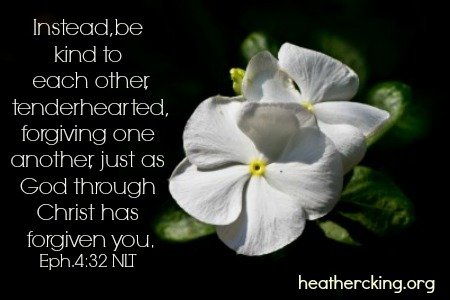
“Be kind to one another, tenderhearted, forgiving one another, as God in Christ forgave you” (Ephesians 4:32).

and

Finally, all of you, have unity of mind, sympathy, brotherly love, a tender heart, and a humble mind” (1 Peter 3:8).

This tender heart so often develops when we ourselves feel broken and beaten down and we are made soft and receptive in the process.ephesians4

If our faith depends on quick answers to prayer and fairy tale lives with superficially happy endings, we’ll be hardened to the needs of others, uncomprehending when they share out of their pain and unmoved by compassion when we see their brokenness.

Not only that, but if our faith doesn’t depend on the Rock of God and His character, but instead stands only on happy (and often misquoted and taken out of context) Christian catch-phrases, we’ll watch the wind and waves of the storm demolish and destroy our houses on the sand (Matthew 7).

We don’t necessarily need enough faith to calm any storm, to walk on the water in the midst of a tempest or sit unmoved and unafraid when our boat seems ready to sink. We just need enough faith to stretch out our hand to Jesus as we sink and cry out, “Lord save me” (Matthew 14:30).

Even that is enough for Jesus to hold us up out of the waves.

Let’s be honest today.  It’s not always easy to sing, “‘Tis so sweet to trust in Jesus.”  Sometimes it’s downright difficult.  It’s murky and hazed over and difficult to see.  Sometimes it’s desperately painful.

But we don’t have to have all the answers.  In fact, we don’t really need to say much of anything at all.  Certainly, we don’t have to pretend that it’s easy or shrug mourning off our shoulders with little more than, “it’s all for the best.”

Instead, we can ask for God to make our hearts tender, soft and pliable in His hands because of the pain we’ve endured.  And we can reach out one desperate hand and cry out, “Lord, save me.” Sometimes, that’s all we can honestly say and that’s enough.

Heather King is a wife, mom, Bible Study teacher, writer for www.myfrienddebbie.com and worship leader.  Most importantly, she is a Christ follower with a desire to help others apply the Bible to everyday life with all its mess, noise, and busyness.  To read more devotionals by Heather King, click here.