A Pentecostal Girl in a Baptist Church Reads the Book of Common Prayer

“Look, girls, this is Abraham Lincoln’s hat!  Isn’t that amazing?  His actual hat that he wore on his actual head!  Cool, huh?”

“Yeah, mom, cool!  Wow” and then they skipped off to the side where a touch screen terminal allowed you to pull up videos on almost every historical subject ever.

“Oh….my….goodness…” I exclaimed. “It’s Kermit!  It’s THE ruby slippers!”  “Look at this!  It’s George Washington’s desk and his field kit.  Wow!  George Washington touched this.”  Incredible, huh?”

“Cool!” my daughters said as they turned back to the museum’s electronic history mini-game.

On a recent trip to the National Museum of American History I learned that young kids don’t really share my appreciation for relics of the past.  They liked history well enough and enjoyed the trip.

Yet, they were drawn like magnets to all the electronic gadgets and doo-dads the museum had added to make the exhibits more interactive.

I, on the other hand, could have just stood in front of a hat, a cane, a chair, and a medical kit and marveled all day.

Perhaps one day, when they’ve learned how quickly time rushes us through life and how people matter, when they discover that it’s hard to make an imprint on this world and leaving a legacy long after death is a marvel, then maybe they’ll treasure relics, artifacts and heirlooms–the physical reminders of people from the past.

For now, though, it’s just “stuff” and the people are little more than black and white photographs on a history book page.

I’ve been thinking recently about the heirlooms of faith, not just salvation itself and the handing down of the Gospel.  But the prayers and readings that unite us to a long history of Christians, centuries and centuries of believers on their knees echoing the same thoughts and words before God’s throne.BookofCommonPrayer
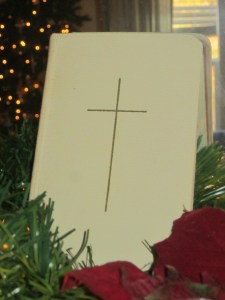
One of the family “heirlooms” I keep on my fireplace mantle is my Grandmother’s Book of Common Prayer.  I’ve had it there since her death years ago, but I’ve never once opened it up.

The tradition of her faith was so very different than mine. I grew up in a Pentecostal church that taught me valuable faith-lessons, doctrinal foundations, daily Bible reading, personal, intimate and honest prayer, and passionate worship.

My faith is alive and vibrant today because I was taught and encouraged to be personal and interactive with God. I wouldn’t trade or change that foundation for anything.

I feel like I’m drawn to the idea of liturgy, though, much like a museum visitor gazing at Lincoln’s hat and thinking about how this “thing,” this “physical object” connects us to living and breathing people from the past.

I’m not changing churches, denominations, or my personal statement of faith.

Yet, how important it is to remember that salvation isn’t new to 21st century Christians.  Connecting with the past reminds us anew that “Jesus Christ is the same yesterday, today, and forever” (Hebrews 13:8). It reminds me that God cared for His people since the creation of the world and that my testimony of His faithfulness joins with the testimonies of believers for thousands of years.

God is bigger than me and bigger than my brief time on this earth. 

I’m curious about this prayer book sitting unopened on my shelf.  First published in the 1500s, it was meaningful for centuries, uniting the hearts of God’s people to pray and read Scripture together.

It was a way of ordering your spiritual walk, not based on your own personal whims, emotions or circumstances, but on the life of Jesus Himself—beginning with the first Sunday of Advent and the account of Christ’s birth.

The object itself isn’t holy, isn’t to be worshiped and isn’t inerrant other than the Scripture readings themselves.

Yet, there’s something breathtaking about opening a prayer book on the first Sunday of Advent and reading the same Scripture passages that Christians have read on this very same day for hundreds and hundreds of years.

And while these pages may be oft-read and well-worn for many who have followed those traditions year after year, for me—for a Pentecostal girl attending a Baptist church in the year 2012—opening the Book of Common Prayer is a wild act of discovery.

Usually each December, I choose my Bible reading plan for the year ahead.  I’m typically a One Year Bible-kind of girl.  This season, though, starting this first Sunday of Advent (Dec. 2nd), I’ll be following the two year-Scripture and prayer plan in The Book of Common Prayer.

It’s a long-held tradition, an heirloom that I’m taking down off a shelf and making new and fresh for me.

What will be you be doing to keep your faith alive and growing in 2013?

*********************************************************

For more information on the history of the Book of Common Prayer, what it’s all about, and how to use it, you can visit this site or watch this video on why it can be used along with spontaneous and personal prayers to build our faith.  The daily Bible reading schedule is provided here.

Christian Writers Blog Chain

Today’s post is part of the November topic ‘Heirloom’ by the ChristianWriters.com Blog Chain. You can click on the links on the right side of this page to read more articles in this series.

Heather King is a wife, mom, Bible Study teacher, writer and worship leader.  Most importantly, she is a Christ follower with a desire to help others apply the Bible to everyday life with all its mess, noise, and busyness.  Her upcoming book, Ask Me Anything, Lord: Opening Our Hearts to God’s Questions, will be released in the Fall of 2013!  To read more devotionals by Heather King, click here.

Copyright © 2012 Heather King

Setting Up Chairs and Why This Matters

“So let’s not get tired of doing what is good. At just the right time we will reap a harvest of blessing if we don’t give up” (Galatians 6:9)

“Who helped lead you to Jesus?”

It was part of the Sunday sermon at my church, our pastor opening up the floor for answers from the congregation.

There wasn’t even time for a more formal pass-the-microphone kind of testimony sharing.  People popped up their hands all over the church and some just called out their answers in tribute to those who carried them to Jesus.

Some mentioned sisters or friends, several Sunday School teachers, a school teacher, pastors and grandparents who had taken them to church.

But overwhelmingly the answers were “My parents.”

In Scripture, that’s part of Timothy’s testimony, too.  Paul writes:

 I remember your genuine faith, for you share the faith that first filled your grandmother Lois and your mother, Eunice. And I know that same faith continues strong in you (2 Timothy 1:5).

If he sat in our church on Sunday, Timothy would have thrown up his hand and said, “My mom and grandma taught me about the Lord.”

It’s one of those moments in life where everything freezes for the slightest breath and you realize something deeply true—“This Matters.”

It’s not always so easy to persevere and keep on keeping on.  When you’re prepping the Sunday School materials week after week …when you’re grading papers and writing lessons….when you’re asking your friend to church for the hundredth time… when you’re just driving kids to church.

Then there are those daily tasks, seemingly unimportant, easily overwhelming, when it’s hard to feel like you’re having any significant impact at all beyond washing clothes and cooking meals.

Most of the Mom-life isn’t deep spiritual lessons and massively important character lessons for our kids.  Most ministry isn’t radical and miraculous transformation.

My children don’t sidle up to me around 4:30 each day, ask me what’s for dinner and hear me preach on the feeding of the 5000 or the Bread of Life or how we should hunger after righteousness.

Usually I just tell them chicken or spaghetti or something I’m going to make up in about 15 minutes that I haven’t decided on just yet but will surely be awesome.

I once heard a youth pastor say that “90% of ministry is setting up chairs.”

Isn’t that true of what we do as well?

Sure, God gives us these perfect moments when our kids ask the deep question and we need to know how to answer with the Bible and with prayer.  Of course, our lives need to be an example of personal faith in Christ.

Other times, though, we’re ‘setting up chairs.’  We’re washing mounds of clothes and matching the socks not devoured by the dryer monster.

We’re filling the cart with groceries and cooking those dinners night after night.  We’re packing lunch boxes day after day and bending over a child’s shoulder to watch her put the final touches of paint on a school project.

It’s jumping up every five minutes when a child calls out, “Mom!” or “Help!”  It’s standing outside waiting for the bus even in the cold and the rain and chasing down children who’ve forgotten their mittens or hats on a frosty day.

It’s losing sleep because of illness, bad dreams, night owls and early birds.  It’s foregoing any attempt at an uninterrupted conversation and occasionally hiding in the bathroom with the telephone just so you can hear what the person on the other end is saying.

It’s shuttling children here and there, cheering from the sidelines of a field on Saturday mornings or snapping photos at a ballet performance.

Setting up chairs–that’s what we’re doing day after every single day.  We’re serving in our homes and communities, schools and churches in hundreds of hidden ways.

Because we love.

We do it because God Himself, the Savior of us all, stooped onto a knee and washed the dust and grime off the feet of His own followers. Then He said, “since I, your Lord and Teacher, have washed your feet, you ought to wash each other’s feet. I have given you an example to follow.  Do as I have done to you (John 13:14-15).

We do it without recognition most of the time.  No onlooker cheers you on for spending your day changing diapers, making meals and giving baths.

There aren’t enough ceremonies to thank the faithful servants who “set up chairs” in our churches every week.

But we can remember in this moment that “This Matters.” We can fold those clothes with a little more joy and prepare that lesson with a renewed sense of purpose.  Because every moment that we’re serving others is part of leading them to Jesus and there’s no greater ministry than that.

Heather King is a wife, mom, Bible Study teacher, writer and worship leader.  Most importantly, she is a Christ follower with a desire to help others apply the Bible to everyday life with all its mess, noise, and busyness.  Her upcoming book, Ask Me Anything, Lord: Opening Our Hearts to God’s Questions, will be released in the Fall of 2013!  To read more devotionals by Heather King, click here.

Copyright © 2012 Heather King

Weekend Rerun: Mom Guilt

Originally posted on November 28, 2011

If you, then, though you are evil, know how to give good gifts to your children, how much more will your Father in heaven give good gifts to those who ask him!”
(Matthew 7:11)

Mom Guilt.

That’s what had me standing in the Christmas lights aisle at Wal-Mart two days after Thanksgiving.  I squinted and stared at the options before me.  Icicle lights.  Blue, green, or red lights.  Sparkly, flashing lights with 12 different settings.  Heavy duty lights.  Mini lights.

Then there were clips and clasps of every variety to attach the perfect lights to your house.  Did I need these things?  Wasn’t there a way to hang lights sans gadgets and gizmos?

I grabbed plain white mini lights from the shelf, thinking my first attempt at decorating the outside of our home should be simple.  “Start small,” I thought.

For years, my oldest daughter had begged me to decorate the outside of our home for Christmas.  This year, her pleading had reached a new level of intensity.

She took one look at the homes with Christmas lights already gleaming in mid-November (insert looks of disgust here!!!) and whined from the back of our minivan, “Mom . . . . . . . .Everyone’s house is so beautiful for Christmas and ours is just DULL.”

I threw angry glances at the decorated houses as we sped by.  Even if they didn’t know I was mad at them, at least I felt better getting the feeling off my chest.

Still, I get it.  I remember being a kid and pestering my dad to hang Christmas lights on our home for years.  I remember taking the lights tour in the family van and oohing and aahing over the decorations and thinking it’d be great to add a little Christmas flare to the outside of our house.

So, there I was buying lights from Wal-Mart.  And there I was starting simple, stringing them up the steps to my home and around the door frame.  And there was my daughter exclaiming how beautiful it was.

She actually had asked for one of those giant blow-up Snow Globes for the front yard along with a massive Frosty the Snowman and maybe some lighted reindeer figurines.

But there are limits.  Mom guilt only gets you so far.

When I’m praying, I wonder how many of my requests to God make it to His throne room sounding like the high-pitched whine of pouring on “God guilt.”

“God, all my friends have their careers all set and know what they want to do with their lives, but I’m floundering around waiting for some direction here!”

“God, You thought everyone else deserved a husband to love them and tell them they’re beautiful.  What’s the deal with me still being single?”

“God, how come everybody else is financially secure and has a savings plan and we’re struggling paycheck to paycheck and never truly making it?”

God doesn’t bless us or rescue us out of guilt, though.  Not now.  Not in the past.  Not ever.  He’s not guilted into love and He wasn’t guilted into the cross.

Deep down, me stringing lights across the front steps of my house wasn’t truly about guilt either.  It was about love.

My daughter had made a request.  Not a ridiculous one, all motivated by greed or pride or selfishness.  It was the simple desire of a child’s heart.

And I love her.

So, I gave in.  I spent less than $10 for some lights and garland and took a tiny piece of my time and gave her the desire of her heart.

I can’t always give her everything she wants.  She can’t have every toy or outfit or trip her friends have.  She can’t do every activity she wants to do.  Nor would that be good for her anyway.

Still, I give her what I can when I can because I love this beautiful daughter of mine.  I love to see her react with joy, love to see her know she’s loved, love to show her that I listen to what she says.

God loves you.

He loves to see you react with joy.  He loves to see you when you know you’re loved.  He loves to show you that He listens to what you say.

God’s intention is always relational, though.  He isn’t just dishing out answers to prayer requests like some sort of holy vending machine.

The Psalmist tells us, “Take delight in the LORD, and he will give you the desires of your heart” (Psalm 37:4).

Take delight in your relationship with Him.  Linger in His presence.  Make Him your first priority.  Allow Him to re-arrange the furniture of your heart and match your desires with His.

And when you begin to feel the frantic panic of need, remember that God tells you “do not worry about your life.”  Not about having food or drink.  Not about having clothes to wear.  He watches over the birds of the air and the flowers in the field and He values us so much more than them.  He surely can handle our every need.

So, keep your focus relational.  “Seek first his kingdom and his righteousness, and all these things will be given to you as well” (Matthew 6:33).

Then when He pours out blessing on you, when He loads your arms full of good gifts, when He grants the simplest petitions of your heart—even the whimsical longings you are too embarrassed to actually ask for—accept it as a reminder of His love.  He wasn’t coerced or guilted into giving you amazing grace.

Heather King is a wife, mom, Bible Study teacher, writer and worship leader.  Most importantly, she is a Christ follower with a desire to help others apply the Bible to everyday life with all its mess, noise, and busyness.  Her upcoming book, Ask Me Anything, Lord: Opening Our Hearts to God’s Questions, will be released in the Fall of 2013!  To read more devotionals by Heather King, click here.

Copyright © 2012 Heather King

Thanksgiving Devotions: Bitter Ingredients and Pumpkin Pie

Almost all of my favorite Thanksgiving memories aren’t really of the feast itself, even though I still say it’s my favorite holiday.  Mostly I grow nostalgic for Thanksgiving Eve and the Wednesday night family baking sessions we had as a kid.

Some of our craziest family legends involve making the traditional chocolate meringue pie the night before the big day.

There’s something deeply relational about baking, whether it’s for someone or with someone.  I find myself even now telling stories as my daughters stir and imparting generational wisdom like: why the butter and sugar get creamed together first and how you have to pack down brown sugar when you measure it out.

Hugely important life lessons like that.

And maybe I learn something, too.

The last time we crowded around the table to make pumpkin pie, my oldest asked, “Mom, what does pumpkin taste like by itself?”

She thought it would be sweet heavenly golden goodness.  After all, this daughter and I share a passion for all things pumpkin—pies, breads, cookies and cupcakes.

But I knew the dark secret about pumpkin and I tried to warn her, “You can try it if you like, but just a small taste.  It’s bitter.”

She licked a tiny bit off her finger and made the appropriate “nasty” face.

How can something so incredibly delicious in everything we bake be so horrible on its own?

I pulled out the vanilla and she bravely tasted the tiniest droplet of that also, despite the grimace over the pumpkin.

Yup, vanilla doesn’t fair any better on its own.

She even smelled each of the spices before we measured them into the bowl.  It turns out that cloves, nutmeg and ginger are more potent than sweet and more pungent than enticing.

Photo courtesy of Viktor Janacek, picjumbo

Photo courtesy of Viktor Janacek, picjumbo

The eggs were runny, sticky and gross.

The salt was…well, salty.

All in all, it was utterly mystifying when we finished stirring and I handed her the spoon to lick, which she popped into her mouth with a muffled, “Yummmmm.”

The truth about baking is the truth about life.  We have a reason to be thankful for every ingredient, even the ones that seem too bitter or salty or potent to turn into anything mouth-watering and delicious.

As Christians, most of us have not only heard Romans 8:28 a million times, we’ve probably quoted it a few thousand times ourselves:

And we know that all things work together for good to those who love God, to those who are the called according to His purpose (Rom. 8:28 NKJV).

You may have even just skimmed through that verse just now because you’ve heard it so often and know it so well.

And yet, we tend to emphasize the “for good” part of this verse, which means we could be expecting instant pumpkin pie when life hands us a can of Libby’s pumpkin.

That job you lost, how can that be for good?

That time of sadness, that mourning, that separation and grief, the broken relationship and the conflict…..tastes so bitter.  It doesn’t seem possible for any of it to be “for good.”

Philosophically, we know the deal.  We’ve heard the sermons.  Maybe one day we’ll see how God turned these times of sadness and stress into blessing.  Maybe it won’t be until heaven, but at least then we’ll be able to see the good that came from the ugly.

It’s a long, hard lesson, realizing that “for good” doesn’t necessarily mean “right now” or “without pain.”

But it’s true, of course.  There are eternal perspectives and long-term visions that we just can’t see from our limited, finite looking glass on circumstances so up-close and personal.

There’s something about this verse that we often overlook, though.  God isn’t just working “for good,” He’s doing it so that “all things work together.” The good comes from the mixing of ingredients, the pooling together of the circumstances into one beautiful wholeness—His plan and will for Your life.

Rick Warren says it this way:

“The events in your life work together in God’s plan.  They are not isolated acts, but interdependent parts of the process to make you like Christ….If you will give God all your distasteful, unpleasant experiences, he will blend them together for good” (The Purpose Driven Life, p. 195).

I’ve had Thanksgivings where gratitude came easy, practically gushing out of me in response to blessing.

And there were years where thankfulness was a discipline of the soul, a determined trusting in God, a sacrifice of praise.

Regardless of whether this year is easy or harder for you, remember that the pumpkin, the eggs, the salt, the vanilla, the spices aren’t delicious on their own.  But trust–and give thanks–that God will bring everything together and it will be sweet and for your blessing and beyond what you could imagine.

Heather King is a wife, mom, Bible Study teacher, writer and worship leader.  Most importantly, she is a Christ follower with a desire to help others apply the Bible to everyday life with all its mess, noise, and busyness.  To read more devotionals by Heather King, click here.

Copyright © 2012 Heather King

Thanksgiving Devotions: Secret Messages, Whispered Thanks

I wanted to write.
She wanted to paint together.
I sat down to answer emails.
She wanted to do puzzles together.
I vacuumed and washed and folded.
She dragged the Play-Doh bucket from the playroom so we could make pizza Play-Doh…together.

Writing projects, church projects, house projects, studying, filling out forms, answering emails, drafting letters, returning phone calls…I had my agenda.

And she had hers, as she handed me a game she couldn’t play on her own and asked for help.  Maybe we could do it together?

Somehow I managed to perform periodic cleaning sweeps through the house in between requests for “together” this or that.  We ate lunch at the school with her older sisters together (of course) and took a trip to the library after school with everyone.

Bedtime arrived and I kissed them all sweetly and patted their heads, read the book(s), prayed the prayer and tucked them into beds.  Then I flopped down into the chair, glad that somehow the house had ended the day clean-ish so I could work on other projects now in my “free time.”

One brief moment of peace passed before I heard the sounds of fighting, ending in screams and tears.

Following that, the post-fight therapy with daughters began, about whether they are loved as much as their sisters, and how come she gets away with this and didn’t I hear the mean things she said?1corinthians1-4

That’s when my tears began.  Because even the time that’s supposed to be free really isn’t when you’re a mom.  Sometimes the whole idea of achieving balance seems like dreaming the impossible dream.  When you’re truly responsible for other people, little people whom you love completely and utterly, you’ll be emptied out over and over again.  Where’s the balance in that?

The truth is life isn’t about balance at all.  It’s about putting people first.

I can’t say that I’m ending this day feeling very accomplished or on top of things, but then usually the most important things in life can’t be crossed off a to-do list.

Yet, as we sat there having lunch at the school, my three-year-old climbed up in my lap and curled up tight.  Her breathing slowed and drew in deeper and deeper until her head flopped forward into the crook of my arm.

I scooped her up, carried her to the car and then into the house after the drive.  If it’s possible for a tiny girl to coo, she did when I settled onto the sofa with her in my arms.

Then I whispered into her ear what I’ve said to my children hundreds of times since their birth: “I love you and I’m so thankful to God that He let me be Your mom.  You are God’s great gift to me.”

Sometimes I’m telling that to wiggly daughters who have zoomed by me in their dash from the kitchen to the bedroom.  I’ve reached out my hand, pulled them close and told them the secret message again and again.

Other times, I’m whispering it to sobbing girls, upset, angry, hurt or feeling unloved.

“I’m thankful to God for you.”

We all have people who need to hear those words from us: Teachers, friends, moms, sisters, dads, children, mentors, caregivers, coworkers, husbands….

Paul teaches us this in his letters to the churches.  He writes with encouragement and challenges, correction, doctrine, and personal testimony, but also with thanks for the very people reading these words.

To the Corinthians he wrote: “I always thank my God for you because of his grace given you in Christ Jesus” (1 Corinthians 1:4).

To the church at Thessalonica, he said: “We always thank God for all of you and continually mention you in our prayers. We remember before our God and Father your work produced by faith, your labor prompted by love, and your endurance inspired by hope in our Lord Jesus Christ (1 Thess 1:2-3).

So often, we skim through the beginning and end of Paul’s letters, rushing through the personal notes so we can dig into meaty questions of doctrine and theology.

But people mattered to Paul. That’s clear when you actually read his thoughtful recounting of the service, ministry, teaching, faithfulness, and generosity of individual people and the church as a whole.

Even when he was tired out from ministry and abandoning his own plans or agenda in order to jot off a letter to a beloved church in need, Paul always took the time to say, “I thank God for you.”

During this week of Thanksgiving, don’t just post a Facebook status thanking God for your husband and kids.  Don’t be satisfied with saying just one word of gratitude before you pass the turkey and mashed potatoes.

Tell others how thankful you are for them here and now.  That’s more important than anything else on your agenda for the day.

Who needs to hear you say, “I’m thankful for you” today?

Heather King is a wife, mom, Bible Study teacher, writer for www.myfrienddebbie.com and worship leader.  Most importantly, she is a Christ follower with a desire to help others apply the Bible to everyday life with all its mess, noise, and busyness.  To read more devotionals by Heather King, click here.

Copyright © 2012 Heather King

Weekend Walk: A Messy Unraveling and a Thanksgiving Verse

We had made a mess.

So far, my daughter’s work at sewing class had impressed me.  She was getting into the groove of things: set the needle, angle the cloth, put down the foot, press the pedal, sew forward, backward and forward again, always guiding the material with her hands without getting her fingers sewn.

That’s a lot for me to remember, much less my six-year-old!

She was proud of her work and I was proud of her concentration and focus.  We’re learning, though, mostly together.  I’m probably not much more expert than she is.  So mistakes are inevitable.

During one of our rows of stitching, she slammed her foot down on the pedal like she was racing in Nascar without setting the needle and without clamping down the material.

We didn’t realize the extent of the disaster at first.  I just stopped her and we started the row over, correctly this time.  But when we lifted the finished row of material off the machine and flipped it over we saw a tangled, unraveling mess of string and knots where a row of straight and even stitches could be.

Sometimes mistakes and mess are like that, hidden underneath the surface.  We look like we have it all together and are happy and whole.

But we’re really unraveling.

And we can only hold it together so long before it all comes apart.

This Thanksgiving week, I’m thankful for mentors and teachers who can teach you how to get it right and what to do when you get it wrong.

But I’m also thankful for grace and fresh starts, for the fact that sometimes God lets us rip out the stitches, reset the material and start again.

I’m thankful that He never leaves us in an unraveling mess.  He’s always stitching us back together, with care and attention.

Our God is full of faithfulness, abundant in mercy and worthy of our praise, and our verse to meditate on all this Thanksgiving week is a reminder of that.

Psalm 100: A Psalm of Thanksgiving

 Shout with joy to the Lord, all the earth!
Worship the Lord with gladness.
Come before him, singing with joy.
Acknowledge that the Lord is God!
He made us, and we are his.
We are his people, the sheep of his pasture.
 Enter his gates with thanksgiving;
go into his courts with praise.
Give thanks to him and praise his name.
 For the Lord is good.
His unfailing love continues forever,
and his faithfulness continues to each generation.

Heather King is a wife, mom, Bible Study teacher, writer for www.myfrienddebbie.com and worship leader.  Most importantly, she is a Christ follower with a desire to help others apply the Bible to everyday life with all its mess, noise, and busyness.  To read more devotionals by Heather King, click here.

Copyright © 2012 Heather King

Flat

Well-meaning strangers have pulled up alongside my minivan and honked the horn so I’ll swivel my head in their direction.  Then they wave their hands at me and initiate a mini-game of charades.

Oh I get it—they want me to roll my window down before the light turns green.  So, I fumble around with my automatic windows, pressing every wrong button in nervousness until I finally get it right just in time to hear them shout out the message.

Passers-by in parking lots have strolled by my minivan and backed up to deliver the news.  Friends from church have walked the perimeter and told me what they saw.

“You have a flat tire.”

I appreciate the alert because I’m an unobservant ignorer of massively important details.  I’ve been known not to notice that my husband has shaved his beard completely off after having it for 3 months.

So, I’m pretty dependent on more observant folks to help me out and sound the alarm.

Unfortunately, the news they bear isn’t at all what I want to hear.

You see, someone has surely placed a magnet inside my tires that attracts every nail on the road in our entire county.  It must be true because I get a flat tire about four times a year.

That seems statistically impossible somehow.

And definitely unfair.

Of course, the frustrating thing about tires is that you never just replace one.  It’s always a matter of two.  That’s a law of physics or something.

Unfortunately, this time the rim was bent and my tires needed to be replaced.

Yes, tire”s” as in two of them (please refer back to the First Law of Tires).

This also means that by some miracle I didn’t drive over a nail in the last month.  I apparently drove over a pothole or something of that nature instead, just to shake things up and keep life interesting. Variety is, after all, the spice of life.

This first reminds me of the Geico commercial of a pothole with a Southern accent.

The difference between the commercial and my reality being that my pothole didn’t speak to me like a Southern belle and apparently it was damaging enough to cause long-term catastrophic failure, but not terrible enough for me to notice it happening.

This whole experience has reminded me of something else, though: How it feels to be flat, sucked dry, breathless, desperate for the Spirit of God, lifeless, joyless, and emptied out.

Oh, how desperately we want to take in God’s presence and His life-giving breath, but no amount of gasping and gulping at the air lifts us off the ground.

So there you remain, feeling the void, unable to move.

It comes on us gradually, this emptiness.  We’ve picked up the tiniest of nails, over and over again from daily annoyances and perpetual busyness.  Perhaps we’ve even bounced over a few potholes that have dented and bruised our Spirit.

Even when you do everything right, even when you flop down at the kitchen table to read God’s Word and you serve in ministry and you love others and you pray and you blast the praise music (when your kids let you choose the songs in the car)….even then it’s possible to wake up one day and realize you are flattened out and suffocating for want of God’s Spirit.

The prophet Ezekiel stood overlooking a valley filled with “bones that were very dry.” They were hopeless and cut off, dried up.  It’s the same as feeling flat with its lifelessness, breathlessness, the deadness, and the void.

God’s message to the bones was:  I will make breath enter you, and you will come to life (Ezekiel 37:5 MSG).  Not just breath!  “I will put my Spirit in you and you will live” (Ezekiel 37:13 MSG).

It was a revival.  A newness of life.  Taking the dead, dried out, and breathless and filling it anew with the very Spirit of our holy God.

But it began with dead bones crying out:  ‘Our bones are dried up and our hope is gone; we are cut off!’ (Ezekiel 37:2, 11 MSG).

They were clamoring for life instead of accepting their dry deadness scattered along the valley floor.  We also cry out to Him, “God, we’re desperate for your Spirit and we won’t remain silent here flattened to the ground.  Fill us anew!  Make Your Word come alive!  Stir my heart to see You, to hear Your voice, to feel Your presence.  Breathe Your life into me.”

And this He will do, maybe through gradual healing and patching together or maybe in a revival of a moment.  He will do it because we ask.  He will do it for the glory of His name so that “you will know that I the Lord have spoken, and I have done it” (Ezekiel 37:14).

One of my favorite worship songs: Desert Song, by Hillsong United

This is my prayer in the desert
When all that’s within me feels dry
This is my prayer in my hunger and need
My God is the God who provides

Heather King is a wife, mom, Bible Study teacher, writer and worship leader.  Most importantly, she is a Christ follower with a desire to help others apply the Bible to everyday life with all its mess, noise, and busyness.  Her upcoming book, Ask Me Anything, Lord: Opening Our Hearts to God’s Questions, will be released in the Fall of 2013!  To read more devotionals by Heather King, click here.

Copyright © 2012 Heather King

Remembering: Some Things Never Change

Originally posted 11/4/2011

“But you remain the same, and your years will never end” (Psalm 102:27).

“Mom, I know how to spell the word ‘kissing.’”

To myself, I think, “That’s kind of a strange word to show up on the first grade spelling list, but okay.”

Aloud, I say, “Wow, that’s a pretty big word.  Spell it for me.”

Immediately, my first grader breaks out into the full-voiced sing-songy chant:

“K-I-S-S-I-N-G
First comes love, then comes marriage, then comes the baby in the baby carriage.”

Some things never change.

The same chants, the same games, the same tears, the same laughs, the same hand-claps and rhymes and teasing from generation right on to the next.

Some things never seem to change with me either.

The truth is I need a Savior.  I can make 50 resolutions a day not to lose my temper with my kids, but the moment my poky kindergartener pits herself against this super-speed mom, the explosions begin.

In my own, the holding it together and the being perfect don’t happen. I find myself sitting in the pupil’s chair again, learning the same lesson from God that He taught me last year, and the year before that, and year after year for as long as I can recall.

In lessons of patience, grace, love and flexibility, I can be a pretty slow learner.

But there’s something else that never changes.

God.

He’s immutable, unchanging, “the same yesterday, today, and forever” (Hebrews 13:8), who doesn’t alter “like shifting shadows” (James 1:17)

So, it gives me hope in all of my wayward sameness, to go back, all the way back to the beginning. That same God, who stared at the dark shapeless mess and saw the potential beauty of the created earth sees beauty in me, as well.  He sees it in you.

No one but God could have seen the potential in that pre-Creation space. Genesis 1:2 tells us, “Now the earth was formless and empty, darkness was over the surface of the deep, and the Spirit of God was hovering over the waters.”

Formless, empty and dark.

And God said, “Let there be light.”

The fact of our Creator God mounts my faith on the firmest of foundations.  I know He can make glorious possibilities out of nothingness, painting the sky onto a blank canvas.

I know He can be original and uniquely imaginative, designing solutions that our finite minds could never have achieved—like how fish “breathe” under water.  That means when I am hopeless with no possibility of salvation, I know my God can create a solution that is beyond my comprehension.

And I know He can bring order to the most disordered and messy aspects of my life just as He shaped the earth out of what was “formless and void.”

So when it comes to the things that just don’t seem to change in me, it’s best for me to “let go, and let God.”  I struggle and strive to do the work of self-improvement, only to fail at the first sign of stress.

But when I call on the name of Jesus and bring the messy disorder of it all to Him, He sifts through the mud and mire and brings forth treasure.

It takes honesty, though, the heart-felt, soul-bearing truth when we finally just say, “God, this is a mess.  I can’t do it.  I’ve tried.  I’m a failure at this.  I’ve done it again.  I’ve fallen into the pit.”

When we finally stop pretending to be perfect, then and only then, can Jesus get busy creating, forming, cleaning, and ordering the mess we’ve brought to His feet.

Lisa Harper wrote,

Our Redeemer will carefully help us sort the treasures from the trash.  If we’ll just be honest about the emotional boxes we’ve squirreled away, Jesus will take charge of the cleaning process.

Our honesty allows God to do the dirty work of changing us.  So, even when it’s painful, and even when it’s slow, and even when it’s hard, we know that we really aren’t staying the same.  The lessons may be the same-old, same-old, and yet our never-changing, immutable God teaches us a bit more and goes a little bit deeper.

We’re growing.  Sometimes in shoots and spurts.  Sometimes in painful inches.

Sometimes we can’t see the change at all, but our roots far below the surface are digging deeper down, planting us firm into the soil so that God can do the visible work later without toppling us right on over.

We’re changing.  But, praise God, He’s not.  He’s what really never changes.  With all His patience, and all His grace, with the love that manages to see beauty in our mess, He’s the Ever-Faithful Creator and we His beloved creation.

What messes do you need to hand over to our Creator God today?

Heather King is a wife, mom, Bible Study teacher, writer for www.myfrienddebbie.com and worship leader.  Most importantly, she is a Christ follower with a desire to help others apply the Bible to everyday life with all its mess, noise, and busyness.  To read more devotionals by Heather King, click here.

Copyright © 2012 Heather King

Weekend Rerun: Marthas Anonymous

Originally posted on October 26, 2011

Fourteen years in women’s small groups and I’ve never once heard someone confess to being a Mary rather than a Martha.

We sit around the table at what might as well be Marthas Anonymous and confess, “Hi, I’m Heather, and I’ve been a Martha now for as long as I can remember.  I’m always busy, can’t seem to sit still and don’t enjoy resting.  I don’t watch TV without something to do at the same time and feel best when following a to-do list.”

I’ve heard the same confessions for years.  What I’ve never heard is, “Hi, I’m Jane and I’m a Mary.  I have no trouble at all dropping whatever I’m doing just to hang out with Jesus.  I’m totally fine if others are working in the kitchen while I sit at His feet.  Priorities for me are never a problem–Christ always comes first.”

That’d be the day!

And while we confess to being Marthas as if we recognize it’s a problem, at the same time, there’s a little bit of pride there.  Pride at being productive and busy.  Pride at being the one to take care of others.  Pride at the fact that people can depend on us to get things done and that we’re necessary to others.

That’s what the busy life does for us—feeds our self-esteem and reminds us that we’re important.

Yet, while we always pick on Martha as she grumbled to Jesus that her sister, Mary, wasn’t helping enough in the kitchen, it’s not Martha’s activity that was the problem. Someone did in fact need to feed Jesus and the disciples lunch and some Ramen noodles or boxed macaroni and cheese wouldn’t really cut it when feeding a crowd of at least 13 traveling evangelists.

Busyness in the kitchen wasn’t necessarily Martha’s issue and it isn’t always ours either.  It’s fine to dream wistfully of hour-long quiet times, but reality doesn’t always allow for that.

Someone has to do your job.  Someone has to mop your floors, do the dishes, make the phone calls, cook the dinner, fold the laundry, play with the kids, read the bedtime stories, and direct the homework.

No, the problem isn’t always a matter of what we’re doing.  It’s a matter of the heart.

For Martha, the first stumble came when she complained about someone else’s lack of activity.

Oh, how often we take it upon ourselves to judge the choices of another, making us angry accusers and our target the burdened recipient of our disapproval.

Imagine if Mary had hopped up at Martha’s griping and headed begrudgingly into the kitchen.  She wouldn’t be serving dinner because God had instructed her to do so.  She would have been serving out of arm-twisted obligation rather than answering a divine call.

There’s no blessing, no peace, and no rest when we serve outside of God’s will.

Jesus asked, “Are you tired? Worn out? Burned out on religion? Come to me. Get away with me and you’ll recover your life. I’ll show you how to take a real rest. Walk with me and work with me—watch how I do it. Learn the unforced rhythms of grace. I won’t lay anything heavy or ill-fitting on you. Keep company with me and you’ll learn to live freely and lightly” (Matthew 11:28-30, MSG).

When we walk in step with Christ, trodding only where He is leading, we can feel the true rest of dependence on Him and the freedom from performance and accomplishment.

Martha’s next problem was thinking that it was all or nothing.  You either work in the kitchen or you listen to Jesus.  You can’t do both.

Surely, though, she could have been listening to Jesus while she stirred the soup at the stove.  We also can bring Jesus into the moments of our day.  Pausing for five minutes to breathe deeply and utter a prayer of need.  Singing praise to Him while we drive and meditating on Scripture as we wash dishes.

In the same way, even when we don’t have time for Jesus, we make time.  No one is too busy for God.  We choose to make His presence our priority, even if it means shutting off the TV, not answering the phone, taking a “Mommy time-out” for 15 minutes, reading the Bible during our lunch break, or delegating tasks to others.

Life crowds out time with God.  It always does.  We must be vigilant to demand those moments with Jesus. They will not happen by accident.

In Stumbling Into Grace, Lisa Harper wrote, “He teaches us . .  to slow down and recuperate after giving our all for the sake of the gospel.  To find a balance between going out and doing and being still and knowing” (p. 119).

Are you a tired Martha? Accept the rest that Christ offers you in His presence.  Return there as often as possible, taking a minute when you need it and an hour when you can. Don’t expect to be energized for eternity.  He gives you enough for today, for just this moment, and we bring that renewal back into all of our activity.

Heather King is a wife, mom, Bible Study teacher, writer for www.myfrienddebbie.com and worship leader.  Most importantly, she is a Christ follower with a desire to help others apply the Bible to everyday life with all its mess, noise, and busyness.  To read more devotionals by Heather King, click here.

When words get in the way

He told me about his wife, about her kidneys not behaving, her liver calling it quits and her heart not being strong. Mostly, though, he told positive news and trends for the better.

Yet, they had dared to throw out the word ‘hospice’ in one of those foggy discussions with doctors where you’re hearing them and you’re nodding your head, but really the words don’t make sense.

On the phone, I heard how ‘hospice’ made him stumble.  He sucked in his breath, cleared his throat and told me the rest.  His brother is already there, in hospice–(there he said it again; that word never seems to come out easy)– 5-1/2 hours away.

As my grandfather talked, I though of my grandmother, spunky and life-filled, always in tennis shoes so she could speed-walk to everywhere, always talking about trips to Haw-a-ii and cruises to Alaska and more adventures.

Then I thought of her in the hospital, under 100 pounds, fragile and so easily broken.

Two irreconcilable images, surely not the same person.  And yet there it was, unreal but real.

My grandfather said, “I’m fixin’ to be an orphan here soon” and laughed a kind of nervous giggle when you make a joke that isn’t truly funny.

What to say to that?

After years of women’s ministry, I’ll tell you what never gets easy—knowing what to say when it’s all spilling out of someone and you just want to rescue and protect and bandage it all up.  But you’re powerless to do little more than hug and slip on a few Band-aids, then pray with desperate cries that God will heal in the deep-down ways we can’t.

Lost jobs, unfaithful husbands, abusive spouses, alcoholism and pornography, runaway kids, bankruptcy, rape, homelessness, pregnancy unplanned and unwanted, pregnancy wanted so bad it hurts every month with that negative test, abortion, custody battles gone wrong, parents not talking to kids and kids not talking to parents, divorce, fatigue, dying moms and dads, babies in caskets, surgeries failing and car accidents turned tragic…

This…. never…. gets …..easy.

How can there be the right words for so much that is wrong?

Maybe that’s exactly the point.  Maybe even a lover-of-words like me has to fess up that sometimes words don’t just fall short, they actually get in the way.

Like for Job, sitting heaped in ashes and wearing torn rags, scraping at the burning blisters on his flesh with broken pottery, mourning his servants, grieving his children.

Scripture tells us:

When Job’s three friends, Eliphaz the Temanite, Bildad the Shuhite and Zophar the Naamathite, heard about all the troubles that had come upon him, they set out from their homes and met together by agreement to go and sympathize with him and comfort him. When they saw him from a distance, they could hardly recognize him; they began to weep aloud, and they tore their robes and sprinkled dust on their heads.  Then they sat on the ground with him for seven days and seven nights. No one said a word to him because they saw how great his suffering was (Job 2:11-13).

They spent a week in silence with Job, just sitting next to him without speaking or offering hollow words of fake comfort.  For guys who turned out to be so chatty (okay, verbose), this was a big deal!

They seemed to get this right, this friendship without words.  Just mourning with those who mourn and leaving it at that.

Unfortunately, Eliphaz finally asked the question: “But who can keep from speaking?” (Job 4:2) and that’s when it all went awry.

The moment he erupted with spiritual cliches, the “pull yourself up by your bootstraps” speeches, theological debates and judgmental accusation…that’s when he felt more impressed with his oratory skills than concerned about loving a friend.

Ezekiel, on the other hand, “came to the exiles who lived at Tel Aviv near the Kebar River.  And there, where they were living, I sat among them for seven days–deeply distressed” (Ezekiel 3:15).

For a week, the prophet crouched in the dust with the exiles from Jerusalem, those who had been carried off after years of starvation and the siege by the Babylonian empire.

And he stayed there until God told him to get up and move on (Ezekiel 3).

Sometimes we back away in fear from those in pain, not really knowing what to do.  After all, we can easily say the wrong thing.

But you really can’t mess up listening.

God brings hurting people to us not so we can fix life for them or speak some magical words that make it all better.

He wants us to get down in the dirt where they’ve fallen, love them, pray with them, serve them, and practice the power of presence, and so often presence without words.

*************************************

May I recommend this book if you are grieving the loss of someone or ministering to another who is mourning?  It is lovely and full of practical advice and spiritual encouragement. Grieving God’s Way: The Path to Lasting Hope and Healing by Margaret Brownley

Heather King is a wife, mom, Bible Study teacher, writer and worship leader.  Most importantly, she is a Christ follower with a desire to help others apply the Bible to everyday life with all its mess, noise, and busyness.  Her upcoming book, Ask Me Anything, Lord: Opening Our Hearts to God’s Questions, will be released in the Fall of 2013!  To read more devotionals by Heather King, click here.

Copyright © 2012 Heather King