Who’s the Boss?

She’s two, this baby girl of mine, but she doesn’t know that means she’s not supposed to be in charge.

Playing cats and dogs is the favorite game of my three stair-step daughters.  Sometimes my baby girl meows and barks with the rest. She crawls over to me so I can pat her head or scratch her ears.  She pants with her tongue hanging out and then stoops low to eat pretend food out of her bowl.

Most of the time, though, she’s the owner.  Holding an invisible leash, my two-year-old guides the other “animals” around the house, maneuvering around furniture and toys.  Then, she stands at her bedroom door and barks orders at the big sisters crawling around on all fours.

“Come, dog dog.  Sit.  Go.”

If they dare to mis-step or head in the wrong direction, she screams at the top of her authoritative lungs while intensely clapping her hands together, “No, no, no, dog dog!”

She knows how to take charge of her older sisters.

That same kind of birth-order role reversal happened in Jesus’ family, too.  His younger half-brothers didn’t mind occasionally “playing boss” either when it seemed like big brother was out of control.

Last week, I was all giddy like my behemoth cat when he knows I’m going to pour food into his bowl, all because my mail carrier dropped off the package with my new Bible study book.

I yanked out my copy of Beth Moore’s James: Mercy Triumphs from the shipping box, plopped it down on my kitchen table with my Bible, journal, computer, and pen.  After I poured my hot tea and added lots of sugar, I settled in for the first day of study.  It didn’t matter what I had planned for that afternoon; my new study was here so I was studying.

I was just a few minutes into the first video session where Beth Moore was introducing the book and WHAM!  She absolutely knocked me flat with something I’ve read a million times and never paid one iota of attention to before.

Mark 3:20-21 says:

Then Jesus entered a house, and again a crowd gathered, so that he and his disciples were not even able to eat. When his family heard about this, they went to take charge of him, for they said, “He is out of his mind.”

James and the other half brothers thought Jesus was plum crazy.  They stormed into the crowd and tried to “take charge of him.”

Taking charge of Jesus!  Sounds to me like they were the ones out of their minds.

Seriously, though, how often do you really feel that maybe God is just “out of His mind”?

And how often do you step in and try to “take charge”?

If you’re anything like me, you’re a lay it down and snatch it up kind of person.  A “God help me” and then “I’ll do it myself” kind of girl.

It’s because when I hand my problems over to Him, He doesn’t always handle them the way I think He should.

It’s because sometimes what He’s asking me to do sounds like crazy talk—it’s not convenient, it doesn’t make sense, it goes somewhere I didn’t intend and that isn’t comfortable or is perhaps downright difficult.

It’s because sometimes He tells me I can’t have what I’m asking for or maybe I’m not ready yet.

Oh and also, sometimes it’s hard to see that He’s doing anything at all.

So, impatiently, I roll up my sleeves and make phone calls and send emails, draft plans on Excel spreadsheets, and rehearse confrontations in my shower and while driving in my car.  I make five-step plans and set five-year goals.

I fail to remember that I’m not supposed to be the one in charge.

On the other hand, Psalm 78 gives a perfect example of what happens when we allow God to assume and maintain the reigns of control in our lives:

But he brought his people out like a flock;
he led them like sheep through the wilderness.
  He guided them safely, so they were unafraid;
but the sea engulfed their enemies” (Psalm 78:52-53).

Those God leads are brought out of slavery.  They are led safely through the wilderness and the simple presence of their Shepherd casts out fear.

There’s never a moment when a sheep needs to grab the rod and staff and lead the flock in lieu of the Shepherd.  Even when the path is rocky or the destination unclear, the Shepherd is a dependable guide through the turmoil and uncertainty.

It’s not easy, this surrender and submission.  Nor is it a forever decision, once done and done forever.

It’s yielding in this moment and the next. It’s facing a life-choice and choosing to go where God leads, even if you’d rather not.  It’s waiting patiently rather than snatching back control from a God who seems perhaps distant or frustratingly quiet.

It’s not trying to take charge of Jesus.

Heather King is a wife, mom, Bible Study teacher, writer for www.myfrienddebbie.com and worship leader.  Most importantly, she is a Christ follower with a desire to help others apply the Bible to everyday life with all its mess, noise, and busyness.  To read more devotionals by Heather King, click here.

Copyright © 2011 Heather King


Back to School Lessons, Part One: How to Use the Bathroom

On the first day of preschool for my oldest daughter three years ago, I drove up to the doorway.  The teacher leaned in to open the car door and greeted my beaming girl, who had her hair done up sweetly and her clothes picked out special.

Other children had been lifted out of the car by the expert educator, as they screamed for mom and hung their heads low in sorrow at the separation.

Not my daughter.  She bounced out the door and practically sprinted down the hallway to the classroom.  So much for separation anxiety.

I, on the other hand, wiped away tears.  For two hours, I would not know what she was doing or whether she needed me.

At the end of the day, I wanted a full report on all her activities.  Instead, the teacher helped her back into the car and said, “She had a good day!”

A whole two hours of her life spent without me there even to watch.

Truly, it’s the difficult goal of parenthood—to train our children so they function independently.  Teach them what they need to know now so that they succeed tomorrow.

While God never trains us for independence, He is forever building into our lives, hearts and minds today what we will need the next day and the day after that. 

And sometimes we miss it.

So often recently, I have heard people denounce the study of God’s Word in favor of what is “practical” and “relevant,” what’s meaningful to them right now rather than digging in deep to the Scripture.  We want to learn “how to” rather than learn who God is.  We shrug off discipleship in favor of temporary spiritual programs built around a single verse or two.

Now, personal application matters.  The holy words on these pages aren’t there for amusement, or intellectual stimulation, or comfort alone.  If we read without change, we are missing it.  We are missing all that Scripture was intended to be for us.

But, how are we to know now what will matter in our lives tomorrow?  If we seek only that which has immediate application to our lives today, here, now, in this situation, the Bible becomes nothing more than a Band-Aid for life’s boo-boos or a pocket map for our life’s journey.

To celebrate the last day of summer vacation, I sat down with my girls today and had a heart-to-heart about the beginning of school.  (I know some of you have already started the school year, but for us it begins tomorrow).

I looked them in the eyes in all their bright-eyed excitement about school and making new friends and opening new crayons and learning new ideas . . . and I gave them the most important instructions I could think of for the year:

  1. Do not wait to go to the bathroom until it’s an emergency.
  2. Go to the bathroom before you go to the playground for recess and before you get on the bus at the end of the day.
  3. Raise your hand and ask your teacher permission to go to the restroom.
  4. Close the door behind you.
  5. Flush when you are done.
  6. Wash your hands.

To me, these seemed like essential words of wisdom.  To them, they seemed banal and unimaginative.

Just wait until they have to go to the bathroom tomorrow . . .

God so often is giving us the training we need for the future, and we in similar fashion, roll our eyes, shrug our shoulders, and avert our gaze at anything so boring, so unnecessary, so impractical.

How could David know that days spent in the fields watching boring, stinky sheep would train him to be a warrior king?

How could Moses know that a childhood in an Egyptian palace and 40 years in the wilderness moving sheep around would prepare him to be the deliverer of the Hebrew nation from 400 years of slavery and then the leader of that nomadic people for another 40 years?

How could Joseph know how years spent managing Potiphar’s house as a slave and another season managing his fellow convicts while wrongfully imprisoned would prepare him to save the entire Egyptian nation and the surrounding countries from a 7-year famine?

How could they know?  How do you know as you sit with your Bible before you what verse you will need to whisper in the night a year from now or the passage you’ll need to cling to even a decade later?

We don’t know.  But God does.

So, we open up His Word and we dig deep.  We search passionately—not just for the solution to our current problem or the manual for our present situation—but we search for Him, God Himself, and who He is.  We sit attentive in His classroom and become the student of God’s character through the study of His Word.

The Psalmist wrote:

I seek you with all my heart; do not let me stray from your commands.  I have hidden your word in my heart that I might not sin against you.  Praise be to you, Lord; teach me your decrees.  With my lips I recount all the laws that come from your mouth.  I rejoice in following your statutes as one rejoices in great riches.  I meditate on your precepts and consider your ways.  I delight in your decrees; I will not neglect your word (Psalm 119:10-16).

The Psalmist was a dedicated student of Scripture and he tells us how to be the same in this passage.  He tells us:

  • Seek God—not what He can do for you, but God Himself, with all your heart.
  • Memorize Scripture and call it to mind during moments of temptation.
  • Give God praise.
  • Ask Him to teach you.
  • Talk to others about what you’re learning from time spent in His Word.
  • Treat God’s Word like it’s a treasure chest filled to the brim with the most magnificent jewels imaginable.
  • Spend time meditating, contemplating, and praying through the Bible and what it reveals about Him.

And more than anything else, do not neglect His word.  You’re guaranteed to need it, if not today then tomorrow.

Heather King is a wife, mom, Bible Study teacher, writer for www.myfrienddebbie.com and worship leader.  Most importantly, she is a Christ follower with a desire to help others apply the Bible to everyday life with all its mess, noise, and busyness.  To read more devotionals by Heather King, click here.

Becoming a Zucchini Farmer

I’ve found my calling, my true gift and talent—growing zucchini.  So, I’m contemplating a new life as a zucchini farmer.

When we planned this mini-garden of ours, my daughters announced that they must grow and eat their own food.  They wanted to plant and watch it grow, pick it with pride and then serve it up with dinner.

Not knowing how well we could produce food we actually eat like tomatoes and cucumbers, I planted two spindly little zucchini sprouts in the garden.  I’d seen many fellow church-goers hand out this cucumber wannabe to worshipers leaving the sanctuary.  “Would you like some?  Please, take it home!  We’re drowning in the stuff.”  So, I thought this must be one sure-fire vegetable to grow in our garden in case our other plants didn’t do well.

I didn’t expect that much success, just a guaranteed one or two veggies that my daughters could pose with in pictures and be proud about growing.

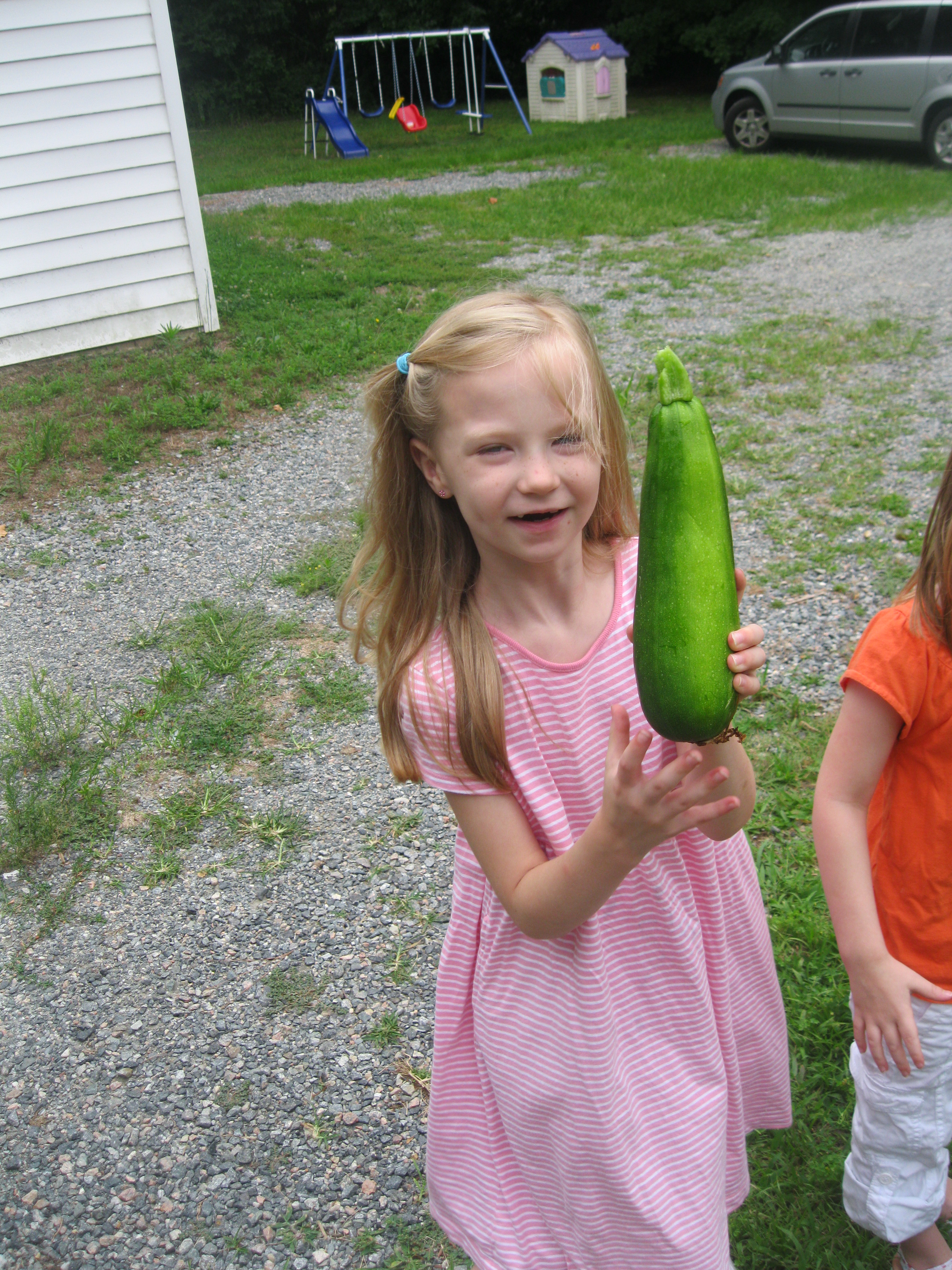
And then this one plant grew to monumental proportions and began producing mammoth zucchini.  I frantically began asking everyone I met, “How do you actually eat this stuff?”  Because we didn’t eat it, not often anyway.  I had no recipes for zucchini and whenever anyone said, “zucchini bread,” I stared at this zucchini the size of my daughter’s torso and wondered how that gets mixed up in a way appropriate for the bread pan.

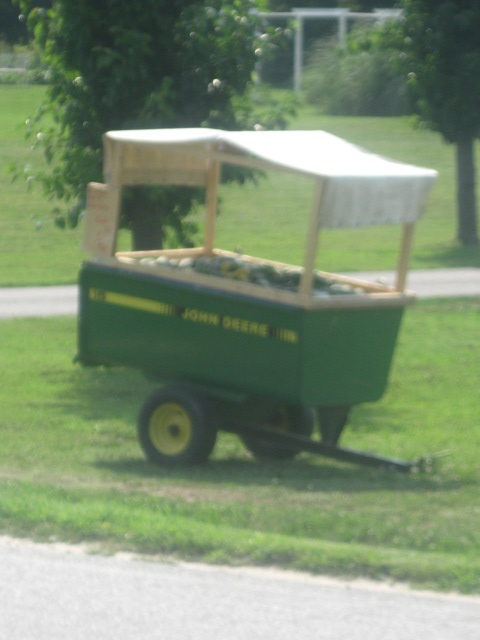
Apparently others are having this problem.  I’ve begun noticing little carts loaded down with zucchini and squash just pushed out to the roadside in front of people’s houses.  These aren’t farmers trying to earn a living off their land.  These are women like me who have run through the entire Food Network recipe book on zucchini and still have some to spare.

This zucchini overload has me asking one question—what’s the point? What’s the point of having abundance if you don’t use it?  Sitting in my refrigerator or on my counter looking green and huge, this zucchini is pointless.  It is designed and intended for nourishment. Unused, it will rot and go to waste.

My question extends out to issues of faith.  What’s the point of spiritual gifts buried deep and hidden away?  God gives them to us, perhaps we even cultivate and harvest them. Then we let them sit unused.  Or perhaps we grow mystery vegetables in our garden, never actually identifying them.  Yes, we have gifts, but not knowing what they are, we simply pick the fruit, place it on the counter and toss into the garbage the rotten results over time.

While building the tabernacle, Moses instructed the Israelites: “Come, all of you who are skilled craftsmen, having special talents, and construct what God has commanded us” (Exodus 35:10 TLB).  That remains God’s desire—we apply our talents to God’s service, to the building of His ministry, His dwelling place, and His body.

What’s the Point of Knowledge?

Then there is also knowledge and discipleship.  What’s the point of study without application and life change?

I’m a student at heart.  To me, learning is fun simply in its own right.  I never in my life sat in a college class and tuned the teacher out because, “it was a pointless class that I’d never need in real life.”

Thus, it’s tempting for me to study and study and study the word of God, writing notes and filling my brain with knowledge.  There’s danger there, though.  Danger that my focus will be on learning and not on my Savior.  Danger that knowledge itself will actually become my god.  Danger that I’ll fill my head full of fascinating facts and never once experience life change in the down and dirty parts of my heart that need cleaning out.

It’s why at the beginning of almost every Bible Study I look around the group and say the same thing, “My goal here is application.  If we talk about not worrying and then go home and worry just as much as ever, we’re not achieving anything.”  What we study must become what we do.

Paul wrote to the Colossians, a church that had fallen into the danger zone, pursuing knowledge and learning to the exclusion of God:

See to it that no one takes you captive through hollow and deceptive philosophy, which depends on human tradition and the elemental spiritual forces of this world rather than on Christ (Colossians 2:8).

They had become so excited about gaining knowledge, they had failed to filter what they were “learning.”  Not every book you read that quotes Scripture is actually scriptural.  It takes discernment rooted in God’s Word to determine the difference.

In his letter to Timothy, Paul declared that people had devoted

“themselves to myths and endless genealogies.  Such things promote controversial speculations rather than advancing God’s work—which is by faith. The goal of this command is love, which comes from a pure heart and a good conscience and a sincere faith. Some have departed from these and have turned to meaningless talk. They want to be teachers of the law, but they do not know what they are talking about or what they so confidently affirm  (1 Timothy 1:3-7).

So, what’s the point?  When we’ve written down the original Greek of a word in Scripture and we’ve taken notes on our favorite preacher’s sermon, when we’ve copied whole devotionals into our journal and highlighted our book . . . then what?

We grow.  We know God rather than just know ABOUT God.  That’s the point.  Paul prayed for the Colossians that God would “fill you with the knowledge of His will through all the wisdom and understanding that the Spirit gives” (Colossians 1:9).

If we’re reading without changing, listening without growing, learning without transformation, then it’s pointless abundance–a garden full of unusable fruit gone to waste as it rots on the vine.

Heather King is a wife, mom, Bible Study teacher, writer for www.myfrienddebbie.com and worship leader.  Most importantly, she is a Christ follower with a desire to help others apply the Bible to everyday life with all its mess, noise, and busyness.  To read more devotionals by Heather King, click here.

Copyright © 2011 Heather King

Welcome to the Bible Study: Part One

For those of you signing on for the first day of our online Bible study, welcome!  For those who are regular blog subscribes but who are not doing the study with us, I hope there will still be some blessing for you in these weekly posts.  Be assured that I’ll still be doing the regular devotionals during the rest of the week.

Let me give you, in a way, a grand tour of this Bible Study of ours.

If you haven’t yet introduced yourself to the group, I hope you’ll take a moment to do so.  It will help us know who is in the group.  You can click here to visit the introduction page: Before Our Online Bible Study Begins.

I’ll begin each week with a brief thought/comment on the reading.  I’ll take you through a simple outline or walk-through of the chapters for that week.  Then I’ll pose some questions for you.

You can either read the book in advance and then read through my entire post in one sitting and answer all at the same time.

Or, you can start here in this space.  Read my intro.  Read some from the book.  Read some of my outline.  Read some more from the book, etc.  Then answer the questions, all at your own pace.

How you do it is up to you and your time and preferences.  This post today will be the longest I write because of these extra introductory instructions.

Every time I post for the Bible study, I will link the new post up on the Online Bible Study space on this web site.  You can easily access every old post from that page.  I hope that makes it easy for you to come back multiple times and do this study in pieces throughout each week or catch up if you get behind.

You can also find the schedule I plan to follow on the Online Bible Study page.

The only thing I ask is that as many of you share as possible your thoughts, comments, questions, and responses.  We want to hear from you.  I know some of you will be reading this book alongside us and you prefer not to chat in this space.  I understand and, again, there is no pressure here.  The more people who share, though, the more benefit we will get from this study.  It is your experiences, knowledge and testimony that we don’t want to miss.

Ready to get started?  I sure am!  Let’s go!

Discerning the Voice of God, Part I
(Intro and Chapters 1 and 2)

My Thoughts

If you called my family home during my teenage years and I answered the phone, you would have heard me say, “Hello, Mason residence.  This is Heather speaking.  May I help you?”

And you’d probably hang up the phone the first time you called for fear that you had mis-dialed an attorney’s office.

That’s how I answered the home phone for years.  It’s because we had a problem in my house—I sounded like my mom. There were a few accidents before my fancy phone answering ways.  People called and launched into a full conversation with my mom after my brief “hello,” while I scrambled to announce that they had the wrong person.

God doesn’t usually speak to us by first identifying Himself.  “Hello, this is heaven.  God speaking.  How may I help you?”

It just isn’t that simple, nor should it be because that would require very little intimacy or personal relationship.  Hearing, identifying and obeying the voice of God takes discernment, which Webster’s dictionary tells us is:  “Keenness of insight and judgment.”

As you read or have read the first part of this book, some of you may have books filled with underlines and highlights and you’re excited to learn more.  Others may be shrugging your shoulders thinking, “That’s all?  This is basic.”  And in some ways it is.  Discerning the voice of God is a basic foundational skill in our journey of faith.

But, do we ever get to the place where we stop growing in this area?  Isn’t there always more to learn?  Discernment is “keenness,” which says to me it is a sharpened skill developed over time.

That’s why I hope that you veterans of the faith will freely and honestly share about how you’ve grown to know God’s voice, so that we can learn from you.

We learn discernment through practice.  We talk with God so much, we listen so much, that His voice eventually becomes distinct from everything else we hear in our lives.  It is experience and sometimes mistakes that turn the basics written down in a book into a living, breathing reality of our faith.

Walking Through the Book:

The Intro:
I personally know a Bible-teaching, home-group leading Christian who does not believe that God speaks to us today.  He believes everything God has said and ever will say is written in the Bible.  More than that, he teaches it is pretentious and prideful of us to assume that God cares enough about our individual lives to have anything to say about them.

I loved that Priscilla Shirer answered this right from the beginning of her book.

On page 14, she reminds us that God is the same “yesterday, today, and forever” (Hebrews 13:8).  So, His pattern of speaking to prophets in the past continues with us today.

She also says that it is God’s voice—the fact that He was an active, involved, listening and responding kind of God—that set Him apart from the myriad of fake gods surrounding Israel.

I think Tozer’s quote on p. 17 (before chapter one begins) sums it up:

Those who do not believe God speaks specifically will simply ignore or explain away all the times when God does communicate with them.  However, those who spend each day in a profound awareness that God does speak are in a wonderful position to receive His word.

Amen!

Chapter One:

Here are the basics of preparing to hear God’s voice:

Come Expecting:  That’s what Habakkuk did.  He dared to ask God such difficult, pain-filled questions and then he waited for God’s response, fully expecting to hear.

Come As You Are:  I love the quote beginning on page 23: “God is gracious, and when we want to speak to Him, He invites us to come as we are – questioning, complaining, and confused.”  He then takes those questions and uses them as a way to reveal more of Himself to us.

Come Determined to Wait: Habakkuk made his complaint to God and then said, “I will stand at my watch and station myself on the ramparts; I will look to see what He will say to me, and what answer I am to give for this complaint” (Habakkuk 2:1).  He waited there patiently for God to answer and didn’t move until he heard God’s clear voice.

Come Believing: God didn’t foretell a fairy tale future for the prophet.  But, when Habakkuk heard God speak, he moved forward in belief—even in the difficult times.  He concluded with my favorite set of verses from the whole book:

Though the fig tree should not blossom and there be no fruit on the vines, though the yield of the olive should fail and the fields produce no food, though the flock should be cut off from the fold and there be no cattle in the stalls, yet I will exult in the Lord, I will rejoice in the God of my salvation (Habakkuk 3:17-18).

It was the sacrifice of praise.

Chapter Two:

Her emphasis in this chapter is on taking time to listen.  Praying in such a way that we don’t just talk to God, but we take time to hear from Him.  She outlines the disciplines of praying Spirit-guided prayers, meditating on God’s Word, and worship as the foundation that allows us to hear God’s voice.

Your Thoughts:

You can share anything you like in this space on the topic of listening and hearing from God.  Here are some specific questions I’d like to ask you:

  • Can you tell us about a time that you  clearly heard God speak?  How did you know it was Him ?
  • Do you have a favorite quote, verse or passage from the book that you want to share with us?
  • What discipline of the faith do you most struggle with?  Do you have any tips you’ve found that help you in this area?
  • What do you most want to learn about discerning the voice of God from this study?

You can post multiple times throughout the week as you read more and read what others have to say.  Please reply to one another and encourage those who have shared with your responses and answers.

You should see a little tiny check box at the very bottom of this page that says: Notify me of follow-up comments via email.  If you click that box, you should receive a notice when someone replies to this post and you won’t miss what others have to say.

I’m praying for you this morning as we begin this study, that God will make His voice clear to you and that you will be able to hear Him and then radically and passionately obey what He’s calling you to do.

~heather~

Heather King is a wife, mom, Bible Study teacher, writer for www.myfrienddebbie.com and worship leader.  Most importantly, she is a Christ follower with a desire to help others apply the Bible to everyday life with all its mess, noise, and busyness.  To read more devotionals by Heather King, click here.

Start Your Engines: Before Our Online Bible Study Begins

Ladies, we are just a few days away (July 5th) from starting our online Bible study on Priscilla Shirer’s book, Discerning the Voice of God.  I don’t know about you, but I’m more than excited.  I get a fluttery stomach and goosebumps on my arms when I think about walking through this book with you.

So that everything jumps off to a smooth start, I thought I’d cover a few things now so we aren’t delayed or confused on the first day.

Your Mission; Hopefully You’ll Accept It

  • Get a copy of the book.
  • Introduce yourself by commenting on this post with your name and a quick bit of info about who you are.
  • Check back on Tuesday, July 5th for my post on Chapters 1 and 2 of the book.

Where are the Books?

I have a few copies of the books available in the Ladies’ Bible Study room at Newington Baptist Church.  You can also order a copy of the book from Christianbook.com or you can download it to your Kindle or nook.

Who is in the group?

Here’s the exciting part.  We aren’t all from the same church, denomination or state, so we’ll hopefully get to hear the thoughts and ideas from women with different experiences and backgrounds.

But, this will only work if we are all actually posting comments and participating in the discussion.  The worst thing that could happen as we do this is if I or only two or three of us actually say anything in this space.

That means we really need to hear from you To make sure we are all able to post and comfortable doing so, I’d like for us to introduce ourselves before the study starts.

Please take the time to post a comment below with your name and maybe one quick fact about yourself.  I’ll do it, too, to get us started.

You’ll need to click the tiny little check box that says, “Notify me of follow-up comments via e-mail” if you don’t want to miss what anyone says.  You can always just check back periodically to see the comments, but following by email notifies you when someone actually posts.

Keep the Discussion Going

Starting July 5th, I’m going to post a discussion starter for the assigned chapter and then it’s up to you—-yes, you!!!—to keep the conversation going.  No awkward pauses at the dinner party or voices trailing off because we don’t have anything to talk about.

Here are some ideas:

  • Tell a story about how this happened or is happening to you.
  • Share a verse that links up with the topic.
  • Post a quote from the book or other source that you find particularly relevant, challenging and/or inspirational.
  • Share a prayer request if you feel comfortable doing so.
  • Ask a question about something that just doesn’t make sense.

And then please answer one another.  The discussion doesn’t always have to come back to me.

Ready, Set, Go!!!

Here, There and Everywhere

Confession time: I am a huge Beatles fan.  Hidden away in those messy closets of mine are Beatles magazines, t-shirts, records, a Paul McCartney figurine, postcards and more.   I have the CDs and movies and have been trying to get my kids to sing Beatles songs since they learned “Old MacDonald.”

So, this weekend, my husband gave me an amazing gift–the chance to see the Beatles in concert.

I know what you’re thinking, where’d the time machine come from and when can you borrow it?!   Really, we went to see four guys amazingly like the Beatles perform the songs with an entire orchestra behind them.  It was great.  More than great.  If I closed my eyes, I wouldn’t be able to tell you Paul McCartney hadn’t flown in from England to sing his songs to me.  Even with my eyes open, it was hard to tell, especially with the Sergeant Pepper outfits and groovy glasses.  I loved every minute of it, even “I Am The Walrus!”

It was as close as I could possibly get to hearing the Beatles sing and it was a fantastic “next best thing.”

Being there, though, made me think how often we as Christians are willing to be satisfied with the “next best thing” when we don’t have to be.  It’s not like me with the Beatles, where the source is gone and the time has past.  We Christians can choose whether to go to the source or accept an interpretation.

We read the Christian books, study our devotional every morning, fill in the blanks in the bulletin about the Sunday sermon, sing with the Christian radio station and travel to arenas to hear our favorite Christian speakers.  And all those things can be great.

Obviously, I wouldn’t keep writing this blog if I didn’t think talking about God’s Word mattered.  I’m an avid reader of Christian books and I love listening to others teach about the Bible.

I believe that God blesses us with Christian writers, authors and leaders who help us learn how to study the Bible and apply it to our lives.  What if we stopped there, though?  What if we only read and listened to people “interpreting” Scripture for us and never read God’s Word for ourselves?

In Exodus 20:18-20, the Israelites did just that.  They told Moses: “Speak to us yourself and we will listen. But do not have God speak to us or we will die” (verse 19, NIV).  In other words, they said, “We’ll pass on the whole talking to God directly thing.  How about we just listen to whatever He tells you.”

I get where the Israelites were coming from.  Sometimes God’s Word is daunting or overwhelming.  Sometimes it tells me what I need to hear instead of what I want to hear and that bruises a bit.  The Israelites were afraid.  They saw the lightning and smoke around the mountain and heard the trumpets blaring and the thunder when God came down on the mountain.   God’s glory astounded them and it says “they trembled with fear.  They stayed at a distance.”

My heart aches to think that sometimes I stay at a distance instead of willingly meeting with God one on one.  I’m missing out on the fullness of what He has for me and instead just accepting what He’s given someone else.  It’s as if I’m offered a brand new outfit and I choose hand-me-downs instead.

But, the Bible is God’s intimate and personal revelation of Himself to us.   He wants us to:

Place these words on your hearts. Get them deep inside you. Tie them on your hands and foreheads as a reminder. Teach them to your children. Talk about them wherever you are, sitting at home or walking in the street; talk about them from the time you get up in the morning until you fall into bed at night (Deuteronomy 11:18-21, MSG)

Yes, we’re busy.  Life is noisy and hectic and finding “quiet time” seems impossible.  Yes, sometimes it’s hard to understand the Bible or we don’t know where to begin.  We might even be afraid of what might happen when we meet with God one on one.  What kinds of mess will He ask to clean out of our hearts?  What kind of life changes will He want us to make?

God invites us to have one-on-one time with Him and sometimes, because of these excuses, we turn down His invitation.  We settle for the “next best thing” and life seems fine that way.  Then, life gets hard.   It’s in those difficult times that we desperately need that deeply personal, relevant and real relationship with God.

Please, keep reading the Christian books and listening to Christian speakers.  Let them be an encouragement and challenge to you.  Watch how others apply the Bible to their lives and implement that in your own life.

But, don’t stop there.  Go up on the mountain yourself and meet with God.  Get His Word deep inside you, think about it and talk about it, take it “Here, There and Everywhere” (I couldn’t resist a Beatles reference!) and let God use it both to transform you to be more like Christ and to draw you into a closer relationship with Him.

*****************************************************************************************************

Heather King is a wife, mom, Bible Study teacher, writer for www.myfrienddebbie.com and worship leader.  Most importantly, she is a Christ follower with a desire to help others apply the Bible to everyday life with all its mess, noise, and busyness.  To read more devotionals by Heather King, click here.

Copyright © 2011 Heather King
Marco Polo

My house really isn’t that big, so it’s a little surprising that my daughters can lose me in it.  And yet, it happens.  I’ll be in the room with my youngest daughter and then I leave to switch over the laundry or put something away in another room.  It’s not long before I hear the shuffle of her feet as she quickly searches for me in one room and then the next.   She doesn’t search long before she assumes the worst–that I’ve abandoned her and left her all alone in the house.  I can tell just by the sound of her voice that she’s standing at the back door and crying for me.

Of course, I would never abandon her.  So, I call out her name as loudly as I can, reassuring her that I’m still here.  Her crying pauses as she listens closely to my call.  Then after just a few seconds of this “Mommy Marco Polo,” she follows the sound of my voice to the one room she didn’t think to look in.  When she sees me, her face lights up for a moment and then she falls into my arms, crying for just a few seconds more as if to tell me how frightening it was to lose sight of me.

Sometimes in the everyday busyness and chaos of life, we can lose sight of God.  We are walking with Him and suddenly we notice that He’s taken another path, and we’re no longer by His side.  Maybe a life crisis or tragedy interrupts our communion with Him and we can’t seem to find God through the darkness we’re in.

It’s so comforting to me that God never really abandons us.  He doesn’t head out the door of our hearts and leave us all alone.   God has said, “Never will I leave you; never will I forsake you” (Hebrews 13:5, NIV) and  Brother Lawrence wrote, “You need not cry very loud; He is nearer to us than we think.”

Just like my daughter finds me as I call to her, we can also follow God’s voice to safety and reunion with Him and His purposes for us.

John 10:3- says:

The gatekeeper opens the gate for him, and the sheep listen to his voice.  He calls his own sheep by name and leads them out.  When he has brought out all his own, he goes on ahead of them, and his sheep follow him because they know his voice.

Sometimes our Shepherd opens the gate and calls out our name so that we’ll follow Him to a new place.  At first, we may think we’ve been abandoned when we no longer see our Shepherd by our side.  But, He’s simply leading us out and He’s issuing a truly personal call for us to join Him.  He knows you, His precious sheep, and He has called you by your name.  God not only loves the whole world, He loves you.  He not only died for everyone, He died for you.  He not only has the whole world in His hands, He has your world in His hands.

Because of His personal care for us, we don’t have to fear abandonment.  We don’t have to fear any circumstance in our life, any tragedy, any deficit, anything new, anything from our past.  God tells us, “Fear not, I have redeemed you; I have summoned you by name; you are mine” (Isaiah 43:1).

So, how do we succeed in this “Spiritual Marco Polo?”–this search for God in the dark places of life?  We know His voice from the time we’ve spent with Him, so even when we cannot see Him at work in our lives, we can hear His call.

This takes effort on our part.  It is a discipline to make time in our busy, fast-paced lives to focus on our Savior.  A.W. Tozer wrote, “God has not bowed to our nervous haste nor embraced the methods of our machine age.  It is well that we accept the hard truth now: The man who would know God must give time to Him!  He must count no time wasted which is spent in the cultivation of His acquaintance.”   We might grow in our faith a little when we listen to Christian speakers or read Christian books or take notes on the sermon on Sunday mornings, but only time spent in God’s presence, meditating on His Word to us in the Bible, really teaches us the sound of His voice.

We can argue that we’re too busy to study the Bible.  Our work schedule is too hectic to allow for significant time in prayer.  Our kids are too loud for us to spend any time in meditation.  Yet, the time to learn the Shepherd’s voice is before darkness.   Then, when we cannot see His face, we can still distinguish His voice and respond to His call.

******************************************************************************************************

Heather King is a wife, mom, Bible Study teacher, writer for www.myfrienddebbie.com and worship leader.  Most importantly, she is a Christ follower with a desire to help others apply the Bible to everyday life with all its mess, noise, and busyness.  To read more devotionals by Heather King, click here.

Copyright © 2011 Heather King