Devotions for Thanksgiving: Bitter Ingredients and Pumpkin Pie

Almost all of my favorite Thanksgiving memories aren’t really of the feast itself, even though I still say it’s my favorite holiday.  Mostly I grow nostalgic for Thanksgiving Eve and the Wednesday night family baking sessions we had as a kid.

There’s something deeply relational about baking, whether it’s for someone or with someone.  I find myself even now telling stories as my daughters stir and imparting generational wisdom like: why the butter and sugar get creamed together first and how you have to pack down brown sugar when you measure it out.

Hugely important life lessons like that.

And maybe I learn something, too.

The last time we crowded around the table to make pumpkin pie, my oldest asked, “Mom, what does pumpkin taste like by itself?”

She thought it would be sweet heavenly golden goodness.  After all, this daughter and I share a passion for all things pumpkin—pies, breads, cookies and cupcakes.

But I knew the dark secret about pumpkin and I tried to warn her, “You can try it if you like, but just a small taste.  It’s bitter.”

She licked a tiny bit off her finger and made the appropriate “nasty” face.

How can something so incredibly delicious in everything we bake be so horrible on its own?

I pulled out the vanilla and she bravely tasted the tiniest droplet of that also, despite the grimace over the pumpkin.thanks3

Yup, vanilla doesn’t fair any better on its own.

She even smelled each of the spices before we measured them into the bowl.  It turns out that cloves, nutmeg and ginger are more potent than sweet and more pungent than enticing.

The eggs were runny, sticky and gross.

The salt was…well, salty.

All in all, it was utterly mystifying when we finished stirring and I handed her the spoon to lick, which she popped into her mouth with a muffled, “Yummmmm.”

The truth about baking is the truth about life.  We have a reason to be thankful for every ingredient, even the ones that seem too bitter or salty or potent to turn into anything mouth-watering and delicious.

As Christians, most of us have not only heard Romans 8:28 a million times, we’ve probably quoted it a few thousand times ourselves:

And we know that all things work together for good to those who love God, to those who are the called according to His purpose (Rom. 8:28 NKJV).

You may have even just skimmed through that verse just now because you’ve heard it so often and know it so well.

And yet, we tend to emphasize the “for good” part of this verse, which means we could be expecting instant pumpkin pie when life hands us a can of Libby’s pumpkin.

That job you lost, how can that be for good?

That time of sadness, that mourning, that separation and grief, the broken relationship and the conflict…..tastes so bitter.  It doesn’t seem possible for any of it to be “for good.”

Philosophically, we know the deal.  We’ve heard the sermons.  Maybe one day we’ll see how God turned these times of sadness and stress into blessing.  Maybe it won’t be until heaven, but at least then we’ll be able to see the good that came from the ugly.

It’s a long, hard lesson, realizing that “for good” doesn’t necessarily mean “right now” or “without pain.”

But it’s true, of course.  There are eternal perspectives and long-term visions that we just can’t see from our limited, finite looking glass on circumstances so up-close and personal.

There’s something about this verse that we often overlook, though.  God isn’t just working “for good,” He’s doing it so that “all things work together.” The good comes from the mixing of ingredients, the pooling together of the circumstances into one beautiful wholeness—His plan and will for Your life.

Rick Warren says it this way:

“The events in your life work together in God’s plan.  They are not isolated acts, but interdependent parts of the process to make you like Christ….If you will give God all your distasteful, unpleasant experiences, he will blend them together for good” (The Purpose Driven Life, p. 195).

I’ve had Thanksgivings where gratitude came easy, practically gushing out of me in response to blessing.

And there were years where thankfulness was a discipline of the soul, a determined trusting in God, a sacrifice of praise.

Regardless of whether this year is easy or harder for you, remember that the pumpkin, the eggs, the salt, the vanilla, the spices aren’t delicious on their own.

But trust–and give thanks–that God will bring everything together and it will be sweet and for your blessing and beyond what you could imagine.

Originally published November 21, 2012

Heather King is a wife, mom, Bible Study teacher, writer and worship leader.  Most importantly, she is a Christ follower with a desire to help others apply the Bible to everyday life with all its mess, noise, and busyness.  Her book, Ask Me Anything, Lord: Opening Our Hearts to God’s Questions, is available now!  To read more devotionals by Heather King, click here.

Copyright © 2013 Heather King
Devotions for Thanksgiving: Secret Messages, Whispered Thanks

I wanted to write.
She wanted to paint together.
I sat down to answer emails.
She wanted to do puzzles together.
I vacuumed and washed and folded.
She dragged the Play-Doh bucket from the playroom so we could make pizza Play-Doh…together.

Writing projects, church projects, house projects, studying, filling out forms, answering emails, drafting letters, returning phone calls…I had my agenda.

And she had hers, as she handed me a game she couldn’t play on her own and asked for help.  Maybe we could do it together?

Somehow I managed to perform periodic cleaning sweeps through the house in between requests for “together” this or that.  We ate lunch at the school with her older sisters together (of course) and took a trip to the library after school with everyone.

Bedtime arrived and I kissed them all sweetly and patted their heads, read the book(s), prayed the prayer and tucked them into beds.  Then I flopped down into the chair, glad that somehow the house had ended the day clean-ish so I could work on other projects now in my “free time.”

One brief moment of peace passed before I heard the sounds of fighting, ending in screams and tears.

Following that, the post-fight therapy with daughters began, about whether they are loved as much as their sisters, and how come she gets away with this and didn’t I hear the mean things she said?

Even the time that’s supposed to be free really isn’t when you’re a mom.  Sometimes the whole idea of achieving balance seems like dreaming the impossible dream.  When you’re truly responsible for other people, little people whom you love completely and utterly, you’ll be emptied out over and over again.  Where’s the balance in that?

The truth is life isn’t about balance at all.  It’s about putting people first.

I can’t say that I’m ending this day feeling very accomplished or on top of things, but then usually the most important things in life can’t be crossed off a to-do list.

Yet, as we sat there having lunch at the school, my three-year-old climbed up in my lap and curled up tight.  Her breathing slowed and drew in deeper and deeper until her head flopped forward into the crook of my arm.

I scooped her up, carried her to the car and then into the house after the drive.  If it’s possible for a tiny girl to coo, she did when I settled onto the sofa with her in my arms.

Then I whispered into her ear what I’ve said to my children hundreds of times since their birth: “I love you and I’m so thankful to God that He let me be Your mom.  You are God’s great gift to me.”

Sometimes I’m telling that to wiggly daughters who have zoomed by me in their dash from the kitchen to the bedroom.  I’ve reached out my hand, pulled them close and told them the secret message again and again.1corinthians1

Other times, I’m whispering it to sobbing girls, upset, angry, hurt or feeling unloved.

“I’m thankful to God for you.”

We all have people who need to hear those words from us: Teachers, friends, moms, sisters, dads, children, mentors, caregivers, coworkers, husbands….

Paul teaches us this in his letters to the churches.  He writes with encouragement and challenges, correction, doctrine, and personal testimony, but also with thanks for the very people reading these words.

To the Corinthians he wrote:

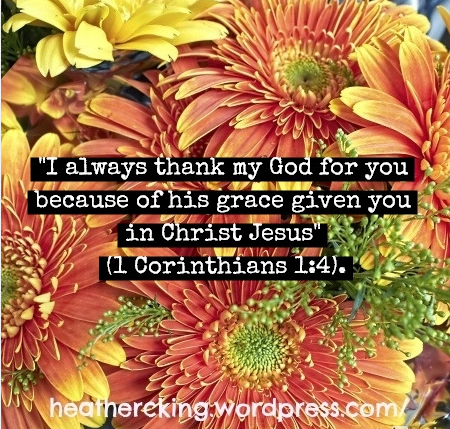
“I always thank my God for you because of his grace given you in Christ Jesus” (1 Corinthians 1:4).

To the church at Thessalonica, he said:

“We always thank God for all of you and continually mention you in our prayers. We remember before our God and Father your work produced by faith, your labor prompted by love, and your endurance inspired by hope in our Lord Jesus Christ (1 Thess 1:2-3).

So often, we skim through the beginning and end of Paul’s letters, rushing through the personal notes so we can dig into meaty questions of doctrine and theology.

But people mattered to Paul. That’s clear when you actually read his thoughtful recounting of the service, ministry, teaching, faithfulness, and generosity of individual people and the church as a whole.

Even when he was tired out from ministry and abandoning his own plans or agenda in order to jot off a letter to a beloved church in need, Paul always took the time to say, “I thank God for you.”

During this week of Thanksgiving, don’t just post a Facebook status thanking God for your husband and kids.  Don’t be satisfied with saying just one word of gratitude before you pass the turkey and mashed potatoes.

Tell others how thankful you are for them here and now.  That’s more important than anything else on your agenda for the day.

Who needs to hear you say, “I’m thankful for you” today?

Originally posted on 11/19/2012

Heather King is a wife, mom, Bible Study teacher, writer and worship leader.  Most importantly, she is a Christ follower with a desire to help others apply the Bible to everyday life with all its mess, noise, and busyness.  Her book, Ask Me Anything, Lord: Opening Our Hearts to God’s Questions, is available now!
To read more devotionals by Heather King, click here.

Copyright © 2013 Heather King

Thanksgiving thoughts while watching the Antiques Roadshow

“He satisfies the thirsty and fills the hungry with good things”
Psalm 107:9, NIV

There’s that moment on every Antiques Roadshow when the appraiser pushes his glasses back on his nose and leans in with excitement.  “So, as to value . . .” he starts.  And the item’s owner looks up with cautious anticipation.

This expert, who has spent all day telling people their precious items aren’t really rare or one-of-a-kind, that their genuine treasures are copies and fakes, that grandmother’s fascinating brush with fame never really happened—this expert places a breathtaking value on an object.

A thing.

A material substance made a treasure because it is unique, somehow special because of the famous person who owned it, or so wrapped up in story and history that the ordinary, everyday is transformed into a retirement fund.

I’ve seen rugs on that show worth more than my house.

At times, I watch that “thing” now deemed a treasure and I wonder—what is hidden in my garage and stuffed in my closets?  What bookshelf conceals my children’s college education?  In what closet could I discover my dream home?

But, I’ve been through all my stuff and it is actually just stuff, perhaps priceless to me and valuable in my life for its utility or the way it connects me to the past, but nothing an appraiser would lose his breath over or call his buddies about.

So then I wonder, how is it that we human creatures can look at tangible objects formed of wood or stone or cloth and so arbitrarily place on them a price tag?thanks8

This one picture costs as much as feeding a village of people in Africa.

The cost of this antique toy could build a well in a village with no clean water.

Seems like something’s wrong here.  Seems like the way we assign value is a little off.

That’s one of our problems, really.  We don’t really know value when we see it most of the time.

And so when God pours Himself out for us and blesses us with good gifts, we sometimes mistake them for not enough and seek out everything that is “other” to fill us up instead.

We keep telling Him we are empty and hold our hands out to Him for more, more, more.  He offers us all that is good and true wrapped up in His presence, but it seems so simple and plain.  Not enough.

Meanwhile, we gorge ourselves on everything we believe will satisfy the deep yearnings and cravings in our hearts.

We pour into our hearts:

success
possessions
romance
position
friendships
successful kids
knowledge
food
entertainment

And it just seeps out of our souls, flowing out as quickly as we can dump it in.  We don’t value what God offers as much as this worldly buffet of good eats around us.  It’s ingratitude.  It’s sin.

Ann Voskamp writes in One Thousand Gifts:

Satan, he wanted more.  More power, more glory.  Ultimately, in essence, Satan is an ingrate.  And he sinks his venom into the heart of Eden.  Satan’s sin becomes the first sin of all humanity – the sin of ingratitude.  Adam and Eve are, simply, painfully, ungrateful for what God gave . . . Our fall was, has always been, and always will  be, that we aren’t satisfied in God and what He gives.  We hunger for something more, something other.

It’s like the Israelites trekking through the desert.  God rained down on them wafers of honey they named manna,  miraculously, faithfully and abundantly every night as they sleep.  It’s tasty and satisfying, nutritionally able to sustain them through long desert marches for 40 years.

And yet, they complained.  “We remember the fish we used to eat for free in Egypt. And we had all the cucumbers, melons, leeks, onions, and garlic we wanted” (Numbers 11:5, NIV).

Nothing they owned, used or ate in Egypt was free.  Everything came at high cost to them–they exchanged hard labor and 370+ years of bondage in slavery for fish and a salad bar.

Seems like something’s wrong here.  Seems like the way they assigned value was a little off.

Adam and Eve were not satisfied with the fruit God had given them for food.

The Israelites were not satisfied with the manna God miraculously laid at their feet every day.

We aren’t always satisfied with God’s Word, with His promises to us, with His provision, with His direction.

Yet, Scripture assures us that God is fully satisfying.

“And God is able to bless you abundantly, so that in all things at all times, having all that you need, you will abound in every good work”  (2 Corinthians 9:8, NIV).

“These all look to you to give them their food at the proper time.  When you give it to them, they gather it up; when you open your hand, they are satisfied with good things” (Psalm 104:27-28, NIV).

He “satisfies your desires with good things so that your youth is renewed like the eagle’s” (Psalm 103:5, NIV).

Have you felt empty, thirsty, hungry, plagued with holes that never allow you to be filled—not with joy, not with peace, not with hope?  We are offered the Bread of Life and buckets of Living Water drawn up from a well that will quench our thirst eternally.

We are offered Christ.  Christ abundantly sufficient for our needs.  Christ the once-for-all sacrifice to cover all our sins.  Christ our Peace.   “Thanks be to God for His indescribable gift!” (2 Corinthians 9:15, NIV).

Originally published as God’s Indescribable Gift on 4/11/2011

Heather King is a wife, mom, Bible Study teacher, writer and worship leader.  Most importantly, she is a Christ follower with a desire to help others apply the Bible to everyday life with all its mess, noise, and busyness.  Her book, Ask Me Anything, Lord: Opening Our Hearts to God’s Questions, is available now!  To read more devotionals by Heather King, click here.

Copyright © 2013 Heather King

What I’m Learning About Operation Christmas Child

Every year, the Operation Christmas Child videos turn me into a tearful mess, just watching children from around the world cheering and dancing because they receive one simple box for Christmas.

Maybe inside they find a toothbrush and toothpaste….or a toy car….or some hair clips.OCC2013

That’s enough to make them cheer.

And it’s enough to make me cry at their grateful hearts and their innocent joy.

Every year, the organization Samaritan’s Purse collects shoeboxes stuffed full of goodies that they then deliver to needy children all over the globe for Christmas.

Oh how easy to forget, though, that the gift isn’t just the items we pack into a small box and ship out.

The gift is the testimony of God’s love–that our God sees them, loves them.  I read an email this week about a boy with a box who looked at the blessing and saw a loving God at work and wanted to know more about Him.

National Collection Week is in November, before Thanksgiving—this year, November 18-25! That means that we’re in the middle of prime shoebox packing season.

We’ve been packing shoeboxes as a family for several years and it’s by far one of my favorite Thanksgiving/Christmas traditions because it’s a reminder to be grateful.  It’s a way to shift our focus off of getting and onto giving.

This year, though, we’re learning new tips from a family at our church who is passionate about OCC!

Our church is hosting  a true packing party for the first time.  In addition to the individual boxes we can pack at home, we’ve been collecting bulk supplies at the church.  This week, we’ll gather as a church family and pack as many boxes as we can by working together.

My husband and some of the families at church even made a fun video about how packing parties are different from packing individual boxes.  Please check it out here:


Now that I know we’ll hold a packing party again next year, I can prepare all year long for the event instead of scrambling for items the last few months of the year.

We learned this year that homemade items and gifts are great to fit into the boxes we send.  I’ve seen videos about women knitting slippers, sewing dresses, and making socks for shoeboxes.

I’m not nearly so craft-capable.

But, my daughter and I can make simple friendship bracelets or my little ones can make beaded necklaces.

The family at church makes small sewing kits for older girls inside empty mint tins and hinged eyeglass cases and they collect small toolkits for boys.

Whatever we decide to make, if we start now, we could have at least a hundred or more homemade gifts for next year’s packing party!

I also have a whole year to collect items for the packing party by shopping clearance sales and deals, especially after each holiday.

Even more than that, if I pick one simple, inexpensive item to buy every single time I walk into the store all year long, I’d have collected almost 100 boxes of crayons or pencil sharpeners or toothbrushes or whatever item I choose.

If your church has a packing party, would you consider picking one or two items to buy at the store each time you go?

I hope that you’ve packed a shoebox before and are making one again this year!  If not, here’s everything you need to know to get involved in Operation Christmas Child as an individual even if your church is not hosting a packing party!

You can begin by learning more about the organization here, like:

If you make a $7 donation online to cover the shipping for your box, you can even print off a label that lets you track it here!!  A few weeks after delivery, they’ll send you an email telling you what country your box was delivered to and some general information about the needs in that area.  Our boxes two years ago ended up in Tanzania.

Most important of all, pray for the child who will receive your shoebox!  Prayer is so powerful.  Don’t just send stuff, send gifts along with time spent on your knees.

Here are some of my favorite OCC videos.

Matthew West shows the Great Lengths OCC goes to bring shoeboxes to kids around the world.

Scotty McCreery shows how to pack a shoebox.

Check out how excited this boy from Angola is to receive his shoebox!  This is my most favorite OCC video!

There are so many opportunities to give every holiday season, but this is my very favorite.  I hope you’ll make Operation Christmas Child a part of your holiday traditions, as well!

Do you have any great ideas or stories about Operation Christmas Child to share with us?


Heather King is a wife, mom, Bible Study teacher, writer and worship leader.  Most importantly, she is a Christ follower with a desire to help others apply the Bible to everyday life with all its mess, noise, and busyness.  Her upcoming book, Ask Me Anything, Lord: Opening Our Hearts to God’s Questions, is available now!  To read more devotionals by Heather King, click here.

Copyright © 2013 Heather King

10 Bible Verses to Pray for Election Day

She wanted us to stop eating and pray.

Just like that.  Just put our forks down and bow our heads then and there.

For our “boo boos” of all things, that’s what had our four-year-old inspired to lead a family prayer meeting in the middle of the evening meal.

So, we did, taking turns around our kitchen table, praying for a scratch, a C-section recovery, a splinter, a bruised shin.  In Jesus’ name, Amen.

I felt the difference the next day.  My recovery post-C-section had gone smoothly, gone well, but I still felt that tender reminder of surgery if I moved too fast, too long, too far.  We prayed at the whim of a preschooler, though, and my healing progressed overnight.

Why then?

Why is it I forget to pray for the big things, the commanded things?

When prayer works, when it’s real and responsive, when I see the answers clearly with my own two eyes and feel the results in my own body, and when a tiny blond-headed girl prompts me to pray…why then do I fail so often to pray as I should?

Because I do.  I forget.  I pray about a million problems and worries and issues I encounter every single day for me, for my family, for my friends, for the people I see driving around my little town, for my kids’ school and my husband’s workplace and the people at church.

Yet, Scripture tells me I need to pray for those in authority, for the government leaders, and I confess this truth:  Other than an occasional quick “help the president and congress, Lord” I forget to pray for them most of the time….at least until our paychecks take the hit and suddenly I’m the one inspired to lead prayer meetings.

This election day in the United States, though, let us commit to pray and really do it, not just mean to do it or start to do it and never finish.

Let ….us….pray:

For us as citizens and for our nation:

Lord, forgive us as a nation:

If my people, who are called by my name, will humble themselves and pray and seek my face and turn from their wicked ways, then I will hear from heaven, and I will forgive their sin and will heal their land (2 Chronicles 7:14 NIV).

Turn our hearts to You so that we walk in righteousness:

Righteousness exalts a nation, but sin condemns any people (Proverbs 14:34 NIV)electionday

Lord, help us revere You and respect those in authority.  Show us how to be good citizens.

Make the Master proud of you by being good citizens. Respect the authorities, whatever their level; they are God’s emissaries for keeping order. It is God’s will that by doing good, you might cure the ignorance of the fools who think you’re a danger to society. Exercise your freedom by serving God, not by breaking the rules. Treat everyone you meet with dignity. Love your spiritual family. Revere God. Respect the government (1 Peter 2:13-17 MSG).

Be a good citizen. All governments are under God. Insofar as there is peace and order, it’s God’s order. So live responsibly as a citizen. If you’re irresponsible to the state, then you’re irresponsible with God, and God will hold you responsible. Duly constituted authorities are only a threat if you’re trying to get by with something. Decent citizens should have nothing to fear. (Romans 13:1-3 MSG).

Then render to Caesar the things that are Caesar’s; and to God the things that are God’s. Matt. 22:21 NASB

For those in authority:

Thank You, Lord, that all authority is subject to You:

For kingship belongs to the Lord, and he rules over the nations (Psalm 22:28 ESV).

He makes nations great, and he destroys them; he enlarges nations, and leads them away. He takes away understanding from the chiefs of the people of the earth and makes them wander in a pathless waste. They grope in the dark without light, and he makes them stagger like a drunken man (Job 12:23-25 ESV).

We ask that You guide and direct our leaders:

I urge, then, first of all, that petitions, prayers, intercession and thanksgiving be made for all people— for kings and all those in authority, that we may live peaceful and quiet lives in all godliness and holiness (1 Timothy 2:1-2 NASB)

Give them wisdom as they lead us:

He changes times and seasons; he sets up kings and deposes them. He gives wisdom to the wise and knowledge to the discerning (Dan. 2:20-21)

For lack of guidance a nation falls, but victory is won through many advisers (Proverbs 11:14 NIV).

In Jesus’ name, Amen.

Heather King is a wife, mom, Bible Study teacher, writer and worship leader.  Most importantly, she is a Christ follower with a desire to help others apply the Bible to everyday life with all its mess, noise, and busyness.  Her book, Ask Me Anything, Lord: Opening Our Hearts to God’s Questions, is available now!  To read more devotionals by Heather King, click here.

Copyright © 2013 Heather King

Rules about Pumpkins: The Lord is My Portion

We have this long-standing family rule. My husband tells my daughters every year at the pumpkin patch before we scramble onto the tractor for the hayride out to the fields:

“You have to pick a pumpkin you can carry….yourself.…as in Mom and Dad aren’t carrying your pumpkin for you.”

They nod their little blond heads in understanding, but when my daughters hop off the back of that hay-covered wagon, their eyes scan the fields for the site of the perfect pumpkin.

And perfect typically means more than just deep orange (not green) and no rot (if they could find one without dirt on it, that’s a bonus).

Perfect usually means “big,” too.

Sometimes, like this year, one unique child will search for half an hour in that field only to pick the tiniest of all miniature orange pumpkins.

Inevitably, though, another child combines rolling, scooting, dragging, and bent-knee carrying complete with huffing, puffing, grunting and groaning to transfer her chosen pumpkin onto the tractor.

Or they’ll blink large, beautiful blue eyes in my direction and ask, “Mommy, can you help me carry this?,” hoping that somehow Mom missed hearing Dad’s speech this year.

Bigger is better.  That’s what they think sometimes.

I need more, more than I can truly carry, more than enough, more than can fit, more than is comfortable…..

As our daughters grow, so do their chosen pumpkins.

Perhaps it’s time to amend the rule because “what you can carry” seems like a dare to choose the largest pumpkin they can maneuver out of the field and onto the tractor.lamentations3

I take this dare at times, too.

Because I feel needy at times, that’s why.

In need of energy, of supply, of vision, of joy, of inspiration, of affection, of deliverance, of encouragement, of peace….and yes, of even more and more than that.

Scripture promises us this—The Lord is our Chelqi—-our Portion.  It’s one of His names, part of His character, the implicit promise dependent not on what He does or has done, but on who He is at the very core of His being.

That’s what it says in Lamentations 3:24:

“The Lord is my portion,” says my soul,
“Therefore I have hope in Him”  (NASB)

and Psalm 73:26:

My flesh and my heart may fail,
But God is the strength of my heart and my portion forever (NASB)

and again in Psalm 16:5:

The Lord is the portion of my inheritance and my cup;
You support my lot (NASB).

He is our Portion.  He is Enough.  He is exactly what we need, how much we need, at the exact moment we need Him.

We needn’t try to fill our arms with more than we can carry, fearful that He’ll give us what we need today, but not tomorrow.

In the wilderness outside of Egypt, God rained down supernatural manna for the Israelites six days a week, enough for each day with extra to set aside for the Sabbath once a week.  And He told them this: Gather enough for today.

Just for today.  Trust me for tomorrow.  I’ll provide again.

Some of them tried to stockpile and store, thinking their own personal planning and feelings of security trumped God’s instruction.

But He meant it…daily bread.  This much, and no more, is perfect.  Trying to live off yesterday’s harvest leaves us with rotten manna, worm-filled bread, starvation for sure.

So, tomorrow and every single day we return for fresh filling and fresh provision, a perpetual looking to the Lord our Portion for all that we need.

And He is ALL we need.  We trust that He isn’t stingy or absent or moody and inclined to provide one day, but not the next.

We don’t gorge ourselves in the fields of life, choosing other methods of filling our void and our emptiness, lumbering back to the tractor with our arms filled with everything that looks so perfect, but never fully satisfies.

He is enough.  His provision is perfect in our seasons of fatigue and sorrow and desperate need .

Charles Spurgeon said it this way:

It is not “The Lord is partly my portion,”nor “The Lord is in my portion”; but he himself makes up the sum total of my soul’s inheritance.  Within the circumference of that circle lies all that we possess or desire.  The Lord is my portion.  Not his grace merely, nor his love, nor his covenant, but Jehovah himself.”

Oh yes, sometimes I think what I need is rest.  I need peace, Lord bring me peace.  God, give me joy.  Father, provide for this need.

But it’s not that He gives me a portion; He is my portion.

It is God Himself that I need, all that I need, everything that I need, and He is enough for me.

Heather King is a wife, mom, Bible Study teacher, writer and worship leader.  Most importantly, she is a Christ follower with a desire to help others apply the Bible to everyday life with all its mess, noise, and busyness.  Her upcoming book, Ask Me Anything, Lord: Opening Our Hearts to God’s Questions, will be released in the Fall of 2013!  To read more devotionals by Heather King, click here.

Copyright © 2012 Heather King

When I Fell in Love….

I can’t say exactly when I fell in love with this man.

He was on stage the first time I saw him, portraying Mr. Elton in a production of Jane Austen’s Emma (my favorite), and I was an audience member.   I laughed loud and long when he delivered the first line of the play while pretending to read from a book:

“It is a truth universally acknowledged that a single man in possession of a good fortune must be in want of a wife.

I heard my laugh hit the silence of the auditorium.  Apparently, I was the only one who got the joke (as a character from Emma read the first line from Pride and Prejudice).  And so I slumped into my chair wishing someone—anyone—shared my sense of humor.

I actually met him a week later after a college worship service.  Someone in the crowd pointed to the guy up front strumming the guitar.  “See that guy,” he said, “You just saw him on stage last week.”

Unbeknownst to me, this young guy who led worship and the drama ministry and acted in productions based on my favorite literature had just prayed a daring prayer two weeks before.

He told God he wasn’t looking for a relationship any more.  He was content to be single until God hit him over the head with a 2 x 4 and told him “Thou shalt marry this girl.”

I met him two weeks later.

And a week after that, I was the new pianist on his praise team (and he’s still my worship leader even now).

I fell in love with the way he used his gifts and talents for God’s glory.

There was his calmness, too.  I loved my dad, but life with him wasn’t calm; it was loud much of the time and sometimes downright volatile.  This man, though, measured his words with wisdom and careful thoughtfulness.

And the first time he dropped the word “obsequious” into a sentence effortlessly, I think I experienced whiplash. (I’m a sucker for SAT words).

Add to that his quick and witty humor that kept me giggling endlessly in the corner of the praise team section, and I realized that he was smarter than me and that was okay.

We’ve never been an opposites-attract kind of couple.  We’re probably two of the most alike people who God matched together.

Except for the fact that he only cares about doing what’s right and not whether it pleases anyone else while I’m a people-pleaser.

And the fact that he can rest and take time (perhaps . . . dare I say it . . .procrastinate) and I’m neurotically pushed to do and do and do relentlessly, first, fastest, and rest when you die.

I can’t say when it happened, but at some point I fell in love.112339-20130114

I can’t speak for him and say exactly why he fell in love with me.

Nor can I say exactly why God loves any of us either, surely not my awkward, nervous, uptight, worrying self.

Amazingly, though, this isn’t a “fall in love” kind of love at all.  God doesn’t grow to love any of us over time or awaken one morning and realize how much He cares.

He loves us.

It really is the beginning and the end of our story.

Like the first time I saw my daughters, I loved them in an instant.  I didn’t slowly grow to appreciate their character or develop feelings for them over time.

In Jeremiah, God declares:

“before I formed you in the womb I knew you”  and David similarly prayed, “you created my inmost being; you knit me together in my mother’s womb” (Jeremiah 1:5, Psalm 139:13).

God loved you before you squinted your eyes at the first burst of light, screamed out and got cleaned off, bundled up and handed to your mom.

He loves you when you feel loved and when you feel overlooked, when you received a blessing and when you endured a trial.  This love of his doesn’t wax or wane, change or alter or depend on us and what we do or say or feel or think.

We’ve never been good enough, pure enough, beautiful enough, or wise enough to earn it.

But even though we’re unworthy, even when we’ve strayed, even when we’ve felt that seemingly incurable distance from Him or poured out in painful honesty what’s troubling us…

Still He loves.

He says, “I have loved you with an everlasting love; I have drawn you with unfailing kindness” (Jeremiah 31:3).

And what can we do with this everlasting and unfailing love, so amazing and confusing because it’s far more than we deserve?

“We love because he first loved us” (1 John 4:19).

Originally published September 24, 2012

Heather King is a wife, mom, Bible Study teacher, writer and worship leader.  Most importantly, she is a Christ follower with a desire to help others apply the Bible to everyday life with all its mess, noise, and busyness.  Her upcoming book, Ask Me Anything, Lord: Opening Our Hearts to God’s Questions, will be released in the Fall of 2013!  To read more devotionals by Heather King, click here.

Copyright © 2012 Heather King

The Quest: Teaching Kids What Easter is About

I’ve been on a bit of a Mom Quest these past few years.  We’ve never been an Easter bunny family who lines up for pictures at the mall or decorated the house with rabbits, chicks and eggs every spring.

Our goal as parents is to keep the focus on Jesus’ death and resurrection.  That’s what we want our kids to remember, ask questions about, investigate and take to heart this season.

But when you bypass the bunnies in the Wal-Mart aisle, you can end up with Easter looking something like this:

Go to church in a pretty dress.  The end.

I want to teach my kids that Jesus is the Reason for THIS Season, too, and that needs to be a big deal.  Not just preaching at them; engaging them.

So, I’ve collected ideas that we do, some every year, some every few years to keep things new and interesting.  Here are some of our favorite ways to focus on Jesus this holiday:

Resurrection Eggs:  It’s an oldie but a goodie, a classic that’s been around since I was a kid.  I love the fact that the children drive the discussion in this activity. They open 12 eggs in a specific order.  Each egg holds a symbol of an event in the Passion week.  My kids tell what they think it might be about (the praying hands for the night Jesus prayed in the garden or the coins that Judas received to betray Jesus), and the booklet directs us to Scripture to fill in any blanks.003Empty Tomb Snack: This was so fun and only took a few minutes.  Each of my kids could basically put the pieces of the snack together.  I didn’t tell them what we were making, just gave them directions along the way.  Once they put the Oreo in place, they knew we had made the empty tomb.  Added bonus: Eating a yummy Entenmann’s chocolate doughnut (a secret passion of mine).  You’re supposed to use shredded coconut dyed green for the grass, but coconut isn’t my favorite.  So, I opted for green icing.

011Butterflies: I order a cup of painted lady butterfly caterpillars every year from Insect Lore.  We learn about how butterflies transform while also talking about a long-standing symbol of the resurrection—how the caterpillar goes into the chrysalis and seems to be dead, but then emerges with new life even more beautiful than before.  It’s science and Scripture together at its best.

butterflyResurrection Rolls: This was a new discovery this year and what a treat!  It’s especially good to do on Holy Saturday, talking about preparing Jesus’ body for burial, placing him in the tomb and sealing it up tightly.  When you open the rolls, they are empty inside.  A great surprise for kids.  It’s easy, too, with crescent rolls, melted butter, marshmallows, and cinnamon and sugar.  Bam!  Here are some great step-by-step directions.Resurrection RollsLamb cupcakes: These cupcakes aren’t just cute, they remind us that Jesus is the lamb of God.  Just top a cupcake with white icing (I’m a cream cheese icing fan, personally) and cover with mini marshmallows and one large marshmallow cut in half for the lamb’s head.  The kids mostly love the cupcake, but it’s also a great opportunity to talk about the Lamb of God who takes away the sin of the world and why Jesus was the perfect sacrifice.

Lamb cupcakesJelly Bean prayer: This is simple and sweet—literally.  I put a handful of jelly beans in a baggie (at least one of each color) and include this little poem to walk my kids through the Gospel.  And I sneak a few of my favorite flavors to eat while I’m packing the bag.  That’s a mom bonus.  Here’s where you can find a free printable for the prayer.013

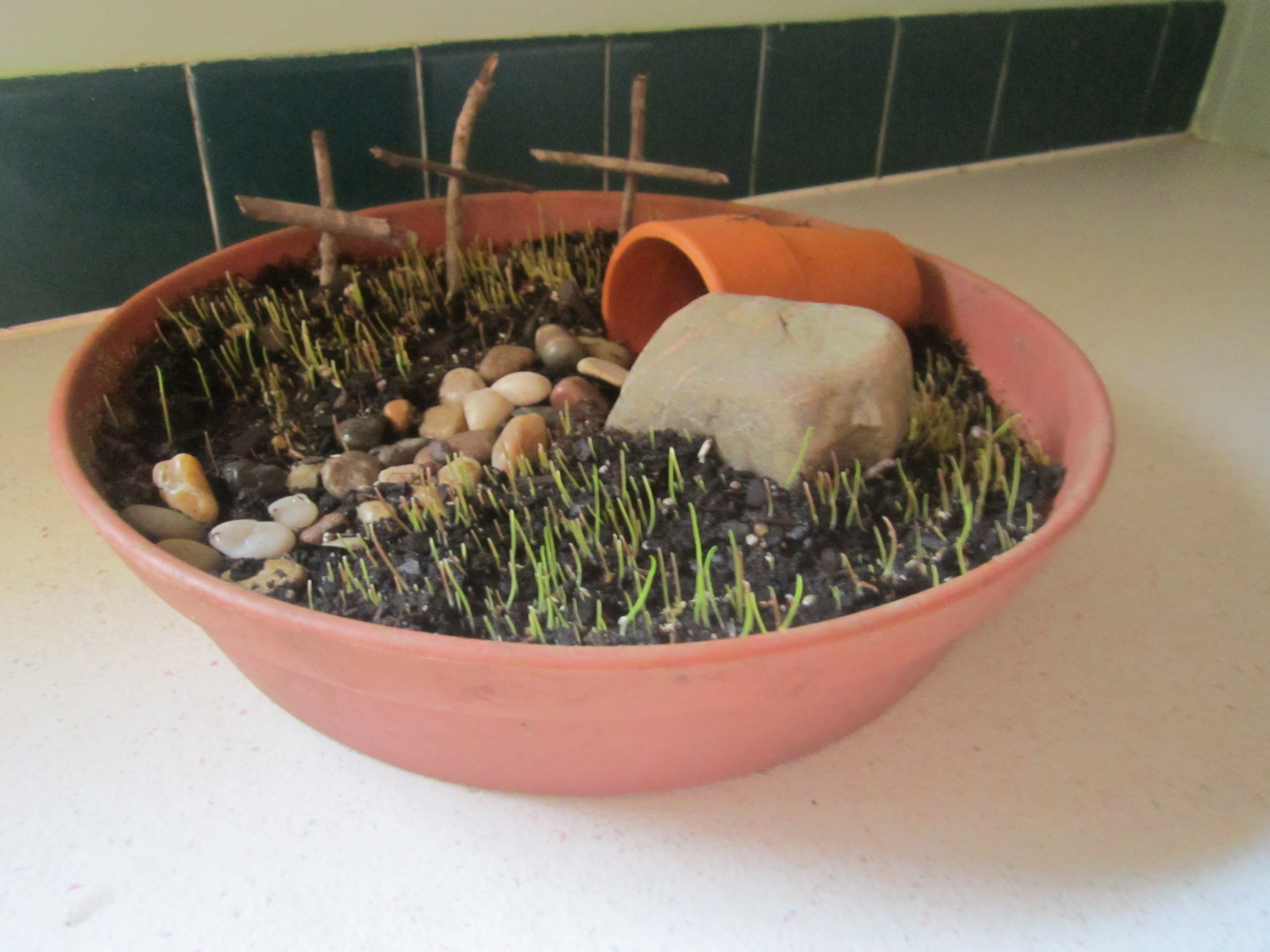
Easter garden:  This idea went viral on my Facebook and Pinterest feed this year and instead of just looking at it, I did a unique thing.  I decided to actually make it.  Shocking, I know!  My daughters and I had the best time setting up our little potted garden.  After all, it feels good to get your hands into a some potting soil in anticipation of spring!  The grass grew very quickly, though, so I’d likely wait until closer to Easter to plant our garden again next year.  I loved that my kids were asking questions about the three crosses, about the size of the stone covering the tomb, and how it was rolled away.Easter Garden

Of course, we don’t miss out on the basics.  We go to church and worship on Easter Sunday.  At night, we read from different children’s devotionals or the Bible, walking our kids through what Scripture says about the week of the Passion.

So, how do you teach your kids about Jesus’ death and resurrection during this season?

What Makes this Good?

She asked me why we call it “Good Friday.”  Why “good?”

Why “Happy Easter” or “Happy Resurrection Day?”

What makes this so “happy?”

How could we celebrate this death, this sacrifice, this sadness?  We should be so much more serious and sad, she tells me.P1040320

Like the disciples who mourned, like Mary Magdalene crying beside the tomb, surely we should remember this day with tears.

This she asks in confusion.

On Thursday, we ate the bread and drank the cup.

That’s what Jesus said that night in the upper room with disciples scattered around:  “This is my body given for you; do this in remembrance of me” (Luke 22:19 NIV).

So, we remember.

She is thinking of grape juice and crackers, a snack when you’re hungry, but I tell her it’s more than that.

And she asks, why do this?  Why talk about blood–so gross, so morbid and earthy?

It’s too corporeal for holiness and for the sacred places, the striking red against the purity of the righteous life.

Why Mom?

That’s yucky.

I think today about the remembrance of it all and why it matters.

Today is Good Friday.

It’s also the eight-year anniversary of my dad’s death.

This morning, I sat with my daughter brushing her hair and telling her about my dad: little remembrances here and there and what makes today special.

So, what makes this a day holy and set apart from other days?  Why Good Friday?

Because there’s beauty in the remembrance.  There’s honor and power in recollection.

I think this about my dad today.  Talking about him makes his life real here and now after death.  It makes it more tangible, relevant.

These daughters of mine who never knew him and only see the pictures in a photo album, mostly after he was sick and didn’t look like the dad I remember, what other way for them to know than for me to tell?

And you just don’t want this day to slip by forgotten because it would be forgetting him.

Is it any different remembering our Savior in this season?

In German, they don’t call this day Good.  They call it Mourning Friday.

But isn’t that the beauty of this day?  That even as we remember Christ’s death, even as we talk about the cross and give it true attention, even as we drink the cup so apt to stain white and we eat the bread broken, even as we tell our children the stories and we say:

This is what He did for us.  Not some pristine ritual, not something pure and clean.  It was bloody and painful.  It was death.  It was hard.  And sacrifice like that was suffering. 

It wasn’t pushed on Him because He was too weak.  Jesus “made himself nothing by taking the very nature of a servant, being made in human likeness. And being found in appearance as a man, he humbled himself by becoming obedient to death— even death on a cross!” (Philippians 2:7-8 NIV).

This is what He chose to do for us because of love so great. 

Love so good.  Love so amazing, so divine…

Even as we say this and tell this to our children, the beauty of remembering the cross isn’t just the Mourning of our Savior, it’s the Good News that the resurrection came.

Why Good?

Why Happy?

I tell her remembering is how we worship, how we give thanks, how we honor His gift to us.

And that gift wasn’t just a trinket wrapped in a package with a bow.

It was good.  Truly good.  The greatest gift at the highest price.

And the resurrection; that’s our joy.  What better reason to be happy than to know the cross was not the end and the tomb didn’t destroy our hope?

Because of this, we have life everlasting.

And because of that day, we can see any crisis as an opportunity for Him to shine with resurrection power, to resurrect the dead, to defy all expectations and trample all over the circumstantial evidence by doing the impossible.

Yes, this remembering is good.

Heather King is a wife, mom, Bible Study teacher, writer and worship leader.  Most importantly, she is a Christ follower with a desire to help others apply the Bible to everyday life with all its mess, noise, and busyness.  Her upcoming book, Ask Me Anything, Lord: Opening Our Hearts to God’s Questions, will be released in the Fall of 2013!  To read more devotionals by Heather King, click here.

Copyright © 2013 Heather King

More than a Lucky Charm

Normally, I hear her sprint across the house around 3 or so in the morning, and I open my eyes into the darkness and ask my daughter, “What do you need, baby?”

Most nights, it’s something to drink.  Or perhaps her blanket had fallen off the bed or somehow ended up scrunched up and tangled in a mesh of other blankets in the night.  So, she needs me to embark on a kind of “Blanket Recovery Mission.”

I plod along after her into the darkness, filling the cup, finding the blanket, and tucking her back into bed.

But last night she dashed across the house in the darkness and climbed right up into my arms.  When I asked her what she needed, her eyes flickered open for the briefest moment.

She whispered, “I need Mom” and then fell asleep.

My little one needed me for me, not for what I could do or provide, find or fill, but for my presence and love and the safety of that relationship.

It’s so hard to say when it’s easiest to start taking our relationship with Mighty God for granted.

Perhaps it’s when times are hardest and our conversations with Him can become an endless litany of our need and pleas for His help and intervention.  We too often want Him only for what He can do for us.

We need that job, that financial deliverance, that health, that relationship, that restoration, that guidance, that intervention, that advocacy, that victory.  Maybe we even search the Scriptures filtering out everything that doesn’t seem to fit or speak to our particular circumstance or situation.

Or perhaps we value this time with Him the least when everything is going well and we have our needs taken care of, so we have very little to say to Him besides an occasional, “thanks, God.”

Yet, while God always invites us to bring our requests and needs to His feet, surely the desire of His God-heart isn’t that we only ever ask for the drink of water or the blanket in the middle of the night.

He wants us to sit at His feet and say, “I need You, God.”482075_10151336449620893_1263122976_n

I need Your provision, yes.  Your strength.  Your help and wisdom.  All those things.

But even beyond anything You can do for me….I simply need You.  “I need Thee every hour…every hour I need Thee.”

And this is the simple truth of this life: That we need Him like breath and food and water, the very life-sources of this physical body.

Perhaps you forget this like I do at times:  Taking Him for granted….forgetting my dependency and trying to act all foolishly independent.

Like the Israelites in 1 Samuel 4, sometimes we treat God as little more than a good-luck charm that we slip out of our pocket on test days for a little extra help and good fortune.

God had promised to be with His people, deliver them, protect them from their enemies, and provide them with abundant harvests and a life of plenty…IF they obeyed Him and stayed faithful to Him.

They, of course, had wandered and strayed, disobeyed and worshiped other gods.

But when they faced a vast army of enemy Philistines, Israel was quick with a solution:

Then they said, “Let’s bring the Ark of the Covenant of the Lord from Shiloh. If we carry it into battle with us, it will save us from our enemies.” (1 Samuel 4:3b NLT).

They didn’t revere the Ark of the Covenant as the earthy dwelling place of God’s glory and they didn’t begin by repenting of all the sin that had driven them to this place of near-defeat.

To them, it was a rabbit’s foot, a pair of lucky socks, a token or totem, no different than the idols of rocks and stone carried around by the enemy.  So, they decided to drag the Ark out and carry it into battle, assuming that God would take it from there, carry the day, and fight on their behalf.

Even the Philistines revered God more in that moment.  They were terrified by news of the Ark’s arrival, knowing full well that if the One True God decided to fight that day, they had no chance of defeating the rag-tag Israelites.  The enemy knew of this God by His reputation–the Deliverer from Egypt and the God of the Plagues.

Yet, God, doesn’t allow Himself to be used and abused like that—not then, not now.  The Israelites lost the battle and the Philistines carried off the Ark like a war-prize, not because God couldn’t defend His people.  Because His people forgot that they needed Him, all the time, every day.

They forgot.

Today we remember to pray: God, I need You and You alone, not for any thing, but for who You are.  You are all I need.

Heather King is a wife, mom, Bible Study teacher, writer and worship leader.  Most importantly, she is a Christ follower with a desire to help others apply the Bible to everyday life with all its mess, noise, and busyness.  Her upcoming book, Ask Me Anything, Lord: Opening Our Hearts to God’s Questions, will be released in the Fall of 2013!  To read more devotionals by Heather King, click here.

Copyright © 2013 Heather King