How I Tried Not To Look Like a Tourist (and probably failed)

psalm-119-66

My husband told me, “try not to look like a tourist.”

That was the advice I tucked away for my recent trip to New York City.

I feel pretty comfortable in Washington, DC, but I know nothing about the Big Apple.

So I bought a laminated map the week before my trip and then I spent an afternoon on my comfy blue sofa with a cup of tea, my map, my itinerary, and my good friend:  Google.

Then I wrote it all down, every bit of it.  What subway stations to use.  How many stops there were between places.  How much tickets would cost.

This is  my modus operandi: intense preparation before any action.

Eventually, though, you just have to do it.  You have to step off the tour bus into the city and make your way to the Metropolitan Museum of Art with nothing but a map, your notes, scattered street signs, and some friends.  Plus you need to do it without looking like a tourist, which probably means not pulling out the map and pointing at landmarks in the middle of Central Park (I failed).

Somehow my friends and I found our way, partly because of my advanced preparations, partly because we  got lost and learned from our mistakes, and mostly because we asked questions.

“If I’m on seventh avenue, which way do I need to go to 8th avenue?”

“Am I headed in the right direction for the art museum?”

“Are the subways on this level going  the direction we want to go?”

I asked the lady pushing her stroller through Central Park, the security guard walking down 42nd street, and the guy adding money to his frequent user subway card. I asked questions all over New York City.

As long as someone looked like they were friendly, approachable, and knowledgeable, they were fair game for one of my questions.

I’m a question-asking girl.  I even wrote a whole book about asking questions (Ask Me Anything, Lord), so this is who I am and how I navigate the big, wide world.ask-me-anything-lord_kd

In life, we can try our best to seek our own answers or wrestle with guidebooks and Google-searches in hope of making good choices.

Or we can make mistakes and then learn from them.

But it’s often much easier and far less painful just to ask.

Ask a friend for help.  Ask someone we respect for advice.  Ask a mentor for prayer.  Ask an expert for some input.

Being willing to seek advice with a humble heart opens us up to wisdom.

Proverbs tells us:

The way of a fool is right in his own eyes,
    but a wise man listens to advice (Proverbs 12:15 ESV).

We don’t just ask any random person, of course.

We ask those we respect, those who have already “been there,” those who are prayerful and those who live with godliness.

More than all of that, though, we can bring our question-filled hearts to God Himself.

Jesus told us to ask (Matthew 7:7).  He gave us permission to come to Him with questions and requests, and He even praised those who sought His help when they needed it.

Of course, it’s deeply humbling to confess the truth: “I don’t know all the answers.”

But this is what we need, to recognize what we don’t know…to trample over our own pride and admit our deficiency.  This is what allows God to teach us and to guide us.

Moses stood barefoot in front of the burning bush and dared to ask the big question:

 “If I come to the people of Israel and say to them, ‘The God of your fathers has sent me to you,’ and they ask me, ‘What is his name?’ what shall I say to them?” (Exodus 3:13 ESV). 

He said to God, “Who are you?!”

No pretending like he had it all together or knew everything or was so capable all on his own.

He asked.

And God answered:

God said to Moses, “I am who I am.” And he said, “Say this to the people of Israel: ‘I am has sent me to you’” (Exodus 3:14 ESV). 

Moses’s question led to revelation, God telling His very holy name: I AM.

One of the deepest moments of divine revelation in the entirety of Scripture came because Moses dared to ask a question.

It takes  time to ask and listen for the answer.

It takes humility to lay aside our own opinion and agenda and seek God’s thoughts and plans.

It takes a teachable heart to seek advice from a respected friend.

But we’ll learn more, make fewer mistakes, and get a little less lost in this life if we embrace humility and learn the art of asking questions.

14 Days of Prayer for Your Marriage with 1 Corinthians 13

prayer for marriage

When I was a girl earning my badges in the kids’ program in my home church, I had to memorize the whole chapter of 1 Corinthians 13 in the King James Version. It’s stuck.  I can still rattle off bunches of it.

But I hope it really stuck…you know?  Not the rote memorization, but the revelation of what love is.  God loves us this way.  And He says even if we’re performing the most outrageous acts of self-sacrifice and service and we’re not doing it out of love, then it’s just meaningless drivel.

So, I’m praying for the next two weeks through this “Love Chapter” for my marriage because I want it to be meaning-full and I want it to reflect God’s love to the world around us.  Perhaps you will be praying for your own marriage, too?

Love is patient, love is kind. It does not envy, it does not boast, it is not proud. It does not dishonor others, it is not self-seeking, it is not easily angered, it keeps no record of wrongs. Love does not delight in evil but rejoices with the truth. It always protects, always trusts, always hopes, always perseveres. Love never fails. (1 Cor. 13:4-8 NIV).

Day One, Love is Patient: 

Lord, today let us respond with patience and show each other grace.  We know that no one changes over night and none of us is perfect.  We make mistakes.  We forget, we grow careless, and we become distracted by life and stress.  Please let us be patient with each other, with our marriage, with our circumstances, just as you are so patient with us.  Help us not to push, nudge, or give up on each other, but instead may we give each other room and grace to grow more like You.

Day Two, Love is Kind:

God, it’s too easy to forget the simple beauty of kindness.  We can neglect courtesy and consideration.  Help us to be thoughtful and kind to one another, showing each other respect and attention in our words and deeds.   Stir our hearts to remember the small things like holding doors, making phone calls, performing acts of service, putting the other’s needs above our own.  As it says in Ephesians 4:32, may we “be kind to one another, tenderhearted, forgiving one another, as God in Christ forgave You.”

Day Three, Love Does Not Envy:

Lord, As it says in The Message, “Love doesn’t want what it doesn’t have.”  Let this be true of us.  Help us appreciate the gift you’ve given us in this marriage and in each other and cultivate contentment and gratitude in our hearts. We don’t need to compare our spouse or our marriage to anyone else’s.  Instead, thank You for the marriage You’ve given us.  Please remind us throughout the day of all the reasons we fell in love in the first place.

Day Four, It does not Boast, it is not Proud:

Jesus, at that Last Supper with Your disciples, You bent so low and You poured that water over their grimy feet.  You, Our Savior, came “not to be served, but to serve” (Matthew 20:28).  May we never be too proud to serve one another in the humblest of ways.  We might think, “That’s his responsibility; that’s her job.”  In our selfishness, we might feel like we’ve given so much already and how could we give any more?  But we bend low today.  We lay down our rights and our pride and choose to serve our spouse just as You served us.

Day Five, It does not dishonor others:

God, may we show each other honor in all we do and say.  Guard our mouths.  May our words be used to encourage, praise, and build one another up, not tear each other down, find fault, or trample all over each other’s feelings.  When we’re with others, don’t let us fall into those traps of complaining about marriage or our spouses, but instead let the way we talk about one another help others to know the beauty of marriage the way You designed it.

Day Six,  It is Not Self-Seeking:

Father, we live in a “me first” world.  We’re told to “look out for number one” and to take care of ourselves above all.  But that is not Your way.  Jesus “made himself nothing” and humbled himself, choosing “even death on a cross” for us—for me (Philippians 2:6-8).  Today, let us choose Your way over the world’s way:  “Do nothing out of selfish ambition or vain conceit. Rather, in humility value others above yourselves, not looking to your own interests but each of you to the interests of the others” (Philippians 2:3-4).

Day Seven, It is Not Easily Angered:

God, forgive me for the times I’ve reacted in anger instead of responding with grace.  And so often, too often really, we can make the smallest issues into the biggest deals.  Help me not to be easily angered.  Today, may we overlook petty offenses and minor bothers.  Redirect our vision to focus on what is good rather than what we think is wrong.  Remind us of what is important and learn to let the inessentials pass by unnoticed.

Day Eight, It Keeps No Record of Wrongs:

Lord, if You kept a record of all my sins, I couldn’t stand up under the weight of them all.  I’d be buried in accusations and proof of my failures.  But You show grace.   May we likewise extend grace to each other, as it says in 1 Peter: “Above all, keep loving one another earnestly, since love coves a multitude of sins” (1 Peter 4:8).  If we excel at anything in this marriage, may it be at forgiveness.  When Satan tries to drag all that trash up from the past, we ask that You help us choose forgiveness instead, choose to let it go, choose to move toward one another instead of apart, choose to rebuild trust, choose moving on.

Day Nine, Love Does Not Delight In Evil, but Rejoices With the Truth:

God, help us rejoice with our spouse when they rejoice and mourn when they mourn.  Let us be a place of refuge and safety for them when they share their struggles, fears, emotions, hopes and dreams.  Help us to “have each other’s back” all the time and to be such a team that we delight and take pleasure in what is good and true and battle together against what is evil and wrong.

Day Ten, Love Bears All Things (ESV, NKJV):

Lord, we are so thankful that when there are burdens to bear, You’ve called us to bear them together.  As it says in Your Word,  “Share each other’s burdens, and in this way obey the law of Christ” (Galatians 6:2 NLT).  May we bear all things together.  May we carry each other to the cross and help each other each day.  If one of us is weak, may the other be strong in You.

Day Eleven, Always trusts:

God, build trust in our marriage.  Create that environment of honesty and truth.  But more than that, may we always trust You to care for us and to guide us.  We know that start to finish, this marriage, our lives, our family is in Your hands.  We know You are trustworthy, so faithful and full of merciful, loyal love for us.  We pray that our home and our marriage reflect that to those around us.

Day Twelve, Always hopes:

Lord, we don’t want to ever lose hope.  We know that You have a plan and a future for us as individuals and as a couple, and we thank You for that.  Thank You that You never give up on us and we pray that we never give up on each other.  Each morning, let us wake with hope for a new day, for fresh starts, and for the work that You want to do in us.

Day Thirteen, Always Perseveres 

God, remind us during the hard days, when we’re hurt or angry, tired, frustrated, or broken, that You are with us.  Help us to persevere through every season of difficulty.  Draw us together during those times instead of letting circumstances drive us apart.  Where there is distance, bring intimacy.  Where there is bitterness, bring reconciliation.  Where there is coldness, bring passion.  Where there is pain, bring healing.

Day Fourteen, Love Never Fails

Father, Your love for us doesn’t fail.  You just never give up on us.  Thank You for that unfathomable and astonishing love when we are so unworthy.  We pray that our marriage will grow ever more beautiful each day, not fading, not failing.  In every single season, we pray that You will help our relationship thrive.  Teach us how to avoid the pitfalls in communication, in intimacy, in finances, in conflict, in friendship, in parenting and in every way so that we will always be putting on love,which binds every other virtue together in perfect unity (Colossians 3:14).  

In Jesus’ name we pray, Amen.

IF YOU’D LIKE TO SEE THE 12 VERSES I PRAY FOR MY HUSBAND, YOU CAN CLICK HERE!

Originally posted MAY 2, 2014 

12 Bible Verses about Trusting God’s Timing

verses-on-gods-timing

  • Psalm 31:15 ESV
    My times are in your hand;
        rescue me from the hand of my enemies and from my persecutors!
  • Ecclesiastes 3:1 ESV
    For everything there is a season, and a time for every matter under heaven:
  • Ecclesiastes 3:11 ESV
    He has made everything beautiful in its time. Also, he has put eternity into man’s heart, yet so that he cannot find out what God has done from the beginning to the end.
  • Ecclesiastes 8:6 ESV
    For there is a time and a way for everything, although man’s trouble[a] lies heavy on him.
  • Isaiah 40:31 ESV
    but they who wait for the Lord shall renew their strength;
        they shall mount up with wings like eagles;
    they shall run and not be weary;
        they shall walk and not faint.
  • Lamentations 3:25-26 ESV
    The Lord is good to those who wait for him,
        to the soul who seeks him.
    26 It is good that one should wait quietly
        for the salvation of the Lord.
  • Habakkuk 2:3 ESV
    For still the vision awaits its appointed time;
        it hastens to the end—it will not lie.
    If it seems slow, wait for it;
        it will surely come; it will not delay.
  • Acts 1:7 ESV
    He said to them, “It is not for you to know times or seasons that the Father has fixed by his own authority.
  • Romans 5:6 ESV
    For while we were still weak, at the right time Christ died for the ungodly.
  • Galatians 4:4 ESV
    But when the fullness of time had come, God sent forth his Son, born of woman, born under the law,
  • Galatians 6:9 ESV
    And let us not grow weary of doing good, for in due season we will reap, if we do not give up.
  • 2 Peter 3:8 ESV
    But do not overlook this one fact, beloved, that with the Lord one day is as a thousand years, and a thousand years as one day.

Halfway through the Big Clean I’m ready to give up

hosea6-jpg

It’s about halfway through a “Big Clean” that I feel like giving up,.

That’s because Big Cleans always make things look way worse before they ever get better.

I’ve been pulling out every scrap of trash from every corner cabinet in our home recently, taking every toy out of a toy box, dusting every book on every shelf.

It seems like such a good idea when I begin.  I am energized and enthusiastic.  This is the day I conquer the cabinet under the bathroom sink and I determine to declare victory.

I begin by taking everything out of the cabinet and that’s about when it hits me:  This is a big job.  This is probably a bigger job than I ever anticipated.

Dealing with all the mess is inevitably exhausting and discouraging and a little disheartening.

And maybe I don’t feel like doing it after all.

But at that point, of course, it’s too late.  I’m surrounded by piles of “stuff” and it has to  be dealt with because there is now no path to the door.

Unless I shove all the mess right back in there, making things worse than they ever were, I simply have to dig deep, take some big breaths of courage and just do it.

Throw out the ancient and the dirty.  Donate the never-used.  Reorganize the keeps.

Then at the end of the day, my kids come home from school, open the cabinet to grab something and they give me the victory prize:  “WHOA!  Mom has been cleaning in here!”

This type of roll-up-your-sleeves Big Clean is no easier in our hearts and our minds than it is in our homes.

It’s deeply humbling when the Holy Spirit reveals those hidden, dark corners of sin where trash and refuse have piled up over time.

And this is true, too, sometimes it gets far messier before it ever gets better.

Somewhere in the process, we might want to yell, “Stop!!  Just put everything back in the cabinet because I don’t want to deal!  It is too painful!”

Maybe that’s what happens when we submit our short tempers to Him, or our impatience, or our worrying, or our judging others, or our need to be in control, or any habit, any sin, any distraction that draws us away from God.

It’s easier to leave it be, but oh, it’s so much better when the Holy Spirit has completed the work and we can come to Him with the ancient things trashed, the dirty things cleaned, and the good things reorganized.

The prophet Hosea wrote about returning to the Lord, about giving up our waywardness and following God with all our hearts.

That’s revival, and personal revival is what I want and need.  You too?

Hosea said:

“Come, let us return to the Lord;
    for he has torn us, that he may heal us;
    he has struck us down, and he will bind us up.
After two days he will revive us;
    on the third day he will raise us up,
    that we may live before him.
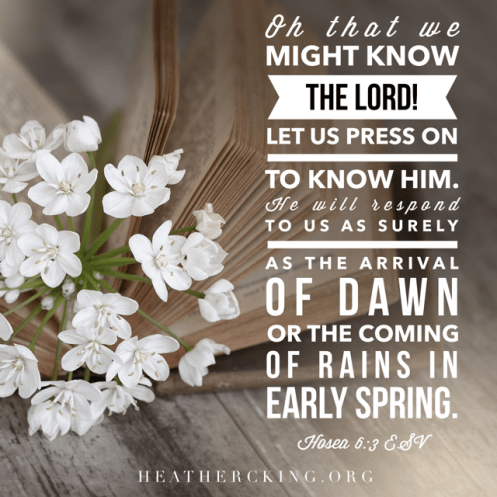
Let us know; let us press on to know the Lord;
    his going out is sure as the dawn;
he will come to us as the showers,
    as the spring rains that water the earth.”

When I’m knee-deep in a Big Clean in my home and I’m surrounded by books, toys, and the fifty million papers that my children have accumulated, I need these reminders likes Hosea’s.

I keep going because I know it’s worth it.  Because there’s no turning back now.  Because even if it’s exhausting in the moment, at the end of this, I’ll be better off.

I’ll have neatly stocked cabinets, less overflow of “stuff” in my home, and fewer junk drawers!

In the same way, when God calls us to a hard work, we keep going because He assures us of what’s ahead if we don’t give up:

Hosea promised:

He can heal us.
He will revive us.
He will  raise us up.
We may live before Him.
He is as faithful as the rising sun and He will come to us like the spring rains.

But here’s the most beautiful thing about the revival God does in our hearts.

He does the work.

I’m the one wiping cabinets down with Lysol at my house.  I’m the one filling up trash bags and taking boxes of donations to the local thrift store.

But it’s the Holy Spirit who does the work of renewal and revival in us.

We submit.  We grant Him access.  We acknowledge our sin.  We pray for His help when we’re tempted or weary or we want to give up.

We yield and we yield again, but the work does not depend on us.  It is His and I am grateful.

Bible Verses for when you need God’s Help

verses-about-gods-help

  • 2 Chronicles 32:8 ESV
     With him is an arm of flesh, but with us is the Lord our God, to help us and to fight our battles.” And the people took confidence from the words of Hezekiah king of Judah.
  • Psalm 10:14 ESV
    But you do see, for you note mischief and vexation,
        that you may take it into your hands;
    to you the helpless commits himself;
        you have been the helper of the fatherless.
  • Psalm 20:2 ESV
    May he send you help from the sanctuary
        and give you support from Zion!
  • Psalm 22:19 ESV
    But you, O Lord, do not be far off!
        O you my help, come quickly to my aid!
  • Psalm 30:2 ESV
    O Lord my God, I cried to you for help,
        and you have healed me.
  • Psalm 30:10 ESV
    Hear, O Lord, and be merciful to me!
        O Lord, be my helper!”
  • Psalm 31:22 ESV
    I had said in my alarm,[a]
        “I am cut off from your sight.”
    But you heard the voice of my pleas for mercy
        when I cried to you for help.
  • Psalm 33:20 ESV
    Our soul waits for the Lord;
        he is our help and our shield.
  • Psalm 34:17-19 ESV
    When the righteous cry for help, the Lord hears
    and delivers them out of all their troubles.
    18 The Lord is near to the brokenhearted
    and saves the crushed in spirit.
    19 Many are the afflictions of the righteous,
    but the Lord delivers him out of them all.
  • Psalm 37:40 ESV
    The Lord helps them and delivers them;
        he delivers them from the wicked and saves them,
        because they take refuge in him.
  • Psalm 38:22 ESV
    Make haste to help me,
        O Lord, my salvation!
  • Psalm 40:13 ESV
    Be pleased, O Lord, to deliver me!
        O Lord, make haste to help me!
  • Psalm 40:17 ESV
    As for me, I am poor and needy,
        but the Lord takes thought for me.
    You are my help and my deliverer;
        do not delay, O my God!
  • Psalm 44:26 ESV
    Rise up; come to our help!
        Redeem us for the sake of your steadfast love!
  • Psalm 46:1 ESV
    God is our refuge and strength,
        a very present help in trouble.
  • Psalm 46:5 ESV
    God is in the midst of her; she shall not be moved;
        God will help her when morning dawns.
  • Psalm 54:4 ESV
    Behold, God is my helper;
        the Lord is the upholder of my life.
  • Psalm 60:11 ESV
    Oh, grant us help against the foe,
        for vain is the salvation of man!
  • Psalm 70:1 ESV
    Make haste, O God, to deliver me!
        O Lord, make haste to help me!
  • Psalm 71:12 ESV
    O God, be not far from me;
        O my God, make haste to help me!
  • Psalm 79:9 ESV
    Help us, O God of our salvation,
        for the glory of your name;
    deliver us, and atone for our sins,
        for your name’s sake!
  • Psalm 94:17 ESV
    If the Lord had not been my help,
        my soul would soon have lived in the land of silence.
  • Psalm 106:4 ESV
    Remember me, O Lord, when you show favor to your people; help me when you save them,
  • Psalm 109:6 ESV
    Help me, O Lord my God!
        Save me according to your steadfast love!
  • Psalm 115:9 ESV
    O Israel, trust in the Lord! He is their help and their shield.
  • Psalm 115:11 ESV
    You who fear the Lord, trust in the Lord!
        He is their help and their shield.
  • Psalm 118:7 ESV
    The Lord is on my side as my helper;
        I shall look in triumph on those who hate me.
  • Psalm 119:147 ESV
    I rise before dawn and cry for help;
        I hope in your words.
  • Psalm 119:173 ESV
    Let your hand be ready to help me,
        for I have chosen your precepts.
  • Psalm 121:1-2 ESV
    I lift up my eyes to the hills.
        From where does my help come?
    My help comes from the Lord,
        who made heaven and earth.
  • Psalm 124:8 ESV
    Our help is in the name of the Lord,
        who made heaven and earth.
  • Isaiah 41:10 ESV
    fear not, for I am with you;
        be not dismayed, for I am your God;
    I will strengthen you, I will help you,
        I will uphold you with my righteous right hand.
  • Isaiah 50:7 ESV
    But the Lord God helps me;
        therefore I have not been disgraced;
    therefore I have set my face like a flint,
        and I know that I shall not be put to shame.
  • John 14:16 ESV
     And I will ask the Father, and he will give you another Helper, to be with you forever
  • Hebrews 4:15-16 ESV
     For we do not have a high priest who is unable to sympathize with our weaknesses, but one who in every respect has been tempted as we are, yet without sin. 16 Let us then with confidence draw near to the throne of grace, that we may receive mercy and find grace to help in time of need.
  • Hebrews 13:5-6 ESV
    Keep your life free from love of money, and be content with what you have, for he has said, “I will never leave you nor forsake you.” So we can confidently say,

    “The Lord is my helper;
        I will not fear;
    what can man do to me?”

How Mourning Changes our Worship

psalm-34

Just a few months after my dad died, we toted our 6-month old baby to a huge outdoor Christian concert where the Newsboys sang.  I still remember them performing one particular song  that night:

Blessed be Your name
On the road marked with suffering
Though there’s pain in the offering
Blessed be Your name….

You give and take away,
My heart will choose to say,
Lord, Blessed be your name. (Blessed Be the Name  of the Lord).

By that point in the concert, it was evening, and the darkness skirted the edge of the crowds  where the huge lights didn’t quite reach.

We had brought my mom along with us, a new widow after my dad’s cancer fight, and I looked through the dimness to see how she was handling that song.  It could have been a tough one.

She was worshiping, though.  I mean all-out worshiping, hands held high to God, singing away.

I’ve been thinking about that moment recently because mourning impacts our worship.  It has to.  We can’t come to God quite the same way after such loss.

There are choices to be made.

Do we clutch our hurt to our own chests and try to hide away?  Do we allow bitterness to creep in and put this safe distance between us and the God who didn’t intervene or heal or rescue?

Or do we bring that same hurt right to Jesus?  Do we lay our brokenness out where He can see it and collapse into His arms and still sing because we’re thankful that He’s there for us and thankful He’s strong enough to carry us?

I find my worship changing these days.  My friend died on December 26th after her own bout with cancer.

We sang together in the praise team and choir for a little more than 12 years, so it’s acutely painful at times to sing praises to God and tangibly know that she is missing.

Those notes she used to sing…her notes….the ones she always sang to harmonize with the notes I always sang…..they aren’t there.  The chord is stripped a bit bare.

It’s not her voice I miss most, of course, it’s her joyful, sweet presence.  Her encouraging kindness, her humor, and her easygoing humility—that willingness to always sing or do whatever we needed sung or done.

I miss her.

The music just reminds me of the loss.

So, there I am playing on the piano, singing the same worship songs, but singing them differently now.

The worship is a little more tender because my heart is softened and aches a bit, like the music is stepping on a bruise that hasn’t healed yet.

The worship is also a little more vulnerable because there’s a rawness and a brokenness I can’t quite hide.  The emotions refuse to be tamped down and kept under control at all times.

And the worship is  now a “sacrifice of praise” (Hebrews 13:15).  I’m not bringing Him what’s easy; I’m bringing Him a costly offering, praise when I’m sad and worship when I’m hurting.

Mourning changes our worship because it brings Him near. The barriers are down.  The need is evident; we’re so truly dependent on Him.

The Psalmist said:

The Lord is near to the brokenhearted
    and saves the crushed in spirit (Psalm 34:18 ESV)

The Bible also promises us that:

He heals the brokenhearted
    and binds up their wounds (Psalm 147:3 ESV).

In order for Him to wrap those bandages around our hearts, He has to come close. He doesn’t just fling the healing in our direction; He reaches out to heal us with His own hands.

We also know Him in a new way.  We may have known Him as God our Provider, or The Lord our Shepherd.  The names of God reflect His character.

And now, in our sadness, we know Him as “The God of all Comfort” (2 Corinthians 1:3).

That is the name I’ve been using in my prayers and in my songs.  Not only is this who He is, it’s a promise of what He does.

Jesus said,

Blessed are those who mourn, for they shall be comforted (Matthew 5:4 ESV).

And when we sorrow, we live this out.  It’s no longer theory, it’s experienced fact.

God comforts us . We personally know His compassion.

Instead of being a distant God, an unfeeling judge or cold overseer, Jesus:

 has borne our griefs
    and carried our sorrows (Isaiah 53:4a).

Worshiping in our mourning allows Jesus to carry us, carry our sorrows, bear our griefs.  He did it on the cross.  He does it now.

Need some more reminders from God’s Word?
Here are Bible Verses for Those Who Mourn

For a while you fall, but then you skate

jeremiah 17

Last year, my little girl made it about 15 minutes on the ice skating rink before she gave up.

Her sisters kept getting better.  They started out along the wall, too, but then they let go and made progress.

But she seemed stuck .

This ice skating business was no fun.

Falling.  Falling.  Falling again.

Clinging to the side for dear life and trying desperately to stay out of everyone else’s way.

Making one s-l-o-w loop around the rink and developing blisters on her feet without much progress to show for the pain.

No fun. At all.

So she gave up.  She sat with me while her older sisters skated and then we packed up and went home.

But this year, we tried again.  She slipped on the skates, stepped out on the ice and shuffled along the wall just like before.  Only this time, she didn’t give up.

The difference wasn’t how she started; it was how she finished.

I glanced up occasionally to check her progress, but mostly I chased around my three year-old son and didn’t see the exact moment it happened, that moment she let go of the wall.

At some point, though, she skated right out into the middle of the ice, brave soul.

But in order to get to the skating part, she had to get past the falling part.

I take this to heart, because failure and falling and weakness can keep me on the sidelines.

I’d rather stick to what I know I can do, invest in guaranteed successes, and live this safe and comfortable life without change or risk.

That’s a life, though, that doesn’t rely on faith.  That’s just relying on my own strength, living on my own abilities without any room for trusting God or relying on His mercy and His strength.

Still, I fear the falling and the failing.

After all, falling is not just painful; it’s embarrassing.  Others zoom by like this is the easiest thing in the world to them and they probably feel pity for those of us hugging the ice.

I found myself snapping in frustration at every annoyance yesterday and it took me all day to realize why.  My emotions were just oozing out all over the place because I’m in a place of weakness.

I’m doing things that I don’t know how to do.  I’m making mistakes and then trying again.  I’m uncertain, fearful, and doubtful of success.

And that makes me cranky.

In Craving Connection, Angela Nazworth wrote:

Falling isn’t the problem.  Being so afraid to fall that you make yourself hard is the problem (p. 16).

Yes.  This.

I can choose in this season to pray through my weakness and seek His help in my need.

Or I can grow hard and I can quit.  I can refuse to bend or step out on any ice at all.

What made the difference for my daughter?  What made her choose this time to take the risk?

Maybe it was just being a little older and a bit more mature.

But there was something else.

She found a friend.  Another little girl out there skating on the ice was also seven and also in second grade and also took ballet and also liked playing Minecraft.

The friend let go of the wall, so Catherine let go of the wall, too.

Weakness so often makes us want to hide away, but the encouragement and prayers of a friend might be the very thing we need to give us:

courage in the fearful moments.

comfort when we’ve fallen (again).

and a helping hand so we’ll get back up and try anew.

Sure, sometimes our friends disappoint us and sometimes we even knock them over because we start counting on them to bear all of our weight and that’s just too much.

Jeremiah wrote:

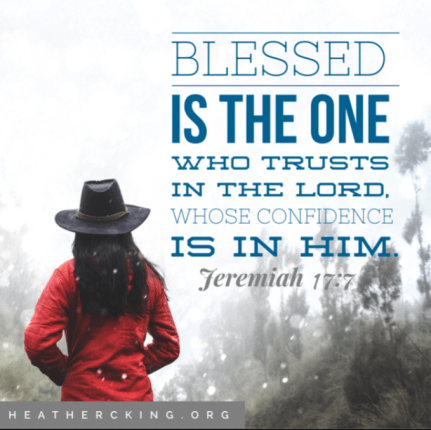
“But blessed is the one who trusts in the LORD, whose confidence is in him.

8 They will be like a tree planted by the water that sends out its roots by the stream. It does not fear when heat comes; its leaves are always green. It has no worries in a year of drought and never fails to bear fruit” (Jeremiah 27:7-8 NIV).

Our confidence isn’t in our friends; they are a help and an encouragement, but they are not our only hope.

Our confidence is not in our own wobbly selves.

Our confidence is in HIM, that He’ll catch us and He’ll help us.   He’ll redeem our failures.  He’ll give us new mercy.  He’ll forgive us and shower us with grace and love us through it all.

When we are God-confident, we don’t fear heat and we have no worries even in years of drought. In all seasons—seasons of weakness and seasons of strength—He helps us be fruitful.


Weakness can be flour and oil or it can be cake

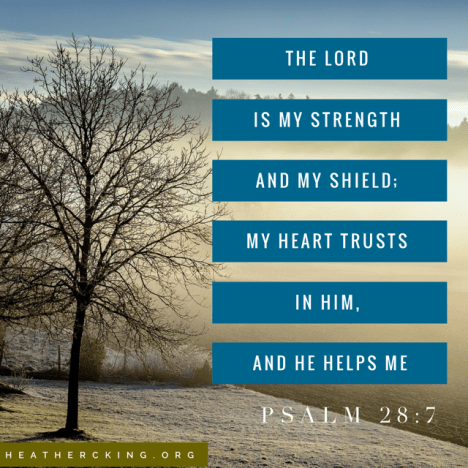
psalm-28-7

On New Year’s Eve, we used our fireplace for the very first time.

We’ve lived in our home 12-1/2 years.

We didn’t even use our fireplace on December 20th, 2004–the night of a huge winter storm when we lost power and running water.

I remember that night and that storm because I was in labor with my first baby and I huddled on the couch with blankets and a flashlight because the contractions kept me awake all night long.

It wasn’t until about 10 years later that I even realized my mistake. I had a fireplace available and didn’t use it.

What was I thinking?  Why did I choose cold and dark when warmth and light were so nearby?

How I have missed out.

How I still sometimes miss out because I have access to all that God gives and offers and simply IS, but still struggle along in my own strength.

I’ve read this verse so often these last two weeks:

But he said to me, “My grace is sufficient for you, for my power is made perfect in weakness.” Therefore I will boast all the more gladly of my weaknesses, so that the power of Christ may rest upon me. (2 Corinthians 12:9 ESV).

It’s a familiar promise, but one I return to now because I’ve been startlingly aware of my weaknesses.

It’s in the days when I want to give up or the moments when I mess up (again).

It’s in the way I try to avoid the difficult and the hard and hide my head in the sand instead of facing what might be.

I remember the widow of Zarephath who only had a little flour and oil to feed herself and her son. It was enough for one final, insufficient meal before resigning to starvation.

That’s the moment Elijah showed up asking for some bread.

Even after she told him how little she had, he boldly asked her to feed him first.  Then he promised this:

 For thus says the Lord, the God of Israel, ‘The jar of flour shall not be spent, and the jug of oil shall not be empty, until the day that the Lord sends rain upon the earth.’” (1 Kings 17:14 ESV).

I don’t know what struggle she might have experienced then.  I can’t imagine the choice–feed this stranger and hope God comes through–or feed my son at least one more guaranteed meal before we starve.

The Bible simply says, “She went and did as Elijah said” (verse 15).

And God came through.

If she kept the flour and oil for herself, she’d have had one small meal.

By giving it up,  though, she had miraculous abundance.

She gave God her weakness, her insufficiency, her smallest supply .  She gave out of her poverty, and He provided.  He refilled the flour and the oil.

God fills the empty when we’re poured out for Him.

Maybe I’ve been living on flour and oil when I could give it over to God and let Him make so much more.

Elisabeth Elliot wrote this about Elijah’s words:

’Make me a cake.’ In other words, Elijah said: There is one thing you can do. Even from your poverty, you can give me something.  It may not seem like much, but it is the very thing I need. If you will give it to me I can do something I could not do without it” (Loneliness).

We can fret over our insufficiency, we can hide away our weakness out of embarrassment and shame, we can run away from challenges, we can give up when it gets too hard.

Or maybe we can try to make do with the little we have.  “I have a little flour and a little oil. It’s not enough, but I’m on my own here.”

But weakness simply remains weakness when we avoid anything difficult and only live within our own abilities.  It’s just flour and oil.

So instead we can learn how to “make a cake” for Him with anything we have, no matter how small or how meager:

Here is everything, Lord.  It’s not enough.  Please be strong in my weakness.

We don’t need to be stronger ourselves; we need God’s strength.

We need more Jesus.

We need Holy Spirit fruit and comfort and anointing.

His strength is a promise.  It’s available!  It’s an unlit fireplace waiting to be filled with flame when we bring Him our needs  and ask Him to be powerfully sufficient in our insufficiency.

In every place we feel weak, we can make a cake, offer it up, and leave everything else to Him:  our future, our provision, our “success,” our salvation.  It is all in His hands.

Our strength begins when we rely on His strength alone.

When I Fell in Love

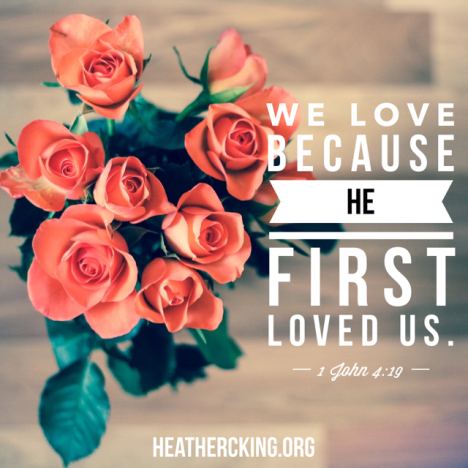
1-john-4-19

I can’t say exactly when I fell in love with this man.

He was on stage the first time I saw him, portraying Mr. Elton in a production of Jane Austen’s Emma (my favorite), and I was an audience member.   I laughed loud and long when he delivered the first line of the play while pretending to read from a book:

“It is a truth universally acknowledged that a single man in possession of a good fortune must be in want of a wife.

I heard my laugh hit the silence of the auditorium.  Apparently, I was the only one who got the joke (as a character from Emma read the first line from Pride and Prejudice).  And so I slumped into my chair wishing someone—anyone—shared my sense of humor.

I actually met him a week later after a college worship service.  Someone in the crowd pointed to the guy up front strumming the guitar.  “See that guy,” he said, “You just saw him on stage last week.”

Unbeknownst to me, this young guy who led worship and the drama ministry and acted in productions based on my favorite literature had just prayed a daring prayer two weeks before.

He told God he wasn’t looking for a relationship any more.  He was content to be single until God hit him over the head with a 2 x 4 and told him “Thou shalt marry this girl.”

I met him two weeks after that.

And a week after that, I was the new pianist on his praise team (and he’s still my worship leader even now).

I fell in love with the way he used his gifts and talents for God’s glory.

There was his calmness, too.  I loved my dad, but life with him wasn’t calm; it was loud much of the time and sometimes downright volatile.  This man, though, measured his words with wisdom and careful thoughtfulness.

Add to that his quick and witty humor that kept me giggling endlessly in the corner of the praise team section, and I realized that he was smarter than me and that was okay.

We’ve never been an opposites-attract kind of couple.  We’re probably two of the most alike people who God matched together.

Except for the fact that he only cares about doing what’s right and not whether it pleases anyone else while I’m a people-pleaser.

And the fact that he can rest and take time (perhaps . . . dare I say it . . .procrastinate) and I’m neurotically pushed to do and do and do relentlessly, first, fastest, and rest when you die.

I can’t say when it happened, but at some point I fell in love.

I can’t speak for him and say exactly why he fell in love with me.

Nor can I say exactly why God loves any of us either, surely not my awkward, nervous, uptight, worrying self.

Amazingly, though, this isn’t a “fall in love” kind of love at all.  God doesn’t grow to love any of us over time or awaken one morning and realize how much He cares.

HE LOVES US.

It really is the beginning and the end of our story.

Like the first time I saw my children, I loved them in an instant–loved them even before I saw them actually.  I didn’t slowly grow to appreciate their character or develop feelings for them over time.

In Jeremiah, God declares:

“before I formed you in the womb I knew you”

and David similarly prayed,

“you created my inmost being; you knit me together in my mother’s womb” (Jeremiah 1:5, Psalm 139:13).

God loved you before you squinted your eyes at the first burst of light, screamed, and got cleaned off, bundled up and handed to your mom.

He loves you when you feel loved and when you feel overlooked, when you received a blessing and when you endured a trial.  This love of his doesn’t wax or wane, change or alter or depend on us and what we do or say or feel or think.

We’ve never been good enough, pure enough, beautiful enough, or wise enough to earn it.

But even though we’re unworthy, even when we’ve strayed, even when we’ve felt that seemingly incurable distance from Him or poured out in painful honesty what’s troubling us…

STILL HE LOVES.

He says, “I have loved you with an everlasting love; I have drawn you with unfailing kindness” (Jeremiah 31:3).

And what can we do with this everlasting and unfailing love, so amazing and confusing because it’s far more than we deserve?

“We love because he first loved us” (1 John 4:19).

Originally published September 24, 2012