
VBS Lessons, Day Two: God Listens To You

This week I’m going through the lessons of Group’s PandaMania VBS and considering how they apply to more than just kids!

God Listens To You
“You know what I am going to say even before I say it”
Psalm 139:4

Last week, I quietly explained to my oldest daughter that even though people are friendly and strangers ask her questions, doesn’t mean they always have time for her entire life story.  Perhaps not everyone can listen to everything she has to say.

She replied, “But I just like to talk and I have a whole lot to talk about.”

Thus, when a friendly cashier asks how old my kids are, they give an unabridged biography as an answer.

And when the lady cutting their hair asks where they go to school, the girls launch into a weekly schedule that lists off all their normal activities and then give an infomercial about their preschool and kindergarten.

My PandaMania VBS leader materials for Day Two say:

Kids can tell you exactly what it’s like to be ignored or unheard.  They know what it feels like to talk to a busy parent or teacher, who responds with a distracted “mm-hmm.” They’ve been that hand, waving in the air, that didn’t get called on to share an answer.  And even when someone is tuned in, kids may not have the words to express what they’re feeling.   . . . God not only hears our voice . . .God hears our heart!

There’s a powerful promise buried in this simple lesson—God Listens to You.  Just like my kids may sometimes feel like I’m not listening closely enough, there are times when I feel as if God has gone deaf or, even worse, is choosing to ignore me.

Last week, a prayer request came through my email and I prayed: “Please don’t turn away from this request; please don’t hide your face from us.  Please hear what we are asking of You and deliver them.  Don’t be deaf to our pleas, not this time.”

I’m not alone in this prayer.

David asked, “Hear my prayer, O God; listen to the words of my mouth” (Psalm 54:2) and “To you, LORD, I call; you are my Rock, do not turn a deaf ear to me. For if you remain silent, I will be like those who go down to the pit” (Psalm 28:1).  Asaph prayed the same:  “God, do not remain silent; do not turn a deaf ear, do not stand aloof, O God” (Psalm 83:1).

Have you prayed this before?  The request of attention, the desire for God’s ear, that He would really hear the petitions you bring so passionately before the throne?  With particular fervency sometimes we say, “I know I pray things all the time, God, but I need you to really pay attention to what I’m asking right now.  This one matters more than normal!”

The promise we are teaching the VBS kids this week is that God always hears us, not just what we say, but even when we don’t know how to pray within the confines of words.  Even when the desires of our heart are too bulky to be smashed into syllables and sounds and long “before a word is on my tongue, you, LORD, know it completely” (Psalm 139:4)

God doesn’t tune us out as we pray or ignore the outpourings of our heart.  Psalm 10:17 says, “Lord, you have heard the desire of the humble; You will strengthen their hearts.  You will listen carefully.”

He hears what we pray.  He hears our heart’s cry even when words escape us.  During the tough times, heaven may seem silent and our prayers may seem to bounce against a ceiling rather than land at God’s feet.

Regardless of how you feel, though, you can trust in an attentive God who hears the prayers we offer on our knees, the whispers as we lie in bed at night, the tears as we fall in despair in His presence.  God listens to you.

We know this because God doesn’t change.  From beginning to end, from person to person, our God is consistent in His character.  So, just as He threw down fire from heaven in response to Elijah’s prayer, so He hears and responds to our cries for help.

In 1 Kings 18, Elijah challenged the 450 prophets of Baal and the 400 prophets of Asherah not just to a test of their gods’ power, but also of their gods’ ability to hear them.  He declared, “Then you call on the name of your god, and I will call on the name of the LORD. The god who answers by fire—he is God” (1 Kings 18:24).

God’s character–the things that sets Him apart–isn’t just that He is able to deliver us; it’s that He truly hears our cries for deliverance.

And so the prophets of Baal danced and shouted. At noon Elijah began to taunt them. “Shout louder!” he said. “Surely he is a god! Perhaps he is deep in thought, or busy, or traveling. Maybe he is sleeping and must be awakened.”  So they shouted louder and slashed themselves with swords and spears, as was their custom, until their blood flowed.  Midday passed, and they continued their frantic prophesying until the time for the evening sacrifice. But there was no response, no one answered, no one paid attention (1 Kings 18:27-29).

Their god was silent.  Their god was deaf.  Their god was unimpressed by their passion and unresponsive to their cries.

Not our God.

Elijah sloshed water all over the altar so it was running down over the soaking wet sacrifice and spilling onto the ground below.  He prayed, “‘Answer me, LORD, answer me, so these people will know that you, LORD, are God, and that you are turning their hearts back again.’  Then the fire of the LORD fell and burned up the sacrifice, the wood, the stones and the soil, and also licked up the water in the trench.  When all the people saw this, they fell prostrate and cried, ‘The LORD—he is God! The LORD—he is God!'” (1 Kings 18:37-39).

Answer me, God, for the display of Your glory!  So that everyone watching my life and these circumstances can see and declare, “The Lord—He is God!  The Lord–He is God!”

The song we will sing tonight at VBS says, “God knows every word before you even say it; He hears every prayer before you even pray it.  So let Him hear you now.  So let Him hear you shout!  He knows you.  He loves you.  God is listening.”

Be assured of that today and rest in that promise.  Remember that what defines God is that He is alive and active, powerfully able, and mercifully responsive to us.

Heather King is a wife, mom, Bible Study teacher, writer for www.myfrienddebbie.com and worship leader.  Most importantly, she is a Christ follower with a desire to help others apply the Bible to everyday life with all its mess, noise, and busyness.  To read more devotionals by Heather King, click here.

Copyright © 2011 Heather King

VBS Lessons, Day One: God Made You

Every year at Vacation Bible School I watch as adults lead the excited children around the church from station to station, sing the songs (maybe we even do the accompanying motions), shout and laugh.  Do we also, though, compartmentalize? Do we box up the VBS messages and declare they are just for kids and not relevant for us?

But is there any message in Scripture that God delivers just for people under 18? We older and wiser ones sometimes make faith so complicated and fail to recognize or really consider the beautiful truths in these simple messages. So, this week, I’m thinking about VBS and what the lessons for children mean for you and me.  Our church is doing Group’s PandaMania VBS, so that’s what’s on my mind.

God Made You

“Thank you for making me so wonderfully complex”
Psalm 139:14

God made us.  What then should we do about that?

Do we nod our heads in complacent agreement? Do we go about our everyday lives with no realization, no recognition, no response to an act so incredible and a God so powerful? Have we forgotten the wonder of it all?

Sometimes we do just that.

But in this very moment, I pause.  “God made me.  God made you.”  That should elicit a response of unconfined, unhindered, from-the-bottom-of-my heart, I-don’t-care-what-anyone-else-thinks praise and thanksgiving.

So often we determine the mission and measure the success of VBS by how well we reached unchurched kids. That’s not necessarily a bad thing. Yet, VBS has power for churched kids, too.  For one week we encourage them to throw their hands up and sing out loud.  We tell them it’s not just okay, but it’s expected for you to be unashamed about worshiping.

It’s not that way all the time.  Truth be told, in normal church mode in some sanctuaries, not everyone looks excited about worshiping God. We so often grip our hands to our side and feel the eyes of others on us if we look too involved, raise our hands, close our eyes, sing loudly. For some of us, Sunday morning worship means feeling peer pressure and avoiding embarrassment rather than giving God the praise He deserves.

This isn’t about musical styles or song choices or volume or service order.  This isn’t about personal preferences.  This isn’t about one person judging another’s worship and determining a set formula for what praise looks like.  How you worship is between you and God and it may be different from day to day, song to song, moment to moment.

God Himself though has declared that “true worshipers will worship the Father in the Spirit and in truth, for they are the kind of worshipers the Father seeks. God is spirit, and his worshipers must worship in the Spirit and in truth” (John 4:23-24).

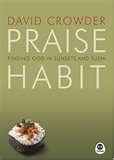
I can’t help but quote my favorite description of praise from David Crowder’s Praise Habit.  He writes:

We naturally understand praise . . . Kids just know how to enjoy things.  They give themselves fully to whatever has a hold on them.  Remember as children how we would fearlessly hold up our favorite toy and petition anyone who was in close proximity to behold it?  ‘Look, Mom, look!’

We instinctively knew what it was to praise something. It’s always been in us.  We were created for it. . . .But as adults we become self-conscious and awkward.  Something gets lost.  I think we do it to each other.  At some point, I hold the toy up exultantly and you comment that it looks ridiculous to hold the toy up in such a way. . . And we slowly chip away at each other’s protective coating of innocence until one day we wake up and notice we are naked and people are pointing.”

I’ve seen this happen. After a few months in Children’s Church, my oldest daughter told me that kids laughed at her when she sang and made her feel silly for raising her hands.

Do we adults do this same thing to each other?  Do we do it for the children who sit next to us in the pews all around the sanctuary?

Do they watch us and see what wholehearted worship and total unashamed glorifying God looks like?  Or do they instead see how peer pressure should control our behavior and even our relationship to God?

For boys, the pressure is even greater.  How often do they see men not just standing up when church music plays, but unashamedly praising God?  Our behavior mostly teaches boys that men don’t get emotional about worship, men don’t raise hands, men don’t sing out, men don’t look involved, men don’t close their eyes.

We forget David.  He fought bears and lions with his hands and as a young boy felled a giant with a slingshot while grown men in hardened armor cowered in their tents. He led armies and slew tens of thousands of the enemy Philistines.

He was the manliest of manly men and yet he also penned most of Psalms, the songs of praise to God.  He danced before the Lord and declared “I will celebrate before the LORD. I will become even more undignified than this”? (2 Samuel 6:21b-22a).  This warrior-king didn’t care what other people thought when he worshiped.

Later David Crowder also writes

My point is we are all fragile.  Somewhere along the way we abandoned abandon.  Or perhaps we gained things that need to be discarded. We have covered ourselves.  Someone pointed out that we were naked, and the clothing we have woven is bulky and pretentious.  It hinders our freedom of movement.  Expression with childlike spontaneity has become difficult.  It bares too much of us. . . .

What if we were so moved by who God is, what He’s done, what He will do, that praise, adoration, worship, whatever, continuously careened in our heads and pounded in our souls? . .. This is what we will do for eternity.  What makes us think our time on earth should be any different?  What keeps it from being so?”

Charles Spurgeon wrote, “When your heart is full of Christ, you want to sing.”  The response in Scripture is clear, when we consider that God has made us, made the universe, poured out His sacrificial love for us, given us the very breath of a new day and provided us with all that we need, we “sing to Him, sing praise to Him” (1 Chronicles 16:9).

  • We “sing psalms, hymns, and spiritual songs with gratitude in your hearts to God” (Colossians 3:16).
  • We “lift up (our) hands in the sanctuary and praise the LORD” (Psalm 134:2)
  • We “make a joyful noise unto the LORD, all the earth: make a loud noise, and rejoice, and sing praise” (Psalm 98:4).

David Crowder is right.  We will be singing praises to God for all eternity.  We will be surrounded by others doing the same at the throne of the Most High God and there won’t be anything in heaven to hold us back from giving “all that is in” us in worship to Him (Revelation 5:13).  No peer pressure.  No embarrassment.  No expectations.

I tell my daughters all the time—Don’t be embarrassed for singing.  Be embarrassed not to sing.  Don’t worry about what other people think.  Care about what God is thinking.

Can you do the same thing?  Can you put aside notions of dignity, feelings of embarrassment, worries about what other people will think and fix your eyes only on God?

This week, every time the kids hear me say, “God made you,” they are to respond immediately in a shout of worship, “Thank you, God!”  How will you also respond in thanksgiving?

**************************************************************************************

PandaMania VBS runs all this week (06/20 to 06/24) from 6:30 to 9 p.m. at Newington Baptist Church for ages 4 through 5th grade.  We hope to see you there!

For those at Newington who are interested in David Crowder’s book, Praise Habit, great news!  It’s in the church library!

Heather King is a wife, mom, Bible Study teacher, writer for www.myfrienddebbie.com and worship leader.  Most importantly, she is a Christ follower with a desire to help others apply the Bible to everyday life with all its mess, noise, and busyness.  To read more devotionals by Heather King, click here.

Take Heart, Daughter

Jesus turned and saw her. “Take heart, daughter,'” he said, “your faith has healed you”
(Matthew 9:22).

My daughters believe their daddy is a superhero with an amazing super power.  He can fix anything.  For years, they have brought me broken toys and pages ripped from books and announced that it was okay because “Daddy could fix it!”  They stand amazed as he pops wheels back on plastic strollers, adjusts the height of swings, and, even more impressive, repairs our broken dishwasher.

Then there was the day that my daughter, then just two years old, came to me, her hands outstretched and holding a DVD split completely into two separate pieces.  Her tiny fingers gripped something totally irreparable.

“Oh, baby,” I said, “It’s broken.  Really broken.”

“It’s okay,” she announced with confident faith, “Daddy can fix it.”

“Most of the time, sweetie, but not this one time,” I whispered.

We’ve all experienced the limited fix-it abilities of others and ourselves.  We can apply glue to relationships and duct tape to careers, we can piece together finances and snap hopes and dreams back into place after countless cracks and rips.

But then there’s the day—we’ve all had those moments—-when we grip in our fingers something irreparable.  No amount of gluing, taping, splicing, snapping, tying, pinning or sewing can undo the damage, fix the broken or resurrect the dead.  Not this time.

So, we bring what is diseased and dead to the God who has power over life and death. My commentary says: “Life in this world will be better if it is lived by a power beyond this world, the power of the resurrected, ascended, glorified Christ.”   We live in resurrection power when we trust Him even in the midst of impossible, overwhelming, hopeless circumstances.  We hold up to Him a mess of shattered pieces and declare, “Abba, Father, My Daddy can fix this.”

Because we know He healed what no one could heal.  Because we know He created a universe, a planet, and life with the power of His Words.  Because we know He even conquered death and overcame the grave.

Just like the woman who had bled for 12 years pushed through a crowd so she could touch Christ’s cloak.  For twelve years, she had been walking dead.  Her sickness made her unclean and cut off from community life, from marriage relationships, and from the ability to worship in the temple.  She shouldn’t have been in the crowd, wasn’t allowed to have contact with people for fear she would spread her uncleanness to them.  Her very presence there was risky.  Anyone could have condemned and publicly shamed her.

My husband reminds me that her story is one of salvation.  Her healing foreshadowed the cross as she transferred years of uncleanness and impurity onto Him with one touch.  He absorbed her uncleanness.  She now, for the first time in 12 years, was made clean, purified, holy, new—–once she was lost, but now she was found.  Then she made public confession when she, “knowing what had happened to her, came and fell at his feet and, trembling with fear, told him the whole truth.” (Mark 5:32-33).  Yes, the whole ugly truth of it all.

Our own redemption stories all echo hers.  Christ miraculously fixes what is unfixable.  He assumes our guilt so that we may receive forgiveness.

There’s something else, here, though, something about her faith that I need to learn.

Her healing didn’t happen by accident, an unexpected brushing against Jesus in the middle of a mob.  No, she had to decide to push through the crowd; she had to choose to reach out a shaking hand to grab the dusty hem of His robe.

So, it is with us.  We could stand on the outskirts of faith, not truly trusting God to heal and redeem us, but we would remain broken. Maybe we feel insignificant, maybe our problem doesn’t seem big enough or maybe it even appears too big for God to handle.  Regardless, until we bring the pieces to the throne and lay them at His feet, we cannot expect healing.

This reaching out for Jesus wasn’t just bold, it was also full of hope when things seemed hopeless.  “She had suffered a great deal under the care of many doctors and had spent all she had, yet instead of getting better she grew worse” (Mark 5:26).  Doctor after doctor, remedy after remedy, year after year, medical bill after medical bill, all leaving her now destitute, hopeless, and still bleeding.

But then our compassionate Savior reassured and comforted her, not just fixing a physical problem, but speaking peace into her fearful heart: “Jesus turned and saw her. ‘Take heart, daughter,’ he said, ‘your faith has healed you’” (Matthew 9:22).

There’s a message for you also in the broken places.  God asks you to “take heart, daughter.” Don’t despair.  Don’t give up hope.  Bring your burdens to Him.

What is it about her faith that healed her? She believed so much more than that He was a medicine man with some effective healing aura.

She believed He could give her new life.
She believed He could remove her impurity and make her clean again.
She believed He would not condemn her for approaching Him in all of her dirty unholiness.
She believed she could come to Him just as she was.
She believed He could bring hope to the hopeless.

Her faith made her well.

Then, she gave testimony to what He had done and announced to the crowd of onlookers that Christ had healed her.

Are you facing brokenness or losing hope? “Take heart, daughter,” and trust Him with the impossible.

And when He has delivered you, fall at His feet in worship and give testimony to His grace. Tell “the whole truth” about what God has done for you.

If you have not received the answer yet, pray for that testimony.  Pray for the glory of His name.

Pray that you will be like the captives brought back to Zion, “who were like men who dreamed.  Our mouths were filled with laughter, our tongues with songs of joy.  Then it was said among the nations, ‘The Lord has done great things for us, and we are filled with joy” (Psalm 126-13).

Lord, fill us with laughter, fill us with joy in these circumstances.  Allow us to declare, “The Lord has done great things for us.”  Give us a testimony for Your glory, so that we can be a walking display of Your healing, resurrecting power and Your deeply compassionate mercy and love.

“God can do anything, you know—far more than you could ever imagine or guess or request in your wildest dreams! He does it not by pushing us around but by working within us, his Spirit deeply and gently within us” (Ephesians 3:20, MSG).

Heather King is a wife, mom, Bible Study teacher, writer for www.myfrienddebbie.com and worship leader.  Most importantly, she is a Christ follower with a desire to help others apply the Bible to everyday life with all its mess, noise, and busyness.  To read more devotionals by Heather King, click here.

Copyright © 2011 Heather King

Christian Blog Topsites

Come Awake

“We know that the whole creation has been groaning as in the pains of childbirth right up to the present time. Not only so, but we ourselves, who have the firstfruits of the Spirit, groan inwardly as we wait eagerly for our adoption to sonship, the redemption of our bodies”
Romans 8:22-23

We shuffled into the tiny unfamiliar building, two parents, three daughters behind.  The man asked me, “Do you need any help?”

“We’re here to visit a site, but I don’t know which one.”

“How long?”

“Ummm . . . (mental calculating) six years.”

He types into the computer as I dictate and prints out a map with instructions.  “Is this him?”

I pause.  For some reason, that question is difficult.  “I think, I mean yes, could it be, it must be, yes, that’s him.”  I read and reread the printout to make sure.

We walk out with paper in hand, follow the signs, count the rows, read the names.  “Here it is,” my husband announces.

And it’s . . . him.

My dad.

Daughters stoop down low and trace letters with fingers.  Was this his name?  Was this his birthday?  Was he a soldier?  Did he believe in God—is that why the cross?  Was he old?

No, not old, just sick, very sick.

I can feel the breeze of heaven in that place.

So many days now, I find myself praying, “Come, Lord Jesus.  Come quickly.”

Is there anything more to say at times?  For tornadoes, hurricanes, floods, wild fires, earthquakes, tsunamis, cancer, death, abused and neglected children—they are the aching screams and moans of an earth longing for its Creator. Death and death and death awaits new life when the trumpet sounds and Christ calls, “Come awake!”

C.S. Lewis wrote, “If I find in myself a desire which no experience in this world can satisfy, the most probable explanation is that I was made for another world.”

That’s why this earth hangs loose on my shoulders, so ill-fitting. I pray, “Come, Jesus.  Come quickly.  Call us to break free from a world of death and live life eternal in Your presence because this place, this death-world is not home for us.”

Yes, Lord “haste the day when my faith shall be sight, the clouds be rolled back as a scroll; the trump shall resound and the Lord shall descend even so, it is well with my soul” (Spafford).

“He who testifies to these things says, ‘Yes, I am coming soon.’  Amen. Come, Lord Jesus” (Revelations 22:20).

Come, Lord Jesus.

Yet, this resurrection thinking, this coming awake, is not just for my eternal future; it’s for the here and now of my life.  Christ renews and resurrects today.

He bids us “Come awake”
when we let spiritual gifts lie dormant
when we withdraw out of pain
when we hold the shattered remains of relationships in our hands
when we hurt and hide away
when we bury a dream
when we face a closed door
when our life season changes
when our rational selves tell us not to hope for what is impossible

Here I sit, still on this earth, still aching and longing for heaven, but living confined by this earthly shell.

Thus, I am reminded as I stand at my dad’s grave
to linger over
to wait upon
to enjoy
to bask in
to rest in
Christ’s presence
because there the scent of heaven is strong.

I ache for time with Him, for moments of worship and soaking in His Word.  Not to rush through and get done, shutting up Bible to turn on television or answer email.  Instead to sit quiet and still, me the saved one with Him the Savior.

This is how I “set (my) mind on things above, not on earthly things” (Colossians 3:2).  This is how I respond as He calls me to “Come awake” and to exit tombs of unbelief and fatigue, of people pleasing and fear, of comfort and complacency, of hurt and brokenness.  I exit the tomb and rise to my Risen Lord.

David Crowder Band: Come Awake
Come awake, from sleep arise
You were dead, become alive
Wake up, wake up, open your eyes
Climb from your grave into the light
Bring us back to life

You are not the only one who feels like the only one
Night soon will be lifted, friend
Just be quiet and wait for a voice that will say
Rise, rise, to life, to life

Heather King is a wife, mom, Bible Study teacher, writer for www.myfrienddebbie.com and worship leader.  Most importantly, she is a Christ follower with a desire to help others apply the Bible to everyday life with all its mess, noise, and busyness.  To read more devotionals by Heather King, click here.

Copyright © 2011 Heather King

Reading Together

I posted a new announcement about the book for our online summer book discussion.  I hope you are planning on participating!  Please take the time to click on “Reading Together” to find out more.

Live Long and Forget or Prosper

Not long ago, I wrote these words in a message to a friend, “Middle school was an absolute nightmare for me.”

Oh, it so was.  I had great friends; it wasn’t peer pressure or mean girls that made it so miserable.  Yet, those were difficult years for lots of reasons all piled together forming one mountain of middle school angst.

Most of the time, I forget those preteen emotions.  They have little presence in the workings of my everyday mind and heart.  Yet, just occasionally I am reminded of them.  Although it takes some purposeful recollecting, and although the pictures are unclear, almost as if they happened to someone else—yes, I do still remember.

Joseph knew more than most of us about enduring hard times and living through moments he’d rather forget.  Narrowly escaping being murdered by his brothers, he had instead been sold into slavery, falsely accused of rape, tossed into prison and left there—not for days or weeks, but years and years.

Time passed and Joseph was freed, even elevated to power in a whirlwind of activity.  Now second in the land, lesser only than Pharaoh, he married and had two sons.  The names he chose for them have made me pause.

Before the years of famine came, two sons were born to Joseph by Asenath daughter of Potiphera, priest of On. Joseph named his firstborn Manasseh and said, “It is because God has made me forget all my trouble and all my father’s household.” The second son he named Ephraim and said, “It is because God has made me fruitful in the land of my suffering.”   Genesis 41: 50-52

Manasseh, God has made me forget.  In some ways, through the sheer distance of time, we cannot remember the details of the past clearly.  Sometimes that’s God’s grace, that our past of pain grows hazy in the light of present blessing. 

Yet, do we ever forget, truly forget, all our trouble?  Did Joseph?

Surely he was now in a foreign land, an adult and no longer a teenage braggart annoying his brothers. No more following sheep in a field; now he managed a world power.  His life seemed totally broken off from the long-ago upbringing by a doting father. The coat of many colors probably wouldn’t have fit over his frame any longer.

But did he forget?  Truly forget?

Not by the way he reacted to his brothers’ sudden appearance in Egypt, begging for food in the midst of famine.  Not as he spotted their faces in the crowd of travelers.  Not as he invited them to a personal audience.  Not as he conspired to see his younger brother and father once again.  Not as he returned their silver.  Not as he fled the room to cry in privacy after talking with them all once again.

Is it not so much that he forgot, but instead that he learned and grew, matured and transformed?  Through trouble, God had refined him.

Not Manasseh.  Not forgetting.  But Ephraim.  Being made fruitful in the land of my suffering

It seems so much less about a past wiped clean from memory and so much more about allowing God to work “for the good of those who love him, who have been called according to his purpose” (Romans 8:28), even during those moments and seasons and years we would prefer to forget.

It is the treasure of God’s presence while in darkness, the discovery of fruitful grace in a barren land, the finding of fresh water for a parched soul.

So it was for Joseph’s brothers, who dug down deep into the sacks of grain they carried back from Egypt.  Suddenly their hands felt not wheat, but silver.  Secretly, Joseph had placed treasure in each bag.

Beth Moore in The Patriarchs wrote:

“In the midst of His unfolding plan, He’d buried treasures for them to unearth at times they least expected.  Do you feel in deep peril?  At great risk?  Your God has given you treasure.  Search for it.” 

We can stand at life’s blackboard and erase and erase and erase in attempts to forget.  Oh, could we just forget how we felt in that moment, how we went through that trial, how we hurt, how we cried, how we were afraid, how we were broken.

But we would miss the treasure hidden there.

When you find yourself in famine, dig deep for the treasure of God.  Perhaps God in His grace will cover over pain with forgetfulness, replacing memories of hurt with the blessing of intimacy in His presence. Yet, even more precious than forgetting is allowing Him to make you fruitful in the land of your suffering. 

Heather King is a wife, mom, Bible Study teacher, writer for www.myfrienddebbie.com and worship leader.  Most importantly, she is a Christ follower with a desire to help others apply the Bible to everyday life with all its mess, noise, and busyness.  To read more devotionals by Heather King, click here.

Copyright © 2011 Heather King
Blessings in Sticky Keys

“For You make him to be blessed and a blessing forever; You make him exceedingly glad with the joy of Your presence.”
Psalm 21: 6

I have a piano.
I have young children.
I’m trusting you can fill in blanks, use your imagination, put two and two together and figure out what all that means.

A few months ago, I sat down to play a song and noticed a key was sticking.  By the second page of music, the key wasn’t sticking anymore; it was downright stuck. Beautiful notes . . . beautiful notes . . . beautiful notes . . . thunk.

This has made my musical life difficult.

Then, there are the piano lessons for these young daughters of mine.  The offending key is not one of the mostly unnecessary ivories on the end of the keyboard.  Oh no; it is an oh-so-necessary note for any song not in C position.  So, I pulled out method book upon method book, recital books, beaten up and falling apart books covered in pencil marks from when I first learned to play.  My daughter played every single song in C position I owned on this overstuffed musical shelf of mine.  All this to avoid the offending key.

Finally, I broke down and called about repairs.  I held my breath waiting to hear how much this fix-it job would cost and then I heard the magic word: Free.

Free I tell you!!  The manufacturer recalled the keyboard on this piano because of sticky keys.  And so I danced around my living room and gave thanks to God for this blessing.  This tiny kiss from God and sweet reminder that He cares not just about the heavy burdens I carry, but also the daily annoyances and petty frustrations.

It’s a moment of visibility, the clear and unmistakable hand of God even when we are busy and rushed and overwhelmed.  It’s a flash of His glory amidst darkness, making us breathless with the beautiful and captivating mercy of it all.

But, then there are the not-so-visible blessings.  The ones we must squint to see or perhaps can only be seen in flashbacks.  While we’re in the pit and trapped in the mire, God’s hand is invisible, His blessings unclear.  Yet, when God has lifted us up, washed us clean, taken our hand and led us forward on the journey, we can then throw a glance at the past and see the shadows of grace and blessing that we missed before.

Sometimes we know a blessing when we see it; sometimes we don’t.

Genesis 49 tells a story of blessing.  Aged Jacob calls his 11 sons to his side to tell them “what will happen . . . in days to come” (Genesis 49:1).  One by one, Jacob blesses each son.

Some of those words are obvious blessings.  Like for Judah: “The scepter will not depart from Judah, nor the ruler’s staff from between his feet” (Genesis 49:10).  And for Zebulun: “will live by the seashore and become a haven for ships; his border will extend toward Sidon (Genesis 49:13).  And for Joseph: “Your father’s blessings are greater than the blessings of the ancient mountains, than the bounty of the age-old hills. Let all these rest on the head of Joseph, on the brow of the prince among his brothers(Genesis 49:26).

Then there are other prophecies for other sons.  Commentator Bruce Waltke called these “antiblessings.”

Like for Reuben:”Turbulent as the waters, you will no longer excel” (Genesis 49:4).  And for Simeon and Levi: “Cursed be their anger, so fierce, and their fury, so cruel! I will scatter them in Jacob and disperse them in Israel” (Genesis 49:7).

Antiblessings.  Maybe they even sound like curses from a dying father to his sons.  And yet blessings they are called.

Have you ever walked through something that seemed like a curse, only to find later it was truly a blessing?

Bruce Waltke explained:

In terms of the nation’s destiny these antiblessings are a blessing.  By demoting Reuben for his turbulence and uncontrolled sex drive, Jacob saves Israel from reckless leadership. Likewise, by cursing the cruelty of Simeon and Levi, he restricts their cruel rashness from dominating.

Beth Moore in The Patriarchs says, “We might call these blessings of restriction. . . .Both what we receive and what we don’t receive can constitute blessings for us and those around us.  God is all-wise.  He blesses us as surely by what He does not grant as what He does.

I have received these blessings that are only visible in memory.  At 13, I decided where I would go to college.  I worked.  I saved my money.  Years passed and I reluctantly applied to other schools along with this college, fully believing those extra applications were simply a waste of time and money.  I only toured my dream school.  I auditioned for the piano teacher of my choice.  I sought out a mentor in the Theory and Composition Department.  I went to the open house.

And then, I couldn’t go.  It was a resounding, clear “No” in the most nearly audible voice I have ever heard from God.

It seemed like a curse.  He didn’t give me the “desire of my heart.”  I was depressed, lost, confused, broken.  Listlessly, I started classes at the one college I simply did not want to attend.

And I grew.  I changed my major.  I met my husband.  My career path altered.

Abundant blessings grew out of the antiblessing.

Has God told you, “No?”  Has He delayed in giving you what you’ve asked for?  Have you been buried in circumstances that seem like curses?

Maybe that’s what you’re living through now or maybe it’s what you’ve experienced in the past. Either way, it may be hard to see a purpose or plan in all of this.

Allow God to peel back the layers of hurt and frustration and reveal underneath all of that the blessing that’s so hard to see.  Ask Him to open your eyes to see His grace at work even in heartache and loss.  It’s there, my friend, the blessing, though hidden perhaps, is there.  “Salvation belongs to the Lord; May Your blessing be upon Your people” (Psalm 3: 8)

Heather King is a wife, mom, Bible Study teacher, writer for www.myfrienddebbie.com and worship leader.  Most importantly, she is a Christ follower with a desire to help others apply the Bible to everyday life with all its mess, noise, and busyness.  To read more devotionals by Heather King, click here.

Quiet Time With a Mop and a Bucket, Lesson 3

“Love never gives up. Love cares more for others than for self.”
1 Corinthians 13:4, MSG

For Lesson 1: You Are Not the Only One, click here

For Lesson 2: There’s Always More to Do, click here

Lesson 3: Extend to Others the Grace You Desire

With the “Big Clean” now finished, you could visit my home at just this moment and make countless assumptions about me.  That I clean all the time.  That the laundry is always washed, dried, folded, and put away.  That my floor is always freshly mopped and carpets vacuumed.  That our home is perpetually dust and cobweb-free.

You’d be wrong.

A few years ago, I was deep in the middle of a “Big Clean” when someone stopped by at the last minute.  Unfortunately, the big bad secret of a “Big Clean” is that the house always looks worse before it looks better.  So, for a large part of the time, even while you are frantically washing and scrubbing, the house looks like a hurricane has blown through.

That’s what my home looked like when our visitor dropped by.  Furniture was all moved out so I could vacuum behind it.  Toys were scattered around waiting to be sorted into bins. Cleaning products were strewn all over the counter.  He could have looked at my home in that moment and thought I was destined to be on the next episode of Hoarders.

But, he’d be wrong.

Fortunately for me, he’s full of grace and hopefully has been in my home often enough to know that we don’t live in a a FEMA-designated disaster zone every day of the year.  Not everyone, though, would look at that mess and assume the best about me.  Not knowing that I was in the middle of an intense cleaning project, they could look around and assume I’m a first-class slob.

We humans are often so quick to judge one another.  Ages ago in my college psychology class, we learned that it’s nearly impossible to overcome a first impression.  What people think about you in the first 3 seconds of meeting is likely how they will think of you forever.

The trouble with these first impressions is that they leave very little room for grace.  And yet, we form opinions and label people all the time.  We push each other into categories.

The truth is, we can be pretty vicious.

In 1 Chronicles 19,  we read about what happens when we make faulty assumptions and judgments about others.  “Nahash king of the Ammonites died, and his son succeeded him as king.  David thought, ‘I will show kindness to Hanun son of Nahash, because his father showed kindness to me.’ So David sent a delegation to express his sympathy to Hanun concerning his father” (1 Chronicles 19:2-3).

Off went David’s men with a message of comfort to the grieving prince.  After expressing their sympathy, though, the king’s advisers questioned their true intentions.  They asked the king, “Do you think David is honoring your father by sending envoys to you to express sympathy? Haven’t his envoys come to you only to explore and spy out the country and overthrow it?” (1 Chronicles 19:3). Full of mistrust, they humiliated David’s men, shaving off their beards, and cutting off their clothes so they were naked, and then sent them back home full of shame.

Even then, King David didn’t react in anger.  He reclothed his men and made accommodations for them to regrow their beards in privacy.  In the meantime, the Ammonites themselves, knowing they had acted badly, preemptively allied themselves with Israel’s enemies and traveled out in battle array against Israel.  And they fought a war, which they lost, all because they didn’t believe in the genuine sympathy that David expressed through an act of kindness.  They assumed the worst about him and made unfair judgments.  They were so quick to take offense and so suspicious of others.

Jesus’s standard, on the other hand, is high.  He said, “Do not judge, or you too will be judged.  For in the same way you judge others, you will be judged, and with the measure you use, it will be measured to you” (Matthew 7:2).

What would happen if we meted out to others the same grace we’d desire from them?  What would happen if we gave second chances and allowed people to grow rather than assuming that one mistake was a sign of permanent character flaws?  What would happen if we assumed the best about others around us instead of allowing mistrust and suspicion to filter our perceptions of their actions and words?  What would happen if we focused on the positives in others and let their faults pass uncommented on?

We would give the same grace we’ve received, sometimes even more.  We would show abundant love to others just as Christ has shown to us.  Paul wrote about love:

Love never gives up.
Love cares more for others than for self.
Love doesn’t want what it doesn’t have.
Love doesn’t strut,
Doesn’t have a swelled head,
Doesn’t force itself on others,
Isn’t always “me first,”
Doesn’t fly off the handle,
Doesn’t keep score of the sins of others,
Doesn’t revel when others grovel,
Takes pleasure in the flowering of truth,
Puts up with anything,
Trusts God always,
Always looks for the best,
Never looks back, But keeps going to the end.
(1 Corinthians 13:5-7, MSG).

Pause a moment on each of those and truly consider whether you’re living out love with those around you, in your home, in your work place, in your church, in your community.  Carry those words with you in the next few days and let them guide your interactions.

When you see someone buried in mess, allow love to motivate your response.  Can you give them some grace, allowing time to show whether they are perhaps just in the middle of a “Big Clean?”  Can you extend a hand of help and bring along your own bucket and mop to help them with the dirty work?  Can you give them the words of encouragement that will spur them on to finish the job rather than sitting down too soon, overwhelmed by the mess?

Can you “look for the best?”  Can you “never give up?”

That’s what it takes to love like Christ, who poured Himself out for us as an offering even when we were messy and piled over with junk and debris.  He loved us that much.

Heather King is a wife, mom, Bible Study teacher, writer for www.myfrienddebbie.com and worship leader.  Most importantly, she is a Christ follower with a desire to help others apply the Bible to everyday life with all its mess, noise, and busyness.  To read more devotionals by Heather King, click here.

Copyright © 2011 Heather King

Quiet Time With a Mop and a Bucket, Lesson 2

“He who began a good work in you will carry it on to completion until the day of Christ Jesus”
Philippians 1:6

For Lesson 1: You Are Not the Only One, click here

Lesson 2: There’s Always More to Do

Hours after I toted all of the cleaning bottles and paraphernalia to the back of the house, I had now systematically worked through each room, accomplishing the “Big Clean.”  Not the everyday wipe-down.  Not the daily decluttering.  The kind of clean you build up to over time, where you flip  over sofa cushions and apply toothbrush to grout.

I emptied the bucket of soapy water, hung up my dish rag, placed the broom in the closet and sat down to write.  I was finished cleaning.  The house was spotless.

Except.

Except for the fact that as I sat at the kitchen table, I now saw the clear handprints left by my daughters on the window next to me.  I just washed that window two days ago.  Now there were handprints.  Up I hopped, grabbed the Windex and a paper towel.  Spritzed.  Wiped down.  Put cleaning supplies away.  Sitting down again, I thought, “yes, now I am truly done.”

Except.

Except now I could clearly see a splotch on one wall that I must have missed earlier.  No problem.  One quick wipe-down and I am done.

Except . . .

The reality of cleaning is that there will always be more mess, if not now than later.

And so it is with us.  We allow God to clean us out, scrubbing out the hidden corners of sin, bad attitudes and rotten motives.  We are purified, refined, and made new.  Yet, no matter how far we have progressed on this road to Christ-likeness, we will not attain perfection on this planet.   “We know that when Christ appears,we shall be like him, for we shall see him as he is” (1 John 3:2b).  But, until Christ appears, we’re not going to be His perfect likeness and we’re going to have more messes to clean up.

We could take that as permission to stop cleaning all together.  Why make the bed, if you’ll sleep it in that night?  Why wash the dishes if they are just going to be dirtied again?  Why keep trying to be more like Christ when I can’t possibly be perfect?

And yet, Paul wrote:

Not that I have already obtained all this, or have already arrived at my goal, but I press on to take hold of that for which Christ Jesus took hold of me. Brothers and sisters, I do not consider myself yet to have taken hold of it. But one thing I do: Forgetting what is behind and straining toward what is ahead,  I press on toward the goal to win the prize for which God has called me heavenward in Christ Jesus. (Philippians 3:12-14)

In her book One in a Million, Priscilla Shirer writes, “You might be in the oasis of complacency if you’ve started thinking you’ve arrived and that nothing more is really required of you at this point in life.  You’ve basically stopped hungering for anything new, concluding that your present experience with God is probably as good as it’s going to get.”

Sometimes the most dangerous place for a Christian to be is immediately following a “Big Clean.”  We feel excited about the work God has done in us, the place He’s brought us to, the revolutionary way He has stirred up our hearts.  Then we begin to think we’ve made it.  We’re so close to God right now; there just couldn’t be anything closer.  We’re so much farther than where we were before, so taking  a moment to enjoy the new and improved location seems like a good idea.  Then we settle in and stop moving forward.

It’s just like the two-and-a-half tribes of Israel that chose to settle down east of the Jordan river rather than taking the land God promised them in Canaan.  They stopped just short of God’s fullest blessing.  They settled for less all because they thought what they had was good enough.

But, I want God’s very best for me, the fullness of His plan, even if that means moving out of what is comfortable, even if that means letting the Holy Spirit take a mop and bucket to my heart day after day.

The solution for continual mess isn’t hopelessly shrugging our shoulders about sin or complacently allowing Satan to clutter our lives with trash and dirt.  Instead, we clean and clean and clean, everyday scrubbing out the fingerprints of Satan and our flesh and the world.  We Windex the windows of our hearts so that Christ can shine through us.  And we do it day after day after day until Christ whisks us away to the glory of heaven and the spotless purity of His presence, because even though we can’t be perfect this side of heaven, the progress we make on this journey, the miraculously transformative work that God does in us, points others to Christ.  Others look at us and see God’s handiwork, testimony that the grace that is at work in us can be at work in them, too.

Heather King is a wife, mom, Bible Study teacher, writer for www.myfrienddebbie.com and worship leader.  Most importantly, she is a Christ follower with a desire to help others apply the Bible to everyday life with all its mess, noise, and busyness.  To read more devotionals by Heather King, click here.

Copyright © 2011 Heather King

Quiet Time With a Mop and a Bucket, Lesson 1

Today, I did the “Big Clean.”  Some of you may wash behind your refrigerator and stove every time you sweep the kitchen floor, but since that doesn’t happen here at my house, I occasionally have to do this super scrub-down.   Normally, I would sit down at this computer to write and share with you from my time spent studying the Bible.  But, today, I have primarily spent my quiet time with a scrub brush in hand, squeezing into corners on my hands and knees and sponging up the bucket of water that my baby girl has spilled onto the floor while “helping.”  I’ve cleaned and prayed, cleaned and thought, cleaned and worshiped, and this is what I have brought to our time together today—-lessons from a quiet time with a bucket and mop.

Lesson 1: You Are Not the Only One

I walked into my daughters’ room and spotted a tiny blob of jelly on one of her dresser drawers (was that jelly or some other mystery purple substance?).  I washed all the walls down in my home with a wet rag and felt mystified by the unidentifiable splatters.  It could be a game show—name that mess!  Is it cat hair, dust, marker, crayon, pencil, food, or drink?  I rescued a dozen stuffed animals from the prison under my daughters’ bed, collected up about 20 missing hair clips and ponytail holders and returned five books to their appropriate shelves.

And I thought, “I’m the only one.”

That’s right—the only woman whose kids leave behind remnants of food and sticky fingerprints as they move from room to room in the house.  I’m the only one who has a bag of socks to be matched and paired.  I’m the only one who has dirty baseboards and marks on the walls.

I’m the only one.  And if every other woman keeps her home spotless and I do not, that makes me a failure.

But then the epiphany moment—what if I think I’m the only one because I only see the homes of others after they’ve just cleaned and not while they are messy?

After all, if someone visited my home right this second (before my children have a chance to make more mess), they’d think, “She has it all together.  She does all of these things and keeps her home spotless.  I’m a failure for not being like her.”  Yet, if someone visited me this morning before I had washed the jelly off the dresser (yes, I definitely think  it must have been jelly), they would be thinking, “She’s a mess.  I’m a mess.  That means I’m normal.  I’m not the only one.  Other people don’t have it all together while I struggle with the daily juggling of life.  We’re all imperfect together.”  And they’d be right.

In life, we have a tendency only to share with people the areas of our heart, mind, experience and attitudes that have been through the “Big Clean.”  So, it’s easy for us all to look outwardly perfect and yet inside be feeling like a disastrous mess.

My all-time favorite move is Philadelphia Story with Katherine Hepburn, Cary Grant and Jimmy Stewart.  In the movie, Katherine Hepburn plays Tracy Samantha Lord, a rich, intelligent, athletic woman who looks and acts perfect at all times.  Finally, though she discovers that she too has weaknesses, that she also needs grace, and that she is at heart “an unholy mess of a girl.”

Tracy Lord learned that we all are a mess at times.  This is one of the things I love about the apostle Paul, his willingness to share from his struggles as much as from his strengths.  He wrote:

Therefore, in order to keep me from becoming conceited, I was given a thorn in my flesh, a messenger of Satan, to torment me.  Three times I pleaded with the Lord to take it away from me.  But he said to me, “My grace is sufficient for you, for my power is made perfect in weakness.” Therefore I will boast all the more gladly about my weaknesses, so that Christ’s power may rest on me.   That is why, for Christ’s sake, I delight in weaknesses, in insults, in hardships, in persecutions, in difficulties. For when I am weak, then I am strong.  (2 Corinthians 12:7-10).

Paul told others that he had problems, that he wasn’t perfect, that he had been the chief of sinners and that it was only God’s grace that saved him and now allowed him to preach the gospel to those who had never heard it.  More than that, he boasted in his weakness because it allowed God to shine through He let people see his life in the messy places so that they could marvel at God’s grace and rejoice in the fellowship of journeying to Christ together.  That’s one of the greatest encouragements we can give one another, the message that we’re not alone, but that we all are in need of Christ’s redemptive and purifying work.


Heather King is a wife, mom, Bible Study teacher, writer for www.myfrienddebbie.com and worship leader.  Most importantly, she is a Christ follower with a desire to help others apply the Bible to everyday life with all its mess, noise, and busyness.  To read more devotionals by Heather King, click here.

Copyright © 2011 Heather King