I Want More

I wanted to walk.

I needed to do other things.

In the 40 minutes between the “Amen” at the end of prayer group and the moment I had to pick up my little one from preschool, I should have been reading, prepping, writing, practicing, answering and completing.

I did, after all, have a to-do list to follow!  Things to check off!  Tasks to accomplish!

Still, I wanted to walk.

It was a warm day, the kind of slightly humid warm of a morning before an afternoon storm.  The clouds hadn’t yet blocked the sun and the cooling wind cut through the sticky heat, carrying scents of fall.

It was lovely.

So, down the Main Street of our town I strolled, wearing ballet flats instead of walking shoes—a reminder of the whimsicality of the moment.

I passed houses with mums dotting the gardens and azaleas in final bloom along the path and business with window displays of colored leaves and pumpkins.

At first, I thought about that dreaded list, the tasks I was leaving undone.  I was problem-solving and planning and mentally re-arranging my day.

But then I noticed the sound of the breeze, how the wind tossing about the leaves in the trees sang a constant hum.

And I saw the acorns scattered along the path and piled into the grass, the wind’s gift to squirrels looking for easy pickings.

And I watched as the clouds didn’t just mosey almost imperceptibly across the sky.  No, they were running and dancing past my eyes, pushed along by the breeze.

My walk was about finding more.

But those times never last forever.  I too quickly returned to the schedule and the to-do list, still wishing for more of something undefinable, indescribable, and impossible to cram into a word from a dictionary.

We talk a lot about what it means to desire more in life.

We say we’ve all been designed with a God-shaped hole.  While we try to fill that void with stuff and with sin, relationships and success, it’s only God who can ever satisfy.  Everything else results in a bottomless pit of emptiness.

That’s true.

And we talk about what it means as Christians to long for more.

How we need to put aside the busyness of religion and pursue relationship with Jesus.  How we must shun the sin that prevents intimacy with God.  And until He’s fully Lord of our lives and we’re walking with Him closely, not just day by day, but moment by moment, we’ll always feel poured out and never filled.

That’s true, too.

We sang it in worship this Sunday morning, “All of You is more than enough for all of me, for every thirst and every need.  You satisfy me with Your love.”

So, what’s wrong with me?  Why, after all of that, can I still feel the longing?

Not for more money or possessions, fame or success, love or attention.

For more Jesus.

So often our typical lessons on this issue follow the same trite pattern.

You want more.
You get rid of sin.
You draw closer to God.
You feel better.
Amen.

Like that’s as far as it goes.

Is God enough for us, enough to fully satisfy the deepest, most cavernous longing of our heart and souls?

Yes, He absolutely is.

Do sin and busyness choke us and keep us from being satisfied in Christ?

Yes, they absolutely do.

But even then, don’t you feel it–the insatiable groaning in your soul for something more than we can ever find in the here and now of life on earth?

C.S. Lewis wrote:

“If we find ourselves with a desire that nothing in this world can satisfy, the most probable explanation is that we were made for another world” (Mere Christianity)

This incessant longing, even in the moments of greatest intimacy with Christ, even on quiet walks with Jesus on lovely fall days, doesn’t mean God isn’t enough.

It just means that we were:

“made for eternity, for glory, and as long as your feet are here on this earth, you will experience a glory ache that only heaven can fully satisfy”  (Sharon Jaynes, A Sudden Glory: God’s Lavish Response to Your Ache for Something More, p. 192).

God designed us not for this life, but for the ever after life with Him.  Ecclesiastes tells us: “He has also set eternity in the human heart” (Ecclesiastes 3:11).

When we see Jesus face to face and the physical realities of this world, the death and sin about us, the crushing grind of the daily, when all that is gone and it’s just our Savior and us and it’s forever . . . then we will be satisfied, fully drenched and totally filled.

Until then, we bring our longing for more to Jesus and let Him whisper to us about heaven and of what awaits us there.

Heather King is a wife, mom, Bible Study teacher, writer for www.myfrienddebbie.com and worship leader.  Most importantly, she is a Christ follower with a desire to help others apply the Bible to everyday life with all its mess, noise, and busyness.  To read more devotionals by Heather King, click here.

Copyright © 2012 Heather King

What’ll You Call Her?

Just about the time that your pregnant belly pops out and people realize you’re going to have a baby, they start asking the big question: “What’ll you name her?”

I’ve had several friends keep their chosen baby names top secret until the birth, not wanting to tell the big news until it’s on the birth certificate.

And I’ve had a few friends who hadn’t actually decided on their baby’s name, even after a day or two of cuddling in the hospital.

We, however, have been a sucker for the name question for years, never keeping our daughters’ names secret once we made the decision.

But when you announce the baby’s name to people, it’s hard to really, fully explain all of the prayer and thought and love that went into that decision.  They just hear a name (that they may or may not like) and not the meaning and story and prayerful thought behind your choice.

And we did all those things.  We prayed over each of the names.  We considered what the names meant and thought about the sound of it and what it stood for or who they would be named after and what their name would say about them as future women of God.  We imagined what awful and ridiculous nicknames kids would use to tease them and whether their initials would spell something horrid or embarrassing.

And my daughters never cease to ask, time after time, even though they could tell the stories themselves, what their names mean and why we chose that special name just for them.

Well, picking the title of a book isn’t all that different.  I sure have prayed over this and I sought your opinions and suggestions.

Thank you so much for all of the voting and comments and private emails you sent me with thoughts about a book title!  I appreciated all of your great input.

I sent along the suggestions to the publisher and even included some of your commentary.  Then the email came in on Monday afternoon with the official name of my upcoming book:

Ask Me Anything, Lord: Opening Our Lives to God’s Questions

I’m in love!

The book is about letting God search our hearts and draw us closer to Him using the questions He asks in Scripture. 

Other titles might have been more aggressively eye-catching, but the publishing team felt this one was the most accessible and descriptive—fitting both the theme and style of the book.

My favorite part is the subtitle.  Is that the same as liking your child’s middle name more than her first name? There’s just an openness and clarity about it that’s just right.

Next up is cover design.  I can’t wait to see what the artists envision for the book cover!

Please keep this book in your prayers and pray for the teams that are working on each part of this process!  Thank you for those very prayers, for your thoughtful encouragement and for your insight all along this exciting journey.

I’ve been reminded once again this week of the promise in Ephesians:

Now to him who is able to do immeasurably more than all we ask or imagine, according to his power that is at work within us, to him be glory in the church and in Christ Jesus throughout all generations, for ever and ever! Amen  (Ephesians 3:20-21)

God can’t do great things because of our strength or ability or power.  It’s never really about what we can do at all.  It’s always because of “His power that is at work within us” and that is why He receives all the glory when He goes above and beyond.

I love the Message paraphrase of verse 21:

God can do anything, you know—far more than you could ever imagine or guess or request in your wildest dreams! He does it not by pushing us around but by working within us, his Spirit deeply and gently within us.

Hopefully, this will all be an encouragement and reminder to you to yield wholeheartedly to God’s work in your life. Listen intently for the Spirit’s gentle voice and step out in wild obedience when He calls you to move.  Watch in anticipation to see what God will do.

You can read more about the amazing story of my book here:

Heather King is a wife, mom, Bible Study teacher, writer for www.myfrienddebbie.com and worship leader.  Most importantly, she is a Christ follower with a desire to help others apply the Bible to everyday life with all its mess, noise, and busyness.  Her upcoming book, Ask Me Anything, Lord: Opening Our Hearts to God’s Questions, will be released in the Fall of 2013!  To read more devotionals by Heather King, click here.

Copyright © 2012 Heather King

Did Jesus Get Splinters?

“Mom, did Jesus get splinters from the cross?”

My daughter doesn’t really know how to whisper.  She somehow manages to make her voice breathy and full of air, but still push the words out with a great deal of volume.

I mentally apologized to the audience members in front of us and behind us, who had come that night to see the Ballet Magnificat dance in worship and to tell the Exodus story.

But then the dancers surprised us.  They fast-forwarded in time to our ultimate Deliverer, Jesus Christ, who sacrificed Himself to give us freedom from slavery to sin.

There He was mocked and scorned by the crowd.
There He was beaten and nailed.
There He was hoisted onto the weathered wood and left to die.
There He cried out in pain.
There He died.

You never know what might make an impression on a child. I had already answered  whispered questions about slavery in Egypt earlier in the program.

Because, as many times as we had talked about the story and read the account in the children’s Bible . . . . and as often as my daughter had heard it in Sunday School and Children’s Church and Awana . . . somehow she had missed the part of slavery where it’s horrible and evil and frightening and relentless and hard and unfair and cruel.

So, the sound of the whip cracking and the way the slaves dropped to the ground in fatigue and despair shocked her.

You mean “slavery” is this?  It’s not just a happy little Jewish community living in tiny houses on the outskirts of Egyptian cities?

No, my baby girl.  Slavery is a pharaoh ordering that every male baby be killed at birth.  It’s waking up every morning to labor hard and long for someone else, no freedom to worship or rise above or choose for yourself or provide for your family.  It’s whips and rods and beatings and shame and being less than.

Why are the slaves working so hard, Mom?  Why is he beating them, Mom?  Why do they look so tired, Mom?

All whispered in my ear and what to say in that moment of hushed conversation other than, “That’s what slavery is, honey.  Didn’t you know?”

But how could she know?  We have a way as humans of protecting ourselves from knowledge that hurts.  And we have a way as parents and teachers of watering down the truth so we don’t frighten kids (or ourselves).  And we have a way as adults of sanitizing reality so we don’t have to face the ugly horror of it.

But when Jesus told the crowd that the truth would make them free, they didn’t understand: “We are Abraham’s descendants and have never been slaves of anyone. How can you say that we shall be set free?” (John 8:34).

They had forgotten their people’s four-century-long history, of slavery in Egypt, and how God sent them the deliverer Moses.

Jesus reminded them: You, yourself, have a lifelong history of slavery to sin and “a slave has no permanent place in the family, but a son belongs to it forever.  So if the Son sets you free, you will be free indeed” (John 8:35-36).

I explain this later to my daughters, when whispering is no longer mandatory, and we have the time and space to talk.

Did you see how terrible slavery was for the Israelites?  Jesus says we were slaves to sin in the same way.

And did you see what Moses had to give up in order to deliver the people out of Egypt?  He couldn’t keep his fancy room in the palace, his princely clothes, his royal position, his delectable foods.  He sacrificed all that to lead his people out of slavery.

But Jesus gave up more.  Paul tells us that Jesus “made himself nothing by taking the very nature of a servant, being made in human likeness.  And being found in appearance as a man, he humbled himself by becoming obedient to death—even death on a cross” (Philippians 2:7-8).

My daughter knew about the nails and the crown of thorns.  She knew about the cross.  But the scornful cries of the crowd, that she couldn’t understand.

Then, while watching the dancers portray Jesus’ crucifixion, she thought of the most horrible thing she could imagine, the thing that terrifies her into wearing shoes on our deck and the thing that has sent her into fits of screaming on our couch when we pull out the tweezers.

Did Jesus get splinters from the cross?

Why yes, baby girl, he probably did.  But he did it for you and for me.  He hung bare-skinned on a rough wooden cross so He could deliver us and set us free.

That’s the truth of costly grace and the Savior who paid the ultimate price: splinters, whips, mockery, the weight of sin, separation from God, and death and all.

How can you keep from forgetting what Christ has done for you?

Heather King is a wife, mom, Bible Study teacher, writer for www.myfrienddebbie.com and worship leader.  Most importantly, she is a Christ follower with a desire to help others apply the Bible to everyday life with all its mess, noise, and busyness.  To read more devotionals by Heather King, click here.

Copyright © 2012 Heather King

Weekend Rerun: How to Handle a Mean Girl

Originally posted on September 26, 2011

Mean girls strike fear into the hearts of moms everywhere.  They certainly make this momma drop to her knees.

So when my daughter announced that she was choosing not to play with a girl at her school table, I pounced with mom questions.

“Well,” my daughter said, “when other people don’t do things the way she wants, she always says, ‘You can’t be my friend anymore.’  So, I told her that’s okay if she doesn’t want to be friends with me.”

Wow!  I was afraid of permanent devastation wrought at the hands of other children, and yet my daughter handled herself with quiet confidence.  It was the kind of answer I’ve been praying my daughter is able to give.

Praise God that He answers our prayers for our children.

But, it’s not just our kids who need to make decisions about friends, nay-sayers, judgers, and mockers.

In her book, Stumbling Into Grace, Lisa Harper writes:

“I want to recognize the dangerous, potentially biting characters in my story; the people who create constant emotional debris with their destructive personalities or who refuse to shed the skin of deception, the ones who threaten the God-with-me peace in my life.  I’m learning to keep my distance and to  pray for snakes, but not make a habit of getting down in the dirt to play with them” (p. 47).

In our lives, we’ll face some biting personalities and snakes in the grass ourselves–even when we are simply pursuing righteousness, just like Hannah in 1 Samuel.

Hannah was a Godly woman.  Religious law dictated that men must travel to the tabernacle three times a year to worship and sacrifice, but we see in 1 Samuel 1:7 that “year by year, she went up to the house of the Lord.”  She committed to going above and beyond the minimum requirements in order to worship God with her whole heart.

But his Godly woman had a personal pain that cut deep: She was childless while her husband’s second wife, Peninnah, was a bunny rabbit of a breeder.  Scripture doesn’t even count all her kids; it just says, “Peninnah . . and  . . . all her sons and daughters” (1 Samuel 1:4).  Sounds like quite a brood.

The worst part of it is that Peninnah gloated.  She boasted and preened.  She set herself up as Hannah’s rival and “provoked her severely, to make her miserable”  (1 Samuel 1:6).

Peninnah was a mean girl.

Sure, Hannah’s husband, Elkanah, loved her and was sad about her distress.  Still, there’s something kind of clueless about his compassion.

He said, “Hannah, why do you weep?  Why do you not eat?  And why is your heart grieved?  Am I not better to you than ten sons?” (1 Samuel 1:8).

Seriously?  He didn’t tell Peninnah to knock off the nastiness.  Instead, he told Hannah just to get over it. Be happy with the fact that she shared a home and husband with a woman who had annual baby showers.  Just shrug off Peninnah’s provoking ways and be content with her husband’s love.

Elkanah was an unhelpful friend.  He didn’t stand up for Hannah, didn’t have her back, and didn’t understand her pain.

Then there was Eli, the priest who watched Hannah’s impassioned prayer at the altar.  He pounced on her in a second, saying, “How long will you be drunk? Put your wine away from you!” (1 Samuel 1:14).

Eli was the judgmental onlooker.  The one with all the opinions who doesn’t even take time to fully understand the situation, just makes accusations and spews forth a diatribe of assumptions and personal attacks.

Beset on every side by those close to her and those in spiritual authority over her, Hannah nevertheless responded with grace.

She spoke “the truth in love” (Ephesians 4:15). She didn’t rebel against Eli, speak badly about him behind his back, or cause a ruckus in the spiritual community, despite the fact that he hurt her.  Instead, she answered calmly, “No, my lord.  I am a woman of sorrowful spirit.  I have drunk neither wine nor intoxicating drink, but have poured out my soul before the Lord” (1 Samuel 1:15).

She trusted God to take care of her.  Hannah “was in bitterness of soul, and prayed to the Lord and wept in anguish” (1 Samuel 1:10).  She took all of her pain to the altar and poured her soul out before God and left it in His hands.

After she held the baby boy God gave her, after she nursed him and weaned him and presented him to the tabernacle, she declared, “For the Lord is the God of knowledge; And by Him actions are weighed” (1 Samuel 1:3).

By Him actions are weighed.  God saw the mocking cruelty of Peninnah, the cluelessness of Elkanah, and the pompousness of Eli.  And he saw Hannah’s brokenness and blessed her.

We likewise can trust God to help us when we face mean girls, unhelpful friends, and those who judge us.  He will show us how to love our enemies and pray for those who hurt us and He will tell us how to avoid the venomous bites of the snakes in the grass.

Heather King is a wife, mom, Bible Study teacher, writer for www.myfrienddebbie.com and worship leader.  Most importantly, she is a Christ follower with a desire to help others apply the Bible to everyday life with all its mess, noise, and busyness.  To read more devotionals by Heather King, click here.

Copyright © 2012 Heather King

Weekend Walk: Will Break for Beauty

We took a day off for beauty.

Yesterday, my youngest and I waved goodbye to her older sisters as they rode off to school and we climbed into the minivan for a drive on a sunny, warm but not too warm day, passing horse farms and the river and watching sunlight burst through the tops of trees, casting shadows here and brilliance there.

We traveled to see friends.  We don’t do this often enough, just sitting and talking, laughing,

watching kids play with toys.  In all of life’s busyness and the red circles around almost every day on the calendar, we don’t give enough time to friendship.

Sitting along the edge of the beach, we helped tip over buckets of moistened sand to form sand castles.  Pine needles and lost feathers, bits of shell and pebbles smoothed by the waves became castle flags and decorations.

Then we walked and collected treasures washed ashore by the tide.  Children see treasures in ways we do not.  I picked up unbroken shells, shiny, smooth, etched with color and patterns.  My little one picked up massive clam shells covered in barnacles and sand, murky in color and awkwardly shaped.  She handed me slivers of broken shells and even tried putting fistfuls of sand in her treasure bucket.

It was beauty to her.

What is it about the seaside that brings peace to the soul?  My friend says maybe it’s the rhythm of the waves.

I think she’s right.  I stood there for a moment and thought of the comfort it brings me knowing that the wave will come and another and another, in constant motion, totally faithful, reliable, trustworthy.

And that is our God.  He doesn’t wash over us and then pull back never to return again. He brings wave after wave of ever-coming, perpetual grace.  The world is an uncertain teeter-totter of a place, with unexpected terrors lurking around corners and surprises that drop us to the ground.

But God—He is faithful.  God—-He is always grace.  God—He is ever true.

After a stop at the school to pick up my older girls, we raced home to eat dinner and become beautiful: Choosing outfits, doing hair.  The girls fought over bracelets.

Then we met with other friends and drove once more, this time to see Ballet Magnificat, a professional Christian ballet company.

The music began.  Just instruments at first.  The dancers took to the stage and we watched and it was fine and it was okay.

But then one lone female voice sang,“Praise the Lord, O my soul and let all that is within me praise His name” and the dancer stretched her arms high in worship, her fingers almost touched heaven she was so long and outstretched.

And I caught my breath.

This was worship.  This was total abandon in praise to a God so worthy.

Yesterday, we took a break for beauty.  We paused and lingered long with friends and we filled our souls in the deep wells of nature and dance and worship.

I want to carry that along all this week and be intentional about it.

After beauty fills you up, it spills out and sloshes over the sides of your heart every time there is rushing, stress, tension, worry, boredom, work, monotony. 

We must work hard to protect the memory and refill often by taking a break for beauty, by seeking the soul-filling glory of God’s presence.

This week, I’ll be meditating on the verse to help me remember:

One thing I ask from the Lord,
    this only do I seek:
that I may dwell in the house of the Lord
    all the days of my life,
to gaze on the beauty of the Lord
    and to seek him in his temple
(Psalm 27:4)

To hear the song by Kristene Mueller that began Ballet Magnificat’s performance, you can click here or click Play on the video below from the blog.

Heather King is a wife, mom, Bible Study teacher, writer for www.myfrienddebbie.com and worship leader.  Most importantly, she is a Christ follower with a desire to help others apply the Bible to everyday life with all its mess, noise, and busyness.  To read more devotionals by Heather King, click here.

How Barbie Ruined My Day (Almost)

Yesterday was Tuesday.

This hardly seems like a revelation, I know.  And yet it has a special sort of meaning for us this year.

Tuesday is our “rush from school to ballet to Bible study without stopping at home for dinner, come home later than bedtime with kids too wired to sleep, and pack school lunches at 10:00 at night” kind of day.

Maybe you have a Tuesday, too.  Maybe your “Tuesday” is on Wednesday or Thursday or both or all of the above.

Since Tuesday was our “Tuesday,” that makes Wednesday our “Wednesday”—-the I wish I could sleep in bed late, lounge in pajamas, read a good book and sip tea without any other commitments but I can’t —-day.   That’s because Wednesday is only slightly less busy than Tuesday.

So, we shuffled out of bed this morning.  I asked my one daughter five times if she was ready for breakfast, but she was “too tired.”  Finally, she just nodded her head “yes” and waited for the cereal bowl to appear.

The girls fought over the television, so I led my preschooler by the hand to the back room, laid her out with her pillow and blanket and let her choose a movie to watch while we rushed through the morning routine.

She picked Barbie.

I quietly slid it into the DVD player, hoping no older children would hear Barbie’s voice.

I failed.

They heard.

The older girls followed the sounds of Barbie and planted themselves in front of the television.  Since she was still noshing on cereal, one girl even brought her bowl and spoon along and set up a makeshift table.

I caught her there, eating in slow motion, too distracted by the movie to chew.  I don’t know how long it should take to mash a piece of Cinnamon Toast Crunch so it’s soft enough to swallow, but I’m pretty sure the cereal was disintegrating in her mouth.

I flicked the TV off and pointed one child to the bathroom to brush her teeth and the other to her socks and shoes.

Then I sent my older girls out to the school bus while I put shoes on the little one, who was now screaming for her sisters not to leave without her.

It’s tradition for us.  Every morning, my older girls hug and kiss their younger sister before getting on the bus.  Today, we had just enough time for a quick kiss, but not for a full-out hug before the bus pulled up.

So, for the next 15 minutes I sat on the couch trying to comfort the now-hysterical un-hugged baby sister.

And I thought, “Thanks a lot, Barbie.”

Thanks for ruining my day.

It’s easy to feel like one stressed morning, one forgotten item, one mistake, one misspoken word can destroy the opportunity and promise of a day.

But I’m thinking I should have a choice in the matter.

When Jesus called out to some fishermen and a tax collector to “Come, follow me,” they had to make a once-for-all, life-altering, totally revolutionary decision to toss aside nets and a ledger and follow an itinerant preacher around the Galilean countryside (Matthew 4:19).

Yet, surely the choice to follow had to be daily and it had to be deliberate.

They had to choose to keep walking alongside Jesus, even when mobs pressed in and they moved from town to town, day after busy, tiring day.

They chose to follow Jesus even into foreign and uncomfortable towns like Samaria.

They chose to follow when religious leaders criticized their every movement, complaining when they gathered wheat because they were hungry on the Sabbath (Matthew 12:1).

When Jesus said, “Come with me by yourselves to a quiet place and get some rest,” they chose to leave the excitement and buzz of successful ministry and walk away for some time with Jesus (Mark 6:31).

They had to choose to follow Christ into Jerusalem even after He told them that arrest, persecution and death awaited Him there.

Whether the command to follow was easy or hard, uncomfortable or downright scary, the decision was theirs to make, not once, but every single day.

Do I follow Jesus when He calls?

Do I set aside my own agenda and allow Him to direct my day?

Do I allow circumstances, a stressful schedule, a rotten morning, a mistake, an annoyance, an unexpected event, or even outright tragedy determine my attitude and actions?  Or do I choose to follow Jesus despite it all?

In her book, Choose Joy, Kay Warren wrote:

If we are going to experience joy in this lifetime, there is only one possible way: we will have to choose it.

So, I make a choice today to have joy despite Barbie.

I make a choice to follow Christ wherever He chooses to take me.

Heather King is a wife, mom, Bible Study teacher, writer for www.myfrienddebbie.com and worship leader.  Most importantly, she is a Christ follower with a desire to help others apply the Bible to everyday life with all its mess, noise, and busyness.  To read more devotionals by Heather King, click here.

Copyright © 2012 Heather King

Sandals in the Grass: Time for a Change

“It is well for us that, amidst all the variableness of life, there is One whom change cannot affect; One whose heart can never alter, and on whose brow mutability can make no furrows.” ~ Charles Spurgeon

The weather changed in the night.

I mistakenly threw on sandals in our mad rush out the door on Sunday morning, not expecting frigid droplets to seep over onto my feet from the damp grass.  Climbing into the mini-van, I tucked my feet under me and pulled my arms through my “sanctuary sweater.”

My heart has always done cartwheels at the first signs of fall.  As a school girl walking home from the bus stop, I’d pass neighborhood porch displays of scare crows, pumpkins and bales of straw.  The lawns would be dotted and then covered with leaves turned gold and red.  The breeze carried the scent of fireplaces lit, perhaps for the first time of the season.

It’s the oddest thing about fall.  Even as everything moves inevitably toward the frozen death of winter, it feels like all is alive and fresh and new and wildly open to possibilities.

Maybe it’s the student in me, who still sees fall as a time of beginnings rather than of harvest.  Maybe it’s just that I hibernate in the summer when the heat of the day is suffocating.  In the fall, it feels like you can breathe in deep for the first time in months.

And that’s not the only oddity about the season.  How can I, someone who resists all change and dreads it as much as a boogeyman in the closet, revel in a season that is all about change?

It just doesn’t make sense.

Yet, there it is.  I love fall.  But I’ve also tossed and turned these past few weeks over my kids getting new teachers (I liked the old ones); about their new lunch schedule (I liked the old one); about my new weekly calendar with kids’ activities, and church meetings, and the like (the old one seemed to work so well.)

Maybe if I had sought these changes out, if I had felt stuck and needed rescue, if I had been languishing and needed new life, then I’d be celebrating instead of whining.

But as it is, I’m feeling like I was kinda happy back there and this change, well I just wasn’t ready for it:  No more ready than I was on Sunday morning when my feet froze in my sandals.

Life forces change on us, though.  God’s goal of transforming us into His Son’s likeness, of making us new and new again, requires constant life-revolutions and world adjustments.

In his book, The Seasons of God, Richard Blackaby wrote:

“Newness is God’s specialty, a trademark of the abundant gifts He gives us—and as we traverse the unique succession of seasons He’s designed for us, we’ll find our way marked by fresh adventures, surprising encounters, and unprecedented fulfillment.”

So, it should be no more surprising than the cooling of the weather in September that God shakes things up in my life.  Yes, change is one thing in our lives that’s constant.

Unlike Blackaby, though, I’m less inclined to call that an “adventure” or look forward to “unprecedented fulfillment.”  I’m more likely to worry all along the way about what’s new and different and therefore out of my control.

Why is that?

I was reading this morning in 1 Corinthians 13 and noticing perhaps for the first time that love “always protects, always trusts, always hopes, always perseveres” (1 Corinthians 13:7).

Always.

I may adore my daughters and love my husband, but I can’t say my love for them always does anything.  Sometimes I lose my temper or forget or say the wrong thing or see the negative instead of the beauty.

But God’s love, that agape, holy and pure, tried-and-true, never-changing love of His is an Always kind of love.

Even the rays of the sun filter through my window in different ways on different days at different times, but God “does not change like shifting shadows” (James 1:17).

So all this fearful anxiety over the newness of it all is foolishness really, because even when every tiny thing in my life changes:

God does not. 

His love does not.

So, I pulled on one of my favorite sweaters this morning and opened the windows of the house to enjoy the breeze.  I’ve lit my pumpkin spice candle and readied my recipe file of Crock-pot soups and stews.  I’ve taken down the marriage prayer plaque and replaced it with my sign: “Bless This Harvest.”

I’ve settled in to enjoy the fall and maybe, just maybe, the change it brings.

What do you love about the fall?  How do you feel about change? 

You can read more devotionals about this here:

Christian Writers Blog ChainToday’s post is part of the September topic ‘Change’ by the ChristianWriters.com Blog Chain. You can click on the links on the right side of this page to read more articles in this series.

Heather King is a wife, mom, Bible Study teacher, writer for www.myfrienddebbie.com and worship leader.  Most importantly, she is a Christ follower with a desire to help others apply the Bible to everyday life with all its mess, noise, and busyness.  To read more devotionals by Heather King, click here.

Copyright © 2012 Heather King

Weekend Walk: Adding that personal touch

Whenever I give my daughters a birthday card to sign, I never know what might end up written on the inside.

At some point, they generally remember to scratch out their names, but along the way they’ll do things like:

sign it from every other member of the family also—-even when it’s a card for a school friend who doesn’t know any of us.

sign their entire first, middle and last names, even on a card for their dad, who most likely picked out their names in the first place.

declare themselves “your best friend with love” and sound more like Anne of Green Gables with all her poetic flare instead of a first grader.

sketch pictures of themselves and their friend, hearts, their family, puppy dogs, rainbows, cats, birds, flowers, their houses, and more.

In the end, the card is signed, but never in the expected, conventional way.  Sometimes that’s a little frightening as I look over their shoulders and wonder if they’ll ever venture into the truly outrageous.

When I notice they’re writing and writing and writing when a simple “Love Lauren” or “From Victoria” would suffice, I start asking nervously, “What are you putting in there?  What are you writing next?  What are you saying?”

Ultimately, though, it’s fun to see their personal style and unique touch.

I’ve been thinking today about the way God rescues us from trouble: How it’s so rarely in the expected, conventional way from planned sources and anticipated possibilities.  It doesn’t often happen according to our own plans.  He is, after all, a creative God, able to do far more than we expect or imagine.

I’m meditating on a verse all this week that reminds me that God is able to save us, but He’ll do so with His own personal touch and divine fingerprint.  Unlike us, He isn’t confined by physical resources or limited in imagination, talent, scope or skill.  He’ll choose a method of rescue not because it’s the only one He can manage, but because it brings glory to His name.  And nothing can stand in the way of that.

“Nothing can hinder the Lord from saving, whether by many or by few”
1 Samuel 14:6

Heather King is a wife, mom, Bible Study teacher, writer for www.myfrienddebbie.com and worship leader.  Most importantly, she is a Christ follower with a desire to help others apply the Bible to everyday life with all its mess, noise, and busyness.  To read more devotionals by Heather King, click here.

Copyright © 2012 Heather King

Whining and Throwing Tantrums

I was in crisis.

Days before the start of the new school year, my daughter complained that her throat hurt, and then there was the fever, and the vomiting.  I wanted God to heal her overnight, pronto, ASAP, immediately, snap-to-it—Amen!

He didn’t.

‘Twas the night before school started and all through the house,
A fever was stirring–that dreaded louse.
The backpacks were placed on the counter with care
In hopes that the school year soon would be there.

The girls were all tucked in, warm in their beds
With dreams of pencils and crayons in their heads.
Except for one daughter whose throat hurt a lot
And whose forehead and body and feet were too hot.

So I began to throw a “holy tantrum,” which is anything but holy.  It involves a little bit of stomping, some harumphing, and a whole lot of whining.

“Lord, seriously?  Why is she going to miss the first days of school?   Now I have to take her to the doctor and get a Strep test on an already busy day.  She hates the antibiotic and always spits it out  . . .whine, whine, whine, whine, whine.”

Yes, it’s my go-to flesh reaction to life’s annoyances and there I was once again at 5 a.m. throwing a tantrum.

And I threw another tantrum when, after a doctor’s appointment, a visit to the pharmacist, and a fight with my daughter over the antibiotic, my husband noticed that my toddler had hurt her ear.  “She needs to go to the doctor.”

My fatigue was moving around my soul like a spotlight, ushering the weakest and ugliest cast members of my heart onto the stage for all to see.

I whined to myself: “I was just at the doctor’s.  This is not the week to move into the medical office building.  Why couldn’t we have noticed this the day before, God?  Don’t You understand the power of multi-tasking and appropriate calendar management?”

Of course it’s no surprise that when I myself began to struggle when swallowing, I whined yet again.

This week has been one topsy-turvy event after another.  Nothing going as planned.  No day’s schedule left untouched.  No moment when we are all well.

But when you’ve whined for days to God . . . eventually you grow quiet.  You’ve plead your case.  There’s a moment when you’ve said all you had to say and you expect God to answer for Himself.

He prompted my heart:

Is it really worth all this, Heather?  When she’s 40 years old, will Lauren’s life be destroyed because she missed the first few days of first grade?

Is it really so terrible if your days don’t go as expected?  Aren’t I always in control?

What about the moms whose children are chronically ill? You are whining over Strep throat.  Some moms cry in the night over cancer.

You are sick in the short-term.  For a few days, it’s hard to care for your family, but a few doses of antibiotics will restore you.  What about the moms who face chemo treatments week after week, or who have MS or fibromyalgia and endure chronic pain and fatigue? 

When I declare “It’s dinner time,” and my kids are in the middle of a game or I turn off the TV so they can finish homework or practice piano, sometimes my children whine. (I wonder where they get that from!)  It’s one of my mom-speeches, quoting at them “do everything without complaining and arguing” (Phil. 2:14 NLT).

Don’t just obey; obey with a cheerful heart.  Trust your mom.  Be grateful for what you have and compassionate for those who have not.

Can’t God say the same to me?

Multiple trips to the doctor’s office?  Convincing children to take yucky pink medicine?  Becoming a “frequent flyer” at the pharmacy counter?  Trading in productivity and accomplishment for a cup of hot tea and oatmeal that feels too thick to swallow?

It all may seem like a crisis in the moment, and maybe we deal with our burdens begrudgingly.

But God is far more interested in our heart condition than in the accomplishments of our day or the success of our plans.

Are you obeying with the right attitude—without grumbling about it? (Philippians 2:14)
Are you not just a giver, but a cheerful one? (2 Corinthians 9:7)
Are you doing more than enduring; are you rejoicing in all things?  (Philippians 4:4)
Are you going through the motions of loving others, or are you really loving them?  (Romans 12:9)

This is God’s concern.  We can do what He asks of us and still get it all wrong.  We can take care of our families and work hard at our jobs and tend to every ministry need and still miss it completely.

He wants us to follow, serve, and obey with a trusting, cheerful, peaceful, loving, rejoicing heart.  He wants us to have a heart like His.

Heather King is a wife, mom, Bible Study teacher, writer for www.myfrienddebbie.com and worship leader.  Most importantly, she is a Christ follower with a desire to help others apply the Bible to everyday life with all its mess, noise, and busyness.  To read more devotionals by Heather King, click here.

Copyright © 2012 Heather King

Remembering: Silly Mom, School Buses are for Kids

Originally posted on September 9, 2011
I dropped my three-year-old off for her first day of preschool today and it reminded me of this lesson last year on my older girls’ first day of school.  Enjoy!
******************************************************************************************

“With your help I can advance against a troop; with my God I can scale a wall”
(Psalm 18:29).

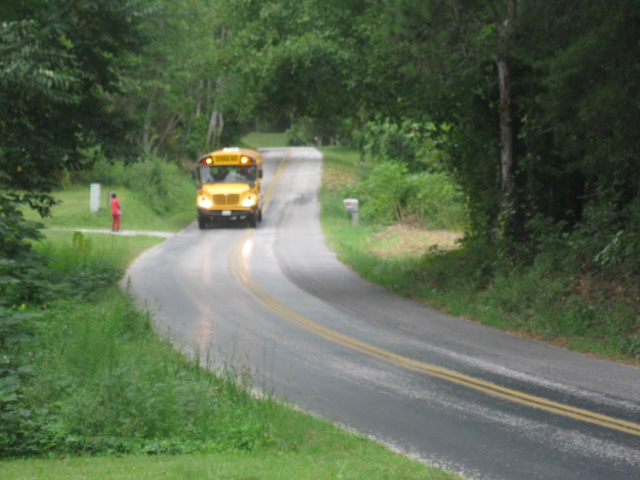
We went out early on the first day of school, so full of excitement about the big day that we couldn’t stand in the house a moment longer.  My girls had been wearing their backpacks for a full five minutes before I finally opened the door and we stepped outside.

And there we stood, dad, mom, and three girls waiting, waiting, and waiting for the big yellow bus.

When it came, the girls climbed up the steps, the doors shut, and the bus pulled away.

And I wasn’t on it with them.

Because school buses aren’t for moms.

At the end of the day, my baby and I watched for the bus to return.  After it was five minutes late, I gripped my cell phone tightly waiting for a call.

After ten minutes of being late, I knew my daughters had gotten lost and placed on the wrong bus.

After fifteen minutes of being late, I thought they must have been so lost in the school, they would be locked in all night.  No one would ever find them.  My girls would simply be missing in the halls of the school forever  . . . all because I wasn’t there to speak for them!

But eighteen minutes after the bus was supposed to arrive, it finally stopped in front of our home.  And guess what?

The girls were on it.  They were safe and cheerful.  They hadn’t gotten lost for a moment

What’s more . . . they knew their room numbers and their teacher’s names and yes, even how to use the school bathroom.

I guess they survived without me.

Maybe there will be times when they struggle and feel a little lost.  Then I’ll need to to decide when to step in and rescue them and when to trust that we’ve trained them well enough to manage on their own.

Even God, the Perfect Father, navigates this fine parental balance between deliverance and training.

In Psalm 18, the writer declares that God:

“reached down from on high and took hold of me;
he drew me out of deep waters.
He rescued me from my powerful enemy,
from my foes, who were too strong for me.

(Psalm 18:16-17).

God yanked the Psalmist out of the drowning waves and rescued him from overwhelming foes.

Not only that, the poet tells God, “You provide a broad path for my feet, so that my ankles do not give way” (Psalm 18:36).

Sometimes God knows we can’t handle this foe and we need rescue.  On other days, He gives us easy circumstances, a broad path, a relaxing walk, rather than a treacherous mountain climb up a narrow rock-filled pathway because He knows our feet are tender and uncertain.

But life isn’t always easy and our journey isn’t always a Sunday stroll on a bright and cheerful day.  God doesn’t always carry us out of tough times; sometimes He asks us to rely on all the training He has poured into our hearts and minds so that we will overcome.

Thus, in that same Psalm, we see: “With your help I can advance against a troop; with my God I can scale a wall” (Psalm 18:29).

And why can we perform these feats of wonder with God’s help?  Because He has trained us in times of peace so that we can battle through times of war.

The Psalmist says:

It is God who arms me with strength and keeps my way secure.
He makes my feet like the feet of a deer;
he causes me to stand on the heights.
He trains my hands for battle;
my arms can bend a bow of bronze (Psalm 18:32-34).

God has exercised our limbs of faith and traveled with us in paths both broad and narrow.  Our feet have grown accustomed to the journey, becoming sure-footed like a deer’s and able to scale great mountainous heights.

And while God is always with us, never abandoning us for a moment, sometimes He chooses to walk alongside us through difficult circumstances rather than lifting us up and carrying us through them.

Maybe God is asking you to walk rather than be carried today. Perhaps you’ve tapped your feet impatiently at God, waiting for Him to place you on His shoulders and make all of these hard times just disappear.

But instead of offering you an escape route, maybe your Father God, knowing full well what is best for you, is asking you to walk through the difficult road, at least a little farther.  He will provide all that you need, the training, the strength, the energy, the patience and perseverance.  And when He sees that your “foot is slipping,” like the Psalmist, you can say, “your unfailing love, Lord, supported me” (Psalm 94:18).

Heather King is a wife, mom, Bible Study teacher, writer for www.myfrienddebbie.com and worship leader.  Most importantly, she is a Christ follower with a desire to help others apply the Bible to everyday life with all its mess, noise, and busyness.  To read more devotionals by Heather King, click here.

Copyright © 2012 Heather King