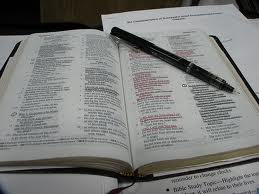
Weekend Walk, 10/22/2011

For those reading Lisa Harper’s book, Stumbling Into Grace, along with my small group, today’s weekend rerun will match up with her ninth chapter, “Who’s Got Your Back?” and today’s memory verse will match up with her tenth chapter, “Busyness Isn’t a Spiritual Gift.”

**********************************

Hiding the Word

Life has been a bit crazy and fast-paced at our house recently, full of busyness, activity, and constant motion.  So I’m choosing a verse to meditate on this week that refreshes me and reminds me that God is in control of all things, even the situations that wake me in the middle of the night.

 He says, “Be still, and know that I am God;
   I will be exalted among the nations,
   I will be exalted in the earth.”
Psalm 46:10

Remember that we’re choosing just one verse to post up around our house, to memorize and meditate on for one week at a time.  I hope you chose a great verse for this week!

Weekend Rerun

Pray For Us, Part I, originally published 5/23/2011

You can read Part II of this post here.

“Finally, brothers, pray for us that the message of the Lord may spread rapidly and be honored, just as it was with you”
2 Thessalonians 3:1

Bible Study time done, the group started sharing prayer requests.  Please pray.  Please pray.  Please pray, we ask one another.  For my friend.  For my child.  For my husband.  For my coworker.

For me.

Dialoguing with myself silently there at the table, I jotted down the requests of others and thought, “mine seems so silly, so selfish, so small.  Haven’t I prayed for myself already?”

Surely I had.  Not more than one hour before sitting down at that table to teach others, I had been face-to-face with my carpet, not just on my knees, but prostrate before God.  All stretched out before His throne in humble need (hoping my children didn’t come searching for me and find Mommy on the floor).  Not for cancer.  Not for death.  Not for brokenness.  For a string of bad days, for lack of sleep, for a husband who was away, for knowing that I felt far too ill-equipped to teach anyone from God’s Word that night.  What else to pray, but “help me, God!” and to tell Satan to get lost—in Jesus’s name, of course.

Yet, knowing full well that it matters when others pray for us, that the combined power of saints on their knees works in ways that my private prayers do not, I shared my tiny need with the group of ladies gathered at the table.  “I need the rest of this week to get better.  I need my children to sleep and not wake up grumpy, whining and so quick to fight with each other.  I need no more animal mishaps like 30 of my fish dying from some freak thermostat disaster.  We’ve had such a rough start; please pray for us.”

We prayed.  I went home, chased children around the house with pajamas and toothbrushes, climbed into bed all weary myself.  The next morning I woke up for the first time in months, not to the sound of a child, but just because of morning sunlight.  I awoke to a day that got better and better and a week no longer plagued with sleeplessness and stress.  I awoke to notes from friends and family saying they were praying for me.

We prayed.  God answered.

How often have you sat in your small group, though, looked around at Christians you love and you trust, and not shared your prayer need?

Because you were afraid to share the request you have, maybe even ashamed and embarrassed.
Because everyone’s prayer requests seemed so much bigger than yours.
Because it seemed so selfish to ask for prayer for yourself and much more acceptable to ask on behalf of others.

Remember these things:

We Need Others to Pray for Us

Paul poured out prayers in his letters to the churches, that they would understand the love of God, know His will, and persevere in the midst of trials.  To the Thessalonians, he wrote: “We always thank God for all of you and continually mention you in our prayers” (1 Thessalonians 1:2).  Then, he asked for their prayers in return, “Finally brothers, pray for us, that the message of the Lord may spread rapidly and be honored, just as it was with you” (2 Thessalonians 3:1).

There is no question that Paul himself was praying for the effective spread of the Gospel; nevertheless, he requested those same prayers from others.  He knew that corporate prayer has power and the unified petitions of the saints have impact.  So, praying in your own home and in your own car is good and necessary, but you should not be ashamed, embarrassed, or reluctant to call for backup and enlist the prayer support of others.  It is part of the giving and receiving that we do in the Body of Christ.  “Therefore confess your sins to each other and pray for each other so that you may be healed. The prayer of a righteous person is powerful and effective” (James 5:16).

In some ways, Paul was giving the Thessalonian church a gift.  He invited them into ministry partnership with Him, asking them to pray for him and his missionary team as they traveled and shared the Gospel.  We give each other a gift when we invite others into prayer partnership with us.  They now have a part in healing marriages, restoring broken relationships, shepherding wayward children, defeating disease, leading ministries, and redeeming finances.  Not in their own strength, but because they intercede before God on our behalf.  They struggle in prayer and wrestle the Enemy and receive victory in partnership with us.

There are times when our friends must carry us to Jesus, paralyzed as we are like the man in Capernaum.  He could have lain their unable to move and simply hoped that Jesus would notice him on the outskirts of the crowd, but the needs were many and the mob of people overwhelming.  Instead, four friends carried him to Jesus, parting the crowds as best they could and then climbing up on the roof and lowering him down to Jesus’s feet (Mark 2:1-5).  We need friends with such faith, friends who will bring us to Christ’s sandaled toes and request healing for what paralyzes us.

Do you have someone to pray for you and with you?  It could be a small group or it could be one faithful praying friend.  Seek that out so that you do not battle the bad days or the life crises alone.

*****************************************************************************************************

Heather King is a wife, mom, Bible Study teacher, writer for www.myfrienddebbie.com and worship leader.  Most importantly, she is a Christ follower with a desire to help others apply the Bible to everyday life with all its mess, noise, and busyness.  To read more devotionals by Heather King, click here.

Copyright © 2011 Heather King

Say, “Cheese!”

“Instead, it should be that of your inner self, the unfading beauty of a gentle and quiet spirit, which is of great worth in God’s sight”
(1 Peter 3:4)

Today is picture day at school and I may need a vacation to recover.

The aftermath of this morning’s preparation is like an explosion in a boutique.  I returned to the house after waving goodbye to my daughters on the school bus and surveyed the damage.

Headbands, combs, clips and ribbon left a trail from the bedroom to the kitchen and the living room.

Pajama bottoms and tops and rejected dresses were strewn across every piece of furniture in sight.

A pile of not-good-enough shoes sat beside one dresser and a stack of pink and white stockings next to the other.

The morning’s activities had tired me out.  Even though we had planned their outfits for a week and carefully laid out their chosen wardrobe the night before, the morning had still been crazy with changed minds, fresh inspiration, and forgotten items.

And then there was the meltdown over the headband.  It involved many tears, angst, stubbornness, threats of punishment and varying opinions about the definition of “matching.”

I imagine my house this morning looks a little like King Xerxes’ court appeared as he searched for a second wife.  It was the biggest beauty pageant of all time and after 12 months of preparation (“six months with oil of myrrh, and six months with perfumes and preparations for beautifying women”), it all came down to one night (Esther 2:12).  One chance to knock the socks off the king and be chosen as his bride.

Yet, Esther was not dependent on beauty treatments, over-the-top jewelry, and exotic perfumes.  Hers was the beauty of consistent character and long-term loveliness of the heart and so she found favor with the king and became queen of the Persian empire.

Like the other women in this great Persian beauty pageant, we Christians sometimes focus too much on dressing up and dousing ourselves with perfume.  Our emphasis is often on the “picture days” of the Christian walk, on the posing, the practiced smile, the activity, the special occasions.

But our faith isn’t about snapshots.

We don’t prep ourselves for five minutes in front of a camera.  Did we greet everyone with joy on Sunday morning?  Did we say the right things in Sunday school?  Did we wear the right clothes?  Did we know the words to the songs and nod our heads at appropriate points in the sermon?

Our heavenly king isn’t making judgments about our beauty based on one night’s impression. That means mistakes don’t determine the rest of our lives.  If you’ve blown it this morning with your kids, made some bad choices, or messed up how you handled that situation, God’s grace provides you with restoration, renewed mercy and the fresh start of a new day. 

That’s why Moses is about more than his disobedience when bringing water from a rock (Numbers 20).  It’s why David’s ministry didn’t end with adultery and murder or why Peter wasn’t cast off forever after denying Christ.

It also means the moments of triumph don’t set us up on permanent religious pedestals.  God isn’t deceived by the external beauty treatments we apply.  Peter wrote, “Instead, it should be that of your inner self, the unfading beauty of a gentle and quiet spirit, which is of great worth in God’s sight” (1 Peter 3:4).

The beauty of our faith isn’t determined by those extraordinary seasons of spiritual victory, crisis or sin.  God is far more interested in the daily wardrobe of our soul and what happens when the cameras aren’t turned in our direction.

Oswald Chambers wrote:

“it does require the supernatural grace of God to live twenty-four house of every day as a saint, going through drudgery, and living an ordinary, unnoticed, and ignored existence as a disciple of Jesus.  It is ingrained in us that we have to do exceptional things for God—but we do not.  We have to be exceptional in the ordinary things of life, and holy on the ordinary streets, among ordinary people.”

My oldest daughter’s goal for picture day was to look just like a real princess.  My middle girl wanted to be “as cute as can be.”  And they succeeded. This one picture, though, won’t make them beautiful or ugly, cute or goofy.  They are always lovely and always loved.

It’s the same with us.  What’s far more important than how we look in a posed portrait is the ordinary, unnoticed, unexceptional holiness that we live out day after daily day. 

It’s the praying in the prayer closet, the doing dishes and washing clothes for your family.  It’s the ministry to a friend and your faithful, hard work at your job.  It’s responding with kindness and having patience with your spouse.  It’s putting the mistakes of the past behind you and it’s obeying God today with a cheerful heart.

Heather King is a wife, mom, Bible Study teacher, writer for www.myfrienddebbie.com and worship leader.  Most importantly, she is a Christ follower with a desire to help others apply the Bible to everyday life with all its mess, noise, and busyness.  To read more devotionals by Heather King, click here.

Why Did the Chicken Cross the Road?: Part II

For those reading Lisa Harper’s book, Stumbling Into Grace, along with my small group, today’s devotional will match up with her eighth chapter: “The Bride Who Tripped Down the Aisle”

**********************************

“Restore to me the joy of your salvation and grant me a willing spirit, to sustain me” (Psalm 52:12).

My first grader brought home a book from school to read over the weekend.  For two days she followed me around the house giggling uncontrollably and reading me her favorite sections aloud.

“Mom, listen to this,” (she’s giggling already).  “This kid just said George Washington was in his underwear.  He said underwear!!!”

“Isn’t this hil-ar-i-ous, Mom?  It says this kid put carrots up his nose and then he ate them!”

She could barely control herself on that one.  Left to her own devices, she’d probably have spent a half an hour in hysterics on the living room floor.

It’s not humor I could understand.  Me, I’m more of a Marx Brothers kind of girl.

In Part I of this post, I wrote that “we Christians should have a joy that people who don’t know Christ just don’t get.”  It’s just as mysterious to them as my daughter’s humor is to me.

Certainly this incomprehensible joy comes from the goodness of our message, the very Gospel of grace itself.  When life weighs us down with its humdrum dailyness, we must remember the great news we have received and that we share with the world.  It’s reason enough for joy in every situation.

Yet, while we always have reason for joy, life isn’t always joy-full.

God never commands us to paste on perfect happy faces to convince the world that Christians never suffer hurt or sorrow.  It’s a deception Christ Himself never engaged in.  He cried out, He asked others to pray with Him, He wept, and He suffered pain.  He assured us that this earth is a place of trouble.

Yet, Peter wrote:

Instead, be very glad—for these trials make you partners with Christ in his suffering, so that you will have the wonderful joy of seeing his glory when it is revealed to all the world ( 1 Peter 4:13).

Does it sound like impossible truth? Being joyful in trials because God will be glorified?  If we’re honest, often our prayers are more for our comfort and relief rather than for God’s glory.

So, was Peter a guy who preached impossible things that he never put into practice himself?  No, not Peter.

His ministry had never been more powerful or full of impact.  He and the other apostles were spreading the Gospel message and people were responding in droves.  Their reputation for miracles spread, so the crowds lined the streets with the sick hoping that Peter’s shadow would fall on them as he walked by and they would be healed (Acts 5).

Reason to have joy?  I’ll say!  Wouldn’t you be celebrating such ministry success?

Yet, full of jealousy, the Sanhedrin and religious leaders imprisoned Peter and the other apostles. After hearing Peter’s astounding defense, the court determined to have him killed, but not immediately.  For now, he and the other apostles were flogged and turned away . . . only to be martyred at a more opportune time.

Acts 5:41-42 tells us, “The apostles left the high council rejoicing that God had counted them worthy to suffer disgrace for the name of Jesus. And every day, in the Temple and from house to house, they continued to teach and preach this message: “Jesus is the Messiah.”

Peter didn’t just preach joy in all situations.  He lived it.

He had joy because of the message he had to share: Jesus is the Messiah!

He had joy because he knew that every trial was “for the name of Jesus.”

It’s not that God rejoices in our suffering, but instead His grace for us, the way He brings us through trials and redeems us from the pits we find ourselves in, the way He carries us through the fire and out the other side of the furnace—it all brings Him glory.  It shows the world that our God is faithful, powerful, mighty to save, and merciful to save us.

This outlook requires continual perspective adjustment.  We remember what matters in eternity.  We consider what will bring God glory.

That’s how the Christians described in Hebrews, “suffered along with those who were thrown into jail, and when all you owned was taken from you, you accepted it with joy.  You knew there were better things waiting for you that will last forever” (Hebrews 10:34).

We likewise know that the eternal is what truly matters and that God’s glory is our ultimate goal.

Still, just being honest, that doesn’t make most of us want to kick our heels and break into song when we’re facing trials.  It’s theologically sound, but practically difficult.

Is it any wonder, then, that the Psalmist has to plea for God’s help with this?  David wrote, “Restore to me the joy of your salvation and grant me a willing spirit, to sustain me” (Psalm 52:12).

That is our prayer also.  “Lord, we ask that You restore our joy.  Help us to recall the excitement about Your Gospel of grace.  In all circumstances, help us to submit to Your plans for us, because that is what will strengthen us and sustain us.  We rejoice that You will be glorified and we ask that You will work in each situation we face so that we can give a testimony to the world of Your power and Your love.  Amen”

Heather King is a wife, mom, Bible Study teacher, writer for www.myfrienddebbie.com and worship leader.  Most importantly, she is a Christ follower with a desire to help others apply the Bible to everyday life with all its mess, noise, and busyness.  To read more devotionals by Heather King, click here.

Copyright © 2011 Heather King

Why Did the Chicken Cross the Road?: Part I

And The Winner Is . . .

Thanks so much to the giveaway participants!  I counted up each comment on the blog, each Facebook share, each new blog follower and used random.org to calculate the winner.  And the winner is . . .  Lynn Holt!  Congratulations!   Lynn, I’ll contact you about your prize choice!

I appreciated every comment, share, and follower.  Thank you for walking on this devotional journey with me.  We may have been celebrating my 150th post on this blog, but really I learn so much from what you have to say.  I hope you all continue to share your thoughts and post comments!

Now on to today’s devotional . . . .

****************************************************

For those reading Lisa Harper’s book, Stumbling Into Grace, along with my small group, today’s devotional will match up with her eighth chapter: “The Bride Who Tripped Down the Aisle”

**********************************

“Therefore God, Your God, has anointed You with the oil of gladness more than Your companions”
Psalm 45:7

What kind of school does a ladder go to?
I don’t know. What kind of school does a ladder go to?
A High School!  Get it?  High . . . ladder.

It was the first joke my five-year-old daughter ever invented that made sense.  I was so proud!  At dinner that night, I made her tell it again to my husband.

We were mostly proud because for years we had endured the nonsensical joke creations of our two oldest daughters.  My six-year-old still thinks every single joke has to begin with knock, knock.

Knock, knock.
Who’s there?
Why did the chicken cross the road?

We’ve tried to explain joke construction and the basic tenets of verbal humor, but to no avail.  The thing is, to them it’s funny.  Even if we simply eke out polite fake laughter, they collapse into squeals of amusement at their own joke concoction.

We just don’t get it.

In the same way, we Christians should have a joy that people who don’t know Christ just don’t get.

This Good News that we have—that God Himself came to earth in human flesh, that He received the punishment we deserve for our sin, that He died in our place and rose again, offering us eternal life with Him in heaven . .. well, that really is good news.  It’s certainly something to get excited about again and again and again!

On Sunday mornings, I’ve been teaching Christmas songs to young children at church.  They are supposed to be angels delivering Jesus’ birth announcement to the shepherds.

At first, these pretend angels sang their song with little gusto or excitement.  They mumbled out the lyrics as if it were a painful exercise.  After weeks of reminding them that this was the greatest announcement the world has ever received, finally they sang with joy: “Hey!  Don’t be afraid.  I’ve got some great news.  Christ is born today in Bethlehem!”

The angel himself on Christmas night promised that “I bring you good news that will bring great joy to all people” (Luke 2:10).

Unfortunately, we become immune over time to the message’s impact.  We forget the joy.  We forget the wonder and excitement.

And when we imagine Jesus Himself healing people and teaching them, so often we picture Him as a melancholy savior, all staid, straight-laced and serious.

Surely, though, he must have smiled a bit as Nicodemus puzzled out the meaning of “born again.”

When Jesus deftly sidestepped the theological traps laid by the Pharisees and Sadducees, I imagine He did it with triumphant joy.

As He delivered the captivating and totally revolutionary Sermon on the Mount, Jesus could not have been a boring monotone preacher.  He held the crowd’s attention for two solid chapters worth of teaching in Matthew 5-7.  There must have been some joy there!

If Jesus never smiled, surely the children in Matthew 19 would have run away rather than willingly climbing onto His lap for a blessing.

Not that our life circumstances always make joy easy.  Sometimes we feel like our “cup runneth over” and sometimes we feel like our cup is all poured out.  What then?

Nehemiah faced a crowd of Israelites who felt too overcome by their sin, too full of repentant sorrow to feel joy. Yet he told them, “Don’t be dejected and sad, for the joy of the Lord is your strength” (Nehemiah 8:10).

At times, it’s difficult to experience joy, when we feel weak, out of control, confused, worried, uncertain, scared, or sad  . . . Yet, the joy of the Lord is where our strength lies.  Without joy in all circumstances, we can become paralyzed by weakness.

So, we rejoice together when we consider the Good News of the Gospel.  We rejoice in God’s presence, in His accessibility to us at all times, in His compassion, in His faithfulness and unfailing love.  We rejoice in the journey of our faith, knowing that wherever He takes us, He will always be there.

Still we have joy.  We determine to “always be full of joy in the Lord. I say it again—rejoice!” (Philippians 4:4, NLT)

Heather King is a wife, mom, Bible Study teacher, writer for www.myfrienddebbie.com and worship leader.  Most importantly, she is a Christ follower with a desire to help others apply the Bible to everyday life with all its mess, noise, and busyness.  To read more devotionals by Heather King, click here.

Copyright © 2011 Heather King

Weekend Walk: 10/15/2011

Welcome to the weekend readers!  Don’t forget we’ve got a giveaway going on to celebrate the 150th post.  To find out all about it, just click here for yesterday’s devotional.  Entering is easy and the winner will get some real goodies!

Hiding the Word:

There are seasons when the prayer requests you hear in small group are heavy and cumbersome.  They weigh down your heart because of the vastness of the need and the depth of the hurt they represent.

There are seasons when you feel the bruises on your soul from where God has been busy shaping your character or you feel pulled and stretched like taffy almost to our breaking point.

There are seasons when stress and annoyances, broken things and unexpected expenses, and the plain out yuckiness of life can fatigue even the strongest soul.

And there are seasons when one overarching trial breaks you down and sends you to your knees.

This week, the verse I’m meditating on reminds me of how God can bring us through anything and even strengthen us along the way.

I’m posting this on an index card on my stove and bathroom mirror to meditate on all week.  I hope you’ll do the same with the verse of your choice!

And the God of all grace, who called you to his eternal glory in Christ, after you have suffered a little while, will himself restore you and make you strong, firm and steadfast (1 Peter 5:10)

Several months ago, I heard Mandisa in an interview on the radio and she quoted this verse before singing her song, Stronger.  So, here’s a song to bless you this week also!  You can view the video here: http://www.youtube.com/watch?v=emgv-VRtMEU or by clicking below from the blog.

Book Reviews:

Normally on the weekend I rerun an old post for the newer blog readers to enjoy, but this weekend I have two book reviews for you!

Whole: An Honest Look at the Holes in Your Life and How to Let God Fill Them

by Lisa Whittle

When I picked up Lisa Whittle’s book, I expected a “yeah, yeah, yeah” read.  You know the kind where every page tells you things you’ve heard a million times. I think the subtitle tricked me into thinking this book would rattle off the familiar mantra: we have a God-shaped hole in our lives that only He can fill.  But I was wrong.

The beginning chapters didn’t rock my world.  Her personal story spoke volumes about the way churches sometimes fail the people in them, especially those in leadership.  Still, she didn’t give a clear, practical picture of what she meant by loving the church and yet not suffering from religious addiction.

Her chapters on the Hole of Roles and the Hole of Experiences, however, were real, vulnerable, and challenging.  If you’ve ever wrapped up your identity in the roles you fill or allowed it to depend on your past experiences, this book will walk you through laying that down, as well as dealing with both failure and loss.

Lisa Whittle shares personal stories with more openness and honesty than most authors do, which makes this read compelling and personally relevant.  While she undergirds her thoughts with an occasional Scripture verse, mostly the book is driven by her own story.  I’d have liked a little more grounding in Bible study, but that doesn’t negate the powerful reminder to find freedom and wholeness in God’s presence.

I received this book free from the publisher. I was not required to write a positive review. The opinions I have expressed are my own.

The Love & Respect Experience:
A Husband-Friendly Devotional That Wives Truly Love

By Dr. Emerson Eggerichs

I’ve heard it before.  Wives telling me that they “accidentally” left a book on marriage where their husband would see it, hopefully read it, and miraculously make all the changes the book prescribes.  What I’ve never heard is a single time that actually worked.  So, I’m not certain that the claim that this is a “husband-friendly devotional” works.  Some husbands will love it and may be open to reading it together as a couple; others won’t.

Still, the baseline concept in this book is absolutely the best marriage principle I have ever heard taught.  Period.  End of story.

Based on Ephesians 5, wives are reminded to respect their husbands and husbands to  love their wives.  Eggerichs is careful not to make generalizations about women and men in marriage and doesn’t define submission as wives serving as mindless automatons or tolerating abuse.  But, he does challenge wives to accept their husbands’ choices, stop nagging, choose not to speak badly about their husbands and not to mock them, joke about them, imply ineptitude, or make comparisons with other men.

This is the same material in the regular book Love & Respect only broken into 52 “devotional” segments with both prayers and action points to finish off each section.  It’s accessible, practical, and full of some good advice for couples.  For a more comprehensive discussion of each topic, though, you may want to read the original book.

I received this book free from the publisher through the BookSneeze®.com book review bloggers program. I was not required to write a positive review. The opinions I have expressed are my own.

Heather King is a wife, mom, Bible Study teacher, writer for www.myfrienddebbie.com and worship leader.  Most importantly, she is a Christ follower with a desire to help others apply the Bible to everyday life with all its mess, noise, and busyness.  To read more devotionals by Heather King, click here.

Copyright © 2011 Heather King

Giveaway!!! and A Broken Lens

First, A Giveaway!!!

I’m celebrating this Friday because we are just about to reach 150 posts on this devotional blog!  So, I thought I’d bring a gift for you to this little party of ours by hosting a giveaway.

Go ahead and get excited.  Jump around a bit if you like!

On Monday, 10/17/2011, I’ll announce the winner who will get some real goodies—the CD Beautiful Things by Gungor and your choice of either the book One Thousand Gifts by Ann Voskamp or What Women Fear by Angie Smith.  I’m sure you’ll love these!

How do you win?  That’s a cinch!  You get one entry for each of these things:

  1. Become a follower of the blog by typing your email address into the blog home page.  Then post a comment to me on this page saying, “I’m following the blog!”
  2. Comment on this post or the Weekend Post on 10/15/2011 with any thought you’d like to share.
  3. Share this post on Facebook and then leave me a comment on this page telling me about it.

That’s all it takes!  If you do all three, that’s three chances to win!

If you have any questions, you can email me: heatherking@cox.net and I’ll be happy to help you out.

And now on to today’s devotional . . . .

******************************************************************************************

“For now we see in a mirror dimly, but then face to face; now I know in part, but then I will know fully just as I also have been fully known” (1 Corinthians 13:2, NASB).

When my daughters are excited, they jump.

Ice cream!
Jump, jump, jump.

Playdate!
Jump, jump, jump.

Trip to the aquarium!
More jumping.

A blog giveaway!
Triple jumping . . . . Okay, that’s me, not them.  Just couldn’t help myself!

You’d think after years of being a mom to these jumping beans, I’d have learned to announce good news from afar.

But I haven’t.  My dentist can probably attest to how many times one of their heads has slammed into my jaw as I foolishly stood over top of them and made a thrilling announcement.

So, when I took the girls to a children’s museum for an exhibit on butterflies, I should have maintained a safe distance, walking behind them the whole way.

But I didn’t.  Instead, I held my camera in my hand and walked next to my oldest daughter who took one look at the massive monarch caterpillar entryway and . . . .

Jumped . . .

Right into my hand, knocking my camera to the concrete sidewalk.  From then on, the lens made this sickening grinding noise as it turned on or tried to focus for a shot.

My husband performed camera surgery and that helped for a while.  Yet, eventually the lens stuck in place again.  Now my camera clicks and grinds when you turn it on and then flashes red light onto the display before showing the message, “Lens error.  Camera will shut down now.”

With my camera out of focus, I’ve been wondering how often we experience brokenness in similar ways.  Something sends us hurtling to the ground—a hurt, a sickness, loss, sadness, fear, death, confusion, loneliness, conflict, fatigue—and suddenly our perspective is askew.  We see everything through a lens that is stuck and out of focus.

Certainly we lose God’s perspective often enough.

This earthly life of ours will always be accompanied by a darkened view and limited line of sight.  Paul tells us in 1 Corinthians, “For now we see in a mirror dimly, but then face to face; now I know in part, but then I will know fully just as I also have been fully known” (1 Corinthians 13:2, NASB).

It’s not until Glory that we’ll receive heavenly lenses and eternal scope.

Until then, we’ll probably still be asking: Why did that happen?  How long will this take?  What’s the point of this and the significance of that?  Is there any hope?  What is around the corner?  What will my future hold? 

But here and now, even the darkness can be enlightened at times.  We can remember that God sees beauty in the broken.

We can remember that God breathed life into dust.

In their song, Beautiful Things, the band Gungor sings:

You make beautiful things
You make beautiful things out of dust
You make beautiful things
You make beautiful things out of us

Hope is springing up from this old ground
Out of chaos life is being found in You

It’s a reminder that the materials we give Him do not limit what God can create.  Peter tells us, “Therefore, those also who suffer according to the will of God shall entrust their souls to a faithful Creator in doing what is right” (1 Peter 4:19). That means in any situation, we can have full confidence in our faithful Creator.  We can trust and have hope because He can make beautiful things out of dust.

We can remember that God restores life when all seems dead.

In the book of Job, we read: “There is hope for a tree: If it is cut down, it will sprout again, and its new shoots will not fail.  Its roots may grow old in the ground and its stump die in the soil, yet at the scent of water it will bud and put forth shoots like a plant” (Job 14:7-9).

So if you are feeling the weight of broken branches and fallen leaves, when you feel fruitless, abandoned, cut down to the very stump and left for dead, remember the power of hope.

Naomi Zacharias in her book The Scent of Water writes:

“The promise is that at even the scent of water, our roots, like that of a tree, will awaken and extend themselves—at the very hint of refreshment and sustenance.  Ah, the perfume of hope that breathes life into the weary and wounded” (p. 168).

You may see fruitless death, but allow hope to refocus your lens.  This will not last forever.  God promises to be with you.  He will work for your benefit and for His glory.

We can remember that even rain is a blessing.

In the book of Joel, God promised Israel restoration and renewal if they would repent and return to Him.  Following judgment and famine, they would see new growth.

But it would take rain to wash away the dry, crumpled weeds and to saturate the earth with life-giving water.

Joel tells the people to “rejoice in the Lord your God!  For the rain He sends demonstrates His faithfulness” (Joel 2:23 NLT).

Lisa Whittle in her book, {W}hole, tells us “It is the goodness of God to bring forth life from deadness . . . restoration from brokenness  . . . growth from grace-filled rain” (p. 113).

So, when we pray for the “rain, rain to go away,” we miss God’s perspective.  Instead we can refocus by praising Him for the downpour that will bring new life and the rain sent by His faithful love.

Oh, it’s not easy of course.  Our lenses are still faulty.  It’s the way we’re made.  We’re finite.  Limited.  Created without the ability to see the long-term and the eternal.

We’re broken cameras, all of us.

Let it be our prayer, though, that He be our vision, that He provide our focus, and that He guide our perspective.  It’s the only way to truly see.

The song Beautiful Things by Gungor blesses me continually!  You can view it here: http://www.youtube.com/watch?v=OR7VOKQ0xJY&feature=youtu.be

Or by clicking on the video below:

Heather King is a wife, mom, Bible Study teacher, writer for www.myfrienddebbie.com and worship leader.  Most importantly, she is a Christ follower with a desire to help others apply the Bible to everyday life with all its mess, noise, and busyness.  To read more devotionals by Heather King, click here.

Copyright © 2011 Heather King

Kissing Cornelius

For those reading Lisa Harper’s book, Stumbling Into Grace, along with my small group, today’s devotional will match up with her seventh chapter: “Getting Our Squeeze On”

**********************************

Our community theater group chose Hello, Dolly! as the fall musical this year. Over the summer, I rented the movie so we could hear the songs and learn the story.

While I love the play, the movie is terrible.  Still, my daughters loved the film. They specially requested it several times a week until I finally returned the DVD, much to their disappointment. (Other kids may be watching Spongebob and Phineas and Ferb.  My girls watch musicals from the 1960’s.)

They can now sing the songs and know every character’s name, despite the ridiculous sound of each moniker: Cornelius Hackl.  Barnaby Tucker.  Horace Vandergelder.

Not exactly John Smiths, these guys.

My daughters took a particular liking to Cornelius Hackl, the 33-year-old store clerk who wants to head off to New York City, fall in love and kiss a girl.

There’s no question who was the most excited to hear that my husband was chosen to play Cornelius.  He was pleased.  Our daughters were overjoyed.  His two biggest fans jumped all over the living room and cheered.

I reminded them that of all the parts in this play, Cornelius is the only guy who might have to kiss another girl–as in a girl who is not me.

“How would you feel about that?,” I asked them.

“That’s okay,” my oldest daughter assured me, “Daddy kisses you all the time.  Like every single morning and when he comes home from work, too.”

Thanks for the support!

Still, it reminded me that how my husband and I interact is a model for our daughters.   This doesn’t just matter now when they need the assurance of a stable home.

It doesn’t just matter in their future, when their own marriages may depend on what we modeled for them.

It really matters eternally.

God makes it clear in Scripture that marriage is an earthly representation of God’s covenant relationship with His own people.  Paul tells husbands to “love your wives, just as Christ loved the church and gave Himself up for her” (Ephesians 5:25).  Jesus calls Himself the bridegroom and Revelation 19 describes the marriage supper of the Lamb in heaven.

That means that our love for one another should reflect Christ’s love.  People should look at our marriages and see God’s love in action.  My daughters should look at our marriage and see God at the center.  How we treat each other should make them desire a relationship with Jesus.

So, do we look like we’re loving one another?

Not just in marriages, but also in our churches and small groups and family lunches at Wendy’s after church . . . do we act loving?

And beyond that, with those outside our inner circle, people who may seem “less than,” those that our downcast, the hurting, people who annoy us a bit and who wear us out a lot, and the faces we’d prefer not to see in the Wal-Mart . . . do we act loving?

Jesus’ healings were rarely cold, distant, impersonal and non-physical.  When Jesus healed, it was usually with action, with physical touch that dramatically broke the barriers of clean/unclean, spiritual/not spiritual, holy/unholy.

Lisa Harper notes that Jesus:

intentionally used tactile methods—hugging a leper, placing His hands on a crippled woman’s spine—in most of His healing miracles.  When the disciples tried to keep little children from interacting with Jesus  . . . the Lamb of God beckoned them to pile onto His lap (Mark 10:13-16).

When Jesus healed the man who had been blind from birth, He once again demonstrated love in unmistakable, physically apparent ways (John 9:1-11).

The disciples pointed to the begging man and asked a theological trick of a question.  Whose sin caused the man’s blindness—his or his parents’?

These 12 guys saw a doctrinal conundrum.  Jesus saw a sick man.

So, Jesus healed him.  Not just with words, though.  The Savior of the World made it clear that He loved this man enough to touch him, to get down in the dirt with him (literally) and to meet his very real need.

Jesus stooped down, made a mud pack, and put it on the man’s eyes.  Then He sent the man away to wash in the Pool of Siloam.  The man, blind from the moment of his birth, could now see.

You couldn’t ever miss Jesus’ love.  Even if He had to stoop low to love another, He did.  Even if it involved getting dirty or if the crowd thought someone was unlovable, dirty, sinful, or unimportant, still Jesus showed love.

People in the back row of the crowd never wondered, “Does Jesus love that person?”  If you looked His way during a miracle, you saw love in action—all the way to the cross.

So, when people glance our way, do they see the same?  Can our kids look at our marriages and identify love?  Can strangers at the restaurant watch us and see love?  Can a visitor to our church see love from the greeter at the door, to the nursery worker and the Sunday School teacher, the pastor and the pianist?

They shouldn’t see just any love either, certainly not superficial, emotional, feeling-directed fluff, the kind that shakes hands and smiles, but never touches what’s broken or brings healing to the hurting.

Instead, they should see Christ’s action-filled, sacrificial, unconditional, healing, reach-out-and-touch someone love and they should be so amazed by it, that they want to experience it themselves.

Heather King is a wife, mom, Bible Study teacher, writer for www.myfrienddebbie.com and worship leader.  Most importantly, she is a Christ follower with a desire to help others apply the Bible to everyday life with all its mess, noise, and busyness.  To read more devotionals by Heather King, click here.

Copyright © 2011 Heather King

What’s My Motivation?

For the word of God is alive and active. Sharper than any double-edged sword, it penetrates even to dividing soul and spirit, joints and marrow; it judges the thoughts and attitudes of the heart.
Hebrews 4:12

It’s typically the actor’s question.  What’s my motivation?

Even though I’m not an actor, I’ve been asking myself the same thing.

Or perhaps it isn’t me asking at all, but God who is nudging my heart.

It’s when I worship.  What is my motivation for singing now?
It’s when I serve.  What is my motivation for this ministry?
It’s when I do Mom things and Wife things.  What is my motivation for caring for my family in this way?
It’s when I speak and write.  What is my motivation for saying this?

It’s easy to feel at times that our behavior and actions are all that matter, thinking that what we do pleases God.

And if that was the true test, maybe some of us would be earning easy A’s in this life.

God, however, is always more interested in our heart than in the activity of our hands. 

The prophet Jeremiah wrote, “I the LORD search the heart and examine the mind,
to reward each person according to their conduct, according to what their deeds deserve” (Jeremiah 17:10).  Our conduct and deeds are not judged on their own.  Instead, God penetrates the closed-off, hidden portions of our hearts and minds.  He seeks out our motivation for all that we do.

He asks questions.

In Mark 10, two brothers and a blind man both came to Jesus with requests and instead of performing immediate miracles or making instant promises, Jesus asked them each the same question.

It’s a question that’s all about motives.

James and John, the fiery sons of Zebedee, started out tentatively, “‘Teacher,’ they said, ‘we want you to do for us whatever we ask.'”

Jesus was no fool.  He asked them for specifics.  “What do you want me to do for you?” (Mark 10:36).

What could their request be?  What was their deep-down true desire?  What motivated their service?

For these two brothers, the truth was an ugly one. They desired self-exaltation and personal glory.  “They replied, ‘Let one of us sit at your right and the other at your left in your glory” (Mark 10:37).

We serve because of the attention and praise it brings.  We want to be told how great we are and to feel proud of being your followers!  We want to be your right and left-hand guys, with all of the power and status that entails.

Jesus denied their request, teaching the disciples instead that God’s Kingdom doesn’t function with the same hierarchy as earthly realms.

“Instead, whoever wants to become great among you must be your servant and whoever wants to be first must be slave of all.  For even the Son of Man did not come to be served, but to serve, and to give his life as a ransom for many” (Mark 10:43-45).

Does a desire for attention and praise motivate us in the same way?  If you allowed God to ask you that question right now—What do you want me to do for you?—how would you answer?

Would you want material provision?
Would you want physical comfort or worldly success?
Would you want to feel like the best mom, wife, employee, daughter, friend?
Would you desire ministry impact and, if so, for what purpose—to feed your pride, to make you feel valued, to give you special status in God’s Kingdom?

Or do you desire His glory?  Do you desire greater intimacy with God?
Do you long to see?

That’s what blind Bartimaeus wanted.  Just verses after Jesus’s motivational chat with James and John, Jesus met this blind beggar.

When he heard that Jesus was in town, Bartimaeus cried out loudly in desperation.  He shouted, “Jesus, Son of David, have mercy on me!” (Mark 10:47)

Have mercy!  That means, “I know I don’t deserve anything from You, but I ask because You are compassionate.”

Daniel prayed in this same way when he said, “We do not make requests of you because we are righteous, but because of your great mercy” (Daniel 9:18).

From the beginning, Bartimaeus’s request was different than the Zebedee brothers, who asked for status in heaven because they felt their earthly service merited it.

But Bartimaeus knew we don’t earn God’s gifts to us.

So the blind man screamed out for Jesus’s attention and Jesus, hearing his cries, called Bartimaeus over.  Then He asked the question: What do you want me to do for you? (Mark 10:51).

What was it Bartimaeous wanted?  A place in Jesus’ kingdom?  A seat near the throne in heaven?  A place in Jesus’ inner circle here on earth now?

No.  “The blind man said, ‘Rabbi, I want to see.” (Mark 10:51).

Immediately, Jesus healed him because of his faith. Then Bartimaeus did the only thing possible when Christ delivers you; he followed Jesus down the road.

What do you want God to do for you?  How painful this question can truly be when we allow Him to weigh our motives, revealing the impurities there.

Are we seeking God’s glory in all things?  Are we longing and searching to see God in every situation?  Or are we out for ourselves, for what we think we need, for what will fulfill us, for what will make us happy, and for what will satisfy our pride?

What’s your motivation?

Heather King is a wife, mom, Bible Study teacher, writer for www.myfrienddebbie.com and worship leader.  Most importantly, she is a Christ follower with a desire to help others apply the Bible to everyday life with all its mess, noise, and busyness.  To read more devotionals by Heather King, click here.

Copyright © 2011 Heather King

Weekend Walk: 10/08/2011

Hiding the Word:

Decisions, decisions.  It seems like I’m making so many of them lately.  Big ones with significant impact.  Little ones about my daughters taking ballet.  Yet, somehow they are all enough to send me to my knees, searching for God’s will and wisdom.

I’m comforted by the fact that if I mis-step, the Lord will lift me up.  It is God who orders my steps and who guides my way.

So, my verses for this week are:

The steps of a good man are ordered by the LORD,
         And He delights in his way.
 Though he fall, he shall not be utterly cast down;
         For the LORD upholds him with His hand.
Psalm 37:23-24

I hope you’ve picked a verse or two to meditate on this week and memorize!  We’d love to hear what your verse might be!

Weekend Rerun

Walking on the Smooth, Straight Road, Originally published 02/22/2011

“Love for God and obedience to God are so completely involved in each other that either one of them implies the other too.”
~F.F. Bruce~

“If you love me, keep my commands” (John 14:15, NIV).

Obedience is on my mind.  That’s partly because I’m a mom and I spend most of my every day giving commands for my kids to obey.  “Brush your teeth.  Get your lunch.  Don’t forget your homework.  Practice the piano.  Move faster.  Don’t run.” If you’ve never seen Anita Renfroe sing her William Tell Momisms, a quick listen will show you how most of my days sound.  If it’s been a while since you heard her sing this, treat yourself to another listen and a good laugh.

I’ve also been thinking about obedience, though, because since the start of this year, God has been gently compelling me to take new steps of obedience, to follow Him into some new areas, even though I don’t know if it will be “worth it,” or why it’s important for me to do these things.  I don’t understand; I’m just obeying.

As I’ve meditated on obedience, I’ve realized that healing, deliverance, blessing, and provision come as we obey—not before we obey.

When we hear God tell us what He wants to do, we could sit back and say, “Okay, God, I’ll totally give that after You provide” or “God, I’ll be happy to minister in that way after You deliver me from my pain.”  I’ve been telling Him I’ll obey after He gives me the time to do it or after He shows me whether what I am doing will matter.

That’s not how God works, though.

In Luke 11:11-17, we read about Jesus healing 10 lepers.   The men were outcasts of society, who cried out to Him to “have pity on us!  It says, “When he saw them, he said, ‘Go, show yourselves to the priests.’ And as they went, they were cleansed.”

At a recent women’s conference, Lysa TerKeurst emphasized how Jesus’s instructions were so strange.  Technically, these men weren’t supposed to leave the leper colony.  If they thought they were in remission, they were supposed to call for the priest and the priest would come to them.  Only when the priest verified that they were “clean” were they allowed to go back to the village.

Yet, Jesus told them to leave and go get the priest before anything had changed for them.  They weren’t healed yet.  The Bible says, “As they went, they were cleansed.”

Sometimes God tells us to obey even before we’ve seen the provision or the healing.   I love reading about families who are adopting and their testimonies are almost always the same.  God called them to adopt.  They were overwhelmed by the financial cost and they had no money to pay for it.  They pursued adoption anyway and God provided every penny at just the right time.

As they obeyed His call to adopt, God gave them the resources they needed.

As you obey God’s call to give, He will provide.  As you obey His call to minister, He will equip you.  As you obey His call to go, He will direct your path.

The blessing is in the going and in the obedience.  In Psalm 128:1, it says:  “All you who fear God, how blessed you are! how happily you walk on his smooth straight road!” We’re blessed when we are walking on the straight road that God has directed us to take.  Our blessing is not in sitting beside the road watching others go by.  Our blessing isn’t in trailblazing our own road, heading in the direction we choose.  It’s only when we are in motion and taking steps of obedience, that we are blessed.

As it says in Psalm 128:2, 4:  “Enjoy the blessing! Revel in the goodness! . . . Stand in awe of God’s Yes. Oh, how he blesses the one who fears God!” (MSG).

*************************************************************************************************************

Heather King is a wife, mom, Bible Study teacher, writer for www.myfrienddebbie.com and worship leader.  Most importantly, she is a Christ follower with a desire to help others apply the Bible to everyday life with all its mess, noise, and busyness.  To read more devotionals by Heather King, click here.

Copyright © 2011 Heather King

Keeping It Simple and Sweet

“In my anguish I cried to the Lord and He answered me by setting me free”
(Psalm 118:5).

I grew up in a family of five kids.  Life at our house was rowdy, busy, loud and fun.  We were always joking.  We were forever playing games.

Like canasta

Now, canasta was “the family game.”  Sure, we plowed through rounds of Monopoly or Yahtzee, Scrabble, Othello or Clue pretty frequently, too.  Playing canasta, though, was like an initiation rite for us.  Friends and boyfriends or girlfriends all gathered around the table at some point and we began the canasta lessons

Okay, so first we are going to tell you about points.  You see the goal is to reach 5000 points before anyone else.  So, Jokers are worth 50.  Got that?  And Aces and 2’s are 20 points.  Now, Jokers and 2’s are wild cards, but everything else is a natural card.  Cards 8 and higher are worth 10 points and anything less than that is worth 5 points.  Except for 3’s, you see, because red 3’s are special.  If you get one of those, you have to put it down right away on your board and you get 100 points for that at the end of the hand and you get another card to replace it.  Unless you don’t put anything else on the board the whole round in which case the red 3 counts against you.  Got it?  Okay, so now let’s talk about how to freeze the deck . . .

It was dizzying really, trying to explain this game to a newcomer.

Sometimes, it may feel like it’s just as complicated to explain the gospel of grace.

It’s not because grace is so convoluted or hard to understand.  It’s us.  We tangle the web until it’s a jumble of mis-explanations and unnecessary additions.

But Jesus said we should have faith like a child and that means that God’s Good News, the Gospel, is simple enough for a child to understand.

Last night, I listened to my oldest daughter recite her memory verse for church.  Romans 6:23: “For the wages of sin is death, but the gift of God is eternal life in Christ Jesus our Lord.”

We broke the verse down and chatted about it.  And as complicated as it may have sounded at first, the message was simple.

We sin and so we’ve earned death.  But because of Jesus, God gave us eternal life.

That’s the whole salvation message right there.  Simple.  Straightforward.  And easy enough for my child to understand during a simple evening chat on our living room sofa.

She learned the verse that summed up Jesus’ entire purpose for coming to this earth: “The Father has sent his Son to be the Savior of the world” (1 John 4:14).  And she can tell you in one quick verse how we accept the gift of eternal life: “Believe in the Lord Jesus, and you will be saved” (Acts 16:31).

So, why do we make it so difficult?  Why do we add in requirements and make judgements?  Why do we create hierarchies of sin and levels of righteousness?  Why do we create rituals and blessings that hinge on extra expectations?

That’s what the Pharisees did.  They tried to trip Jesus up with complicated questions about the after-life and regulations about the Sabbath and whose sin was to blame for a man’s blindness.  They delighted in the complexity of the law and rejected the simplicity of grace.

In the same way, we ourselves stumble into being spiritual lawmakers at times.  But we are always doomed to failure in that system of rules and regulations and hoops to jump through.  We become chained, trapped and imprisoned by the law.

Paul called it slavery.  He said it was a “yoke of bondage” that we accept even though “Christ has made us free” (Galatians 5:4).

Free.  Free from condemnation.  Free from perpetually feeling less than.  Free from always having to perform to earn approval, salvation, and nearness to God.  Free from the oppressiveness of perfection.

That’s not to say that God lacks depth or that it’s enough to skirt the surface of the Bible, dwelling in a shallow and superficial understanding of our faith.  Just because the gospel that God has crafted is simple, doesn’t mean God is.

Even Paul, the accomplished Jewish scholar and rhetorical expert, admitted sometimes God was just too much for him to fathom.  He exclaimed, “Oh, the depth of the riches of the wisdom and knowledge of God! How unsearchable his judgments, and his paths beyond tracing out! (Romans 11:33).

And so we plunge the depths of God’s Word, rolling up our sleeves and becoming students of the Bible, not to earn religious accolades, but to know Him.  We want to worship Him in “spirit and an in truth.”  We want to love Him not just with our heart and soul, but with our mind also.

But at the end of the day, we need to be able to explain grace to a child, partly so we can maintain our own focus.

When I was an English teacher, I occasionally marked students’ papers with K.I.S.S.—Keep It Simple and Sweet.  That’s what our God did for us.  He knew our propensity to miss the point because we’re ensnared in confusion, so He kept grace simple.  He placed the freedom of the gospel within easy grasp.

If we’re making it difficult, if we’re expecting perfection, if we’re demanding impossible standards and if we’re imposing obstacles to salvation, we’re missing just how simple and sweet God’s grace really is.

Heather King is a wife, mom, Bible Study teacher, writer for www.myfrienddebbie.com and worship leader.  Most importantly, she is a Christ follower with a desire to help others apply the Bible to everyday life with all its mess, noise, and busyness.  To read more devotionals by Heather King, click here.

Copyright © 2011 Heather King