Where is the Whole World?

I sought the LORD, and he answered me; he delivered me from all my fears.
Psalm 34:4

During my second pregnancy, I went happily to my 20-week ultrasound and learned we were having another girl (the joys of pink!) and that she was healthy and developing well.

Except she was small.  They said smaller than she should be and I’d need to go get a 3-D ultrasound at a specialized neonatal center.  But, not to worry, they were sure it was okay.  This was just to be safe.

One 3-D ultrasound later, the technician sent back the report.  She was healthy.  Good heart.  Good blood flow.  Organs just fine.  But she was small.  Too small.  It was probably okay, but just to be safe I had to go for weekly stress tests for the remainder of the pregnancy and some more ultrasounds.

Every stress test was fine.  She was moving (boy was she moving!) and she was growing, but not fast enough.  She was just too small.  But, no need to worry, they said, because she was probably just fine; it’s just that they needed to induce her a week early so they could figure out why she was so small (under 5 pounds they said) and help her grow outside the womb.

We packed a bag for the hospital and let the Pitocin get to work.  Induction was terrible; the worst of my three deliveries.  In the end, though, Lauren was born.  I didn’t have my glasses on.  I couldn’t see her.  Was she okay?  Was she too small?  Was she in danger or sick or worse?

My husband served as my eyes for me.  At first he said nothing; she was purple they told me later from the chord double-wrapped around her neck. But then she cried.  And my husband said, “She’s beautiful.  She’s perfect.”

The NICU pediatrician who had been on call to assist at the delivery of this at-risk baby peeked over the nurses’ shoulders and left the room without a word.  The nurse laid her on the scale.  She weighed 6 pounds 13 ounces, my one-week-early little one, too big for the preemie outfits we’d picked out for her.  God had brought her to us safe, healthy, and gorgeous and we praised Him, so tearfully thankful for His protection over our baby girl.

Between that first announcement that our baby was too small and the moment we saw her, we fought against fear.  My husband and I held hands and prayed for her each night.  We calmed our fears and shrugged off ultrasound results.  Then I’d sit at the next appointment and be told once again that she was just too small. All the anxiety we had kept at bay rushed in with renewed strength.

Someone asked me during that time, “You’re not freaked out about this, are you?”

I didn’t know.  Was I freaked out?  Was I okay?  It wasn’t the same from day to day or minute by minute.  I was fine.  I was scared.  I was trusting.  I was fearful.  I was relying on God.  I was unbelieving.

At that time, Tim Hughes was singing on the radio:

When all around is fading, and nothing seems to last
When each day is filled with sorrow
Still I know with all my heart
He’s got the whole world in His hands
I fear no evil, for You are with me
Strong to deliver, mighty to save

The whole world is nestled in the safety of His hands.  My world that I saw every day.  The world of my unborn baby girl, whose somersaults I could only envision and whose face I couldn’t wait to see.  Yes, her world was in His hands, too, and so I had to trust her to His care.

Isaiah wrote: “So do not fear, for I am with you; do not be dismayed, for I am your God. I will strengthen you and help you; I will uphold you with my righteous right hand” (Isaiah 41:10).
Held in His hands as I am, still there are so many reasons to tremble.

For bills and jobs and relationships, for school, health, my kids’ friendships, safety and their faith, for my daughter not getting lost, for school bus rides and mean girls, for conflict, for things I forgot to do, for the decisions I make as a mom and how often I mess it all up, for the future, for the unseen, for the nosebleed that I’ve blown up into a brain tumor, for what’s happening tomorrow and what’s happening ten years from now, for the divorces I’ve witnessed and how did it all happen anyway, for the things I said and the things I didn’t say.

But when I’ve lost my breath because of worry and fretted over a solution only to find no visible answer, nothing I can do, and no way to fix the problem or avert disaster, then I remember hope.

Oh yes, now I remember hope.

Fear says, “There is no way out of this.”
Hope says, “God is going to make a way.”

Fear tells me “You’ve messed this up so badly there’s nothing that can fix it.”
Hope says, “I have a Redeemer who can heal and restore even what is dead.”

Fear whispers, “What you can see is all there is and that’s not enough.”
Hope shouts, “The Lord created the universe with His words.  He can create something out of nothing.”

Fear argues, “You’ve been abandoned.  God doesn’t even care that you are under attack.”
Hope assures me, “You are held in His hand, carried through hardship by His open palm.”

This world, my life, the daily schedule, the care of my children, the bills and the doctor’s appointments, and all there is remains outside my control.  That’s why there is fear.  It’s ridiculous pride and foolish unbelief that makes me believe God can’t possibly care for me and that I could do better on my own.  So I worry because I’d like to control the uncontrollable.

Fear isn’t an enemy you defeat once and then mount on your wall like a trophy.  It’s a sneaky foe, inching it’s way into your life at the slightest provocation.  It creeps into your thoughts at night and asks to be your companion as 3:00 a.m. and then 4:00 ticks and tocks by on your nightstand alarm clock.

In the night as you rumple the covers with your constant turning, when the bill comes, when your child steps onto the school bus, when you sit in the doctor’s office, when the lawyer calls . . . remember hope.  It’s the ultimate weapon in this battle against fear.  We have hope because we’re in His hands and so is our whole world.  Our kids in His hands.  Our finances in His hands.  Our jobs, our marriages, our friendships, our ministries, our careers, our future—in His hands.

We say with the Psalmist, “Even though I walk through the darkest valley, I will fear no evil, for you are with me” (Psalm 23:4).

Heather King is a wife, mom, Bible Study teacher, writer for www.myfrienddebbie.com and worship leader.  Most importantly, she is a Christ follower with a desire to help others apply the Bible to everyday life with all its mess, noise, and busyness.  To read more devotionals by Heather King, click here.

Copyright © 2011 Heather King

Well-Hunting in the Desert

“Water will gush forth in the wilderness and streams in the desert. The burning sand will become a pool, the thirsty ground bubbling springs”
(Isaiah 35:6-7).

When we first moved into this house, we quickly discovered something unnoticed during the walk-through or inspection.  The water smelled like rotten eggs. As a result, I was brushing my teeth with bottled water and holding my breath while taking a shower.

Like any good 21st century homeowners, we Google-searched our way into solutions and scoured the Internet for answers.  Which we found.  Simply open the top of our well and shock the water with a $1 jug of bleach.

Sounded easy.  Until we realized that somewhere on this half acre of land is the top to a well that we could not find.  We knew it had to be there.  We had running water and didn’t pay the city for it.  We consulted drawings of our property and sheepishly hinted to the water specialist (whom we had to call since we couldn’t fix the stinky water ourselves, having not found the well), that we really would like to know where the well was hidden on this land of ours.  He wasn’t helpful.

We have a guess as to where it might be, but we are in some ways still well-hunters, searching for the source of our water, assuming its presence without seeing it ourselves.

I’ve been well-hunting recently in real life, too.  Like Hagar, wandering in the wilderness, running low on provisions, hopelessly lost and not able to go back and yet not certain where to go instead. Out there in her wilderness, “God opened her eyes and she saw a well of water” (Genesis 21:19).

“Open my eyes,” I’ve prayed, “to the well of your provision, to the fountain of Your presence, to the water of sustenance and hope. I want to see the well You have provided in this desert place.”

Because I’m parched and yet I feel like I’m drowning.

It’s so often God’s way to bring water and with it so much more to those in His care.

To Hagar, a well in the desert that she hadn’t seen before.

To Elijah, “bread baked over hot coals, and a jar of water” to sustain him on a 40-day walk to the Mountain of God (1 Kings 19:6).

To the Israelites who complained, “there is no water to drink!,” He brought forth water from rock.

For the redeemed, He promises that “water will gush forth in the wilderness and streams in the desert. The burning sand will become a pool, the thirsty ground bubbling springs” (Isaiah 35:6-7).

To the woman sitting next to a well with a jar on her shoulder, living water drawn up even without a bucket (John 4:10).

Out of nothing, amidst wilderness and desert, even burning sand, He brings water that heals, sustains, provides, and gives life eternal.  He brings it in abundance with bubbling springs, streams filled so quickly that they are pooling, water we could drink that would satisfy us forever.  All out of nothing.

We could spend our lives sitting by clear-running streams of water, never risking the travel through the valley.  We could pitch our tents there by the known source of water and never lose sight of the well, never grow uncomfortable, never walk far enough away to be uncertain of provision, never venture one step into the wilderness.

But we’d never make it to the Mountain of God like Elijah and the Israelites.  Never know the God Who Sees like Hagar.  Never know the Giver of Living Water like the woman at the well.

So, as we scan the horizon and see only barren land, rocks of gray and dusty earth cracked from lack of rain, we search for the well.  It’s there.  Maybe hidden now so that we cannot see, but God works in the hidden places to bring us provision at the exact moment of our need.

David searched for the well in the desert.  He wrote:

“You, God, are my God, earnestly I seek you; I thirst for you, my whole being longs for you, in a dry and parched land where there is no water” (Psalm 63:1).

and

“As the deer pants for streams of water, so my soul pants for you, my God.
My soul thirsts for God, for the living God” (Psalm 42:1-2)

David, my fellow well-hunter, knew the best way to find the hidden water, even when his soul was downcast, even when he thirsted for God’s presence like a deer dehydrated after too long a journey away from the stream.

  • Put your hope in God.
  • Praise Him even in sorrow.
  • Remember what God has done.

He says: Why, my soul, are you downcast? Why so disturbed within me? Put your hope in God, for I will yet praise him, my Savior and my God.  My soul is downcast within me; therefore I will remember you (Psalm 42:5-6).

Years ago, Caedmon’s Call sang these words: “Down in the valley, dying of thirst.  Down in the valley, it seems that I’m at my worst.  My consolation is that You baptize this earth when I’m down in the valley.  Valleys fill first.”

Valleys fill first, my friend.  When God brings the water, when He rains down “showers of blessing” in their season (Ezekiel 34:26), the valley is where you will want to be so that you can fully receive all that He pours over your head.

Heather King is a wife, mom, Bible Study teacher, writer for www.myfrienddebbie.com and worship leader.  Most importantly, she is a Christ follower with a desire to help others apply the Bible to everyday life with all its mess, noise, and busyness.  To read more devotionals by Heather King, click here.

Online Bible Study: Week 3, Chapters 5 and 6

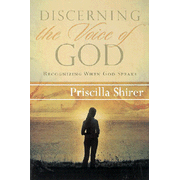
Ladies, we’re already in our third week of our time together studying Prisiclla Shirer’s Discerning the Voice of God.  It’s been a blessing to walk this journey with you!

If you haven’t read through all the comments on Week Two, please take the time to do that.  Your thoughts have been a blessing and encouragement to me!  Thanks for continuing to share.

Last week, I announced that we were reaching 100 posts on this devotional blog and as a way to celebrate and to say thank you, I was hosting a giveaway.  Anyone who commented from then up through Sunday, 0717, at midnight was entered into the drawing (my comments were excluded).

So, our three winners, selected using random.org, are:

Congratulations! Now on to this week’s study!

My Thoughts:

Almost two weeks ago, I was burdened to be more purposeful about Scripture memory rather than just memorizing the Awana verses with my kids, which is good, but not enough. Not only that, but it seemed like God wanted me to invite you to come along on this verse-learning journey with me.

Finally, despite my numerous objections, I agreed to begin weekend posts where I share in a new Scripture verse that I’d be memorizing for the week and ask you to participate, maybe learning your own verse instead.  In all my “wisdom,” though, I thought it would make sense to start something new after the 100th post and not before.  So, I agreed to do what God said, but only when I was good and ready.

As long as I put it off, though, I was unsettled and uncomfortable, like God was talking and I was purposely covering my ears and averting my eyes to ignore Him.  I gave in.  I wrote the first post about Scripture memory just over a week ago.

For those who have already delved into Chapter 5 of our book, you’ll know that on page 73, she says:

“If we don’t consciously attempt to combat those messages by saturating our minds with Scripture, our souls will be conformed to the world’s standards instead of God’s.  The more Scripture you have hidden in your heart, the more opportunity the Holy Spirit will have to bring it instantly to your mind to verify how you should proceed.”

When I read that this weekend (yes, a week after I wrote about how we need to memorize Scripture), I almost dropped my book into my cup of hot tea.  (If it had fit in the cup, the book certainly would have gone in.)

This week we read in Chapter 5 that God’s voice is verifiable and that His Word “isn’t just an old book that has a lot of theology for us to digest; it’s the living Word of God” (p. 74).  His voice is also persistent as it says in Chapter 6.  “He keeps at it.  He orders our circumstances, so that they relentlessly bombard our thoughts and hearts with His message until we are convinced of its authenticity” (p. 79). I certainly was reminded this week of the verifiability and persistence of God’s voice, as well as the blessing that comes with obedience.

The Outline

Chapter 5: A Verifiable Voice

I loved this chapter and its emphasis on the relevancy of Scripture to our everyday life situations.  God’s Word is alive; it’s meaningful; it’s powerful now in your life and in mine.

And yet we’re busy, oh so busy.  While I think there’s a certain amount of schedule-trimming we can do, we can’t cut everything from our agenda.  If you have a job or a house, if you serve in the church or community, if you have parents, friends, a husband, if you have kids, then you’re probably busy.

On page 73, though, Priscilla Shirer makes meditating on the Word of God accessible.  One verse a week.  Tape it to your mirror, in your car, maybe on your stove like me.  Put it where you’ll see it and read it over and over and over.  Pray it.  Live it.  Think about it while you stir the noodles on the stove or do your hair before work.  Let God minister to you through that verse.

As I said above, we’ve already begun picking one verse a week in this very blog, so I hope you’ll join with me. This isn’t to give us one more thing “to do,” but because the purposeful meditation on Scripture helps us not to sin, helps us to discern His will, helps us to fight the Enemy, helps us make decisions, and helps encourage us on the dark days.

Chapter 6: A Persistent Voice

On page 78, she directs us to pay attention to consistent messages—like when you hear the same thing in the sermon, Sunday School, in the book you’re reading, in your devotional and on the radio.  Then, it’s time to perk up your spiritual ears because God’s got something to say.

Also on page 78, she quotes Revelation 3:20 (“Look! Here I stand at the door and knock. If you hear me calling and open the door, I will come in, and we will share a meals as friends.”  She importantly notes that this was originally written to lukewarm Christ-followers, not unbelievers in need of salvation.  Christ wanted more of them and He was going to keep on a-knocking until they opened the door.

Oh my, the rest of this chapter for me was just one big underlined, highlighted, exclamation mark fest.  So, rather than take up all this space writing out my thoughts, I’ll share some of my favorite quotes with you:

  • “Scripture is full of people whose most life-changing encounters with the Lord occurred while they were in places they didn’t want to be” (p. 81).
  •  “Even difficult life circumstances are being used to give us a clear reception to hear His voice” (p. 82)
  • “There’s something in your current situation that God is going to use to draw you closer to Him so He can tell you something about Himself and His plan for your life.  no matter what tight spot you may find yourself in, ask God to open your ears to what He is saying in your circumstances” (p. 83)
  • “Rather than wishing you were married instead of single, in full-time ministry instead of corporate America, attending a big church instead of a small one, married to a saved spouse instead of an unsaved one, listen for what God is saying in your circumstances right now.  Don’t waste your time wishing; get busy looking and listening.  Ask the Lord to open your ears to hear what He is saying to you right where you are” (p. 84).
  • “One of the best pieces of advice I ever got was ‘Do the next thing'” (Elisabeth Elliott, p. 85).
  • “God is the God of right now.  He doesn’t want us to regret yesterday or worry about tomorrow.  He wants us to focus on what He is saying to us and putting in front of us right now.  The Enemy’s voice will focus on the past and the future, but the voice of our God will focus on today.  God’s voice tells us what we can do now.  Satan’s voice tells us what we could do ‘if only'” (p. 85).

Your Thoughts:

I hope you loved these two chapters as much as I did and I also hope you’ll post a comment here to let us know your thoughts on these topics.  Short or long, it doesn’t matter.  We want to hear what you have to say!

Here are some questions to get the conversation started.  I’m asking a lot this week, so answer however many you like:

  • Have you found a way of meditating on Scripture that works for you? If so, please share or maybe share something new your trying out.
  • How have you seen how the Holy Spirit change your “taste buds” over time? (p. 69).
  • Tell how God has used Scripture to help you make a very practical life decision (as she did on p. 67).
  • Tell how God has used difficult life circumstances or a place you didn’t want to be to give you “clear reception to hear His voice” (p. 82).
  • What is the “next thing” that you think God is asking you to do? (p. 85).
  • Is there anything you need to stop wishing and waiting for in order to do what God has asked you to do right now? (p. 85-86).
  • As always, I’d love to hear your favorite quotes and verses from this chapter!!!  Don’t worry if your favorites are the same as mine; please share them anyway!

Heather King is a wife, mom, Bible Study teacher, writer for www.myfrienddebbie.com and worship leader.  Most importantly, she is a Christ follower with a desire to help others apply the Bible to everyday life with all its mess, noise, and busyness.  To read more devotionals by Heather King, click here.

Copyright © 2011 Heather King

Weekend Walk: 07/16/2011

Welcome to the weekend walk!

We hit 100 posts on this blog on Friday, and now we’re celebrating with a giveaway.  Don’t forget to enter by commenting anywhere on this website by midnight on Sunday, 7/17.  I’ll announce the winners in Monday’s post!

If you’re doing the online Bible study with us, please take time to comment on this week’s post before our new reading begins on Monday.

Hiding the Word:

How did your first week of Scripture memory go?  I copied my verse onto an index card, said it aloud several times and set it on my stove so I’d read it all week.  I hope you found a method that worked for you!

Here’s my verse for the new week:

Psalm 34:4
“I sought the LORD, and he answered me; he delivered me from all my fears.”

If you are choosing a different verse, please share it with us in this space!

I’m slowly adding to our collection of verses on this website.  I hope they are a blessing to you.

The Weekend Rerun:

Tyranny of the Urgent (Originally published on 2/19/2011)

Charles Hummel wrote about how to be free from the “Tyranny of the Urgent,” and I could probably use some of those tips just about now.  My windows are open, it’s beautiful outside and instead of enjoying a relaxing day, I’m rushing to meet demands and fulfill requests, mostly for people under 4 feet tall.

How about you?  Do you feel like you are pushed from one urgent thing to another, always rushed, always breathless?  When my husband asks me in the evenings or weekends, “What do you want to do?,” I always answer with the list of things I have to do.  I have to do the laundry and the dishes, mop the floor, answer some emails, send a note, finish some work . . .

This morning, I was reading Psalm 127 and it made me laugh.  All you moms of young children might enjoy a giggle, too:

In vain you rise early
and stay up late,
toiling for food to eat—
for he grants sleep to those he loves.

Children are a heritage from the LORD,
offspring a reward from him.
Like arrows in the hands of a warrior
are children born in one’s youth.
Blessed is the man
whose quiver is full of them (Psalm 127:2-3, MSG).

Are you laughing?  I just find it so perfect that God promises rest and sleep and then in the very next verse reminds us that “Children are a heritage from the Lord.”  Some days we just need the reminder that these precious little people who don’t let us sleep in and think that Mom sitting down for 2 minutes is a problem best rectified by asking for her help every 10 seconds–yes, these little children are a blessing from God.

Even those of you who don’t have young children at home probably feel the burdens of numerous demands placed on your shoulders.  Living in this world requires us to meet certain demands and expectations.  We can’t simply shrug off all of our responsibilities.  We have school schedules to submit to, work deadlines to meet, ministry demands to fulfill, and families to care for.

It reminds me of Martha in Luke 10. She’s rushing around, totally stressed, trying to provide the best hospitality for her guests, Jesus and His followers.  It says that, “Martha was distracted by all the preparations that had to be made.”   She was doing what she “had to” do.

What blesses me about this is that Jesus looked right at her and said, “Martha, Martha,” the Lord answered, “you are worried and upset about many things,  but few things are needed—or indeed only one” (Luke 10:41-42, NIV).

God can look straight into my heart many times every day and say, “Heather, Heather, you are worried and upset about so many things, but only one thing really matters–your relationship with Me.”

In the middle of all of the “musts,” “have-to’s,” and “shoulds” on our to-do lists, it’s easy for time with God either not to fit into our highly scheduled lives at all or for it make it on the list just as another “have-to.”

God doesn’t want to be another item on our to-do list.  He doesn’t keep a running tab in heaven of how many minutes you spent on your quiet time today or whether or not you are behind on your Bible reading plan.  He simply desires intimacy with you.  He calls you to come away to spend time with Him, but He does it by wooing us and offering us grace and rest in His presence, not by making demands on us.

As it says in Matthew 11:28-30:

Are you tired? Worn out? Burned out on religion? Come to me. Get away with me and you’ll recover your life. I’ll show you how to take a real rest. Walk with me and work with me—watch how I do it. Learn the unforced rhythms of grace. I won’t lay anything heavy or ill-fitting on you. Keep company with me and you’ll learn to live freely and lightly (MSG).

This world forces its rhythms onto us, but God offers to teach us the “unforced rhythms of grace.”   Accept His grace.  You are loved and valued by Him whether or not your house is spotless, your kids practiced the piano every day this week, the laundry is folded neatly and put away, your work is perfect and your desk organized.  His grace sets you free from the “tyranny of the urgent” and lets you “live freely and lightly” instead.

************************************************************************************************************

Heather King is a wife, mom, Bible Study teacher, writer for www.myfrienddebbie.com and worship leader.  Most importantly, she is a Christ follower with a desire to help others apply the Bible to everyday life with all its mess, noise, and busyness.  To read more devotionals by Heather King, click here.

Copyright © 2011 Heather King

I’m Not a Boy

Happy 100th post everyone!  I’m so thankful that through God’s grace we have made it this far and I pray that He will bless us with much more time together in the days ahead.

To celebrate with you and as a way to say thanks to you for reading these devotionals, I’m hosting a giveaway!  I hope you’ll post a comment anywhere on this website by Sunday, 07/17/2011 at midnight, and I’ll announce the winners in Monday’s post.

Now, onto today’s devotional:

I’m not a boy.
I’m not a good dancer.  I’m not easily offended.  I’m not a blonde or a red-head.
I’m not tall.
I’m not artistic.  I’m not quick to cry.
I’m not usually a fan of “chick flicks.”  I’m not much of a TV watcher.
I’m not from a small family.
I’m not a quick decision maker.
I’m not an extrovert.  I’m not athletic.  I’m not fond of “outside.”

We all define ourselves by lists of “I ams” and “I am nots.”

“Are you a Christian?”  I am.
“Are you fond of sports?”  I am not.

Is it any wonder that God has a list, too?  His “ams” and “am nots” through Scripture establish His character and give us reliable assurances in times of trouble.

We rest in safety because we know He is “I am.”

It’s the most powerful declaration of God’s identity in Scripture, when He tells Moses His name: “I AM WHO I AM . . .This is my name forever, the name you shall call me from generation to generation” (Exodus 3:14, 15).

My Bible notes that His name could also be read as: “I WILL BE WHAT I WILL BE.”

He is I am and I will be.  He is eternal.  He has existed before our human history began and He has walked through the entirety of our time on this planet and will still remain forever.

So, we can trust Him.  We can place in His capable hands all that frightens us because He knows where we have come from and where we are headed.

It’s more than that.  He tells us:

  • “I am with you” (Genesis 26:24).
  • “I am God Almighty” (Genesis 35:11).
  • “I am the LORD, who heals you” (Exodus 15:26).
  • “I am the LORD your God” (Exodus 16:12).
  • “I, the LORD your God, am holy” (Leviticus 19:2).
  • “For I am the LORD your God, the Holy One of Israel, your Savior” (Isaiah 43:3).
  • “I am the LORD, and there is no other; apart from me there is no God” (Isaiah 45:5).
  • “I am the LORD your God, who teaches you what is best for you, who directs you in the way you should go.” (Isaiah 48:17).
  • “I am the LORD your God, who stirs up the sea so that its waves roar—the Lord Almighty is His name” (Isaiah 51:15).

Can you read through this list of what God says about Himself, His “I ams” and not be in awe, not be filled with the desire to worship, not be comforted?

He is with you, there in the places of hurt and despair.  He heals you.  He is holy.  He is your Savior, pulling you out of the pit and redeeming you through the blood of His Son.  He is the only God.  He directs our steps.  He is Lord Almighty, in control of all creation, including the circumstances you find yourself in.

Praise God!

He doesn’t stop there, though.  He also has “am nots.”  Just as powerful, these are declarations of His dominion over all the fake gods that vie for our worship.

In Daniel 2:11, the magicians and advisers of King Nebuchadnezzar whine that no one can possibly tell the king what he dreamt except the gods, and “they do not live among humans.”

Not our God.  He made His dwelling among His people, directing them to “make a sanctuary for me, and I will dwell among them” (Exodus 25:8).  He abandoned the glories of heaven and “The Word became flesh and made his dwelling among us” (John 1:14).

He can say, “I am not distant from you.”

In Psalm 135:15-18, the Psalmist writes:

The idols of the nations are silver and gold, made by the hands of men.  They have mouths, but cannot speak; eyes, but they cannot see; they have ears, but cannot hear nor is the breath in their mouths.

Not our God.

Our God is the Shepherd who speaks to His sheep (John 10:27).  He is the God who sees us (Genesis 16:13) and hears our voices when we call to Him (Psalm 5:3).

He can say, “I am not ignorant of your need .”

And our God “is not human, that he should lie, not a human being, that he should change his mind. Does he speak and then not act? Does he promise and not fulfill?” (Numbers 23:19).

Colin Urquhart wrote, “God is the God of promise.  He keeps His word even when that seems impossible.”

He can say, “I am not a promise-breaker.”

It may feel difficult at times to believe in God’s nearness, responsiveness, concern, love and faithfulness because we are immersed in a pit of circumstances that blocks our view of Him.  And yet, He tells us all the things He is and all the things He is not and it is that Scriptural assurance of His character to which we cling.

We can rest in safety knowing that He is I AM.  We can rest in safety knowing all that He is not.

Heather King is a wife, mom, Bible Study teacher, writer for www.myfrienddebbie.com and worship leader.  Most importantly, she is a Christ follower with a desire to help others apply the Bible to everyday life with all its mess, noise, and busyness.  To read more devotionals by Heather King, click here.

Copyright © 2011 Heather King

A Giveaway and a Trophy!

Giveaway!

I promised in my weekend post that we’d celebrate reaching the 100th entry in this devotional blog and we’ll hit the big 100 on Friday!  Thanks so much to you for traveling on this journey with me.  I pray for you–even if I don’t know who you are or what you’re going through.  God knows all these things and I ask for His hand of blessing on you as you seek Him.

On to the giveaway!  I’m just over a month away from traveling to the Women of Faith conference in Washington, DC, so I’m going to give away some Women of Faith goodies.

The prizes:  The first person whose number is drawn will receive a brand new copy of Sheila Walsh’s book, Beautiful Things Happen When a Woman Trusts God.

I’m also giving away two brand new Women of Faith Worship CDs including songs they’ll be singing at this year’s conference.  These will go to the second and third numbers drawn.

To Enter:

Post a comment anywhere on this web site starting today and ending at midnight on Sunday, July 17th.  I’ll use random.org to randomly select the winners and I’ll announce their names in Monday’s post.

Today’s Devotional: Do I Get A Trophy?

The kids piled onto the stage for the practice before the big program.  At first, I arranged them like carefully planned chess pieces—tallest in the back, little ones up front.  Brothers not next to other brothers for fear of poking and other tomfoolery.  Eventually, though, the kids just kept coming and shifting around and they ended up in no particular order.

However it happened, in the very middle of the stage in the very front row was the most precious little boy you could imagine.  He sang.  With all his might, he sang.  You could hear his voice in any place in the sanctuary and those passing by the closed doors could hear him singing down the hall.  His sister poked him during each song and whispered to him, “Don’t be so loud!” Those watching us practice from the pews couldn’t help but smile as he made a “joyful noise.”

Then, the practice done, each child climbed down the steps of the stage and filed into the back room to wait for the actual program.  Except for this one singing boy.

He took hold of my hands and asked, “Ms. Heather, did I do a good job?”
“Oh, you did a great job. I love how you sang with all your heart.”
“So, do I get a trophy?”
“Well, I don’t have trophies, but I have candy!”

He seemed happy with the alternative and ran off with the other kids.

We Don’t Serve To Earn a Trophy

For most of the truly important things in life, we don’t get trophies.  Coaches hand them out for playing on a soccer team, but no woman polishes the brass trophy on her shelf for enduring labor and having a baby.  There’s no “stayed up all night with vomiting children” trophy.  No trophy for “visiting the nursing home without anyone else knowing you did it.”  No plaque for “spent hours on knees praying for wayward child.”

We don’t serve for awards that will hang on our wall or adorn our bookshelves.  Other than an occasional mug from our kids saying, “World’s best mom,” we go through our everyday acts of ministry without recognition.

Sometimes our motives twist and need readjusting.  Deep in our heart, we occasionally slip into acting out of a desire to be seen, noticed and praised.  Or we take on a task because it feels good to be needed and asked.  We fear that no one else could possibly do it, so we sign on the dotted line.

When others are looking, we sometimes put on the voice and physical appearance of “Super Christian,” and then snap at our family, grumble and complain, and gossip about others as we sink into the seats of our cars and drive from church to home.

Then there are those moments when we shove the dishes into the dishwasher and slam the pot down on the counter wishing that someone would recognize what we do.  It may not be Nobel prize worthy, but this is our life’s service we’re talking about!  This is self-sacrificing.  This is humbling.  This is always putting others first!

It’s not always articulated in our heart and mind that way. It’s not something we always admit or even recognize.  But our motives are distorted and we’ve begun to serve for trophies–polished brass rewards of attention, praise, personal pride and recognition from others.

Jesus warned: “Be careful not to practice your righteousness in front of others to be seen by them. If you do, you will have no reward from your Father in heaven” (Matthew 6:1).

We shouldn’t serve in any capacity to get a trophy.  If we do, we’re forfeiting heavenly reward, trading eternal glory for a temporary self-esteem boost.

But We Serve As If God Was Handing Out Trophies

Here’s the challenge, though.  With pure motives and sometimes hidden service, without seeking praise and recognition, we can still serve with all our heart as if we would get a trophy.

We don’t seek the prize, but we strive with all our might to be worthy of it.  Because even when we are invisible to everyone else, God sees us.

He sees you.  All of your effort, your service, your laying down of self, your sacrificial giving, your stepping out in faith, your steady faithfulness, your lack of sleep, your soul emptied out.

Just like my singing friend.  Fully knowing that he wouldn’t get a trophy, he still sang loudly and enthusiastically during the program.  He gave his best effort anyway and I’m positive that God was beaming at every word he sang.  God didn’t miss a single second of his heartfelt praise.

In the same way, we worship wholeheartedly, we serve menially, we act selflessly not for our own glory, but for the glory of God.

We pick up toys for the “Well done, my good and faithful servant.”  We work at our jobs not so we receive promotions, but so that our “light (will) shine before men, that they may see your good deeds and praise your Father in heaven” (Matthew 5:16).  We walk away from gossip.  We take a meal to the family who needs it.  We write the note of encouragement.  We pray for our friend.  We teach the Sunday School class year after year after year.  We rock the baby.

Because God sees and cares.

We sing with all our hearts not because some human being is going to hand us a physical trophy, but we’re singing for God, so that He will be pleased.  This is our worship, the offering we place before Him.  When we grow weary or frustrated, feeling annoyed or walked all over, pouring out our very soul for the sake of others, we do not give up and go through halfhearted motions of service.  Our motivation remains the same, to serve God, to bring Him glory, to give Him praise.

Because even when no one else notices, we know that God sees.

We remember what Paul wrote:

Do you not know that in a race all the runners run, but only one gets the prize? Run in such a way as to get the prize (1 Corinthians 9:24-27).

and

So let’s not allow ourselves to get fatigued doing good. At the right time we will harvest a good crop if we don’t give up, or quit. Right now, therefore, every time we get the chance, let us work for the benefit of all, starting with the people closest to us in the community of faith (Galatians 6:9-10 MSG).

For those who feel invisible at times, here’s a video from Nicole Johnson on The Invisible Woman.  I hope you are blessed by it as much as I was:

Heather King is a wife, mom, Bible Study teacher, writer for www.myfrienddebbie.com and worship leader.  Most importantly, she is a Christ follower with a desire to help others apply the Bible to everyday life with all its mess, noise, and busyness.  To read more devotionals by Heather King, click here.

Copyright © 2011 Heather King

Online Bible Study: Week 2, Chapters 3 and 4

Welcome back Bible study friends!  I’m glad to see you here for week 2 of our time together reading Priscilla Shirer’s Discerning the Voice of God.  Some quick notes before we begin this week:

Thanks so much to all who shared in last week’s discussion. I learned so much from you!

Some of you were still getting the book as of the end of last week.  I want to reassure you that there is time for catching up and no need to feel overwhelmed. These posts of mine will fall at the beginning of each section.  That means you can start the week’s reading on Monday morning and post comments whenever you feel ready (or as you feel ready) all week long.  You can also easily go back to old posts by clicking here: Online Bible Study.

The comments can be short!  You don’t have to answer every question and certainly not all at once unless you want to.  If you only have time to write a sentence or two, that’s perfectly fine.

Here goes week two!

My Thoughts

My family used to have several Magic Eye books, each page filled with bright colors and wavy lines.  If you stared long enough and in just the right way (they say don’t cross your eyes, but I usually did), then a 3-D image would pop off the page for you to see.

I occasionally managed to manipulate my eyes and the book and see the hidden pictures.  What I’ve never been able to do, though, is stare at a close-up photograph of an object and decipher the whole image from just a tiny piece.  (Like the pictures along the side).

In the same way, most of us can see the amazing, gloriously evident work of God in our lives.  When He’s big, awesome, miraculous, life-changing and writing words on hearts in neon, we notice.  We see the “Magic Eye” pictures of God.

But it’s much harder when we look close-up at the images of life to determine the big picture view.  What exactly are we looking at?  A cornflake?  A spider web?  A temptation?  God’s will?  A trial?  A blessing?

We can’t tell because we can’t walk far enough away from our daily lives to scan the entirety of the picture—past, present, future—and see the true image that God sees.

Oh, how simple this faith-walk would be if the magic pictures always popped off the page for us, if the 3-D image of God’s plan was ever before us, magnificent, amazing and clear.  This is what we so often ask for.  We look for signs and wish for physical manifestations of our Mighty God.

Priscilla Shirer says:

We want God to show us His will in a tangible way–a sensational way . . . What we want is for God to speak today the same we He spoke in Old Testament times.  It seemed much easier to discern God’s voice back then (p. 45).

While God is ever-creative and able to speak to us in any way He chooses, since the time of Christ’s ascension:

the primary way God has spoken to His people has been through the person of the Holy Spirit, who confirms God’s written Word and applies it to our life.  The Holy Spirit and the Bible go hand in hand (p. 50).

We so often overlook the powerful gift of the Holy Spirit living in us!  Do we truly understand what it must have been like not to have God with us and in us all the time, whenever and wherever we went?

In the Old Testament, people traveled to a physical building where God’s Spirit dwelt and the Holy Spirit “only came to specific people at a specific time in order to achieve a specific task.  When that task was accomplished (or when those people sinned or rebelled), the Holy Spirit withdrew” (p.49).

We feel jealous of those who saw God intermittently.  Sure it was unmistakable and flashy, but it was not ever-present.  Wouldn’t those same people be jealous of us, having the very Spirit of God with us at all times, guiding and directing us in our moment-to-moment lives?

Even when we cannot see the big picture, we can trust that the Spirit within us does and He’s leading us in the way we need to go.  There’s power in the presence of God if only we learn to listen.

(I’ll post the answers to the pictures at the bottom of the page.)

Walking Through the Book:

Chapter 3: A Marvelous Voice

On pages 48-50, she walks us through primary ways God has spoken over time:

  • Old Testament: The person of a prophet confirmed usually through a visible sign.
  • The time of Christ: The person of His Son confirmed through miracles.
  • After Christ’s ascension: The person of the Holy Spirit confirmed through God’s written Word, the Bible.

That’s not to say God cannot or does not ever use miraculous means to speak to us today.  As she notes, though, “if God chooses to speak in miraculous ways today, these ways do not lay the foundation for us to hear from Him.  Rather they just provide confirmation of the messages we receive through the Holy Spirit’s leading and the guidelines of Scripture” (p.51).

We must always go back to God’s Word as our touchstone of truth.

Chapter 4: A Guiding Voice

Because we fellow-Bible study participants aren’t all from the same denomination, we might disagree about some issues, like how and when we experience the Holy Spirit.  Let’s not get distracted by that discussion because on the foundational, salvation-dependent doctrinal issues we have agreement.

Here’s what we do know: the Holy Spirit within us allows us to hear God’s voice and understand His truth more clearly (p. 57).

She also notes that “our human conscience is not the voice of God.  It isn’t infallible” (p. 59).  Our moral guidelines and consciences can be deceived and deformed.

Over time, though, as we transform into being more Christ-like, there is an agreement between our conscience and the Holy Spirit (p. 67).  Eventually our conscience becomes a method our “control tower” uses to direct our “pilot” as we make decisions.  “He is steering us into God’s will” (p. 61).

This transformation by the renewing of our minds is gradual.  “So, as you listen to your Spirit-led conscience, we must always confirm what we hear” and as she notes, He will graciously confirm it (p. 62-63).

The guidelines she gives us for discerning God’s voice (p. 63):

  • Look for the MESSAGE of the Spirit.
  • Search the MODEL of Scripture for guidance.
  • Live in the MODE of prayer.
  • Submit to the MINISTRY of Eli (counsel of a mature believer).
  • Expect the MERCY of confirmation.

Your Thoughts:

  • Can you give an example from your own life or in Scripture when God graciously confirmed His word?
  • Do you have “Eli’s” in your life—mature believers who give Godly counsel?  How did you choose them and in what ways have they helped you?
  • Have you ever been confused by what God is doing in the here and now only to have Him reveal the big picture much later on?
  • What are some of your favorite quotes/Scriptures/passages from chapters 3 and 4 that you’d like to talk about?

What were those close-up pictures above?  Some of you may be better at this than me and have been able to guess–a pinwheel and a flyswatter. 

Heather King is a wife, mom, Bible Study teacher, writer for www.myfrienddebbie.com and worship leader.  Most importantly, she is a Christ follower with a desire to help others apply the Bible to everyday life with all its mess, noise, and busyness.  To read more devotionals by Heather King, click here.

Copyright © 2011 Heather King

Weekends: Doing Some New Things!

Dear friends,

I went looking for an old devotional on this website the other day and found that we had nearly reached 100 posts since this devotional blog began.  To be honest, a year ago I would have told you that I didn’t have anything to say, certainly not 100 posts full of things to say.  And so I am reminded even as I sit here typing away at post number 97 what Paul writes in 1 Corinthians 12:9: “My grace is sufficient for you, for my power is made perfect in weakness.”

As we near the big 100 this week, it’s on my heart to do a few new things:

  • Weekend Reruns: On the weekends, I’ll post a “rerun,” an old post to share, especially for those new to the blog who may have missed it the first time and also hopefully as a renewed encouragement for long-time subscribers.
  • Hiding the Word: I’ve been challenged recently to be more deliberate about Scripture memorization.  For those of you who want to walk on this new journey with me, I’ll share the verse I’ll be working on that week.  You can learn the same verse as me or choose your own (but if you choose your own, will you post it here and share it with us?)
  • Verses Collection: Since we’ll be memorizing Scripture together, I thought I’d compile some of my favorite verses into categories and share them with you.  This will be a slowly building collection and I’ve only posted a few verses to start.  You can check the page out here.  Please share your favorites with me and I’ll post them to our collection.
  • Giveaway: And when we reach 100 posts, I’ll do something never before in this space—a giveaway!  That should happen this coming week so stay tuned!

Welcome, then, to our very first weekend together!

Hiding the Word

Here’s the verse on my heart for this week:

“Do not love the world or anything in the world . . . The world and its desires pass away, but the man who does the will of God lives forever”  1 John 2:15,17

If you choose to memorize this verse, will you post and let us know how it goes?  If you choose another verse, will you share that with us also?

Weekend Rerun

Everyday, Ordinary Life (First published February 12, 2011)

“So here’s what I want you to do, God helping you: Take your everyday, ordinary life–your sleeping, eating, going-to-work, and walking-around life–and place it before God as an offering” (Romans 12:1, MSG).

I love that verse in Romans and I came across it again today in my reading. The thing is, there are so many parts of my “everyday, ordinary life” that don’t seem really offering worthy.  I don’t mean because they are mundane.  I mean because they’re ugly and messy and well, failures really.

Like when your daughter decides to take the ballet shoes that you placed next to the front door, hide them and then forget where they are 5 minutes before you have to leave for ballet class and you lose it.

Maybe that kind of stuff only happens to me, but believe me, my reaction to this “irritation” wasn’t really an offering worthy of God.

To be honest, how I react to the big crises in life is much more holy and Christian.  I lean in to God and I grow in my faith in the process because I have no other choice really.  I know fully well that I’m not able to handle any of the big stuff on my own.

It’s the daily annoyances, interruptions, and irritants that bring out the worst in me, partly because I forget to look to God for any help or input at all.

So, how—-how do I turn my everyday, ordinary life into an acceptable sacrifice and a way to give God glory?

I’m reading this fantastic book by Eugene Peterson called A Long Obedience in the Same Direction and he drew my attention to something I had ignored before in this verse.  Three little words: “God helping you.” In the NIV translation, the verse reads:  “Therefore, I urge you, brothers and sisters, in view of God’s mercy, to offer your bodies as a living sacrifice, holy and pleasing to God—this is your true and proper worship.”

With God’s help and in view of God’s mercy, I can make my life–my whole life, not just the “important” parts—an offering to God.

In Romans 9:16, Paul writes, “It does not, therefore, depend on man’s desire or effort, but on God’s mercy.”  I don’t know about you, but I’m so thankful to know that my salvation, my joy, my future don’t depend on anything other than God’s great mercy.

That means when I mess it up and lose it over hidden ballet shoes that actually don’t reappear until 3 days later (hidden behind the chair in my room), I can have a fresh start.  As it says in Lamentations 3:21-24:

Yet this I call to mind and therefore I have hope: Because of the LORD’s great love we are not consumed, for his compassions never fail.  They are new every morning;  great is your faithfulness.  I say to myself, “The LORD is my portion; therefore I will wait for him.

We fail, but His compassion doesn’t fail.  He gives us new grace every morning.  He is our portion.  He is all we need in every difficult, annoying, frustrating moment of our everyday lives, just like He’s faithfully with us in every crisis.  It is only with His help that my reactions to the daily can be placed before Him as an offering.

*******************************************************************************************************************

Heather King is a wife, mom, Bible Study teacher, writer for www.myfrienddebbie.com and worship leader.  Most importantly, she is a Christ follower with a desire to help others apply the Bible to everyday life with all its mess, noise, and busyness.  To read more devotionals by Heather King, click here.

Copyright © 2011 Heather King

Becoming a Zucchini Farmer

I’ve found my calling, my true gift and talent—growing zucchini.  So, I’m contemplating a new life as a zucchini farmer.

When we planned this mini-garden of ours, my daughters announced that they must grow and eat their own food.  They wanted to plant and watch it grow, pick it with pride and then serve it up with dinner.

Not knowing how well we could produce food we actually eat like tomatoes and cucumbers, I planted two spindly little zucchini sprouts in the garden.  I’d seen many fellow church-goers hand out this cucumber wannabe to worshipers leaving the sanctuary.  “Would you like some?  Please, take it home!  We’re drowning in the stuff.”  So, I thought this must be one sure-fire vegetable to grow in our garden in case our other plants didn’t do well.

I didn’t expect that much success, just a guaranteed one or two veggies that my daughters could pose with in pictures and be proud about growing.

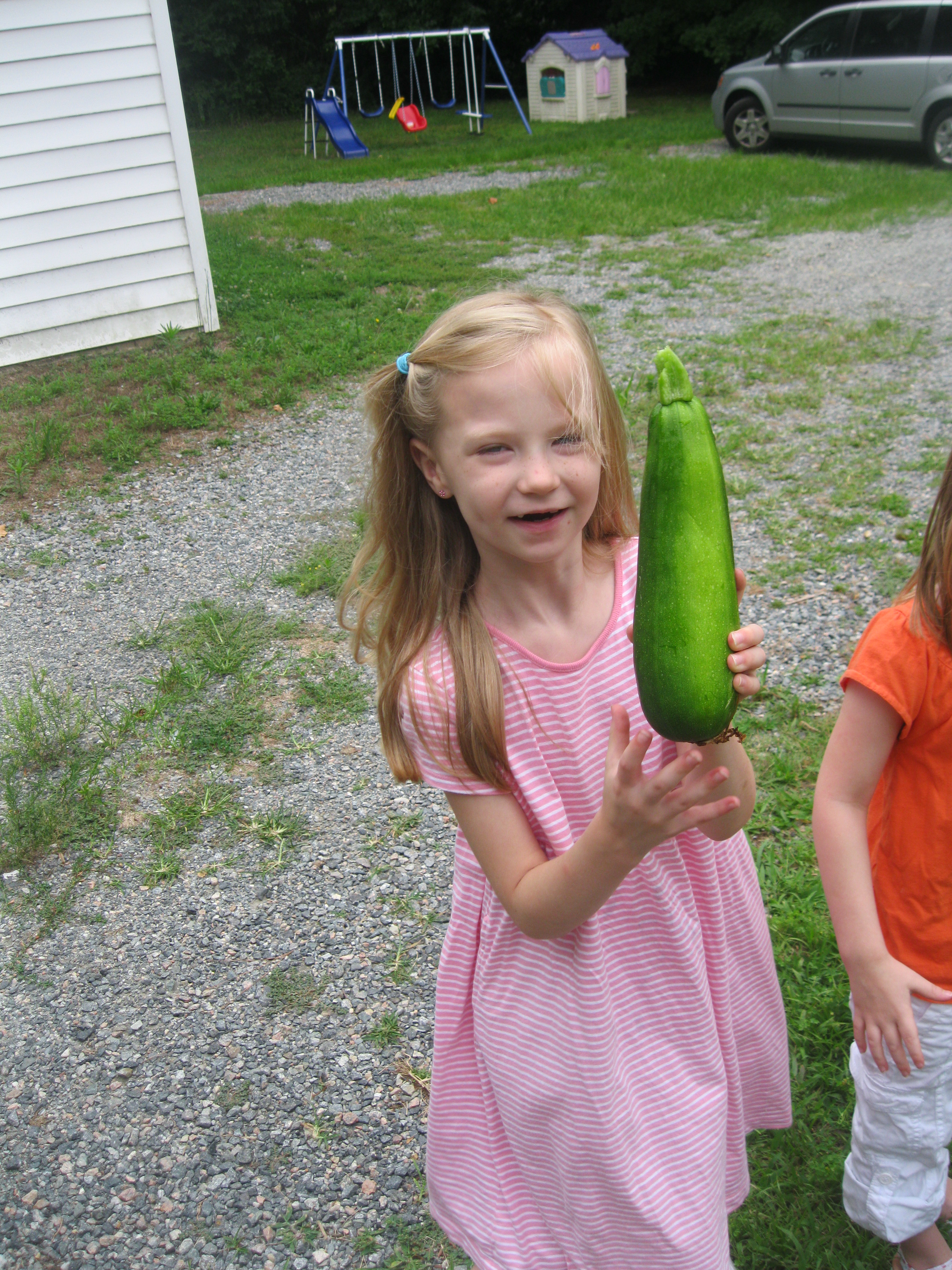
And then this one plant grew to monumental proportions and began producing mammoth zucchini.  I frantically began asking everyone I met, “How do you actually eat this stuff?”  Because we didn’t eat it, not often anyway.  I had no recipes for zucchini and whenever anyone said, “zucchini bread,” I stared at this zucchini the size of my daughter’s torso and wondered how that gets mixed up in a way appropriate for the bread pan.

Apparently others are having this problem.  I’ve begun noticing little carts loaded down with zucchini and squash just pushed out to the roadside in front of people’s houses.  These aren’t farmers trying to earn a living off their land.  These are women like me who have run through the entire Food Network recipe book on zucchini and still have some to spare.

This zucchini overload has me asking one question—what’s the point? What’s the point of having abundance if you don’t use it?  Sitting in my refrigerator or on my counter looking green and huge, this zucchini is pointless.  It is designed and intended for nourishment. Unused, it will rot and go to waste.

My question extends out to issues of faith.  What’s the point of spiritual gifts buried deep and hidden away?  God gives them to us, perhaps we even cultivate and harvest them. Then we let them sit unused.  Or perhaps we grow mystery vegetables in our garden, never actually identifying them.  Yes, we have gifts, but not knowing what they are, we simply pick the fruit, place it on the counter and toss into the garbage the rotten results over time.

While building the tabernacle, Moses instructed the Israelites: “Come, all of you who are skilled craftsmen, having special talents, and construct what God has commanded us” (Exodus 35:10 TLB).  That remains God’s desire—we apply our talents to God’s service, to the building of His ministry, His dwelling place, and His body.

What’s the Point of Knowledge?

Then there is also knowledge and discipleship.  What’s the point of study without application and life change?

I’m a student at heart.  To me, learning is fun simply in its own right.  I never in my life sat in a college class and tuned the teacher out because, “it was a pointless class that I’d never need in real life.”

Thus, it’s tempting for me to study and study and study the word of God, writing notes and filling my brain with knowledge.  There’s danger there, though.  Danger that my focus will be on learning and not on my Savior.  Danger that knowledge itself will actually become my god.  Danger that I’ll fill my head full of fascinating facts and never once experience life change in the down and dirty parts of my heart that need cleaning out.

It’s why at the beginning of almost every Bible Study I look around the group and say the same thing, “My goal here is application.  If we talk about not worrying and then go home and worry just as much as ever, we’re not achieving anything.”  What we study must become what we do.

Paul wrote to the Colossians, a church that had fallen into the danger zone, pursuing knowledge and learning to the exclusion of God:

See to it that no one takes you captive through hollow and deceptive philosophy, which depends on human tradition and the elemental spiritual forces of this world rather than on Christ (Colossians 2:8).

They had become so excited about gaining knowledge, they had failed to filter what they were “learning.”  Not every book you read that quotes Scripture is actually scriptural.  It takes discernment rooted in God’s Word to determine the difference.

In his letter to Timothy, Paul declared that people had devoted

“themselves to myths and endless genealogies.  Such things promote controversial speculations rather than advancing God’s work—which is by faith. The goal of this command is love, which comes from a pure heart and a good conscience and a sincere faith. Some have departed from these and have turned to meaningless talk. They want to be teachers of the law, but they do not know what they are talking about or what they so confidently affirm  (1 Timothy 1:3-7).

So, what’s the point?  When we’ve written down the original Greek of a word in Scripture and we’ve taken notes on our favorite preacher’s sermon, when we’ve copied whole devotionals into our journal and highlighted our book . . . then what?

We grow.  We know God rather than just know ABOUT God.  That’s the point.  Paul prayed for the Colossians that God would “fill you with the knowledge of His will through all the wisdom and understanding that the Spirit gives” (Colossians 1:9).

If we’re reading without changing, listening without growing, learning without transformation, then it’s pointless abundance–a garden full of unusable fruit gone to waste as it rots on the vine.

Heather King is a wife, mom, Bible Study teacher, writer for www.myfrienddebbie.com and worship leader.  Most importantly, she is a Christ follower with a desire to help others apply the Bible to everyday life with all its mess, noise, and busyness.  To read more devotionals by Heather King, click here.

Copyright © 2011 Heather King

Welcome to the Bible Study: Part One

For those of you signing on for the first day of our online Bible study, welcome!  For those who are regular blog subscribes but who are not doing the study with us, I hope there will still be some blessing for you in these weekly posts.  Be assured that I’ll still be doing the regular devotionals during the rest of the week.

Let me give you, in a way, a grand tour of this Bible Study of ours.

If you haven’t yet introduced yourself to the group, I hope you’ll take a moment to do so.  It will help us know who is in the group.  You can click here to visit the introduction page: Before Our Online Bible Study Begins.

I’ll begin each week with a brief thought/comment on the reading.  I’ll take you through a simple outline or walk-through of the chapters for that week.  Then I’ll pose some questions for you.

You can either read the book in advance and then read through my entire post in one sitting and answer all at the same time.

Or, you can start here in this space.  Read my intro.  Read some from the book.  Read some of my outline.  Read some more from the book, etc.  Then answer the questions, all at your own pace.

How you do it is up to you and your time and preferences.  This post today will be the longest I write because of these extra introductory instructions.

Every time I post for the Bible study, I will link the new post up on the Online Bible Study space on this web site.  You can easily access every old post from that page.  I hope that makes it easy for you to come back multiple times and do this study in pieces throughout each week or catch up if you get behind.

You can also find the schedule I plan to follow on the Online Bible Study page.

The only thing I ask is that as many of you share as possible your thoughts, comments, questions, and responses.  We want to hear from you.  I know some of you will be reading this book alongside us and you prefer not to chat in this space.  I understand and, again, there is no pressure here.  The more people who share, though, the more benefit we will get from this study.  It is your experiences, knowledge and testimony that we don’t want to miss.

Ready to get started?  I sure am!  Let’s go!

Discerning the Voice of God, Part I
(Intro and Chapters 1 and 2)

My Thoughts

If you called my family home during my teenage years and I answered the phone, you would have heard me say, “Hello, Mason residence.  This is Heather speaking.  May I help you?”

And you’d probably hang up the phone the first time you called for fear that you had mis-dialed an attorney’s office.

That’s how I answered the home phone for years.  It’s because we had a problem in my house—I sounded like my mom. There were a few accidents before my fancy phone answering ways.  People called and launched into a full conversation with my mom after my brief “hello,” while I scrambled to announce that they had the wrong person.

God doesn’t usually speak to us by first identifying Himself.  “Hello, this is heaven.  God speaking.  How may I help you?”

It just isn’t that simple, nor should it be because that would require very little intimacy or personal relationship.  Hearing, identifying and obeying the voice of God takes discernment, which Webster’s dictionary tells us is:  “Keenness of insight and judgment.”

As you read or have read the first part of this book, some of you may have books filled with underlines and highlights and you’re excited to learn more.  Others may be shrugging your shoulders thinking, “That’s all?  This is basic.”  And in some ways it is.  Discerning the voice of God is a basic foundational skill in our journey of faith.

But, do we ever get to the place where we stop growing in this area?  Isn’t there always more to learn?  Discernment is “keenness,” which says to me it is a sharpened skill developed over time.

That’s why I hope that you veterans of the faith will freely and honestly share about how you’ve grown to know God’s voice, so that we can learn from you.

We learn discernment through practice.  We talk with God so much, we listen so much, that His voice eventually becomes distinct from everything else we hear in our lives.  It is experience and sometimes mistakes that turn the basics written down in a book into a living, breathing reality of our faith.

Walking Through the Book:

The Intro:
I personally know a Bible-teaching, home-group leading Christian who does not believe that God speaks to us today.  He believes everything God has said and ever will say is written in the Bible.  More than that, he teaches it is pretentious and prideful of us to assume that God cares enough about our individual lives to have anything to say about them.

I loved that Priscilla Shirer answered this right from the beginning of her book.

On page 14, she reminds us that God is the same “yesterday, today, and forever” (Hebrews 13:8).  So, His pattern of speaking to prophets in the past continues with us today.

She also says that it is God’s voice—the fact that He was an active, involved, listening and responding kind of God—that set Him apart from the myriad of fake gods surrounding Israel.

I think Tozer’s quote on p. 17 (before chapter one begins) sums it up:

Those who do not believe God speaks specifically will simply ignore or explain away all the times when God does communicate with them.  However, those who spend each day in a profound awareness that God does speak are in a wonderful position to receive His word.

Amen!

Chapter One:

Here are the basics of preparing to hear God’s voice:

Come Expecting:  That’s what Habakkuk did.  He dared to ask God such difficult, pain-filled questions and then he waited for God’s response, fully expecting to hear.

Come As You Are:  I love the quote beginning on page 23: “God is gracious, and when we want to speak to Him, He invites us to come as we are – questioning, complaining, and confused.”  He then takes those questions and uses them as a way to reveal more of Himself to us.

Come Determined to Wait: Habakkuk made his complaint to God and then said, “I will stand at my watch and station myself on the ramparts; I will look to see what He will say to me, and what answer I am to give for this complaint” (Habakkuk 2:1).  He waited there patiently for God to answer and didn’t move until he heard God’s clear voice.

Come Believing: God didn’t foretell a fairy tale future for the prophet.  But, when Habakkuk heard God speak, he moved forward in belief—even in the difficult times.  He concluded with my favorite set of verses from the whole book:

Though the fig tree should not blossom and there be no fruit on the vines, though the yield of the olive should fail and the fields produce no food, though the flock should be cut off from the fold and there be no cattle in the stalls, yet I will exult in the Lord, I will rejoice in the God of my salvation (Habakkuk 3:17-18).

It was the sacrifice of praise.

Chapter Two:

Her emphasis in this chapter is on taking time to listen.  Praying in such a way that we don’t just talk to God, but we take time to hear from Him.  She outlines the disciplines of praying Spirit-guided prayers, meditating on God’s Word, and worship as the foundation that allows us to hear God’s voice.

Your Thoughts:

You can share anything you like in this space on the topic of listening and hearing from God.  Here are some specific questions I’d like to ask you:

  • Can you tell us about a time that you  clearly heard God speak?  How did you know it was Him ?
  • Do you have a favorite quote, verse or passage from the book that you want to share with us?
  • What discipline of the faith do you most struggle with?  Do you have any tips you’ve found that help you in this area?
  • What do you most want to learn about discerning the voice of God from this study?

You can post multiple times throughout the week as you read more and read what others have to say.  Please reply to one another and encourage those who have shared with your responses and answers.

You should see a little tiny check box at the very bottom of this page that says: Notify me of follow-up comments via email.  If you click that box, you should receive a notice when someone replies to this post and you won’t miss what others have to say.

I’m praying for you this morning as we begin this study, that God will make His voice clear to you and that you will be able to hear Him and then radically and passionately obey what He’s calling you to do.

~heather~

Heather King is a wife, mom, Bible Study teacher, writer for www.myfrienddebbie.com and worship leader.  Most importantly, she is a Christ follower with a desire to help others apply the Bible to everyday life with all its mess, noise, and busyness.  To read more devotionals by Heather King, click here.