Much More Than We Deserve

For those reading Lisa Harper’s book, Stumbling Into Grace, along with my small group, today’s devotional will match up with her fifth chapter: “Cat Appreciation Day”

***********************************************************

“My soul glorifies the Lord and my spirit rejoices in God my Savior, for he has been mindful of the humble state of his servant.”
Luke 1:46

The Christmas lists have begun in our house.  My kids spot fairy costumes and toys, games, and crafts at Wal-Mart and suddenly they’re pleading and begging.  My response is nearly automated, “Maybe that’s a good thing to request for Christmas!”

My kids know they’ll have presents under the Christmas tree this year because we love them and we enjoy giving them good gifts. Unlike Santa’s treats, our gift-giving doesn’t depend on whether they accumulated enough nice points and avoided the naughty list.  The gifts we give them are gifts of grace.

Just like God does for us.

It’s so easy for us to blur the lines between grace and works.  It’s easy to slowly forget just how incredible this unreasonable and abundant grace of God’s really is and to start drifting ever so slowly into working, doing, serving, and earning God’s affection and blessing.

Not that there aren’t consequences for behavior.  Sometimes we lose out on God’s best for us simply because we didn’t follow His commands in the first place.

But sometimes blessing is more than just avoiding the pitfalls of bad choices. Sometimes God chooses to rain down good gifts on His children simply because He loves them.

There are times, though, when we’re searching, searching, searching the sky for any sign of showers of blessing.  Maybe we’re even toting an umbrella around in hopes for a drop of grace or two.  But we feel overlooked instead.

Worse yet, sometimes it looks like others are receiving so much.  And then the jealousy kicks in because we’re too busy watching the weather patterns in other people’s yards.

Jeremiah felt the same way when he asked, “Why does the way of the wicked prosper?” (Jeremiah 12:1).  Job asked, “Why do the wicked live on, growing old and increasing in power?” (Job 21:7).  The Psalmist wrote, “How long, LORD, will the wicked, how long will the wicked be jubilant? (Psalm 94:3).

This was probably Hannah’s struggle on a daily basis.  Her husband loved her, but it was his second wife, Peninnah, who had all the babies.  While Hannah prayed continually for a son, she remained childless.

It just didn’t make sense.  Hannah was a righteous woman.  She prayed faithfully and worshiped God.  All this while Peninnah purposely “provoked her severely, to make her miserable” (1 Samuel 1:6).

Well, that just doesn’t seem right and certainly doesn’t seem fair—does it?

And it’s true.  We don’t always understand the whys and wherefores of when God blesses, who God blesses, how He blesses and why.

In Psalm 37, though, David tells us, “Do not fret because of those who are evil or be envious of those who do wrong; for like the grass they will soon wither away, like green plants they will soon die away. Trust in the Lord and do good; dwell in the land and enjoy safe pasture” (Psalm 37:1-2).

In other words, don’t spend time worrying about others. You just worry about you.  Trust in God.  Obey what He tells you.  He’ll take care of what you need.

God did finally give Hannah the desire of her heart.  Maybe it was because of her persistent prayer or the pain that she poured out on the altar before Him.  Maybe it was because she vowed not to keep the blessing for herself, but instead to turn over the promised son to the service of the Lord.

Or maybe, as she says herself, it was because “by strength no man shall prevail” (1 Samuel 2:9).

You see, Hannah was humble.  She knew that any blessing she received from God was just that—a blessing, a gift, not something she deserved because she prayed hard and long enough or went to church often enough. 

“For by strength no man shall prevail,” she said.  That means it’s never because of our strength, effort, or ability that we get anything.

It’s always because of His grace.

In her prayer, she reminds us of the same principle expressed in 1 Peter 5:5-6: “All of you, clothe yourselves with humility toward one another, because, ‘God opposes the proud but shows favor to the humble.’ Humble yourselves, therefore, under God’s mighty hand, that he may lift you up in due time.”

Hannah says, “The Lord kills and makes alive; He brings down to the grave and brings up.  The Lord makes poor and makes rich; He brings low and lifts up.  He raises the poor from the dust and lifts the beggar from the ash heap, to set them among princes and make them inherit the throne of glory” (1 Samuel 2:6-8).

Mary had this exact reaction when Gabriel told her that she was chosen by God to be the mother of the long-awaited Messiah!  It was the greatest honor any woman could receive, but she knew it wasn’t about her.  It was about Him.

She sang:

“My soul glorifies the Lord
and my spirit rejoices in God my Savior,
for he has been mindful
   of the humble state of his servant.
From now on all generations will call me blessed,
for the Mighty One has done great things for me—
holy is his name.
His mercy extends to those who fear him,
   from generation to generation.
He has performed mighty deeds with his arm;
 he has scattered those who are proud in their inmost thoughts.
He has brought down rulers from their thrones
   but has lifted up the humble.
He has filled the hungry with good things
   but has sent the rich away empty.
He has helped his servant Israel,
remembering to be merciful
to Abraham and his descendants forever,
just as he promised our ancestors” (Luke 1:46-55).

Sometimes we begin to feel that we deserve God’s grace, that we’ve earned good gifts from Him or have merited His favor. It’s the sneaking influence of spiritual pride and deep down we begin to think God owes us something.

But Hannah and Mary remind us that God loves a humble heart.  He enjoys blessing those who receive His gifts with true gratitude and who respond with praise, thanking Him for His mercy, for His grace, and for giving us much more than we deserve.

Heather King is a wife, mom, Bible Study teacher, writer for www.myfrienddebbie.com and worship leader.  Most importantly, she is a Christ follower with a desire to help others apply the Bible to everyday life with all its mess, noise, and busyness.  To read more devotionals by Heather King, click here.

Copyright © 2011 Heather King

How to Handle a Mean Girl

For those reading Lisa Harper’s book, Stumbling Into Grace, along with my small group, today’s devotional will match up with her fourth chapter: “No Fangs Allowed.”

***********************************************************

Mean girls strike fear into the hearts of moms everywhere.  They certainly make this momma drop to her knees.

I’ve begun praying once a week with some other moms for our kids and their school.  As we’ve prayed together, I’ve discovered that we moms share the same concerns for our kids.  We pray for their academics, sure, but mostly we pray for their hearts.

We pray they will be a light in dark places and that they will choose good friends.  We ask that our kids will not be too sensitive and will know how to respond in tough situations.

So when my daughter announced this weekend that there was a girl at her school table that she chose not to play with, I pounced with my mom questions.

“Well,” my daughter said, “when other people don’t do things the way she wants, she always says, ‘You can’t be my friend anymore.’  So, I told her that’s okay if she doesn’t want to be friends with me.”

Wow!  Here I was afraid of permanent devastation wrought at the hands of other children and my daughter handled this with calm grace and confidence. She knew that friendship is too valuable to use as manipulative weaponry in the social arsenal.

It was the kind of answer I’ve been praying my daughter is able to give.  Praise God that He answers our prayers for our children.

But, it’s not just our kids who need to make decisions about whom to befriend or how to answer detractors, nay-sayers, judgers, and mockers.

In her book, Stumbling Into Grace, Lisa Harper writes:

“I want to recognize the dangerous, potentially biting characters in my story; the people who create constant emotional debris with their destructive personalities or who refuse to shed the skin of deception, the ones who threaten the God-with-me peace in my life.  I’m learning to keep my distance and to  pray for snakes, but not make a habit of getting down in the dirt to play with them” (p. 47).

In our lives, we’ll face some biting personalities and snakes in the grass ourselves–even when we are simply pursuing righteousness, just like Hannah did in 1 Samuel.

Hannah was a Godly woman.  Religious law dictated that men must travel to the tabernacle three times a year to worship and sacrifice, but we see in 1 Samuel 1:7 that “year by year, she went up to the house of the Lord.”  She committed to going above and beyond the minimum requirements in order to worship God with her whole heart.

But, this Godly woman had a struggle, a personal pain that cut deep.  She was childless while her husband’s second wife, Peninnah, was a bunny rabbit of a breeder.  Scripture doesn’t even count all her kids; it just says, “Peninnah . . and  . . . all her sons and daughters” (1 Samuel 1:4).  Sounds like quite a brood.

The worst part of it is, that Peninnah gloated.  She boasted and preened.  She set herself up as Hannah’s rival and “provoked her severely, to make her miserable”  (1 Samuel 1:6).

Peninnah was a mean girl.

But it wasn’t just Peninnah who was the problem.  There was also Hannah’s husband, Elkanah.  He truly loved Hannah and he was sad about her distress.

Still, there’s something kind of clueless about Elkanah’s compassion.  He said to her, “Hannah, why do you weep?  Why do you not eat?  And why is your heart grieved?  Am I not better to you than ten sons?” (1 Samuel 1:8).

Seriously?  He didn’t tell Peninnah to knock off the nastiness.  Instead, he told Hannah, the innocent one, to just get over it. Just be happy with the fact that she shared a home and husband with a woman who had annual baby showers when she herself could not get pregnant.  Just shrug off Peninnah’s provoking ways and be happy with her husband’s love.

Elkanah was an unhelpful friend.  He didn’t stand up for Hannah, didn’t have her back, and wasn’t concerned with the true depth of her pain.

Then there was Eli, the priest who watched Hannah’s impassioned prayer at the altar.  He pounced on her in a second, saying, “How long will you be drunk? Put your wine away from you!” (1 Samuel 1:14).

Eli was the judgmental onlooker.  The one with all the opinions who doesn’t even take time to fully understand the situation, just makes accusations and spews forth a diatribe of assumptions and personal attacks.

Beset on every side by those close to her and those in spiritual authority over her, Hannah nevertheless responded with grace.

She spoke “the truth in love” (Ephesians 4:15). She didn’t rebel against Eli, speak badly about him behind his back, or cause a ruckus in the spiritual community, despite the fact that he hurt her.  Instead, she answered and said, “No, my lord.  I am a woman of sorrowful spirit.  I have drunk neither wine nor intoxicating drink, but have poured out my soul before the Lord” (1 Samuel 1:15).

She trusted God to take care of her.  Hannah “was in bitterness of soul, and prayed to the Lord and wept in anguish” (1 Samuel 1:10).  She took all of her pain to the altar and poured her soul out before God.

And after she held the baby boy God gave her, after she nursed him and weaned him and presented him to the tabernacle, she declared, “Talk no more so very proudly; Let no arrogance come from your mouth, For the Lord is the God of knowledge; And by Him actions are weighed” (1 Samuel 1:3).

By Him actions are weighed.  God saw Peninnah in her meanness, Elkanah in his cluelessness, Eli in his pompousness and Hannah in her brokenness.  Hannah placed the entire situation in God’s hands and trusted in His ability to judge and to bless.

We likewise can trust God to help us when we face mean girls, unhelpful friends, and those who judge us.  He will help us know how to love our enemies, pray for those who hurt us, and turn the other cheek, and yet all the while protect us from the venomous bite that comes from stepping too close to the snakes in the grass.

Want to learn more about praying for your kids and their school?  Check out Moms In Touch International.  There are groups of moms, grandmas, and school staff internationally who meet once a week for one hour to pray for our children. You can find a group in your area by searching their website.

Heather King is a wife, mom, Bible Study teacher, writer for www.myfrienddebbie.com and worship leader.  Most importantly, she is a Christ follower with a desire to help others apply the Bible to everyday life with all its mess, noise, and busyness.  To read more devotionals by Heather King, click here.

Copyright © 2011 Heather King

Weekend Walk, 09/23/2011

Hiding the Word:

Are you in a season right now—or are you even just having one of those days—-where you need the encouragement to keep going, to not give up and to persevere even in waiting on God?  I have a verse for you this week!

“Be of good courage,
And He shall strengthen your heart, all you who hope in the Lord”

Psalm 31:24

Maybe you could use some heart-strengthening at the moment.  This verse is my prayer for you this week.  And, to be honest, I’m praying for a little of that for myself, too!

I hope you enjoy meditating on this verse through the upcoming week or find a verse of your own!

Weekend Rerun:

Traveling Companions, Originally Published 04/03/2011

On Tuesday nights, I sit at a table with other women, Bibles open.  We ask—What’s going on in your life?  What does the Bible say?  Where are you headed?  Where have you been?  What do you need?  How can I pray for you?

It’s a safe place, an encouraging place, a challenging place, a growing place, a grace place, a truth place.

I love these women, each so uniquely designed by God with pasts so different, but hope in Christ the same.  They are my traveling companions.

And this is what we need, really.  Community.  Strength from relationships.  Just how far would Naomi have made it in her travels if Ruth hadn’t insisted on packing a bag for the journey, too?  Naomi —A hurt woman, weighed by age and life, far from her homeland, changing her name to Mara—“Bitterness”— and trekking back to her people, her nation, her God.  Widow Naomi.   Now childless Naomi.  Without Ruth, Naomi would probably have been buried along the pathway, lost and alone.  With Ruth, came strength, companionship, blessing.  A new home.  Food from Ruth’s work gleaning in the fields.  Redemption by Kinsman-Redeemer Boaz through Ruth’s marriage.  And a place in the lineage of King David, of Jesus, through Ruth and Boaz’s son.

All because of tenacious friendship, of shared pain and faith, of the self-sacrifice of one friend to another.

Then there’s Elijah.  The bold and courageous prophet who, in the showdown of all showdowns against 450 prophets of Baal, had demonstrated God’s glory before all the people of Israel.  Fire from heaven consumed a sacrifice soaked and an altar pouring over with water.   The people “fell prostrate and cried, ‘The LORD—he is God! The LORD—he is God!'” (1 Kings 18:39, NIV).

Immediately after this victory, Queen Jezebel threatens to kill him and “Elijah was afraid and ran for his life.  When he came to Beersheba in Judah, he left his servant there, while he himself went a day’s journey into the wilderness” (1 Kings 19:3-4, NIV).

Elijah’s mistake was in the traveling alone.  He ran to Beersheba—the southernmost portion of the land—and then he left his servant and ran for another whole day by himself.  Alone.  No companion to speak truth into his heart.  No friend to share his burden and pray with him and point him back to God.  No accountability.  No encouragement.  No truth-speaking.  No love.

It’s what happens when we journey without a traveling companion.

And so Elijah sat on a mountain, dejected, depressed, overcome with fear and grief and bitterness.  God met him in that place, talked him out of the cave and down off the precipice.  The very next thing God did was give him a friend.

So Elijah went from there and found Elisha son of Shaphat . . . Elijah went up to him and threw his cloak around him…Then he set out to follow Elijah and became his servant (1 Kings 19:19-21, NIV).

Elijah needed Elisha.  Partner, friend, servant, apprentice.

Not just any traveling companion will do, though.  Who we walk with determines where we go.  Some make the journey harder or full of obstacles or lead us astray to shortcuts and paths unknown.

Just ask Abraham.

Abram and Sarah didn’t set out for Canaan alone.

Terah took his son Abram, his grandson Lot son of Haran, and his daughter-in-law Sarai, the wife of his son Abram, and together they set out from Ur of the Chaldeans to go to Canaan. But when they came to Harran, they settled there.   Terah lived 205 years, and he died in Harran (Genesis 11:31-32, NIV).

God called Abram out of Ur, told him to pack his bags and get going on a journey at God’s direction.  And Abram obeyed, taking his father, Terah, and his nephew, Lot.  But, something happened along the way.  It’s a mysterious blank.  We can’t peek into the windows of the family tent and overhear the discussion.  Something happened and they stopped before reaching their destination. 

They didn’t just check in for an overnight rest in the Motel 8.  They settled there.  And when Abram’s dad passed away, that’s when the journey began again.  That’s when God called Abram once more and told him to keep moving forward on the path that had so mysteriously been interrupted.

Sometimes our traveling companions convince us to settle with less than God’s promises.  They look around at what the world has to offer and find fertile land and a good place to dwell. Pitching their tents, they urge us to make this our home.  Not God’s best, perhaps, not all that God has planned for us, but surely good enough.

The Apostle Paul, though, knew how to choose a traveling buddy.  Paul with Silas, singing praises in the prison in the night.  Paul with Barnabus–the Encourager—set aside for ministry to the Gentiles.  Paul and Timothy–building a church, building church leadership.

And Paul and Titus.  In 2 Corinthians 7:5-6, Paul wrote to the church, “For when we came into Macedonia, this body of ours had no rest, but we were harassed at every turn–conflicts on the outside, fears within.   But God, who comforts the downcast, comforted us by the coming of Titus” (NIV).

Paul was the apostle who told us all things work for the good, to rejoice always and again rejoice, to be content in all circumstances, that God can supply all our needs, and do abundantly and immeasurably more than our wildest dreams.

Still, Paul was frightened at times, too.   Just like you and me, he had his moments.  God didn’t punish Paul for lack of faith or chastise his weakness.  Instead, God provided for a need.  Paul needed a traveling companion to bring comfort and encouragement in dark days.  Titus was God’s answer to Paul’s fear.

Paul knew this truly.  He usually traveled in partnership.  He had written: “Carry each other’s burdens, and in this way you will fulfill the law of Christ… for each one should carry their own load” (Galatians 6:2, 5, NIV).

It seems contradictory at first.  Carry each other’s burdens.  Each one carry their own load.  But there’s a difference here.  Paul says each one of us should do our own daily load of life, the everyday, the things we can handle.  Do it yourself.  Don’t lay your everyday over the back of someone else and kick back and relax while they struggle.

Burdens, though, are meant to be borne in partnership.  In community with each other, we lift up onto four shoulders what is far too heavy for just two.

That’s the way God designed us—to travel together.  Ruth with Naomi.  Elijah with Elisha.  Paul with Titus, with Silas, with Barnabas, with Timothy.  You and me, heading to Canaan, to Christ-likeness, to abundant life, shifting burdens onto backs along the way and laying them down at the cross together.  Alone we will not make it.   Together, though, we journey past obstacles, depression, fear, and discouragement, to our hoped-for destination, our Promised Land.

************************************************************************************************************

Heather King is a wife, mom, Bible Study teacher, writer for www.myfrienddebbie.com and worship leader.  Most importantly, she is a Christ follower with a desire to help others apply the Bible to everyday life with all its mess, noise, and busyness.  To read more devotionals by Heather King, click here.

Copyright © 2011 Heather King

Quick! Close the Curtains, Turn out the Lights and Hide!

For those reading Lisa Harper’s book, Stumbling Into Grace, along with my small group, today’s devotional will match up with her third chapter: “Take a Load Off”

***********************************************************

“I no longer call you servants, because a servant does not know his master’s business. Instead, I have called you friends, for everything that I learned from my Father I have made known to you.
John 15:15

I hadn’t invited her over.  It was a busy day with a lengthy to-do list and I had no time for visitors.

Yet, my best friend in the whole wide world unexpectedly appeared on my doorstep in the middle of the day and she brought some friends with her.

My first impulse was to hit the light switch and hover in the back of my house in the dim light, hoping she thought I wasn’t home.

But I didn’t.  I scooped up the laundry from my couch and dumped it on my bed, closing the bedroom door behind me. Glancing in the mirror, I smoothed back my hair and threw open the front door, pasting a welcoming smile on my face.

Hey!  What a surprise! Come in!  Welcome, welcome.  Have a seat.  I’ll be with you in a minute.

The sound of the dryer finishing a load cut through the small talk.  I meant to get my guests something to drink and scan the fridge for some lunch prospects.  I meant to.  But, I took a detour to the laundry room to switch over the clothes.

Then the phone rang.  I answered it and made apologetic faces at the visitors while ironing out the details for an upcoming church program with the lady on the other end of the line.

Hanging up the phone, I remembered that I had to get dinner in the crockpot right away or the 6 hours my food was supposed to spend on low heat would end up being 3 hours on high or maybe even 15 minutes in the microwave.

So, I shouted out, “What brings you here today?  What’s new with you?” from the kitchen as I chopped carrots and celery.  Then I made occasional sounds of mild interest and attention, (mmmm hmmmm,  Oh, I see, Wow) while my very dearest and best friend in the whole wide world told me what was on her mind.

Seeing my to-do list on the counter, I entered the living room and gave verbal cues to my friend that it was now time to go.

Well, it was great to see you.  I’m so glad you could stop by for this little chat.  Maybe I’ll call you later this week and we’ll schedule time to get together.

She quickly caught on and stood up to go.  The visit ended, just like that………………………….

Now, don’t cancel your plans to visit with me.  While hospitality certainly isn’t my spiritual gift, I’m not as rude as that made-up story would suggest.

Still, does it amaze you how Abraham reacted when God showed up at his tent door unexpectedly with two friends in the heat of the day?  God didn’t even call first!

When Abraham saw the three surprise visitors headed his way, he didn’t run inside his tent, hang a sign on the door that read “Out to Lunch” and then shut the flaps, hoping they’d think he wasn’t home.

No, he “hurried from the entrance of his tent to meet them and bowed low to the ground” (Genesis 18:2).

Then, he immediately and without complaint abandoned his plans for the day and made their comfort his sole focus.

He said, “If I have found favor in your eyes, my lord, do not pass your servant by.  Let a little water be brought, and then you may all wash your feet and rest under this tree.  Let me get you something to eat, so you can be refreshed and then go on your way—now that you have come to your servant” (Genesis 18:3-5).

He showed hospitality to God.

Abraham begged the Lord to “not pass your servant by.”  And God didn’t.  Instead, He rested in that place.  Rather than delivering a divine message and then disappearing, He sat in the shade of the tree, eating and chatting with Abraham.

That’s right.  God and Abraham “hung out.”

And when the visit was over, the Lord, having been shown hospitality, shared with Abraham the plan for Sodom and Gomorrah’s destruction.  This was not the purpose of the visit, but it was a divine revelation borne out of intimate fellowship with God.

While we have the Holy Spirit’s presence in our lives continually, still there are moments when He shows up in clear and powerful ways in the middle of our busyness.

He appears at the tent of our heart.  He inquires if we’re home, if we’re willing to spend time with Him.

Do we tell Him to come back tomorrow because we’ve already fulfilled our quiet time quota for the day?  Or do we usher Him into the center of our hearts and show Him hospitality?

Chris Tiegreen wrote:

When He comes to you in the heat of the day, do you bow before Him, offer Him the refreshment of your hospitality, and give of your possessions?  Do you aim to serve?  Then don’t be surprised if God lingers.  Don’t be surprised if He communicates with  you as with a privileged friend.”

I don’t know about you, but I echo Abraham’s prayer that God will “not pass your servant by.”  Oh, how I long for friendship with God.

But, why should He linger with us if we make it clear by our actions that He’s not welcome?

When He asks to spend time with you, turn off the TV.  The next time hubby watches the kids, don’t hit the shops, grab your Bible and journal and visit a park instead.  Or grab a cup of coffee (or in my case a scoop of ice cream) together—yes, go on a date with God.

Make it clear to Him, the best and dearest Friend you’ll ever have, that He is welcome in your life—not for what He does for you or because He fulfills your needs or fixes your problems—but because of who He is.

Heather King is a wife, mom, Bible Study teacher, writer for www.myfrienddebbie.com and worship leader.  Most importantly, she is a Christ follower with a desire to help others apply the Bible to everyday life with all its mess, noise, and busyness.  To read more devotionals by Heather King, click here.

Copyright © 2011 Heather King

Now Where Did I Put That?

After he had dismissed them, he went up on a mountainside by himself to pray
Matthew 14:23

If I really want to lose something, I mean make it disappear for all time, I know exactly what to do.

I put it in a “safe place” in my home where I will “remember right where it is” so that I will “be able to find it right away when I need it.”

It’s like the story of my life, I tell you.  I place important things in special safe places and then absolutely don’t remember what I did with them later.

I’m certain that when my back is turned, these precious items spring up on legs and dash out my door, giggling all the way at the cruel joke they are playing on the poor woman who will have to look for them later.  “Just think,” I’m certain they whisper, “she’ll search and search.  She’ll dump out all her drawers and toss out everything in her closets.  She’ll turn over every paper on her desk.  And guess what, she’ll never find us!!”  And then I’m sure they share in the maniacal laugh of evil villains.

It’s a cruel world.

So, over the summer, I took my child’s very important Awana vest—-the one she had worked for an entire year to deck out with awards and patches and pins earned from hard work—and put it in a safe place so I would immediately know where it was when Awana restarted in the fall.

It seemed to make so much sense at the time.

Then the first night of Awana arrived. I opened up the safe place where I was certain the Awana bag and vest were tucked away and found . . . empty space.

I did some frantic mental rewinding.  When had I last seen it?  What did I remember doing with it?

Nothing.  No grand revelation. So, off we sped to church sans Awana vest.

On the way home, I prepared myself for the high-stress act of tearing apart my home to find the missing vest.

If you’re perfect and have never engaged in this horrible ritual of finding your lost keys or wallet or library book or Awana vest or whatever .  . . let me assure you that it ain’t pretty.

But then we prayed.  My girls and I bowed our heads for our nightly prayer and I asked for God’s help.

With the many deeply important prayer requests I had made that day, both for myself and others, this one seemed so miniscule and mundane.

And it’s not some magic formula that I just whip out whenever I lose something either.  Many times (believe me, many, many, many times) I have lost things and prayed and still I didn’t find them.

But this one night after this one prayer, I tucked the girls in, walked over to the cabinet in their room, opened the door and pulled out the missing Awana vest.  I had discovered the safe place without dumping out one single drawer in my home.

So often, I am quick to jump immediately to solutions and activity and doing things on my own rather than dropping right away to my knees.  But that night I was reminded that time on our knees is never wasted.  The energy we exert in prayer is always more effective than struggling in our own strength and ability.

Conflict at work?  Don’t rehearse confrontations in your shower; pray first.
Concerns about church problems?  Don’t draft letters to the pastor; pray first.
Scheduling issues with your husband’s work?  Don’t practice storming into your husband’s work place and chewing out his boss; pray first.
Overwhelmed by a project?  Don’t make lists and then plan how to quit; pray first.

Pray first.  Pray unceasingly.  Pray with thanksgiving.  Pray for God’s glory and ask for His help.

So often we invest too much effort in and give too much attention to our problems.  We make the problems themselves our focus rather than making the wiser investment of our time by giving it to the Lord in prayer and letting Him work on our behalf.

The disciples saw this principle in action themselves during one of the many stormy nights they spent on the sea. In Matthew 14, we read that after a busy day of ministry,

“Jesus made the disciples get into the boat and go on ahead of him to the other side, while he dismissed the crowd.  After he had dismissed them, he went up on a mountainside by himself to pray. Later that night, he was there alone, and the boat was already a considerable distance from land, buffeted by the waves because the wind was against it”  (Matthew 14:22-24).

The disciples pitted their considerable skill as fisherman against the powerful winds and struggled.

Jesus spent time in prayer and then walked across the water to the weary crew, climbed into the boat and “the wind died down” (Matthew 14:32).

In his book, A Year With Jesus, Eugene Peterson says it this way:

While the disciples had been struggling in the boat, Jesus had been praying on the mountain.  Their work was getting them nowhere; Jesus, strong from his hours of prayer, gives them what they need.

What issue are you struggling with right now?  How much time have you spent working and reworking the problem, searching for a solution, and using all of your skills and abilities to resolve things?

Stop trying to survive the storm in your own strength.  Instead, pour all of your energy into prayer.  It is God’s presence in your boat that will bring peace.

Heather King is a wife, mom, Bible Study teacher, writer for www.myfrienddebbie.com and worship leader.  Most importantly, she is a Christ follower with a desire to help others apply the Bible to everyday life with all its mess, noise, and busyness.  To read more devotionals by Heather King, click here.

Copyright © 2011 Heather King

Free to Dance

For those reading Lisa Harper’s book, Stumbling Into Grace, along with my small group, today’s devotional will match up with her second chapter: “The Very Real Problem of Pantyhose” 

***********************************************************

“It is for freedom that Christ has set us free. Stand firm, then, and do not let yourselves be burdened again by a yoke of slavery”
(Galatians 5:1).

My mom will still tell you I was the best little four-year-old ballerina in my class.  I knew every step in our recital routine perfectly.

Performance night arrived and I was decked out in my ballet outfit and felt super fancy with my parasol.

Stepping onto the stage, I glanced to my left and realized my teacher stood in the wings.  She mouthed the words, “Watch me” as our music began.

So, I watched her.  She stepped.  I stepped.  She twirled.  I twirled  She lifted her pretend parasol up.  I lifted up my prop, as well.

I thought it was odd that she was also frantically shaking her head no and making strange motions with her hands in between each move. Then I noticed that all the other girls were one step behind me and the teacher, and I was mortified on their behalf.

They were all doing it wrong! An entire stage full of tiny ballerinas, and I was the only one doing the routine correctly!  Could they not see the teacher shaking her head at them and telling them what to do?

Determined to obey the instructor, I dogmatically refused to match my steps to the other girls in my class.  After all, who was most likely to be right—the teacher or a dozen four-year-old girls?

What I didn’t realize was that the teacher had been one step ahead of the routine the whole time.  She was showing us the move that was coming next, not the step we were actually on.  So I, in all my stubbornness, had been one step ahead of the actual routine for the entire performance.

That, my friends, was the end of my very promising ballet career.

On the other hand, I’ve spent years of my life worrying about what the audience thinks of me and fearing what will happen if I make a mistake and mis-step.  Not that my ballet fiasco is to blame for that, but it’s there nonetheless.

It’s the very real straightjacket of people-pleasing.

In her book, Stumbling Into Grace, Lisa Harper writes, “Jesus provides freedom, regardless of what’s been cramping our stories” (p. 19).

I don’t know what restricts you or binds you or has you so tied up that you miss out on the glorious freedom that Christ brings, but worrying about what other people think of me—well, that’s been my personal prison for a long time.

And even those of you who boldly announce all the time that, “I don’t care what other people think of me,” may deep down in the depths of your tender soul do just that.  Maybe you desperately care about what other people think after all.

You want them to have a high opinion of you.  You want them to agree that the choices you’ve made as a woman, as a wife, as a mom are the right ones.  You want people to see you’re an awesome mom and you’re a great wife.  You want them to be blind to your mistakes. You want them to buy into the persona you’ve created for yourself—that you’ve got it all together, that you’re smart, strong, capable, and surely superwoman in the flesh.

And our great fear, the thing that just rips us to pieces—is what happens if people realize we are . . . . not perfect.

And the thought that even when we’re doing the right thing or doing our best, some people won’t approve . .  that’s devastating.

In Genesis 29, we read about a precious woman who longed with all her being to be good enough and to perform well enough to earn her husband’s love.

There wasn’t ever any doubt about it.  Jacob’s “love for Rachel was greater than his love for Leah” (Genesis 29:30).

My heart just breaks for the unloved Leah.  So did God’s.  “When the LORD saw that Leah was not loved, he enabled her to conceive” (Genesis 29:31) and in quick succession, she gives birth to three sons: Reuben, Simeon and Levi.

When each son was born, Leah revealed what was in her heart:

  • “Surely my husband will love me now” (verse 32)
  • “Because the LORD heard that I am not loved, he gave me this one too” (verse 33)
  • “Now at last my husband will become attached to me, because I have borne him three sons” (verse 34)

She was buying her husband’s affection with babies.  More particularly, the male sons that a man in Jacob’s time and culture prided himself on.  Rachel may have been loved, but she remained barren for many years while Leah delivered son after son.

Still, Leah never once was able to perform well enough to earn Jacob’s love.

Eventually something clicked in Leah’s heart.  After having four sons for a man who still didn’t love her, she finally declared at the birth of her fourth baby, “‘This time I will praise the LORD.‘ So she named him Judah. Then she stopped having children” (Genesis 29:35).

For one brief moment in her life, Leah threw off the crippling chains of trying to please a human being and flung her unhindered arms open wide in worship of God.

Because God cared for her immensely and unconditionally.  God thought she was beautiful.  God thought she was worthy of notice.  God lavished on her the gift of four healthy sons. 

And that, for the moment, was enough.

Is it enough for you to know that God loves you?  Is it enough to know that you are obeying His instructions?

We people-pleasers can’t often escape from the binding fear of what others think about us in one magical moment.  No, it’s a battle.  It’s an active choice we make over and over to make pleasing God our supreme life passion rather than allowing the expectations of others to bind us hand and foot.

Paul wrote, “It is for freedom that Christ has set us free. Stand firm, then, and do not let yourselves be burdened again by a yoke of slavery” (Galatians 5:1).

Christ offers you freedom.  Glorious freedom.  So, stand firm in that.  Stand confidently assured of your calling.  Dance to the song He has given you and perform only for Him.

*****************************************************************************************************

I’m excited to share with you one of my most favorite songs on the freedom that Christ brings.  I hope you are blessed by it.

Hear the song here: http://www.godtube.com/watch/?v=JM2C1MNU

Free by Ginny Owens

Turnin’ molehills into mountains,
Makin’ big deals out of small ones,
Bearing gifts as if they’re burdens,
This is how it’s been.
Fear of coming out of my shell,
Too many things I can’t do too well,
afraid I’ll try real hard, and I’ll fail–
This is how it’s been.
Till the day You pounded on my heart’s door,
And You shouted joyfully,
“You’re not a slave anymore!”

“You’re free to dance-
Forget about your two left feet
And you’re free to sing-even joyful noise is music to Me
You’re free to love,
‘Cause I’ve given you My love
and it’s made you free

My mind finds hard to believe
That You became humanity and changed the course of history,
Because You loved me so.
And my heart cannot understand
Why You’d accept me as I am,
But You say You’ve always had a plan,
And that’s all I need to know.
So when I am consumed by what the world will say,
it’s Then You’re singing to me, as You remove my chains-

Heather King is a wife, mom, Bible Study teacher, writer for www.myfrienddebbie.com and worship leader.  Most importantly, she is a Christ follower with a desire to help others apply the Bible to everyday life with all its mess, noise, and busyness.  To read more devotionals by Heather King, click here.

Copyright © 2011 Heather King

Weekend Walk, 09/17/2011

Hiding the Word:

In my personal devotionals this week, I read Psalm 23—“The Lord is my Shepherd, I shall not want.”

The danger of familiarity is complacency.  We become insensitive to the wonder of Scriptures that we hear and read all the time.

But I was struck anew by this powerful thought in this oft-quoted verse—“I shall not want,” not because I have a shepherd.  No, it’s because of who my Shepherd is—The Lord.  I have the best, most compassionate and capable Shepherd of all. It is because of His character that I never need to fear or worry or fret over provision and safety.

In her book, Stumbling Into Grace, Lisa Harper talks about Luke 12:22-32, where Jesus instructs us not to worry about what we’ll eat or wear because He takes care of the birds and the lilies of the field.  He loves us ever so much more than them and will care for our every need, as well.

At the end of that passage, Jesus says,

But seek his kingdom, and these things will be given to you as well.
Do not be afraid, little flock, for your Father has been pleased to give you the kingdom.
Luke 12:31-32

Lisa Harper notes that Luke’s “use of the term little flock in verse 32 is so unique that this is the only place it can be found in the entire Bible” (p. 10).

Once again, it is the fact that we are such beloved sheep of such a Good Shepherd that calms my heart and gives me peace when I am afraid. And so, this is the verse I have chosen to meditate on this week.  I’ll write it on index cards, post it around my house, and remind myself all week long of how much my Shepherd loves me.

For more thoughts on the way we sheep can trust in our Shepherd, please check out my article: Living the Sheep’s Life: Choosing Grace Over the Law.

What verse are you meditating on this week?

Book Review:

Waiting on God and being persistent in prayer—not the two easiest disciplines of the Christian walk.  But, John I. Snyder addresses both in his book: Your 100 Day Prayer: The Transforming Power of Actively Waiting on GodEach day’s entry begins with a verse and thoughtful devotional and concludes with an opportunity to pray.  The goal is to take a specific prayer request to God every day for 100 days.

Snyder’s book not only gives you verses and prayer prompts, but his daily devotionals are well-thought out and challenging.  This is more than a fluffy feel-good devotional.  Instead, it is an impassioned look at God’s character and what it means to pray with persistence.  He deals with difficult topics, such as “When God Says No” and “The Silent Heaven,” with insight and wisdom.

The author himself says, “This sustained, stubborn, never-give-up spirit of prayer is not so much to persuade God to give us what we want, but rather to transform us in the process.” His book could help transform and enliven your prayer life, as well as spur you on to greater spiritual maturity as you engage in the daily disciplines of Bible reading and meditation, prayer and journaling.

I received this book free from the publisher through the BookSneeze®.com <http://BookSneeze®.com> book review bloggers program. I was not required to write a positive review. The opinions I have expressed are my own.

Heather King is a wife, mom, Bible Study teacher, writer for www.myfrienddebbie.com and worship leader.  Most importantly, she is a Christ follower with a desire to help others apply the Bible to everyday life with all its mess, noise, and busyness.  To read more devotionals by Heather King, click here.

Copyright © 2011 Heather King

Learning the Ways of the Ninja

For those reading Lisa Harper’s book, Stumbling Into Grace, along with my small group, today’s devotional will match up with her first chapter: “Ewe Scared?”  I hope you are enjoying the start of the book!

“‘This is what the LORD says: ‘Do not be afraid’”
(2 Kings 19:6).

I am in training to be a ninja.

Even while driving, I can instantly stretch out my hand as quickly as a frog’s tongue and grab a mosquito out of the air.

There are splatter marks on my car door from where I have slammed my palm down on the pests who foolishly chose to land within my reach.

For those bugs who play it safe and land an inch or two farther away, I have a rolled up newspaper on the seat next to me. I am a prepared ninja.

During the first few days of school, fears of missing the bus and uncontainable excitement lured us outside not five minutes before the bus came, but ten, even twelve.  There we stood, open to attack from the swarms of mosquitoes in my front yard.

I’m pretty certain I heard them sending messages to each other, “This family is out here every morning and every afternoon—just standing there in short sleeves and shorts with lots of skin to bite and blood to suck. Come over for breakfast and an early dinner.”

I have become a wise ninja.  Now, we stand at the front door until the last possible minute and dash out to the bus just in time.  The girls are off to school and we’re back inside before the mosquitoes know we’ve even been there.

I have practiced with the weaponry of the ninja.  After two days of discovering red bites on my kids’ arms, legs, feet, necks and even faces, I pulled out the bug spray.  We spritzed every inch of revealed skin.

But still I did not let my defenses down because mosquitoes are not always defeated by one weapon alone.  One second after finishing the spray-coating of mosquito repellant on my two-year-old, a daring and bold bug landed on her leg.  He mocked me as I stood there with my bug spray still in my hand.

I squished him.

In this all-out battle against mosquitoes, I am growing wiser and more capable by the day.

I hope I can say the same in my battle against the Enemy and the greatest weapon he uses against me — Fear.

Maybe you’re afraid sometimes, too.  It’s not a God-thing “for God has not given us a spirit of fear, but of power and of love and of a sound mind” (2 Timothy 1:7).  If we’re afraid it’s because Satan pushes fear on us.  We must learn to recognize his tactics so that we can defeat the swarm of worry and anxiety he sends our way daily.

King Hezekiah faced an enemy who used fear tactics also. The king of Assyria had sent his greatest military big-shots with a large army to surround Jerusalem (2 Kings 18:17).

He had one goal—make the King of Judah so afraid that he’d surrender, just give up and hand over the keys to the holy city of God.

This was an enemy swarm if ever there was one.

The Assyrian field commander asked King Hezekiah’s messengers, “On what are you basing this confidence of yours? . . .On whom are you depending, that you rebel against me?” (2 Kings 18:19-20). 

Isn’t this one of Satan’s favorite attack methods?  He belittles our faith in God.  He reminds us over and over of the impossible circumstances we face and ridicules our confidence that God can save us against all odds.

But our confidence in God is never mis-placed.  Our faith in the midst of impossibilities may seem foolhardy to our enemy, but our God is faithful to deliver us.  We have hope because of our God’s character–His might and power; His incredible mercy.

The prophet Jeremiah wrote,

This I recall to my mind, Therefore I have hope. Through the LORD’s mercies we are not consumed, Because His compassions fail not. They are new every morning; Great is Your faithfulness. “ The LORD is my portion,” says my soul, “ Therefore I hope in Him!” (Lamentations 3:20-24).

So we must become vigilant warriors against the barbs of fear that Satan sends against us.  The times when we look at our reality and think, “Even God can’t help me.  It’s impossible.”  The moments when we feel overwhelmed by our circumstances and Satan says, “just give up; it’d be so much easier.”

Satan sometimes makes the road to defeat seem more acceptable with minor compromises that lure us into giving up altogether.  In the same way, the enemy commander suggested to Hezekiah, “Come now, make a bargain with my master, the king of Assyria” (2 Kings 18:23).

When we allow fear to take hold, we give in.  We wave the white flag, accept whatever deal Satan is offering, and then run as fast as we can off the battlefield.

But Hezekiah ran to God instead.

He took the letter with the words from the enemy, carried it into the temple and “spread it out before the Lord” (2 Kings 19:14).  Then He prayed.  He declared God’s might.  He denounced the enemy. He explained the problem that he faced.  He begged God to “give ear, Lord, and hear; open your eyes, Lord, and see.”

Then Hezekiah made the greatest request of all: Now, LORD our God, deliver us from his hand, so that all the kingdoms of the earth may know that you alone, LORD, are God” (2 Kings 19:19).

Take what you are facing and spread it out on the altar before God.  Tell Him all that you are afraid of and make a bold request—ask Him to be glorified in this circumstance.  “Be awesome, be powerful, be mighty, be miraculous—do whatever it takes, Lord, to be glorified in this situation.”

The prophet Isaiah sent this message to King Hezekiah, “‘This is what the LORD says: ‘Do not be afraid'” (2 Kings 19:6).

Then God, in a complete and utter miracle, defeated the Assyrian army and sent them back to their homeland.  And God was glorified!!

Don’t give in to fear, my friend.  Don’t give up and miss out on God’s glory.  Take it to the Lord and trust in Him to deliver you.

Heather King is a wife, mom, Bible Study teacher, writer for www.myfrienddebbie.com and worship leader.  Most importantly, she is a Christ follower with a desire to help others apply the Bible to everyday life with all its mess, noise, and busyness.  To read more devotionals by Heather King, click here.

Copyright © 2011 Heather King

Knit1, Purl What?

Knit1, Purl1.

Wait, was that Purl1 or Purl2?

Oh man, was I knitting or purling when I last put down my project?  I can’t even tell by looking at my stitches.  I’ll just guess.

Somehow that doesn’t look right.

I know! I’ll make a blanket.  A blanket should be easy!  I’ll just puzzle out the knitting jargon and decode the pattern.

1st row: (RS). With MC, K83. Work 1st row of Chart I, reading row from right to left. With MC, K13.
2nd row: With MC, P13. Work 2nd row of Chart I, reading row from left to right. With MC, P83.

What? I just want to make a blanket, not develop some chemical formula to save the universe!

So, back I go to what I know how to do: Knit. Just knit.  I am great at making scarves, perfectly straight, totally un-fancy scarves with only one kind of stitch done hundreds of times until I’m finished

If I ever want to knit anything other than scarf, I will really need the help of an expert.

Now, many expert knitters have told me what I need to do.  They’ve explained in great detail the difference between a knit stitch and a purl stitch.  They’ve thoroughly convinced me of the need to use circular needles.  I’ve been told how to make cable knit patterns and how easy it is to whip out a hat and even top it with a perfect pom-pom.

I don’t need to be told, though.  I need to be shown.

So, I sought out someone who knows what to do and asked her to show me.  She will hold her knitting needles and I will hold mine; she will make a stitch and I will make a stitch.  And then I will learn what to do, by listening to and by watching an expert.

We need experts in so many areas of our faith-walk also.  People who, like Paul, could say, “Follow my example, as I follow the example of Christ” (1 Corinthians 11:1). They are the prayer warrior we ask to teach us how to pray, the servant we ask to teach us how to serve, the teacher we emulate so that we may better teach others.

If we know that we need to grow in our prayer life, we could read scriptures on prayer, we could pray about being better at prayer, we could hear sermons on prayer, we could read how-to guides on prayer from our favorite Christian authors and maybe we’d learn some prayer tips.

But if we really want to pray better, we could simply ask the woman at church who has a passion for prayer to pray with us and to teach us what she has learned from time on her knees.

It’s not just faith skills we seek expertise in, it’s character also.  Galatians 5:22-23 tells us:  “But the fruit of the Spirit is love, joy, peace, forbearance, kindness, goodness, faithfulness, gentleness and self-control. Against such things there is no law.”

It’s a rare Christian indeed who displays the whole bowl filled to the brim with the Spirit’s sweet fruit.  Yet, there are women I immediately think of when I hear the words, “peace,” “joy,” “gentleness,” and “self-control.”  Without even knowing it, just by living out their faith in everyday circumstances, I can see the Spirit at work in them.

And I am reminded to imitate them as they imitate Christ.  Even from afar, I can consider their example, holding the knitting needles of my life up to their own and matching the stitches they are forming with their faith.

I can also ask them, “How did God form this faithfulness in your heart?  What has He taught you over time that has developed this gift in you?”

In his letters to the churches, Paul so often concludes with greetings and praise for those who have faithfully served with him.  At the conclusion of Romans, Paul writes:

Greet Priscilla and Aquila, my co-workers in Christ Jesus. They risked their lives for me. Not only I but all the churches of the Gentiles are grateful to them.
Greet also the church that meets at their house.
 …
Greet Mary, who worked very hard for you.
Greet Andronicus and Junia, my fellow Jews who have been in prison with me. They are outstanding among the apostles, and they were in Christ before I was.

Greet Apelles, whose fidelity to Christ has stood the test.

Greet Tryphena and Tryphosa, those women who work hard in the Lord. Greet my dear friend Persis, another woman who has worked very hard in the Lord (Romans 16:3-12).

Paul held each man or woman in this list up as an example of faithfulness, of hard work, of teaching and of perseverance.  They are names we barely blink at now as we most likely rush through the wrap-up to each of his epistles.  Long name, long name, long name I can’t pronounce, blah, blah, blah  . . . okay, done with that book of the Bible.

But those men and women mattered.  They were walking examples of Christ’s character to others and when Paul greeted them in his letters, he made sure to praise their actions, so that others would know what has value and how we ourselves should live.

Who is teaching you the pattern of faith?  Whose workmanship are you holding up as an example for your own life stitches?  What Christian, full of the spirit of gentleness, is showing you how to be gentle?  If you need to learn patience, whose example of great patience can you follow? Who is the expert that can both tell you and show you how to knit joy into your life?

Heather King is a wife, mom, Bible Study teacher, writer for www.myfrienddebbie.com and worship leader.  Most importantly, she is a Christ follower with a desire to help others apply the Bible to everyday life with all its mess, noise, and busyness.  To read more devotionals by Heather King, click here.

The Kindness of Strangers

I’m so excited to be restarting my small-group tomorrow after a summer hiatus!  Thanks to those of you who participated in the Online Bible Study and whose input blessed me so much.

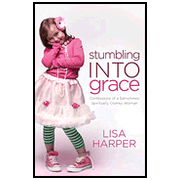
My small-group is kicking off the year by reading Lisa Harper’s book, Stumbling Into Grace: Confessions of a Sometimes Spiritually Clumsy Woman.  If you can’t join us for Bible Study together, you can still read along with your own copy of the book.  I’ll be using it to guide some of my posts in the weeks ahead and hope you’ll be encouraged by it.

Now on to today’s devotional:

****************************************************************************************************

“‘Love the Lord your God with all your heart and with all your soul and with all your strength and with all your mind’ and, ‘Love your neighbor as yourself'”
Luke 10:27

By the time I made it to the checkout line at Wal-Mart that day, I was a bit frazzled.  The shopping with children while sticking to a budget and using coupons and planning meals for the week on the fly had done me in.  I ran the gauntlet, which any mom knows is the candy aisle that also now comes fully equipped with toy cameras and play cell phones and lip gloss and shiny and wonderful overly expensive nothing toys that every child must have or she will simply die!

Finally, I was done.  Groceries in the cart.  Coupons handed over.  Total amount deducted from my checking account.

Freedom!!

We made it to the van.  My kids piled in.  I loaded every last grocery bag into the back and slammed the door shut.

Then I realized that I had left my wallet inside.

Because that’s what tired, frazzled, totally stressed and generally scatterbrained women do.  We leave our personal identification and all access to our financial lives sitting around the Wal-Mart.

I re-opened the van door and started unbuckling my confused children so we could go back inside and hunt for the missing wallet when I heard him.

The man who saved my day.

He ran over to me holding my wallet outstretched.  “The cashier let me run it out to you,” he explained.

In A Streetcar Named Desire, the character Blanche DuBois frequently says, “I have always depended on the kindness of strangers.”

Don’t we all?  At some time or another, haven’t we all depended on the kindness of somebody, whether stranger or friend?  They’ve saved us from a rotten day and might as well wear a cape and some tights because it’s as good as being rescued by a superhero.

But, here’s the catch, showing kindness always involves at least a little inconvenience.

My kind stranger abandoned his own cart of groceries and delayed his day to run out to a parking lot and find the crazy woman who can’t keep track of her things.

Too often we don’t make the choice he did.  Instead, we choose convenience over service and comfort over love for our neighbor.

We’re busy. We’re tired. We have important ministry commitments that keep us from  ministering to an individual in need. We hope another will offer help.

We miss it.  We miss the point.

Just like the disciples did in Matthew 19.  You see they had grown accustomed to Jesus’ usual ministry pattern.  That day didn’t seem any different: “When Jesus had finished saying these things, he left Galilee and went into the region of Judea to the other side of the Jordan. Large crowds followed him, and he healed them there” (Matthew 19:1-2).

Jesus drew a crowd.  Everywhere He went, so did a mob of searching people and those in need. They pressed in for healing and he performed amazing miracles for the people gathered there.

It must have been thrilling to be a disciple of this Rabbi—to see His Spiritual power, His draw, to think perhaps He was the Messiah they had waited for all this time.

And He didn’t just attract a crowd of needy paupers or country-folk.  Oh no.  Where Jesus traveled, so did the powerful elite to examine and cross-examine this religious phenomenon.  So it was on this day as “some Pharisees came to test him” (Matthew 19:3).

Can you imagine this picture?  The disciples are the closest people on earth at the moment to a superstar and they must have felt like a little stardust had fallen on their own faces.  Jesus had mass appeal and the attention of big-shots.

But then some parents did the unthinkable.  They “brought little children to Jesus for him to place his hands on them and pray for them.  But the disciples rebuked them” (Matthew 19:13).

We normally read this passage and praise Jesus’ love for children specifically, and certainly that’s there.  He instructs His followers to “Let the little children come to me, and do not hinder them, for the kingdom of heaven belongs to such as these” (Matthew 19:15).

But there’s something else here, too.  It’s not just that He stops for children, but that He stops at all.  You see, to the disciples, these families with their kids weren’t important enough to have a moment of Jesus’ time.  He had crowds to attend to, the sick to miraculously heal, and the Pharisees to spar with verbally.  If anyone in the world was too busy, it was Jesus.

But He took the time for kindness.  He didn’t ignore them in the name of ministry impact.  He accepted a little inconvenience in order to show love because “love is patient; love is kind” (1 Corinthians 13:4).

And He did it for the least of these.  How often have we been like the disciples, running interference instead . . . making sure that those who come to Christ are worthy enough of His attention?  We forget that He came for all.  He died for each of us.

More to the point sometimes, we make sure those coming to Christ are worthy enough of our attention.

We pass by the dying man on the side of the road just like the priest and the Levite in Luke 10 because we are busy with important tasks, even sometimes too busy in the service of God to serve the people He’s placed along the road we’re traveling.

Could we instead live a Samaritan life, valuing the lives of others, even strangers sometimes, over our schedule and agenda?

Would it matter the next day if the Samaritan had arrived late at his destination?  Probably not.  But it would always matter that he saved a man’s life.  The kindness was worth the inconvenience.  It always is.

Heather King is a wife, mom, Bible Study teacher, writer for www.myfrienddebbie.com and worship leader.  Most importantly, she is a Christ follower with a desire to help others apply the Bible to everyday life with all its mess, noise, and busyness.  To read more devotionals by Heather King, click here.