A Giveaway and a Trophy!

Giveaway!

I promised in my weekend post that we’d celebrate reaching the 100th entry in this devotional blog and we’ll hit the big 100 on Friday!  Thanks so much to you for traveling on this journey with me.  I pray for you–even if I don’t know who you are or what you’re going through.  God knows all these things and I ask for His hand of blessing on you as you seek Him.

On to the giveaway!  I’m just over a month away from traveling to the Women of Faith conference in Washington, DC, so I’m going to give away some Women of Faith goodies.

The prizes:  The first person whose number is drawn will receive a brand new copy of Sheila Walsh’s book, Beautiful Things Happen When a Woman Trusts God.

I’m also giving away two brand new Women of Faith Worship CDs including songs they’ll be singing at this year’s conference.  These will go to the second and third numbers drawn.

To Enter:

Post a comment anywhere on this web site starting today and ending at midnight on Sunday, July 17th.  I’ll use random.org to randomly select the winners and I’ll announce their names in Monday’s post.

Today’s Devotional: Do I Get A Trophy?

The kids piled onto the stage for the practice before the big program.  At first, I arranged them like carefully planned chess pieces—tallest in the back, little ones up front.  Brothers not next to other brothers for fear of poking and other tomfoolery.  Eventually, though, the kids just kept coming and shifting around and they ended up in no particular order.

However it happened, in the very middle of the stage in the very front row was the most precious little boy you could imagine.  He sang.  With all his might, he sang.  You could hear his voice in any place in the sanctuary and those passing by the closed doors could hear him singing down the hall.  His sister poked him during each song and whispered to him, “Don’t be so loud!” Those watching us practice from the pews couldn’t help but smile as he made a “joyful noise.”

Then, the practice done, each child climbed down the steps of the stage and filed into the back room to wait for the actual program.  Except for this one singing boy.

He took hold of my hands and asked, “Ms. Heather, did I do a good job?”
“Oh, you did a great job. I love how you sang with all your heart.”
“So, do I get a trophy?”
“Well, I don’t have trophies, but I have candy!”

He seemed happy with the alternative and ran off with the other kids.

We Don’t Serve To Earn a Trophy

For most of the truly important things in life, we don’t get trophies.  Coaches hand them out for playing on a soccer team, but no woman polishes the brass trophy on her shelf for enduring labor and having a baby.  There’s no “stayed up all night with vomiting children” trophy.  No trophy for “visiting the nursing home without anyone else knowing you did it.”  No plaque for “spent hours on knees praying for wayward child.”

We don’t serve for awards that will hang on our wall or adorn our bookshelves.  Other than an occasional mug from our kids saying, “World’s best mom,” we go through our everyday acts of ministry without recognition.

Sometimes our motives twist and need readjusting.  Deep in our heart, we occasionally slip into acting out of a desire to be seen, noticed and praised.  Or we take on a task because it feels good to be needed and asked.  We fear that no one else could possibly do it, so we sign on the dotted line.

When others are looking, we sometimes put on the voice and physical appearance of “Super Christian,” and then snap at our family, grumble and complain, and gossip about others as we sink into the seats of our cars and drive from church to home.

Then there are those moments when we shove the dishes into the dishwasher and slam the pot down on the counter wishing that someone would recognize what we do.  It may not be Nobel prize worthy, but this is our life’s service we’re talking about!  This is self-sacrificing.  This is humbling.  This is always putting others first!

It’s not always articulated in our heart and mind that way. It’s not something we always admit or even recognize.  But our motives are distorted and we’ve begun to serve for trophies–polished brass rewards of attention, praise, personal pride and recognition from others.

Jesus warned: “Be careful not to practice your righteousness in front of others to be seen by them. If you do, you will have no reward from your Father in heaven” (Matthew 6:1).

We shouldn’t serve in any capacity to get a trophy.  If we do, we’re forfeiting heavenly reward, trading eternal glory for a temporary self-esteem boost.

But We Serve As If God Was Handing Out Trophies

Here’s the challenge, though.  With pure motives and sometimes hidden service, without seeking praise and recognition, we can still serve with all our heart as if we would get a trophy.

We don’t seek the prize, but we strive with all our might to be worthy of it.  Because even when we are invisible to everyone else, God sees us.

He sees you.  All of your effort, your service, your laying down of self, your sacrificial giving, your stepping out in faith, your steady faithfulness, your lack of sleep, your soul emptied out.

Just like my singing friend.  Fully knowing that he wouldn’t get a trophy, he still sang loudly and enthusiastically during the program.  He gave his best effort anyway and I’m positive that God was beaming at every word he sang.  God didn’t miss a single second of his heartfelt praise.

In the same way, we worship wholeheartedly, we serve menially, we act selflessly not for our own glory, but for the glory of God.

We pick up toys for the “Well done, my good and faithful servant.”  We work at our jobs not so we receive promotions, but so that our “light (will) shine before men, that they may see your good deeds and praise your Father in heaven” (Matthew 5:16).  We walk away from gossip.  We take a meal to the family who needs it.  We write the note of encouragement.  We pray for our friend.  We teach the Sunday School class year after year after year.  We rock the baby.

Because God sees and cares.

We sing with all our hearts not because some human being is going to hand us a physical trophy, but we’re singing for God, so that He will be pleased.  This is our worship, the offering we place before Him.  When we grow weary or frustrated, feeling annoyed or walked all over, pouring out our very soul for the sake of others, we do not give up and go through halfhearted motions of service.  Our motivation remains the same, to serve God, to bring Him glory, to give Him praise.

Because even when no one else notices, we know that God sees.

We remember what Paul wrote:

Do you not know that in a race all the runners run, but only one gets the prize? Run in such a way as to get the prize (1 Corinthians 9:24-27).

and

So let’s not allow ourselves to get fatigued doing good. At the right time we will harvest a good crop if we don’t give up, or quit. Right now, therefore, every time we get the chance, let us work for the benefit of all, starting with the people closest to us in the community of faith (Galatians 6:9-10 MSG).

For those who feel invisible at times, here’s a video from Nicole Johnson on The Invisible Woman.  I hope you are blessed by it as much as I was:

Heather King is a wife, mom, Bible Study teacher, writer for www.myfrienddebbie.com and worship leader.  Most importantly, she is a Christ follower with a desire to help others apply the Bible to everyday life with all its mess, noise, and busyness.  To read more devotionals by Heather King, click here.

Copyright © 2011 Heather King

Online Bible Study: Week 2, Chapters 3 and 4

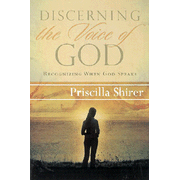
Welcome back Bible study friends!  I’m glad to see you here for week 2 of our time together reading Priscilla Shirer’s Discerning the Voice of God.  Some quick notes before we begin this week:

Thanks so much to all who shared in last week’s discussion. I learned so much from you!

Some of you were still getting the book as of the end of last week.  I want to reassure you that there is time for catching up and no need to feel overwhelmed. These posts of mine will fall at the beginning of each section.  That means you can start the week’s reading on Monday morning and post comments whenever you feel ready (or as you feel ready) all week long.  You can also easily go back to old posts by clicking here: Online Bible Study.

The comments can be short!  You don’t have to answer every question and certainly not all at once unless you want to.  If you only have time to write a sentence or two, that’s perfectly fine.

Here goes week two!

My Thoughts

My family used to have several Magic Eye books, each page filled with bright colors and wavy lines.  If you stared long enough and in just the right way (they say don’t cross your eyes, but I usually did), then a 3-D image would pop off the page for you to see.

I occasionally managed to manipulate my eyes and the book and see the hidden pictures.  What I’ve never been able to do, though, is stare at a close-up photograph of an object and decipher the whole image from just a tiny piece.  (Like the pictures along the side).

In the same way, most of us can see the amazing, gloriously evident work of God in our lives.  When He’s big, awesome, miraculous, life-changing and writing words on hearts in neon, we notice.  We see the “Magic Eye” pictures of God.

But it’s much harder when we look close-up at the images of life to determine the big picture view.  What exactly are we looking at?  A cornflake?  A spider web?  A temptation?  God’s will?  A trial?  A blessing?

We can’t tell because we can’t walk far enough away from our daily lives to scan the entirety of the picture—past, present, future—and see the true image that God sees.

Oh, how simple this faith-walk would be if the magic pictures always popped off the page for us, if the 3-D image of God’s plan was ever before us, magnificent, amazing and clear.  This is what we so often ask for.  We look for signs and wish for physical manifestations of our Mighty God.

Priscilla Shirer says:

We want God to show us His will in a tangible way–a sensational way . . . What we want is for God to speak today the same we He spoke in Old Testament times.  It seemed much easier to discern God’s voice back then (p. 45).

While God is ever-creative and able to speak to us in any way He chooses, since the time of Christ’s ascension:

the primary way God has spoken to His people has been through the person of the Holy Spirit, who confirms God’s written Word and applies it to our life.  The Holy Spirit and the Bible go hand in hand (p. 50).

We so often overlook the powerful gift of the Holy Spirit living in us!  Do we truly understand what it must have been like not to have God with us and in us all the time, whenever and wherever we went?

In the Old Testament, people traveled to a physical building where God’s Spirit dwelt and the Holy Spirit “only came to specific people at a specific time in order to achieve a specific task.  When that task was accomplished (or when those people sinned or rebelled), the Holy Spirit withdrew” (p.49).

We feel jealous of those who saw God intermittently.  Sure it was unmistakable and flashy, but it was not ever-present.  Wouldn’t those same people be jealous of us, having the very Spirit of God with us at all times, guiding and directing us in our moment-to-moment lives?

Even when we cannot see the big picture, we can trust that the Spirit within us does and He’s leading us in the way we need to go.  There’s power in the presence of God if only we learn to listen.

(I’ll post the answers to the pictures at the bottom of the page.)

Walking Through the Book:

Chapter 3: A Marvelous Voice

On pages 48-50, she walks us through primary ways God has spoken over time:

  • Old Testament: The person of a prophet confirmed usually through a visible sign.
  • The time of Christ: The person of His Son confirmed through miracles.
  • After Christ’s ascension: The person of the Holy Spirit confirmed through God’s written Word, the Bible.

That’s not to say God cannot or does not ever use miraculous means to speak to us today.  As she notes, though, “if God chooses to speak in miraculous ways today, these ways do not lay the foundation for us to hear from Him.  Rather they just provide confirmation of the messages we receive through the Holy Spirit’s leading and the guidelines of Scripture” (p.51).

We must always go back to God’s Word as our touchstone of truth.

Chapter 4: A Guiding Voice

Because we fellow-Bible study participants aren’t all from the same denomination, we might disagree about some issues, like how and when we experience the Holy Spirit.  Let’s not get distracted by that discussion because on the foundational, salvation-dependent doctrinal issues we have agreement.

Here’s what we do know: the Holy Spirit within us allows us to hear God’s voice and understand His truth more clearly (p. 57).

She also notes that “our human conscience is not the voice of God.  It isn’t infallible” (p. 59).  Our moral guidelines and consciences can be deceived and deformed.

Over time, though, as we transform into being more Christ-like, there is an agreement between our conscience and the Holy Spirit (p. 67).  Eventually our conscience becomes a method our “control tower” uses to direct our “pilot” as we make decisions.  “He is steering us into God’s will” (p. 61).

This transformation by the renewing of our minds is gradual.  “So, as you listen to your Spirit-led conscience, we must always confirm what we hear” and as she notes, He will graciously confirm it (p. 62-63).

The guidelines she gives us for discerning God’s voice (p. 63):

  • Look for the MESSAGE of the Spirit.
  • Search the MODEL of Scripture for guidance.
  • Live in the MODE of prayer.
  • Submit to the MINISTRY of Eli (counsel of a mature believer).
  • Expect the MERCY of confirmation.

Your Thoughts:

  • Can you give an example from your own life or in Scripture when God graciously confirmed His word?
  • Do you have “Eli’s” in your life—mature believers who give Godly counsel?  How did you choose them and in what ways have they helped you?
  • Have you ever been confused by what God is doing in the here and now only to have Him reveal the big picture much later on?
  • What are some of your favorite quotes/Scriptures/passages from chapters 3 and 4 that you’d like to talk about?

What were those close-up pictures above?  Some of you may be better at this than me and have been able to guess–a pinwheel and a flyswatter. 

Heather King is a wife, mom, Bible Study teacher, writer for www.myfrienddebbie.com and worship leader.  Most importantly, she is a Christ follower with a desire to help others apply the Bible to everyday life with all its mess, noise, and busyness.  To read more devotionals by Heather King, click here.

Copyright © 2011 Heather King

Weekends: Doing Some New Things!

Dear friends,

I went looking for an old devotional on this website the other day and found that we had nearly reached 100 posts since this devotional blog began.  To be honest, a year ago I would have told you that I didn’t have anything to say, certainly not 100 posts full of things to say.  And so I am reminded even as I sit here typing away at post number 97 what Paul writes in 1 Corinthians 12:9: “My grace is sufficient for you, for my power is made perfect in weakness.”

As we near the big 100 this week, it’s on my heart to do a few new things:

  • Weekend Reruns: On the weekends, I’ll post a “rerun,” an old post to share, especially for those new to the blog who may have missed it the first time and also hopefully as a renewed encouragement for long-time subscribers.
  • Hiding the Word: I’ve been challenged recently to be more deliberate about Scripture memorization.  For those of you who want to walk on this new journey with me, I’ll share the verse I’ll be working on that week.  You can learn the same verse as me or choose your own (but if you choose your own, will you post it here and share it with us?)
  • Verses Collection: Since we’ll be memorizing Scripture together, I thought I’d compile some of my favorite verses into categories and share them with you.  This will be a slowly building collection and I’ve only posted a few verses to start.  You can check the page out here.  Please share your favorites with me and I’ll post them to our collection.
  • Giveaway: And when we reach 100 posts, I’ll do something never before in this space—a giveaway!  That should happen this coming week so stay tuned!

Welcome, then, to our very first weekend together!

Hiding the Word

Here’s the verse on my heart for this week:

“Do not love the world or anything in the world . . . The world and its desires pass away, but the man who does the will of God lives forever”  1 John 2:15,17

If you choose to memorize this verse, will you post and let us know how it goes?  If you choose another verse, will you share that with us also?

Weekend Rerun

Everyday, Ordinary Life (First published February 12, 2011)

“So here’s what I want you to do, God helping you: Take your everyday, ordinary life–your sleeping, eating, going-to-work, and walking-around life–and place it before God as an offering” (Romans 12:1, MSG).

I love that verse in Romans and I came across it again today in my reading. The thing is, there are so many parts of my “everyday, ordinary life” that don’t seem really offering worthy.  I don’t mean because they are mundane.  I mean because they’re ugly and messy and well, failures really.

Like when your daughter decides to take the ballet shoes that you placed next to the front door, hide them and then forget where they are 5 minutes before you have to leave for ballet class and you lose it.

Maybe that kind of stuff only happens to me, but believe me, my reaction to this “irritation” wasn’t really an offering worthy of God.

To be honest, how I react to the big crises in life is much more holy and Christian.  I lean in to God and I grow in my faith in the process because I have no other choice really.  I know fully well that I’m not able to handle any of the big stuff on my own.

It’s the daily annoyances, interruptions, and irritants that bring out the worst in me, partly because I forget to look to God for any help or input at all.

So, how—-how do I turn my everyday, ordinary life into an acceptable sacrifice and a way to give God glory?

I’m reading this fantastic book by Eugene Peterson called A Long Obedience in the Same Direction and he drew my attention to something I had ignored before in this verse.  Three little words: “God helping you.” In the NIV translation, the verse reads:  “Therefore, I urge you, brothers and sisters, in view of God’s mercy, to offer your bodies as a living sacrifice, holy and pleasing to God—this is your true and proper worship.”

With God’s help and in view of God’s mercy, I can make my life–my whole life, not just the “important” parts—an offering to God.

In Romans 9:16, Paul writes, “It does not, therefore, depend on man’s desire or effort, but on God’s mercy.”  I don’t know about you, but I’m so thankful to know that my salvation, my joy, my future don’t depend on anything other than God’s great mercy.

That means when I mess it up and lose it over hidden ballet shoes that actually don’t reappear until 3 days later (hidden behind the chair in my room), I can have a fresh start.  As it says in Lamentations 3:21-24:

Yet this I call to mind and therefore I have hope: Because of the LORD’s great love we are not consumed, for his compassions never fail.  They are new every morning;  great is your faithfulness.  I say to myself, “The LORD is my portion; therefore I will wait for him.

We fail, but His compassion doesn’t fail.  He gives us new grace every morning.  He is our portion.  He is all we need in every difficult, annoying, frustrating moment of our everyday lives, just like He’s faithfully with us in every crisis.  It is only with His help that my reactions to the daily can be placed before Him as an offering.

*******************************************************************************************************************

Heather King is a wife, mom, Bible Study teacher, writer for www.myfrienddebbie.com and worship leader.  Most importantly, she is a Christ follower with a desire to help others apply the Bible to everyday life with all its mess, noise, and busyness.  To read more devotionals by Heather King, click here.

Copyright © 2011 Heather King

Becoming a Zucchini Farmer

I’ve found my calling, my true gift and talent—growing zucchini.  So, I’m contemplating a new life as a zucchini farmer.

When we planned this mini-garden of ours, my daughters announced that they must grow and eat their own food.  They wanted to plant and watch it grow, pick it with pride and then serve it up with dinner.

Not knowing how well we could produce food we actually eat like tomatoes and cucumbers, I planted two spindly little zucchini sprouts in the garden.  I’d seen many fellow church-goers hand out this cucumber wannabe to worshipers leaving the sanctuary.  “Would you like some?  Please, take it home!  We’re drowning in the stuff.”  So, I thought this must be one sure-fire vegetable to grow in our garden in case our other plants didn’t do well.

I didn’t expect that much success, just a guaranteed one or two veggies that my daughters could pose with in pictures and be proud about growing.

And then this one plant grew to monumental proportions and began producing mammoth zucchini.  I frantically began asking everyone I met, “How do you actually eat this stuff?”  Because we didn’t eat it, not often anyway.  I had no recipes for zucchini and whenever anyone said, “zucchini bread,” I stared at this zucchini the size of my daughter’s torso and wondered how that gets mixed up in a way appropriate for the bread pan.

Apparently others are having this problem.  I’ve begun noticing little carts loaded down with zucchini and squash just pushed out to the roadside in front of people’s houses.  These aren’t farmers trying to earn a living off their land.  These are women like me who have run through the entire Food Network recipe book on zucchini and still have some to spare.

This zucchini overload has me asking one question—what’s the point? What’s the point of having abundance if you don’t use it?  Sitting in my refrigerator or on my counter looking green and huge, this zucchini is pointless.  It is designed and intended for nourishment. Unused, it will rot and go to waste.

My question extends out to issues of faith.  What’s the point of spiritual gifts buried deep and hidden away?  God gives them to us, perhaps we even cultivate and harvest them. Then we let them sit unused.  Or perhaps we grow mystery vegetables in our garden, never actually identifying them.  Yes, we have gifts, but not knowing what they are, we simply pick the fruit, place it on the counter and toss into the garbage the rotten results over time.

While building the tabernacle, Moses instructed the Israelites: “Come, all of you who are skilled craftsmen, having special talents, and construct what God has commanded us” (Exodus 35:10 TLB).  That remains God’s desire—we apply our talents to God’s service, to the building of His ministry, His dwelling place, and His body.

What’s the Point of Knowledge?

Then there is also knowledge and discipleship.  What’s the point of study without application and life change?

I’m a student at heart.  To me, learning is fun simply in its own right.  I never in my life sat in a college class and tuned the teacher out because, “it was a pointless class that I’d never need in real life.”

Thus, it’s tempting for me to study and study and study the word of God, writing notes and filling my brain with knowledge.  There’s danger there, though.  Danger that my focus will be on learning and not on my Savior.  Danger that knowledge itself will actually become my god.  Danger that I’ll fill my head full of fascinating facts and never once experience life change in the down and dirty parts of my heart that need cleaning out.

It’s why at the beginning of almost every Bible Study I look around the group and say the same thing, “My goal here is application.  If we talk about not worrying and then go home and worry just as much as ever, we’re not achieving anything.”  What we study must become what we do.

Paul wrote to the Colossians, a church that had fallen into the danger zone, pursuing knowledge and learning to the exclusion of God:

See to it that no one takes you captive through hollow and deceptive philosophy, which depends on human tradition and the elemental spiritual forces of this world rather than on Christ (Colossians 2:8).

They had become so excited about gaining knowledge, they had failed to filter what they were “learning.”  Not every book you read that quotes Scripture is actually scriptural.  It takes discernment rooted in God’s Word to determine the difference.

In his letter to Timothy, Paul declared that people had devoted

“themselves to myths and endless genealogies.  Such things promote controversial speculations rather than advancing God’s work—which is by faith. The goal of this command is love, which comes from a pure heart and a good conscience and a sincere faith. Some have departed from these and have turned to meaningless talk. They want to be teachers of the law, but they do not know what they are talking about or what they so confidently affirm  (1 Timothy 1:3-7).

So, what’s the point?  When we’ve written down the original Greek of a word in Scripture and we’ve taken notes on our favorite preacher’s sermon, when we’ve copied whole devotionals into our journal and highlighted our book . . . then what?

We grow.  We know God rather than just know ABOUT God.  That’s the point.  Paul prayed for the Colossians that God would “fill you with the knowledge of His will through all the wisdom and understanding that the Spirit gives” (Colossians 1:9).

If we’re reading without changing, listening without growing, learning without transformation, then it’s pointless abundance–a garden full of unusable fruit gone to waste as it rots on the vine.

Heather King is a wife, mom, Bible Study teacher, writer for www.myfrienddebbie.com and worship leader.  Most importantly, she is a Christ follower with a desire to help others apply the Bible to everyday life with all its mess, noise, and busyness.  To read more devotionals by Heather King, click here.

Copyright © 2011 Heather King

Welcome to the Bible Study: Part One

For those of you signing on for the first day of our online Bible study, welcome!  For those who are regular blog subscribes but who are not doing the study with us, I hope there will still be some blessing for you in these weekly posts.  Be assured that I’ll still be doing the regular devotionals during the rest of the week.

Let me give you, in a way, a grand tour of this Bible Study of ours.

If you haven’t yet introduced yourself to the group, I hope you’ll take a moment to do so.  It will help us know who is in the group.  You can click here to visit the introduction page: Before Our Online Bible Study Begins.

I’ll begin each week with a brief thought/comment on the reading.  I’ll take you through a simple outline or walk-through of the chapters for that week.  Then I’ll pose some questions for you.

You can either read the book in advance and then read through my entire post in one sitting and answer all at the same time.

Or, you can start here in this space.  Read my intro.  Read some from the book.  Read some of my outline.  Read some more from the book, etc.  Then answer the questions, all at your own pace.

How you do it is up to you and your time and preferences.  This post today will be the longest I write because of these extra introductory instructions.

Every time I post for the Bible study, I will link the new post up on the Online Bible Study space on this web site.  You can easily access every old post from that page.  I hope that makes it easy for you to come back multiple times and do this study in pieces throughout each week or catch up if you get behind.

You can also find the schedule I plan to follow on the Online Bible Study page.

The only thing I ask is that as many of you share as possible your thoughts, comments, questions, and responses.  We want to hear from you.  I know some of you will be reading this book alongside us and you prefer not to chat in this space.  I understand and, again, there is no pressure here.  The more people who share, though, the more benefit we will get from this study.  It is your experiences, knowledge and testimony that we don’t want to miss.

Ready to get started?  I sure am!  Let’s go!

Discerning the Voice of God, Part I
(Intro and Chapters 1 and 2)

My Thoughts

If you called my family home during my teenage years and I answered the phone, you would have heard me say, “Hello, Mason residence.  This is Heather speaking.  May I help you?”

And you’d probably hang up the phone the first time you called for fear that you had mis-dialed an attorney’s office.

That’s how I answered the home phone for years.  It’s because we had a problem in my house—I sounded like my mom. There were a few accidents before my fancy phone answering ways.  People called and launched into a full conversation with my mom after my brief “hello,” while I scrambled to announce that they had the wrong person.

God doesn’t usually speak to us by first identifying Himself.  “Hello, this is heaven.  God speaking.  How may I help you?”

It just isn’t that simple, nor should it be because that would require very little intimacy or personal relationship.  Hearing, identifying and obeying the voice of God takes discernment, which Webster’s dictionary tells us is:  “Keenness of insight and judgment.”

As you read or have read the first part of this book, some of you may have books filled with underlines and highlights and you’re excited to learn more.  Others may be shrugging your shoulders thinking, “That’s all?  This is basic.”  And in some ways it is.  Discerning the voice of God is a basic foundational skill in our journey of faith.

But, do we ever get to the place where we stop growing in this area?  Isn’t there always more to learn?  Discernment is “keenness,” which says to me it is a sharpened skill developed over time.

That’s why I hope that you veterans of the faith will freely and honestly share about how you’ve grown to know God’s voice, so that we can learn from you.

We learn discernment through practice.  We talk with God so much, we listen so much, that His voice eventually becomes distinct from everything else we hear in our lives.  It is experience and sometimes mistakes that turn the basics written down in a book into a living, breathing reality of our faith.

Walking Through the Book:

The Intro:
I personally know a Bible-teaching, home-group leading Christian who does not believe that God speaks to us today.  He believes everything God has said and ever will say is written in the Bible.  More than that, he teaches it is pretentious and prideful of us to assume that God cares enough about our individual lives to have anything to say about them.

I loved that Priscilla Shirer answered this right from the beginning of her book.

On page 14, she reminds us that God is the same “yesterday, today, and forever” (Hebrews 13:8).  So, His pattern of speaking to prophets in the past continues with us today.

She also says that it is God’s voice—the fact that He was an active, involved, listening and responding kind of God—that set Him apart from the myriad of fake gods surrounding Israel.

I think Tozer’s quote on p. 17 (before chapter one begins) sums it up:

Those who do not believe God speaks specifically will simply ignore or explain away all the times when God does communicate with them.  However, those who spend each day in a profound awareness that God does speak are in a wonderful position to receive His word.

Amen!

Chapter One:

Here are the basics of preparing to hear God’s voice:

Come Expecting:  That’s what Habakkuk did.  He dared to ask God such difficult, pain-filled questions and then he waited for God’s response, fully expecting to hear.

Come As You Are:  I love the quote beginning on page 23: “God is gracious, and when we want to speak to Him, He invites us to come as we are – questioning, complaining, and confused.”  He then takes those questions and uses them as a way to reveal more of Himself to us.

Come Determined to Wait: Habakkuk made his complaint to God and then said, “I will stand at my watch and station myself on the ramparts; I will look to see what He will say to me, and what answer I am to give for this complaint” (Habakkuk 2:1).  He waited there patiently for God to answer and didn’t move until he heard God’s clear voice.

Come Believing: God didn’t foretell a fairy tale future for the prophet.  But, when Habakkuk heard God speak, he moved forward in belief—even in the difficult times.  He concluded with my favorite set of verses from the whole book:

Though the fig tree should not blossom and there be no fruit on the vines, though the yield of the olive should fail and the fields produce no food, though the flock should be cut off from the fold and there be no cattle in the stalls, yet I will exult in the Lord, I will rejoice in the God of my salvation (Habakkuk 3:17-18).

It was the sacrifice of praise.

Chapter Two:

Her emphasis in this chapter is on taking time to listen.  Praying in such a way that we don’t just talk to God, but we take time to hear from Him.  She outlines the disciplines of praying Spirit-guided prayers, meditating on God’s Word, and worship as the foundation that allows us to hear God’s voice.

Your Thoughts:

You can share anything you like in this space on the topic of listening and hearing from God.  Here are some specific questions I’d like to ask you:

  • Can you tell us about a time that you  clearly heard God speak?  How did you know it was Him ?
  • Do you have a favorite quote, verse or passage from the book that you want to share with us?
  • What discipline of the faith do you most struggle with?  Do you have any tips you’ve found that help you in this area?
  • What do you most want to learn about discerning the voice of God from this study?

You can post multiple times throughout the week as you read more and read what others have to say.  Please reply to one another and encourage those who have shared with your responses and answers.

You should see a little tiny check box at the very bottom of this page that says: Notify me of follow-up comments via email.  If you click that box, you should receive a notice when someone replies to this post and you won’t miss what others have to say.

I’m praying for you this morning as we begin this study, that God will make His voice clear to you and that you will be able to hear Him and then radically and passionately obey what He’s calling you to do.

~heather~

Heather King is a wife, mom, Bible Study teacher, writer for www.myfrienddebbie.com and worship leader.  Most importantly, she is a Christ follower with a desire to help others apply the Bible to everyday life with all its mess, noise, and busyness.  To read more devotionals by Heather King, click here.

Women Warriors, Part II

When I was about ten or 11, my mom marched me past the shelves of Sweet Valley Twins books in the teen section of the library and led me to the literary classics section with Shakespeare and Tolstoy and Jane Austen.  She waved her hands over the greats and said, “These.  You can read these.”  And I did.  I devoured them. I fell in love with them.  I studied them in college. I taught them to high schoolers.  To this day if you say Macbeth to me I’ll light up like a teenage girl in love and 15 minutes later you’ll emerge from a lecture on soliloquies.

Later, when I was 12 or 13, we visited my great-uncle Henry’s farm, something we did only infrequently.  He walked us around to see the cows in the fields and we took a tour of the old farm house with Aunt Mary and creaked along the floor boards from room to room.

Aunt Mary discovered that day that I was a bookworm.  So, in her enthusiasm to share her own love of reading with me, she handed me a pile of books that she had finished and was eager to pass along to someone else.

I thought I had received a great treasure that day!

And then I opened one book and learned what a Harlequin romance novel was.  She probably didn’t even realize how young I was and how those books weren’t really a good fit for me.

To this day, I don’t read romance novels.  Not the ones you can buy from the racks at the grocery story.  Not the Christian ones where the girl loves God and falls in love with a guy that loves God.  Not any.

Sure I have opinions on the matter.  I have principles guiding my decision that God has laid on my heart, all of the whys and wherefores that make that particular genre off-limits for me.

But, do I think the eleventh commandment is Thou Shalt Not Read Romance Novels?

Nope.

Do I think you are doomed for all time if you like a good clean Christian romance?

No way.

Maybe God has told you that other things are off-limits.  Something you eat, watch, read, or do that isn’t clearly wrong or covered under a Biblical commandment, but that God has personally convicted you about.

God has given us so much freedom and yet that doesn’t mean anything goes.  Paul wrote, “’I have the right to do anything,’ you say—but not everything is beneficial. ‘I have the right to do anything’—but not everything is constructive” (1 Corinthians 10:23).

This principle covers more than just what shows we watch on TV or what books line our bookshelves at home.  Some of us God has called to be stay-at-home moms and some to work outside the home. Some to have large families.  Some to be one-and-done. Some to adopt.  Some to home school.  Some to choose public schools.

What happens when I impose on you the calling God has given me?  Then we have explosive battles of criticism and condemnation.  We have legalism where we add mandates to Scripture and make everyone else obey the instructions God personally designed for us.

Oswald Chambers wrote: “At first, Jesus Christ through His Spirit has to restrain you from doing a great many things that may be perfectly right for everyone else but not right for you.  Yet, see that you don’t use your restrictions to criticize someone else.”

How then do we navigate these explosive relationships where even the most innocent remark or most God-directed decision becomes the atomic bomb in the next World War Women?

Allow for the Calling of Others

In Part One, I reminded you to Do What You Are Called to Do.

But, there’s another side to the story.  We also need to let others do what they are called to do.

What if we allowed for differences, not just in opinion, but in calling?  Not differences in doctrinal truth or the very clear mandates in Scripture, but differences in style, taste, gifting, personality, ability and weaknesses.

In Genesis 26:2, God told Isaac, “Do not go down to Egypt; live in the land where I tell you to live.”

Decades later, God said to Jacob, “Do not be afraid to go down to Egypt, for I will make you into a great nation there” (Genesis 46:3).

Don’t go to Egypt.  Do go to Egypt.

Does it seem like God can’t make up His mind?

But consider that Isaac and Jacob were different people, in different circumstances at different times.  God’s calling for each of them was uniquely appropriate.

What if Jacob had never traveled to Egypt because he felt that God’s command to Isaac must carry over to him, as well?  He would never have seen his long-lost son, Joseph, again.  No reconciliation.  No 400 years of the Israelites in Egypt.  No slavery—yes—-but also no deliverance.  It’s highly possible that Jacob and his remaining sons would have died off in obscurity as the result of famine.

Paul wrote, “If it is possible, as far as it depends on you, live at peace with everyone” (Romans 12:18).  Peaceful relationships in this world aren’t always possible and that’s the ugly truth of it all.

But, we need to do everything we can to cultivate peace even in disputed territories where landmines of personal opinion dot the fields.  Sometimes that means we stay-at-home moms need to go out of our way to encourage the working moms we know, to pray for them, to help them out if they need it and not to exclude them from our activities and friendships.

Sometimes that means letting petty jealousies and misinterpreted comments and too-sensitive feelings fall to the ground and instead choose—sometimes it’s a difficult choice—-but choose not to be offended.  Choose to put on thick skin.  Choose to let comments pass by unanswered.

Sometimes we need to keep some opinions to ourselves.  We must put down the protest signs and banners about issues that God doesn’t clearly address in Scripture.

If God has told you to go to Egypt, then go.  Pack up your bags and take the first plane out of here because you need to live in obedience to God.  But don’t condemn those who are boarding a different plane also in obedience to Him.

Heather King is a wife, mom, Bible Study teacher, writer for www.myfrienddebbie.com and worship leader.  Most importantly, she is a Christ follower with a desire to help others apply the Bible to everyday life with all its mess, noise, and busyness.  To read more devotionals by Heather King, click here.